



Abstract
This bibliometric study analyzed characteristics of publications related to art therapy for children from 1990 to 2020, based on the datasets taken from Web of Science (WoS) core collections. The results indicate that the USA, Israel, Germany, UK, Australia, and Canada were six leading countries in this field of research interest. The Top 5 most influential journals were identified by the number of publications, TLCS, TGCS and by their impact factor. Five leading journals in the art therapy studies include Arts in Psychotherapy, American Journal of Art Therapy, Child & Family Social Work, Frontiers in Psychology, and Monatsschrift Kinderheilkunde. Core themes from the 87 articles focus on surrounding socialization and attachment relationship, art therapy for the well-being of children with learning disabilities, alternative intervention for art therapy, and parent-child art therapy. This bibliometric study portrayed the development of art therapy for children by means of visualization techniques. The potential issues emerging from the data will contribute to future studies in this field. Multiple methods of art therapy are applied for all children’s well-being; as such, children’s art therapy in schools can be seen as the potential trend for researchers and teachers.
Plain Language Summary
This study, based on a dataset from the Web of Science (WoS) Core Collection, analyzed the bibliometric characteristics of publications related to child art therapy from 1990 to 2020. Results showed that the United States, Israel, Germany, the United Kingdom, Australia, and Canada are the six leading countries in this research interest area. The five most influential journals in the field of art therapy research include Arts in Psychotherapy, American Journal of Art Therapy, Child & Family Social Work, Frontiers in Psychology, and Monatsschrift Kinderheilkunde, identified based on the number of publications, TLCS, TGCS, and their impact factors. The hotspots of the 87 articles focused on social and attachment relationships, art therapy for the well-being of children with learning disabilities, art therapy as an alternative intervention, and parent-child art therapy. Visualization techniques used in this study depict the development of child art therapy. Potential issues emerging from the data will be helpful for future research in this field, such as the adoption of a variety of art therapy approaches for the well-being of all children; therefore, child art therapy in schools can be viewed as a future trend by researchers and teachers.
Introduction
Art therapy, also known as creative arts therapy or expressive arts therapy, is a beneficial activity that combines creative artistic expression and traditional psychotherapy on a professional basis. Malchiodi (2012) concluded the significance of art therapy as follows, Creative activity has also been used in psychotherapy and counseling not only because it serves another language but also because of its inherent ability to help people of all ages explore emotions and beliefs, reduce stress, resolve problems and conflicts, and enhance their sense of well-being. (p. VIII)
Nevertheless, art therapy with children “cannot be a ‘simplified’ version of adult therapy” (Klop, 2017, p. 283). Art therapy for children is used to provide children with psychotherapeutic assistance through artistic media for achieving self-understanding, reconciling emotions, improving socializations, fostering self-awareness, enhancing behavior management and problem-solving capabilities, promoting self-transformation and growth, and fostering personality integration and potential development (Malchiodi, 2012). With the advent of art therapy practices, advocates believe that art therapy with children may cast a positive light on all children. For example, Rosal’s (1993) study indicated that “art therapy can be a vehicle for helping children gain control over behavior and change perceptions of power and control (p. 16)”; Yan et al.’s (2019) study stated that the bullying victimization of left-behind children in the art therapy group was significantly improved.
Effects of Art Therapy on Children
Results of a systematic literature review by Cohen-Yatziv and Regev (2019) reveals five clinical categories of children’s art therapy: trauma, special education and disabilities, non-specific difficulties, medical conditions and juvenile offenders. They found that art therapy is helpful for children, especially art therapy with children who are dealing with traumatic events of the past and with children who have special educational needs or disabilities. A meta-analysis of group interventions for trauma and depression yielded 16 studies using eight interventions with 976 immigrant and refugee children and found little effect on post-traumatic stress symptoms with no significant effect on depression (Rafieifar & Macgowan, 2022). Of 16 studies, two art therapy studies showed effects leading to helpful thinking and the rebuilding of healthy social connections (Ugurlu et al., 2016) and the effectiveness of expressive arts groups with intervention relating to unaccompanied minor asylum-seeking adolescents in Norway (Meyer DeMott et al., 2017). Another meta-analysis by Morison et al. (2022) found the significant effectiveness of creative arts-based interventions on children experiencing traumatic events; in addition, significant reductions were found with negative moods. Further, some problems may exist in the current spate of published articles (Eaton et al., 2007). For example, there are far fewer studies on art therapy related exclusively to children (Cohen-Yatziv & Regev, 2019); there are only sporadic case studies, the sample size is small (less than ten participants), the duration of each intervention was not specified, and there is a lack of evidence-based quantitative research.
Bibliometric Analysis
Bibliometric analysis is not new, and since it is such a time-effective research method it has been broadly applied in various scientific fields, such as education, by reviewing the development of relevant publications from academic databases. Thus, it is defined as “the application of mathematical and statistical methods to books and other means of communication” (Pritchard, 1969, p. 349).The rationale behind bibliometric analysis is to reveal the influence and impact of scientific publications, authors, and journals by using quantitative measures to help to evaluate the performance of research institutions, to detect research trends, and measure the productivity of individual researchers.
The objective of bibliometric analysis is to measure the quantity, quality, and impact of scientific publications (Durieux & Gevenois, 2010). It aids researchers and institutions in identifying influential research works, collaborations, and networks. This analysis is used in policy-making, accreditation, and funding decisions. By providing an objective and quantitative evaluation of research works, bibliometric analysis plays a crucial role in identifying and rewarding excellence in scientific research. There are three types of indicators: quantity indicators that may be utilized to measure the productivity of related publications; quality indicators that may be used to measure the performance of a researcher’s output; and, structural indicators which may measure connections between publications, authors, etc. Since it is such a time-effective research method, it has been broadly applied in various scientific fields, such as education, by reviewing the development of relevant publications from academic databases. In this study, bibliometric analysis can also serve as an alternative for exploring the knowledge gap of children’s art therapy.
To better define art therapy for children, it is necessary to conduct a bibliometric study, which can be used to discover influential publications, journals, authors, institutions, countries, and major issues of this scientific research field efficiently. This bibliometric study aims at mapping a knowledge-set of art therapy for children through a bibliometric evaluation for the years 1990 to 2020. Based upon the dataset and methods, the following six questions regarding art therapy for children were in need of response:
What is the distribution of yearly publications on art therapy for children?
Which countries/regions have contributed most to research of art therapy for children?
What are the most influential publications in the studies of art therapy for children?
What are the most influential journals in the studies of art therapy for children?
Who are the most influential authors to the studies of art therapy for children?
What are the core themes emerging from the highly cited keywords and the selected articles?
Method
The datasets were retrieved from the Social Science Citation Index (SSCI) and Science Citation Index Expanded (SCIE) in the core collection of the Web of Science (WoS) on May 24, 2020. Two keywords “art therapy” and “art-therapy” were used for searching related journal articles using HistCite software. The timespan was set as “ALL YEAR” in order to comprehensively retrieve related data from the recent past. HistCiteTM (Garfield, 2004; Garfield & Pudovkin, 2004; Garfield, Pudovkin, & Istomin, 2002)is “a software tool for analyzing and visualizing direct citation linkages between scientific papers” (Garfield et al., 2006, p. 391). Histcite Pro 2.1 is an upgraded version of the software developed by Wang, a scholar from Mainland China, using python to improve the process of launching Histcite quickly and effectively. Data obtained from WoS exported to Histcite pro 2.1 were used to visualize bibliometric maps related to scientific affairs; and, through Histcite software, each collected article was numbered in the order of its publication date.
This search resulted in a final number of 985 publications that met inclusion search criteria and were regarded as the literature of art therapy for children from 1990 to 2020. The functionality of Mark & Tag in Histcite Pro 2.1 was used to identify 87 publications which indicated the author keywords of “child,”“children,” or “childhood” in the 985 articles searched. There were 87 articles focusing on art therapy for children, representing 219 authors in the 47 journals scanned, published in the years ranging from 1990 to 2020. A total of 75 keywords were included in the titles and abstracts. The bibliometric indicators applied in this study are the following:
TP: The number of total publications is a determinant indicator to represent publishing frequency of a year, an author or a country.
TLCS: Total local citation score, which reflects how many times the work is cited in the collection of articles of WoS; in short, TLCS refers to the total number of citations (TC) from scholars in the field of art therapy for children within the collected datasets.
TGCS: Total global citation score represents the number of citations calculated by WoS database to describe how the article impact on other scientific research fields (Coba Salcedo et al., 2018); like TLCS, TGCS is an indicator for ranking journals of a knowledge domain.
IF: The Impact Factor is the most broadly applied quantitative metric to peer-reviewed journals. IFs are frequently used as a bibliometric indicator “for the relative importance of a journal within its field” (Brown et al., 2018, p. 2). IFs are according to the average number of citations to those papers published in the two preceding years that were cited by the journals indexed in the Thomson Reuter’s Journal Citation Reports. Journals with higher IFs deemed to be more important than those with lower IFs. In this study, 2-year impact factors are used.
TC/TP: the citations per publication are based on the calculation of the average citation to total number of publications for individual author or country.
TC/PY: the citations per year are based on the calculation of the average citations to total number of publishing years.
h-index: The h-index, sometimes called the Hirsch index or Hirsch number, is an author-level metric that measures that both the academic output and impact of an author. Hirsch (2005) defined h-index in this way: “A scientist has index h if h of his or her Np papers have at least h citations each and the other (Np–h) papers have ≤h citations each.”
Word cloud: A word cloud presents an image composed of keywords in the field of art therapy for children, in which the size of each keyword indicates its frequency and importance. HTML5 Word Cloud by Timothy Guan-tin Chien and other contributors is used in this study (https://wordcloud.timdream.org/).
Results
What is the Distribution of Yearly Publications on Art Therapy for Children?
Figure 1 presents the year-wise frequency and distribution trend in the number of publications from 1990 to 2020 and show the gradual growth of children’s art therapy publications. As shown in Figure 1, the first two articles appeared in 1990 were written by Hairston (1990) regarding the responses of children with autism and intellectual disabilities to art therapy and music therapy, and Kunklemiller (1990), regarding the issues of establishing an art-therapy for use for children with deafness. Only a few articles are in evidence between 1990 and 2010; and, the number of articles increased slightly after 2011. The value peaks in 2019 (9).
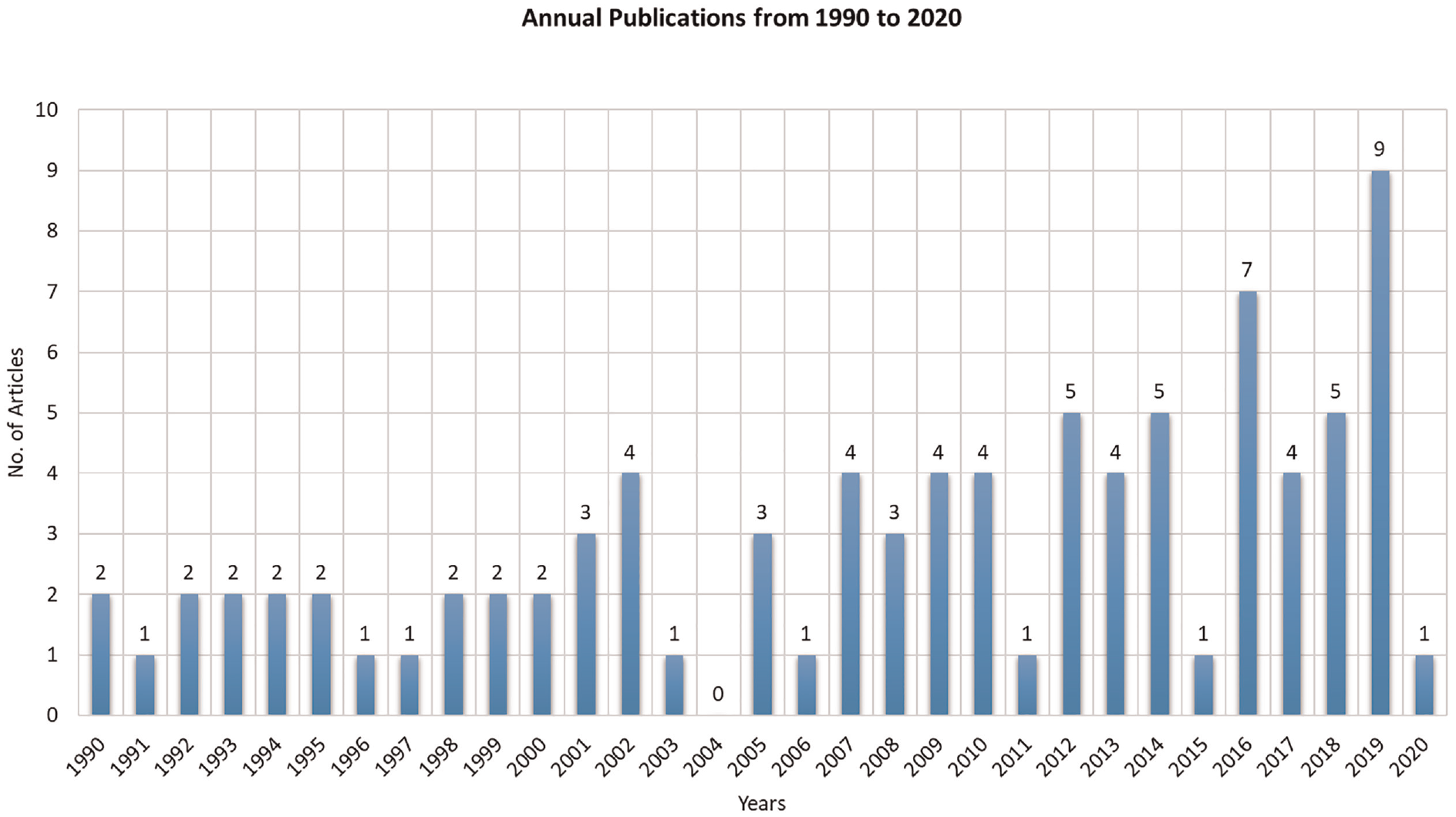
Annual publications from 1990 to 2020.
Which Countries/Regions have Contributed Most to Research of Art Therapy for Children?
A total of 17 countries were counted and listed in Figure 2. The number of total publications (TP) was used to depict the countries which have contributed most to research of art therapy for children. The USA, ranking first, contributed the most original articles (26, 30 % of the 87); followed by Israel (14, 16.1%), Germany (9, 10.3%), the UK (6, 7%), Australia (4, 4.6%), Canada (4, 4.6%). Respectively, the USA constituted 30% of 88 articles, whereas the other 16 countries constituted 70% of the 88 articles.

Publications of 17 countries (related to art therapy for children 1990 to 2020).
Figure 3 presents the result of a bibliometric analysis with 985 articles extracted from WoS to indicate the top six countries which have contributed most to research of art therapy from 1989 to 2020. Based on TP, Figure 3 shows that the USA (368) ranked first, followed by Germany (102), the UK (76), Israel (74), Canada (42), and Australia (37). Based on TLCS, the USA (549) ranked first, followed by the UK (89), Israel (88), Germany (87), Canada (46), and then Australia (37). According to TGCS, the USA (4384) still ranked first, followed by Germany (957), the UK (756), Israel (626), and the others, respectively. The six leading countries all appear in Figures 2 and 3. The USA is the most important country for research of art therapy and children’s art therapy. Israel, ranking second in Figure 2, is the second important country in the field of Children’s art therapy in the world.

Total publications of top six countries (related to art therapy: 1989 to 2020).
What are the Most Cited Publications in the Studies of Art Therapy for Children?
As shown in Table 1, the 10 most-cited publications from 87 articles were considered according to TLCS, which scores above 2 were selected. Nine out of the 10 articles were published in The Arts in Psychotherapy, whereas only one was published in Epilepsy & Behavior (IF value = 2.508). The top two articles were written by Eaton et al. (2007) (#312), whose study is a review of research and methods used to establish art therapy as an effective treatment method for children experiencing trauma, and or (2010) (#441), whose study is about clay sculpting of mother and child figures encourages self-reflection. The majority of the publications focus on art therapy for different types of children suffering different disabilities, such as behavioral disabilities (Rosal, 1993), children after a disaster (Orr, 2007), children with learning disabilities (Freilich & Shechtman, 2010), children with sexual abuse trauma (Meekums, 1999), children undergoing bone marrow transplantation (Günter, 2000), and children and adolescents with epilepsy (Stafstrom et al., 2012). Regev and Snir’s (2014) study mentioned working with parents in combined parent–child art psychotherapy.
The Top 10 Publications of Art Therapy for Children from 1990 to 2020.
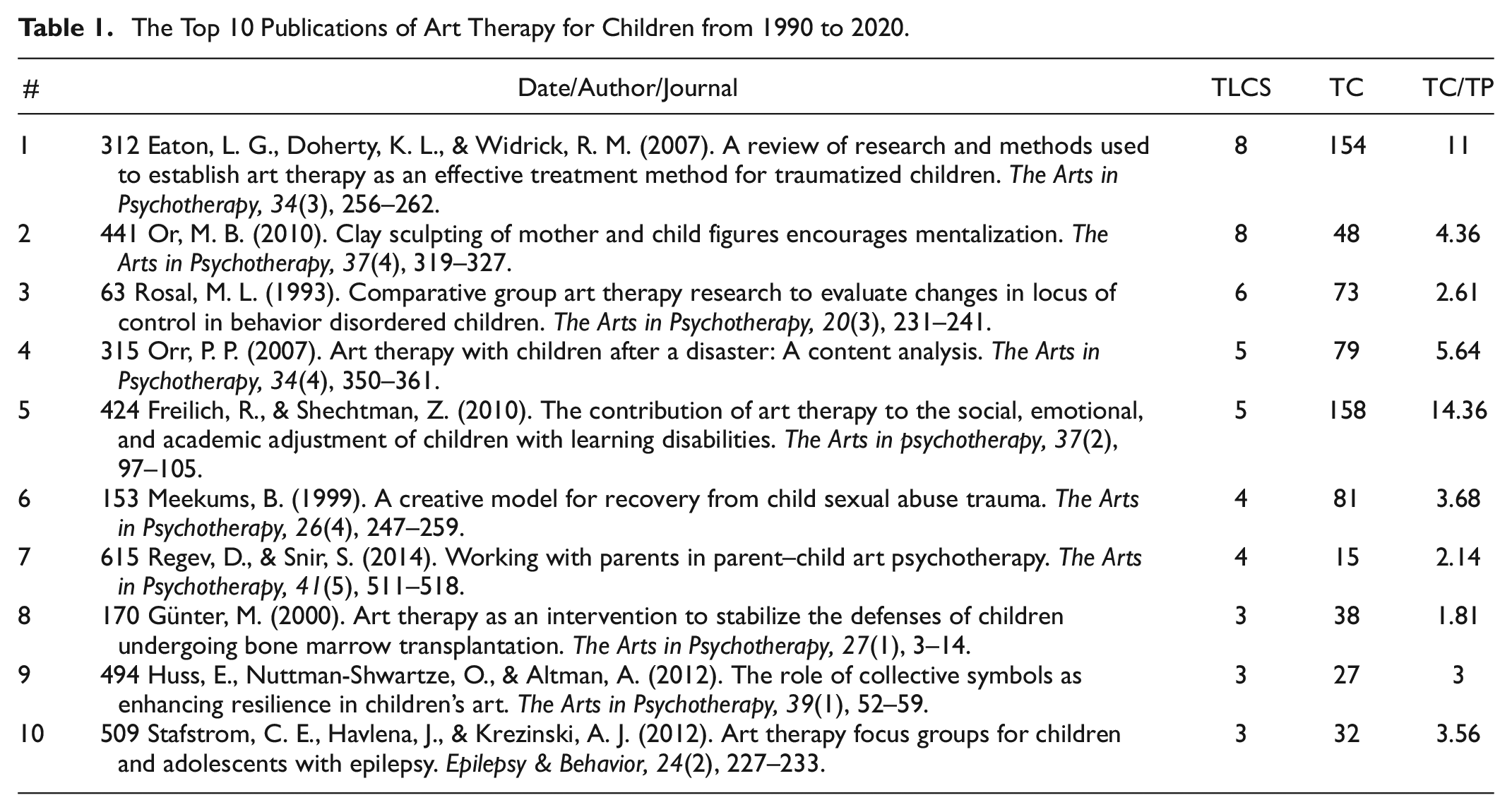
Total citations (TC) and citations per publication (TC/TP) were also listed to see overall citations of each article. Freilich and Shechtman’s (2010) article, ranking first (TC = 158; 14.36), illustrated the contribution of art therapy to the social, emotional, and academic adjustment of children with learning disabilities; Eaton et al. (2007) ranked second (154; 11). These two articles can provide scholars with fundamental literature related to children’s art therapy for they systematically depict the relevant research about methods of art therapy and the contribution of art therapy for children with learning disabilities.
What are the Most Cited Journals in the Studies of Art Therapy for Children?
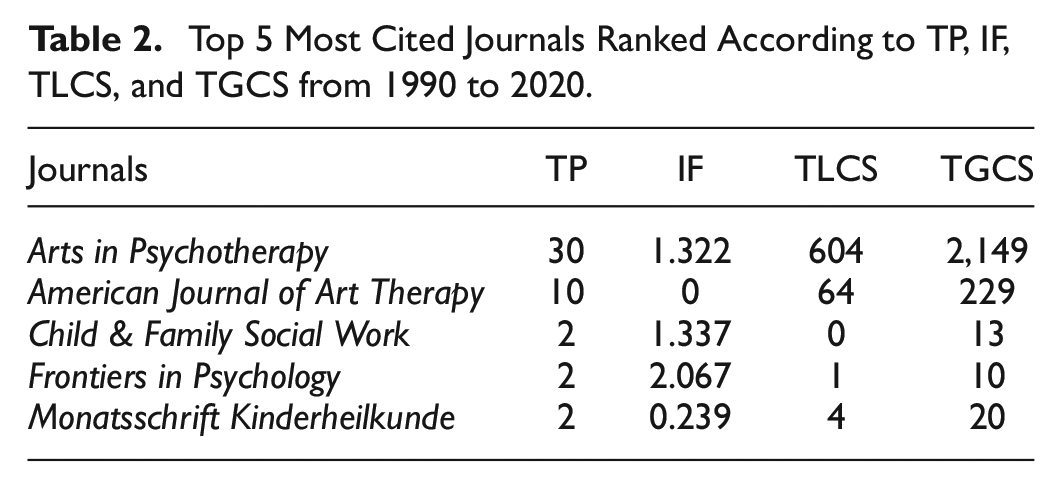
According to retrieved data, the 87 articles were published in 47 journals. Five most-cited journals were listed in Table 2, and in the other 42 journals published, only one paper for each. The five journals that published the most articles in the art therapy field for children were listed by a ranking based on a statistical analysis of the TP, TLCS, TGCS, and the IFs respectively. Based on TP, Arts in Psychotherapy (30) ranked first, followed by American Journal of Art Therapy (10), Child & Family Social Work (2), Frontiers in Psychology (2), and Monatsschrift Kinderheilkunde (2). According to TLCS and TGCS, The Arts in Psychotherapy (604; 2149) ranked first, followed by American Journal of Art Therapy (64; 229). Based on IFs, Frontiers in Psychology (2.067) has the highest IF among the top five journals, followed by Child & Family Social Work (1.337), and The Arts in Psychotherapy (1.322). To be more specific, Frontiers in Psychology, with a high IF, has 1 TLCS, and Child & Family Social Work ranking second in IF has 0 TLCS. Apparently, the publications related to children’s art therapy in Arts in Psychotherapy tend to receive more citations when compared to the other journals in Table 2. Moreover, those journals with higher IF values published fewer articles related to children’s art therapy; therefore, they were scarcely or never cited by authors in the field of art therapy. Arts in Psychotherapy and American Journal of Art Therapy can be regarded as the most influential journals because they meet three bibliometric indicators, more publications, higher TLCS, and higher TGCS. However, American Journal of Art Therapy seemed to cease publication in 2004, so its IF is unavailable.
Top 5 Most Cited Journals Ranked According to TP, IF, TLCS, and TGCS from 1990 to 2020.
Who is the Most Cited Authors to the Studies of Art Therapy for Children?
To determine the most influential authors, the top six influential authors in the field of children’s art therapy are listed in Table 3, ranked according to TP, TLCS, and hi-index respectively. The word clouds also generated in this analysis presented that Henley and Huss are the important authors, followed by Harada, Kim, Nissimov-Nahum, and Regev. These five most influential authors are all from the Middle-East or Asia: Huss, Regev, and Nissimov-Nahum are from Israel; Henley is from Japan; Choi is from South Korea. Henley, Huss, and Regev, who have higher TP and h-index values, are ranked first. Henley (1998, 1999) is committed to utilizing expressive therapies to assist children with attention deficit hyperactivity disorder (ADHD) during socialization; Henley (2005) also studied Art therapy approaches for attachment disorders in children adopted post-institutionally. Huss and his co-authors (2008, 2012) studied effective various methods of art therapy for children by bridging objective and subjective experiences, enhancing resilience by means of collective symbols, and using photo-voice with children of parents with substance-addiction disorders to integrate phenomenological and social reality (2018). Regev is an art therapist, psychotherapist and a special education expert from the University of Haifa. Her research interests are in the effectiveness of art therapy (2014), parent-child art therapy (2014), art therapy with children in a special education setting and theoretical approaches to art therapy (2015). Regev received the highest TLCS compared to the other authors in Table 3. Choi and her co-authors (2012, 2016) focus on the effects of group art therapy on mother–child attachment. Nissimov-Nahum (2008, 2009) uses art therapy in educational settings for intervention with children who present aggressive behaviors.
Top 6 Most Influential Authors Ranked According to TP, TLCS, and h-Index from 1990 to 2020.

What are the Core Themes Emerging from the Highly Cited Keywords and the Selected Articles?
A total of 75 author keywords are derived from 87 articles on children’s art therapy. The top 14 keywords are shown in Figure 4 within the threshold set with the minimum of a term as 5, using HTML5 Word Cloud. As shown in Figure 4, “intervention,”“art-therapy,”“adolescent,”“psychotherapy” and “therapy” are the top five keywords which play a central role and connect with many other keywords listed in Figure 5. For instance, “intervention” represents the methods, tools, techniques for “psychotherapy” and “therapy” which may be applied with “young children” and “adolescent” who have different needs, such as depression, attachment disorders, diseases, or symptoms.

Top 14 most-cited keywords word cloud from 1990 to 2020.

Top 14 most-cited keywords from 1990 to 2020.
Figure 6 shows the historiograph produced by Histcite Pro 2.1 to depict the citation relationship of the 87 articles related to the literature of children’s art therapy. There are four core themes identified from the historiograph. Nodes [146] (Henley, 1998), [167] (Henley, 1999), [225] (Henley, 2005) and [558] (Armstrong, 2013) form the first core theme: socialization and attachment relationship. Node [312] (Eaton et al., 2007) is a review paper which can serve as a guide for scholars who are interested in children’s art therapy. Led by [312], node [424] (Freilich & Shechtman, 2010) and [600] (Beauregard, 2014) form the second core theme: art therapy for well-being of children with learning disabilities. Also led by [312], node [587] (Kennedy et al., 2014) and node [747] (Dionigi & Gremigni, 2017) form the third core theme: alternative intervention for art therapy. This core theme illustrated how the combined intervention of art therapy can be applied to help children in need effectively and creatively. Nodes [441] (Or, 2010), [494] (Huss et al., 2012), [615] (Regev & Snir, 2014) and [857] (Gavron & Mayseless, 2018) form the fourth core theme: parent-child art therapy.

Historiograph of art therapy for children based on the 87 articles.
According to Table 4, the main issues in the first decade (1990–1999) are using art therapy for children who have been sexually-abused, children who need socialization, children with ADHD, children with intellectual disabilities, and children suffering from headaches. The second decade (2000–2009) focuses on art therapy for children with trauma or aggression issues, and children with chronic pain, phonological problem, and in need of pediatric care. The third decade (2010–2020) displays versatile issues, such as health (especially mental health), and art-therapy methods that tended to be more creative with alternative techniques or materials. In the 87 articles, the art therapy approach was applied in at least 34 different settings with children or adolescents, who are refugees, immigrant children, children with ADHD, children with autism-spectrum disorder, children with intellectual developmental disability, children with trauma, children with depressive disorder, children who have been sexually-abused, children with learning disabilities, children with deafness, children with asthmatic syndrome, children with behavioral disorder, children with intellectual disabilities, children with pre-operative anxiety, children suffering through alcohol or drug abuse, children with aggressive behaviors, children with chronic pain, children with chronic diseases, children with brain injury, cancer, epilepsy, marrow transplantation, witnesses of intimate partner violence, attachment disorder, children who are hospitalized, children who are left-behind, children who are bullying victims, HIV patients, headache, phonological problem, and victims of an earthquake or other disasters.
The 87 Publications of Children’s Art Therapy.

More attention has been paid to applying the art therapy approach in educational settings than ever before. In the first decades, there were 16 publications, but only two articles focused on educational issues (#22, #167); there were 25 publications in the second decade, and seven articles mentioned about art therapy for education (#187, #207, #264, #289, #345, #356, #393); in the third decade, 46 articles were published and 11 articles were about art therapy applied in educational settings. It is seen that scholars have gradually contributed to enrich the extant database with valuable research articles.
Discussion
Based on the collected data, more and more educational studies mentioned an art-therapy approach during the 3 decades covered. The findings first reveal that art therapy has become an effective intervention or treatment for children and adolescents to gain insight into things, promote self-transformation, and affect personal growth through artistic creation. Especially, the expressive art therapy used in clinical psychotherapy, with a combination of expressive art activities and psychotherapy, can be of great significance to children with mild to severe disability symptomization (Henley, 1999) or under pressure (Siegel et al., 2016) and crisis (Decosimo et al., 2019). Cohen-Yatziv and Regev (2019) also point out the effectiveness of art therapy to include: helping children to “alleviate post-traumatic symptoms,” having “a positive effect on children with special educational needs and disabilities,” and “dealing with medical conditions and specifically persistent asthma” (p. 100). In addition, art therapy can assist juvenile offenders and children with no specific difficulties to face the challenges in their life, for instance, bullying and witnessing intimate partner violence. However, the growth of publications over the past decades increased slowly, leading to a continuous but less-than-significant surge in future anticipated interest (see Figure 1).
Second, art therapy can be applied in various settings with multiple methods and techniques to meet children with various needs. According to the findings, 87 selected articles were published in 47 journals. This suggests that the art therapy approach has been broadly adopted in several research fields. Therefore, complementary and alternative therapy or more creative ways are developed (Kennedy et al., 2014). For example, the art expressive forms are not limited to drawings; art materials, such as clay sculpture, used in art therapy vary to provide clients with a wider variety of artistic experiences (Or, 2010). Furthermore, there are many types of group art therapy, including school-based art therapy (Kunklemiller, 1990), therapeutic camp therapy (Henley, 1999), and parent-child dyad therapy (Gavron & Mayseless, 2018; Proulx, 2002; Schreier et al., 2005). Due to the impact of COVID-19, a remote psychosocial art therapy by Valldejuli and Vollmann (2022) was carried out with children in Kenya, an economically disadvantaged urban area, in 2020 to 2021. Such a cross-cultural art therapy provided arts-based and trauma-informed interventions for children to enable the expression of shared trauma, sense of loss, compromised faith, and resilience. The ongoing identification of challenges that arise in cross-cultural art therapy settings should be taken into consideration and the long-term effects and efficacy of art therapy interventions with children is recommended.
Third, art therapy in schools has received much attention and may prove to be a potential research trend. Regev and Snir (2015), a professional art therapist from Israel, emphasizes the benefits of integrating art therapy into schools. On the one hand, the major advantage is to establish a therapeutic environment within a larger educational system to “provide teachers with tools to cope with the difficulties that children encounter at school” (p. 54). On the other hand, the art therapists working within a system further the ability to assist “children to cope with problems in their daily life,” and to enable “teachers to know more about the children in their classrooms” (p. 54). Regev (2022) indicated the cognitive-behavioral approach plays a crucial role in the relationship between process variables and outcome variables in a school-based art therapy setting. Although Regev’s study presents a significant correlation between improvement in client involvement and cognitive-behavioral exploration and improvement of internalizing problems, it provides initial support for the claim that the processes of school-based art therapy with children in particular is more complicated than what is typically assumed for art therapy.
The findings of this study strengthen the claim that artistic creation is another language used for children’s self-expression and considered to enhance children’s flexibility, autonomy and psychological growth. Moreover, the increased publications over the past decades point out five clinical categories representative of a wide variety of the field in art therapy with children. Despite the positive effects of art therapy on children and adolescents proven in previous studies, the complexity of the process in children’s art therapy is worth studying to an in-depth manner. More studies are focusing on art therapy for children with trauma and special educational needs. However, results of remote psychological and cross-cultural art therapy interventions continue to hold promise.
Conclusion
In this paper, we analyzed 87 articles in the field of children’s art therapy during the past 30 years, from 1990 to 2020, by means of bibliometric analysis based on SSCI and SCI-E from the WoS database. The publishing trend of related publications, the most influential countries, the most influential publications, the most influential journals, the most influential authors, and the core themes were analyzed to respond to the six research questions that were posed. It should be noted that the number of publications began to increase slightly after 2010. The six leading countries identified are the United States, Israel, Germany, the UK, Australia, and Canada. The top 10 publications that receive the most citations and citations per publication (TC/TP) are crucial for scholars who are interested in studying children’s art therapy. Five of the most influential journals include Arts in Psychotherapy, American Journal of Art Therapy, Child & Family Social Work, Frontiers in Psychology, and Monatsschrift Kinderheilkunde, in terms of values of TP, TC/TP, and IFs. Most articles were published in Arts in Psychotherapy. Henley, Huss, Regev, Choi, and Harada are the five most influential authors with a higher number of citations, publications, and TC/TP score.
Moreover, four core themes emerging from the historiographs, most-cited keywords, and the contents of the 87 articles are: socialization and attachment relationship, art therapy for the well-being of children with learning disabilities, alternative intervention for art therapy, and parent-child art therapy. Art therapists, such as Regev, advocate integrating art therapy into school systems for the benefits of art therapy can assist every child no matter who are diagnosed with specific difficulties. Thus, art therapy in schools can possibly be a potential research trend.
This study was subject to some limitations. First, bibliographic data were exclusively selected from SSCI and SCI-E in Web of Science, therefore, some relevant publications might be excluded in the scope of this study. Second, since the data retrieved on May 24, 2020, for 2020 is non-representative enough because it lacks the completeness of year-wide data. Third, English is the main language for publications in the WoS and other publications in different languages are not collected. As concluded in previous studies (Reynolds et al., 2000; Slayton et al., 2010), although there has been a revival in this field of art therapy, “there was still a long way to go (Cohen-Yatziv & Regev, 2019, p. 100).” According to the above limitations, further studies are necessary to expand the scope of databases to include other retrieval systems, such as PubMed, Google Scholar, SCOPUS, and ERIC. The following points are further recommended for consideration: the need for discovery of more valuable information; second, educators are highly recommended to conduct a content analysis of publications by the most influential authors in order to unearth the major effects and alternative approaches of art therapy for children; and, third, the need for better facilitation of an acquisition of a greater knowledge of art therapy and establish a friendlier therapeutic environment in school systems.
Footnotes
Author's Note
Chi-Yang Chung is is also affiliated to Jiaying University, Meizhou, Guangdong, China.
Declaration of Conflicting Interests
The author(s) declared no potential conflicts of interest with respect to the research, authorship, and/or publication of this article.
Funding
The author(s) received no financial support for the research, authorship, and/or publication of this article.

Data Availability Statement
Data sharing not applicable to this article as no datasets were generated or analyzed during the current study.