




Abstract
Participatory Varietal Selection (PVS) is the selection by stakeholders of varieties in advanced testing stages by plant breeding programs. With Burundi as a case example, this study incorporated qualitative Focus Group Discussions (FGDs) into the quantitative PVS structure so as to elicit deeper insights into rice trait preferences and illuminate broader issues affecting rice farmers. During two consecutive years, this study surveyed 174 participants across six stakeholder groups (administrators, farmers, custom millers, researchers, seed producers, and traders) in three locations. There were statistically significant associations in rice trait preferences across locations, participating stakeholders, and genders, highlighting preference alignment. Moreover, multiple traits were desired simultaneously, beyond productivity-related traits, and sometimes contradicting researchers’ preferences, especially in rainfed systems. By moving beyond quantitative PVS preference scores as being the only way of gathering trait preference data, this study has shown how the incorporation of qualitative FGDs into the PVS structure can elicit deeper insights on trait preferences and illuminate broader issues affecting rice farmers, which when solved can accelerate the momentum in widespread adoption of new rice varieties.
Plain Language Summary
The purpose of this paper is to illustrate the power of pairing quantitative with qualitative data collection methods to elicit rice varietal preferences in Burundi. By combining FGDs with PVS, we show the multiple traits desired, beyond production-related traits, and sometimes contradicting breeders’ preferences. With the key limitation and areas for improvement hinging on the need for more robust quantitative PVS that goes beyond binary scores as well as the need for more time-efficient FGDs by use of local language that reduces translation times, it is more feasible to move beyond quantitative PVS preference scores as being the only way of gathering trait preference data. This study has shown how the incorporation of qualitative FGDs into the PVS structure can elicit deeper insights on trait preferences and illuminate broader issues affecting rice farmers, which when solved can accelerate the momentum in widespread adoption of new rice varieties.
Introduction
Rice is the third most important staple crop across sub-Saharan Africa (SSA), after maize and cassava (Stryker, 2013). Across SSA countries, average rice consumption surpasses production, and its consumption has been steadily increasing over the years (Arouna et al., 2021). While rice production in SSA has increased in the past decade, only a few countries have doubled their rice production and reached close to self-sufficiency (Arouna et al., 2021). While some countries like Tanzania, Madagascar, and Uganda have reached over 50% self-sufficiency (United States Department of Agriculture Foreign Agricultural Service Production SaD, 2021), a majority of the SSA countries, including Burundi (Ndayitwayeko & Korir, 2012), are struggling with multiple rice production challenges across different agro-ecological zones. Furthermore, local rice production meets only about 55% of the demand in SSA, with the rest being met through imports (United States Department of Agriculture Foreign Agricultural Service, 2021). The low rice productivity in SSA is due to multiple issues, including the use of old varieties susceptible to biotic and abiotic stresses (Nhamo et al., 2014). One of the ways to counter this gap in supply and demand is by the use of improved seed varieties (Oparinde et al., 2016). This entails accelerating breeding efforts so as to enhance genetic improvements in farmer fields (Setimela et al., 2017). However, farmer adoption of new varieties is low and use of old varieties in most of SSA is prevalent.
To sway farmers’ acceptability of new varieties, there is a need for end-user-focused breeding (Custodio et al., 2016, 2019; Virk & Witcombe, 2007) where information is obtained beforehand regarding desirable traits. This is because users are central to enabling the generation of products that meet their needs, thus understanding factors that clients consider when making crop variety choices is paramount (Asrat et al., 2010; McEwan et al., 2021). One of the reasons why improved varieties may still not be widely adopted several years after their first introduction could be because they are not meeting farmer needs (Walker et al., 2015). For example, in Burkina Faso, several improved rice varieties for irrigated lowland areas developed using scientists’ criteria rarely matched farmers’ expectations, a situation that was rectified by involving farmers in the new variety evaluation and selection process (Sié et al., 2006). Breeding programs also accorded low priority to consumer-preferred traits in new varieties of potatoes in Kenya, cassava in Nigeria, and bananas in Uganda, resulting in low varietal adoption rates (Thiele et al., 2021). Through other similar illustrations, more breeders have seen the importance of incorporating users’ feedback, especially when some high-yielding varieties receive low rankings during farmers’ evaluations (Worku et al., 2020). Moreover, it is becoming evident that breeders need to consider traits beyond yields in their breeding programs by incorporating end-user needs in terms of grain quality, grain shape and size, texture, fragrance, and specific cooking quality traits (Bairagi et al., 2020; Britwum et al., 2020; Custodio et al., 2016, 2019; Teeken et al., 2018). For example in Burundi, as in other east African countries, consumers prefer aromatic long grain rice, due to spillover of preferences from neighboring Tanzania and from Indian imports (Kilimo Trust, 2018).
Socio-ecological systems (SES) is the theoretical background concept for understanding the interconnected nature of human and natural systems that goes beyond merely combining social plus ecological systems but rather a cohesive integrated system with strong connections and feedbacks within and between social and ecological components (Biggs et al., 2021). As a type of a complex adaptive system, the study of SES can be operationalized by combining multiple methods that build on one another to better understand the overall dynamics. Participatory data collection that combine quantitative with qualitative approaches are considered holistic (Biggs et al., 2021). Thus, a participatory way for breeders to engage with clients, especially farmers, is important (Sumberg et al., 2013). Approaches that integrate farmers usually entail collaborations with breeders so as to ensure research meets farmers’ needs as well as offers plant genetic advancements (Hardon et al., 2006). Moreover, breeders provide perspectives on the feasibility and cost-effectiveness of traits and hence enable confronting demand with supply (Maligalig et al., 2021). One form of this participatory plant breeding is Participatory Varietal Selection (PVS), which is a mechanism for creating user feedback (Sumberg et al., 2013). PVS is the selection by stakeholders of finished or near-finished varieties in advanced testing stages by plant breeding programs (T. Paris et al., 2008). It involves testing and selecting new varieties developed by institutions either or both in farmers’ fields and at local research stations in various environments and allowing farmers to compare these varieties against local farmer varieties currently in use (Hardon et al., 2006). There is a need to increase the involvement of farmers in different stages of the process that moves beyond their being merely data providers to building a sense of ownership and control over the process, leading to the production of varieties that are better suited to client needs (T. R. Paris et al., 2008).
The mode in which PVS is implemented also has an effect on understanding disaggregated trait preferences and in turn influencing adoption levels of new varieties. Thus, there is a need to be innovative whilst modeling PVS best practices. PVS studies have been operationalized using different models, ranging from traditional breeding institution-led to the farmer field school approach with a focus on institutions empowering farmers (Hardon et al., 2006). Participation of both men and women farmers in the early stages of evaluations could also lead to the development of varieties better suited to farmers’ environments (T. R. Paris et al., 2008). While documentation on the role of both women and men farmers in variety choices is needed, this is still insufficient for widespread varietal adoption. Among other systemic challenges, wider adoption of selected varieties remains a bottleneck due to the absence of a developed seed market (Hardon et al., 2006).
In prior research, PVS contributed to the development of salt- and flood-tolerant rice varieties in affected coastal deltas of South and Southeast Asia (Burman et al., 2018), most suitable improved rice varieties in Ayeyarwady Delta, Myanmar (Rahman et al., 2015), submergence-tolerant rice varieties in the Philippines (del Rosario, 2014), and salt-tolerant rice varieties in Bangladesh (Islam et al., 2008). While PVS is widely used, the limitation is that it is one of the common methods that is unfortunately applied in a mechanical way that limits its ability to capture farmers’ needs or the broader context in which they make decisions (Almekinders et al., 2019). The novelty of this study to literature and practice is the integration of the hitherto routine quantitative-based PVS with a qualitative FGD approach so as to fill in some of the weak links and contribute to the discussion of methods that enable a more comprehensive and inclusive understanding of trait preferences that are disaggregated by gender, stakeholder groups, and geographies. Moreover, the study also adds to the debate on gender and seed system considerations across different geographies in a rice-based agri-food system in Burundi.
The study sought to answer two research questions:
RQ1: How do stakeholder and gender-differentiated rice trait preferences impact the selection of various PVS rice varieties, geographically?
RQ2: How does the combination of PVS and FGDs enhance the understanding of rice variety trait preferences of the participating stakeholders?
Methodology
Description of the Study Areas
Participatory Varietal Selection (PVS) evaluations have been conducted by the International Rice Research Institute (IRRI) since 2011 in various locations across Burundi. The PVS model used in terms of the experimental layout and management was researcher-managed trial in farmers’ fields (Sié, 2009). IRRI collaborated with other organizations in the PRDAIGL project (Regional Project for Integrated Agricultural Development in the Great Lakes). Among the activities assigned to IRRI was the introduction of new rice varieties. In line with this goal, IRRI established demonstration plots using one replicate experimental design in three locations of the lowland Imbo plain in Kansega, Mugweji, and Mugerero villages in northern, southern, and central Burundi, in the provinces of Cibitoke, Makamba, and Bubanza, respectively (Figure 1). The 2019 PVS in Mugerero was conducted on 19th November. The two 2020 PVS evaluations were conducted on 11th November and 13th November in Kansega and Mugweji, respectively (Figure 1).

Map of the PVS study site locations (Kansega, Mugweji, and Mugerero) in Burundi.
Rice-growing areas in Burundi are not managed in an orderly manner and irrigation infrastructure is mostly old and dilapidated. Nevertheless, major-rice growing areas of the country benefit from government support, implemented in the context of two main forms of government-run rice management systems. Firstly, the Sociéte Régionale de Développement de l’Imbo/ Regional Development Corporation of Imbo (SRDI) managed the 2019’s PVS site in Mugerero. Irrigation infrastructure in Mugerero covers 2305.5 ha, where all the surveyed farmers in the area cultivated. The two 2020 PVS sites were managed by the Provincial Bureau of Environment, Agriculture, and Livestock (BPEAE). While Kansega rice-growing area has 60 ha under irrigation (Niyongabo, 2008), rice is more predominantly grown on around 1,000 ha under rainfed conditions. The area under rice cultivation is Mugweji is between 800 and 900 ha, predominantly grown under rainfed conditions. Only about 80 ha is currently under irrigation (Niyongabo, 2008).
Description of the Participating Stakeholders
Six participating stakeholder groups were targeted in the study (Table 1). A list and description of these is detailed below:
1. Farmers:
Rice is considered a cash crop destined for urban areas in eastern Africa. Moreover, as close to half of rice farmers in Burundi lease land, rice cultivation is treated as a business (International Rice Research Institute and Faculty of Agronomy and Bio-Engineering [IRRI and FABI], 2020). Consequently, the majority of rice farmers in Burundi are market-oriented and well-acquainted with rice market-related information. For most of these rice farmers, if the rice market price is attractive, they will sell all their rice produce and engage in subsistence production of other commodities. Across all the study sites, a total of 51 farmers were surveyed, with an almost balanced representation of both genders (26 men and 25 women; Table 1).
2. Researchers:
Researchers were represented by rice extension officers from SRDI as well as breeders and socio-economists from IRRI, University of Burundi’s Faculty of Agronomy and Bio-engineering (FABI) and Institut des Sciences Agronomiques du Burundi (ISABU). With a total of 60 researchers, they recorded the highest presence when compared with the other participating stakeholders, and they were predominantly represented by men (with 48 men and 12 women; Table 1).
3. Custom millers:
While millers in Africa sometimes also integrate rice trading into their business model, due to funding constraints, they usually tend to sell milling services only (Twine et al., 2021), thus henceforth we will refer to them as custom millers. The study sampled 17 millers, mainly represented by men (there were 13 men and 4 women millers; Table 1).
4. Traders:
There were 18 traders, mainly women (there were 7 men and 11 women traders; Table 1). As in our study, traders in Burundi are predominantly represented by women. A few of them are engaged in white-milled rice grain selling in the market or nearby milling machines. In most cases, traders buy paddy rice from farmers, custom mill it, and sell it to buyers thereafter. They may sometimes even pay farmers cash in advance for expected paddy rice harvest prior to the cropping season, a practice locally termed as procuring a “loan shark.”
5. Administrators:
There were 22 administrators engaged in the study, who were only men (Table 1). Administrators were represented by local leaders in the areas, such as chiefs and village elders.
6. Seed producers:
With only six seed producers, predominantly men (in total, they were represented by five men and one woman; Table 1), these were the fewest participating stakeholders in the study. Seed producers are lead farmers nominated and trained to produce rice seeds by SRDI and BPEAE. SRDI’s standard product is long-grain rice (United States Agency for International Development, 2010).
Socio-economic Characteristics of PVS Participating Stakeholders in the Three Study Sites (Mugerero, Kansega, and Mugweji) in 2019 and 2020.

Data Collection
The 2019 and 2020 PVS were both a one-day event comprising two key parts: (i) PVS rice varietal evaluation and, (ii) Focus Group Discussions (FGDs) with separate men and women farmers. The PVS and FGD sessions were conducted at the IRRI demonstration sites in the three locations during the harvesting time. Participating stakeholders were invited to examine the varieties being evaluated. The names of the varieties (both during the PVS and FGDs) were not revealed to the participating stakeholders until after the evaluation. The varieties were numbered with labels.
The overall questionnaire detailing the PVS and FGD contents is elaborated upon in the guide by IRRI and GENDER Platform (2021). The PVS evaluation form comprised three main sections: (i) basic details of where the PVS was conducted; (ii) a form that captured basic socio-economic and demographic characteristics of the participating farmers, including variety scoring and scoring rationale; and (iii) a form for other participating stakeholders that recorded their numbers, variety scoring, and scoring rationale. All participating stakeholders also received separate cards of two colors for capturing positive and negative score counts. The FGD checklist was designed to elicit detailed qualitative information underlying varietal scores and preferences. It comprised three main parts: (i) Oral informed consent, (ii) Introduction, with the main goal to help the group feel comfortable and letting them know what to expect, and (iii) Detailed discussions, resulting in the ranking of their three most preferred rice varieties and what they liked and disliked about the mentioned varieties. This section also explored sources and accessibility of rice variety and rice seed information.
Data Analysis
The analysis of preference data was used to select the rice varieties that participating stakeholders liked and disliked. Preference data for each of the rice varieties were collected by tallying the votes generated using colored cards—green cards for positive scores and red cards for negative scores. At the back of these cards, additional data recorded on the reason(s) behind the scoring of the rice varieties being evaluated, were transcribed.
Quantitative Preference Scores (PS) for each of the rice varieties were expressed as the number of votes received divided by the total number of votes cast. The PS generated were continuous numerical variables (with four decimal places), computed using the below formula (Paris et al., 2011):

Simple descriptive statistics such as means, frequency counts, and percentages were computed to characterize the socio-economic characteristics of the participating stakeholders. To determine the direction and degree of association between the PS for each of the varieties (PS at variety level) among different participating stakeholders as well as between genders within each stakeholder by location, bivariate Pearson’s correlation coefficients were computed using Statistical Package for Social Sciences (SPSS) version 24.0.
Qualitative analyses were performed on notes taken during both the multi-stakeholder PVS event and the farmer FGDs, which were then transcribed after the sessions. To reveal insights into the liked and disliked characteristics of each of the rice varieties, a qualitative content analysis was conducted (Graneheim & Lundman, 2004). Specifically, the qualitative data transcripts were reviewed, sorted, and organized so as to identify and code recurring themes and concepts related to key issues identified by participating stakeholders (Creswell, 2014; Newing et al., 2011), using NVIVO version 12.6.0. Where applicable, verbatim quotations that better articulated participating stakeholders’ issues in their own voices were utilized so as to better position and augment the analysis.
Results
Socio-Economic Characteristics of Participating Stakeholders
For the PVS, a total of 174 participating stakeholders were randomly selected: 78 in Mugerero, 49 in Kansega, and 47 in Mugweji. Across these three sites, six main stakeholder groups were targeted, that is, farmers, custom millers, researchers, seed producers, administrators, and traders. However, in Mugweji, there were no seed producers available for the PVS event (Table 1). In the other sites, few seed producers (especially women) participated. Nearly all traders were women. The majority of the participating stakeholders were researchers (with specialization in breeding and socio-economics), closely followed by farmers.
Besides the PVS preference scores, socio-economic data were collected only among the farmers (Table 1). Across the three areas, there was an almost equal representation of both men and women farmers. The majority of the farmers were middle-aged. Except for one of the three areas (Kansega), a majority of the women farmers had obtained a lower level of formal education. The majority of the farmers were married and had an average household size of eight members. On average, the majority of the farmers had farmed rice for more than a decade (Table 1).
A sub-set of the PVS farmers were randomly selected to participate in sex-disaggregated FGD sessions, with an almost equal representation of both men and women farmers, and they had cultivated rice for an average of between 7 and 20 years (Table 2).
Socio-economic Characteristics of FGD Participating Stakeholders in the Three Study Sites (Mugerero, Kansega, and Mugweji) in 2019 and 2020.

Rice Variety Preferences Across Locations
Our study showed that rice traits preferred by most participating stakeholders were those that would make the crop disease-free and with perceived high yield potential, mainly gleaned from the rice crop stand’s panicle size, number of tillers, number of grains, or grain weight. Conversely, rice traits of the different rice varieties that were undesirable to participating stakeholders were those that would render the crop susceptible to diseases and with perceived low yield potential as characterized by few tillers, short panicles, short grains, or many unfilled grains. Table 3 lists all the 17 rice PVS varieties (columns D–T) and their perceived 32 key positive and negative characteristics (rows 1–32) that were stakeholder, gender, and geographically differentiated. The four most liked rice varieties across the sites were IR15L1564, IR87546-84-3-3-2 (kazosi), ARS 774-58-B-2, and IR 72667-16-1-B-B-3. These four rice varieties were preferred for their high tillering, long panicles, high yielding, heavy grain weight, disease tolerance, and standing crop homogeneity traits. Nonetheless, these same rice varieties also had a few inherent weaknesses, mainly short grains with few tillers that had late or irregular maturity (Table 3). Most of the stakeholders were represented by both men and women, except for administrators, who were only men. Both men and women FGD farmers explained that high tillering ability was preferred as it meant that from one seedling, one could obtain many tillers with panicles thus likely to result in high yield potential. Moreover, the longer the panicles the higher the likelihood of many grains on each panicle and thus the higher the yield potential. Women FGD farmers further explained that when there are many (and filled) grains on a panicle, one can be sure that even in the milling machine, the grains will not get broken, thus likely to result in high head rice recovery. While in the PVS it was only the men farmers who mentioned their preference for panicles bending on one side, women FGD farmers also had a preference for this trait. These women FGD farmers elaborated that panicles bend on one side when the grains are long and heavy, signifying high rice grain weight quality.
Gender-differentiated Rice Varieties’ Trait Preferences by Multiple Stakeholders in the Three Study Sites, as Reported During PVS and FGD Sessions in 2019 and 2020.

Note. Alphabetical letters represent the three study sites (KA: Kansega, MW: Mugweji, and MR: Mugerero) as well as the six stakeholder groups (A: administrators, F: farmers, M: custom millers, R: researchers, SP: seed producers, and T: traders). Gender-differentiated rice trait preferences are represented by symbols: ♀ for traits selected by women only, ♂ by men only, and ♀♂ by both men and women participants, and white cells in case there was no selection by any participant. As a guide to interpreting the table, all the 17 rice varieties are listed on the columns (letters A–T) and their perceived 32 key positive and negative characteristics are indicated on the rows (numbers 1–31). Pertaining the rows, the key gender-differentiated traits are marked in
While the least preferred varieties across the three locations also exhibited some of the aforementioned positive traits, their weak points were more pronounced. The three least preferred rice varieties across the three areas were IR126816-37-2-2, KDML, and IR 103728-B-B-B-B-1. While the latter two rice varieties were considered high tillering and featuring high milling recovery, respectively, they both had few tillers, short grains, short and small panicles, and were late maturing. IR126816-37-2-2 also had few tillers, few grains, and it was not only disease-susceptible but also currently diseased (Table 3). All stakeholders disliked rice varieties that were susceptible to diseases (Table 3). Short panicles were perceived to contain fewer grains per panicle which translated to lower yields. While the late-maturing rice trait was disliked by most stakeholders, it was interesting to note that men FGD farmers perceived that late-maturing varieties sometimes may result in high yields, especially if the rest of the variety’s characteristics (mainly phenotypic attributes) were considered superior, as was perceived to be the case with kazosi. Uniquely, only the men FGD farmers recognized kazosi as one of the rice varieties that they were currently growing on their farms (which had actually been put on display during the PVS exercise as a control rice variety). According to the men FGD farmers’ experience, kazosi was easily attacked by diseases but if well taken care of, it could easily recover.
Differing Rice Variety Preferences by PVS Researchers and FGD Farmers
In each of the three locations, the majority of the most preferred traits were voted for by both genders and across all stakeholder groups, as revealed by the PVS preference scores (Figure 2). For some rice varieties, breeders’ preferred traits did not align with those of farmers. In 2019, the main observation was that kazosi was the most preferred rice variety by all stakeholders except by the researchers (Figure 2). Despite kazosi’s many positive attributes mentioned by the diverse stakeholders, the women and men researchers’ dislike for kazosi was due to its late to irregular maturity and weak stem that was susceptible to lodging (Table 3). While researchers also mentioned all the positive attributes of the kazosi variety, which was introduced in 2014 (Table 4), their most preferred variety was the newer ARS 774-58-B-2 (Figure 2), which was introduced in 2018 (S2). In 2020 in Kansega, farmers’ and researchers’ perceptions of three rice varieties also sharply contrasted. GSR 1R259D2S1D1 was disliked by men farmers but liked by men researchers (Figure 2). While the latter liked the variety’s heavy grain weight, men farmers disliked it as it had a weak stem (Table 3). Contrary to farmers’ indifference to IR103728-B-B-B-B-1, both men and women researchers disliked this rice variety (Figure 2) due to its discolored grains, late maturity, low yield, few tillers, and small grains (Table 3). KDML was liked by both men and women farmers but disliked by men researchers (Figure 2). While farmers preferred not only the variety’s long panicles and long grain but also disease tolerance traits, the researchers disliked the variety’s short grain, late maturing, and low-yielding attributes (Table 3). Despite these differences, generally, the overall preferences and perceptions of the diverse stakeholders matched most of those in the breeder-derived passport data (Table 4).

Gender-disaggregated preference scores per variety in the three locations (Mugerero, Kansega, and Mugweji) for the six stakeholder groups (A—administrators, F—farmers, M—custom millers, R—researchers, SP—seed producers, and T—traders). Please note that for longer variety names, truncated syllables have been labeled in the figure—for example GSR 1R2-12-R5-YI-L2-ARS-1 (labeled as GSR1R212), GSR IR25-9-D2-S1-D1 (indicated as GSRIR259), IR103728-B-B-B-B-1 (indicated as IR103728), IR15L1564 (indicated as IR15L156), and IR7266716-1-B-B-3 (indicated as IR72667I).
2019 and 2020 PVS Passport Data of Different Oryza Sativa Indica Rice Varieties.
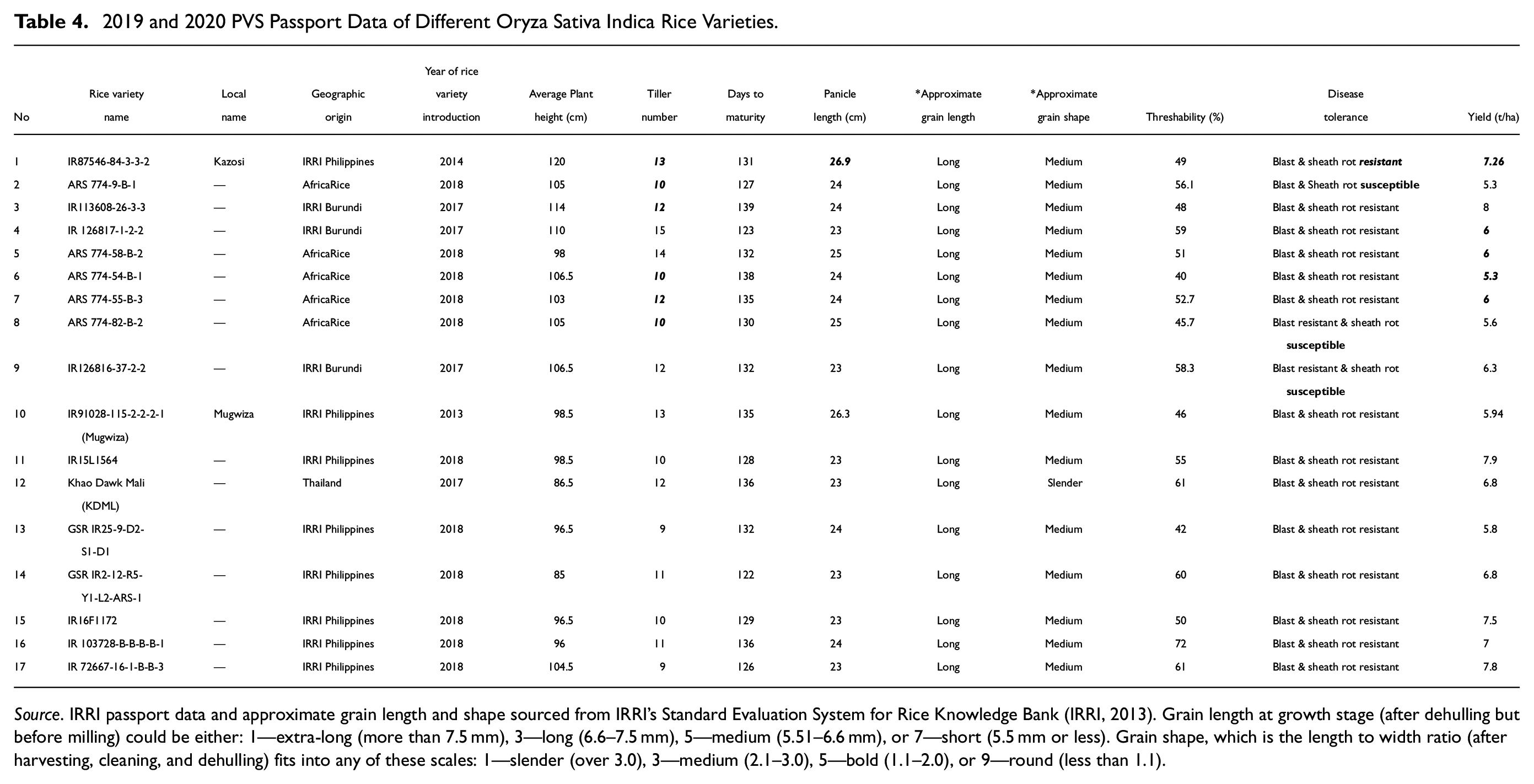
Source. IRRI passport data and approximate grain length and shape sourced from IRRI’s Standard Evaluation System for Rice Knowledge Bank (IRRI, 2013). Grain length at growth stage (after dehulling but before milling) could be either: 1—extra-long (more than 7.5 mm), 3—long (6.6–7.5 mm), 5—medium (5.51–6.6 mm), or 7—short (5.5 mm or less). Grain shape, which is the length to width ratio (after harvesting, cleaning, and dehulling) fits into any of these scales: 1—slender (over 3.0), 3—medium (2.1–3.0), 5—bold (1.1–2.0), or 9—round (less than 1.1).
Gendered Trait Preference Differences
Rice trait perceptions by both men and women stakeholders were mostly similar across the different rice varieties in the three locations (Figure 2). Nonetheless, gendered trait preferences were observed for a few rice traits, mainly on standing crop and cooking attributes for men and women farmers, respectively (Table 3). On the one hand, women farmers in two out of the three locations were the only ones who mentioned their preference for rice varieties based on their good taste (for rice varieties IR113608-26-3-3 and IR15L1564, Table 3 row 12) while in one out of the three locations, women farmers had a disliking for a non-aromatic rice variety (for rice variety IR 72667-16-1-B-B-3, Table 3 row 31). On the other hand, men farmers in different locations preferred rice varieties with strong stems (ARS 774-58-B-2, Table 3 row 11) and slender grains (IR 72667-16-1-B-B-3, Table 3 row 6), while they disliked rice varieties that were non-homogenous IR113608-26-3-3, Table 3, row 25) and with irregular maturity (kazosi variety, Table 3 row 28).
Preference Alignment Between Genders and Across Participating Stakeholders
Despite subtle gendered differences (Table 3), location-specific correlations showed strong associations on the preference scores between genders and across participating stakeholders, except in 2020’s Kansega area where there were no significant correlations for any of the variables (Table 5). There was also a weak positive association on the preference scores between farmer and researcher preferences in 2019. Pooled correlations, combining variety preference scores across the three different locations, revealed strong correlations between genders and across participating stakeholders (Table 6). Pooled gender-related bivariate analyses showed that the majority of the correlation coefficients between men and women participating stakeholders were positive and significant, except among seed producers (Table 6). Stakeholder-related results similarly showed positive and significant correlations for a majority of the participating stakeholders, except for coefficients between seed producers and most of the other participating stakeholders (Table 7). Grouped correlations between profit (seed producers, custom millers, and traders) and non-profit oriented participating stakeholders (researchers and administrators) showed that all correlation coefficients were positive and significant (Tables 5 and 7). In summary, the correlations showed that preference scores of men and women by participating stakeholders were positive and significantly correlated. Moreover, the correlation coefficients between participating stakeholders were positive and significant.
Separate and Pooled Ranking of Most Preferred Varieties and Results of Preference Analyses Conducted in Mugerero, Mugweji, and Kansega, 2019 and 2020.

and** significant at p < .05 and .01, respectively.
Pooled Results of Gender-Related Preference Analyses Across the Three Sites in 2019 and 2020.

No data on women administrators. **Significant at 1%.
Pooled Results of Stakeholder-related Preference Analyses Conducted Across the Three Sites in 2019 and 2020.

Significant at 1%. *Significant at 5%.
Rice Variety and Rice Seed Information Challenges and Opportunities
FGD results delved into challenges and opportunities of obtaining rice variety and rice seed information. Regarding information sources for new rice varieties, both men and women farmers in the well-established Mugerero rice irrigation scheme got information on new varieties from the government-led SRDI extension staff. Farmers in Mugweji, an area with no seed producers and limited extension service providers, experienced numerous challenges in the acquisition of new rice varieties and seed information. One of the Mugweji farmers elaborated further, stating that “It is difficult – for about three years now, we have not obtained seeds of new varieties. In fact, some groups have seeds of new varieties but they refuse to distribute them, for fear of competition and market monopoly.” In Kansega area, the situation was less bleak as there were a few seed producers and co-operatives. One of Kansega farmers remarked that “We get information about new rice varieties when we visit rice fields of either a seed producer, an extension officer, or a cooperative member who can get seed from SRDI. Some NGOs also give seeds to farmers. From all those sources, farmers have to check if the new rice variety has an added value compared to the one they are currently growing.” Due to these challenges, farmers in both Mugweji and Kansega areas mostly relied on their old saved seeds from previous harvests. If in short seed supply or in need of seeds of a new rice variety, they would then purchase these seeds from neighbors or they could request people who were traveling to Mugerero area to purchase seeds on their behalf.
It was interesting to note that even in the well-established Mugerero area, most participating stakeholders still raised broader rice value chain input access issues that transcended rice seed and variety challenges. Notably, concerns on access to affordable loan repayment modalities for inputs were raised by the farmers. One man farmer in Mugerero area noted that:
Actually, for seeds and technology, we do not have any problem – the issue is with accessing the other inputs. There is no bank or microfinance institute to offer us loans with low interest rates. Farmers in this area are not well assisted in terms of the provision of inputs such as fertilisers and pesticides. If you go [to these institutes], the interest rates are as high as 20%, which is not affordable to a farmer. We would wish to get some bank or microfinance to assist us access loans at low-interest rates to make rice farming more affordable
Therefore, limited access to seeds of new rice varieties in two out of the three study areas impacted the extent and frequency of farmer adoption of new rice varieties. Besides seeds, broader concerns on the affordability of other inputs were still cited as a challenge even in the well-organized Mugerero rice scheme, thus pointing to a hierarchy of different region-specific farmer needs.
Discussion
Incorporation of FGDs Into the PVS Structure Elicits Richer Insights on Rice Variety Trait Preferences
As opposed to previously gathering trait preference data solely by the use of PVS, complementing it with FGDs offered the added benefit of providing richer data, which deepened the understanding of diverse perspectives from both men and women participating stakeholders. Secondly, the detailed explanations of the trait preferences given by the participating stakeholders during the PVS were enhanced, in most cases, by those from the opposite gender. Thus, the combined FGD results by the separate men and women FGD farmers ended up supporting each other in elaborating each other’s perspectives when either gender experienced an explanation deficit. Thirdly, the FGD feedback in some cases also contradicted the PVS findings, especially pertaining the FGD farmer-preferred tall kazosi rice variety which was perceived to present a lodging challenge by PVS researchers. These differing opinions in turn led to an overall more holistic viewpoint. Thus, the use of both methodologies generated more balanced views from both men and women participating stakeholders.
This finding on varietal preference for largely the same reasons by a majority of both men and women participating stakeholders is consistent with that of a rice PVS study conducted in the coastal deltas of south and southeast Asia (Burman et al., 2018) as well as in a maize PVS study conducted in Zimbabwe (Setimela et al., 2017). In central Benin, a PVS evaluation that incorporated additional data on reasons underlying the selection of preferred varieties was administered among 60 farmers, 23 of whom were women, leading to the selection of rice varieties that combined multiple traits (Bello et al., 2015). Thus, more diverse representation can offer holistic viewpoints that are likely to result in greater impact.
User-Centric Breeding Can Advance New Rice Varietal and Seed Replacement
Our finding on farmers’ preferences differing with those of researchers’ criteria is aligned with a study on rice PVS in south and southeast Asia (Burman et al., 2018). In our study, the highest preference for the same (old) rice variety by all participating stakeholders in the 2019 Mugerero area, except among the researchers, stood out. This old variety, locally named as kazosi, meaning elongated neck, described the variety’s long panicle size. Best and long-used varieties usually have local names (Dorward et al., 2007) usually alluding to the most liked plant traits (Nuijten & Almekinders, 2008). Similar to our study, the most preferred IDSA85 rice variety in Ghana was locally referred to as “idana” meaning “you will not be tired,” in recognition of the variety’s threshing ease (Dorward et al., 2007). Besides its long panicle size, kazosi also had many other positive attributes. While researchers also liked these attributes, they still disliked kazosi’s lodging susceptibility due to its tall plant height. Contradicting this researcher-focused perspective is a finding by close to a third (22%) of farmers in southwest Burkina Faso who did not select lodging resistance as an important rice trait as they argued that lodging was due to heavy panicles, which was a high-yield indicator (Kam et al., 2013). In Nepal, despite the release of new rice varieties, the majority of the farmers continued to cultivate old rice varieties, sometimes with an average age of 20 years since their release date (Witcombe et al., 2017). Some of the benefits derived by farmers growing older varieties include greater ease of seed access and better adaptability to local agro-ecologies (Mansaray et al., 2019). Our finding on the preference for old kazosi variety suggests there is a need for researchers to consider farmers’ perspectives during their selection process.
Besides researchers pointing out deficiencies in the old varieties in use, farmers were not only aware of these and other challenges but they had also found ways to work around them. Besides the lodging challenge pointed out by researchers, there were other few demerits and adaptation measures concerning the most popular kazosi rice variety that Mugerero farmers reported. Specifically, the men FGD farmers elaborated on kazosi’s disease susceptibility, proneness to irregular maturity and tall stem that rendered it susceptible to lodging. It is likely that kazosi’s tall height that made its stem weak and posed higher susceptibility to lodging and lower yields was the reason why PVS men researchers disliked kazosi. However, farmers may not have considered these few weaknesses to be a detriment per se. Furthermore, plant height preference could be location-specific. On the one hand, while farmers in one region of Mali preferred short varieties as they were less susceptible to bird attacks, farmers at a different location in the same country preferred tall varieties as they were able to compete with a local prevalent weed (Efisue et al., 2008). While breeders selected short and stronger rice plants so as to avoid lodging, rice farmers in different parts of Benin and Nigeria predominantly preferred tall and medium-height varieties as they were less laborious to manually harvest (Horna et al., 2005). Tall plants were also preferred by farmers in Mali cultivating rice under both rainfed and irrigated areas as they lessened the burden of manual harvesting. This was especially important among women farmers who had to harvest the crop while at the same time carrying children on their backs. In this context, the likely gender-differentiated effect of replacing tall with short rice plants would result in an increase (rather than reduction) in rural women’s work burden (Efisue et al., 2008). Moreover, tall plants do offer an additional advantage as they have long rice straws needed to mix with clay in tent building (Efisue et al., 2008), a task usually done by men in most African setups (Norman & Kebe, 2006). There are also other easy-to-ignore multiple uses of rice straws (Nygaard et al., 2016) which serve important domestic uses and forms a basis for additional income-generating activities for both men and women. Thus, it is important for breeders to take localized problems into consideration and develop custom-made varieties that are suitable to specific contexts (Asante, Asante, Acheampong, Offei, et al., 2013).
Selection of PVS Varieties Is Dependent on Gender, Stakeholder Type, and Geographical Realities
The many similarities in trait preferences between men and women participating stakeholders suggests that both genders are involved in rice production, albeit in different stages. This is because while there were many similarities in gendered rice trait preferences, there were few but important differences in standing crop and cooking attributes as mentioned by only men and women farmers, respectively. Gender roles drive the traits uniquely prioritized by either gender (Teeken et al., 2018). On the one hand, the surveyed women rice farmers were likely more involved in post-harvest cooking stages, with their mentioning of taste and aroma rice traits. On the other hand, the men farmers were more involved in the standing rice crop production stages, with their articulation of standing crop homogeneity, stem type, grain shape, and maturity traits. In Burundi, men rice farmers are mostly engaged in pesticide application, harvesting, and selling paddy rice, given their role as the head of the family, while women farmers are involved in land preparation, weeding, and rice trading after milling. A study conducted in different African rice-growing countries revealed that most women rice farmers do not necessarily spend more time when compared with men in rice cultivation (Medagbe et al., 2020). In fact, rice production is perceived to be a labor-intensive and tedious activity, which explained why rice production in southern Ghana was dominated by men, despite there being equal gender distribution in the household surveys (Asante, Asante, Acheampong, Wiredu, et al., 2013). Rice processing, including parboiling, was exclusively done by women and girls in central Benin (Zossou et al., 2010), as well as in Ivory Coast, Madagascar, Sierra Leone, and southwest Burkina Faso (Medagbe et al., 2020). However, a different study in the same region of southwest Burkina Faso showed that rice farming was mostly the responsibility of women farmers, where they accounted for 83% of the surveyed farmers in the Cascades region. In the dominant ethnic group surveyed, women inherited their mothers’ rice fields, and rice cultivation knowledge was transmitted from mother to daughter, while men were more involved in the cultivation of maize, sorghum, and millet (Kam et al., 2013). These gendered differences, including within the same region, highlight the need to contextualize gender roles and to tailor the recommendations to better suit the gender(s) that are more actively engaged in different stages of the rice value chain.
Another important aspect that is relevant for preferences of women and men rice farmers is where they lie in the subsistence-market production gradient. On the one hand, the more that rice farmers are subsistence-oriented, the more that women and men preferences may differ, due to gendered differences in involvement in preparation and consumption. On the other hand, the more that farmers are selling for the market, the more that women and men preferences tend to align to millers’ preferences, which are aligned to those of the end-users (consumers). In our study, the latter was the case, confirming our earlier claim that the majority of farmers are market-oriented and well-acquainted with rice market-related information.
The non-significant correlation coefficients between researchers and farmers in Kansega may point to a lack of alignment in preferences between these two stakeholder groups. Researchers may be more focused on increasing productivity through irrigation (so as to increase yields in Cibitoke province from the current 2,270 ha to the projected 15,509 ha; IRRI and FABI, 2020), by their preference for productivity traits such as high yields, heavy grain weight, long grains, and panicles. However, these traits may be more tailored to irrigated rice areas (such as Mugerero) rather than rainfed areas (such as Kansega) where more resilience traits to reduce production risks may be more relevant, such as farmer-reported preference for strong stems and disease tolerance traits. This finding is consistent with a study conducted in the predominantly rainfed lowland coastal Kenya where low-yielding local landraces were still dominantly cultivated as they possessed multiple superior traits that enhanced their local environment adaptation (Musila et al., 2018). The big rice land areas owned by farmers in Kansega is likely because they had migrated from the more populated and less available land in neighboring provinces near Northern Burundi (Law, 2015), in search of bigger portions of farmland to purchase. Moreover, due to lower productivity and higher production risk in rainfed rice production, these farmers require larger rice areas to mitigate risks and sustain food security. Their purchasing power could have been accentuated as Kansega farmers had obtained the highest education level when compared to farmers in the other two areas. The combined role of young age, higher education, and farm ownership has been shown to be an influencing factor in the adoption of new rice varieties by rice farmers in Sierra Leone (Mansaray et al., 2019), Pakistan (Chandio & Yuansheng, 2018), and Indonesia (Aristya et al., 2021). It is likely that increased investment in rice production support such as provision of seeds and extension services could incentivize these emerging rice farmers to bolster rice productivity in this nascent area.
Broader Data Collection Enhances Opportunities to Address Low Adoption Rates
Broadening the PVS structure and scope into a flexible process that links with local seed systems is essential (Dorward et al., 2007). It is probable that correlations between seed producers and most of the other participating stakeholders were not significant (Table 7) because of the few seed producers available (Table 1). In fact, in Mugweji area, seed producers were completely absent. The FGDs further revealed challenges of access to improved rice variety and rice seeds in not only Mugweji but also Kansega, two out of the three study areas that had no or few seed producers, respectively. Malfunctioning seed systems present a major constraint in rice production under different rice-growing ecologies across SSA (Efisue et al., 2008). Nonetheless, the existing and widespread informal rice seed system has the power to disseminate improved variety seeds as was successfully done in Ghana (Dorward et al., 2007). In Niger, there’s even a recommendation to have a national seed policy that restructures the formal seed sector and opens it up to multiple participating stakeholders (Sow et al., 2015). Even in the elaborate seed system network in Mugerero study area, there was still a challenge of poor access to affordable loans, which was more of a constraining factor when compared to access to rice variety seeds. A study of rice systems in Benin solved this issue by supporting farmers to easily access either or both formal and informal credit sources, which strengthened women groups’ access to input and output markets (Zossou et al., 2010). Thus, there is a need to not only consider specific trait preferences but also address broader systemic issues if improved varieties are to be widely adopted by farmers in the developing world. Among these wider systemic issues in rice-based systems is the need to incorporate approaches that are climate-resilient, for example, when considering interannual variations in the upper troposphere that affects the performance of different rice varieties. Large-scale farmer uptake of climate-smart agricultural practices requires a multi-faceted method that simultaneously incorporates technology development, capacity development, and policy influence (Hellin et al., 2021). Co-enabling technological, institutional, governance and social interventions will go a long way in shifting from incremental to the much-needed far-reaching transformative change that addresses the root causes of climate vulnerability (Hellin et al., 2022; Hochrainer-Stigler et al., 2023) and results in higher adoption rates of new rice varieties.
Conclusion
Our study revealed evidence on alignment of preferences for rice traits among men and women participating stakeholders in areas that are dominated by irrigated rice cultivation. The FGD findings were similar to those obtained from the PVS exercise, especially in terms of rice variety preference rankings and rationale, with the added benefit of richer feedback obtained from the FGDs. Social scientists and breeders can use these data to define market segments and develop target product profiles (product concepts) for varieties that can respond to the preferences and needs in these market segments. The absence of evidence of preference alignment in areas that are dominated by rainfed rice production suggests that participating stakeholders may not accurately capture farmers’ preferences and needs, which may be different from irrigated rice production and more focused on risk reduction and resilience (such as disease tolerance), rather than productivity (such as high yields). This divergence between production systems warrants further investigation.
Two main methodological limitations and suggestions for improvement emerged, hinging on more robust quantitative data collection and better time efficiency. Pertaining to the robustness of quantitative data collection, numerical preference score values could enhance capturing more quantitative scores beyond the binary like/dislike scores. Increasing the experimental study design bolsters the generation of average scores from multiple replicates. Having similar sets of varieties grown in all the trial sites across multiple years can enhance even more insightful comparisons across regions. While the small sample size may limit quantitative insights, it is suggested that small sample sizes are adequate (Cohen, 1990), especially if the research aim is to explain phenomena rather than to estimate the statistical representativeness of data (Djurfeldt, 2012). Secondly, there is a need to ensure that the add-on FGD sessions are time-efficient. With this, local staff speaking local language(s) need to be trained to moderate FGD sessions so as to overcome language barriers that in turn leads to longer translation times. While sensory evaluations involving the assessment of cooking and eating attributes of shortlisted rice varieties are usually conducted together with the PVS preference evaluation, this study found it best to conduct these two steps on different days, depending on the outcome(s) of the PVS preference evaluation stage. While this was also a time-saving strategy at the time, preference evaluations which focus on standing crop are just one step in the overall PVS evaluation, which may limit inclusion of women who may have more elaborate feedback in the subsequent sensory evaluation PVS stage. Nonetheless, as our study found that the 2014-introduced kazosi rice variety was the most liked and thus no new rice variety was preferred by the invited participating stakeholders in 2019, the PVS organizers did not proceed with the subsequent sensory evaluation at a later date, thus it was time-saving in that context. The 2020 PVS events in Mugweji and Kansega led to preference of a new rice variety (the 2018-introduced IR15L1564), for which the next official release steps are currently being managed by the national research institute—ISABU, specifically conducting all pending tests, including sensory evaluations. Overall, this study has shown the differences and similarities in stakeholder preferences for various PVS rice varieties and the gaps and opportunities for breeder-driven programs to match and respond to user needs. One immediate policy implication of working in this complex adaptive system is the need for inter- and transdisciplinary collaboration that starts with embracing the need to “do research differently” in a way that allows the use of a combination of methods that connect technological advancements with capacity development and social networking leading to co-development of pathways that evolve with non-academic partners, especially farmers (Hellin et al., 2022). Thus, we suggest that a holistic and multi-stakeholder approach to addressing a hierarchy of needs and issues in the rice value chain needs to be taken into account if farmers are to comprehensively adopt new rice seed varieties to bolster food and income security.
Footnotes
Acknowledgements
We are grateful to all the farmers and other stakeholders for their participation in the survey and to Dr. Alexis Ndayiragije (IRRI, Mozambique), Dr. Ir. Joseph Bigirimana (IRRI Burundi Country Representative), Dr. Ranjitha Puskur (IRRI, India), Dr. Shalabh Dixit (IRRI, Philippines), and Leilani Nora (IRRI, Philippines) for their great research support and comments on an earlier draft of this manuscript. We also gratefully acknowledge the extensive general support and useful comments provided by staff at IRRI Burundi office prior to and during implementation of the field work. Among these, the excellent field research support by Jean Berchmans Bizimana, Menedore Ndagijimana, Noëlla Nahimana, and Donatien Bigirimana is greatly appreciated. Study sites map generation by Noël Nzeyimana is also much appreciated. The authors attest originality of the results and assume full responsibility for any remaining shortcomings.
Author Contributions
Mary Ng’endo: Conceptualization, Methodology, Validation, Formal Analysis, Investigation, Writing—original draft, Writing—review and editing, Visualization. Julien Nduwimana: Conceptualization, Methodology, Validation, Investigation, Writing—review and editing, Project administration. Donald Villanueva: Validation, Formal analysis, Writing—review and editing, Visualization. Matty Demont: Validation, Writing—original draft, Writing—review and editing, Supervision, Funding acquisition.
Declaration of Conflicting Interests
The author(s) declared no potential conflicts of interest with respect to the research, authorship, and/or publication of this article.
Funding
The author(s) disclosed receipt of the following financial support for the research, authorship, and/or publication of this article: This research was funded by World Bank Group’s Regional Project for Integrated Agricultural Development in the Great Lakes (PRDAIGL) grant number PRDAIGL/IRRI/BI-PIU-68409-CS-CDS//ED/2019, Bill & Melinda Gates Foundation’s Accelerating the Genetic Gains in Rice (AGGRi)— grant number OPP1194925, and, CGIAR CGIAR Research Initiatives on Climate Resilience and Market Intelligence (ClimBeR) and Market Intelligence. We would like to thank all funders who supported this research through their contributions to the CGIAR Trust Fund ( ).
).
Ethical Approval statement
The authors obtained oral informed consent from each participant in the survey through a Yes/No procedure prior to beginning the interview. All participants were informed about the context of the study and the anonymous nature of the survey. Permission was sought from each respondent, and they openly and freely answered the questions asked.