




Abstract
Food production in Nigeria is almost entirely rain fed despite the great potential of irrigation in Nigeria to boost agricultural productivity. The study assessed the profitability and efficiency of dry season irrigated okra farming in Adamawa State using primary data collected from 180 farmers through a simple random sampling technique. Profit efficiency and stochastic frontier function were used in analyzing the data. The result revealed that labor costs accounted for 48% of average variable cost while a farmer’s total revenue from irrigated okra produce was ₦228,642.56K ($408.2), total fixed cost and variable input cost was ₦102,440.37K ($182.93), resulting in a net farm income (NFI) of ₦126,201.63K ($225.36). The coefficients of farm size, household size, and fertilizer were positive and significant at the 1%, 10%, and 5% levels of probability, respectively, as revealed by the OLS results. Empirical estimate shows that the mean technical efficiency value of vegetable farmers was about 0.73 while Technical inefficiency coefficient of farming experience (−0.420), adjusted household size (−0.193), and extension contacts (−0.162) are variables that increased technical efficiency. Lack of access to water, high cost of equipment, and inadequate finance were identified as lead constraints of the okra farmers. Therefore, recommendations by the study are that farmers be encouraged to establish cooperative organizations so that they can pool their resources to create an irrigation system that is affordable. Also, sustainability of small scale irrigation scheme should be promoted by the government through skill enhanced trainings.
Introduction
Nigeria is endowed with ample irrigable water resources over a wide range of agro ecologic zones enough for the country to produce crop and crop products to feed the people and also to export to other nations. Despite this large agricultural potential and natural irrigable water resource endowment in Nigeria, there exist experiences of food shortage by the farming households because the agricultural resources were largely untapped and underutilized making poverty and hunger a critical developmental challenges (Babalola et al., 2020).
There are two distinct seasons in most parts of Nigeria: the “rainy season and the dry season.” The traditional cropping season is the rainy season, which runs from April to October; November to March is usually the dry season. The majority of rural households only engage in agricultural operations during the brief wet season; as a result of which farmers hardly produce to meet domestic food demand. Thus, the Nigerian farming households usually experience double barrel problems of incidence of hunger few months after harvest because of low productivity and sales of their farm produce at harvest time and may or may not be able to engage in any other subsidiary paid job during the dry season.
Irrigation involves water supply system that is planned and designed to aid agricultural land to produce crops where rainfall is insufficient. It is also aimed at protecting crops that are affected by insufficient rainfall or drought.
Okra production is high during the wet season, resulting in market saturation, but there is usually a scarcity of this important agricultural crop during the dry season, resulting in a high price due to scarcity (Ekunwe et al., 2018).
Okra (“Abelmoschus esculentus (L.) Moench”) is a popular crop that is grown in most parts of the world (Narayanamoorthy & Devika, 2018). India produces the most okra in the world, followed by Nigeria and Sudan. In Nigeria, it is grown all year on approximately 2 million hectares (Ekunwe et al., 2018).
Okra contributes to human nutrition by providing lipids, proteins, carbs, minerals, and vitamins (Elkhalifa et al., 2021). It is high in proteins, carbs, and vitamin C, and it is an important part of the human diet (Sarker et al., 2022). Okra mucilage is extensively used in the production of glace paper and confectionery, and it is good for industrial and therapeutic uses (Dantas et al., 2021). Okra is also used in medicine as a plasma substitute or blood volume expander (Gemede et al., 2015; Liu et al., 2021).
“All parts of okra plant are useful, its leaves and tender shoots can be cooked and eaten by humans and also eaten fresh by livestock like cattle, goat, sheep, etc.” The pods can be consumed fresh or dried form and it is a crop that can be grown for export because of its various uses (Osalusi et al., 2019).
Dry season Okra production, is the cultivation of okra outside of the normal growing season with the aid of infrastructure such as greenhouses, irrigation, and watering cans, among other things.
Farmers can engage in irrigation farming during off-farm season so that additional income can be earned as a result of the rising food prices but smallholder farmers must employ agricultural inputs more effectively if they hope to increase output (and food security). The design of agricultural policies and programs could be enhanced by better understanding the production elasticity of inputs, efficiency, and any socioeconomic traits of the farmers that affect such efficiency. Hence, the research objectives are to:
Describe the socioeconomic characteristics of dry season okra farmers
Determine the costs and profitability of okra production during the dry season in the study area
Identify the determinants of dry season okra production
Examine the production efficiency of dry season okra farming
Describe the problem and constraints militating against dry season okra farmers
This justification of this study is that the study adds to the ongoing discussion on how to increase productivity in smallholder farming by emphasizing important policy entry points and to understand the causes of production efficiency. The results can also assist policy formulators in coming up with policies that can increase smallholder okra production. This will enhance household food security, increase farmer incomes, and decrease poverty in the nation.
Materials and Methods
Study Area
This research was conducted in Adamawa State, Nigeria. Three Local Governments Areas were selected comprises of Ganye, Numan, and Shelleng LGAs. The savanna region of Nigeria lies within the geo-coordinate of latitude 14°N and longitude 2°44′E to 140°42′E constitute a bulk segment of the northern part of Nigeria (Oladipo, 1995). The two seasons in the region are dry and wet seasons with a mean annual temperature of 26.7°C while the mean annual rainfall is 1,350 mm. Wet season begins in April and ends October with a temperature that is moderately equally distributed throughout the year. Ganye, Numan, and Shelleng Local Government Areas are located within the state’s Guinea Savannah Zone (Adebayo, 2012). The soil composition is flat to gently undulating well drained medium texture soils (Jamala & Oke, 2013) while the topography is mountainous areas forms the barrier between Cameroon forested and Savannah North (Oladipo, 1995). Vegetables like okra, onion, tomatoes, sweet pepper, and garden egg are predominantly produced in the region.
Sampling Procedure
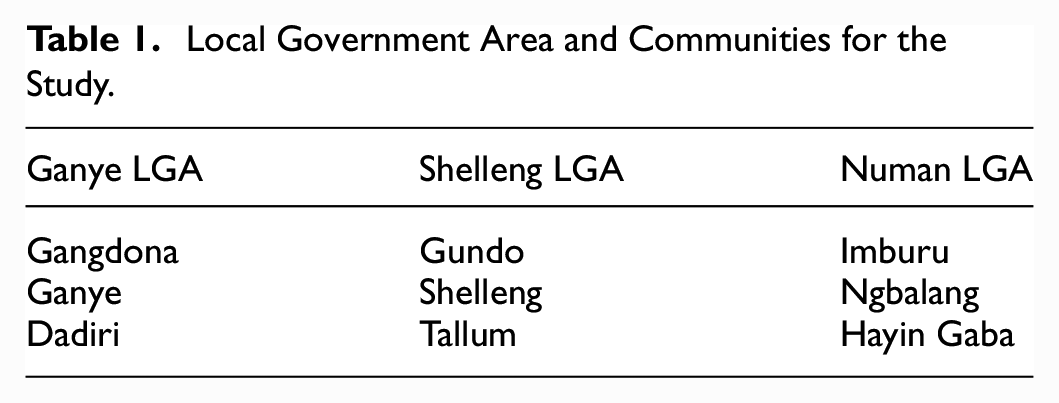
Through a three stage sampling technique, the data were obtained for this study. In the first stage, Three Local Government prominent with okra production were purposively selected. These are Ganye, Shelleng, and Numan. The second stage involve random selection of three communities from each of the local Government (Table 1) and random selection of 20 okra farmers from each of the nine communities was done in stage three, making a total of 180 respondents
Local Government Area and Communities for the Study.
Data Collection
The representative sample was made of 180 households from nine settlements, with a confidence level of 95%, and an accuracy rate of 7%. The informed consents of all participants of the research were sought before being surveyed. Data collected were through a semi-structured questionnaire together with an interview schedule–guide. Due to high rate of illiteracy among the respondents, interview schedule was included to aid the collection of the required information from the rural farming households. The data were collected by the researchers and research assistants who understand the local languages for easy communication with the rural farmers.
Data Analysis
Descriptive statistics, individual dietary intake, and logistic regression were employed in analyzing the data. Demographic features of the farming households were described with descriptive statistics. This includes the use of frequency, percentage, and mean.
Analytical Techniques and Variable Measurement
Using descriptive statistics like frequency distribution and percentages, the socioeconomic characteristics of okra growers were investigated. The costs and returns were estimated using Gross margin and net farm income, while ordinary least square regression (OLS) and the stochastic production frontier were used to investigate the factors that affect the productivity of okra production and efficiency of resources usage during dry season, respectively. “5-point Likert scale” was employed to describe the problem and constraints militating against dry season okra farmers in the area. The product of the prevalent wage rate and total man-days of family labor was used to assign values to family labor. To arrive at the net farm value, the values of the fixed items (such as hoes, cutlasses, and sprayers) of the cost were depreciated and added to the rent on land.
Cost and Return
Equation (1) implicitly indicate the model taken into consideration for cost and return per hectare and per respondent estimation.

Where:
TR = “Total revenue in Naira/ha”
TC = “Total cost in Naira/ha”
GM = “Gross margin (Naira/ha)”
TR = “Total revenue (Naira/ha)”
TVC = “Total variable costs (N/ha)”

Where,
NFI = “Net Farm Income”
Yi = “Gross Output (kg)”
Py = “Unit price of product Yi in (Naira)”
Xj = “Quantity of variable input (where j = 1,2,3….n)”
Pxj = “Price per unit of variable input in (Naira)”
Fk = “Cost of fixed inputs K (where K = 1, 2,3k fixed inputs)”
“Ordinary Least Square Regression Model.”
To identify the determinant of okra production, OLS was employed.
Model implicit form is specified as:

Where
Y = Okra output (kg)
Estimation of Stochastic Production Frontier Model
The efficiency and productivity of the farmers in the study area were estimated using a “stochastic production frontier model.”
The model specification for the production stochastic frontier is specified as:

Thus, to estimate the Cobb-Douglas production function, all the input variable and output data were converted into natural log form before analysis (Coelli, 1995; Tsiboe et al., 2019),
Where:
Y = Output of okra in the ith farm (kg),
Xi = Input vector used in the production,
β i = Unknown parameter vector,
ei = Vi − Ui (error term in composite form),
VI = Assumed same random parameter, normally distributed, with zero means, and constant N (0, Ϭ2) They were regarded as being independent from the Ui, which represented the stochastic effects that cannot be controlled by the farmers. This includes natural disaster, weather etc.
Ui = Random variable of the technical inefficiency,
X 1 = Labor (man-day),
X 2 = Fertilizer quantity used/ha (kg),
X 3 = Quantity of pesticide used/ha (l),
X 4 = Quantity of seed used/ha (kg),
X 5 = Farm size (hectares of land),
X 6 = Number of irrigated equipments (standardized).
Likert Scale Analysis
A “5-point Likert type scale” was employed to identify and rank the constraints to okra production among the farmers. Bishop and Herron (2015) identified the Likert type scale as comprising single unrelated and independent questions whose responses cannot be combined into a composite scale as in the case of the Likert scale. The scale used was as follows: 5 = extremely serious 4 = Very severe; 3 = moderately serious; 2 = Mild; and 1 = Not serious.
Results and Discussion
Socioeconomic Characteristics of the Farmers
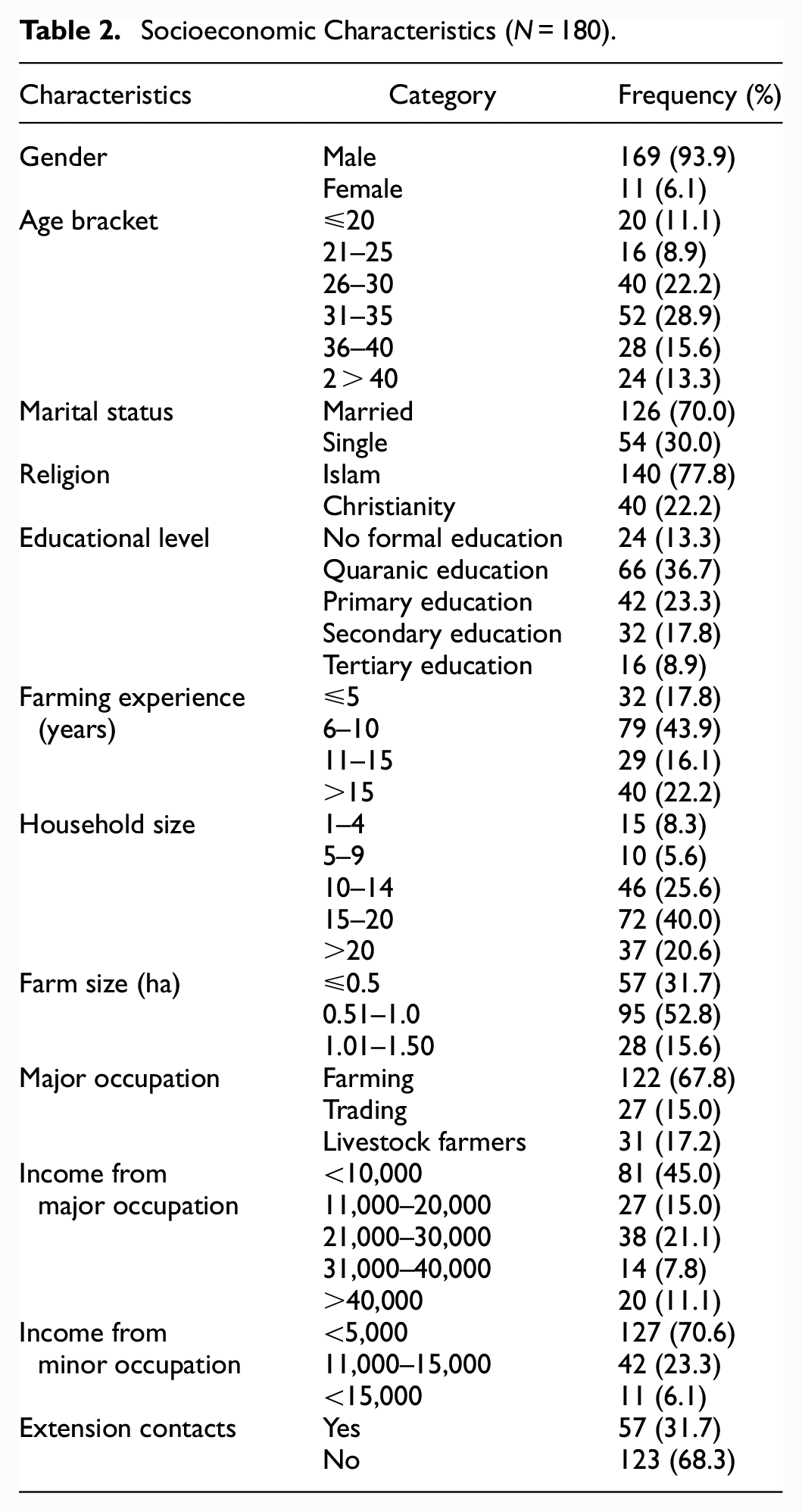
The dry season okra farmers socio economic characteristics as shown in table 2, reveals that during the dry season, 93.9% of okra is grown by men. The arduous processes and tasks connected with dry season irrigation farming may explain the limited female participation. Findings also revealed that only 11.1% of the respondents were below 20 years of age, while majority, 28.9% falls within age 31 to 35 years age bracket. This indicates that the respondents were active, young, and agile. According to Ekunwe et al. (2018) age plays a big and vital role in okra farming and it impacts the farmer’s capacity to carry out demanding and laborious farm work as described by specific activities in okra production. About 70% of the farmers are married. However, based on the educational level of the studied population, larger percentage had “Quranic” education (36.7%), while 23.3% and 17.8% had primary and secondary school education, respectively. Few of the respondents had a higher level of education. Meanwhile, the modal age experience was between 6 and 10 years at 43.9%, with the least experience of 16.1%, implies that the majority of okra dry season farmers have prior okra farming expertise. The number of years of farming experience may promote better agricultural techniques and help farmers. Farm experience can reduce or increase the application scales of tried-and-true farmer talents, as well as repair earlier faults or blunders. Farmers with many years of farming expertise may be better able to predict future okra market conditions in which they will sell their crop at higher prices and make more money. This result is in consonant with Ezeano et al. (2016). Farmers also engage in other occupations such as trading (15%) and livestock rearing (17.2%). Farmers’ average monthly wages from the principal occupation varied depending on the amount of land they cultivated and how much they contributed to dry season farming in the study area. Moreover, about 45% of the farmers earned at least N10,000 per month. The nature of extension visit or contact varied among the respondents. Only 31.7% of the respondents had contact with extension agents in the last farming season.
Socioeconomic Characteristics (N = 180).
Cost and Returns of Dry Season okra Production
Table 3 reveals that the total revenue from the sales of dry season okra produce for a typical farmer was ₦228,642.56 k/ha while the total fixed cost was ₦19,950.00k and variable input cost amounted to ₦146,151.63 k/ha. This gives a net farm income (NFI) of N126,201.63 k/ha. This shows that the dry season okra farmers under irrigation practices actually yielded a total amount of ₦126,201.63 k profit per hectare.
“Cost and Returns of Dry Season Okra Production.”
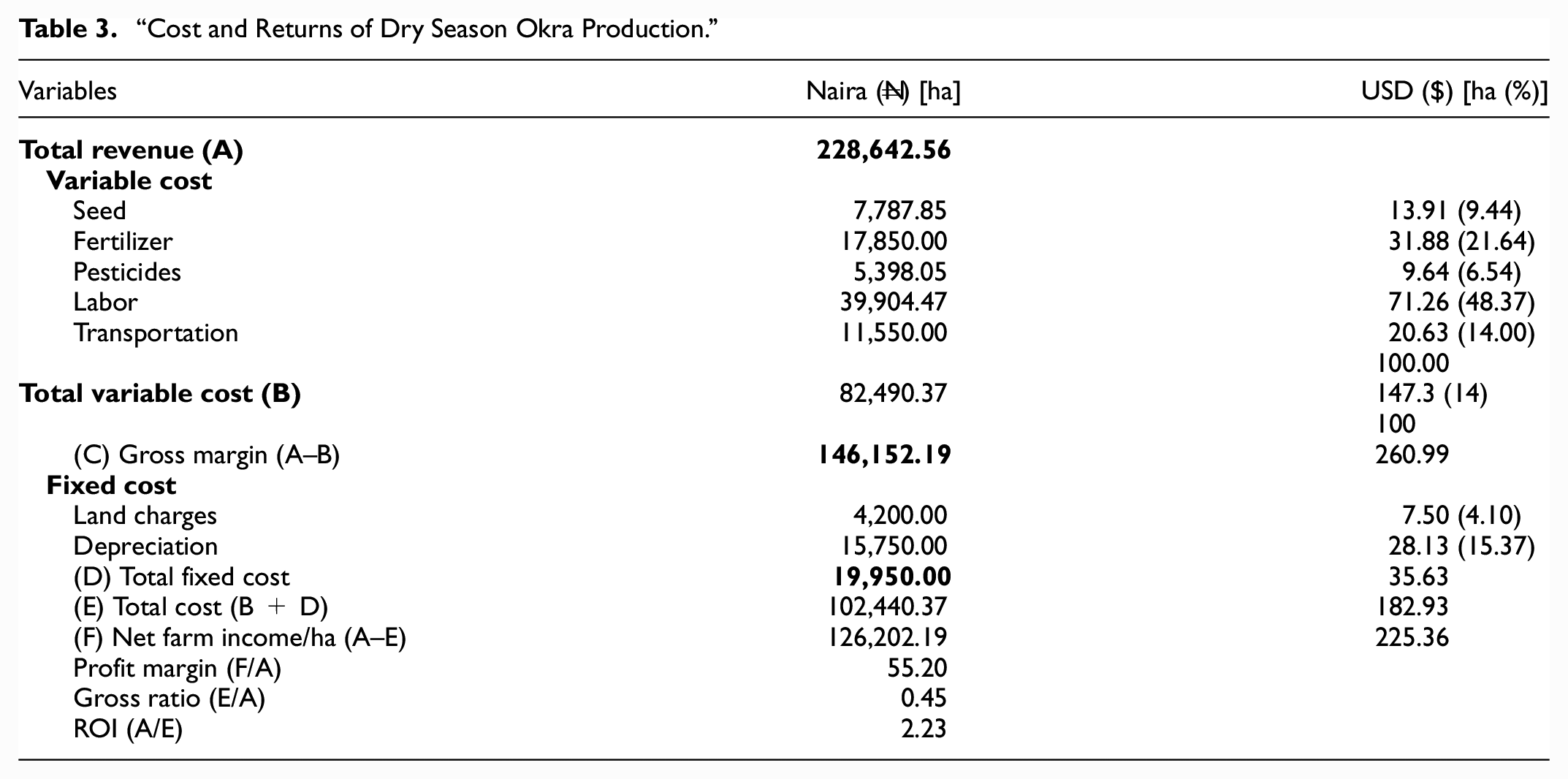
The outcome also showed that labor costs made up about 48% of variable costs, followed by fertilizer costs at 22% of variable costs. Table 2 profitability ratios also revealed that the profit margin, gross ratio, and return on investment were 0.55, 0.45, and 2.23, respectively. The return on investment of ₦2.23 shows the profit made for every one naira invested in dry season okra farming. This is a reflection of the returns available to investors and a measure of the profitability of the capital invested over the production period (Kshash & Oda, 2022). This result indicates a high level of efficiency in capital usage and also significant return to the enterprise. This result agrees with the findings of Kehinde and Kehinde (2022) in their assessment of resource use efficiency among okra farmers in Osun state, Nigeria
Regression Analysis of Determinants of Dry Season Okra Production in the Study Area
Table 4’s findings on the factors affecting the production of okra during the dry season demonstrate that household size and farm size both have positive coefficients and are significant at levels of probability of 1% and 10%, respectively. This suggests that an increase in farm area by 1 ha will lead to an increase in dry season okra production by 1,419 kg. Therefore, increasing the amount of land that is cultivated will result in higher production output. Also, household size was significantly positive (10%). This suggests that a 225 kg increase in dry season okra production will result from a unit increase in family size. This suggests that an increase in household size will lead to an increased labor availability, which will increase output as a result of an increase in labor. Another significant variable was the quantity of fertilizer utilized. The production of okra will therefore increase by 262 kg for every unit increase in fertilizer application. This result agrees with the findings of Nwaobiala and Ogbonna (2014). The household head age, was not significant, which suggests that age is not a significant factor in dry season okro production. The education level of the household head is also not significant, but has positive coefficient which is in consonant with apriori expectation. Education is expected to have positive impact on the level of production of the farmers. Extension contact is not significant but has a positive coefficient which is in agreement with apriori expectation. Number of extension contact is expected to contribute to the knowledge and information acquired by the farmers thereby improving their productivity. Cost of pumping machine is not significant but has a negative coefficient which is in agreement with apriori expectations. A higher cost of pumping machine will lead to increase in the cost of production and lead to reduction in the profit from the enterprise. Quantity of labor has a positive coefficient but not significant. Quantity of labor is expected to have a positive impact on the production in the long run; since production is expected to increase with more labor. Experience is also not significant and it has negative coefficient, which is in variance with apriori expectations; meaning that, an increase in the year of experience will impact the production negatively. This result can be attributed to the major dependent of dry season okra production on other variables such as irrigation materials thereby, making the year of experience of less importance.
Results of OLS Regression Analysis of Determinants of Dry Season Okra Production in the Study Area.
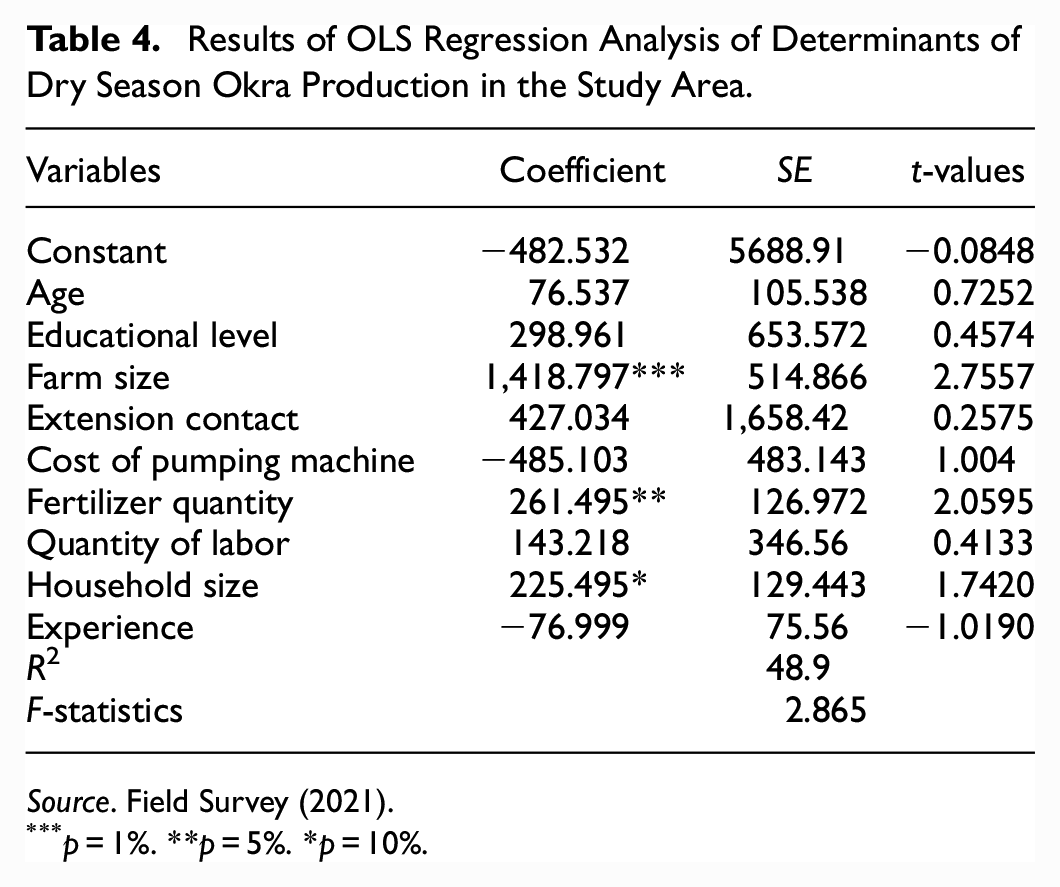
Source. Field Survey (2021).
p = 1%. **p = 5%. *p = 10%.
Maximum Likelihood Estimate (MLE) of the Cobb-Douglas Production Functions
A total of 180 okra farmers in Adamawa State had significantly different levels of technical efficiency, according to the estimates from the stochastic frontier model in Table 5. Sigma-squared was .444 and at 1% level of probability it is different from zero. This is a sign of a good fit and the correctness of the composite error term. The results also revealed that labor input (X1), farm size (X5), and irrigation equipment (X6) were significant variables in okra farmers’ technical efficiency. Farm land for okra cultivation has estimated coefficient of (0.17), indicating that 1% increase in farm size would induce a 17% change in okra output. This is in line with a priori expectation, since land is a significant factor in okra output. This result is in line with those of Adelodun (2021).
“Maximum Likelihood Estimate (MLE) of the Cobb-Douglas Production Functions” Based on Stochastic Production Frontier Function for Dry Season Okra Farming.

Source. Field Survey (2021).
1% significant level, * 10% significant level
Also, irrigation equipment parameter estimate (0.152), significant at 10%, and labor input (0.995) significant at 1% were all in line with expectations. The positive signs of these variables were not surprising as the number of irrigation materials owned by a farmer and amount of labor used, being a subsistence venture, are expected to increases output of okra. The results also inferred that a unit rise in labor, area devoted to okra farming, irrigation materials, would increase okra output by 0.995, 0.166, and 0.152 units, respectively. Pesticide (X3), and seed (X4) were not significant their negative value however implies that a unit increase in these variables will not have any positive effect on the efficiency of okra production. This suggests that since they are small-scale farmers constrained by the size of the farm and availability of labor, the availability of more seed may not have any effect on efficiency.
The Cobb-Douglas production function regression coefficients are the production elasticity’s, and their sum reveals the return to scale. The 2.456 elasticity of production in this result, indicate increasing returns to scale. This implication of this is that a greater percentage increase in output is expected with a percentage increase in all the inputs that showed positive relationship. At this stage, farmers cannot maximize their profit because resources were under-utilized, so farmers can still increase the use of input for profit maximization.
The inefficiency model reveals that years of experience, adjusted household size and, Extension contacts are significant factor affecting dry season okra production in the area.
Distribution of Technical Inefficiencies of Okra Farmers
The distribution of technical efficiency scores as reported in Table 6 shows that the mean technical efficiencies were roughly 0.73. This suggests that if input utilization efficiency is enhanced by 0.27, okra farmers could boost production. Thus, opportunity still exists for increasing okra productivity and income through increased efficiency with the use of existing resources. Despite this, the majority of okra growers (about 70%) had distribution efficiency above the sixth quartile.
Deciles Distribution of Technical Inefficiencies of Okra Farmers.

Source. Field Survey (2021).
Constraints Facing Dry Season Okra Producers in the Study Area
The results of ranking among the identified constraints as shown in Table 7 reveals that constraints related to high cost of irrigation materials were ranked first. This indicates that the constraint is a major perceived challenge identified by the okra farmers affecting their effective production, and hence their profit. Constraints related to the high cost of transportation ranked second and this suggests that some of the respondents did not have quick access to affordable means of transporting their farm produce to the market place, which can lead to post harvest losses and reduction in their profit. This is in consonant with Osalusi et al. (2019) who found out that transportation was one of the major constraints faced by okra farmers in Oyo state, Nigeria. Inadequate credit facilities ranked third which is an indication that the dry season farmers ability to expand their production will be hindered. The fourth identified constraints of high cost of hired labor will translate to the consumers paying higher price for the commodity. The lack of storage facility which was ranked fifth implies that the farmers had no adequate storage facilities to store their farm produce which may lead to post-harvest losses. Other constraints are Pest and diseases, destruction of farm by cow, Lack of seedling, High cost of farm input, and Pilfering which ranked sixth, seventh, eighth, ninth, and tenth, respectively.
Constraints Facing Dry Season Okra Producers.
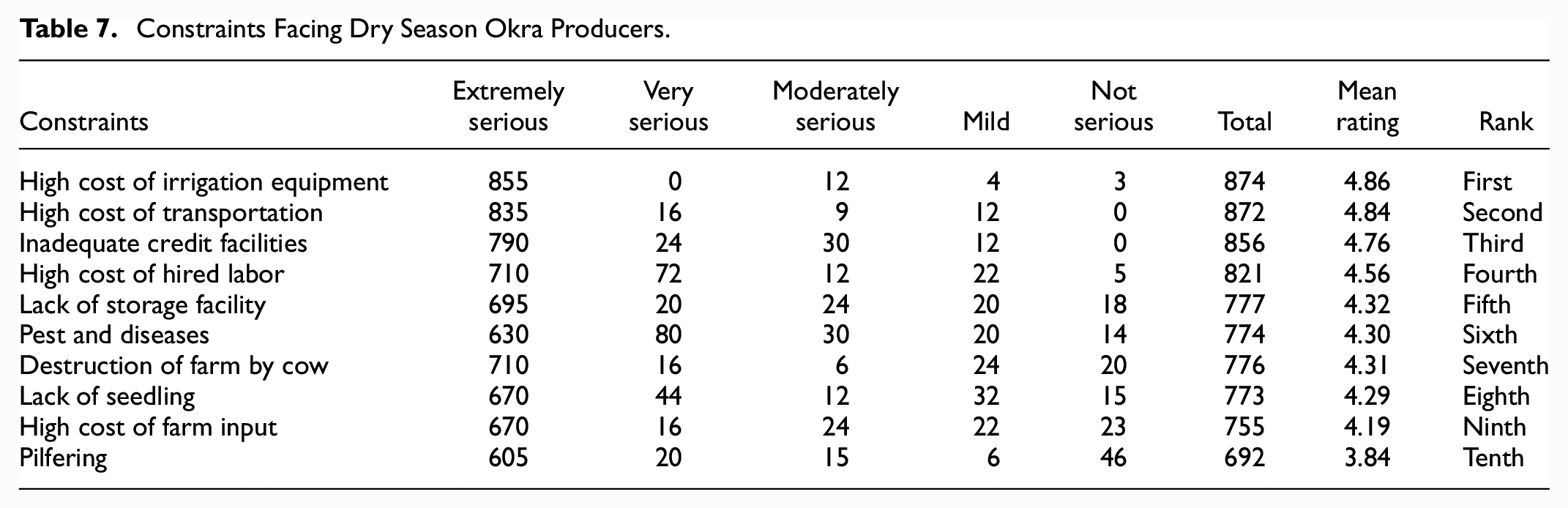
All these afore-mentioned constraints severely influenced the respondents negatively in practicing dry season okra production in the study area.
Conclusion and Policy Recommendations
Farm size, quantity of fertilizer use and household size were the determinants of production. Labor, farm size, and irrigation materials affected the efficiency of production. Furthermore, farmers were severely constrained by High cost of irrigation equipment, high cost of transportation, inadequate credit facilities, and high cost of hired labor.
The policy implications of these findings are that dry season okra farming can be considered as profitable business, technical efficiency in smallholder okra production could be increased by 27% on average through better use of available resources (e.g., land, irrigation equipment, and labor), given the current state of technology.
Investment in irrigation might therefore be a catalyst for ensuring sustainable food and water security and raise standards of living for rural people thereby help to achieve SDG 1 and 2, No poverty and Zero hunger among the farming households.
In light of the results of the study, the authors suggest the following:
Farmers should be encouraged to form groups and cooperatives, where they can pull their resources together to construct cost effective irrigation systems. This is necessary to ensure agricultural production throughout both the rainy and dry seasons.
Provision of subsidies for farmers by the government and other non-governmental groups is recommended.
By ensuring improvements to the current irrigation infrastructure, such as the provision of pumping machines, access to underground water through wells and boreholes, conserving surface runoff during precipitation, the government could help smallholder dry season okra farmers increase their technical efficiency.
Footnotes
Acknowledgements
We appreciate the logistical support provided by the Staff of Upper Benue, Adamawa and staff of Green Eagles Agribusiness Limited during this study.
Declaration of Conflicting Interests
The author(s) declared no potential conflicts of interest with respect to the research, authorship, and/or publication of this article.
Funding
The author(s) received no financial support for the research, authorship, and/or publication of this article.
