




Abstract
Social skills training (SST) is often used to teach basic and specific social skills in the treatment of social anxiety disorder (SAD). However, the content, duration, and form of such training vary. This systematic review aimed to (a) to examine the demographic and clinical characteristics of the populations for whom these interventions have been used, such as age, gender, and the composition of the subgroups, (b) to describe the main elements of different SST programs, and (c) to evaluate the effectiveness of SST, including session duration, setting, content, population, and techniques, and analyze the effects of reducing symptoms of social anxiety. We conducted a systematic literature review using three databases to identify the literature on SST. The search was restricted to peer-reviewed studies published from January 2000 to December 2023 that used SST to treat SAD in any age group. We found 14 different SST programs used with individuals aged 6 to 78 years. The content of these programs was mainly similar. However, there was considerable variation in small-group sessions’ duration and frequency, and how they were delivered and/or integrated into daily life. SST showed positive effects in the majority of included trials. Symptom reduction was maintained or further reduced after 6 months to 5 years of follow-up. Our review found a need for more research focusing on methodological rigor, standardization, the role of parental involvement, the role of supervision, and the comparison of SST with other therapies.
Keywords
Introduction
Social anxiety disorder (SAD; ICD-11: 6B04) (World Health Organisation, 2024) is a mental health issue that can cause significant distress and impairment of quality of life by causing individuals to avoid certain social situations (Kandola et al., 2018; Zika & Becker, 2021). SAD is the fear of being observed and judged by others, for example, at work or in everyday situations (Asbrand et al., 2022). Symptoms of social anxiety can include blushing, sweating, trembling, palpitations, or rapid heartbeat (Petzold et al., 2020). Eye contact with strangers and feared situations are often avoided (Beidel, 2014). Individuals suffering from social anxiety are extremely self-conscious and have more difficulty identifying, naming, expressing, and understanding their emotions than their peers (Rozen & Aderka, 2023).
Globally, SAD is one of the most common anxiety disorders, with a lifetime prevalence of 12.1% (Mohammadi et al., 2020; Stein et al., 2017). Avoiding social situations is one of the main diagnostic criteria for SAD, and it causes psychological and economic distress and burden worldwide (Schulz et al., 2014). Women typically have a higher prevalence of SAD than men (Stein et al., 2017). Additionally, SAD is associated with significant impairment in social, occupational, and academic functioning, as well as reduced quality of life (Patel et al., 2002). The COVID-19 pandemic has led to adverse mental health outcomes worldwide, and its impact on social interactions may have led to problematic social anxiety (Kindred & Bates, 2023) and a significant increase in symptoms of anxiety disorders in general, particularly in children and adolescents (Theberath et al., 2022). Early identification and intervention are necessary to minimize the long-term consequences of the disorder (Vilaplana-Pérez et al., 2021).
SAD is a common, distressing, and persistent mental disorder characterized by social anxiety and unrealistic social standards (Hofmann, 2007). Those affected tend to have negative self-assessments, fear social consequences, and lack confidence in their social skills, which leads to avoidance behavior and rumination after social events, perpetuating the disorder. Wong and Rapee (2016) define SAD as an intense fear of social or performance situations in which evaluation by others might occur. The disorder usually occurs in childhood or adolescence and is often chronic (Beesdo et al., 2007).
Psychological models identify cognitive and behavioral factors that explain social evaluation anxiety in SAD. Integrated models (e.g., IAM; Wong & Rapee, 2016) combine biological, psychological, and social risk factors to develop and maintain SAD. Shyness, as a facet of SAD, is associated with psychosocial difficulties and poorer academic performance (Mirella & Lucas, 2021). Developmental models show that child-environment interactions can increase or decrease social anxiety (Cordier et al., 2021).
SAD is often successfully treated with cognitive-behavioral therapy (CBT)—individually, in groups, or in combination with other psychotherapies and pharmacotherapy (Bennett et al., 2016; Petzold et al., 2020; Rozen & Aderka, 2023). Social skills training (SST) is a specialized behavioral therapy approach usually carried out in groups. SST aims to address participants’ social deficits by training and improving social skills (Baer & Garland, 2005) and can be used independently or as part of behavioral treatment. Community-based interventions and specific mental health promotion strategies can help prevent dysfunction and promote well-being (Kindred & Bates, 2023). Promoting social connectedness is likely beneficial, as it helps protect against social anxiety, depression, and loneliness (Kindred & Bates, 2023).
Social skills encompass the behavioral repertoire necessary to meet interpersonal demands. A deficit in these skills correlates with SAD (Angélico et al., 2013; Mirella & Lucas, 2021). Intervention studies suggest that improved social skills can reduce the risk of social anxiety (Levitan & Nardi, 2009). The most common treatment for SAD is “in vivo exposure, a method that involves gradually confronting real-life anxiety-inducing situations to reduce fear and build coping skills. Additionally, virtual reality therapies have proven to be a valid alternative for the acquisition of social skills, with the advantages of low cost and flexibility” (Caponnetto et al., 2021).
SST is a treatment component that focuses on acquiring basic and specific social skills through modeling and behavioral rehearsal (Fernández-Martínez. SST programs aim to teach and improve individuals’ appropriate, adaptive social behavior (De Mooij et al., 2020). Learning appropriate social behaviors can address the persistent pattern of social avoidance, missed social opportunities, and building connections (Beidel * et al., 2014). Helping an affected person gradually enter an anxious situation to gain new experiences and improve communication skills is often a treatment goal (Barnett et al., 2021). SST is usually conducted in small groups, which can provide a safe environment for learning and practicing. Particularly for children and adolescents, it seems beneficial to include SST as an active treatment and practice element, and it may enhance the potential positive effect of treatment (Scaini et al., 2016). As the prevalence of social anxiety is high, there is a need for complementary and low-threshold interventions (Stein et al., 2017).
Over the past decade, various reviews have examined the relationship between social anxiety and social skills. High social anxiety negatively affects social performance, communication skills, and academic success (Angélico et al., 2013). For children, peer-inclusive, school-based interventions have proven effective in mitigating shyness-related challenges, supporting the need for age-appropriate, socially supportive, and widely accessible programs in schools (Cordier et al., 2021). A systematic review found a negative correlation between deficits in specific social skills and social anxiety in children and adolescents, suggesting that improving social skills could reduce social anxiety (Mirella & Lucas, 2021). Cognitive-behavioral therapy (CBT) for social anxiety disorder (SAD) has shown consistent effectiveness, especially when combined with social skills training, which enhances therapeutic outcomes (Scaini et al., 2016). However, a recent review of seven school-based CBT studies revealed minor symptom reductions (Tse et al., 2023).
The objective of the present study was to summarize the state of research from January 2000 to December 2023 and to clarify which methods and tasks are involved in SST, as well as in which cases and populations its application may be beneficial.
In particular, this systematic review aims (a) to examine the demographic and clinical characteristics of the populations for whom these interventions have been used, such as age, gender, and the composition of the subgroups, (b) to describe the main elements of different SST programs, and (c) to evaluate the effectiveness of SST, including session duration, setting, content, population, and techniques, and analyze the effects of reducing symptoms of social anxiety.
Methods
This review followed the guidelines described by the Preferred Reporting Items for Systematic Reviews and Meta-Analyses Statement (PRISMA 2020) (Popay et al., 2005) and was pre-registered on PROSPERO (CRD42024496356).
Literature Research
On January 25 and 26, 2024, we systematically searched the PsycINFO, PubMed, and CINAHL databases for studies written in English or German. We chose these databases as they jointly provide comprehensive coverage of medical, psychological, and allied health research on Social Skills Training and Social Anxiety Disorder. To ensure that the literature analyzed reflected sufficiently up-to-date research and methods, we filtered for studies published from January 2000 to December 2023. The search strategy included the search blocks’ social anxiety disorder and social phobia’ and “social skills training,” and the filter “humans” was used when available (Appendix 1).
Selection Criteria (Inclusion and Exclusion)
The exclusion criteria for this review encompass several dimensions, as shown in Table 1. Regarding participants, studies involving individuals diagnosed with conditions other than social anxiety or social anxiety disorder, as well as patients with severe comorbidities alongside social anxiety disorder, were excluded (as explicitly mentioned).
Study Selection Criteria.

In terms of study types, publications not meeting the criteria for peer-reviewed journal articles were excluded, including those published before 2000, systematic reviews, meta-analyses, conference abstracts, thesis publications, books, case reports, and study protocols. Studies for which full-text versions were unavailable were also excluded.
With respect to the main outcomes, studies that focused on primary outcomes unrelated to social anxiety were excluded. Furthermore, interventions based on virtual reality, cognitive behavioral therapy (CBT) without an in-person social skills training component, and interventions lacking a social skills training element altogether were not considered. Exclusively virtual-based interventions were also excluded to focus our work really on personal social contact and social skills training in person.
Study Screening
The search results were imported to a Zotero library (Zotero Organisation, 2022), and duplicates were removed automatically/manually (Figure 1). Title, abstract, and full-text screening were independently completed by at least two reviewers (IH, CB, PH, and SPS) using the web tool Rayyan (https://www.rayyan.ai). Studies were selected by predefined inclusion and exclusion criteria presented in Table 1. Disagreements were resolved by discussion among the reviewers involved (IH, CB, PH, and SPS).

PRISMA flow diagram.
Quality Assessment
The methodological quality of the studies was assessed independently by at least two reviewers (IH, CB, PH, and SPS) using the Quality Assessment with Diverse Studies (QuADS) tool (Harrison et al., 2021). The tool scores 13 items on a scale from 0 (no mention) to 3 (detailed information). It assesses the extent to which studies cover common quality indicators. The maximum possible score is 39. The inter-rater reliability was calculated using weighted Cohen’s kappa. Two reviewers (IH, CB, PH, and SPS) independently rated all included publications, and a percentage of the maximum score was calculated for each publication.
Data Extraction and Analysis
One reviewer (IH) extracted the data into a predefined Excel spreadsheet, and at least one other reviewer (PH, CB, and SPS) double-checked the data extraction. First, general information such as the author, publication year, country where the research took place, language, sample size, measures used, intervention, results, and follow-up (if any) were extracted. Second, detailed information about the intervention, the social skills training, and how it was used for which population was extracted. The results were narratively synthesized to answer the review questions (Popay et al., 2005).
Risk of Bias Assessment
The aim of this systematic review was to provide an overview of the available literature without undertaking a statistical assessment of internal validity. The focus was on mapping the evidence and identifying research gaps.
Results
Study Selection/Search Results
Finally, N = 22 studies were included in the data analysis (Figure 1). The articles resulting from the search phase in the databases listed above produced a total of 6,184 articles. After this first search, 270 duplicates were eliminated, thus identifying 5,914, and then 5,877 articles were detected and excluded because they did not meet the eligibility criteria; afterward, the remaining studies, n = 37, were included for full-text screening. The most frequent reasons for exclusions were (1) wrong outcome (27%), (2) wrong publication type (10.8%), and (3) wrong population (2.7%). Accordingly, the final step yielded 22 unique articles that were included and considered for the data analysis.
The small number of studies confirms that this is a new field and that its potential is still to be fully explored (as in Caponnetto et al., 2021). The above description is summarized in the flowchart in Figure 1.
Characteristics of the Included Studies
We included N = 22 original studies in our systematic review. Characteristics of the included studies sorted by year of publication, number of the subgroup’s participants, gender (and or %), age (M) in years, standard deviation (SD; and age range are summarized in Table 2. According to author by year of publication, we obtained the following: one study in 2023 (van Loon * et al., 2023); and two studies in 2022 (Asbrand & Tuschen-Caffier *, 2022; Serrano-Pintado * et al., 2022); 2020 (Fernández-Martínez * et al., 2020; Orgilés * et al., 2020), one study each in 2019 (Olivares-Olivares * et al., 2019); 2018 (Bernik * et al., 2018); 2014 (Beidel * et al., 2014); 2008 (Bögels & Voncken *, 2008); and 2007 (Masia Warner * et al., 2007); 3 studies in 2015 (Caballo * et al., 2015; Öst * et al., 2015; Vagos * et al., 2015); 2 studies in 2006 (Beidel * et al., 2006; Garcia-Lopez * et al., 2006); and in 2005 (Beidel * et al., 2005; DeRosier & Marcus *, 2005); and finally, the remaining five studies were published in 2000 (Beidel * et al., 2000; Cottraux * et al., 2000; Spence * et al., 2000; Stravynski * et al., 2000; van Dam-Baggen & Kraaimaat *, 2000). In accordance with these studies by country, most studies were conducted in the US (n = 7), followed by Spain (n = 5) and the Netherlands (n = 3). One study each was conducted in Brazil, Canada, Portugal, Australia, Sweden, France, and Germany. More than N = 2,100 study participants were involved in all 22 studies combined. The studies included using SST with children as young as 6 years and adults as old as 78 years. However, most studies used SST for children, adolescents/and young adults (aged 6–22 years) (n = 16). The number of participants within the small groups was between four and eight. In the majority of the studies, the participant samples were balanced regarding gender (female, male), except in one study (only female participants) (Vagos et al., 2015) (Table 2).
Characteristics of the Included Studies (N = 22), Sorted by Year of Publication, Country, Population, Groups, Gender, and Age.

Note. *Indicates studies included in the systematic review. Abbreviations: AC = Educational Supportive Group; AU = Australia; BRA = Brazil; CA = Canada; CBT = Cognitive Behavioral Therapy; CT = Cognitive Therapy; DEU = Germany; ESP = Spain; ET = Exposure Treatment; EXP = Exposure Therapy; F = Female; FRA = France; GCBT = Group cognitive behavioral therapy; GPT = Group psychodynamic therapy; HC = Healthy Control; M = Male; NL = Netherlands; NR = Not reported in the original publication; SWE = Sweden; SAD = Social anxiety disorder; SASS = Skills for Academic and Social Success; SD = standard deviation; SER = Sertraline; SST = Social skills training; ST = Supportive Therapy; PI = parents involved, PLA = Placebo; PNI = parents not involved, PRT = Portugal; WLC = Waitlist control; US = United States of America.
Moreover, the features of the included studies (N = 22) by SST name, number of sessions and duration time, the setting, professional background of therapists/trainers, the experimental and control group, the content and skills, diagnostic measures in posttests and follow-up, and lastly, the intervention effectiveness of social skills training programs as assessed by the significance (p value), were summarized in Table 4. Accordingly, in the next section, we will discuss these characteristics in detail.
Methodological Quality of the Studies
The quality of the original studies was good, ranging from 0.67 to 1; thus, all were included in the analyses. Inter-rater reliability for the QuADS ratings was calculated using weighted Cohen’s kappa, resulting in a mean κ of 0.85 (SD = 0.06), indicating “almost perfect” agreement between reviewers (Landis & Koch, 1977) (Appendix 2).
Characteristics of SST
All included studies contained the following elements: small group meetings, different forms of didactic and educative instructions/psychoeducation, and active practices and hands-on activities. As shown in Table 3, different trainings included observing, giving, and receiving feedback from the leader and the participants, and two comprised video registration with feedback. A few studies used practices such as holding eye contact, showing interest, and listening. Several studies contained behavioral exposure (in vivo or imagined) regarding difficult and feared situations, some cognitive restructuring, and challenging situations. As for the program modes, several SSTs comprised individual sessions in addition to group sessions. A few studies contained peer generalization (i.e., the use of friendly, outgoing peers to assist in peer generalization sessions (see Beidel et al., 2021). And trained elements to receive and give compliments. Two studies mentioned an element/practice titled realistic thinking. Several studies included training to establish and maintain conversations or training in communication skills. Only one study expressed negative and positive feelings as part of the SST. Five trainings comprise explicit homework to reinforce the acquired knowledge, facilitate the practical application of the learned skills in authentic settings, and generalize to daily social interactions. A few studies used practice as a relaxation technique in training. Two studies mentioned the skill of being trained to stand up for themself. Only one study included setting boundaries and identifying personal qualities. Similarly, one study contains the skill of flirting or coping with teasing and peer pressure.
Contents/Elements of SST and Number of the Studies (N = 22) and Corresponding References.

Note. *Indicates studies included in the systematic review; SST = social skills training; SAD = social anxiety disorder.
Only SET comprises the skills of posing questions to strangers, ordering at a restaurant, and making phone calls. Only the SASS contains additional training sessions for social events such as bowling; this training also includes (as the only) two booster sessions to discuss continued improvements with participants. This training and another training/study integrated relapse prevention. One training explains the focus on being better able to deal with common symptoms in SAD, such as blushing, trembling, or sweating, and the reactions of others to those physical symptoms, to reduce these symptoms through SST, and to be able to deal with them differently. Most of the studies mentioned using a manual for the sessions (Table 3).
Although our study identified 14 different structured versions of SST, they are all based on the principles of behavior therapy. The most studied SST in the selected time frame was the Social Effectiveness Training (SET) (Beidel * et al., 2000, 2005, 2006, 2014; Garcia-Lopez * et al., 2006; Öst * et al., 2015). Two studies each applied the Skills for Academic and Social Success (SASS) training (Masia Warner * et al., 2007; Vagos * et al., 2015) and an SST Training called Super Skills for Life on Social Skills (SSL) (Fernández-Martínez * et al., 2020; Orgilés * et al., 2020). One study each applied the Interpersonal Skills Program for Teens (PEHIA) (Serrano-Pintado * et al., 2022), the Playing and Learning Social Skills (JAHSO) (Caballo * et al., 2015), and the Social Skills Group Intervention (S.S. GRIN) (DeRosier & Marcus *, 2005). Other studies did not mention a specific name for the SST used (Asbrand & Tuschen-Caffier *, 2022; Bernik * et al., 2018; Bögels & Voncken *, 2008; Cottraux * et al., 2000; Olivares-Olivares * et al., 2019; Spence * et al., 2000; Stravynski * et al., 2000; van Dam-Baggen & Kraaimaat *, 2000; van Loon * et al., 2023) (Tables 3 and 4).
Characteristics of the Included Studies (N = 22) by Content and Effectiveness of Social Skills Training Programs.
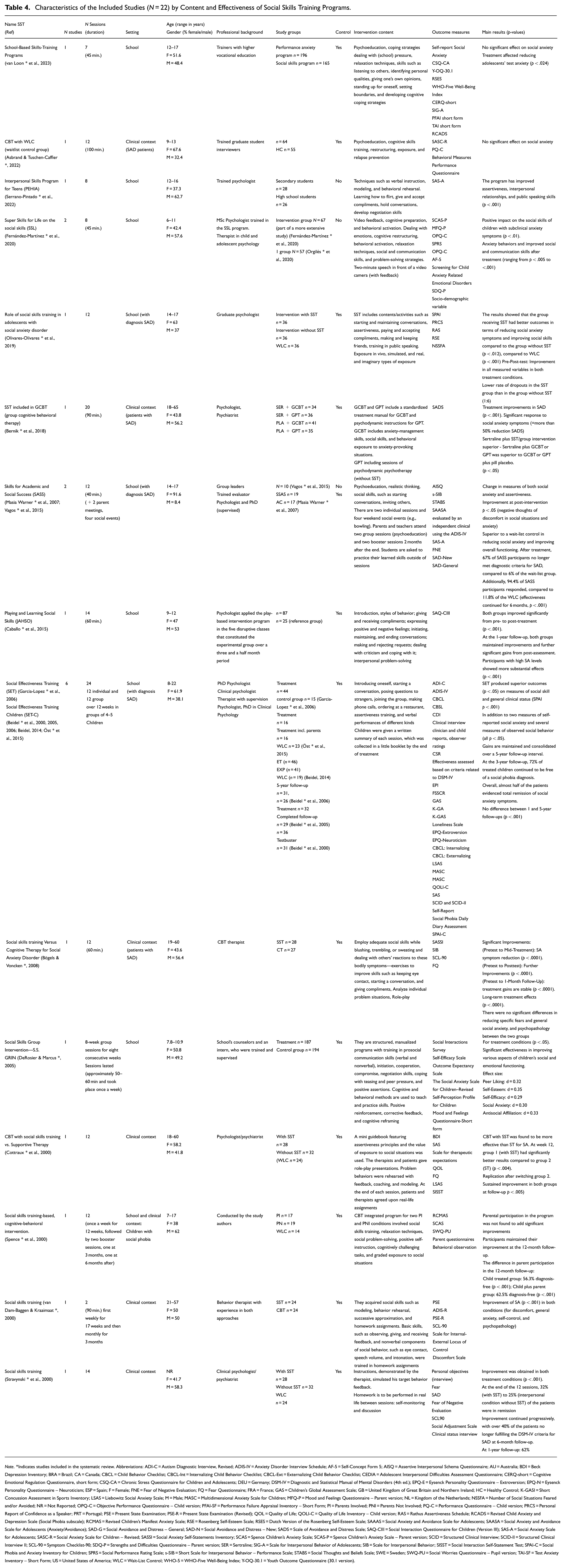
Note. *Indicates studies included in the systematic review. Abbreviations: ADI-C = Autism Diagnostic Interview, Revised; ADIS-IV = Anxiety Disorder Interview Schedule; AF-5 = Self-Concept Form 5; AISQ = Assertive Interpersonal Schema Questionnaire; AU = Australia; BDI = Beck Depression Inventory; BRA = Brazil; CA = Canada; CBCL = Child Behavior Checklist; CBCL-Int = Internalizing Child Behavior Checklist; CBCL-Ext = Externalizing Child Behavior Checklist; CEDIA = Adolescent Interpersonal Difficulties Assessment Questionnaire; CERQ-short = Cognitive Emotional Regulation Questionnaire, short form; CSQ-CA = Chronic Stress Questionnaire for Children and Adolescents; DEU = Germany; DSM-IV = Diagnostic and Statistical Manual of Mental Disorders (4th ed.); EPQ-E = Eysenck Personality Questionnaire – Extroversion; EPQ-N = Eysenck Personality Questionnaire – Neuroticism; ESP = Spain; F = Female; FNE = Fear of Negative Evaluation; FQ = Fear Questionnaire; FRA = France; GAS = Children’s Global Assessment Scale; GB = United Kingdom of Great Britain and Northern Ireland; HC = Healthy Control; K-GASI = Short Concussion Assessment in Sports Inventory; LSAS = Liebowitz Social Anxiety Scale; M = Male; MASC = Multidimensional Anxiety Scale for Children; MFQ-P = Mood and Feelings Questionnaire – Parent version; NL = Kingdom of the Netherlands; NSSFA = Number of Social Situations Feared and/or Avoided; NR = Not Reported; OPQ-C = Objective Performance Questionnaire – Child version; PFAI-SF = Performance Failure Appraisal Inventory – Short Form; PI = Parents Involved; PNI = Parents Not Involved; PQ-C = Performance Questionnaire – Child version; PRCS = Personal Report of Confidence as a Speaker; PRT = Portugal; PSE = Present State Examination; PSE-R = Present State Examination (Revised); QOL = Quality of Life; QOLI-C = Quality of Life Inventory – Child version; RAS = Rathus Assertiveness Schedule; RCADS = Revised Child Anxiety and Depression Scale (Social Phobia subscale); RCMAS = Revised Children’s Manifest Anxiety Scale; RSE = Rosenberg Self-Esteem Scale; RSES = Dutch Version of the Rosenberg Self-Esteem Scale; SAAAS = Social Anxiety and Avoidance Scale for Adolescents; SAASA = Social Anxiety and Avoidance Scale for Adolescents (Anxiety/Avoidance); SAD-G = Social Avoidance and Distress – General; SAD-N = Social Avoidance and Distress – New; SADS = Scale of Avoidance and Distress Scale; SAQ-CIII = Social Interaction Questionnaire for Children (Version III); SAS-A = Social Anxiety Scale for Adolescents; SASC-R = Social Anxiety Scale for Children – Revised; SASSI = Social Anxiety Self-Statements Inventory; SCAS = Spence Children’s Anxiety Scale; SCAS-P = Spence Children’s Anxiety Scale – Parent version; SCID = Structured Clinical Interview; SCID-II = Structured Clinical Interview II; SCL-90 = Symptom Checklist-90; SDQ-P = Strengths and Difficulties Questionnaire – Parent version; SER = Sertraline; SIG-A = Scale for Interpersonal Behavior of Adolescents; SIB = Scale for Interpersonal Behavior; SISST = Social Interaction Self-Statement Test; SPAI-C = Social Phobia and Anxiety Inventory for Children; SPRS = Social Performance Rating Scale; s-SIB = Short Scale for Interpersonal Behavior – Performance Scale; STABS = Social Thoughts and Beliefs Scale; SWE = Sweden; SWQ-PU = Social Worries Questionnaire – Pupil version; TAI-SF = Test Anxiety Inventory – Short Form; US = United States of America; WLC = Wait-List Control; WHO-5 = WHO-Five Well-Being Index; Y-OQ-30.1 = Youth Outcome Questionnaire (30.1 version).
Settings and Age Groups Utilizing SST
SST Duration as appeared in Table 4, the duration of the Intervention sessions ranged between 7 and 24 (45–100 min each). SST is usually used in a school or a clinical context; in our review, we found SST n = 5 (+2 follow-up) in a school context and n = 7 in a clinical context (with patients with SAD) (Beidel * et al., 2014).
Therapist/trainer: Generally, the training was conducted by psychologists (n = 10) or PhD psychologists or therapists (each mentioned three times). Other professionals, such as psychiatrists, group leaders, trained evaluators, trainers, and trained graduate student interviewers (supervised) were mentioned once each. In some studies, the authors or experienced colleagues supervised the trainer/psychologist. However, the studies could have provided more detailed information on how the professionals delivering the SST were supported by supervision, for example, if they encountered difficulties with the group or with some participants.
Instruments: The following questionnaires were used for symptom screening and assessment: Five times SPAI-C (Social Phobia and Anxiety Inventory for Children) (Beidel * et al., 2000, 2005, 2006, 2014; Garcia-Lopez * et al., 2006; Öst * et al., 2015), four times SAS (Social Anxiety Scale) (Beidel * et al., 2006; Cottraux * et al., 2000; Masia Warner * et al., 2007; Serrano-Pintado * et al., 2022), three times CDI (Children’s Depression Inventory) (Beidel * et al., 2000, 2005; Öst * et al., 2015), ADIS-IV (Anxiety Disorders Interview Schedule for DSM-IV) (Beidel * et al., 2006; Vagos * et al., 2015; van Dam-Baggen & Kraaimaat *, 2000), SCL-90 (Symptom Checklist-90) (Bögels & Voncken *, 2008; Stravynski * et al., 2000; van Dam-Baggen & Kraaimaat *, 2000), and two times MASC (Multidimensional Anxiety Scale for Children) (Beidel * et al., 2006; Öst * et al., 2015) and CBCL (Child Behavior Checklist) (Beidel * et al., 2000, 2005). All these scales are self-reported except the CBCL (parent report).
Effectiveness of SST
SST reduced social anxiety statistically significantly (Beidel * et al., 2014; Bernik * et al., 2018; Bögels & Voncken *, 2008; Caballo * et al., 2015; Cottraux * et al., 2000; DeRosier & Marcus *, 2005; Masia Warner * et al., 2007; Orgilés * et al., 2020; Öst * et al., 2015; Serrano-Pintado * et al., 2022; Spence * et al., 2000; Stravynski * et al., 2000; Vagos * et al., 2015; van Dam-Baggen & Kraaimaat *, 2000). These reductions were maintained over follow-up periods ranging from 6 months to 5 years, and the percentage of participants retaining a diagnosis of SAD was significantly reduced (Beidel * et al., 2000, 2005, 2006). Participants in SST intervention groups had significantly better outcomes at follow-up than waitlist/control groups, demonstrating the superiority of SST. However, two of the included studies showed no effect of SST on social anxiety scores (Asbrand & Tuschen-Caffier *, 2022; van Loon * et al., 2023).
In more detail, in one study, 67% of participants no longer met diagnostic criteria for SAD after treatment, compared with 6% in the waitlist group, and the treatment response rates of 94.4% versus 11.8% further underscore the success of SST over the waitlist/control groups (Masia Warner * et al., 2007). Additionally, programs such as Social Effectiveness Training for Children (SET-C) showed that 72% of children/adolescents were free of a diagnosis of SAD 3 years after treatment, with the majority of post-treatment gains maintained (Beidel * et al., 2005). Significant social anxiety reduction was observed, defined as a more than 50% reduction on the Scale of Avoidance and Distress Scale (SADS), which indicated that fear situations are less avoided (Bernik * et al., 2018). So, it seems that participants were able to increase their capacity to confront possible feared situations. Participants with high social anxiety levels at the start of treatment seemed to experience more pronounced effects from treatments, experiencing more substantial improvements and a larger number of diagnosis-free statuses compared to those with everyday anxiety problems (Caballo * et al., 2015).
Similarly, SST improved assertiveness, interpersonal relationships, and public speaking skills, particularly in children with subclinical anxiety symptoms (Garcia-Lopez * et al., 2006; Masia Warner * et al., 2007; Serrano-Pintado * et al., 2022). Additionally, another program reduced anxiety behaviors and improved social and communication skills, particularly in children with subclinical anxiety symptoms (Asbrand & Tuschen-Caffier *, 2022; Serrano-Pintado * et al., 2022). One program improved peer liking, self-esteem, and self-efficacy while reducing social anxiety and antisocial affiliations (DeRosier & Marcus *, 2005). Post-intervention changes were statistically significant for negative thoughts in social situations and anxiety during new social interactions (Vagos * et al., 2015).
Additionally, the implication of SST in the treatment is associated with a lower dropout rate from the training (Bernik * et al., 2018; Bögels & Voncken *, 2008; Cottraux * et al., 2000; Olivares-Olivares * et al., 2019). In general, whether or not the parents participate in the training or receive psychoeducation seems not to affect the outcome for children (Beidel * et al., 2005; Caballo * et al., 2015; Cottraux * et al., 2000; DeRosier & Marcus *, 2005). Conversely, the involvement of the parents of the children in the follow-up assessment indicates a significant advantage regarding the results, and further improvements (post-treatment) were observed in this group (Öst * et al., 2015).
The combination of SST with antidepressant medication (sertraline) proved superior to SST with placebo, suggesting that pharmacotherapy can support the therapeutic effect (Bernik * et al., 2018). It seems that the additional use of sertraline potentiated the impact of group treatment with SST by enhancing the acquisition of social skills (Bernik * et al., 2018). An interpersonal treatment with SST showed faster effects and improvement initially. This trend leveled off later and significantly improved at follow-up assessment (12 months after treatment) (Stravynski * et al., 2000). The results are consistent with findings in adult and preadolescent children, suggesting that SST can help patients with SAD learn prosocial behaviors that they often lack (Beidel * et al., 2014; Herbert et al., 2005).
Discussion
This systematic review found variations in SST’s content, number, and duration of sessions, and efficacy in clinical and school contexts. SST is used most in clinical and school contexts, targeting diverse age groups, from children to older adults. Some SSTs involve individual sessions, during which participants are encouraged to utilize their newly acquired skills in real-life situations (Beidel * et al., 2000).
Several studies included in our review reported that SST has a clinically and statistically significant impact on SAD and anxiety symptoms (Beidel * et al., 2000; Bernik * et al., 2018; Caballo * et al., 2015; DeRosier & Marcus *, 2005; Garcia-Lopez * et al., 2006; Masia Warner * et al., 2007; Öst * et al., 2015; Vagos * et al., 2015). Long-term follow-ups have indicated that these benefits are sustained and durable (Beidel * et al., 2005, 2006; Spence * et al., 2000). This finding suggests that SST has a lasting impact on social anxiety symptoms, with participants continuing to apply and improve their learning after the treatment (Olivares-Olivares * et al., 2019). This aligns with the literature, which emphasizes exposure and SST as elements considered efficient (Diaz-Castela, 2023). The effects of SST, which may underlie the changes in cognitions and behaviors, are rooted in social learning through modeling and role-playing (De Mooij et al., 2020).
Additionally, long-term effects were reported to be better in children when parents were involved in the training (Spence * et al., 2000). This indicates that SST can provide long-lasting enhancements in social skills and anxiety reduction, with parents presumably playing a crucial role in integrating the learned skills into daily life and better understanding their child’s social difficulties. One possible interpretation of these findings is that parents are additionally sensitized to the issue, feel less helpless, and can (also indirectly) support their children in continuing to use what they have learned.
Our findings indicate that SST is more effective when used with individuals suffering from severe social anxiety problems (Caballo * et al., 2015). In one study, the SST effect was more pronounced in males (Orgilés * et al., 2020). Nevertheless, some studies showed CBT results equal to or better than SST (Bernik * et al., 2018; Bögels & Voncken *, 2008; Cottraux * et al., 2000). Likewise, we found two studies in our review that showed no significant effect of SST in reducing social anxiety symptoms (Asbrand & Tuschen-Caffier *, 2022; van Loon * et al., 2023). One study showed reduced social performance in front of others but no effect on social anxiety in general (van Loon * et al., 2023). Performing in front of others is also one of the possible symptoms of social anxiety. The authors suggested that the training was probably too broad and not intensive enough to explain the lack of effect on social anxiety (van Loon * et al., 2023). Another reason might be that the group setting is only optimal for some individuals. Of course, there are differences in how individuals respond to treatment (De Mooij et al., 2020).
While some programs in our review were overseen by experienced practitioners and accompanied by written instructions, this was not a consistent feature. The lack of consistent supervision and a control group in some included studies may impact the interventions’ validity. It would also be desirable if more information were provided about the supervision and how the trainers were supported in the event of any challenges. For example, this may be important when the teacher/trainer feels overwhelmed. As the factor “relation” or the “working alliance” is one of the most important in psychotherapeutic treatment (independent of the theoretical background) (Flückiger et al., 2018), good support from the supervisor seems very important, especially if there is a difficult situation to manage. Therefore, standardized training protocols and supervision guidelines seem essential to enhance the reliability and reproducibility of SST programs, a key area for future research and development in the field.
Peer generalization, often used in SST, can be problematic in the clinical setting. Programs can replace it with virtual applications, which may also improve homework or real-life application compliance. However, personal contact is a critical issue of SAD, so in-person practice may also be essential. Contact and interaction with others can help deal with challenging emotions (Porges, 2022).
Implications for Clinical Practice
SST seems to be particularly effective in cases of severe social anxiety symptoms. The reduced symptoms could be maintained or even decreased over time. One explanation is that the participants are exposed to stimuli that cause anxiety in the group session, so they must face the feared situation, and habituation can happen (Cordier et al., 2021). Patients can thus check and refute their irrational fears and have new, corrective experiences (Hoyer & Lueken, 2021). A fear-inhibiting memory trace can be established (Hoyer & Lueken, 2021). Ideally, this can lead to the person experiencing more self-efficacy, and corrective experience can contribute to a different way of dealing with their social difficulties and challenges. SST is based on the view that avoidance prevents the development of appropriate skills for various social situations and extinguishes feared situations (Beidel et al., 1999). Thus, practicing social behavior in small groups, as in the SST setting, should be included when treating SAD.
In addition, elements learned during SST, such as making eye contact, expressing needs, conversing, etc., can be continued and practiced in everyday life during and after training. One study has shown that SST can be an effective intervention for improving test anxiety or fear of failure (van Loon * et al., 2023). Even though this study could not prove that it reduced social anxiety in general, it did show an improvement in test anxiety, a difficulty often associated with SAD. Feared performance situations may be avoided, and people may be less able to realize their potential.
Although SST seems to be most effective for high-severity levels of social anxiety (Caballo * et al., 2015), we advise verifying the use of such training also in persons with less severe symptoms to prevent a further increase in symptoms (Orgilés * et al., 2020). However, in case of low symptoms, the persons may have many possibilities in daily life to practice the elements mentioned, and, in some cases, such a program will not be necessary.
While parental participation did not significantly enhance outcome measures after the training, it may still provide additional support and reinforcement of skills in the long term. This result suggests that parental involvement can be beneficial as a critical component for some adolescents and children, depending on the individual family dynamics and the specific needs of the child/adolescent. In line with our findings, a recent umbrella review, which investigated practical components in general for treating SAD in children and adolescents, concluded that SST is an essential and practical treatment element (Diaz-Castela, 2023).
Strengths and Limitations
Missing group/waitlist control groups for several trials make it challenging to conclude reliable effectiveness. Most trials (n = 7) were carried out in the US. It is, therefore, inadvisable to generalize the results to all geographical contexts, as cultural aspects and how such programs are integrated (e.g., co-financing by health insurance companies, etc.) vary considerably by country. The heterogeneity of the included studies must also be considered. Several studies rely on self-reported measures of social anxiety and observer ratings, which might introduce observer bias (Beidel * et al., 2006). Additionally, variation across variables such as the severity of symptoms and participants’ characteristics may limit the findings’ validity and generalizability. These factors would ideally be considered within the framework of a full risk adjustment. However, given the heterogeneity of the included studies in terms of design, populations, interventions, and outcome measures, a statistical meta-analysis was not feasible. Therefore, a narrative synthesis was conducted to allow for a systematic and meaningful integration of the diverse findings. While this constitutes a methodological limitation, as it reduces the potential for quantitative comparison, it also enabled us to identify important contextual insights and patterns across the evidence.
A strength of this review is the inclusion of studies conducted over the last 23 years, using various methods to answer the study question. Our analysis provided a comprehensive overview of the evaluation of SST. Furthermore, the significance of our findings is emphasized by the extensive participation of over 2100 study participants across a vast age range (6–78 years) in all included studies. In addition, more than one researcher independently performed title and abstract screening, full-text screening, data extraction, and quality assessment, which is another strength of the present study.
Conclusion
In conclusion, SST is generally effective for people with severe SAD across different age groups. Parents’ involvement can improve the long-term effectiveness of the treatment process. Combining SST with pharmacotherapy also leads to better outcomes. However, further research is needed to improve methodological rigor, standardize training protocols, and ensure adequate supervision. Research into virtual SST may add to the evidence, although personal interaction remains crucial due to the nature of SAD. Finally, the human element in SST is essential to facilitate corrective experiences, and small group exercises should be incorporated into treatment, especially for severe cases.
Footnotes
Appendix 1
Appendix 2
Original Studies: Methodological Quality
Acknowledgements
Not applicable.
Abbreviations
ADIS-IV Anxiety Disorders Interview Schedule for DSM-IV
CBCL Child Behavior Checklist)
CBT Cognitive Behavioral Therapy
CDI Children’s Depression Inventory
CT Cognitive Therapy
ICD-11 International Statistical Classification of Diseases and Related Health Problems, rev. 11
JAHSO Playing and Learning Social Skills
MASC Multidimensional Anxiety Scale for Children
PEHIA Interpersonal Skills Program for Teens
QuADS Quality Assessment with Diverse Studies
S. S.GRIN Social Skills Group Intervention
SAD Social anxiety disorder
SADS Scale of Avoidance and Distress Scale
SAS Social Anxiety Scale
SASS Skills for Academic and Social Success
SCL-90 Symptom Checklist-90
SET Social Effectiveness Training
SET-C Social Effectiveness Training for Children
SPAI-C Social Phobia and Anxiety Inventory for Children
SSL Super Skills for Life on Social Skills
SST Social Skills Training
WLC Waitlist control group

Ethical Considerations
An ethical statement is not required for this article.
Author Contributions
IH, CB, PH, SPS, and GM contributed to the design of the review. IH searched the literature, CB, PH, and SPS double-screened all the references, IH extracted the data, and CB, PH, and SPS double-checked the data extraction. IH, CB, PH, and SPS assessed the quality of the included studies. IH wrote the first draft of the manuscript and prepared figures and tables, to which all authors provided feedback. All authors read and approved the final version of the manuscript.
Funding
The authors received no financial support for the research, authorship, and/or publication of this article. Open access publication fees were covered by the University of Lucerne.
Declaration of Conflicting Interests
The authors declared no potential conflicts of interest with respect to the research, authorship, and/or publication of this article.
Data Availability Statement
Data sharing not applicable to this article as no datasets were generated or analyzed during the current study.