




Abstract
Self-regulated language learning (SRLL) plays a crucial role in the language development of Chinese college English as a Foreign Language (EFL) learners. This study presents a systematic literature review aimed at identifying the key variables associated with SRLL among Chinese college EFL learners. By conducting an extensive search of the Web of Science and Scopus databases, 88 relevant research articles were analyzed to gain insights into the effectiveness of SRLL in this context. Through a meticulous analysis of the target articles, this review uncovers the essential variables that shape the landscape of SRLL in the context of China’s tertiary education. To examine the interrelationship among these variables, this study utilized Partial Least Squares Structural Equation Modeling (PLS-SEM) for a comprehensive quantitative analysis. PLS-SEM enables a robust examination of multiple variables simultaneously, making it an ideal statistical technique for analyzing the complex dynamics of SRLL. By identifying the crucial factors that drive the SRLL process, researchers and educators can develop targeted interventions to enhance language learning outcomes among Chinese college EFL learners. Moreover, this research will shed light on the existing gaps in the literature and pave the way for future investigations in areas such as technology-assisted learning, individual differences, and the relationship between self-regulation and language proficiency. By unraveling the complexities of SRLL among Chinese college EFL learners, this study strives to empower educators and researchers with valuable insights to foster successful language acquisition and proficiency.
Plain Language Summary
This research explores how Chinese college students learning English on their own can improve their language skills. We looked at 88 research articles to understand what helps these students study better. Our study finds important things that affect how students learn, like their habits and methods. We used a special analysis method to study all these factors together. By understanding what drives self-regulated learning, teachers and researchers can create better ways to help Chinese students learn English. Our study also shows where more research is needed, like using technology in learning and how different students learn differently. We hope this research helps teachers and researchers support Chinese students in learning English more effectively.
Keywords
Introduction
Self-regulated language learning is a critical factor in the language development and proficiency of Chinese college English as a Foreign Language (EFL) learners (An et al., 2021). It encompasses learners’ ability to actively monitor, control, and regulate their learning process, making informed decisions about their language learning strategies, and taking ownership of their progress (D. Zhang & Zhang, 2019). As the field of foreign language education continues to evolve, understanding the factors that influence self-regulated language learning becomes essential for designing effective instructional approaches and interventions (Teng, 2022).
Self-regulated language learning has gained significant attention in the field of language education, as it is considered a vital skill for learners to effectively engage in language learning activities and achieve successful language acquisition (Bai et al., 2020). Among Chinese college EFL learners, SRLL plays a crucial role in their language development and proficiency (R. Zhang & Zou, 2022). However, Chinese college EFL learners have encountered specific challenges in their language learning journey, which highlighted the importance of self-regulated learning (SRL) to enhance their ability to autonomous learning. To be specific, they are often required to acquire a high level of English proficiency for academic and professional purposes in this competitive environment (Qiu & Fang, 2019). In this increasingly globalized world, proficiency in English is highly valued and provides opportunities for career advancement and academic success (Yang et al., 2022). Mastery of SRL competence enables them to identify and target specific language weaknesses, break free from rigid educational systems, and cultivate autonomy over their learning. It also helps them manage their time effectively amidst demanding schedules, fosters cultural sensitivity, and equips them with lifelong skills for career development. Furthermore, SRL enables adaptability to evolving language needs, ensuring that Chinese EFL learners remain proficient and competitive in an ever-changing globalized world of English communication. Therefore, equipping Chinese college EFL learners with SRLL skills is not only beneficial for their language development but also enhances their competitiveness in the global job market (Li et al., 2023).
Moreover, according to previous studies, SRLL has been associated with positive outcomes such as increased motivation (R. Zhang et al., 2020), engagement (Zhou & Hiver, 2022), and metacognitive awareness (Chon & Shin, 2019). By actively monitoring their learning progress, setting goals, and employing effective language learning strategies, Chinese college EFL learners can enhance their language proficiency and develop a lifelong learning mindset (Xu et al., 2022). This empowers them to continue improving their language skills beyond the formal educational setting and adapt to the demands of the ever-evolving linguistic landscape (Kang, 2022).
Understanding the background and significance of self-regulated language learning among Chinese college EFL learners provides a foundation for designing effective instructional approaches and interventions (Teng & Zhang, 2020). By incorporating self-regulation principles into language teaching methodologies, educators can foster a learner-centered environment that promotes autonomy, self-efficacy, and active engagement. This, in turn, can lead to improved language learning outcomes and increased learner satisfaction (Y. Zhang et al., 2022)
While there is a substantial body of research on language learning strategies and the importance of self-regulation in language learning, there remains a significant research gap concerning the specific dynamics of self-regulated language learning among Chinese college EFL learners. Existing studies often provide a broad overview of self-regulated learning or focus on learners from diverse linguistic backgrounds. However, the distinct sociocultural and educational context of Chinese college EFL learners, characterized by the influence of Confucian traditions, the Gaokao (college entrance exam), and the dominance of teacher-centered instruction, creates unique challenges and opportunities for self-regulated language learning that warrant in-depth investigation (Ping et al., 2014).
Based on the above-mentioned, the primary objective of this research paper is to explore the variables that might influence the effectiveness of SRLL among Chinese college EFL learners. By conducting a systematic literature review and PLS-SEM analysis, this study aims to identify the key factors that shape the landscape of SRLL in the Chinese EFL learning realm. Understanding these variables would provide valuable insights into the dynamics of SRLL and its impact on language acquisition and proficiency among Chinese college EFL learners.
By exploring the variables associated with self-regulated language learning among Chinese college EFL learners, this research aims to contribute to the field of language education and provide empirical evidence to inform effective instructional practices and interventions. The findings of this study will enhance our understanding of self-regulated language learning processes and provide valuable insights for researchers, educators, and policymakers seeking to promote successful language acquisition and proficiency among Chinese college EFL learners.
Literature Review
Definition and Theoretical Foundations of Self-Regulated Language Learning
Self-regulated language learning refers to the process in which learners take control of their own language learning activities, monitor their progress, and regulate their learning behaviors to achieve desired language learning outcomes. It involves learners setting goals, planning their learning strategies, monitoring their progress, and reflecting on their learning experiences (Yoon et al., 2021). SRLL is an active and dynamic process that empowers learners to become autonomous and independent in their language learning process (Kumar et al., 2023).
The theoretical foundations of SRL draw upon several models and frameworks that provide insights into the cognitive, metacognitive, and affective processes involved in this learning approach (Şahin Kızıl & Savran, 2018; Su et al., 2018). To begin with, drawing from the principles of Social Cognitive Theory (SCT) provided by Bandura (1986), SRL recognizes the significance of observational learning and the cultivation of self-efficacy. Chinese EFL learners, for instance, observe English language usage in their social environment and gradually develop a belief in their ability to conquer the challenges of mastering a new language. This burgeoning self-efficacy serves as a motivational catalyst, prompting learners to engage in SRL practices like setting specific language acquisition goals and meticulously monitoring their progress. By doing so, they actively bolster their language skills, thereby advancing their language learning procedures. Originating from SCT, Zimmerman (2000) proposed one of the most prominent models in this field, the cyclical phase model, which outlines the cyclical nature of SRL and considers it a dynamic interplay involving individual, behavioral, and environmental elements. This model emphasizes the importance of learners’ metacognitive awareness and self-control in driving their learning behaviors (Chen et al., 2023).
Furthermore, cognitive constructivism has assumed a pivotal role in understanding how SRL operates. Within the framework of SRLL, learners become architects of their own language proficiency by taking an active role in constructing knowledge. This constructivist perspective entails learners setting clear linguistic objectives, vigilantly monitoring their progress, and flexibly adapting their language learning strategies in response to the evolving nature of their language skills. Just as a builder adjusts their construction plans based on the progress of a structure, learners fine-tune their language learning methods to ensure that they are effective and aligned with their evolving linguistic needs. This dynamic, self-guided approach is central to the successful procedure of self-regulated language learners, including Chinese EFL students, as they navigate the intricacies of English language acquisition. By considering these theoretical foundations, this study aims to provide a comprehensive overview of SRLL and its underlying constructs and serve as a foundation for the empirical analysis and interpretation of the research findings.
Self-Regulated Language Learning Among Chinese College EFL Learners
Previous studies have extensively investigated the effectiveness of SRLL among Chinese college learners (e.g., Shen et al., 2023; Y. Zhang et al., 2016, 2022). These research endeavors have provided valuable insights into the factors that affect SRLL and how they influence language learning achievements within this particular context. An examination of existing literature indicates that self-efficacy beliefs have a substantial impact on the way Chinese college EFL learners approach self-regulated language learning (Teng, 2021). Investigations have uncovered that learners who possess stronger self-efficacy are inclined to employ more efficient learning strategies, establish ambitious learning objectives, and demonstrate greater perseverance in their language learning pursuits. Meanwhile, self-efficacy itself is shaped by an array of elements, encompassing learners’ prior language learning experiences, their perception of their own competence, and the level of social support they receive. Furthermore, research has explored the relationship between SRL strategies and language proficiency among Chinese college EFL learners. It has been observed that learners who employ effective SRL strategies, such as goal setting, planning, and self-monitoring, tend to achieve higher language proficiency levels. These strategies enable learners to take control of their learning process and adapt their approach based on their individual needs and preferences (Su et al., 2019). Despite the significant body of research on SRLL among Chinese college EFL learners, there are still gaps and limitations that need to be addressed. A systematic literature review should be conducted to explore the dynamic characteristics and the interrelationship among the variables of the SRLL process in China’s tertiary education, which is scant in the current literacy (Shen & Bai, 2022).
Methodology
Systematic Literature Review Process
Procedure
In this study, the researchers utilized the methodology outlined by Petticrew and Roberts (2008) to conduct a systematic literature review, a well-established and frequently employed approach in the realm of social science research to explore the phenomenon of SRLL among Chinese college EFL learners. A systematic literature review is a rigorous and comprehensive method that aims to identify, analyze, and synthesize existing research studies on a specific topic (Snyder, 2019). This approach ensures a thorough examination of the available literature and provides a reliable basis for drawing conclusions and making informed recommendations.
In accordance with the framework delineated by Petticrew and Roberts (2008), the current research endeavor encompassed seven distinct stages. These stages encompassed the formulation of research inquiries or hypotheses, determination of the categories of studies to be incorporated, the execution of an exhaustive exploration of the existing literature, meticulous screening of the search outcomes, critical appraisal of the studies that aligned with the predefined inclusion criteria, synthesis of the acquired findings, and an evaluation of the heterogeneity among the studies that met the criteria for inclusion. In the present study, the research questions were derived and validated through a systematic literature review concerning the factors linked to SRLL among Chinese college EFL learners.
RQ1: What are the key variables associated with self-regulated language learning among Chinese college EFL learners?
RQ2: How do these variables interact and influence the outcomes of the self-regulated language learning process?
Search Criteria
The inclusion criteria for this systematic literature review encompass studies directly addressing SRLL among Chinese college EFL learners, regardless of age or proficiency level. Peer-reviewed journal articles published in English within the last ten years are considered. Research of various designs, including quantitative, qualitative, and mixed methods, that investigate factors influencing SRLL would be considered. Conversely, the exclusion criteria entail the omission of irrelevant studies, including dissertations, theses, book chapters, and non-peer-reviewed sources, as well as studies involving participants beyond the specified population or employing inadequate research methodology or lacking relevant variables. These criteria ensure the systematic review’s alignment with research objectives and the maintenance of rigor throughout the review process.
Search and Screening
The chosen databases for this review are the Web of Science and Scopus. The selection of the two databases for this review is highly justified due to their comprehensive coverage, multidisciplinary approach, emphasis on quality and relevance, and the availability of bibliometric tools. Additionally, the use of these databases enhances the credibility of the review’s findings and facilitates the identification of key authors, influential works, and emerging trends within the field, thereby enriching the overall quality and impact of the research. The study identified the key concepts relevant to its research objectives. To enhance the effectiveness of the search process, the research team identified pertinent search terms, encompassing synonyms and alternative spellings that had been employed in prior studies on the topic.
The screening process, covering stages 4 to 7, proceeded as follows. The initial search query yielded a total of 231 articles relevant to the research topic. Among these, 105 were located in Web of Science and 126 in Scopus. In the fourth stage, an in-depth screening process was conducted, applying the specific inclusion and exclusion criteria outlined above. As a result, 137 articles fulfilled these criteria and were deemed eligible for further comprehensive analysis and inclusion in the review. During the fifth stage, a thorough evaluation of the articles was performed by the researchers, focusing on their titles, abstracts, keywords, and alignment with the established inclusion criteria. This rigorous assessment led to the identification of 107 articles that warranted further thorough analysis. Subsequently, in the sixth stage, the researchers synthesized the findings derived from these selected articles. Finally, in the seventh stage, an assessment of the heterogeneity among the chosen articles was undertaken. This comprehensive process ultimately resulted in a final set of 88 articles that remained for further scrutiny and examination. The entire process of conducting searches and conducting screenings has been visually represented in Figure 1.

Searching and screening procedures.
Partial Least Squares Structural Equation Modeling Phase
After conducting a systematic literature review, Partial Least Squares Structural Equation Modeling (PLS-SEM) was chosen as the statistical analysis technique to explore the interrelationship among the key variables in the SRLL process. The data was cleaned and analyzed through using Smart PLS and the subsequent sections would explain the SMART PLS results. PLS-SEM is particularly suitable for exploring complex relationships among variables, as it does not rely on strict distributional assumptions and can handle small sample sizes effectively (Hair et al., 2021). This technique allows for the examination of multiple variables simultaneously, enabling a comprehensive analysis of the interrelationship among SRLL variables.
Data Collection
Before commencing the research, the researchers obtained consent and secured the necessary approval letters to ensure access to the research site. The research site is a public college situated in the central province of China. Toward the conclusion of the 2022/2023 academic year semester, questionnaires were distributed to students in the fifth and seventh semesters. A total of 230 eligible students who came from the English education major, the Faculty of Education, received and completed the related questionnaires.
Instruments
The instruments comprised two sections, which included a cluster of questionnaires and a standardized test. The questionnaires consisted of three sections. Section 1: Motivated Strategies for Learning Questionnaire (MSLQ) was developed by Pintrich and De Groot (1990). In the current study, MSLQ was employed to gauge students’ self-perceived motivational beliefs and self-regulated learning (SRL) strategies. Section 2: Student Conceptions of Feedback Questionnaire-III (Irving & Peterson, 2007) was employed to assess students’ perceptions of feedback. Section 3: Engagement in Learning English. The questionnaire used in this study was adapted from a survey originally developed by M. T. Wang et al. (2016) to assess students’ engagement in mathematics and science. In the present study, the College English Test (CET) was utilized as a standardized test to evaluate the language performance of the participants. CET is a national standardized test that evaluates the English proficiency of university non-majors in the four language skills: listening, speaking, reading, and writing in China. CET scores are universally recognized across the country as the standardized assessment of college students’ English language level (Huang, 2022).
Results and Discussion
RQ1: What Are the Key Variables Associated With Self-Regulated Language Learning Among Chinese College EFL Learners?
Through the in-depth analysis of these articles, several key variables related to the dynamic trait of the SRLL process in the EFL realm have been elicited in the literature.
Self-Efficacy
In the EFL domain, self-efficacy refers to learners’ beliefs in their ability to successfully perform language learning tasks. Following a comprehensive systematic literature review, it becomes evident that self-efficacy emerges as the pivotal variable in this context. The selected studies consistently highlighted the influential role of self-efficacy beliefs in shaping Chinese EFL learners’ language learning outcomes and experiences. These beliefs empower learners to take charge of their learning process, enhancing a sense of confidence and competence in their language acquisition endeavors. Higher self-efficacy is associated with increased language learning motivation, more effective learning strategies, and positive feedback, all of which contribute significantly to enhanced language proficiency. According to Gan et al. (2020), English language self-efficacy was found to exert a significant impact on both feedback behavior and feedback preference among Chinese university students. The results underscore the central position of self-efficacy in Chinese EFL learning and accentuate the imperative of recognizing and nurturing this key variable to promote successful language acquisition.
Motivation
The results have revealed that motivation serves as a crux in the SRLL process, as it significantly influences students’ engagement, persistence, and the effective utilization of self-regulation strategies. Chinese EFL learners, often facing challenges such as the complexity of the English language and external pressures, are deeply motivated by a myriad of factors including intrinsic interest, instrumental goals, and cultural influences. As Y. Zhang et al. (2016) illustrated intrinsic motivation had a distinct and positively significant impact on vocabulary knowledge and it also partially mediated the relationship.
Learning Strategies
The comprehensive synthesis of prior research illuminates that the efficacy of learning strategies, encompassing techniques such as metacognition, goal setting, self-monitoring, and language skill practice, plays a central role in shaping the language acquisition process among Chinese EFL learners. These strategies are found to significantly influence language proficiency development, with studies consistently highlighting their positive impact on students’ performance, motivation, and overall learning outcomes. For instance, Sun and Wang (2020) indicated that there is a statistically significant but modest correlation between proficiency and the utilization of SRL strategies in writing. Therefore, learning strategies stand out as a critical and influential variable that demands focused attention in both research and pedagogical practices, offering valuable insights into optimizing Chinese EFL education.
Engagement
Engagement refers to learners’ active involvement, interest, and emotional connection to language learning activities. It encompasses cognitive, behavioral, and emotional aspects of learning. Scholars emphasize that engaged learners actively participate in language activities, demonstrate sustained interest and motivation, and exhibit a genuine commitment to the learning process. High levels of engagement are associated with increased self-regulated language learning behaviors, such as concentration, effort, and participation (Yang & Zhang, 2023). As an illustration, Zhou and Hiver (2022) stated that student engagement was observed to have a significant and negative predictive effect on students’ propensity for procrastination in L2 writing tasks. Chinese college EFL learners who are highly engaged in their language learning tasks are more likely to exhibit effective self-regulation and achieve better language performance.
Feedback
Feedback plays a critical role in self-regulated language learning as it provides learners with information about their performance, progress, and areas for improvement. Research consistently indicates that well-structured and timely feedback, whether from teachers, peers, or technology-assisted systems, facilitates learners’ self-regulation, motivation, and language proficiency development. Furthermore, feedback appears to be closely intertwined with learners’ self-efficacy beliefs, affecting their confidence and willingness to engage in self-regulated language learning practices (Lu et al., 2022).
Understanding the relationships among these variables is crucial for developing effective interventions and instructional strategies that promote self-regulated language learning among Chinese college EFL learners (An et al., 2020; Shen & Bai, 2022; H. C. Wang & Chen, 2020). The identification of these key variables and their relationships will serve as a foundation for further analysis and interpretation in subsequent sections of the paper.
RQ2: How Do These Variables Interact and Influence the Outcomes of the Self-Regulated Language Learning Process?
The results from the Partial Least Squares Structural Equation Modeling (PLS-SEM) analysis were reported to address the RQ2, which allowed for a comprehensive examination of the relationships and influences among the variables associated with SRLL among Chinese college EFL learners. The PLS-SEM analysis involved the construction of a measurement model and a structural model. The measurement model will assess the reliability and validity of the measurement instruments used to capture the latent constructs. The structural model will examine the relationships between these constructs, exploring the direct and indirect effects of the independent and mediating variables on the dependent variable.
Measurement Model
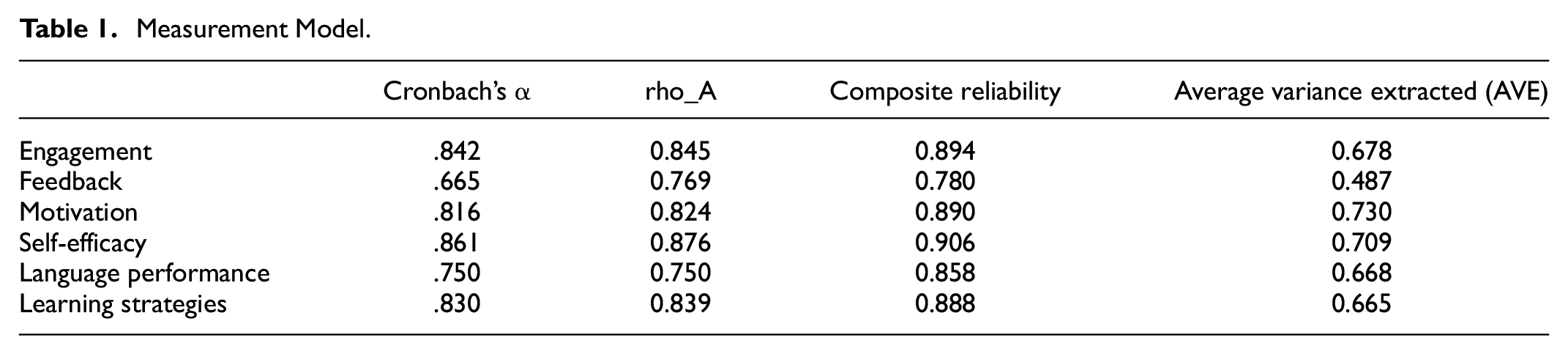
Following the evaluation criteria for the measurement model, the data collected for each outer model is subsequently analyzed in Table 1 and Figure 2 presented below. The reliability of the constructs, including Engagement, Feedback, Motivation, Self-efficacy, Language Performance, and Learning Strategies, has been rigorously assessed.
Measurement Model.

PLS-SEM measurement model.
The Cronbach’s Alpha values, ranging from .665 to .861, signify the internal consistency of these constructs. Higher values of Cronbach’s Alpha are indicative of stronger reliability, and in this study, all the constructs demonstrate acceptable levels of internal consistency. These findings instill confidence in the robustness of the measures used to assess these critical factors in self-regulated language learning within the context of EFL education.
In addition to Cronbach’s Alpha, another valuable measure of internal consistency, rho_A, has been employed in this study. Rho_A takes into account factor loadings and the communalities of the items and offers an alternative estimate of reliability. The noteworthy aspect here is that all the constructs exhibit rho_A values within the range of 0.769 to 0.876. These robust rho_A values emphasize the good reliability of the constructs, reinforcing the solidity of the measurement instruments used in this research. Composite Reliability Higher values of composite reliability indicate better internal consistency. In this case, all constructs have composite reliability values ranging from 0.780 to 0.906, suggesting good reliability.
Average Variance Extracted (AVE) assesses convergent validity, indicating the extent to which the observed variables measure the same underlying construct. Higher values of AVE indicate better convergent validity. In this case, all constructs have AVE values ranging from 0.487 to 0.730, suggesting moderate to good convergent validity.
Overall, the results of the SEM analysis measurement model indicate that the observed variables are reliable and valid measures of their respective latent constructs. The constructs show acceptable to good levels of internal consistency, suggesting that the measurement instruments used in the study are reliable. Additionally, the observed variables demonstrate convergent validity by capturing a substantial amount of variance in their corresponding constructs.
Structural Model
T-statistics and p-value on the SmartPLS output were employed to analyze the effects illustrated in Table 2. Effects are deemed significant at a 5% significance level when T-Statistics exceed 1.96 and p-values are less than .05. Conversely, if T-Statistics are lower or p-values are higher, the effects are considered insignificant. T statistics measure the magnitude of the estimated coefficients (Original Sample) relative to their standard errors (Standard Deviation). It indicates the significance of the path coefficients. Higher absolute T statistics values indicate more significant relationships. In this case, all the T statistics values are relatively large, ranging from 8.086 to 49.591, suggesting highly significant relationships between the constructs. p Values: p values represent the probability of obtaining the observed results by chance. They are used to assess the statistical significance of the path coefficients. In this table, all the p values are reported as .000, which means the relationships between the constructs are statistically significant at conventional levels.
Path Coefficients.

The PLS-SEM analysis revealed significant relationships among the independent, mediating, and dependent variables identified in the previous sections as illustrated in Figure 3. Self-efficacy was found to have a positive and significant impact on learning strategies, engagement, and motivation, indicating its crucial role in driving self-regulated language learning behaviors. Furthermore, learning strategies were found to mediate the relationship between self-efficacy and language performance, suggesting that learners’ strategic choices and actions play a key role in their language learning outcomes. It suggests that learners’ strategic choices and actions—such as their approaches to vocabulary acquisition or participation in language-related activities—significantly influence their ultimate language learning outcomes. This multi-faceted interplay of self-efficacy, learning strategies, and language performance not only enhances our understanding of self-regulated language learning but also points to potential pedagogical strategies for fostering effective language learning practices among Chinese college EFL learners.

PLS SEM structural model results.
The results also indicated that higher levels of engagement are strongly correlated with increased utilization of learning strategies and enhanced language performance. This suggests that when students are actively involved in the learning process, participating in language-related activities and assignments, they tend to employ more effective strategies and exhibit improved language proficiency. Additionally, motivation was found to be closely linked to heightened self-regulation and greater language proficiency. In essence, students with high motivation levels demonstrate a more proactive and self-regulated approach to language learning, resulting in enhanced language proficiency. The mediating variable, feedback, demonstrated its importance in the SRLL process, which indicated that when students receive constructive and valuable feedback on their language learning efforts, it bolsters their self-efficacy, motivates them to employ more effective strategies, actively engage in learning activities, and enhances their overall motivation. Consequently, these accumulated benefits led to improved language performance, highlighting the multi-dimensional role of feedback in shaping successful self-regulated language learning experiences. This finding emphasizes the need for educational institutions and instructors to prioritize the provision of high-quality feedback to support students’ language learning endeavors effectively. These findings have significant implications for language educators and policymakers. By understanding the factors that influence self-regulated language learning, educators can design instructional interventions and strategies that promote self-regulation and improve language learning outcomes. Additionally, policymakers can develop policies and frameworks that support the integration of SRLL practices in educational settings.
Implications
Practical Implications
The findings of this study have important practical implications for educators and language learning practitioners who work with Chinese college EFL learners. Understanding the variables associated with SRLL can inform instructional practices and interventions aimed at enhancing the language learning process.
Firstly, the identification of self-efficacy as a crucial independent variable emphasizes the importance of fostering learners’ belief in their own abilities. Educators can implement strategies to enhance self-efficacy by providing clear learning goals, offering positive reinforcement, and promoting a growth mindset. By addressing learners’ self-efficacy beliefs, instructors can empower students to take ownership of their language learning and adopt effective self-regulated learning strategies.
Secondly, the promotion of learning strategies, engagement, and motivation can significantly impact SRLL among Chinese college EFL learners. Educators can incorporate varied and interactive instructional approaches that encourage active participation, critical thinking, and learner autonomy. Creating a supportive and stimulating learning environment that promotes intrinsic motivation and fosters students’ engagement can contribute to their self-regulation and language learning outcomes.
Furthermore, the role of feedback as a mediating variable highlights the importance of providing timely and constructive feedback to students. Educators should strive to offer specific and actionable feedback that guides learners’ self-reflection and self-adjustment. Utilizing a variety of feedback sources, such as peer feedback, automated feedback, and teacher feedback, can facilitate students’ self-regulation and promote their language performance.
By implementing these practical implications, educators and language learning practitioners can effectively enhance self-regulated language learning among Chinese college EFL learners. This, in turn, can lead to improved language proficiency, increased learner autonomy, and a more sustainable approach to language education.
In conclusion, this study’s findings provide practical insights for educators and language learning practitioners working with Chinese college EFL learners. By addressing variables such as self-efficacy, learning strategies, engagement, motivation, and feedback, educators can create an optimal learning environment that promotes self-regulated language learning. Ultimately, these practical implications contribute to the development of effective instructional strategies and interventions that facilitate successful language acquisition and proficiency among Chinese college EFL learners.
Theoretical Implications
The findings of this study have significant theoretical implications for the field of SRLL. By examining the variables associated with self-regulated language learning among Chinese college EFL learners, this study contributes to the existing theories and models in the field.
Firstly, this research contributes to the theoretical understanding of SRLL in the context of Chinese higher education by validating and expanding existing models and frameworks. The identification of variables such as self-efficacy, learning strategies, engagement, motivation, and feedback supports and enhances the theoretical foundations of self-regulated language learning. It provides empirical evidence of the relationships and influences among these variables, adding to the body of knowledge in the field.
Furthermore, this study highlights the need for further research in specific areas to fill existing gaps in the literature. For instance, the relationship between technology-assisted learning and self-regulated language learning warrants further investigation, considering the growing influence of digital resources and online platforms in language education. Additionally, exploring individual differences and their impact on self-regulation and language proficiency can contribute to a more comprehensive understanding of self-regulated language learning among Chinese college EFL learners.
By identifying these gaps and areas for further research, this study encourages scholars and researchers to delve deeper into the complexities of self-regulated language learning. It provides a foundation for future investigations to expand theoretical frameworks, refine existing models, and explore new dimensions of self-regulation in language learning contexts.
In conclusion, this study’s theoretical implications contribute to the advancement of SRLL theories and models. By validating and expanding existing frameworks, as well as identifying gaps for further research, this research enhances the theoretical understanding of SRLL among Chinese college EFL learners. It provides a platform for future studies to build upon and expand the theoretical foundations, ultimately benefiting the field and informing future educational practices.
Conclusion
Summary of the Key Findings
This research aimed to explore self-regulated language learning among Chinese college English as a Foreign Language (EFL) learners. Through a systematic literature review and quantitative analysis using Partial Least Squares Structural Equation Modeling (PLS-SEM), several key findings emerged.
Firstly, the systematic literature review identified the variables associated with self-regulated language learning in the Chinese college EFL context. These variables included self-efficacy, learning strategies, engagement, motivation, feedback, and language performance. The quantitative analysis using PLS-SEM revealed the relationships and influences among these variables, providing a comprehensive understanding of the dynamics of self-regulated language learning among Chinese college EFL learners.
Contribution of the Study
This study makes several significant contributions to the field of self-regulated language learning. Firstly, it advances the theoretical understanding of self-regulated language learning by validating and expanding existing models and frameworks. The findings support and enhance the theoretical foundations of self-regulated language learning, contributing to the existing knowledge in the field.
Secondly, this research provides empirical evidence of the variables influencing self-regulated language learning among Chinese college EFL learners. By identifying the key variables, such as self-efficacy, learning strategies, engagement, motivation, feedback, and language performance, this study offers valuable insights into the factors that drive successful language learning in this context.
Moreover, this study contributes to sustainable language education practices by providing empirical evidence to design effective interventions and instructional strategies. By identifying the crucial factors that shape self-regulated language learning, educators and practitioners can develop targeted interventions to enhance language learning outcomes among Chinese college EFL learners.
Limitations and Suggestions for Future Research
Despite its contributions, this study has a few limitations that should be acknowledged. Firstly, the inclusion of only research articles from the Web of Science and Scopus databases may have resulted in the exclusion of relevant studies published in other sources. Therefore, future research should consider incorporating a wider range of databases and sources to ensure a more comprehensive literature review.
Secondly, the study focused exclusively on Chinese college EFL learners, limiting the generalizability of the findings to other populations and language learning contexts. Future research should explore SRLL among learners from diverse cultural backgrounds to gain a more holistic understanding of the phenomenon.
Additionally, the quantitative analysis using PLS-SEM, while providing valuable insights into the relationships among variables, may not capture the complexity of SRLL entirely. Future studies could employ mixed methods approaches, combining quantitative analysis with qualitative methods such as interviews and observations, to gain a more in-depth understanding of learners’ experiences and perspectives.
Footnotes
Acknowledgements
I thank all the co-authors for their expertise and assistance throughout all aspects of our study and for their help in writing the manuscript.
Declaration of Conflicting Interests
The author(s) declared no potential conflicts of interest with respect to the research, authorship, and/or publication of this article.
Funding
The author(s) received no financial support for the research, authorship, and/or publication of this article.
Ethical Approval
Ethical approval did not apply in this study as the research did not include any human or animal participants.
Informed Consent
This article does not contain any studies with human participants performed by any of the authors.

Data Availability
The datasets generated during and/or analyzed during the current study are available from the corresponding author on reasonable request