




Abstract
Pansori, traditional Korean music, has recently been expanding its boundaries and increasing its sustainability through collaboration with other genres. The present study aimed to evaluate panelists’ perceptions of new trends in performing arts in Korea, focusing on the convergence of Pansori and Korean contemporary dance. This study analyzed panelists’ perceptions of the convergence of Pansori and Korean contemporary dance using the Delphi technique. Thus, 20 panelists on Pansori and Korean contemporary dance were recruited to propose a facilitation strategy for converging the two performing arts. This study was conducted over 3 months, from November 2021 to January 2022. A total of three Delphi rounds were held, and the panel reached a consensus in five areas. The panel suggested various facilitation strategies: development of performing arts content for convergence of Pansori and Korean contemporary dance; reinforcing manpower exchanges between Pansori and Korean contemporary dance; improving the treatment of performers; reasonable ticket prices; and reinforcing government support policies. As a result, this study shows that the fusion performance of traditional and contemporary elements, Pansori and Korean contemporary dance, needs to explore blending disciplines and styles, breaking traditional boundaries, and exploring new creative expressions.
Plain Language Summary
Postmodernism emphasizes the connection between fusion performance and cultural hybridity, encouraging collaboration among artists from different disciplines. Research on the fusion performance of Pansori and contemporary dance is significant for preserving cultural heritage, fostering artistic innovation and experimentation, promoting interdisciplinary collaboration, facilitating cultural exchange, and engaging audiences. The panelists proposed several facilitation strategies, including developing performing arts content, promoting exchanges between the two genres, improving the treatment of performers, setting reasonable ticket prices, and reinforcing government support policies. The findings offer valuable insights for further promotion and support for the fusion of these two art forms, ultimately enriching Korea’s cultural landscape and artistic expression.
Introduction
The Korean people have been renowned for their enjoyment of song and dance since ancient times (Jang & Paik, 2012). Pansori, traditional Korean narrative music, is a unique genre of Korean art music, which was designated Korea’s national intangible cultural property by UNESCO, and is representative of folk music in Korea. With its passionate, melancholy melodies, the Korean traditional music genre known as Pansori, or “the epic chant of Korea,” has long moved the emotions of its listeners (Yoon, 2018). Pansori has recently been expanding its boundaries and increasing its sustainability through collaboration with other genres. Thus, Pansori employs a number of formal devices in its narration, and various attempts have been made to popularize it, such as joint performance with K-pop (Shim, 2006). Cross-cultural negotiation and rapprochement between the West and the non-West remain a vital concern for theater makers, taking place in various forms via the fusion between interrelated genres (Komporaly, 2017). Recently, there have been trends in performing arts in Korea that include the convergence of Pansori and other genres (Lim et al., 2020).
Since Pansori is an integration of traditional musical genres and practices from all over Korea, it can work well with various dance genres. Contemporary dance refers to what is known in the United States as “modem dance” and in Europe as “contemporary dance” (Van Zile, 2019), which is a genre of dance performance that developed during the mid-20th century. Influenced by American and Japanese contemporary dance, Korean contemporary dance began in the 1960s (Nasti, 2015). Korean contemporary dance has successfully collaborated with various genres of art, including Korean traditional arts, to gain popularity and recognition (Kwan, 2017). This study seeks to preserve and innovate traditional arts by exploring the convergence of Pansori, a centuries-old Korean musical genre, with Korean contemporary dance. It allows for the expansion of Pansori’s boundaries, attracting new audiences and ensuring its sustainability in the modern era. For example, Inalchi, a musical group established in 2019, showcases a reinterpretation of Pansori through their song “Tiger is Coming,” featured on their debut album “Sugungga.” This song draws inspiration from a Pansori narrative that revolves around a dragon king and a clever rabbit. “Tiger is Coming” depicts the story of a menacing tiger descending from the mountains, posing a threat to the villagers. With this composition, Inalchi skillfully combines the skills of traditional singers and contemporary dancers, resulting in a captivating fusion of artistic expressions (Y. J. Kim, 2022).
Meanwhile, “Jeokbyeok” is a groundbreaking performance that merges the traditional Korean narrative singing style of Pansori with modern dance in a production called “Jeokbyeokga,” which represents one of the five stages of Pansori. Based on the epic tale of the Battle of Jeokbyeok, which originates from the renowned Chinese novel, “The Romance of the Three Kingdoms,” the performance dynamically portrays the story on stage (H. J. Choi, 2023). The cases above show that the fusion of Pansori and Korean contemporary dance can open up new possibilities for artistic expression, and this study seeks to examine the potential of this convergence and understand its impact on the performing arts scene in Korea.
However, as far as the authors know, there are few studies on the convergence of Pansori and Korean contemporary dance. Therefore, this study explored the activating factors of fusion performances of Pansori and Korean contemporary dance using the Delphi technique, which is widely used to develop consensus on group opinion (Trevelyan & Robinson, 2015). The Delphi technique is well suited as a method for consensus-building with a series of questionnaires delivered using multiple iterations to collect data from a panel of selected subjects (Hsu & Sandford, 2007; Keegan et al., 2019).
Theoretical Background
Pansori
Pansori is a musical storytelling type performed by a vocalist and a drummer that has been passed down from the 18th century to the present, particularly in Korea (Creutzenberg, 2019). In a typical Pansori performance, the singer recites a long narrative to the rhythm of a drum while combining it with singing, recitatives, and bodily gestures. As a result, Pansori is literature as well as music. Furthermore, if the focus is on theatrical factors, Pansori is a composite art form that falls under the category of drama (Pandeya et al., 2022). Pansori is thought to have originated in the late 17th century during the Joseon Dynasty (1392–1897). The earliest performers of Pansori were most likely street performers and shamans, and their audiences were lower-class people. Pansori was restructured in the 19th century to make it more accessible to the Korean elite (Son, 2016). Pansori is often compared to Western operas, such as “Carmen” or “La Boheme.” However, unlike them, the stage for Pansori is simple: a male or female vocalist wears a traditional Korean dress, holds a fan, and is accompanied by one drummer playing a barrel drum. Thus, the stage of a Pansori has only a solo singer holding a single folding fan along with a drummer carrying a single drum (McAllister-Viel, 2001). A piece of Pansori performance requires a maximum of 8 hours and a minimum of several hours (D. G. Kim & Jeong, 2015).
While public interest in Pansori temporarily decreased in the mid-20th century, today’s South Korean public, as well as government, are passionate about registering and recognizing many Pansori artists as “living national treasures of Korea.”(McAllister-Viel, 2001). Since 1964, Pansori has been designated as Korea’s National Intangible Cultural Heritage. Furthermore, UNESCO proclaimed the Pansori tradition a Masterpiece of the Oral and Intangible Heritage of Humanity in 2003 (D. G. Kim & Jeong, 2015). Although the number of Pansori artists has increased significantly in the 21st century, Pansori has not attracted the general public’s attention. The audience consists mainly of older adults, scholars, students majoring in traditional music, and some enthusiasts. Partial-length Pansori performances or modified performances combining other genres are frequently performed since full-length Pansori performances last hours (Creutzenberg, 2019). Additionally, Pansori performances have been held in consideration of Western culture and the understanding of Western audiences (Komporaly, 2017).
Contemporary Dance
Contemporary dance is a genre of dance performance that has become one of the dominant genres for formally trained dancers all over the world, with particularly strong popularity in the U.S. as well as Europe (Mackrell, 1991). Furthermore, contemporary dance can be defined as a work in which the major medium is movement, deliberately and systematically cultivated for its own sake (Stevens & McKechnie, 2005). Contemporary dance is described as “modem dance” in the United States (Van Zile, 2019). Despite being influenced by and borrowing from classical and jazz traditions, contemporary dance has evolved to integrate aspects from a wide range of dance styles. In terms of the focus of its technique, contemporary dance tends to employ floor work, fall, and recovery, drawing on both classical dance and ballet (Mantellato, 2022).
Contemporary dancers, who are frequently expected to improvise on stage, can demonstrate relatively high levels of verbal and figural creativity, followed by jazz or musical dancers, and finally by ballet dancers. Many ballet steps are still used in their choreographed contemporary dance routines (Campoy et al., 2011). Moreover, contemporary dance that uses unpredictable changes in rhythm, speed, and direction often incorporates elements of non-Western dance cultures, such as elements from African dance, including bent knees, or movements from Japanese contemporary dance, Butoh (Stevens & McKechnie, 2005).
Postmodernism and Fusion Performance
Postmodernism is referred to as an artistic movement from the 1960s to the 1990s that rejected Modern art and idealism (Smith, 2010). Fusion performances within the context of postmodernism are characterized by blending diverse artistic disciplines, styles, and techniques, breaking traditional boundaries, and embracing a multidisciplinary approach that incorporates elements from music, dance, theater, visual arts, and more (Condee, 2016). It celebrates cultural hybridity, drawing inspiration from multiple traditions and influences, challenging notions of authenticity, and fostering intercultural dialog. Fusion performance encourages artistic experimentation, pushing boundaries, questioning norms, and exploring new possibilities through innovative technologies, unconventional staging, and narrative structures. Intertextuality is a common feature, incorporating references and borrowing from existing works, cultural symbols, and popular culture to create new meanings and unexpected juxtapositions (Calder, 2022).
Fragmentation and collage techniques are employed, breaking down narratives, structures, and forms and rearranging them in non-linear or unconventional ways that challenge traditional notions of coherence and unity. Playfulness and irony are embraced, utilizing humor, parody, and satire to subvert expectations and highlight the artificiality of performance, engaging the audience in critical reflection. Fusion performance actively engages the audience, breaking down the performer-spectator boundaries and inviting them to become active participants in creating and interpreting the performance (Choi, 2019). These characteristics reflect the postmodernist principles of deconstruction, intertextuality, hybridity, and challenging established norms, resulting in innovative and hybrid artistic expressions (Arxer, 2008).
Methodology
Delphi Technique
The Delphi technique is an iterative and anonymous process used to achieve consensus on a subject using multiple rounds of discussion with controlled feedback (Trevelyan & Robinson, 2015). Thus, this study analyzed panelists’ perceptions of the convergence of Pansori and Korean contemporary dance using the Delphi technique (Du Plessis & Human, 2007). The Delphi technique has been demonstrated to be effective in gathering panelists’ opinions on a particular topic, allowing for asynchronous engagement with the panelists. The Delphi technique’s anonymity offers unlimited discussion without expert opinions being swayed by others (Steurer, 2011).
Participants
In this study, panelists for the Delphi round were recruited through a random selection process. The panelists were selected through random sampling of those who had worked in the performing arts for more than 5 years, including art educators who were running dance and Pansori schools in the Seoul metropolitan area, organizers, and participants of the fusion performance “Jeokbyeok,” and university professors. From the pool of potential participants, a total of 20 individuals who agreed to take part in the Delphi Round were randomly selected. This study communicated with 20 panelists using email and social media. Written informed consent was obtained from the panelists. This study selected a panel of participants who had more than 5 years of experience in their field. The panel consisted of Pansori performers, dancers, performance planners, and professors. This study was conducted for 2 months, from November to December 2021. Baker et al. (2006) reported that researchers must strive for the “best options” when selecting and defending the most appropriate panel of available panelists. All 20 panelists (100%) participated in the three Delphi rounds. Table 1 presents the demographic characteristics of the panelists who participated in the final round.
The Demographic Characteristics of the Panelists.

Data Collection
Each Delphi round was composed of data collection, analysis, and controlled feedback (Okoli & Pawlowski, 2004). The initial survey was an open questionnaire to derive unbiased opinions from the 20 panelists. The second Delphi round was conducted using a five-point Likert scale based on the results of the first round. The third Delphi round was based on the outcomes of the second round. The first author was designated as the facilitator to organize the panel and undertake communication with the panelists. The panel was required to assess the importance of each item in the questionnaire. Also, panelists were allowed to reconsider their answers after they heard the answers from the other panelists.
Data Analysis
In this study, content analysis and descriptive statistics were used for the collected data. The responses collected from the panelists in the first questionnaire, which was composed of open-ended questions, were analyzed, and similar questions were integrated. In this study, the mean value, standard deviation, and content validity ratio (CVR) were obtained in the second and third questionnaires for each item prepared based on the response data to the first, open-ended questionnaire.
Results and Discussion
In the second and third Delphi rounds, items with a CVR ratio of 0.62 or less were excluded from the survey questions. In addition, the contents of each question were ranked according to the mean value. Thus, the item results are shown in this section.
First Delphi Round
In the first round, an open-ended questionnaire was presented to panelists. Table 2 shows their answers, and similar responses from the panelists are presented collectively. As shown in Table 2, a total of 14 types of content were derived: development of performing arts content for a convergence of Pansori and Korean contemporary dance, exchange between Pansori and Korean contemporary dance, improvement of the treatment of performers, government support, fostering of performance planners, strengthening public relations and marketing, development of popular works, improving accessibility to performance venues, improving performance facilities, education for audiences, improvement of ticket reservation systems, promotion of overseas performances, and attempts at various convergence performance programs. In this study, the panelists were asked to present their answers to the second questionnaire, which was composed of structured, closed-type questions, by analyzing and editing the responses from the panelists to the first open-ended question. Thus, opinions generated in the first Delphi round were presented to the panelists in a second round.
Panelists’ Responses to the Open-Ended Questionnaire.

Second Delphi Round
Table 3 summarizes the results of the second Delphi round with the panel. In the second Delphi round, the panelists were asked to present their opinions on the 5-point Likert scale (strongly disagree; disagree; neither agree nor disagree; agree; and strongly agree) to the 10 questions presented in the first Delphi round. The panelists reached a consensus on the followings (CVR = 1.00): development of performing arts content for convergence of Pansori and Korean contemporary dance (4.90), promotion of manpower exchanges between genres (4.85), and improving the treatment of Pansori and dance performers (4.75). In addition, 19 panelists agreed on the followings (CVR = 0.90): reasonable performance ticket price (4.65), reinforcement of government support (4.60), and fostering performance planners (4.55). Eighteen panelists agreed on the followings (CVR = 0.80): strengthening public relations and marketing (4.45), development of popular works (4.35), and improving the accessibility of the venue (4.25). Also, 17 panelists agreed on the improvement of the facilities of the concert hall (4.20) and its CVR was measured as 0.70.
Results of the Second Delphi Round.

Note. SD = standard deviation, CVR = content validity ratio.
Third Delphi Round
Table 4 summarizes the results of the third Delphi round with the panel. The panelists reached a consensus on the followings (CVR = 1.00): development of performing arts content for convergence of Pansori and Korean contemporary dance (5.00), promotion of manpower exchanges between genres (5.00), improving the treatment of Pansori and dance performers (5.00), reasonable performance ticket prices (4.95), and reinforcement of government support (4.90). Nineteen panelists agreed on the followings (CVR = 0.90): fostering performance planners (4.75), strengthening public relations and marketing (4.60), and development of popular works (4.55). In addition, 18 panelists agreed on the followings (CVR = 0.8): improving the accessibility of the venue (4.45) and improving the facilities of the concert hall (4.35). Therefore, the panelists proposed the following five pieces of content as facilitating strategies for the convergence of Pansori and Korean contemporary dance in the third round: development of performing arts content for convergence of Pansori and Korean contemporary dance; promotion of manpower exchanges between genres; improving the treatment of Pansori and dance performers; reasonable performance ticket prices; and reinforcement of government support.
Results of the Third Delphi Round.
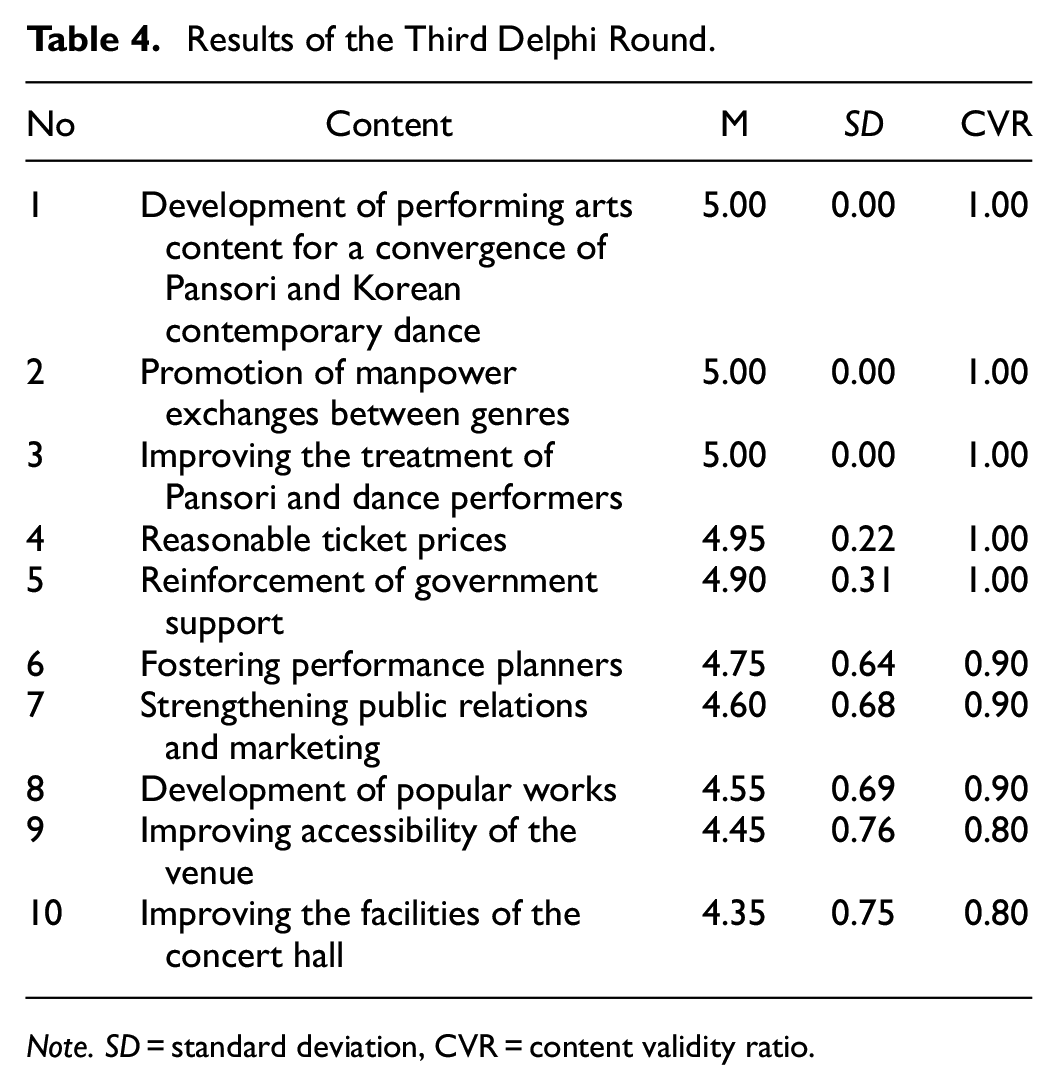
Note. SD = standard deviation, CVR = content validity ratio.
Discussion
Fusion performance involves the blending of disciplines and styles, as seen in the conceptualization of fusion performance and the application of interdisciplinary approaches in performing arts, which result in the fusion of traditional and contemporary elements (Bel & Bel, 1992). From a theoretical perspective, postmodernism highlights the fusion performance’s connection to cultural hybridity in performing arts while considering the esthetics and criticism of such a fusion. Interdisciplinary collaboration is one of the characteristics of postmodernism in performing arts. Artists from different disciplines, such as music, dance, visual arts, and theater, create collaborative works that transcend traditional boundaries (Kristberga, 2016). By blending multiple art forms and integrating various artistic languages and techniques, these collaborations challenge established norms, break disciplinary barriers, and explore new possibilities for creative expression.
Pansori is Korea’s representative traditional musical drama genre in which a singer with drum accompaniment delivers an epic story (Creutzenberg, 2022). Its prefix “pan” means a place where people gather together or a stage, and the suffix “sori” means sound or singing (You & Kang, 2022). In its text, Pansori has incorporated a variety of sources, such as myths, legends, and folk tales, in addition to classical Korean and Chinese literature and history, enriching the themes and narrative contents (Um, 2012).
In the realm of contemporary dance, there have been numerous attempts to fuse the art form with other genres, resulting in exciting and innovative cross-genre collaborations (Kwan, 2017). These fusions enable dancers and choreographers to explore new movement vocabularies, artistic expressions, and interdisciplinary collaborations, pushing the boundaries of traditional dance. For instance, the fusion of contemporary dance with hip-hop brings together dynamic and rhythmic movements with the versatility of contemporary dance, resulting in a unique blend of urban and contemporary styles. Another fusion lies in the integration of contemporary dance and martial arts, where choreographers incorporate techniques from martial arts into the dance vocabulary, embodying both power and grace. Furthermore, the fusion of contemporary dance and theater combines elements of narrative, character development, and dramatic storytelling with the physicality and expressiveness of dance, creating multidimensional performances that blur the boundaries between these art forms (Ashley, 2014). Lastly, contemporary dance has embraced the fusion with digital technology, integrating live performance with digital media, interactive projections, and motion capture, leading to immersive and visually captivating experiences. These fusions not only expand artistic possibilities, but also engage audiences in new and exciting ways, bridging different artistic disciplines and creating fresh and captivating experiences (Leach, 2014).
Meanwhile, traditional Pansori is currently handed down in only five works that are not much loved by modern audiences due to the long performances, monotonous storytelling, and format (S. Kim et al., 2019). Therefore, traditional Pansori has been fused with other dramatic and performance traditions in Korea (Komporaly, 2017). For example, Pansori was performed with Shakespeare’s Hamlet (Choi, 2019). Also, a performance combining traditional Pansori and contemporary dance has been recently attempted. Much attention has recently been placed on the Korean fusion band LEENALCHI (Yoo, 2020). Their popularity is proven by the over 50 million views on their YouTube video. LEENALCH’s hit song “A Tiger is Coming Down” was influenced by “Sugungga (Song of the Underwater Palace),” a sort of Pansori. They released six videos with members of Ambiguous Dance Company that combine traditional Korean rhythm and narrative with Korean contemporary dance (Park, 2021).
Research on the fusion performance of Pansori and contemporary dance is essential for various reasons. Firstly, it contributes to the preservation of cultural heritage by integrating traditional and contemporary elements, ensuring the relevance and accessibility of Pansori to modern audiences. Secondly, it encourages artistic innovation and experimentation, enabling the exploration of new storytelling methods, movement, and visual presentation. Additionally, research in this field promotes interdisciplinary collaboration, fostering the exchange of knowledge and ideas among artists, scholars, and practitioners from different disciplines. Moreover, the fusion of Pansori and contemporary dance facilitates cultural exchange and dialog, exploring shared themes and experiences across diverse cultural traditions. Lastly, it enhances audience engagement and understanding by creating dynamic and multi-dimensional performances that attract a broader audience, thus expanding the reach and appeal of traditional arts. Therefore, research on the fusion performance of Pansori and contemporary dance can be vital in exploring artistic, cultural, and social possibilities, preserving heritage, promoting collaboration, facilitating intercultural exchange, and enriching the audience’s live performance experiences.
This study evaluated the panelists’ perceptions on the convergence of Pansori and Korean contemporary dance using the Delphi technique. The Delphi technique is a forecasting process framework based on the results of several rounds of questionnaires sent to a group of panelists. Recently, the Delphi technique has been used as a constructive method (Du Plessis & Human, 2007). Research using the Delphi technique is often used to derive ways to revitalize the art industry. Mateos-Ronco, and Peiró Torralba (Mateos-Ronco & Peiró Torralba, 2019) analyzed the sustainable management of contemporary art galleries using the Delphi technique. They focused on art galleries, performing a role beyond the mere distribution of art. They developed and applied a prospective methodology based on the subjective information compiled with the Delphi method to identify and evaluate the factors that determined the current situation and future outlook for Spanish contemporary art galleries.
Min et al. (2016) presented management strategies for Taekwondo centers in the United States using the Delphi technique. According to their study, the panelists achieved a consensus through iteration and ranked the possibility of change. The previous studies suggest that applying the Delphi technique is one of the effective methods for establishing a development strategy in the field of performance and arts. Pansori is a form of traditional Korean music, and performances combined with various genres are being attempted. Therefore, this study evaluated panelists’ perceptions of new trends in performing arts in Korea, focusing on the convergence of Pansori and Korean contemporary dance.
Based on the results of Delphi rounds, this study shows panelists’ perception of facilitation strategies for the convergence of Pansori and Korean contemporary dance. Among the various facilitation strategies, development of performing arts content for convergence of Pansori and Korean contemporary dance, as well as the promotion of manpower exchanges between genres, had been suggested by the panel from the beginning to the last round. As a result, when planning a fusion performance of Pansori and contemporary dance, it will be necessary to go through several key steps and considerations, including conceptualizing the artistic vision, assembling a collaborative artistic team, conducting research, creating choreography, developing music and sound design, refining through rehearsals, considering technical and production elements, strategizing promotion and audience engagement, and evaluating the performance to inform future endeavors. As a result, our findings showed that the sustainability of Pansori required the promotion of human exchanges with other genres and the development of various content for collaboration. Titon (2009) mentioned that diversity, stewardship, and interconnectedness would be necessary for cultural sustainability, which indirectly supports our results. Therefore, Pansori’s pursuit of collaboration with other genres, such as Korean contemporary dance, can be a way to enhance the sustainability of traditional Korean culture.
Conclusion
Postmodernism emphasizes the connection between fusion performance and cultural hybridity, encouraging collaboration among artists from different disciplines. The fusion performance of Pansori and Korean contemporary dance within the context of postmodernism showcases a dynamic and innovative approach to blending traditional Korean musical storytelling with contemporary movement expressions. Therefore, an academic approach to the fusion performance of the two genres was required, and this study evaluated ways to revitalize fusion performances by analyzing the opinions of panelists using the Delphi technique. As a result, 20 panelists on Pansori and Korean contemporary dance were recruited to propose a facilitation strategy for converging the two performing arts. The panelists in this study agreed on facilitation strategies for the convergence of Pansori and Korean contemporary dance as follows: development of performing arts content for a convergence of Pansori and Korean contemporary dance; reinforcing manpower exchanges between Pansori and Korean contemporary dance; improving the treatment of performers; reasonable ticket prices; and reinforcing government support policies.
In conclusion, this study shows that the fusion performance of traditional and contemporary elements, Pansori and Korean contemporary dance, needs to explore blending disciplines and styles, breaking traditional boundaries, and exploring new creative expressions. However, this study has a limitation in that it did not investigate the audience’s perception of performances combining Pansori and Korean contemporary dance. While the study did not investigate the audience’s perception of fusion performances, it is significant in deriving facilitation strategies for the convergence of Pansori and Korean contemporary dance through the Delphi technique. The findings offer valuable insights for further promotion and support for the fusion of these two art forms, ultimately enriching the cultural landscape and artistic expression in Korea.
Footnotes
Acknowledgements
We express our gratitude to all the participants of the research.
Author Contributions
Seo contributed to paper planning, data collection, data analysis, paper writing, proofreading, and rewriting. You contributed to paper planning, data collection, and paper writing. Kang supervised all processes as the corresponding author and provided proofreading.
Declaration of Conflicting Interests
The author(s) declared no potential conflicts of interest with respect to the research, authorship, and/or publication of this article.
Funding
The author(s) received no financial support for the research, authorship, and/or publication of this article.
Ethics Statement
This research is based solely on a questionnaire and does not involve animal or human studies; hence, it is not subject to IRB.

Data Availability Statement
Data sharing not applicable to this article as no datasets were generated or analyzed during the current study.