



Abstract
This study aims to cross-culturally adapt the Yonsei Lifestyle Profile (YLP) to a Japanese version of YLP (YLP-J) for older Japanese adults. We translated YLP to the YLP-J using a formal forward–backward translation method. Subsequently, we investigated content validity using the Delphi expert method to assess the multifaceted lifestyle of older Japanese adults. A total of 11 health-related experts participated in the panel, and opinions were collected through 61 closed questions on item relevance and linguistic relevance. Based on the responses, sum, average, standard deviation, content validity ratio (CVR), stability, convergence, and consensus of each item were obtained. As the results of the first Delphi, 43 and 25 questions did not meet the CVR in linguistic and item relevance, respectively. We modified the item questions according to the comments of the expert panel. According to the results of the second Delphi in linguistic relevance, the mean values of CVR, stability, convergence, and consensus were 0.92, 0.17, 0.39, and 0.77, respectively. According to the results of the second Delphi in item relevance, the mean value of CVR, stability, convergence, and consensus were 0.93, 0.16, 0.39, and 0.80, respectively. The content validity of the YLP-J was examined so that the YLP tool could be applied to the linguistic and cultural context of Japan. It is expected that the YLP-J will be a useful tool for improving the health and quality of life of older adults in Japan.
Introduction
Lifestyle refers to a coherent way of life that is formed under the influence of environmental factors as well as individual living consciousness, values, and personality (Park et al., 2019). According to health lifestyle theory, lifestyle comprises life choices (self-direction) and life chances (the structural probabilities of realizing one’s choices; Cockerham, 2017). That is, lifestyle is a deliberate choice, not a random action, so people have the freedom to choose from a variety of circumstances (Cockerham, 2017). A lifestyle that includes such multifaceted factors can have a positive or negative effect on an individual’s life, but given the increase in people’s life expectancy, it has been reported that the accuracy of evaluating instruments used to identify and understand the lifestyle of older adults is limited (Ferreira et al., 2018). Therefore, it is very important to evaluate and understand how lifestyle can affect the quality of life and health of older adults using a carefully developed and valid instrument.
As population aging becomes more serious, it is crucial to embrace wellness and live an independent life through a healthy lifestyle rather than to simply live a long life (World Health Organization, 2015). Japan is implementing the National Health Promotion (Healthy Japan 21, second term) to promote people’s health, and among the five basic goals, prevention of lifestyle-related diseases and lifestyle improvement are emphasized (Yokoyama, 2020). However, in studies dealing with the lifestyle of older adults in Japan, the characteristics are collected through self-reported questionnaires rather than objectified evaluation tools (Katayama et al., 2021). It is a limited approach to measuring lifestyle and reflecting individual values, activities, and way of life (Haruyama et al., 2013; Liu et al., 2021; Masood et al., 2019). Considering this situation, the need for an evaluation tool that can objectively and multifacetedly evaluate the lifestyle of older adults and suggest an appropriate lifestyle is emphasized.
On the other hand, although HPLP (Walker et al., 1987), ILP (Nahas et al., 2000), and Fantastic (Wilson & Ciliska, 1984) are used as tools with validity and reliability, there is a limit to understanding an individual’s multifaceted lifestyle by attempting to quantify the quality based on the total score of such items. As described above, although lifestyles that include variables affecting health and quality of life are evaluated, it is difficult to achieve results that reflect individual habits and multifaceted characteristics.
Recently, the Yonsei Lifestyle Profile (YLP), which aims to quantitatively evaluate the multifaceted lifestyle of older adults in Korea, has been developed (Park & Park, 2020). This evaluation consists of lifestyle-related physical activity, participation, and diet, and can provide an in-depth understanding of lifestyle for healthy aging of older adults. It has been reported that physical activity, diet, and participation factors constituting the YLP lifestyle have a causal relationship that not only has a correlation with an individual’s quality of life and health but also has a positive or negative effect (Park & Park, 2019). However, the tool has limited efficacy for analyzing the lifestyles of people from various cultures because the characteristics of Korean society are integral to its function, and it was composed of a panel of multidisciplinary medical experts in Korea alone (Park & Park, 2020).
At a time when the importance of lifestyle for health and quality of life is being emphasized worldwide, it is essential to use an appropriate evaluation instrument that can identify the multifaceted lifestyle characteristics of an individual. However, YLP was developed in and for Korean society where its accuracy has been verified. To expand the application of YLP, it is necessary to reassess the validity of the results provided by the original instrument in a different society by reflecting on the characteristics of language and culture in these societies. Therefore, this study examines the validity and usefulness of the Japanese version of the YLP instrument through the Delphi survey of a group of experts with an understanding of Japanese cultural background and linguistic expression.
Methods
Study Design
We used the Delphi method to examine and validate the content of older Japanese adults’ lifestyle profiles (Gordon, 1994). The Delphi method was developed in the 1950s and is widely used as a research methodology in psychiatry, social sciences, health, and related fields (Nasa et al., 2021). The advantage of the Delphi method is it allows one to collect opinions from experts about a particular research topic (Gordon, 1994; Taylor, 2020; Zimmerman et al., 2022). Therefore, it is an appropriate method to develop a cross-cultural adaptation of the assessment tool in this study. The Delphi method was carried out as follows, with the researchers performing the following roles in each step of the process. First, Delphi panel recruitment: The researchers found a group of professionals who had studied the quality of life or lifestyles of older adults or had worked as occupational therapists for older adults and asked them if they would be willing to participate in the Delphi study. Second, preparation of a questionnaire: A questionnaire was created and reviewed to ask questions about the content validity of each item of the YLP-J that had been translated. Third, distribution of the questionnaire: The questionnaire was distributed to the recruited expert panel. Fourth, questionnaire collection and response recording: Distributed questionnaires were collected and the responses of each expert panel were recorded. Fifth, statistical analysis: Based on the responses of the expert panel, the average value, content validity ratio (CVR), stability, and convergence of the responses were calculated. Our ethics were approved by the local institute. Informed consent was obtained from the expert group by signing the agreement document, which was approved by the local institute.
Instrumental Tool: YLP
YLP was developed for the assessment of the multidimensional lifestyle of older Korean adults in 2020 using the Delphi method, and it consisted of physical activity, activity participation, and diet (Park & Park, 2020). Physical activity included aerobic exercise, anoxic physical exercise, low-intensity physical activity, moderate-intensity physical exercise, high-intensity physical exercise, and walking. Activity participation included instrumental activities of daily living, leisure activities, social activities, productive activities, education, and sleep. Diet included consuming water, minerals, vitamins, fat, carbohydrate, protein, etc. It has been used to assess the lifestyle of middle-aged and older adults in previous studies; additionally, YLP has high internal reliability with Cronbach’s alpha of 0.83 (Park & Park, 2020).
Translation
We conducted the process of translating the YLP using a formal forward–backward translation method. First, the YLP was translated from the original language (Korean) to the target language (Japanese) by a bilingual person, that is, a forward translator, who works at universities in Japan as an occupational therapy professor with Korean as their native language. Next, backward translations were conducted from the Japanese version to Korean by another translator. A backward translator is a bilingual person who graduated from a university in Japan and has been working at a university in Korea as an occupational therapy professor. After that, the first and fourth authors discussed back-translated YLP with the backward translator. Subsequently, all authors compared and discussed the original version of YLP and backward translated YLP.
Delphi Expert Group
The researchers in this study decided on the inclusion criteria of the Delphi expert group. The inclusion criteria were as follows (1) Person who has published research about older adults’ life such as physical activity, lifestyle, and quality of life, (2) Person who has worked in a department of occupational therapy in a Japanese university as a professor, (3) Person who has worked in a hospital or nursing home for at least 5 years in occupational therapy, or (4) Person who is Japanese or has extensively studied in Japan.
Procedure of Delphi Survey
The Delphi survey was conducted twice (Round 1 and Round 2), which consisted of 62 closed-ended questions and was classified into three themes: physical activity, participation and nutrition. After Round 1 was finished, the first author gathered the answers collected in the Delphi survey. Next, the first author summarized the parts that needed revision, and then all authors discussed and annotated those results. After round 1 was finished, the first author gathered the answers received to the Delphi survey. The first author summarized the parts that needed revisions, which all authors discussed and revised. The discussion was done, all authors agreed to the revised version of the assessment tool. We conducted round 2 immediately, which had the same questions and scale.
Regarding the relevance of language and assessment items, we asked the expert panel group two kinds of questions: (1) Does the item consist of appropriate terms to evaluate the Japanese lifestyle, and (2) Is the item suitable to Japanese older adults’ lifestyle from a Japanese cultural point of view? The scale of questions was a 4-Likert scale (1 = Very inappropriate, 2 = Inappropriate, 3 = Appropriate, and 4 = Very appropriate). We requested the expert panel group to make their ratings according to their professional opinions.
Statistical Analysis
We calculated sum, average, standard deviation, CVR, stability, convergence, and consensus of each item based on the answers of the Delphi surveys. The CVR suggested in the study of Lawshe (1975) was used as a reference, and when the number of experts is 11, the CVR value is 0.59 (Lawshe, 1975). In this study, the CVR value of 0.59 was applied to both the first and second surveys to determine whether to delete or modify it. Three researchers determined deletion or review of items, and in case of disagreement, consensus was reached through discussion. Stability is a method of examining the degree of agreement between items. An item with stability of 0.5 or less means a high degree of agreement between the expert panel responses. Questions with a stability of 0.8 or higher require additional surveys. In this study, a stability criterion of 0.5 or less was applied to both the first and second surveys (Sempik et al., 2003). Convergence is an index indicating the degree of convergence according to the response results obtained through the Delphi survey and is calculated by dividing the difference between the first quartile and the third quartile by 2. Based on the initial degree of convergence, it can be examined that the responses of experts are converging as the degree of convergence is smaller. Consensus is an index indicating the degree of agreement among experts. It is a value obtained by dividing the difference between the first quartile and the third quartile by the median and subtracting it from 1. It was judged that the higher the level of consensus, the higher the level of agreement of experts’ responses.
Results
Demographic Characteristics of the Panel Experts
We sent a total of 60 invitations to request responses to the Delphi survey according to our inclusion criteria. Of these, 11 participants responded to our request. All 11 experts in this study completed the first and second surveys. No one dropped out on the survey between the first and second Delphi surveys. Table 1 shows the demographic characteristics of panel experts. Six participants (54.5%) were male, and nine participants (81.2%) were Japanese. The participants who were Korean had lived in Japan for over 5 years. The majority of participants consisted of those working in occupational therapy, public health, health science, gerontology, and social welfare.
The Demographic Characteristics of Panel Experts.

Result of Round 1
Figure 1 shows the process of collecting and analyzing the responses in the Delphi process and indicates the table numbers where the results from each process are presented. Table 2 shows the mean of the first and second Delphi surveys. As a result of the first Delphi survey, in 61 questions asking about linguistic relevance, 43 questions did not meet the CVR value 0.59 criterion. The mean value of CVR was 0.36 and the mean value of stability was 0.27. Among 61 questions about the relevance of an item, 25 questions did not meet the CVR value 0.59 criterion of the expert panel. The mean value of CVR was 0.58 and the mean value of stability was 0.25. Expert panels were allowed to explain their reasoning in the additional comments section. As a result of a comprehensive summary of the opinions of the 11 expert panelists, the rating scale of items was not presented, and they were asked to provide accurate examples of activities and precise criteria. For example, in the dietary domain, additional questions were asked about why bread and rice cakes were grouped together. In response, all researchers decided to revise the contents according to the opinions of the expert panel, and then added answers to the second Delphi questionnaire. Therefore, the second Delphi survey was conducted based on the opinions of the expert panel.

The process of collecting and analyzing the responses in the Delphi process.
The Result Mean Value of the First and Second Delphi Survey

Result of Round 2
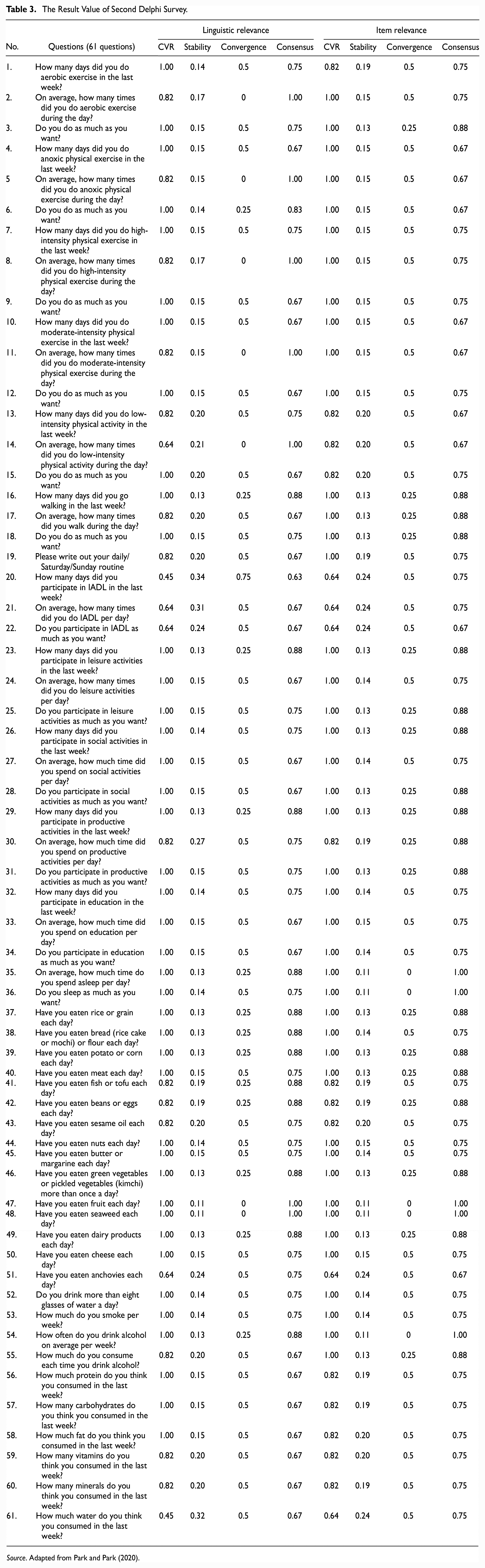
The detailed results of the second Delphi survey are presented in Table 3. As a result of the second Delphi survey, among 61 questions about linguistic relevance, 59 questions met the criteria of CVR. The average stability was 0.17, and the stability of all questions ranged from 0.1 to 0.3. As a result, very stable results were obtained, so the response of the expert panel was high, and it was judged that no additional questionnaire was necessary. The average value of convergence was 0.39, and the consensus, indicating the degree of agreement among experts, was 0.77. The comment on the two items (in Table 3, items 20 and 61) which did not meet CVR criteria was that the words used to describe activities of daily living and the meaning of water were not accurate. All researchers discussed whether to modify or delete this. As a result, the suitability of the item was more than the CVR value, and the expert panel informed the corrections, so it was decided to modify it rather than deleting. Therefore, as suggested by the expert panel, the words for activities of daily living were modified to instrumental activities of daily living, and the meaning of water was clearly modified.
The Result Value of Second Delphi Survey.
Source. Adapted from Park and Park (2020).
All questions about item relevance met the criteria of CVR. The mean value was 0.93. The mean of stability was 0.16 and the mean of convergence was 0.39. The mean of consensus was 0.80, and the closer to 1, the higher the level of agreement of expert responses, so the result of this study was judged to be high.
Discussion
Our study conducted a cross-cultural adaptation of YLP, a previously developed assessment tool, for the assessment of the lifestyle of older Japanese adults. For the purpose of this study, we transformed the YLP and investigated the validity of the new content using the Delphi survey. The content relevance of all assessment items satisfied the criteria, and the language relevance of the two assessment items did not. We accepted the panel experts’ corrections for language and expression. Thus, we finalized all 61 items of the Japanese version of YLP (YLP-J).
Precise assessment leads to appropriate intervention. In gerontology, the lifestyle factors of older adults such as physical activity, nutrition, participation in social activities and education, alcohol consumption, and smoking are associated with individual health and quality of life (Bae et al., 2021; Govindaraju et al., 2018; Potter et al., 2011). Many researchers who specialize in gerontology recognized the importance of lifestyle and thus developed and applied appropriate lifestyle interventions (Juang et al., 2018; Mountain et al., 2017). If there is no precise assessment of a multi-factored lifestyle, the intervention may not be appropriate. In particular, the lifestyle of older adults was different from other age-groups, so the assessment tool has to include lifestyle factors relevant to older adults. We developed YLP-J through a cross-adaptation of YLP for that reason. Our research has investigated the content validity of YLP-J, and it is indicated as an appropriate assessment tool for evaluating the lifestyle of older Japanese adults. In addition, YLP-J can be used as a guideline for intervention. Since YLP-J has three domains and detailed evaluation items, if it is used to evaluate the lifestyle of older Japanese adults, the participants will be able to recognize which lifestyle elements are lacking and which to pursue.
Our study investigated the content validity of the YLP-J to evaluate the lifestyle of older Japanese adults. As mentioned in the introduction, an assessment tool for evaluating the lifestyle of older Japanese adults was still insufficient. Specifically, previous studies about lifestyle in Japan and the assessment tool to measure lifestyle did not consider the multifaceted lifestyle of older adults (Katayama et al., 2021; Shinohara et al., 2021). Our research team previously developed the original Korean version of the YLP to evaluate the lifestyle of older adults in multiple ways through a literature review and the Delphi method (Park & Park, 2020). Therefore, we expanded the YLP to YLP-J to evaluate the multifaceted lifestyle of older Japanese adults and to supplement the previous study. Furthermore, YLP and YLP-J can be used in cross-national comparison research; by comparing the current health status and lifestyle of older adults in Japan and Korea, it will be possible to understand the impacts of health policies and support projects currently being implemented for older adults in Korea and the direction to be pursued in the future.
A previous study recommends that consistent participation in social, education, leisure, etc. aids in the prevention of mental disease, increases the quality of life, and delays cognitive decline (Iizuka et al., 2019; Ma et al., 2020). In the Delphi survey, the panel expert agreed that participation in various activities is an important lifestyle factor for older adults. The advantage of YLP-J is that it recognizes and evaluates the importance of participation as a lifestyle factor. Many other lifestyle assessment tools do not recognize the importance of participation (Goodyear-Smith et al., 2009; Park et al., 2019). Since it is important to understand whether older adults continue to participate in society and how meaningfully they use their leisure time, health professionals should continuously monitor and suggest these to the subjects if they lack participation in various activities (Lee et al., 2019). Previous assessment tools did not provide an evaluation of activity participation; therefore, it was not possible to understand the multifaceted lifestyle of older adults. However, YLP-J can be widely used as an assessment tool to compensate for such limitations.
Nutritional management is one of the factors contributing to the health status of older adults and is a major determinant of successful aging (Gaudreau et al., 2007). Healthy dietary habits contribute not only to physiological health, but also to social, cultural, and psychological well-being (Leslie & Hankey, 2015). Loss of nutrition leads to frailty in older adults, which needs to be managed (Hernández Morante et al., 2019). YLP-J recognizes the necessity of nutrition management for older adults and included the nutrition-based questions for this reason. Based on this, YLP-J can be used as an intervention factor in assessing the dietary habits of older adults and their lifestyle.
Lifestyle is chosen by individual values and beliefs in a variety of environments, meaning it can be modified (Cockerham). Several studies have reported that lifestyle modifications have improved the quality of life and physical health of older adults, suggesting that health care is possible even with changes in individual behavior, versus immutable characteristics such as age and sex (Hirvonen & Johansson, 2023). This study recognized the importance of lifestyle and developed YLP to conduct not only an accurate evaluation but also intervention. Moreover, cross-adaptation was performed with YLP-J so that it could be used in Japan. Furthermore, after the translation process, it was expanded to a valid assessment tool by investigating the content validity of linguistic and assessment items. Through this study, it is expected that the lifestyle of older adults living in Japan can be evaluated and used for intervention.
This study has limitations. Our study evaluated only the content validity and relevance of the assessment tool items of YLP-J. Thus, this study did not analyze the validity and reliability. To examine the validity and reliability, YLP-J data need to be collected from Japanese older adults. However, our study aimed to investigate content validity, and it is necessary to investigate validity and reliability after evaluating older Japanese adults using the Rasch model through future research.
Conclusion
We conducted the cross-cultural adaptation of YLP-J through translation from YLP to YLP-J and the Delphi method. The Delphi expert group consisted of 11 people who specialize in occupational therapy, gerontology, and rehabilitation science, and we obtained responses about 61 questions each about linguistic and item relevance for one Delphi survey. The Delphi survey was conducted twice; after the first Delphi survey, questions that do not meet the CVR were modified after discussion with all authors. In the second Delphi, all of the questions in item relevance did meet the CVR, and two questions in linguistic relevance did not meet the CVR; however, we modified that to the appropriate word that the expert panel provided. Our study provides assessment tools that have examined the content validation to evaluate the multidimensional lifestyle of older adults. In addition, YLP-J can help plan interventions of lifestyle redesign for health professionals.
Footnotes
Author Contributions
Ms. Jin and Ms. Bae performed the Delphi survey with assistance from Dr. Lim, Dr. Gang, and Dr. Hong; Ms. Bae analyzed the result of the Delphi survey; Ms. Bae, Dr. Lim, and Dr. Hong wrote the manuscript; Ms. Jin and Dr. Gang reviewed questionnaire; All authors reviewed the manuscript.
Declaration of Conflicting Interests
The author(s) declared no potential conflicts of interest with respect to the research, authorship, and/or publication of this article.
Funding
The author(s) disclosed receipt of the following financial support for the research, authorship, and/or publication of this article: This work was supported by the Ministry of Education of the Republic of Korea and the National Research Foundation of Korea (NRF-2021S1A3A2A02096338).
Ethical Approval
This study has been reviewed and approved by the Institutional Review Board of the Yonsei University Mirae Campus (1041849-202112-SB-217-01).
