




Abstract
Schools develop mission statements in part to communicate their purposes of schooling to internal and external audiences. The goal of this study is to employ text analytic techniques to analyze school mission statements. Focusing on Arizona and New Jersey’s schools, we seek to understand: 1) what themes (topics) emerge from their mission statements, 2) whether local context (politics) and institutional factors (being a charter) mediate topic prevalence, and 3) how similar school mission statements are to one another overall and across select factors. Using structural topic modeling we find that five topics emerge as particularly prevalent, and they address key purposes within the US context related to social, academic, and civic development with an emphasis on a safe environment and a sense of community. Local political leanings have a minor impact on the prevalence of topics but being a charter has a distinct influence. Compared to regular schools, charters are more likely to include themes related to preparing for college, academic approaches, and character and family ties, but they place lower emphasis on community and citizenship themes. School missions display moderate levels of similarity, indicating that a common set vocabulary has permeated schools’ missions, though differences remain, including between states. Overall, this study deepens our understanding of the varieties of schools’ missions and reveals text analytic techniques are well suited for uncovering them.
Plain Language Summary
Schools develop mission statements in part to communicate their purposes of schooling to internal and external audiences. In a novel application, the goal of this study is to employ text analytic techniques to analyze school mission statements. Focusing on Arizona and New Jersey schools, we seek to understand what themes (topics) emerge from their mission statements, whether local context (politics) and institutional factors (being a charter) mediate topic prevalence, and how similar school mission statements are to one another overall and across select factors. Employing structural topic modeling, five themes emerge as most prevalent. The themes broadly address key purposes within the US context related to social, academic, and civic development with an emphasis on a safe environment and a sense of community. Local political leanings have a minor impact on the prevalence of topics but being a charter has a distinct influence. Compared to regular schools, charters are more likely to include themes related to preparing for college, academic approaches, and character and family ties, but they place lower emphasis on community and citizenship themes. School missions display moderate levels of similarity, indicating that a common set vocabulary has permeated, though differences remain, including between states. One limitation of the study is the focus on two states; however, preliminary analyses of a small national sample suggest comparable vocabularies. Overall, this study reveals school mission statements present meaningful variations in the purposes of schools. Schools are communicating interpretable goals and text data mining techniques are well suited for uncovering them.
Introduction
Organizations of all types seek to distill their raison d’etre into concise mission statements. These pithy yet often generic statements are used to help manage and shape practices, communicate values and goals, and comply with expectations and requirements (Stemler & Bebell, 2012; Williams, 2008). Due in part to the wave of accountability reform that impacted on public education in the United States in recent decades, with many practices borrowed from the private sector, schools, and school districts have frequently tasked themselves with the formulation of mission statements (Berends, 2004; McDermott, 2011). Whether buried or touted, mission statements can be commonly found in school and school district websites, report cards, or physical school documents. While common, school mission statements are not universal. In our exploratory analyses of school mission statements, inspecting school websites in 2019 from a small national sample of schools, 49% had a mission statement in their website.
As school mission statements have become more visible, providing a window into the core goals of a school, it is not surprising that they have garnered the attention of education scholars. By now there is a growing, though still sparse, line of research that has examined school, or school district, mission statements to understand which purposes of schooling prevail and whether schools’ stated purposes align with other measurable correlates (Allen et al., 2018; Chapple, 2015; Ingle et al., 2020; Schafft & Biddle, 2013; Stemler & Bebell, 2012; Stemler et al., 2011). Underlying much of this research is the more general concern with the validity and value of school mission statements per se. That is, do they reflect actual practices or aspirations of a school or are they merely bland blanket tropes?
Since scholars have utilized varied approaches, such as different units of analysis and geographical focus, the research is understandably still evolving. However, several initial findings have begun to emerge. First, three to five themes or purposes are often the most prevalent, with cognitive development or academic success frequently at the top (Chapple, 2015; Stemler et al., 2011). Second, the specific themes that arise can vary distinctly across countries, and in the case of the United States somewhat across states, but overall, there seems to be limited evidence in the US setting of local contextual factors mediating theme prevalence (Ingle et al., 2020; Schafft & Biddle, 2013). Lastly, while more work is needed to understand whether school mission statements indeed shape or reflect practice, missions in the US setting are seemingly influenced by discourse at broader and higher organizational levels such as state, national, and professional institutions (Ingle et al., 2020).
Prior research has examined a broad swath of school and local contextual factors to help explain, or correlate with, the presence of a given theme in a school’s mission statement. But two potentially relevant factors have remained largely unexamined: local political tendency and charter school status. Charter schools are public schools that have been exempted from certain state and local regulations and which as such can pursue distinct educational objectives (National Charter School Resource Center [NCSRC], 2023). In addition, previous studies have often used mixed methods designs, with the initial stage consisting of qualitative coding for the occurrence of a theme and the later stage consisting of quantitative analyses of bivariate association or logistic regression (Ingle et al., 2020; Schafft & Biddle, 2013; Stemler et al., 2011). This kind of coding captures only the presence (“1” yes or “0” no) of a theme, as opposed to its prevalence within a statement, and is limited by the coders’ ability to read through a bounded number of documents. Big data and its associated set of computational text analytic techniques can help alleviate these and other constraints.
In this study we employ structural topic modeling (STM) to estimate the prevalence of different themes in school missions and to examine their association to an array of school and local factors. We also utilize similarity distance metrics to compare pairs of mission statements. We focus on school mission statements from Arizona and New Jersey since at the time of collection (2019) these two states mandated the inclusion of a mission statement in all their schools’ report cards. Our analyses show that, in line with previous research, five topics emerge as especially prevalent and these can be understood as focusing broadly on learning in a safe environment and socio-emotional skills; success and academic outcomes; citizenship outcomes; school-community ties and soft skills; and being a member of a global society. Local political dispositions have a substantively minor effect on topic prevalence. Being a charter, on the other hand, influences a plurality of the topics’ incidence, making these institutions thematically distinct. Among charter schools certain topics become more prevalent, such as, college-career preparation, academic approaches, and character and family ties, while others become less prevalent, such as, success, safe learning and socio-emotional skills, and citizenship outcomes. State level differences emerge for most of the topics. In terms of distance metrics, the school mission statements in this study display moderate but appreciable similarities suggesting a generic vocabulary is at work—but differences remain. All in all, we find that school mission statements display meaningful variations in school purposes, though not fundamentally linked to the locality, and text data mining emerges as a very promising analytic tool for revealing them.
Research on School Mission Statements
Mission statements have become standard and expected instruments in organizations. F. R. David and David (2003) define missions as “enduring statements of purpose that distinguish one organization from other similar enterprises.” Mission statements can be conflated with vision statements. While mission statements often emphasize the reasons an organization exists, vision statements emphasize its aspirations for the future (Davies & Glaister, 1997). Many scholars have maintained the importance of having a mission statement. The reasons can be for management purposes (planning and prioritizing), communication purposes (for internal and external stakeholders), or compliance purposes (to satisfy external requirements) (Davies & Glaister, 1997; Drucker, 1974; Morphew & Hartley, 2006; Pekarsky, 2007; Williams, 2008). Conversely, other researchers have highlighted the shortcomings of mission statements, such as their mixed impact (Boerema, 2006), audiences who are not aware of them (Gurley et al., 2015), and poor content (Holosko et al., 2015; Rozycki, 2004).
One way of categorizing the large and varied literature on organizations’ mission statements is by the nature of the central research questions and design: descriptive or causal. Mission statements can be examined in a descriptive manner to uncover the specific purposes being put forth. Mission statements can also be examined in a causal (or associational) manner to reveal either their impact on select outcomes or to assess the determinants behind any given purpose. For example, the research on mission statements in the private sector has focused on descriptive questions, including what makes a good mission statement (Allison, 2016; Alshameri et al., 2012; David & David, 2003; M. E. David et al., 2014; King et al., 2013), and causal questions related to their impact on an enterprise’s performance (Braun et al., 2012; Duygulu et al., 2016; Khalifa, 2011). 1 As we discuss shortly, school mission statements have primarily been studied to understand what purposes of education are included (descriptive) and what contextual and institutional factors drive the presence of any given purpose (causal), with fewer efforts focusing on consequences to performance (see, Kurland et al., 2010; Perfetto et al., 2013; Slate et al., 2008).
A school mission statement typically aims to communicate a school’s core purposes in terms of educating children and youth. In the United States, different purposes or goals of education have been emphasized at different historical times (Janak, 2019; Rury, 2016) and there have been diverse theoretical perspectives
From a legal perspective, the purposes of schooling are not spelled out in the US Constitution and only a select number of states address the goals of education in their state constitutions (Rippner, 2016). As Stemler et al. (2011) remind us, in our fragmented and decentralized educational system, “educational practices are more a direct function of the community and government organizations, which underwrite and typically manage education” (p.386). The specific balance of expressed goals of schooling then may depend on local environments.
So, which educational goals are included in school mission statements in the United States at present, and what drives their inclusion? Focusing on public schools, to the best of our knowledge, there are only a limited number of studies that have systematically addressed both questions. In seminal work, Stemler et al. (2011) examined a sample of 421 high school mission statements drawn from 10 different states. The key contributions centered on the mixed-methods research design, the reliable coding of 11 emergent themes (purposes), and the thorough examination of the links between school characteristics and context and the presence of any given theme. Subsequent studies have set on similar paths though with varying geographical scope and units of analysis. Schafft and Biddle (2013) focused on school districts in Pennsylvania; Ingle et al. (2020) focused on school districts in Kentucky; and Slate et al. (2008) focused on schools in Texas.
There are several common findings from this research in terms of the distribution and prevalence of key themes. First, the number of themes uncovered is relatively consistent across studies, ranging between 10 and 15. The average number of themes per mission statement is also comparable in the studies that provide this information, with Stemler et al. (2011) finding a mean number of themes of 3.4, Schafft and Biddle (2013) finding a median number of themes of 3, and Ingle et al. (2020) finding a mean number of themes of 3.05. There is considerable overlap, though also some difference in which themes are most prevalent. All four studies identify themes related to academic success and civic outcomes within the top-four most common themes. Three of these studies identify ties to the community within the top four themes and two of the studies identify social or emotional development among the top four themes.
The recurrent themes of academic success, civics, community ties and socio-emotional skills may seem like the universal “usual suspects” for school mission statements, but, while these themes are the ones most manifested in the United States, studies of other countries yield different results. For example, a study on primary schools in Turkey finds valuing the principles and reforms of the political leader Atatürk as the top-most common purpose (Turhan & Kirkgoz, 2020). Studies focusing on mission statements from Australian high schools (Allen et al., 2018), New Zealand and Japanese primary schools (Chapple, 2015) and Omani primary schools (Al-Ani & Ismail, 2015) find, as in the United States, academic/cognitive outcomes as among the top-four most prevalent themes. However, civic development or citizenship outcomes are not prominent in any of these later three studies while local-community ties themes are only prevalent in the Omani study.
In terms of what drives or correlates with the presence of a theme in a school’s mission statement in the US, the evidence is mixed. Much of the scholarly attention has focused on standard correlates such as urbanicity, academic performance, demographic student representation, and enrollment. Based on the three studies that address these factors, the results are suggestive of a limited role for local school-related influences. Stemler et al. (2011) find a statistically significant association between urbanicity and the themes of local community ties and challenging environments. Schafft and Biddle (2013) find a statistically significant association between enrollment and performance and the theme of individual attention and Ingle et al. (2020) find a statistically significant association between urbanicity and non-white student representation and the theme of diversity, and between performance and the theme of student support. Given the large array of possible associations (at the minimum 44), very few are statistically significant and with almost no overlap across studies.
One should bear in mind that the more recent studies are all single-state studies, so we cannot derive cross-state inferences, while only the earlier work by Stemler et al. (2011) includes 10 states. In fact, Stemler et al.’s (2011) findings may provide evidence of some interstate level influences when, for example, California’s schools, compared to other states, are shown to have a higher prevalence of the vocational preparation theme and Colorado’s schools have a higher prevalence of the safe and nurturing environment theme. All in all, as Ingle et al. (2020) argue, it may be that “the broader institutional discourses at the state -and federal- level supersede those of local place and context in mission statements” (p.332).
Research Questions
The overarching goal of this study is to further unpack school mission statements, the purposes of schooling in them and their correlates. Building on prior research, we do this by utilizing text analytic techniques that to our knowledge have not been previously used in this setting and by examining some of the determinants of a theme’s presence that are still unexplored. Specifically, we seek to answer the following research questions within the US context:
(1)
(2)
(3)
For research questions (1) and (3) we do not have sharper expectations than what prior work has suggested, mainly, the importance of themes related to academic and civic outcomes and school community ties, and the lack of much differentiation in school mission discourse by local context. For research question (2), on the yet unexamined determinants, we have mixed expectations. We expect politics to have a limited association, given that schools have historically been organized to operate somewhat sheltered from political and electoral trends and institutions, though this might be evolving (Rippner, 2016; Rury, 2016; Tyack & Cuban, 1995). Given that the Democratic party has traditionally sought broad constituencies we may expect schools embedded in more-Democratic leaning areas to espouse mission statements that support or value diversity-related themes (Grossmann & Hopkins, 2016). There is some preliminary evidence that this may be the case. Content analyzing and coding over 1300 school districts in the US, Pew researchers find that in Democratic-voting areas 56% of school districts mention diversity, equity, or inclusion efforts in their mission statements compared to 26% in Republican-voting areas (Odabaş & Aragão, 2023). In terms of charter status, we may expect these schools to be strongly linked to select topics given that charters came about to break away from the perceived strictures and failures of traditional public education (Hochschild & Scovronick, 2003; Sowell, 2020). But because of this original impetus, charters have a motley of orientations and offerings (e.g., focus on languages, character/religion, college-career preparation, or vocational training) which could attenuate any specific charter-theme association.
Data and Methods
The general sequence of collection and analyses undertaken in this study is as follows: first, we selected the states of Arizona and New Jersey since at the initiation of the study these were the sates that mandated school mission statements; next, we collected the school missions from each state (Fall 2019) and collected school and local contextual covariates; finally, we deployed text analytic techniques (topic modeling with covariates, word frequencies, and similarity metrics) to examine the schools’ missions given our research questions. We describe below in more detail the data collected, mission statements and covariates, and then the specific text analytic techniques.
The school mission statements for Arizona’s schools corresponding to the 2018-19 academic year were obtained by scraping the Arizona Department of Education’s database of school report cards in October 2019. The school mission statements for New Jersey’s schools were downloaded from the New Jersey Department of Education’s repository of school performance reports in December 2019 and correspond to the 2017-18 academic year. 2 In each case, we are considering the universe of K-12 public schools, that is, all grade levels excluding pre-K (elementary, middle school, and high school), types (regular, technical, alternative or special education), and status (charter and non-charter). This amounts to N=1902 schools with a mission statement for Arizona, and N=2278, for New Jersey, for a combined total of N=4180 schools and school mission statements.
Among the school missions of study, the average number of words is 51 and the median value is 50, with the shortest mission having 3 words (e.g., “Learning for all” or “Honor, inspire, excel”) and the longest 223 words. Below are 4 examples of mission statements of median length: It is our intent to prepare our students for the innovation age by incorporating the use of computers into the daily curriculum. In addition, we strive to teach model behaviors that will assist students in developing positive social skills. Various community resources are utilized to assist us with this task (Elementary school, Arizona). Our mission is to instill a true passion for lifelong learning and discovery within each child. We emphasize the importance of strong character traits, such as accountability, honesty, respect and kindness. These traits create a positive environment that is safe, nurturing and educational for each member of our school family (Elementary school, New Jersey). [Name] High School is committed to ensuring all students gain the social and academic skills needed to attend and graduate from an institution of higher learning. The shared efforts of students, parents, and staff will result in the development of life-long learners and productive citizens of the global community (High school, New Jersey). [Name] Academy is an innovative K-12 charter school where teachers, students and families share the same goal – college graduation. Our mission is to provide premium environments for learning, helping all students become innovative leaders and problem solvers who are prepared for success in college and their preferred careers (Preparatory academy, Arizona).
In relation to the covariates, we include virtually all the ones that have previously been examined plus our own two additions: charter (or not) status and local political partisanship. Specifically, with regards to type of institution, we identify whether a school is a high school (1-0) or a charter (1-0). The geographic context is captured through these different indicators of locale: city (1-0), town (1-0), and rural (1-0), with suburban being the omitted baseline category. In terms of school level factors, we include the percentage of Hispanic and African American students (which we refer to as percent minority students), total school enrollment (logged), student teacher ratio, per student instructional expenditures (logged), and the percentage of students who met English Language Arts (ELA) proficiency annual targets of the state. We did not include the percentage of students receiving free or reduced-price lunch, as prior research had done, since many charter schools in Arizona do not collect or provide this information. However, free and reduced-price lunch was not statistically significant in any of the previous studies. Last, we add a measure related to local political leanings: the percentage voting Democrat (Hillary Clinton) in the 2016 presidential election in the precinct where the school is located. To incorporate data on local party-line votes we utilized a school’s latitude and longitude location to match a school’s location within a political precinct’s geocoded boundaries. After excluding observations for missing covariate data, we arrive at a final sample of N=3490 schools and their missions. The largest drop stems from schools missing the percent proficient in ELA and student teacher ratios.
Supplement A provides a statistical summary and sources for each of the covariates. The following are a few descriptive highlights from the schools in the study: 12% are charters, 20% are high schools, 26% are located in cities, 11% are located in rural areas, and 45% are in Arizona. The average enrollment in the sample’s schools is 613 students, while the average percent minority is 46%, and the average percent proficient in ELA is 45%. In terms of political inclinations, the average Democrat vote share is 56%.
Turning to the methods, our central approach is to use topic modeling, specifically, a structural topic model (STM). Topic modeling is an unsupervised method of classification of documents, similar to clustering but distinct, in that “it treats each document as a mixture of topics, and each topic as a mixture of words” (Silge & Robinson, 2017, p.89). That is, the algorithm behind topic modeling uncovers parameters from an assumed data-generating process that links documents to topics, and topics to words (Blei, 2012; Roberts et al., 2019). Documents are pre-processed to exclude common English stop-words, numbers, and punctuation. After generating a topic model over a corpus of documents, each document has its own distribution of topic probabilities, or prevalence, and each topic has a distribution of word probabilities over the fixed vocabulary within the corpus. What distinguishes structural topic models is their inclusion of covariates, or document level metadata, that can influence topic prevalence and topical content. In our study, we include all the covariates described above as potential sources of modulation of topic prevalence and use the stm package in R developed by Roberts et al. (2016, 2019). 3
To generate topic models, including structural ones, the number of topics must be specified in advance. While there are various diagnostic measures (e.g., of heldout-likelihood, residuals, or semantic coherence), in practice the number of meaningful and interpretable topics is most often finalized through inspection (Bail, 2020; Chang et al., 2009; Grimmer & Stewart, 2013). Guided by previous school mission research, which has often identified between 10 and 15 themes, the aforementioned diagnostics, and our own ability to find meaningful and distinct topics, we elected to study a model with 12 topics. We elaborate on this choice in the “Validation” section and in Supplement B. Also, to assist with the interpretation, topics can be given labels for ease of identification. To label the topics we referred to the themes qualitatively coded in the previous literature while also adding new labels as needed. Specifically, after inspecting the highest probability words in each topic, we examined if any of the labels from Schafft and Biddle’s (2013) study were suitable. These labels are: school community ties, the local embedded in the global, changing environment, academic outcomes, citizenship outcomes, success, emotional and soft-skill development, academic rigor, safety, student support, individual attention, and valuing diversity (Schafft & Biddle, 2013, p. 65). Schafft and Biddle’s (2013) labels are similar to those from Stemler et al. (2011) and the same used in Ingle et al. (2020). If no prior label was applicable, we incorporated a new one and this was necessary for five topics.
For our final research question centered on the similarity of school missions, we use word frequency counts and distance metrics. As Grimmer et al. (2022, p. 148) argue, while topic models stem from a multinomial model of language which produce relative probabilities of generation, word counts and distance metrics result from a vector space model of language. In a vector space model, vectors are produced from the frequencies of words in a corpus, and distance metrics capture the relative degrees of closeness between two documents as vectors. We use the cosine similarity metric which captures the number of words two documents share in common accounting for the length of the documents.
4
The cosine metric lies in text applications between 0 and 1, with 0 being most dissimilar and 1 being most similar. We use Quanteda’s commands in
Findings
The estimation of a structural topic model provides multiple pieces of information from which to understand the topicality of our documents. We start by discussing the average prevalence of each topic and the words most associated with them, as seen in Table 1. The first column is the topic’s reference number, out of 12, the second column presents the labels we assigned to each topic, the third column shows the average prevalence of a topic as a proportion, and the last column includes the top 15 highest probability words within a topic.
Topics in Arizona and New Jersey’s (2019) School Mission Statements.

Note. Mean topic prevalence is the average proportion of a topic across the missions computed using a structural topic model (stm) by Roberts et al. (2019).
The top five topics have proportions that average between 0.16 and 0.09 while the following seven topics have proportions between about 0.08 and 0.05. The top five topics focus respectively on: safe learning and socio-emotional development (0.16), success and academic skills (0.11), citizenship outcomes and life-long learning (0.10), school-community ties and soft skills (0.10) and being a global society member and diversity (0.09). These top five topics are also the ones most schools are consistently incorporating in their missions, as seen in Figure 1. More specifically, Figure 1 shows the frequency distribution of topics within mission documents, with topic proportions on the horizontal axis and counts of mission statements on the vertical axis. The five topmost prevalent topics (Topics 1, 2, 7, 10, and 12), compared to the other topics, have a distribution considerably more spread out, with more distributional weight on higher proportions, suggesting they are a more substantial component of schools’ missions.

Distribution of topic prevalences across AZ and NJ mission statement.
Next, we examine the distribution of words within topics. Figure 2 shows the top 15 words for each topic, also listed in Table 1, and their probability. This analysis can highlight which words are anchoring a topic and provide semantic validation of which topics are better thematic constructs. We find that most topics have four or five top words with higher probabilities, 0.02 and above, that are already suggestive of a coherent theme. In these well-defined topics, the next most frequent words continue to have relatively high probabilities and secure the established themes. For example, in Topic 2, community, learners, responsible, and citizens can be clearly linked to civic outcomes, which is only then strengthened by the words that follow them down the rankings, lifelong, develop, potential, and productive. Similarly, in Topic 11, high, students, college, and career suggest a theme of college-career preparation that continues even with less prominent words like rigorous, education, arts, and provide. The notable exceptions are Topics 4 and 6, which we labeled as addressing “Student support” and “Academic approaches.” In these two topics the first set of words with higher probabilities are followed by words with a substantial drop in their likelihood, which might suggest these are less consolidated topics (Bail, 2020).

Highest word probabilites for each topic.
Another perspective from which we can examine the topics is by their correlations. Figure 3 displays the topics that are positively associated among each other, utilizing stm’s force directed layout algorithm. In general, the correlations among topics, or lack thereof, seem to align well with our expectations and provide strong plausibility to our interpretations. Topics 5, 7, and 1 are linked and address character, safe learning, and school-community ties. The linked Topics 2, 12, and 3 address the themes of citizenship outcomes, being a member of a global society, and innovative leaders. The linked Topics 9, 4, and 6 speak to standards, student support, and academic approaches. And the linked Topics 8 and 10 address success and individual attention. Last, Topic 11, addressing the theme of college and career preparation, one that can override other themes, is not positively correlated with any other topic.
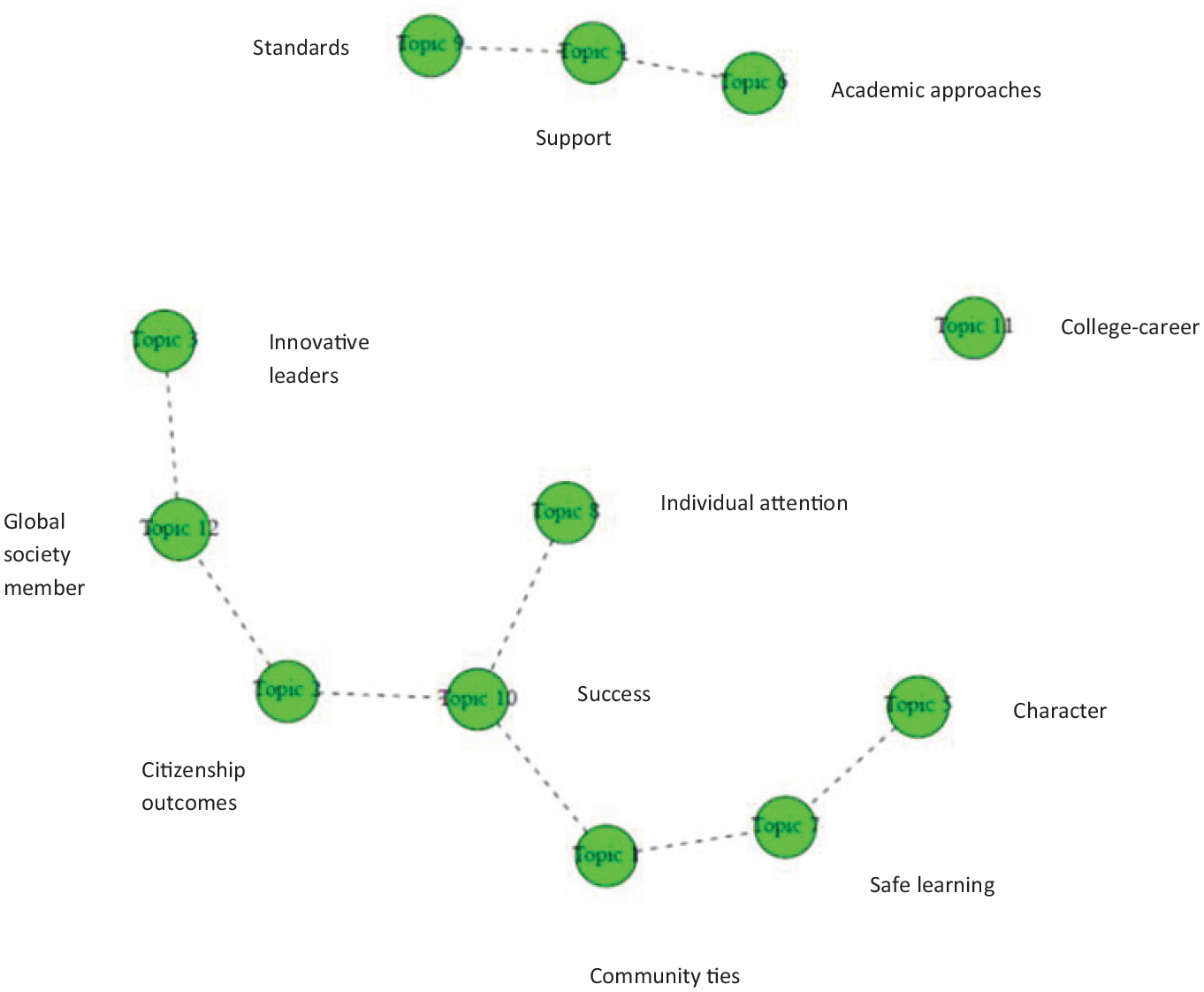
Topic correlations in AZ and NJ mission statements.
In sum, with regards to our first research question–which themes are most common–we have found that five topics are the most prevalent among Arizona and New Jersey’s schools. These topics comprise some of the core purposes of schooling, namely, those that address the social, academic and civic goals of public education in the US, doing so in a safe environment, and a globally aware community. As seen in Figure 2, the top five topics have high probability words that would seem to adequately distinguish them, and as seen by the links in Figure 3, these topics are associated amongst each other through a path of correlations. The importance of these topics agrees with the trends in prior studies, but in particular with Stemler et al.’s (2011) multi-state study in which they find that the top five themes are: civic, emotional, and cognitive development, and then integration into the local community, and integration into the global community.
We turn to our second research question: assessing the relationships between the factors of charter status and local political leanings and topical prevalence. Table 2 presents the estimates from school-level regressions in which the outcome is the proportion of each topic and the regressors are all the covariates specified above, including our two factors of interest. These estimates are not just ordinary least squares estimates. The regressions are obtained through the stm package’s estimateEffect post-estimation routine which also accounts for the uncertainties associated with the topic proportions as estimated quantities (Roberts et al., 2019). If we consider the R2 from simple ordinary least squares (not shown) these range from 2% (Topic 8) to 31% (Topic 11), with an average R2 across the models of 10%.
Covariate Regression Effects on Topic Prevalence.

Note. Coefficients and t-statistics were rounded to the nearest ten thousandth and hundredth place, respectively. There are no true zeroes. Regression models are estimated using stm’s estimateEffect procedure. Significance codes: . p < .1, *p < .05, **p < .01, ***p < .001.
Being a charter has a remarkable effect on a plurality of topics. It is statistically significant at conventional levels in eight out of the twelve topics, half positively and half negatively. Figure 4 plots the marginal effects of being a charter which can also be seen in Table 2. Compared to regular public schools, charters have higher proportions of the topics related to college-career preparation (Topic 11 by 0.08), academic approaches (Topic 6 by 0.08), character and family ties (Topic 5 by 0.07), and standards (Topic 9 by 0.03). Conversely, charters have lower proportions of the topics related to success and academic outcomes (Topic 10 by -0.08), citizenship outcomes and life-long learning (Topic 2 by -0.06), safe learning and socio-emotional development (Topic 7 by -0.07), and global society member and diversity (Topic 12 by -0.04). Charter schools in Arizona and New Jersey seem to be tapping into some of the themes that have traditionally been linked as specialty niches for these schools, namely, the college preparation track, standards, and the character and family values focus. But, notably, charters in our study are also de-emphasizing themes related to citizenship, global membership, and a diverse community.

AZ and NJ: Effect of charter vs Non-charter.
As for the contextual effect of local politics, we find that the percent Democrat in a school’s precinct is statistically significant at conventional levels for only three topics: those related to character and family ties (Topic 5), safe learning and socio-emotional development (Topic 7), and global society member and diversity (Topic 12). In each instance the relationship is negative and, unexpectedly so for Topic 12. However, substantively the impact is minor in each case. For example, if we toggle the percent Democrat from its first quartile value, 27%, to its upper quartile, 60%, the expected change in topic proportions is of the order of 0.01 for Topics 5 and 7, and 0.02 for Topic 12. In general, schools’ missions in Arizona and New Jersey in 2019 do not seem then to be majorly influenced by local political leanings.
Regarding the ten other covariates, most of the statistically significant effects are substantively marginal, except for the indicators of being a high school and being a school from Arizona, which have sizeable effects. Being a high school is statistically significant in 8 out of the 12 topics. For example, high schools have higher proportions of the topics related to college-career preparations (Topic 11 by 0.17, the largest effect across all topics) and being a global society member and diversity (Topic 12 by 0.04). Being a school from Arizona is statistically significant in 9 out of the 12 topics. For example, schools in Arizona have higher proportions of the topic related to success and academic skills (Topic 10 by 0.05) but lower proportions of the topic related to being a global society member (Topic 12 by -0.03). Compared to New Jersey schools, Arizona’s school mission statements seem to be emphasizing more aspects related to innovative thinking, college preparation, and academic success, and de-emphasizing themes related to student support and global membership and diversity. We also ran structural topic models separately for Arizona and New Jersey and obtained in general comparable results. We pool the data for estimation purposes to ensure sufficient observations.
The last research question centers on examining how similar school mission statements are overall and by relevant factors. We do this by considering, first, word frequencies across documents, and next, by comparing pairs of school missions using the cosine distance metric (see Section 4). Table 3 presents the most frequent words among: all schools, Arizona schools, New Jersey schools, charter schools, and non-charter schools. Focusing first on all schools, we notice that the top 10 words are present in a substantial number of documents, between about 70% and 20% of them. These ubiquitous words include students (68%), learning (44%), community (44%), environment (40%), academic (30%), provide (29%), and safe (22%). The next 40 words have frequencies that range between 20% and 8%, such as, excellence (17%), social (15%), citizens (14%), lifelong (12%), diverse (10%), global (11%), and college (8%).
Top 50 Most Frequent Words in Arizona and New Jersey School Mission Statements.


Note. The % column indicates the rounded percentage of mission documents that include the word at least once. Select words have been shaded according to the following topics. Red tag: success and academic skills, standards, and individual attention. Green tag: safe learning. Blue tag: school community ties. Brown tag: global society member. Yellow tag: citizenship outcomes. Grey tag: college and career preparation.
Below are three sample mission statements, from non-charter schools, that include some of these words and illustrate their use.
Our mission through the support of family, school staff, and the To The mission of [Name], in partnership with parents and
While a core vocabulary may be at work, schools are also making distinct expressive choices, such as when 10% elect to include the word diverse, 9% the word standards, 7% the word character, and 3% the word creativity. If we examine word frequencies by state, we find similar patterns. We see the same set of words at the top (e.g., community, learning, and academic) for both Arizona and New Jersey schools. But there are also some substantial differences. For instance, citizens is in 18% of New Jersey’s missions, but in 9% of Arizona’s missions; diverse is in 15% of New Jersey’s missions, but it is not in the top 50 words of Arizona (even though Arizona’s schools have higher minority student representation than New Jersey’s schools); and college is in 10% of Arizona’s missions, but it is not in the top 50 words in New Jersey. As in the topic model analyses, there are notable differences between the states’ mission vocabularies.
Turning to charter status provides even starker distinctions in terms of word frequencies. First, we can already see different words among the top 10. Compared to regular schools, charters utilize the core vocabulary words, such as community, environment, and safe, much less often. On the other hand, charters use the words curriculum and college 20% of the time, whereas for regular schools curriculum is towards the bottom of their rankings and college is not even present among the top 50 words. As expected, charters include words that speak to their specialized offerings, such as arts, technology, and innovative. None of these words is in the top 50 of regular schools. In addition, the words responsible and society are in 14% of regular schools’ missions but, notably, they are not in the top 50 of charter schools. The word citizen is in 14% of regular schools’ missions but in 10% of the charter ones, and the word diverse is in 10% of regular schools’ missions but in 4% of the charter ones.
We wrap up our comparisons of mission statements by examining cosine distance metrics. These are computed for each pair of documents (missions). Recall that the cosine similarity metric captures the extent two documents share words in common taking into consideration the length of the documents. Since we have N=3490 mission statements there are
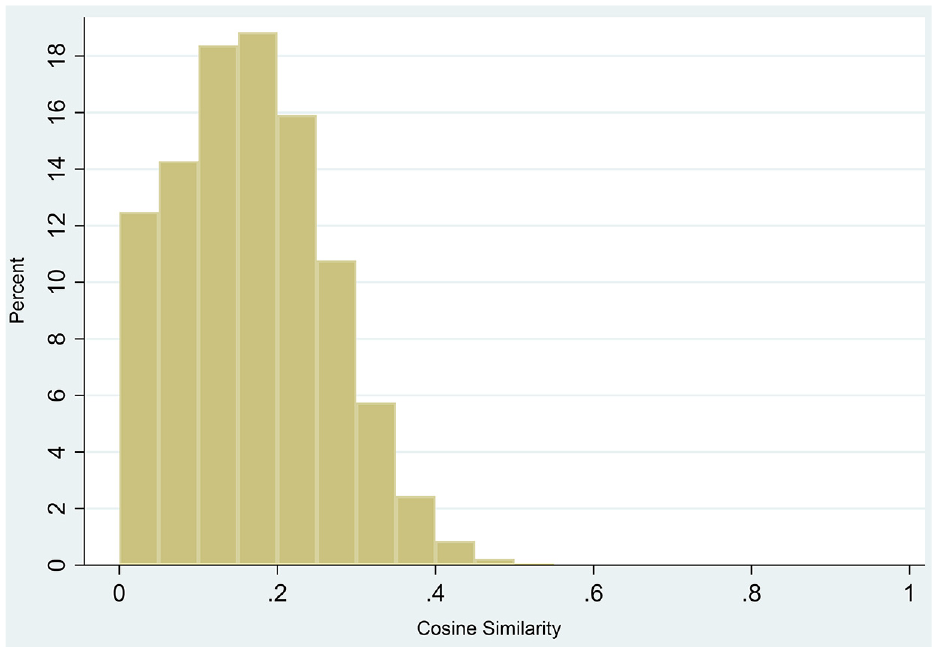
Distribution of mission similarities within AZ and NJ schools.
The average cosine similarity is 0.17 and the median is 0.16. To get some understanding of this measure, the cosine similarity between the first and second sample mission statements mentioned above is 0.33, having seven lemmatized words in common. The first and third mission statements, which may read as somewhat more distinct, have a cosine similarity of 0.17, with four words in common. A similarity of 0.17 may then correspond for many paired missions in this corpus to a handful of shared words, so not too many, but ones that could set the tone of the statement (e.g., safe or citizens). We also considered cosine similarities broken down by the factors particularly relevant in the topic models (e.g., charter status, state, and instructional level), but found modest differences. 5
More broadly, we also want to examine the spread of similarities: 50% of the similarities lie between 0 and 0.16, 40% lie between 0.16 and 0.3, 9% lie between 0.3 and 0.9, and less than 1% are above 0.9. Put another way, about 1 out of 10 comparisons are moderate to substantial (i.e., 0.3 and above). Similarly, if we look at the distributions of similarities for each school individually, and take the average of their 90th percentile value, we obtain 0.27. This means a typical school will have its mission moderately, or more, similar to 10% of other school missions; conversely, its mission will have low similarity values with 90% of other missions. These are substantively bounded estimates since we are not considering synonyms. Combined with the word frequency analyses, the cosine similarity analysis further suggests schools are partially sharing a mission vocabulary, but with different sets of schools emphasizing different parts of the mission lexicon beyond the handful of most common words.
Validation
Text analytic models, including topic models, require attention to validation issues. There are different conceptions of validity when carrying out content and text analyses. In this study we considered measurement validation in two forms: statistical and semantic (Grimmer & Stewart, 2013; Isoaho et al., 2021; Quinn et al., 2010). With statistical validation we focus on various fit statistics that can provide some guidance on whether the model is over-fitting (DiMaggio et al., 2013; Ying et al., 2022). In semantic validation we assess the extent to which the model outputs (i.e., topics) have a coherent, plausible interpretation (Quinn et al., 2010). The details of the statistical and semantic validation checks can be found in Supplement B. Overall, we believe they provide supportive evidence for our topic modeling choices, namely, the number of topics, and our subsequent interpretations.
In addition, we considered the external validity of the results. That is, are the results generalizable beyond Arizona and New Jersey? We carried out a preliminary assessment of external validity by examining a small random sample of school mission statements (
Conclusions
Our study, focusing on mandated school mission statements from Arizona and New Jersey, expands the prior literature by considering covariates that have received limited attention and by utilizing innovative text mining techniques. Employing structural topic modeling, five themes (topics) emerge as most prevalent. The themes are in-line with prior work and broadly address key purposes within the US context related to social, academic, and civic development with an emphasis on a safe environment and a sense of community. Moreover, the topics seem to balance collective and individual goals of schooling (Hochschild & Scovronick, 2003). The five topics most related to collective goals (Topics 1, 2, 5, 9, and 12) have a combined prevalence of 0.40 while the remaining seven topics, mostly related to individual goals, have a combined prevalence of 0.60. Although individual-related goals achieve a majority, schools may be seeking to address and balance these different goals.
In terms of the drivers of school mission topics, like previous studies, we find minimal influence from an array of school characteristics and local contextual factors, including now political inclinations. However, when considering the type of school, being a charter distinctly influences the presence of select topics and select words. Compared to regular schools, charters are more likely to emphasize preparing for college, academic approaches, and character and family ties. Charters’ missions more frequently include the words academic, college, character, and rigor but less frequently include the words community, global, citizens, and responsible. Charters’ relative lower emphasis on community and citizenship themes and words may seem to align with arguments that pose certain charter schools, and the school choice movement more broadly, as potentially undermining traditional public schooling and efforts (Ravitch, 2016). While we do not find much influence from local contextual factors, we did uncover substantial state-level differences in schools’ missions, as in Stemler et al.’s (2011) work. Schools and their leadership may be responding to state level cultural and institutional factors, as well as professional inclinations.
Our analyses of word frequencies and mission similarities suggest school mission statements across the nation are in part employing a common discourse or shared “mimetic language,” as Schafft and Biddle (2013) would assert. To a degree, our findings would be consistent with a scenario in which ten or so different types of mission statements, each including a bundle of topics or themes, had become part of a standard school mission repertoire in the US context. As Ingle et al. (2020) state, this sharing of mission language is not necessarily a drawback since “common language may demonstrate alignment and commitment to shared educational goals.” At the same time, we also found differences manifested at the institutional level (charters vs regular schools; high schools vs non high schools), the state level (Arizona vs New Jersey), and even the school level given that the bulk of mission comparisons (90%) have low similarity values. That is, schools are displaying both a common and differentiated discourse in relation to their goals.
In terms of future questions for research along the lines of this study we see several fruitful possible paths. Methodologically, we found that topic modeling was very well-suited for the study of school missions. More work can be carried out with other text analytic techniques that take into consideration synonyms, bundles of words, or words in context. Substantively, there are still many questions in terms of the evolution of school purposes across time and settings for which text analysis could be helpful. This present study can be expanded to a large national sample of schools, allowing to probe the impact of local political inclinations and state level differences more thoroughly. Also, school mission statements can be examined across time with attention to evolving trends, such as the rise in accountability in the last decades, or in more recent years the rise in local concerns with districts’ versus parents’ control. While we found that local political leanings did not impact missions’ topics to a significant degree this might be changing (e.g., Odabaş & Aragão, 2023). Finally, we found a higher degree of distinctiveness among charter schools’ missions. But charters themselves are truly diverse institutions, in terms of charter authority, management, and focus, which suggests more work can be carried out to unpack these implications.
What may warrant further attention, which was outside the scope of this study, is how school mission statements are developed and how they relate to actual school practices and outcomes (see Gurley et al., 2015; Sevier, 2017). With regards to the development of mission statements, one implication from this study is that more attention to both thoroughness and specificity might be warranted. After all, half of the missions studied were less than 50 words long, which may not be sufficient to convey even the handful of prevalent themes. That is, though missions are expected to be pithy statements, schools’ purposes are veritably multiple which may require more expansiveness. In addition, the fact that overall local school and contextual factors had a minor impact on mission themes, and that schools did resort to a degree to a generic vocabulary, suggests more goal specificity may be warranted. In general, this may provide an invitation for school leaders to more actively engage with their community to unpack their shared mission.
Supplemental Material
sj-docx-1-sgo-10.1177_21582440231218495 – Supplemental material for More than Meets the Eye? Using Text Analytic Techniques to Unpack School Mission Statements
Supplemental material, sj-docx-1-sgo-10.1177_21582440231218495 for More than Meets the Eye? Using Text Analytic Techniques to Unpack School Mission Statements by Valentina A. Bali and Devin Higgins in SAGE Open
Supplemental Material
sj-xlsx-2-sgo-10.1177_21582440231218495 – Supplemental material for More than Meets the Eye? Using Text Analytic Techniques to Unpack School Mission Statements
Supplemental material, sj-xlsx-2-sgo-10.1177_21582440231218495 for More than Meets the Eye? Using Text Analytic Techniques to Unpack School Mission Statements by Valentina A. Bali and Devin Higgins in SAGE Open
Footnotes
Acknowledgements
The authors would like to thank Emily Hatch for assistance in collecting the national sample of mission statements. We also would like to thank the Department of Political Science (MSU) for providing research funds. Finally, we thank the reviewers for their insightful comments.
Declaration of Conflicting Interests
The author(s) declared no potential conflicts of interest with respect to the research, authorship, and/or publication of this article.
Funding
The author(s) received no financial support for the research, authorship, and/or publication of this article.
Ethics Statement
this study did not involve human or animal subjects.

Supplemental Material
Supplemental material for this article is available online.
Data Availability Statement
data analyzed during the study is available upon request from the authors and will be included in the supplementary files upon publication.
Notes
References
Supplementary Material
Please find the following supplemental material available below.
For Open Access articles published under a Creative Commons License, all supplemental material carries the same license as the article it is associated with.
For non-Open Access articles published, all supplemental material carries a non-exclusive license, and permission requests for re-use of supplemental material or any part of supplemental material shall be sent directly to the copyright owner as specified in the copyright notice associated with the article.
