




Abstract
The essential value of sustainability has warranted firms to disclose their environmental, social, and governance (ESG) visions. We conducted a significant data analysis using text mining to assess Korean companies’ ESG perceptions in accordance with the 17 Sustainable Development Goals (SDGs) suggested by the United Nations. Bigram frequency, term frequency–inverse document frequency, semantic network, and convergence of iteration correlation analyses were performed in this study. The results indicate that Korean companies focus on consumer protection, especially digital human rights. However, efforts toward global partnerships, as emphasized by the SDGs, were not apparent. These results suggest important ESG values for countries advancing toward the Fourth Industrial Revolution, which will ultimately contribute to global cooperation and sustainable development.
Introduction
Since the 20th century, sustainable development has been proposed as an alternative strategy for preventing resource depletion and crises (Meadows & Meadows, 2007). Sustainable development requires the joint effort of global civil society, including changes in economic development processes, policymaking (Brundtland, 1987), and, most importantly, efforts toward fulfilling the rising demand for corporate social responsibility (CSR) and environmental responsibility.
Sustainability in business strategies is often decomposed into environmental, social, and governance (ESG) implications (The Korea Chamber of Commerce, 2021). ESG encompasses non-financial and social factors for achieving sustainability. Stakeholders’ demands for an understanding of company performance and vision have increased, leading many companies to disclose their plans for and achievements in sustainable management through corporate sustainability management reports (Velte, 2016). In these circumstances, ESG achievements extend beyond non-financial outcomes and impact business performance.
Corporate sustainability management reports are an official communication method for announcing how a company has contributed to sustainable development based on the United Nations’ (UN) Sustainable Development Goals (SDGs), which serve as a global agenda (United Nations Department of Economic and Social Affairs, 2015). It is necessary to compare specific agents’ SDGs with the UN’s SDGs (as international codes of conduct) to establish the long-term direction of stakeholders responsible for sustainable development. SDGs are thus a popular sustainability framework for businesses, governments, and civil society; they serve as a basis for establishing a vision for corporate sustainability management.
This study examines corporate sustainable management reports in South Korea, focusing on their alignment with the SDGs. South Korea’s notable growth in the ESG market and SDGs index is highlighted through the performance of 15 Korean companies on the Fortune Global 500 list in 2020. The government’s proactive engagement and creation of the K-SDGs further support the effective implementation of the SDGs. Governmental and non-governmental organizations have established favorable environments for discussions on practical sustainable development measures. Under these conditions, Korean companies excel in ESG evaluations.
Our research aims to address the following questions: (1) How do Korean companies implement ESG practices and initiatives? (2) To what extent do Korean companies align their sustainability strategies with SDGs? Against the backdrop of Moody’s Investors Service (2021) positively evaluating South Korean ESG, this study aims to provide practical insights into effective sustainability policies by comparing Korean corporate ESG strategies and the UN SDGs.
Literature Review
Concept of Sustainability
Sustainability implies the ability to cater to the needs of the present generation while also meeting the needs of future generations (Kuhlman & Farrington, 2010). The concept of sustainability first appeared when resource shortages were discussed. As resource shortages lead to economic and environmental problems, multidisciplinary research, including in economics, has been conducted (Wilderer, 2007). Sustainability research has focused on ecological sustainability since the 20th century as a concept for solving climate change and environmental issues caused by industrialization (Dovers, 1994). In the business sector, the triple bottom line (TBL) was introduced to incorporate sustainability into corporate management (Elkington, 1998). The TBL is an operating system of CSR that implies that business behavior harmonizes economic stability, environmental friendliness, and social responsibility (Elkington, 1998). Based on these findings, the concept of sustainability has become the core of the modern economy and has expanded as a strategy for sustainable development. The demand for sustainable development from a business perspective focuses on the ecological and social environment and their role as sound economic agents that contribute to society’s broader and long-term sustainability.
Sustainable Development Goals
As a declarative and practical approach toward a sustainability movement, the SDGs were first proposed at the 2015 UN Summit in New York to provide action plans and guidelines for the world’s future by 2030. The SDGs comprise 17 goals for solving environmental, social, and economic problems (Gupta & Vegelin, 2016). Because each of the 17 targets comprises measurable indicators, they can be easily modified and applied to regional or national circumstances (Meschede, 2020). Thus, SDGs have been widely used as global citizenship codes.
The SDGs emphasize the cooperative efforts of three sectors: business, government, and civil society. Salvia et al.’s (2019) survey analysis of SDG research trends reveals that many studies on SDGs 4, 11, 13, and 15 have been conducted in the United States and Asia. However, European studies tended to focus more on SDGs 4, 11, and 12. The social aspects of SDGs 4 and 11 are common to many countries. Analysis of approximately 2,000 articles on sustainable development further reveals that “sustainable urban development,”“water management,”“environmental assessment,” and “public policy” are popular keywords used by major media worldwide, while common keywords in SDGs literature were “developing countries,”“engagement,”“reporting,”“policies,” and “education” (Caputo et al., 2021). In recent years, SDG research trends have focused on the business sector, including firm roles, innovative idea generation, products/services, and stakeholder impact (Cordova & Celone, 2019). SDGs have had a major impact on the transformation of companies from traditional to innovative business models.
Research on sustainable development cannot be limited to theory but must also require the active participation of companies in practical terms. To expand the vision of the SDGs, the concept of ESG management was introduced in the capitalist market, which became a significant turning point in practical terms when considering companies’ non-financial factors.
ESG as an Approach to SDGs
As the need for sustainable development has increased in the public and private sectors, business entities have incorporated SDGs into their ESG business plans from a long-term and comprehensive perspective. ESG is often described as the expansion and replacement of CSR and involves broader ideas related to overall sustainability (Gillan et al., 2021). By contrast, Hazen (2020) argued that ESG is a subcategory of CSR rather than a replacement thereof. Although there are differences in the relationship between ESG and traditional CSR, both concepts specify the approach required for a sustainable society in the corporate sector.
ESG research is now most grounded in two theories: stakeholder theory, which primarily discusses the overall interactions of stakeholders, and institutional theory, which focuses on the actions of corporations as institutions (Li et al., 2021). Research based on the stakeholder theory calls for interactions between stakeholders and companies using ESG concepts. Farooq et al. (2017) studied the relationship between social responsibility and employee behavior by demonstrating how companies’ socially responsible actions toward employee welfare may positively alter employees’ perceived respect and attitudes. Naughton et al. (2019) found that investors’ sentiments toward social responsibility activities may influence companies’ social responsibility movements. Research based on the institutional theory focuses on corporate actions using the ESG concept. Jayachandran et al. (2013) showed that the social (S) dimension has a more substantial positive impact on corporate performance than the environmental (E) dimension. A. I. Nour et al. (2022) emphasized the significance of disclosing social sector information in the case of Jordanian and Palestinian firms.
Empirical research on corporate governance offers practical findings on the positive effects and outcomes of ESG. Traditionally, corporate governance attributes have been recognized as playing a crucial role in ensuring organizational legitimacy through CSR disclosure (Khan et al., 2013). For instance, board diversity positively affects the extent of CSR disclosure and corporate performance (Khatib & Nour, 2021; A. Nour et al., 2020). Similarly, Fayyaz et al. (2023) found a positive relationship between corporate governance, board size, gender participation, and dividends per share.
There exists compelling evidence for the positive effects and outcomes of ESG. These findings shed light on companies’ endeavors toward sustainability, as reflected in their sustainability reports, thus informing our research objectives. Understanding the current corporate sustainability landscape can help us establish a valuable foundation for proposing future research directions. Consequently, it is crucial to find a rationale for understanding the values and goals of companies’ current ESG strategies to find a practical approach to SDGs.
ESG aims at balancing the sustainability goals of all stakeholders; it seeks to reflect sustainability between society and the environment, at the intersection of which SDGs can be applied to corporate management. This SDGs-ESG relationship has become an essential topic of research. Plastun et al. (2020) identified the relationship between a country’s position in the SDGs ranking and ESG disclosure regulations, showing that the more the ESG disclosures, the higher the SDGI ranking. Indahl and Jacobsen (2019) studied the ESG disclosure regulations and SDGs of Norway, whereas Bala (2018) focused on the same aspects in Bangladesh. Leleux and van der Kaaij (2019) focused on the connection between SDGs and ESG ratings and evaluations of the stock market. Khaled et al. (2021) described a link between ESG scores and the SDGs. These studies indicate that explicit ESG efforts are associated with advanced sustainable development. Our research strengthens the depth of research on the relationship between SDGs and ESG using text mining techniques to analyze corporate ESG reports based on SDGs.
Text Mining Analysis
Text mining analysis is a method for automatically extracting hidden information from vast amounts of data. The core function of text mining is to extract meaningful facts from large quantities of data and create hypotheses by effectively connecting the extracted information (Gaikwad et al., 2014; Inzalkar & Sharma, 2015). Studies on the modeling and analysis of unstructured data have increased, accelerating the development of new tools for handling unstructured documents.
Over the past few years, various text mining techniques have been actively used in SDGs research. Sebestyén et al. (2020) conducted a comparative analysis of national reviews of sustainable development using n-grams, network analysis, and a clustering approach. By applying multiple text mining techniques, they aimed to identify specific themes from the sustainable strategies of each country and clusters of countries facing similar problems. Research themes and gaps, specifically in SDG 6, have been identified using cooperation networks, theme networks, and cluster analysis. There now exists a conceptual framework of SDG 6 and a classification of the relationships between the environment, economy, and society (Roy et al., 2022).
Polychronopoulos et al. (2021) used latent Dirichlet allocation (LDA) topic modeling analysis to obtain insights into entrepreneurs’ engagement in SDGs. In topic modeling, the entire dataset is analyzed by inferring the characteristics of each topic based on keyword extraction results (Alghamdi & Alfalqi, 2015). Term frequency–inverse document frequency (TF-IDF) is widely used in text mining analysis as a tool for testing the relevance of words. Aiba et al. (2020) used the TF-IDF algorithm as a background for their suggested ESG scoring method, and Taleb et al. (2020) used it to directly compare the values of ESG and SDGs.
Semantic networks and convergence of iteration correlation (CONCOR) analyses are popular techniques for comparison studies in ESG-related fields. Moon and Kim (2022) reviewed Korean corporations’ ESG strategies and pursued the value of human rights development (HRD) programs using CONCOR analyses. They used CEO messages contained in the sustainability report and were able to observe how the disclosure of ESG and HRD themes was formed. Jo and Kim (2017) also used semantic network analysis and CONCOR analysis to compare the ESG strategies of Starbucks in South Korea and the US. They revealed distinct differences in marketing strategies and customer-corporate relations between the United States and South Korea.
As the preceding literature shows the useful applicability of text mining methods for the exploration and analysis of ESG strategies, we adopted text mining analysis in our study to view and compare corporate ESG efforts and SDGs.
Methodology
Data
We collected sustainable management reports of the top 300 companies in the Korean stock market. We compiled the most up-to-date sustainability reports since 2019, noting that Korea’s gradual mandatory disclosure of reports on corporate governance, an area of sustainable management, began in 2019. Since 2019, the Korea Exchange has made corporate governance report disclosures mandatory. Subsequently, the Financial Services Commission announced a plan for the compulsory gradual disclosure of sustainable management reports in 2021. Given this progress, we collected sustainable management reports of 300 Korean companies from 2019 to 2022 through their websites. We then removed non-English samples, as well as if a company shared the same report as its affiliates. Finally, the sustainable management reports of 101 companies from 2019 to 2022 were used as data.
Analysis
As shown in Figure 1, this study follows sequential stages of natural language processing and text analysis to compare and characterize the sustainable management reports of Korean companies with the SDGs. Throughout the process of natural language processing and text analysis, we step closer to our research questions of finding and providing practical insights regarding Korean ESG and sustainability policies. As the first step, a bigram analysis was conducted by dividing the entire report and appendix based on the parts dealing with SDGs. The differences are shown in a Venn diagram. Additional unigram frequency and TF-IDF analyses were conducted for the entire report to analyze crucial words. A semantic analysis was performed to grasp the semantic importance of words in context by obtaining the relationships between words in the entire report. Finally, LDA topic modeling was conducted to explore topics valued by Korean companies for sustainable management. Through this process, it was possible to understand what Korean companies valued in sustainable management reports and the interrelationships between the visions of each company. By analyzing these reports, we attempted to interpret and compare the results based on SDGs. A comparison between corporate ESG strategies and SDGs indicates the position of Korea’s vision of sustainable development from a macro perspective.

Analysis flow chart.
Feature Extract by Natural Language Processing
Data pre-processing was performed before any computational analysis to improve the overall data quality and consistency of the raw report. The collected reports were then reclassified according to their subheadings. Introductions and appendices were removed because they were inappropriate for grasping corporate trends, and the text containing the company’s ESG situation was partially extracted. Finally, 1,631 different subtexts were extracted from 101 companies. Morphemes were selected and pre-processed using proper and complex nouns as analytical articles. Parts with verbs, adjectives, and nouns were not included in the analysis to objectively identify ESG trends. After morpheme analysis, meaningless words were refined using functions such as thesaurus, negative dictionary, and designated dictionary.
The entire report is divided into subsections to better reflect the meaning of each ESG topic. The primary analysis methods include text mining, such as word cloud analysis, TF-IDF analysis, and semantic network analysis. CONCOR analysis was performed to visualize the word networks.
Through n-gram analysis, the frequency of the simultaneous appearance of words, where n words appear as serial probabilities, can be measured. Although unigrams help identify only the frequency of the simple appearance of a specific word, n-grams are more effective in grasping the simultaneous appearance relationship between words.
The TF-IDF method calculates each document's characteristic words using sentences categorized in the subsection. TF-IDF analysis is a consistent and effective measurement method for quantifying the importance of each word in a specific document (Taleb et al., 2020). As the TF-IDF value increases and the number of documents containing that word decreases, it is suitable for finding important specific words that cannot be found in keywords with a high word frequency. This is a sophisticated method for controlling the frequencies of commonly used words. Thus, TF-IDF analysis provided hints for noteworthy words.

Semantic network analysis is a network informatics approach that extracts meaningful words from language messages and constructs a network based on semantic relationships (Drieger, 2013). This is a helpful method for analyzing the various semantic characteristics of language messages using network analysis indicators. In this study, semantic network analysis was performed to identify the frequency and relationship of words, extract the meaning or conceptual characteristics inherent in the messages of sustainability reports, and identify the relational attributes between them. The network was visualized using CONCOR analysis, a method for finding an appropriate level of similar groups by repeatedly performing a correlation analysis between nodes. The cosine similarity generates a word-relation matrix that represents the similarity between words.

Topic modeling is a statistical tool used to discover hidden contexts in extensive unstructured data. Although various sources and forms can be applied, text data are best suited for topic modeling (Vayansky & Kumar, 2020). Since its emergence, topic modeling has been considered an influential technique for extracting meaningful structures by exploring the latent patterns of word use and linking documents with related patterns (Zhu et al., 2016). Topic modeling has been used in various fields, including science, social science, and engineering. Although topic modeling involves several algorithms that handle data, LDA is the most common and has been refined by addressing the defects of previous algorithms. This study used LDA topic modeling to analyze several electronic reports. An important issue when applying the LDA model is determining the optimal number of topics. In general, the criteria for determining the number of topics are perplexity, which indicates the predictability of the results of a specific probability model, and coherence, which indicates the degree of topic aggregation (Zhu et al., 2016). When applying LDA, the optimal number of topics can be determined by comparing and analyzing the results of the derivation of three to ten topics, depending on the study’s usefulness, validity, and interpretability (Nahm, 2016). We attempted to conduct an objective analysis by excluding researcher subjectivity as much as possible. The results were interpreted by referring to relevant literature and establishing an objective interpretation method through a mutual review by our research team.
Result
N-Gram Word Frequency Analysis
The sustainable management reports of Korean companies are composed of subsections, including the introduction, main text, and appendix. The appendix contains pages dealing with the SDGs. A separate page in the appendix explains the company’s vision of sustainable management in conjunction with the SDGs. In this study, a bigram analysis was conducted by collecting only SDGs pages from the report appendix.
Figure 2 presents the results of the bigram frequency analysis of the SDGs of the 101 companies expressed in the word cloud. With the UN SDGs, companies mainly focus on goals such as local communities, social contributions, greenhouse gas (GHG) emissions, climate change, and quality education. Keywords such as “decent work” and “renewable energy” also appeared. Thus, it can be confirmed that it is mainly composed of keywords such as contributions to the local community, eco-friendly activities, and employee welfare.

SDG-goals word cloud.
Subsequently, a bigram frequency analysis was conducted on the entire report to understand the focus of the content. Figure 3 shows the results of the word cloud frequency analysis for the entire report. From this, it can be observed that Korean companies’ sustainability management reports focus on keywords such as “human rights,”“social distribution,”“local community,”“climate change,” and “safety health.”

Entire report word cloud.
For an in-depth interpretation of the bigram frequency analysis of Korean companies’ sustainability management reports, 50 words with high frequency were represented in a Venn diagram. Their classification into “environmental,”“social,” and “governance” categories follows the SDGs classification system presented by DiligenceVault (2019). The words corresponding to each ESG element are shown in Figure 4.

SDG-goals in ESG.
TF-IDF Result
TF-IDF analysis was performed on all data. In addition, a unigram frequency analysis was performed to compare the differences between the simple frequency analysis and TF-IDF analysis. Table 1 lists the top 30 words derived from the term frequency–inverse document frequency (TF-IDF) analysis and unigram word frequency analysis of the entire dataset.
Result of Word Analysis.

The most frequent keywords in the report were “employee,”“business,”“company,”“risk,”“safety,” and “customer.” In addition, words such as “information” and “environment” were prominent. Based on the TF-IDF analysis that calculates the importance of a word in the document set, “consumer,”“climate,”“chemical,”“manage,”“economic,” and “responsible,” in this order, appeared at the top. This demonstrates the interest of Korean companies in employees, risk management, and environmental and climate change. The word “consumer” did not appear frequently and had high semantic importance. A similar term, “customer,” had a high frequency, indicating that Korean companies place significant value on their customers in sustainability management reports.
Semantic Network Analysis Result
For semantic network analysis, the centrality value of the word was calculated based on the co-occurrence frequency of the words appearing in the sustainability reports of large Korean companies, as presented in Table 2.
Result of Semantic Network Analysis.
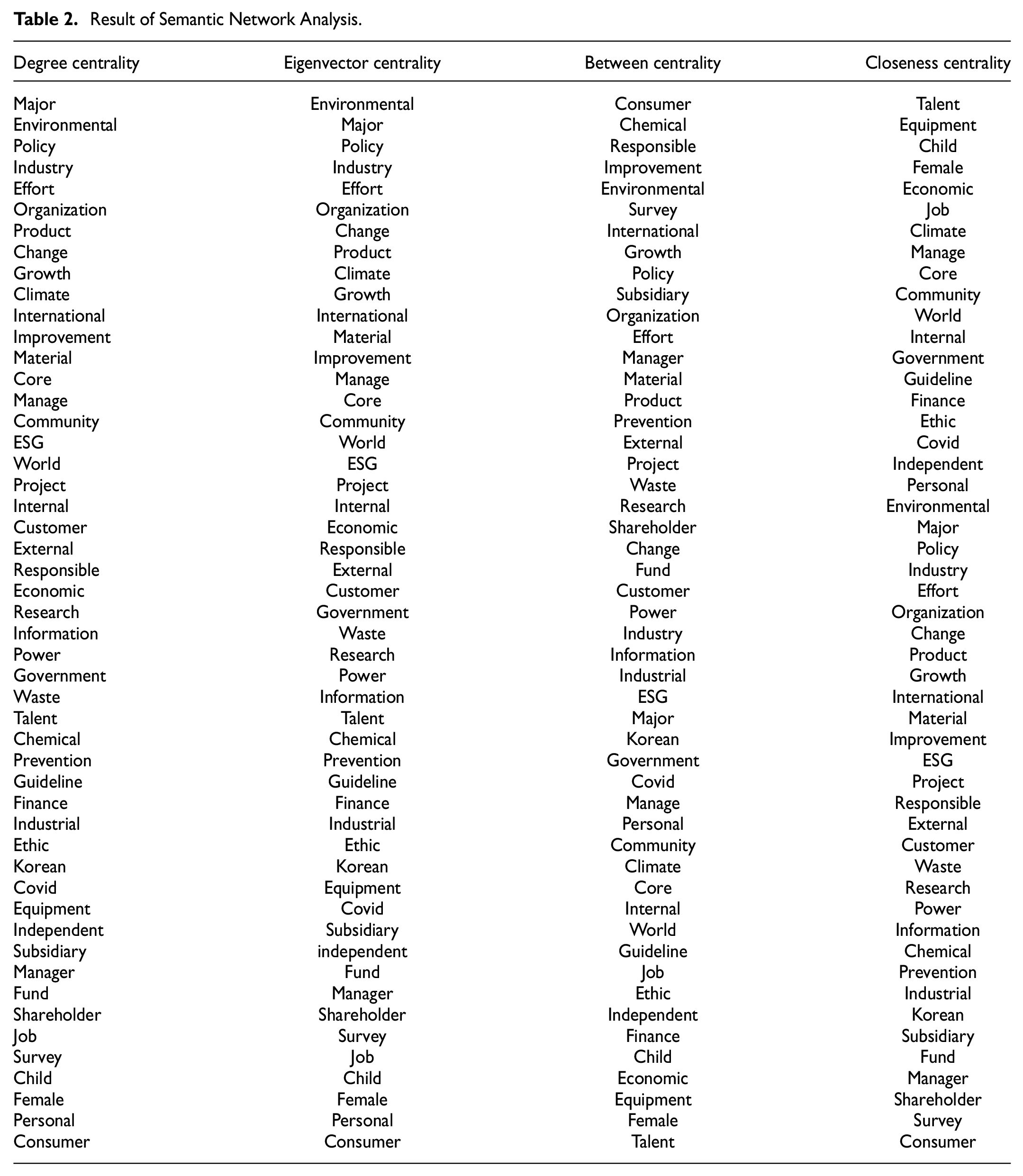
The centrality of the words was calculated as the degree centrality, eigenvector centrality, centrality, and closeness centrality. Degree centrality refers to the number of connections that a comment has and is central to. Eigenvector centrality is one step deeper; words with high connectivity are analyzed by considering the connectivity among highly connected words. For between centrality analysis, the higher the centrality, the more important its role in the diffusion of meaning in the network. Closeness centrality focuses on independence and measures centrality based on the distance between words, with the minimum number of steps required to reach one word to another.
By analyzing words with high centrality, the similarities and differences between centralities can be found. High centrality values were generally observed for environment; however, each centrality differed. The degree and eigenvector centralities generally have similar central words. Keywords related to environmental and climate change generally have high centrality. Like degree centrality and eigenvector centrality, between centrality shows interest in the environment, but the keyword “consumer” has the highest centrality. Thus, it is possible to understand the consumer interests of Korean companies. In closeness centrality, keywords that did not stand out in other centrality analyses, such as “talent,”“child,”“female,” and “job,” appear. These words were related to employee employment and lives. In other words, words related to equal employment and employee welfare strongly influence closeness centrality, indicating contextual similarity between Korean companies’ sustainability reports.
CONCOR Analysis Result
This study identified the connection structure between words, analyzed the centrality of the degree of connection, and quantified the degree of relationship between words. UCINET was used to derive clusters formed by words with similar meanings by conducting a CONCOR analysis (Figure 5).
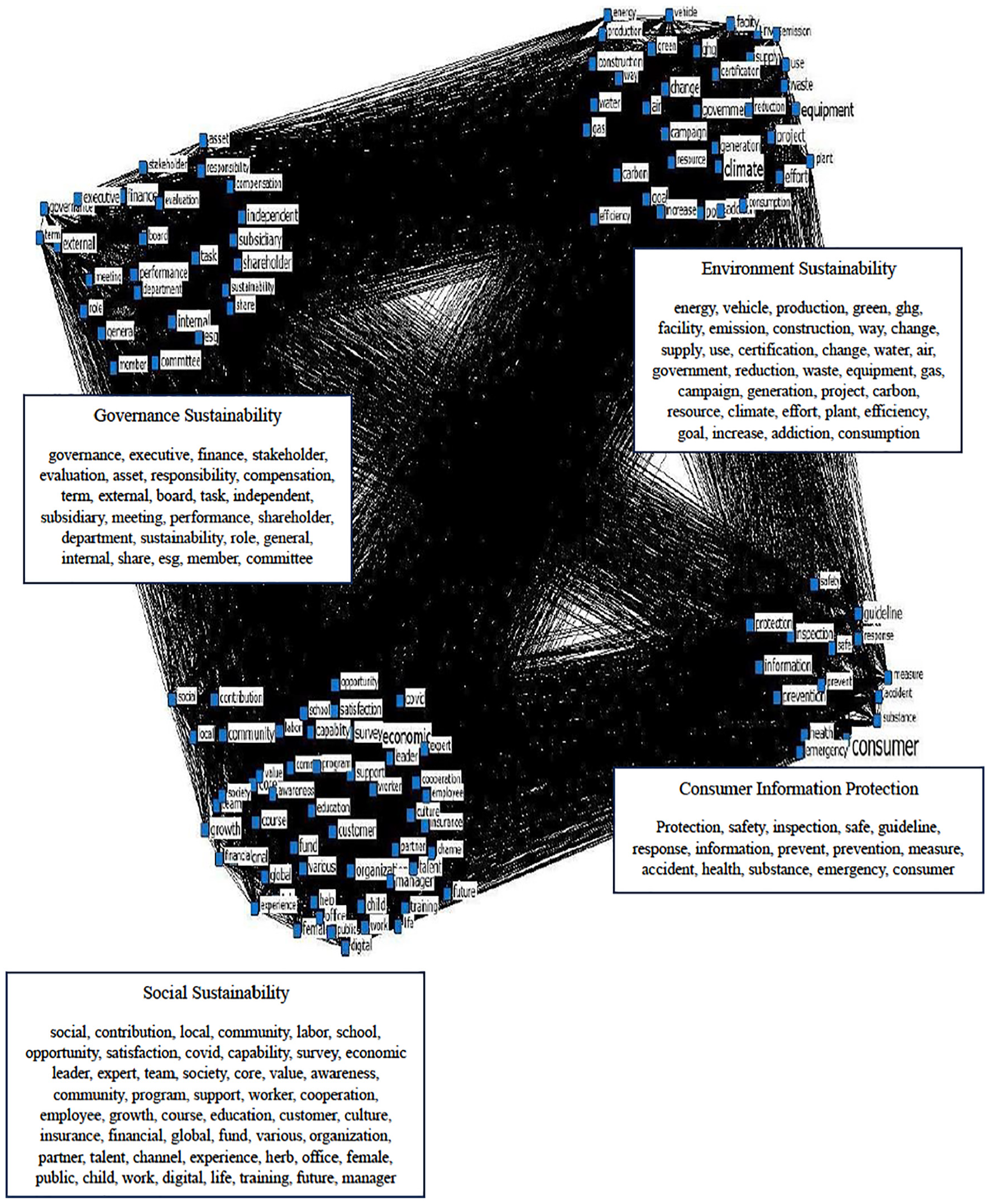
CONCOR network.
Based on CONCOR analysis, four clusters were formed. From each cluster, we confirmed which words were related to the keywords. Word relationship information from earlier word analysis results was used to interpret the CONCOR results. The main context of the report was understood more accurately by combining the results of both analyses.
In the first cluster, it was confirmed that keywords such as “shareholder,”“committee,”“governance,”“stakeholder,”“asset,”“valuation,” and “board” form a group. These words correspond to the governance aspects of ESG. Therefore, the first group was named “governance sustainability.”
The words appearing in the second cluster are “climate,”“change,”“greenhouse gas,”“carbon,”“energy,”“water,”“waste,”“green,” and so on. These words correspond to the environment, and these groups were named “environment sustainability.”
The third cluster consisted of words corresponding to the social aspects of ESG. This group contains words related to social contributions, such as “social,”“contribution,”“local,” and “community.” In addition, words related to employee welfare and employment, such as “labor,”“worker,”“child,”“training,”“employer,”“talent,” and “female,” were also observed. Employee welfare and equal employment are important issues discussed as social responsibilities that companies must ensure to ensure sustainable growth. Words such as “economic,”“financial,” and “growth” are also included, which indicate the direction of sustainable growth through a company’s financial influence. The keyword “COVID,” the most discussed social issue since 2020, was also noticeable. The third cluster deals with the social issues emphasized by ESG over a wide range, from community contributions to employment systems and economic growth. Considering this, the third cluster was named “social sustainability.”
Words appearing in the last cluster include “consumer,”“protection,”“information,”“prevention,”“guideline,” and “health.” This includes the protection of digital consumers’ personal information. This finding indicates that Korean companies deal with consumer and personal information protection in a single context. Considering these characteristics, the last cluster was named “consumer information protection.”
Topic Modeling Results
The results of the sustainability report analysis were analyzed by comparing them with the 17 SDGs proposed by the UN. Table 3 presents the keywords and the 17 main SDGs presented by the UN.
United Nations’ SDGs.

This study compared topic derivation results by varying the number of topics from 3 to 17. By comparing the coherence and perplexity, the number of topics that best represented the meaning of major topics in the sustainability reports of large Korean companies was considered. Finally, the six topics judged to be the most appropriate were extracted. Topic modeling was performed based on unigram words, but the bigram analysis results were also referenced to accurately grasp the context of the words in the interpretation process. Table 4 lists the main keywords corresponding to the six topics.
Results of Topic Modeling Linked With SDGs.

Note. GHG = greenhouse gas; Pulmuone = Pulmuone Co., Ltd. It is a South Korean company that produces plant-based foods.
Topic 1 is related to overall business risk management, derived from words like “safety,”“risk,”“information,”“business,”“protection,”“human,”“right,”“health,”“security,” and “ethic.” These words pertain to the protection of human rights, particularly personal digital data. Clearly, in the SDGs, human rights are a critical topic, and Korea treats both human and digital human rights as essential.
Topic 2 comprised keywords related to environmental and climate change. “Environmental” appeared as the main topic, followed by keywords such as “energy,”“emission,”“water,”“chemical,”“plant,”“gas,” and “reduction.”“GHG,”“climate,”“green,”“recycling,” and “carbon” are also included in the second topic. All these keywords indicate the interest of Korean companies in eco-friendly sustainable development.
In Topic 3, words such as “social,”“business,”“financial,”“value,”“activity,”“growth,”“contribution,”“local,”“community,” and “performance” were extracted. In the previous bigram frequency analysis, “social contribution” and “local community” appeared most frequently. These words reveal interest in activities and performances related to social contributions and the local community.
For Topic 4, keywords related to “customer service” were extracted. Keywords such as “customer” and “service” are primary, followed by “product,”“quality,”“market,”“sale,”“consumer,” and “innovation,” In the previous semantic analysis, “consumers” was identified as one of the most important words for Korean companies. Topic 4 reflects these results and shows which words are closest to consumers: life and services. Consumer topics focus on services provided to consumers throughout their lives, such as markets, products, sales, and innovation in consumer life.
Topic 5 comprised words related to employee welfare, centered on the keyword “employee.” Keywords such as “employee,”“program,”“work,”“training,”“working,”“children,”“education,”“job,”“talent,” and “family” were also extracted. Through this topic, it is possible to understand how Korean companies deal with employee welfare. They actively support the improvement of employees’ abilities through education and various workplace programs. In addition, companies manage their welfare outside of work by caring for their families and children.
Finally, keywords such as “committee,”“board,”“shareholder,”“meeting,”“executive,” and “governance” were extracted for Topic 6, corresponding to governance. In sustainable management reports, Korean companies emphasize the board of directors and shareholders’ efforts for fair and ethical management. All companies separated the “environmental,”“social,” and “governance” aspects for emphasis. Furthermore, the vision of governance showed a similar pattern.
Discussion
Sustainability is an essential requirement for firm survival. The growing demand for a sustainable society, coupled with evolving technology and changes in the investment landscape, is a driving force behind sustainable development. Against this backdrop, this study explores the ESG management practices implemented by Korean companies, aligning them with the UN’s proposed SDGs. By examining the current state of ESG management and contemplating its future direction, this study sheds light on prevailing practices and identifies potential pathways for ESG management. The findings of this study contribute to the ongoing discourse on sustainable development and its pivotal role in shaping the future of Korean businesses. Overall, by analyzing Korea’s sustainable management reports within the framework of the SDGs, we identified both common and unique areas of focus pursued by Korean companies.
Comparison of SDGs and Korean Companies’ ESG
A bigram frequency analysis of keywords and aligning them with individual SDGs, we discovered that Korean companies commonly prioritize social contributions and climate change responses within their ESG management practices, reflecting their alignment with international sustainable development objectives. This suggests that while Korean companies emphasize common goals, such as community contribution, climate change, and human rights protection, they also recognize the importance of addressing issues specific to Korean society. Furthermore, the topic modeling results showed how Korean companies focused on six main topics corresponding to the “environmental,”“social,” and “governance” aspects, whereas the remaining three topics represented factors that Korean companies were particularly interested in beyond the general ESG vision.
The first category deals with general safety and management policies. Companies must deal with diverse risks, including business risks, human rights of customers and employees, and ethical issues. In the era of the Fourth Industrial Revolution, in which the digital transition is actively underway, human rights, including privacy and information protection, have become important issues. This topic indicates that Korean companies are showing interest in human rights protection and crisis management and that they consider a wide range of safety aspects, from health to information protection (Andriushchenko et al., 2020). This is similar to the efforts emphasized in SDGs 3 and 9. These goals aim to create a healthy society by responding to crises that harm sustainable development and by establishing a healthy infrastructure. Goal 9 aims to build residential infrastructure, promote sustainable industrialization, and foster innovation in a sustainable society. It emphasizes ensuring affordable prices and the provision of infrastructure to support human welfare. The UN stated that the effects of establishing national human rights installations, despite the probable duration of the pandemic, need to be reinforced. Topic 1 indicates that Korean companies sympathize with this goal. In particular, the approach to “information protection” is a new movement, not yet emphasized by the SDGs, indicating that Korea is taking the lead in digital human rights protection.
Topic 2 deals with words related to the environment that are essential for sustainable development. All companies showed their efforts and interest in the environment, such as working to combat climate change and prevent environmental pollution. The SDGs also emphasize efforts to protect the environment through various detailed goals. These goals provide direction for developments related to ensuring safe drinking water, sustainable energy sources, response to climate change, and the conservation of marine and terrestrial ecosystems. Topic 2 shows that Korean companies meet the goals suggested by various SDGs. These results reveal a common interest in the environment among companies and show that eco-friendly attitudes and efforts are essential for sustainable development.
Topic 3 shows that Korean companies also participate in social responsibility as emphasized by the SDGs. By analyzing this topic, it was confirmed that “social contribution,”“local community,” and “economic growth” were taken in one context. In other words, economic growth is emphasized as a way to contribute to the local community and create a sustainable society. What is noteworthy is the difference between the word “partner” in Topic 3 and the concept of “partnership” covered in SDG 17, which aims to strengthen the means of implementation and revitalization of the global partnership for sustainable development. However, the previous bigram analysis and Venn diagram confirmed that most Korean companies focus on partnerships with domestic companies.
Topic 4 indicated that Korean companies pay significant attention to customers. The previous TF-IDF analysis also confirmed that Korean companies consider consumers valuable. As consumer influence increases, companies must produce sustainable value for consumers. The SDGs also emphasized these efforts through Goals 2 and 12. Goal 2 aims at ending hunger, achieving food security, improving nutrition, and promoting sustainable agriculture. Topic 4 also deals with issues facing consumer life, such as food and the market, and considers the overall quality of life of consumers. Goal 12 emphasizes the efforts to achieve sustainable consumption and production. The UN has insisted on implementing a 10-year program for sustainable consumption and production under the leadership of developed countries. Topic 4 represents the interests of Korean companies regarding this sense of responsibility. The analysis of sustainable management reports confirms that Korean firms are taking the lead in building a healthy social infrastructure through sustainable consumption and production, as emphasized by the UN.
The words appearing in Topic 5 had a configuration similar to the words with high closeness centrality in the previously implemented semantic network analysis. Indeed, companies have enormous social responsibility toward their employees for sustainable growth (Majid, 2020). The Korean companies analyzed herein emphasize their efforts toward employee welfare at the corporate level in their sustainability management reports. They claim to establish various systems to ensure fair employment and a better quality of life for their employees. They also provide various educational and training programs to employees to help them improve their vocational skills. This effort is emphasized by SDGs 4, 5, and 8, which contend that learning opportunities should be provided to help all humans obtain quality jobs. They also emphasize the establishment of not only a fair employment system and equal workplaces for all humans but also a healthy social foundation based on work-life balance. Topic 5 shows that Korean companies pay great attention to the goals emphasized by the UN SDGs.
Finally, Topic 6 consists of keywords corresponding to “governance.” The need for a fair governance structure beyond environmental and social efforts for sustainable growth has long been discussed (Farooq et al., 2017). The SDGs have also emphasized the responsibility for sustainable growth in terms of governance through Goal 16. Major Korean companies divide their sustainability reports into separate “environmental,”“social,” and “governance” reports to reveal their efforts to establish fair governance structures. This is understood to have the same context as the responsibilities emphasized in SDG 16. Topic 6 is related to governance, showing that Korean companies pay attention to all three factors.
In this analysis, Topics 1 to 6 were mapped to SDGs, each with the same vision, and the development goals presented by Korean companies were compared and analyzed. However, of the 17 SDGs, Goal 10 did not match any topic for Korean companies. SDG 10 addresses the concept of reduced inequality. As the UN deals with sustainable development at the global level, efforts toward inequality are emphasized as a distinct topic. Unlike other goals, Korean companies do not emphasize or deal with efforts to reduce inequality separately. This may reflect the ethnic homogeneity of Korean society. Thus, there may be a blind spot in the pursuit of globally cited SDGs. However, as Korea is increasingly emphasizing multicultural factors and diversity, Korean companies must incorporate concrete responses to inequality into their ESG visions.
Unique Areas of Korean Companies’ Sustainable Management
First, we identify unique areas of interest for Korean companies that were not explicitly specified in the SDGs. The results of the bigram analysis revealed keywords such as “information protection” and “personal information,” indicating the significance of Korean companies in these domains. This finding suggests that practices aimed at preventing consumer information leakage and enhancing security in the information environment are firmly established as integral components of ESG efforts in Korea. We also identified keywords that exhibited significantly higher centrality and played a key role in forming and expanding the semantic structure and context. Based on the TF-IDF results, “consumer” emerged as a keyword with relatively low frequency but ranked first in terms of TF-IDF frequency and between-centrality, highlighting its contextual importance.
The CONCOR analysis yielded four clusters, elucidating the relationships among the keywords. In particular, Cluster 4 revealed factors that hold a specific interest for Korean companies, going beyond the general scope of the SDGs and encompassing consumer and personal information protection within a single context. Overall, these findings indicate that Korean companies attach significant importance to consumer protection, particularly information protection. As entrepreneurial organizations worldwide embrace innovative approaches to address various social challenges through digital technology (George et al., 2021), Korean companies strive to have a positive societal impact through sustainable management in the digital realm.
Second, Korean companies pursue partnerships between society and the government, as emphasized by the SDGs, to achieve the common goal of sustainability. However, as previously discussed, notable differences were observed in the scope of partnerships. While the UN SDGs aim to establish a global framework for sustainable development, our bigram analysis revealed that Korean companies often focus on partnerships with specific terms such as “fair trade” and “business partner.” The influence of these bigram words associated with partnerships was found to be narrower in comparison with a focus on domestic collaborations rather than broader global concepts such as trade or official development assistance cooperation. Consequently, while the partnership perspective of the UN encompasses a broad perspective, including developed and developing countries, most Korean companies demonstrate a narrower scope of cooperation within their own countries, such as cooperation between large companies and small and medium-sized enterprises (SMEs).
Third, our research identified Korean companies’ interest in their employment and employee welfare. Employment and welfare are among the main aspects of ESG’s emphasis on sustainable growth (Gillan et al., 2021). By analyzing the employee policies of Korean companies, we can confirm that harmony between companies and employees is consistent with the global vision. Korean companies’ policy of equal employment is reflected in words such as “female” and “fair,” whereas harmony between work and daily life is demonstrated by terms such as “family” and “child.” In addition, words such as “education” and “training” indicate that individual employee competence improvement is also a concern. It was confirmed that Korean companies’ policies toward employees align with the virtues emphasized by the UN in that the SDGs also emphasize equal employment and growth through jobs (Sustainable Development Report, 2021).
Conclusions
Corporate sustainability reports have become powerful tools for measuring corporate performance in service of global sustainable development frameworks (International Organizations, 2001). Many countries, including Korea, are aligning their development goals with the SDGs proposed by the UN, emphasizing the need to harmonize the domestic context with international trends.
This study contributes to the understanding of Korean corporate sustainability practices within the framework of the UN SDGs, providing valuable insights and lessons for enhancing sustainability efforts. The analysis of Korean corporate sustainability reports reveals a significant alignment with the global SDGs, demonstrating Korea’s commitment to sustainable development. Notably, Korean companies have focused on consumer protection and digital human rights, recognizing the significance of consumers and their position as leaders in the information and communication technology sector.
However, this study has several limitations that should be considered. First, limited data were available for analysis. In Korea, large corporations are obligated to prepare and disclose reports on sustainable management, restricting their ability to fully capture the landscape of ESG practices, including those of SMEs. In addition, the lack of standardized formats and tones across reports poses challenges in the analytical process. Furthermore, there is a need for extensive data to interpret the practical performance and social impacts of sustainable management comprehensively. The limited availability of such data hinders tracking corporate contributions to sustainable development.
Based on these findings, several lessons and suggestions emerged. First, the development of standardized reporting formats and guidelines is crucial for ensuring consistency and comparability across corporate sustainability reports. This would facilitate an easier analysis and assessment of sustainability practices. Second, including SMEs in future research is essential to obtain a comprehensive understanding of sustainability efforts and minimize bias. In addition, encouraging companies to regularly review and update their sustainability reports ensures alignment with evolving global goals and the ability to effectively address emerging sustainability challenges.
A combination of qualitative and quantitative approaches could be adopted to improve future CSR research. This would provide deeper insight into corporations’ societal impacts and validate the effectiveness of their sustainability initiatives. Empirical research that validates corporations’ contributions to sustainable development is necessary to provide concrete evidence.
Conducting a comparative analysis of sustainability reports from other countries would offer valuable insights and facilitate the identification of best practices that can be adopted or adapted in the Korean context. While this study focused on the Korean context and aimed to align it with the global SDGs trend, it is crucial to expand the scope of future research to include comparative national interpretations and examine the trends in multinational corporations. Learning from global sustainability trends and experiences can further enhance sustainability efforts in Korea.
This study sheds light on the alignment of Korean companies with global goals and highlights the unique aspects that underscore the importance of consumer protection and digital human rights in the Korean context. However, it is important to acknowledge the limitations of this study, such as the sample data availability, the exclusion of SMEs, and the subjective interpretations involved. These limitations should be considered when conducting a comprehensive assessment of sustainability practices in South Korea.
Nevertheless, this research serves as a foundation for the further exploration and improvement of sustainability efforts, ultimately contributing to a more sustainable future. By addressing the identified limitations and building upon the insights gained from this study, we can continue to advance sustainability practices in Korea and work toward a more sustainable world.
Footnotes
Data Availability
Data available on request from the authors
Declaration of Conflicting Interests
The author(s) declared no potential conflicts of interest with respect to the research, authorship, and/or publication of this article.
Funding
The author(s) received no financial support for the research, authorship, and/or publication of this article.
