




Abstract
This study identified production components unique to self-produced web entertainment programs, with a key focus on the program “Going Seventeen.” The researchers identified and used production components as independent variables categorized into human, content, and format components with subcategories. We then developed a research model to examine their impact on program satisfaction and artist loyalty. The findings reveal that all components, except the artist–producer relationship, positively influence program satisfaction, which enhances artist loyalty. We also observed significant differences based on nationality, education, familiarity with Korean variety shows, and fanship level.
Plain Language Summary
Introduction
The past decade has witnessed a digital transformation that has resulted in content production shifting from traditional television (TV) broadcasting to online platforms (García–Perdomo, 2021; S.-H. Yoon et al., 2021). This shift represents a new wave of media globalization, facilitated by online platforms such as YouTube and other social media (Girardin et al., 2020; Ojomo & Sodeinde, 2021), whose ease of access has made the process of content distribution more “frictionless” compared to traditional means like national broadcasting (Cunningham, 2015). These online platforms have also facilitated the monetization of content produced by creators from various cultural backgrounds, enabling them to establish their brands and engage with a wide-ranging, cross-cultural fanbase on a transnational level (Cunningham & Craig, 2016; S. Kim et al., 2021).
This change—the substantial rise in online content creation—has significantly impacted the K-pop industry. Traditionally, K-pop idols have relied on TV variety program appearances to connect with their fans and gain more public exposure. These entertainment programs became a major criterion for determining the success of a K-pop idol’s brand (M. Lee, 2010). However, despite the entertainment value K-pop idols provide, the frequency of their group appearances on TV has diminished due to the potential risks it poses to broadcasting companies. Programs featuring idols have seen a decline in television ratings due to reduced viewership among the younger generation (T. Lee, 2022). As a countermeasure, newly formed and well-established idol group agencies are creating increasing amounts of YouTube content to gain public attention and connect with the global community. As a result, YouTube has solidified its role in K-pop marketing strategies and helped reposition Korean culture globally (Ono & Kwon, 2014; S. Park et al., 2023). However, despite the rapid advancement of online video platforms and self-produced programs, academic studies in this area are scarce and have remained limited to broadcasting (Seo et al., 2018).
Seventeen, a K-pop group managed by Pledis Entertainment (a Hybe subsidiary), has enjoyed popularity since its debut in 2015. Its fanbase has recently expanded rapidly, and its surge in popularity has culminated in a remarkable feat. In May 2023, their album FML made history by selling over 3 million copies on its release day. It exceeded the impressive milestone of over 4.5 million sales within just 1 week, breaking the record previously set by BTS in 2020 (Benjamin, 2023). Seventeen’s popularity also extends to their self-produced web entertainment program “Going Seventeen,” which they share for free on YouTube. The program has gained immense popularity among the group’s dedicated fanbase (known as Carats) as well as non-fans, as evidenced by its regular inclusion in the “trending” category on YouTube in Korea. The program’s increasing popularity has resulted in the emergence of a separate fandom (known as Cubics), highlighting its standalone appeal and quality.
Motivated by the lack of prior exploration in this area, this research employed the example of “Going Seventeen” to address these key research questions:
RQ1: What are the production components of self-produced web entertainment in the K-pop industry as perceived by the audience?
RQ2: How do these components impact viewers’ satisfaction with the program and their loyalty to the artist?
We explored our research questions by thoroughly examining episodes of “Going Seventeen,” incorporating audience feedback and relevant literature as references. Additionally, we employed an online survey to collect data for empirical analysis. The study informs content creators about the audience-engaging aspects of their material, thus aiding in resource allocation and better planning. It also offers insights through demographic analysis for agencies to tailor marketing strategies. Furthermore, it emphasizes the promotional value of self-produced web shows for K-pop idols, correlating audience contentment with heightened fan dedication and overall support. Lastly, our findings expand the literature on television format elements and viewer experience studies.
Literature Review
Self-Produced K-pop Web Entertainment Programs
A web entertainment program uses the Internet to produce and distribute content. Due to the rapid spread of online platform use, television programs have gradually become available for online viewing to appeal to a broader audience (J. O. Kim, 2019; S. Park et al., 2023; S.-H. Yoon et al., 2021). This shift eventually led to an influx of entirely new content produced and distributed exclusively via the Internet, giving rise to a new form of “web entertainment.”
A self-produced web entertainment program is a type of “original content” created by individuals and entities other than traditional broadcasting companies (S. Lee & Huh, 2021) or directly by the online platform (D. Lee, 2022; T. Lee, 2022; Seo et al., 2018). All the production stages, including planning, filming, and editing, involve the creators’ direct participation (Seo et al., 2018). As a result, web-based programs offer several benefits for K-pop idols, including creating more personalized content, having greater control over their image and message, and gaining international exposure.
The definition of self-produced K-pop web entertainment programs applied in this study encompasses programs produced by entertainment agencies in collaboration with online platform providers or video production companies without involvement from broadcasting companies. These programs feature a consistent main cast composed of K-pop group members and are published online for several seasons under the same name (e.g., “Run BTS” and “Going Seventeen”). Such programs typically have average airtimes of 30 to 50 minutes, resembling the longer format of legacy media rather than the shorter format of most online content, which ranges from 15 seconds to 10 minutes (D. Lee, 2022). As a result, these programs adopt a more structured format that shares similarities with traditional TV programs, distinguishing them from other online content, which often has no structure and is “format-less.”
TV Program Production Components
Given the extensive history of TV broadcasting, there is vast research on TV program components (Hong et al., 2010; Jeong, 2013). Specifically, researchers have primarily focused on program production components in the context of the format industry (Bae, 2008; Wang & Choi, 2015). In this industry, it is crucial to focus on replicating licensed content while making minor adjustments to ensure it appeals to local audiences. Hong et al. (2010) refers to this process as the “recipe” for producing successful television programs. Table 1 summarizes the TV program production components identified in previous research.
TV Program Production Characteristics.

Additionally, Korean reality TV has garnered considerable research attention due to its distinctive qualities compared to other genres and formats. Many studies have explored how reality is constructed in these programs while identifying the unique features that enable them to achieve this effectively. For example, Chang and Roh’s (2010) research accentuates how “self-organization” within reality TV allows for more creative expression, free from a single, controlling agent. They also examined how this process allows for a more natural and authentic experience for the viewer and the cast. Conversely, using the program “New Journey to the West” as an example, J. O. Kim’s (2019) approach emphasizes that the producer is the primary storyteller and that his crucial role shapes the narrative through intertextual storytelling. However, T. Yoon’s (2011) research links the viewer, cast, and producers together, identifying three key components of Korean reality TV: storytelling, voyeurism, and role-switching between the cast and producers. T. Yoon (2011) argues that these mechanisms enhance audience engagement by reinforcing affective realism and, as a result, aid in realizing the reality constructed (p. 36). Meanwhile, Skinner et al. (2021), while not focusing on Korean reality TV in particular, define reality television as programs that capture real people creatively experiencing a form of reality that, while unscripted, are increasingly more controlled and structured, but despite this, seen as authentic by the audience. The participants are self/media-aware and actively participate to resonate with the audience.
The studies mentioned above employed different methodologies, but their primary purpose was not to provide specific analytical overviews of reality program characteristics. However, each offers valuable insights into the production components unique to reality TV that can shape the viewers’ perceptions of the program, as summarized in Table 2.
Reality Program Production Characteristics.

K-pop Self-Produced Web Entertainment Program Production Components
This study focused on “Going Seventeen,” a self-produced web entertainment program featuring the K-pop idol group Seventeen. The group’s agency, Pledis Entertainment, produces the program in collaboration with content production company Visual Andwit and is distributed for free on YouTube. The program initially launched in 2017, showcasing behind-the-scenes content of the group’s performances and album preparations. In 2019, the program changed to variety by incorporating games, skits, and other activities. Since this change, the program has grown in popularity and attracts millions of views per episode and a new group of viewers who are not fans of the group.
This study focused on the program “Going Seventeen” for several reasons. First, Seventeen is known as a “self-production” group, as the members are actively involved in producing the music, lyrics, choreography, and other aspects of their comeback concepts—including video content such as “Going Seventeen.” Second, as mentioned in the introduction, “Going Seventeen” has gained popularity among fans and non-fans; the latter comprise a separate fandom, Cubics. Finally, the program format of “Going Seventeen” is representative of similar programs, which allows the generalizability of this study’s findings in the broader landscape of self-produced online K-pop programs.
We thoroughly analyzed Going Seventeen’s video content and viewers’ opinions to identify the production component characteristics of self-produced web entertainment programs. Our goal was to use comment analysis to determine the production components commonly recognized by viewers that previous research already acknowledged as program components. We organized and used the details listed previously in the TV production components section as a reference throughout the analysis process. We used all episodes from season 2019 and onward for video content analysis.
We analyzed two Reddit posts:
(104 comments total) expressing viewers’ thoughts on why “Going Seventeen” was successful and enjoyable. This analysis looked for insights regarding which components the viewers perceive and enjoy. During this phase, we meticulously examined the content of each comment and episode to locate these elements. The following sections summarize the findings, one production component at a time.
Human
Artist Participation (AP)
Artist participation refers to the degree to which group members actively participate in the program’s content generation and production process. The members do this in different ways, such as providing ideas for filming and planning their execution (’19 Ep. 3,4, 27,28; ’21 Ep. 1,2), creating the program’s theme song (’19 Ep. 6) and opening video (’19 Ep. 7), and constantly improvising while filming. Members’ ideas formed the basis for the 2020 season, each month featuring a distinct theme and the episodes hosted by the member who contributed the idea. The viewers acknowledged artist participation in nine out of 104 comments as a component that makes “Going Seventeen” more enjoyable to watch.
Artist–Producer Relationship (APR)
The artist–producer relationship refers to a close and comfortable bond between the cast and production team, often seen in episodes explicitly mentioning or featuring the production team on screen. For example, the producers appear in the program several times (e.g., ’20 Ep. 31, 32, 33; ’21 Ep. 25, 26). However, ’20 Ep. 42 and 43 “Going vs. Seventeen” especially emphasize the artist–producer relationship in which the group members compete against the “Going Seventeen” production team in a tournament featuring different games. The viewers recognize this aspect as their comments acknowledge the apparent closeness and chemistry between the production team and the group and their comfort level while working together (7 out of 104 comments).
Content
Content Creativity (CC)
Content creativity refers to the program utilizing a variety of concepts, genres, and filming locations. “Going Seventeen” is renowned for its creative ideas and inclusion of various genres into the program, such as games, challenges, skits, role-plays, escape rooms, talk shows, reality, sports, cooking, ASMR, horror and thriller specials, and so on. The episodes are always filmed at different locations, indoors and outdoors, with some episodes containing both. Certain episodes also draw inspiration from other sources. These sources include other reality and variety programs (’20 Ep. 5, 6, and 7: old Korean variety show games, and ’20 Ep. 23 and 24: “Ad-Lib: Seventeen’s Got Talent”) and other creative media such as books (’20 Ep. 16 and 17: Harry Potter) and movies (’22 Ep. 5 and 6: The Truman Show). The 2020 season featured a unique concept called “Be careful what you say” (Korean: mal josim). This perspective meant that anything the members said could be an inspiration for an episode, which was done multiple times (’21 Ep. 33 and 34: SVT’s Kitchen for Two), with 7 out of 104 comments mentioning this component.
Meta-Reference (MR)
In this context, meta-reference is a form of intertextuality that uses self-awareness and self-reference, achieved by using inside jokes and “self-aware” captions. In contrast to more general forms of self-reference, meta-reference involves the awareness of an artifact’s medial status and media-related issues rather than references to the world outside the media (Wolf et al., 2009). It is a type of self-reference found in literature, film, or TV programs, where characters acknowledge their existence in that work or when one uses specific editing or filmmaking techniques to comment on the work itself. Meta-reference in television utilizes intertextuality by including inside jokes, voiceover narration, and self-aware product placement to emphasize the artificiality of a program and awareness of its production context (Lander, 2013)—all of which occur in “Going Seventeen.” Thanks to the nature of online mediums, web entertainment can incorporate the voiceover element in the form of self-aware captions presented on the screen along with the cast’s dialogue, enabling viewers to follow both elements simultaneously.
This component appears in ’20 Ep. 44 “TTT #1 (Hyperrealism Ver.)” when one of the “Going Seventeen” producers contacted the members with instructions on what to say. The producer explained that the members needed to ensure their performance appeared natural and not too scripted. However, one of the members read the instructions aloud, resulting in the other members delivering their so-called “spontaneous” lines sarcastically while giggling. During the episode, the producer directly commented on the situation through captions added during the post-production process. Similarly, in the “Carnival” episode (’20 Ep. 39), the production team and members laugh off the failed episode concept, while “Planting rice and making bets” (’21 Ep. 14) demonstrates an example of self-aware product placement. Of the 104 comments examined, 9 mentioned these meta-components.
Format
Editing Style (ES)
The editing style component refers to the visual effects, transition screens, and background music that complement the theme of each episode, enhancing the overall entertainment value and reinforcing the sense of realism and tension. Viewers seem to particularly enjoy the editing of “Going Seventeen” as they praised the editors (9 out of 104 comments), explicitly mentioning they enjoyed the captions and transition screens, and the way the editors cut off bad jokes. Program content analysis confirmed a similar editing style in all episodes, including the above techniques.
Program Satisfaction (PS)
Viewing satisfaction refers to a piece of media meeting or exceeding viewers’ expectations (i.e., fulfilling their viewing needs) by consuming that specific piece or type of media. As satisfying the viewer reflects a program’s success, viewing satisfaction is essential in understanding the viewers’ media viewing experience (Ban & Park, 2013; Han & Kim, 2020). Although numerous studies on audience viewing experience exist, researchers lack consensus regarding the terminology used to describe it. Researchers interchangeably use terms such as viewing effects (Ban & Park, 2013; Wang & Choi, 2015), media effects (J. Kim & Rubin, 1997), satisfaction (J. Kim, 2017; Shim, 2000; Wu, 2019), and viewing attitude (Han & Kim, 2020; Lim & Kim, 2018; Wu, 2019) without a uniform definition. Despite the varied terminology, the terms all essentially refer to the concept of a positive viewing experience, evaluated with considerable overlap in measurement techniques. As “satisfaction” is the prevailing expression, this study uses the phrase program satisfaction (PS) to denote a positive viewing experience, in contrast with what we will refer to as artist loyalty (AL).
Artist Loyalty (AL)
Previous studies have demonstrated that product satisfaction increases brand loyalty (Back & Parks, 2003; Bloemer & Kasper, 1995; G. Kim, 2007; B. Park & Ahn, 2010). Brand loyalty refers to customers repeatedly choosing a particular brand and developing positive emotions and attitudes toward it—even when competitors offer similar products or services (Kotler & Keller, 2006). Researchers have extensively studied brand loyalty across various industries, and in the TV industry, this often translates into broadcast channel loyalty (Choi et al., 2019; Jung et al., 2017; J. Park, 2014; Rhee & Shim, 2005). Seo et al. (2018) examined how the quality and satisfaction of self-produced variety programs affect Tencent’s brand equity using Shim et al.’s (2003) brand equity subdivision of perceived quality, brand awareness, and brand “preference” (i.e., loyalty). They state that since the program forms the perception of broadcast channels, emitting it through the Internet might also create the perception of playback platforms (Shim et al., 2003, p. 22). However, when uploading content on YouTube it merely serves as a distribution platform and does not involve the production process unless it’s a YouTube original. Therefore, the channel that uploads the content assumes the producer role—the term used in this situation is YouTube channel loyalty (Kim & M. Chong, 2022; J. Park, 2020). In the case of K-pop self-produced content, programs are associated with specific idol groups and typically uploaded onto their channel. In this context, the artist or group is a “human brand,” and their program is a “product” of that brand.
Method
We developed a research model (depicted in Figure 1) and conducted an empirical analysis to investigate Going Seventeen’s production components’ impact on viewers’ program satisfaction and artist loyalty. We divided the independent variables into three groups with subcategories: human components (subcategories artist participation and artist–producer relationship), content components (subcategories content creativity and meta-reference), and format components (subcategory editing style). The moderating variables included demographics, such as nationality, education, familiarity with Korean variety shows, and fanship level.

Research model.
We adapted the survey from the research of Wang and Choi (2015) and Wu (2019) to ensure the specifications were appropriate for this type of content. We adapted the measurements for brand loyalty from the research of Bobâlcă et al. (2012) and S. Lee et al. (2015) and collected all responses using a 5-point Likert scale.
Findings
From August 28 to September 4, 2022, we conducted an online survey using convenience sampling and shared it on social media to gather responses from a global audience. All respondents were followers of the program “Going Seventeen.” The survey asked them to identify themselves based on their level of fanship toward the program (more detailed information is in the Fanship section). We collected 925 responses (all females) and analyzed them using SPSS 26 and SPSS Amos. First, we conducted exploratory factor analysis using SPSS 26 and confirmatory factor analysis in SPSS Amos. After deleting items with low communality values and low factor loading, the total variance explained value was 60.16%, with a KMO value of 0.883 and Cronbach’s α of .876. We achieved acceptable validity, reliability, and internal consistency for all items and scales (see Table 3).
Validity and Reliability.

Typically, the minimum criterion accepted for AVE is 0.5; however, if the items show an AVE value less than 0.5 and CR greater than 0.6, the construct convergent validity is considered adequate (Fornell & Larcker, 1981). Thus, the validity of all the items was satisfactory as they showed CR over 0.6. All the items showed acceptable (Janssens et al., 2008) or moderate (Hinton et al., 2004) Cronbach α values over .6, with most of them >.7, and the overall model also showed Cronbach α value >.8, which indicates high reliability. We also employed a correlation matrix analysis to establish the connections among the variables. The findings of this analysis are available in Table 4.
Correlation Matrix of the Study Variables.

p < .001.
Since this study collected data from the same respondents in the same way to measure the variables, there is a possibility of a common method bias problem (Podsakoff et al., 2003). Therefore, we performed Harman’s single-factor test to check this possibility. Harman’s single-factor test assumes that the issue of common method bias exists if a single factor explains more than 50% of the variance of measured variables in exploratory factor analysis (Harman, 1967; Podsakoff et al., 2003). As a result of the analysis, the factor with the greatest explanatory power among the factors in this study explained 24.551% of the total factors, confirming that the research had no common method bias issue. Table 5 presents the model fit indices calculated for the proposed model.
Model Fit Indices.

Although values for CMIN/DF between 1 and 3 are preferable, a value of <5 also presents a reasonable fit (Marsh & Hocevar, 1985). RMSEA (<0.08), PGFI (>0.5), and PNFI and PCFI (>0.5) are all within acceptable parameters. GFI and CFI show a value over the required 0.9 cutoffs. Hence, the overall model fit is good.
Additionally, it is important to note that Chi-square values are highly sensitive to sample size. Therefore, in practice, Chi-square is often not a useful fit index because its value and other indices are calculated based on its influence by sample size (Curran et al., 1996; Gomer et al., 2019). Some researchers claim that one can disregard the Chi-square value if the sample size exceeds 200 (Jöreskog & Sorbom, 1996), so we omitted the Chi-square value in Table 5.
SEM Path Analysis
Based on the path analysis results, four of five program composition components significantly and positively influenced viewers’ program satisfaction. These components included artist participation (β = .227***), content creativity (β = .224***), meta-reference (β = .082*), and editing style (β = .086*). The only component that did not have a significant effect was artist–producer relationship (β = .007, p = .856). Program satisfaction (β = .329***) also significantly and positively affected artist loyalty.
Moderation Analysis
We also conducted path analysis by considering demographics as moderating variables. Nationality (DF = 5, CMIN = 51.881, p = .000), level of education (DF = 5, CMIN = 34.062, p = .000), length of experience with similarly formatted programs or Korean variety shows (DF = 5, CMIN = 11.500, p = .042), and fanship levels (DF = 5, CMIN = 37.079, p = .000), showed a significant moderating effect on the relationship between production components, program satisfaction, and artist loyalty. Table 6 provides a detailed overview of the demographic characteristics of the study sample.
Demographics.

Nationality
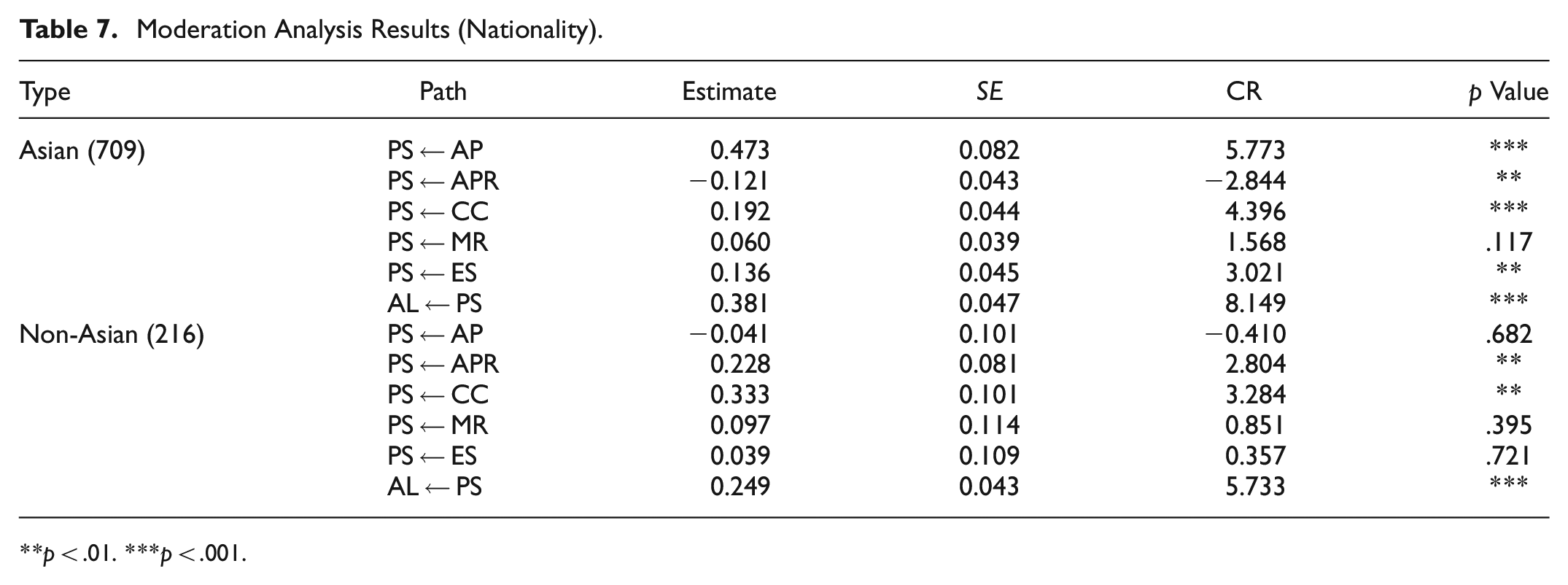
We asked all respondents to indicate from which continent they originated. For this study’s analysis, we divided them into two groups—Asian and Non-Asian (from other parts of the world). We used two criteria in dividing the respondents: the number of respondents and cultural proximity. The results are in Table 7.
Moderation Analysis Results (Nationality).
**p < .01. ***p < .001.
Length of Experience
The respondents indicated how long they have been familiar with Korean variety shows and evaluated their level of experience with this particular program format. This information was particularly pertinent as entertainment programs in the East and West often have very different formats and editing styles. We examined two groups—those with less experience (less than 4 years) and those with more experience (over 4 years). The results are in Table 8.
Moderation Analysis Results (Korean Variety Experience).

*p < .05. **p < .01. ***p < .001.
Education Level
We used the respondents’ education level as a moderator to analyze the differences in results. We categorized education levels into two groups: respondents with less education (i.e., high school and junior college) and respondents with higher education (i.e., undergraduate and graduate degree holders). The results of this analysis are in Table 9.
Moderation Analysis Results (Education).

*p < .05. ***p < .001.
Fanship
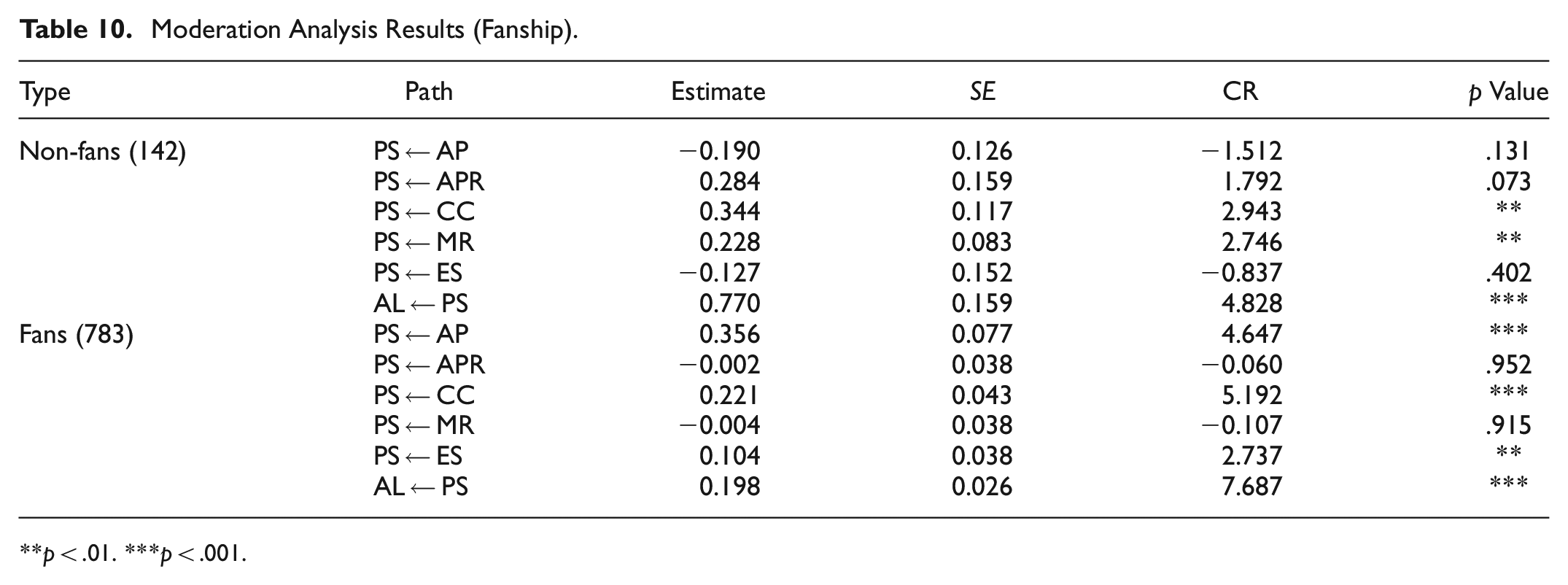
The respondents identified with one of the following: casual viewer, Cubic (fan of the program), Cubic-turned-Carat (someone who became interested in the group Seventeen after watching the program first, that is, they met the group through the program), or Carat (fan of the group). We then separated the respondents into two groups based on their level of fanship toward the group as opposed to the program. Specifically, we grouped the first three as they include people with a lower fanship level toward the group, that is, they watched the program first and then became interested in the group. For convenience, this study refers to these three groups as “non-fans.” Meanwhile, we categorized those who watch the program as fans of the group into a distinct group referred to as “fans.” The results are in Table 10.
Moderation Analysis Results (Fanship).
**p < .01. ***p < .001.
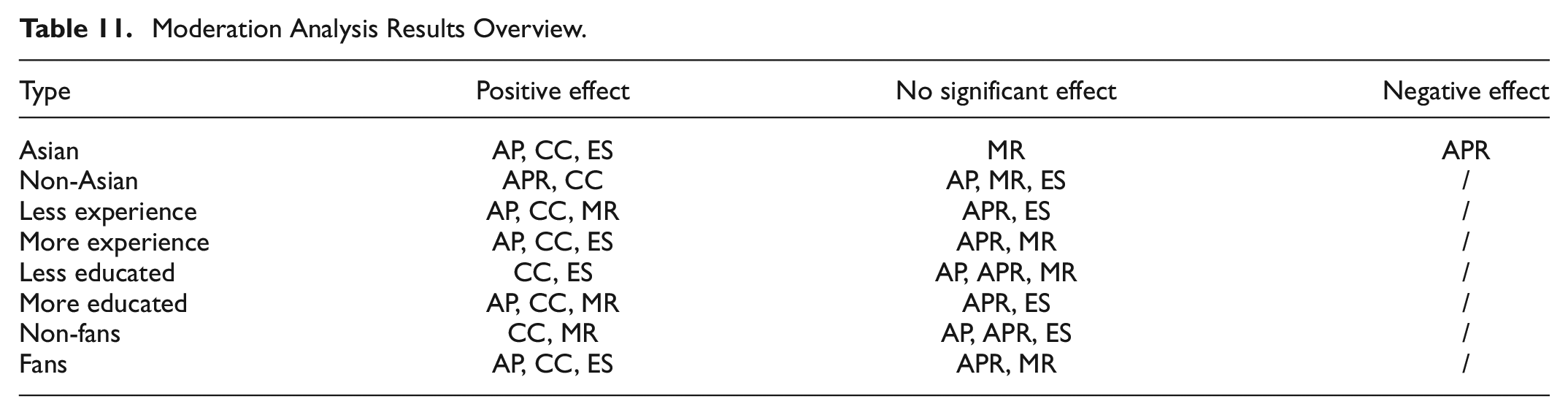
Table 11 provides a summary of all the moderation analysis results presented above. It shows which program components had a positive, negative, or no significant effect on each demographic group.
Moderation Analysis Results Overview.
Discussion
The study addressed two principal research questions on self-produced web entertainment in the K-pop domain from the audience’s perspective. The study aimed to identify the critical production components recognized by the audience and explore their influence on viewer satisfaction with the program and loyalty to the artist. We categorized the discerned production components into three groups: human components comprising artist participation (AP) and artist–producer relationship (APR), content components encompassing content creativity (CC) and meta referencing (MR), and a format component denoted as editing style (ES). The subsequent quantitative phase of the study revealed compelling insights. Notably, four of the five production components positively impacted program satisfaction. Specifically, artist participation (AP) and content creativity (CC) exhibited stronger positive effects in contrast to meta-referencing (MR) and editing style (ES). The artist–producer relationship (APR), one of the human components, was the only component that did not demonstrate any significant impact.
Human Components
Further analysis revealed that the results differed based on nationality, as the artist–producer relationship had a positive effect on non-Asian viewers but a negative effect on Asian viewers. This result is because fans in South Korea, particularly female fans, exhibit possessiveness toward idols and believe that as public figures, they have no personal lives. This belief leads to the discouragement or concealment of idols’ real-life relationships (Iwicka, 2014). The findings in this study imply that this possessiveness also extends to producers who appear on the program. Although a sense of possessiveness is present in many fandoms worldwide, it is more pronounced in the fandom culture (particularly K-pop fandom) in Asian countries.
As anticipated, the effect of artist participation was more significant on group fans due to their stronger sense of attachment and fanship toward the artists. Those who develop a strong emotional connection to idols or celebrities often try to maintain a parasocial relationship with them, typically by purchasing their music products repeatedly (Huang et al., 2015). This behavior indicates a higher chance fans will seek proximity to celebrities and idols (Oplustilova et al., 2022; Wong & Lai, 2015).
Format Components
This study also revealed that the editing style used had different impacts on program satisfaction. For example, editing style had a positive effect on Asian viewers and those who had more experience watching similarly formatted programs. This finding supports the mere exposure effect, a psychological phenomenon that suggests individuals are more likely to develop a positive attitude toward something they are exposed to repeatedly while having a more hesitant approach toward new things (Zajonc, 2001). Asian viewers are generally more acquainted with the editing style of Korean variety shows due to their exposure to Korean TV and similarly formatted programs in other Asian countries. Out of the 492 respondents who had more than 4 years of experience watching similarly formatted programs, 395 were Asian.
Interestingly, the findings of this study contradict those of Wang and Choi (2015), as we observed that editing style had a significant positive impact on program satisfaction. In contrast, they reported that editing styles (“audio and visual characteristics”) had a negative effect. However, their study centered on a reality program aired on TV, which was required to adhere to specific video and audio broadcasting standards. Online platforms are less restrictive when it comes to censorship, which means one can adjust editing styles to fit a particular niche and reflect the target audience’s preferences instead of catering to a broader audience (Fung, 2019), explaining the difference in results.
Content Components
Previous studies have highlighted content variety and creativity’s crucial role in maintaining viewer satisfaction. The results of this study further emphasize its ongoing significance, as it was the only component that had a positive impact on all demographic groups. However, we observed some differences in the other content component. Meta-reference seems to significantly impact those with more education, likely due to the component’s complex nature. Detecting some of the references and thoroughly appreciating their contribution to the program requires mental effort, which we expect from viewers who understand these concepts better. Per Lander (2013), the subtle references to the program and other media in narratively complex programming suggest that producers assume their viewers have a certain level of intelligence and media literacy, allowing them to recognize and appreciate the self-referential messages. Conversely, editing style had a more positive impact on the viewing experience of viewers with lower levels of education, indicating that less educated viewers may be satisfied with a more straightforward form of visual entertainment that demands less mental effort.
Fanship
Perhaps the most crucial finding in this study was the difference in viewing preferences between fans and non-fans. While non-fans placed more importance on content components, such as content creativity and meta-reference, fans equally valued content and human components. This finding suggests that non-fans are more likely to continue watching the program if the content is engaging and varied. Additionally, program satisfaction was particularly strong for those with less experience watching Korean variety shows (β = .718***) and lower levels of fanship (β = .770***). This outcome highlights the potential of online video programs with a similar format to replace TV broadcasts as marketing tools designed to boost artist support, thus cultivating a more extensive dedicated fan base.
Conclusion
Fandom and fan discourse have become a vital driving force in online TV content production, giving rise to a new, closely intertwined digital ecology (Fung, 2019). This ecology emphasizes how important it is to understand the opinions and preferences of fans, a concept that producers can leverage during all stages of the production process. As such, the online TV industry needs to engage its audience by creating content that satisfies their preferences and encourages continued viewership. This approach can lead to an increased attachment to the cast and, subsequently, a greater interest in their other projects. However, there is a lack of studies on current shifts in viewing experiences from the audiences’ perspectives. The evolving television consumption patterns emphasize the urgency of revitalizing audience studies (Lüders & Sundet, 2022). Thus, the motivation for this research stems from the lack of comprehensive studies on the audience-perceived production components in self-produced web entertainment programs, particularly within K-pop. This study explored and identified these production components while examining their effect on the audience’s viewing experience. This research makes several contributions to the field.
First, by identifying the program components present and perceived by the audience, this study provides valuable insights for program producers. This knowledge can guide them in allocating resources and attention to the components that resonate most with viewers during planning and production. Understanding which elements are particularly impactful in capturing the audience’s attention and satisfaction can contribute to the overall quality of future self-produced web entertainment programs.
Second, by investigating whether specific program components yield different results based on demographic factors, such as nationality, experience with programs of a similar format, education level, or fanship, this study has the potential to inform agencies on effectively segmenting their audience and tailoring their promotional strategies. This understanding of audience preferences and perceptions can aid agencies in creating more targeted advertising campaigns, maximizing the impact of their program marketing efforts.
Lastly, this research highlights the broader marketing potential of self-produced web entertainment programs for K-pop idols. By demonstrating the link between audience satisfaction with the program and a more loyal fanbase, this study emphasized the role of these programs as a powerful marketing tool. A satisfied audience is more likely to engage in other projects and activities of the idol group, leading to increased support and participation in various ventures, including music releases, merchandise sales, and live events.
Our research connected fandom, production, and agency by identifying components that production teams can incorporate to create an optimal viewing experience. It also highlights how to utilize the differences between viewer groups to develop marketing and promotion materials suited to each specific group based on their corresponding viewer demographics. Producers and agency can achieve this primarily due to the interactive nature of online entertainment, making it easier to perform customer segmentation.
Although this study focuses on “Going Seventeen” as a successful representation of the web entertainment program format, the study’s findings are insufficient for universal generalizability from one case study. This area of research would benefit from further theoretical and empirical studies on similar program formats, a big data approach to online web entertainment programs, and possible refinement of the research model. This exploratory research represents a starting point with significant growth potential and sheds light on previously unexplored aspects of online TV.
Footnotes
Acknowledgements
None
Declaration of Conflicting Interests
The author(s) declared no potential conflicts of interest with respect to the research, authorship, and/or publication of this article.
Funding
The author(s) received no financial support for the research, authorship, and/or publication of this article.
Ethics Statement
Not applicable to this type of study.

Data Availability Statement
Data sharing not applicable to this article as no datasets were generated or analyzed during the current study.