




Abstract
This paper aims to explore whether the development of competitive computer gaming (eSports) industries is sustained in China. In doing so, we apply the Generalized Supremum Augmented Dickey-Fuller (GSADF) method to investigate when the bubbles originated and crashed in the Chinese eSports market from 2014 to 2021. Utilizing the data of the Chinese Electronic Sports Thematic Index (CESI), the empirical outcomes show that the Chinese eSports industry may deviate from its market value and that the industry witnesses bubble behaviors. The latent reasons might be attributed to government policies, economic growth, stock market crises, and venture capital investments. Therefore, to promote the stabilized and sustained development of the eSports industry in China, regulators and authorities should pay attention to the evolution of bubbles. Moreover, maintaining policy consistency and continuity may be beneficial in stabilizing investors’ expectations and reducing speculative investment behaviors.
Plain Language Summary
This study delves into the rollercoaster journey of China’s eSports industry. Using advanced statistical methods and corresponding data, our findings suggest that the Chinese eSports market experiences deviations from its true value, indicative of bubble behaviors. We attribute these fluctuations to a variety of factors, including government policies, economic shifts, stock market crises, and venture capital investments. To foster stable growth in the Chinese eSports sector, regulators and stakeholders must closely monitor and address bubble phenomena. Maintaining consistent policies can help stabilize investor expectations and curb speculative investment practices, ultimately promoting the industry’s long-term sustainability.
Introduction
Competitive computer gaming (electronic sports or eSports) has seen tremendous development in terms of the number of participants and commercial revenue in recent years, which helped eSports establish itself as one of the 21st century’s burgeoning sports (Jenny et al., 2016; Parshakov et al., 2018, 2021; Scholz, 2020). Over the decades, eSports has become popular with an emerging generation, and the industry has a high potential for growth (Jonasson & Thiborg, 2010; Zarand et al., 2018). Its rapid growth can be attributed to economic growth, the social recognition of video game players, and advances in technology (Borowy & Jin, 2013; Mora-Cantallops & Sicilia, 2018; Seo, 2016; Thiel & John, 2018).
In November 2003, the General Administration of Sports of China officially designated eSports as the 99th sport in China. That is, eSports became a member of China’s sports industry. After nearly 20 years of rapid development, China now ranks first in the world in terms of eSports competition viewers, with 163 million eSports audiences (2020 Global Esports Market Report, Newzoo). Moreover, according to Newzoo, the revenue of China’s eSports market increased from $327.2 million in 2019 to $344 million in 2020, making it the world’s largest eSports market. This is followed by North America ($225.5 million) and Western Europe ($175.3 million). The report also reveals that emerging eSports markets will show the highest compound annual growth rate (2018–2023). Considering the rapid development of eSports and the growing size of the eSports market in China, on 16 December 2020, the Olympic Council of Asia announced that eSports would become an official event of the Asian Games and participate in the 19th Asian Games in Hangzhou 2022.
Similar to other sports industries in the early stages of development, the Chinese e-sports market has seen a gradual increase in participants due to its leisure and competitive characteristics. The growing market size and bright development prospects have attracted a large number of investors. It is worth noting that the frenzied influx of capital into the market has brought about volatility in the market value. The high volatility of prices in the Chinese eSports market is detrimental to the sustainable development of that market. Therefore, detecting bubbles in the eSports market of China and understanding the characteristics of this market price dynamics are very important for market participants and policymakers.
Previous research has looked into the price fluctuations of the Chinese eSports market and its possible factors. Many studies have considered advances in computer gaming technology to be the main driver of the growth of eSports (Marques, 2019). The second factor is economic and financial activities (Chikish et al., 2019; Cranmer et al., 2021; Wang et al., 2021). For example, as a proxy of economic activity, the stock price is commonly used, which can affect the price fluctuations of the Chinese eSports market. Wang et al. (2021) point out the strong information interdependence between eSports market returns and Chinese stock returns. In addition, a set of studies also considers the eSports industry policy as an important factor that affects the Chinese eSports market price (Cortés et al., 2021). Since the Chinese eSports market is at an early stage of development, the asymmetric leverage effect and the lack of a well-established regulatory mechanism have caused the Chinese eSports market to have strong arbitrage opportunities (Chikish et al., 2019), which indicates that speculation and price bubbles inevitably exist in this market. Therefore, the research hypothesis of this paper is that there is a bubble in the Chinese eSports market.
Considering the aforementioned realities, it is necessary to study the potential bubbles in the Chinese eSports market to fill the gaps in the existing literature. Besides that, the current study could also be helpful to policymakers in reducing the volatility of eSports market prices by adjusting various industry support policies in a timely manner, which will then help build an effective eSports market and promote new economic growth.
Therefore, the current study aims to examine the potential bubbles in the Chinese eSports market. With the help of the supremum augmented dickey-fuller (SADF) test and the generalized supremum augmented dickey-fuller (GSADF) test, which is proposed by Phillips et al. (2012, 2015), we discover that the eSports market in China has experienced a total of 30 weeks of bubble periods, spreading over four different periods, and they are all positive bubble types. Among them, the market experienced the longest bubble period from 7th Feb 2015 to 26th Jun 2015, and the size of the bubble from origination to the peak was 2,298.46. Moreover, the shortest bubble period was found from 24th Jun 2020 to 10th Jul 2020, and the size of the bubble from origination to the peak was 403.26. According to these findings, we can conclude that the Chinese eSports industry does witness speculative bubble behaviors.
The following are the main contributions of this study. First, the current literature on the economic perspective of the Chinese eSports business is still in its infancy, with little attention dedicated to the “bubble” phenomenon. Due to the rapid development of the Chinese economy and technology, the Chinese eSports sector has also made rapid progress in recent years. Studying whether the price growth of the eSports market is sustainable is crucial for the sustainable development of this market. Second, the current paper tries to uncover the causes of the bubble in the burgeoning eSports market, particularly in China, which has not before been researched. This is one of the first studies that, to the best of our knowledge, look at the bubble phenomenon through the lens of the emerging eSports market. Third, in the existing literature, scholars have used the SADF and GSADF tests to explore bubbles in the art market, the finance market, and the energy market (Khan et al., 2022; Li et al., 2020; Umar et al., 2021; Zhao et al., 2023), but it has been applied less in the eSports market. In this study, in order to calculate how long the bubble has been present in the Chinese eSports industry, we make use of the SADF and GSADF tests that are provided by Phillips et al. (2012, 2015). In contrast to the other techniques, which depend on the user’s subjective evaluation of the degree to which fundamentals or moderate states have deviated, these algorithms may be used to any frequency data to determine whether or not bubbles are present. Because of the benefits offered by these tests, the identification of more than one bubble in the price of the Chinese eSports market may be both effective and substantial.
The rest of this paper is organized as follows. In Section “Literature Review,” the corresponding literature is reviewed. In Section “Methodology,” we introduce the methodology that is conducted in this paper. In Section “Data,” we discuss the description of the data. Section “Empirical Results” reports the experimental results. Section “Discussion” concludes the paper.
Literature Review
The popularity of eSports during recent decades has been accompanied by rapid growth in research on the topic of eSports in academia (Reitman et al., 2020). The literature focuses on research in sports science, business economics, and media coverage. A review of the literature can help us to better understand the current state of eSports research.
The first section of the literature focuses on detecting the underlying determinants of eSport development (Kim et al., 2021; Newman et al., 2020; Parshakov & Zavertiaeva, 2018; Wang et al., 2021). Among these studies, a large number try to explain from the perspective of economic and financial factors. Their empirical results show that gross domestic product (GDP) per capita is the main factor influencing the rapid growth of eSports in a country (see, e.g., Emrich et al., 2012; Lu, 2016; Niculaescu et al., 2021; Parshakov & Zavertiaeva, 2018; Yu, 2018). In addition to the effect of GDP per capita, the total number of players and online population play key roles in explaining the expansion of eSports growth (Conroy et al., 2021; Palma-Ruiz et al., 2022). This is due to affluent residents having more time and money to spend on leisure, especially eSports (Hamari & Sjöblom, 2017; Pack & Hedlund, 2020; Scholz, 2020; Wohn & Freeman, 2020). Citizens of less developed economies, on the other hand, spend the majority of their time working and thus have less time and money to devote to eSports. Furthermore, fast-growing economies have a well-established infrastructure that can support eSports as a new business or sector (Parshakov et al., 2018; Zhang et al., 2023). In China, for example, eSports plays a critical role in technical innovation and national science since it creates a new market for technological experimentation as well as a new sort of consumer behavior (Yang et al., 2020).
Over the years, the number of tourists eager to travel to different cities or countries to watch sporting events has grown substantially (Dilek, 2019). This tendency gave rise to a new sort of tourism: eSports tourism. Therefore, the second strand of research has attempted to examine the impact of eSports on tourism and the economic development of the host city. For instance, according to Fong and Trench (2019), the development of eSports can provide several tangible benefits. Investment from sponsors and advertisers may help eSports tournaments create employment and money in a variety of businesses. The holding of eSports tournaments benefits the hospitality industry’s income and can help the host regional economy (Jenny et al., 2018). According to Dilek (2019), eSports enthusiasts may contribute to local economic growth by spending money on lodging and food and drink. Moreover, eSports tournaments also serve to boost the host city’s brand value, and innovation in related technologies may be pushed during this period (Pu et al., 2023; Yang et al., 2020). Zhu et al. (2022) employ a shift-share analysis (SSA) approach to assess the evolutionary features of the esports sector in China between 2004 and 2018. According to the empirical results, they find that the esports business in the Yangtze River Delta is growing from the central metropolis to the neighboring minor cities.
The third strand of studies carries out an investigation into factors influencing eSports-related stock prices. For example, Wang et al. (2021) utilized a newly developed nonlinear estimation to investigate the oil price, COVID-19, and uncertainty index on the stock price of electronic sports. Specifically, the authors used the daily news-based index on Electronic Arts Inc.’s stock prices (EAI) to represent the eSports industry development and applied the Quantile Autoregressive Distributed Lag (QARDL) approach to uncover the underlying linkages. Their empirical outcomes suggest that COVID-19 has a positive influence on EAI. The stock price of eSports companies has been boosted by the growing popularity of eSports during COVID-19, as most people entertain themselves at home and have more time for online gaming activities. Furthermore, Wang et al. (2021) also noted that oil price and economic policy uncertainty (EPU) both have a Granger causality on EAI, and the oil price has a negative effect on EAI for 20% to 95% quantiles. More recently, Li et al. (2023) further studied whether winning and losing in eSports affects the stock price of eSports teams. The authors take Astralis Group as a case study and use the event study method to prove that winning the championship game affects the eSports team’s stock returns.
In light of the literature review shown above, there are a number of issues and shortcomings that need attention and improvement. First, China is the largest developing economy and the largest eSports market in the world (Newzoo, 2020). In addition, China is dominating the eSports business over the Korean and European markets (Kim & Kim, 2022; Zhao & Lin, 2021). However, the majority of the study that has been done so far has been on either the European or the North American markets, and there has been very little research done on the Chinese eSports market. Moreover, most previous research has considered the eSports market as a new investment market, and it is well known that investments may include bubbles, especially during extreme economic situations. To date, most articles or media coverages suggest that the global eSports industry is in a bubble but fail to provide evidence from an econometric perspective. To fully comprehend the Chinese eSports market, especially for the market’s long-term sustainability, further study on the industry is needed, particularly on the bubble phenomena in this industry. Therefore, whether speculative price bubbles exist in this market must be investigated, which may be critical for this market regulator and policymaker.
Methodology
According to Newzoo, the Chinese eSports market share has been growing in the last 5 years, with the revenue of the eSports market reaching $344 million in 2020, making it the largest eSports market in the world. In addition, the development of China’s eSports industry is spatially dependent, with industry clusters mainly concentrated in the Guangdong, Hong Kong, and Macau Bay Area, and the trend of eSports industry clustering in South and Central China is becoming more and more obvious. With such rapid growth and spatial clustering effects, it is worth exploring whether there is a bubble in this market.
Therefore, this paper attempts to investigate the eSport stock market bubble evolution by applying a modified asset pricing model (APM), which is often utilized as a basic point for financial bubble analysis (Su et al., 2017). More importantly, this modified APM has been successfully employed in the energy and financial commodity fields (Li et al., 2020). According to the model, eSports industry stock bubbles might emerge from the difference between fundamental value and trading price, which can be written as the following equation:

where
When identifying

Any sequence of random variables with bubbles can be written to this homogeneous expectational equation (Wang et al., 2020). As a result, the following is an example of a generic solution that may be obtained from a class that has the potential to be infinite:

Equation 3 denotes that the asset price, such as the eSports market price in the current paper, can be impacted by the “market fundamental” part (
In terms of empirical testing of bubble detection, previous studies have employed various methods, including the momentum threshold autoregressive (MTAR) model, cointegration-based test, intrinsic bubble test, Markov Switching Augmented Dickey-Fuller (MSADF) test, and so on (see, e.g., Chen et al., 2009; Engsted, 2006; Payne & Waters, 2005; Xie & Chen, 2015). However, these examinations have proven to be inadequate in bubble investigation, and corresponding judgments are not valid (Wang et al., 2020). Therefore, to overcome these shortcomings, the Generalized Supremum Augmented Dickey-Fuller (GSADF) test (Phillips et al., 2012, 2015) has been employed in the current paper to investigate bubble behaviors in the Chinese eSports market, which makes a feasible and flexible window size in the recursive regression process to extend the sample sequence and improve the detection ability of testing bubble behavior.
According to Homm and Breitung (2012), the mentioned test is an excellent technique for identifying bubble behavior and is resistant to structural breaks. Specifically, in the model, the size of the forward-expanding window

The GSADF method, like the SADF test, is based on the principle of repeatedly running the ADF test regression on a sample sequence, which permits the starting point

More generally, the finite distribution of this statistic can be calculated when the model includes an intercept element and the null hypothesis is a stochastic process. That is,
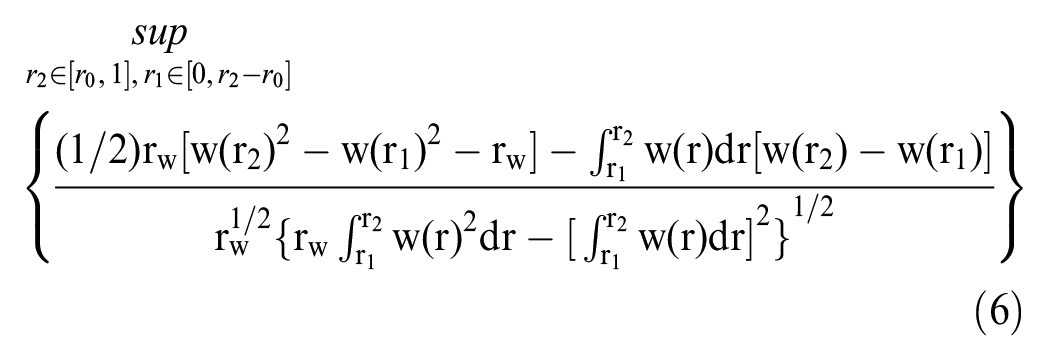
The calculations of GSADF and SADF tests are performed by GAUSS software (an econometric data analysis tool). Homm and Breitung (2012) indicate that the GSADF test is the most useful method for detecting multiple bubbles. However, the GSADF test has a minor drawback. That is, the dynamic critical values are computationally intensive and the test suffers from delayed bias, which is a statistic of events that have already occurred and cannot be effectively used to predict the bursting point of future bubbles (Qin et al., 2023; Su et al., 2023). Even so, this paper can still use Monte Carlo simulation to overcome the complexity of critical value calculation and use the above advantages to conduct a case study to explore the historical bubble of the eSports industry in China.
Data
This paper utilizes the primary weekly data of the Chinese Electronic Sports Thematic Index (CESI) in our empirical study, covering the period that ranges from 3 January 2014 to 15 September 2021 and contains a total of 455 weekly observations. The corresponding data are obtained from the Wind Information Database of China, and the starting point relies on the availability of data that were openly published in 2014. We choose weekly data over monthly and daily data, mainly because it is a consensus that monthly data would average out too much important information, while daily data would be affected by excessive noise.
Table 1 provides descriptive statistics for the Chinese eSports market’s stock price. Several preliminary results can be noticed. For instance, the maximum value of the variable is 5,200.950, and the minimum value is 1,035.770, with a large variance (959.932) over the sample period. Considering that the data used in this paper have 455 observations, we follow the recommendation of Jarque and Bera (1987) and use the Jarque-Bera test to test the normality of the data distribution in our empirical analysis. According to the Jarque-Bera test, the variable rejects the null hypothesis of the test, indicating that the Chinese eSports market price tends to be a non-normal distribution. Moreover, in terms of the skewness and kurtosis statistics, the eSports market follows right-skewed due to the statistic sign of skewness being positive, which means that the return distribution has little exceeding gains and recurrent small losses. The value of the kurtosis statistic is less than 3, which demonstrates a significant discrepancy with the characteristics of the normal distribution. Overall, the distribution of Chinese eSports market prices has an asymmetric characteristic.
Descriptive Statistics.

Represents significance at the 1% level.
Empirical Results
This paper aims to investigate the bubble behaviors in China’s eSports market and uncover the underlying reasons behind bubbles. Table 2 represents the corresponding results of price bubble detection in the market. From Table 2, the statistics of the SADF test for the Chinese eSports market are 4.156, which exceeds its critical value of 2.275 at a 1% significance level. Moreover, the statistics of the GSADF test show similar results (4.343 > 3.834). Therefore, we can infer that the Chinese eSports market might bear multiple bubbles. Specifically, we provide a new date-stamping strategy for the market to further detect the existing bubble periods, and Figure 1 shows four bubbles in the eSports market.
Results of the SADF and GSADF Tests.

denote significance at the 1% level. Critical values for both tests are obtained from Monte Carlo simulations with 10,000 replications.

GSADF test of the China Electronic Sports Index.
The first bubble period occurs between Sept 5th 2014 and Sept 30th 2014 (5 weeks). The economic reasons can be explained by the rapid economic development at that stage. The existing literature points out that the development of the eSports industry is closely related to the macroeconomic situation (see, e.g., Chikish et al. 2019; Cranmer et al., 2021; Wang et al. 2021). Changes in economic growth can affect eSports-related stock prices by influencing investment and consumption in the eSports industry (Chikish et al. 2019; Wang et al. 2021). According to the National Bureau of Statistics, China’s GDP increased by 7.3% in the third quarter of 2014 compared to the second quarter of 2014. When economic development rises, total social investment expands, and entertainment consumption increases. As an emerging investment sector, the eSports market has caught the attention of investors. Ceteris paribus, a corresponding increase in capital inflows to the eSports industry will drive up the industry’s share prices.
In addition, with the advancement of electronic technology and the promotion of the 4G network in 2014, mobile games are prevalent. The new eSports model has brought in new market players. The market size further expanded, thus further boosting the industry share price. Besides that, the rapid rise in eSports stock prices is associated with the announcement of sports policies (Parshakov & Zavertiaeva, 2018). State policy support for the cultural and creative industries, such as the implementation of the Management Measures for Special Funds for the Development of Cultural Industries in 2014, has supported the development of more than 800 cultural enterprises. The State General Administration of Sports pointed out that the eSports industry is a developing sector of the cultural economy. With the support of national policies and strong government support, the eSports market developed rapidly, causing stock prices to soar during this period. However, the bubble burst on September 30, 2014, which can be attributed to the sharp rise in club operating costs (Lu, 2016). Most professional eSports clubs provide players with at least 8,000 RMB per month. As recruitment expands without access to tournament prize money, operating costs continue to rise. Therefore, Club layoffs and player departures lead to a decline in industry earnings, which eventually reacts to a drop in stock prices and ultimately leads to the bubble bursting.
The second bubble occurred between 7th Feb 2015 and 26th Jun 2015 (18 weeks). The duration of this bubble is the longest in the sample. The economic reasons behind this can be explained in several ways. Since eSports is an emerging industry, it maintains a rapid growth trend in the initial stage of its emergence, which can be attributed to the successful introduction of relevant supporting policies (Yang et al., 2020). Existing studies point out that the development of the eSports industry is influenced by government policies (Yang et al., 2020). For example, in the first half of 2015, China’s State General Administration of Sports issued the Interim Provisions for the Management of eSports Events, which provided policy support and regulation for the development of the eSports industry and stimulated the development of eSports events. Due to the strong policy support from the State General Administration of Sports, the eSports market developed rapidly in the first half of 2015. However, in mid-June 2015, a full-blown crisis erupted in the Chinese stock market, with share prices in all sectors plummeting. The downward spiral of the economy and the plunge of the stock market are considered important factors to explain bubble behavior (Parshakov & Zavertiaeva, 2018). For example, from June 15 to June 26, 2015, the Shanghai Composite Index dipped by 18%, which fell sharply from 5,062.99 to 4,192.87 points, a drop of 870.12 points. Thus, poor stock market performance and systemic risk dragged down the price of the eSports industry by influencing investor behavior (Wang et al., 2020).
The third bubble was detected between 20th Dec 2019 and 10th Jan 2020 (4 weeks). Moreover, the bubble seems to be positive and to have experienced a shorter period than the last two bubble periods. The reasons for this can be explained in several ways. First, as the eSports market developed, the State General Administration of Sports of China established and launched several new programs related to the industry to continue to support the development of the eSports market. These include New Regulations on Sports Industry Statistics and other supporting measures. These initiatives formalize eSports as a sports competition and performance activity and ensure the standardized operation of the eSports market. As mentioned above, the development of the eSports market is related to the release of sports policies (Parshakov & Zavertiaeva, 2018). Related policies favorable to the development of the eSports market release good signals and attract more investors to enter this market. The continuous influx of investment funds leads to an increase in the industry’s stock prices. Second, there is a long-term dynamic equilibrium relationship between economic development and the stock market (Su et al., 2017; Wang et al., 2020). Since eSports market prices are mainly influenced by macroeconomic indicators (Chikish et al., 2019; Wang et al., 2021). When the socio-economic environment deteriorates, a decline in the eSports industry is inevitable. As the socio-economy was hit by the “lockdown” policy at the beginning of the COVID-19 pandemic, China’s economic growth rate dropped sharply during this period. The economic downturn and the plunge in global financial markets caused market panic and the withdrawal of funds invested in the eSports industry, which ultimately led to a decline in the eSports market’s price.
Moreover, the fourth bubble is examined from 24th Jun 2020 and 10th Jul 2020 (3 weeks). We find that the duration of this bubble is the shortest in the sample. The economic reasons behind this can be explained in several ways. Wang et al. (2020) state that economic growth is an important factor affecting stock market prices and that the connection is positive. In other words, when the economy grows, additional investments are made in the financial market, and the stock market price rises accordingly. As an emerging industry, the eSports market has attracted more investors’ attention in recent years. During the economic growth phase, increased investment in the eSports market has driven the market price of the industry. According to the National Bureau of Statistics, China’s GDP grew by 11.5% in the second quarter of 2020 compared to the first quarter, the highest in the last decade. In particular, other economies were hit by the COVID-19 pandemic during that period and their economic growth rates were negative. China’s positive economic growth provides strong confidence to investors, contributing to the positive growth of the eSports industry. When the economy is booming, eSports companies expand their production accordingly, which leads to higher stock prices. However, the implementation of the Double reduction policy and the Policy on preventing minors from indulging in online games further regulate the development of the eSports market. On the one hand, the policy squeezed out some users and the reduction in the number of participants reduced the industry’s profitability. On the other hand, for investors, the introduced policy is a shock to the development of the eSports market, and while regulating the development of the market, it also brings uncertainty about the further development of the eSports market. When investors hesitate to invest in the eSports industry, it is eventually reflected in the decline of the market’s price, leading to the bursting of the bubble.
Discussion
We summarize the above results in Table 3, which can help us observe the numbers and the characteristics of the formed bubbles more clearly. Specifically, the Chinese eSports market has experienced a total of 30 weeks of bubble periods, spreading over four different periods, and they are all positive bubble types. Among them, the Chinese eSports market experienced the longest bubble period from 7th Feb 2015 to 26th Jun 2015, and the size of the bubble from origination to the peak is 2,298.46. Moreover, the shortest bubble period was found from 24th Jun 2020 to 10th Jul 2020, and the size of the bubble from origination to the peak is 403.26.
The Number of Bubbles in China’s Electronic Sports Index.

Note. H is the length of the explosive episode for a minimum of 4 weeks, 8 weeks, and more than 8 weeks. The numbers between parentheses are the size of the bubble from origination to peak or trough.
Our findings shed light on the presence of bubbles in China’s eSports market, which are linked to economic development, the implementation of sports industry policies, and investment funds. In order to reduce the damage caused by the bursting of the bubble, policymakers should stabilize economic development, enact timely industry support policies, and strengthen the regulation of market investment fund entry. The well-established regulatory mechanism could be beneficial to the stable development of the Chinese eSports market.
In order to test the robustness of the findings in this paper, we follow Zhang et al. (2013) and Zhao et al. (2018) to utilize the hedonic price model to calculate the intrinsic values of the Chinese eSports industry and use differences between the Chinese eSports market value and the calculated intrinsic value to evaluate the “bubble” phenomena. The corresponding results are registered in Table 4.
The Bubble Levels of the Chinese eSports Market.

From Table 4, it can be found that
Conclusion
Using the GSADF test established by Phillips et al. (2012, 2015), this research explores the potential bubbles in the Chinese eSports industry. Our outcomes indicate that multiple bubbles exist in the CESI in the periods from 2014 to 2021. A time of increasing prices coincides with the beginning of the bubble, and a period of falling prices coincides with the exploration of the bubble, as predicted by the bubble model. Understanding the dynamics and behavior of pricing over time is important for regulators in the Chinese eSports industry, and the evidence presented in this paper may be useful in this regard. Some implications are discussed below.
First, this paper finds that there are bubble behaviors in the Chinese eSports market. Therefore, in addition to focusing on the factors influencing the eSports market prices, policymakers need to prevent a large inflow of speculative capital during the emergence of bubble behavior. This is to limit the consequences of the accumulation and expansion of the market bubble. Second, the Chinese eSports market is in the initial development stage, and the policies and regulations are still incomplete. In order to promote the development of the Chinese eSports market, the authorities should formulate regulations to support the eSports industry, strengthen investment in technological innovation, and improve the training of the talent system, which is based on the experience of Korean eSports market development. Moreover, the emergence and bursting of the bubble are closely related to the entry and exit of investment funds. Therefore, policymakers should formulate and improve industry investment policies and regulations as soon as possible to guide market participants to make reasonable investments. Third, information asymmetry and market imperfection can put market prices in an imbalanced state, especially in the early stage of Chinese eSports market development, and it is difficult to correct the bubble based on the market’s equilibrium price deviation. Therefore, during the crisis, policymakers should also introduce supportive policies to tide the industry over, such as reducing taxes and increasing government subsidies. Finally, signals released by policymakers can influence public expectations. Therefore, policymakers should maintain policy consistency and continuity over time and reduce policy uncertainty to stabilize investors’ expectations while strengthening market regulation and promoting the improvement of policies and regulations in the Chinese eSports market.
Although this paper uses the GSADF method for the first time to explore the historical bubble of the Chinese eSports industry, there are still shortcomings. Due to the availability of data, this paper only focuses on the overall eSports market and pays less attention to the segmented eSports market (e.g., Mobile games, PC games) and differences between regions. When additional data for the eSports industry is available, future studies can investigate the heterogeneity of the eSports market development.
Footnotes
Declaration of Conflicting Interests
The author(s) declared no potential conflicts of interest with respect to the research, authorship, and/or publication of this article.
Funding
The author(s) received no financial support for the research, authorship, and/or publication of this article.

Data Availability Statement
Data sharing not applicable to this article as no datasets were generated or analyzed during the current study.