



Abstract
The capability of computer programming language logic is one of the basics of technical education. How to improve students “interest in program logic design and help overcome students” fears of coding has become vital for educators. Cultivating practical talents with information technology application and basic programming development will become one of the important topics in the department of information related science. The objective of this research is to improve the ability of learning basic programming courses by using Zuvio interactive software. Zuvio employs the mathematical logic of computational thinking to analyze problems and enhance learners’ interest in learning programming skills through a graphical interface tool with building blocks. It uses innovative interactive teaching to use peer and self-assessment to study the content of the course. Zuvio improves the design ability of different groups of class learning Python programming. In line with the innovative teaching policy of the schools and the current stage of the learner’s learning model, learning effectiveness can be achieved. The research results were analyzed by midterm and final experimental group scores, and the progress of the experimental group’s scores was examined through descriptive statistics. The average and standard deviation of the assessment were used to analyze the progress of the experimental group students in the programming course. In the classroom, assessment criteria were set up as the basis for peer assessment scoring. After the midterm and final exams, the teacher assessment and peer assessment scores were analyzed for cognitive differences, and possible learning differences were analyzed. The students’ professional ability was examined to see if it met the professional standards required by the course, and whether innovative teaching methods could improve the learning outcomes of learners with different professional backgrounds in Python programming.
Plain Language Summary
The students’ professional ability was examined to see if it met the professional standards required by the course, and whether innovative teaching methods could improve the learning outcomes of learners with different professional backgrounds in Python programming
The research results were analyzed by midterm and final experimental group scores, and the progress of the experimental group’s scores was examined through descriptive statistics. The average and standard deviation of the assessment were used to analyze the progress of the experimental group students in the programming course. In the classroom, assessment criteria were set up as the basis for peer assessment scoring. After the midterm and final exams, the teacher assessment and peer assessment scores were analyzed for cognitive differences, and possible learning differences were analyzed. The students’ professional ability was examined to see if it met the professional standards required by the course, and whether innovative teaching methods could improve the learning outcomes of learners with different professional backgrounds in Python programming.
Keywords
Introduction
Background and Motivation
In recent years, the ever increasingly fierce competition in IT has become a global phenomenon for leading countries to remain their dominant position in the industry. Whether the education system can cultivate the human quality that meets the needs of the country and the industry holds the key to their success.
With the advent of IT explosion era, IT products are in every walk of life and business, especially for large enterprises or any industry which employ IT related technologies. For example, in the era of Internet of Things (IoT), through the interconnected networks, the data that may have been scattered can be gathered. These aggregated big data require appropriate tools for analysis, modeling, and visualization to create a more convenient life in the future. The latest survey at Gregory in 2017 (Gregory, 2017) showed Python is the most widely programming language used in data science with a top 1 usage rate. Taiwan is one of the IT industry strongholds. Therefore, higher education must cultivate IT application in any fields. At present the technical vocational system and the science universities are promoting practical education to cultivate talents who can be both innovative in mastering programming. The impact of low birth rate in Taiwan results in the recruiting policy change in higher education. For many struggling IT related departments, it became necessary to accept students with no IT background, which lead to low programming capacity after they’re admitted and students eventually have to change their major or even transfer to other institutions. This has made promoting programming education quite difficult and creates a shortage of talents in many tech industries. Technology industry is the foundation of Taiwan’s economy. Therefore, the issue of IT talent cultivation must be given special attention. This study believes it is quite appropriate to teach programming beginners Python as the programming language. The advantages are that the syntax is simple and easy to remember; and the way the code is presented is easy to read and facilitates rapid application development. In addition, by learning computational thinking, supplemented by mathematical logic analysis, using building block programming logic to decompose problems to generate innovative teaching model can solve the beginners’ comprehension problems because programming teaching is mostly carried out through programming instruction interface which leads to learners’ lack of interest in the programming courses and resulted in the inadequacy of learning motivation.
Through differentiated tutoring based on student composition, this study regularly discusses the course content and increases teacher-student interaction to train students to use their spare time to find the mathematical logic behand the problem. Supplemented by building block programming logic design and comprehension, through problem decomposition and mathematical logic to decompose programming process teaching, students can immediately present the results of program writing and achieve the theoretical and practical teaching of using programming to solve problems. Through transforming the block-style programming into Python, students can achieve rapid learning as well as experience the application of block-style programming and the fun of solving problems.
Objectives
Through innovative teaching and computational thinking capacity application and cultivation, the objectives of the study are to teach students, by means of the mathematical logic analysis of problems supplemented by building block programming logic design, programming logic design and steps to solve problems and applications; to nurture learners to use the content of the courses to quickly learn and compare the usage of related syntax to develop problem-solving skills and independent thinking; through peer discussions, learners are expected to explore the realms for problem-solving and application and design related innovative information applications and integrate cross-domain output to build innovative information application and value.
The objective of this study is to first analyze the problem through mathematical thinking, and then decompose the problem into various program processes and use the Blockly development method to convert the program into the principles, conduct guided program logic training, and learn relevant program knowledge and theory.
Match the mathematical logic analysis of problems and apply Blockly to solve the assignments problems and visualize the programs written to learn the relevant program syntax and execution flow, for example: the operation flow of playing a lottery game.
Interesting examples for step-by-step teaching are used to stimulate students’ mathematical logic capacity, such as: ultimate password, invoice redemption helper, etc. Simple games are used to create questions to conduct interesting model questions to cultivate students’ problem-solving capacity and interest in independent thinking.
Literature Review
Information Education and Learning Assessment Development
The development of IT has become one of the dominant technical issues today. It not only has a significant impact on the development of social culture and industrial fields, but also is a leading force on changes in future work patterns and learning patterns. The Taiwan MOE mentioned in the 2016 to 2020 Blueprint on Information Education that effective deep learning through information technology will enable future digital citizens to apply the technology and solve problems in different situations and become talents with proper behavior, attitude, and sense of responsibility (Chung, 2020; Ministry of Education, 2016). Due to the continuous popularity of Maker in recent years, practical operations have returned to the focal issue in IT courses. The practical courses are often conducted in groups; however, group member usually discuss the practical content face-to-face and find correct solutions through trial and error instead of focusing on the process of data collection, analysis, and evaluation. Repeating the cycle of work production and revision are not conducive for the group to improve work quality. The reason may be that the practical course lacks a convenient and immediate real-time interactive discussion channel (Pardim et al., 2023). In this study, Zuvio is used as a teaching tool to provide students with a convenient and effective discussion platform, so that the feedback of teaching results can be processed in real time (Calder, 2010) to allow students to use mobile devices to discuss course content freely without location or time constraints. In addition, the course combines Python design for practical teaching to provide future teachers in the IT field with an innovative teaching strategy and method.
IE education focuses on finding solutions to problems through program logic rather than just writing program syntax (Gülbahar & Kalelioğlu, 2014). Computational thinking is an important part of programming education planning for children in various countries (Piteira & Costa, 2013). Computational thinking is a thinking method that can solve problems in a systematic way. However, computational thinking not only requires teaching by the teachers, but also needs to be continuously implemented and experienced so that children can establish the model of computational thinking in the process. In addition, the problems of daily life can also be solved by learning programming, using mathematical logic analysis to convert the problem itself into a program process and the algorithm as the basic theory to solve the root of the problem (Papadakis et al., 2016). The goal of promoting programming education is to guide and cultivate students’ ability of programming logic.
In the past, the reason why students lacked motivation in learning programming was that most of their courses were instruction editing interfaces (Akcaoglu, 2014). If students are new to programming, they may find it relatively difficult. Therefore, it is necessary to understand the bottlenecks or setbacks students encountered in programming and stimulate students’ interest in learning through the adjustment of teaching strategies (Kordaki, 2012). The learning mode based on computational thinking can help students who are exposed to programming for the first time interested in learning. Jeannette M. Wing, a professor at Carnegie Mellon University in the US, said that the elements of computer operation should be integrated into basic language skills (Carr & Kemmis, 1986), and daily life problems can be solved through the operations of computational thinking.
Through investigation and analysis, this study found that there are four major steps to raise students’ interests in programming. The first is to analyze, before writing a program, the problem through mathematical thinking and use the ability to disassemble the operational thinking to define and modularize the steps and processes. When encountering a problem, students first imagine all the possibilities and then disassemble the work into steps. This is the thinking mode of people who are used to writing programs when they face problems. The second step is that the program works must be able to be displayed immediately to the designers. For example, the literal translation function of Python can control the self-propelled vehicle and the robot, and the effect of the work can be displayed immediately so that the programmer can understand the application and fun of program designed and experience how to solve problems through Blockly programming (Kordaki, 2012). The third step is to simplify the development interface of programming so that students can more quickly respond and understand the operation method. The fourth step is to maintain students’ motivation for learning through mathematical logic training and to teach and cultivate students’ capacity to solve problems and apply them by holding regular seminars. It can also teach the applicability of information functions in other fields and create its application value (Carr & Kemmis, 1986). And assessment can be used as the most specific and direct educational method to understand the students’ learning situation. Therefore, the main goal of teaching is to help learners through assessment, which is also one of the important issues that educators are currently concerned about and devoted to in their research (Nielsen, 2014).
There are four dynamics in learning: learner-centered, knowledge-centered, assessment-centered, and community-centered (Ming & Chun, 2022). Assessment-centered means that evaluation method is important to education. Thus, if teachers and students neglect the evaluation in the educational process, the learning content and effect of the learner will be different (Eksi, 2012). In recent years, domestic higher education has been affected by the rapid development of digital technology and the M-shaped university campuses, and the installation of wireless networks has diversified its teaching modes and made the learning environment more flexible. Improving the effectiveness of classroom teaching through digital network resources and products has been an important issue in higher education today. Zuvio can be used as an aid to improve the effectiveness of classroom teaching, because it provides interaction between teachers and students and their peers, which is conducive to cultivating students’ initiative in learning and enhancing classroom participation (Tzu, 2019). This study mainly explores the teaching effect of applying Zuvio to Python programming related courses in Freshman or Sophomore year and examines the learning effect of the innovative teaching technology practice in classroom from the perspective of students (Lundstrom & Baker, 2009).
The current teaching mode is mainly based on peer assessment to carry out two-way interaction between students. Through mutual discussion, students can think about the problems in depth, thereby enhancing and deepening the purpose of learning effectiveness (Gielen et al., 2010). The extant research has pointed out that peer assessment provides immediate feedback on both sides of the learners which can improve students’ learning and develop their problem-solving skills (Gregory, 2017). This study is based on the interactive teaching function of the Zuvio system with real-time feedback. The system answers classroom questions online and graphs the answering situation to quickly browse the students’ learning status so that teachers can grasp the degree of absorption of the course content by the students in the class. In addition, Zuvio has a peer-evaluation function, which can track and count students’ answer records and data, which not only helps improve students’ classroom participation but also promotes the communication and interaction between teachers, students, and peers (Fen, 2019). Applying this technology to Python programming teaching activities provides a supporting tool and resource that can help improve learning effectiveness (Das et al., 2022).
The traditional teaching mode often makes students feel stressed and promote learning through unilateral assessment by teachers. To make peer assessment and feedback the main focus of teaching, the existing identities and relationships of teachers and students much be changed by changing the teaching role of teachers in the classroom and guide students to conduct peer assessment (Deacon et al., 2022). Finn and Garner’s (2011) study on the functional practice of the role of peer assessment put forward the following suggestions: state and construct peer feedback, grasp and context of peer feedback, provide students with multi-faceted support, examine the content of peer feedback, and encourage students to reflect and deal with unusual viewpoints (Anna et al., 2020; Weintrop & Wilensky, 2015).
In view of the above, in the implementation of the feedback learning activities of peer assessment, teachers play the role of scaffolding for students’ learning, provide students with appropriate multi-dimensional help, and also play the role of guides in the overall teaching activities to achieve teaching goals.
Self-Assessment Enables Independent Learning
Self-assessment mode refers to self-evaluation on the results of self-learning during the learning process to improve learning effectiveness based on self-assessment feedback. Self-assessment enables learners to grasp more important learning information and thus has great significance and implications for learning (Piteira & Costa, 2013; Siegler et al., 2015). The extant research showed that the learning mode of self-assessment is not of a single step. It can guide learners to develop a set of self-development process which is helpful for learners to use successful experience to improve the next learning effect.
Based on the principles related to self-assessment in Nielsen’s (2014) study, the proposed area of self-assessment includes the following effective teaching strategies:
Before implementing self-assessment, teachers should provide students with organized, step-by-step and clear self-assessment exercises.
Before self-assessment, students should have a clear understanding of the task objectives to be assessed, and teachers should instruct students how to rate their own works and give specific evaluations on implementation.
Students can be assessed by learning specific skills from the completed practice examples provided by teachers.
Students’ participation in the development of assessment standards is beneficial to their mastery and understanding of the assessment standards.
Teachers can provide feedback on students’ work journey in a positive guiding way in teaching evaluation activities, rather than confining to the evaluation of students’ actual final works.
The nature of self-assessment is formative rather than summative so that students can be more honest and mature in their self-assessment.
Teachers should provide students with appropriate space and time for self-assessment activities.
Teachers must try their best to give positive feedback and encouragement to students during the assessment activities and monitor the assessment process at all times.
Positive responses from teachers can enhance students’ self-affirmation, enthusiasm for learning, and self-assessment effectiveness.
Teachers should make timely adjustments to assessment strategies based on the self-assessment results.
Through the above-mentioned self-assessment principles, it is known that its main characteristic is to provide students with autonomy in the development of their learning process to encourage students to make good use of their own learning methods and experiences to solve problems and to enhance students’ interests and passion in the learning activities through implementing innovative teaching models (Chung & Tan, 2022). Students can use self-assessment to structure the content of their learning to achieve the goal of effective learning.
Methodology
Research Framework
The framework of teaching process of this study is shown in Figure 1. First, it showed how the 6-week course of basic Python instructions and operation process analysis is planned and how the Blockly process programming course content and teaching materials is drawn. Then, according to the problem-oriented classification, the Blockly program flow method is used to design the teaching of the first five-unit courses. The class is divided into the peer-assessed class of the experimental group and the traditional program-based class of the control group. To explore whether different teaching modes affect students’ learning effectiveness, at the end of the teaching mode, the relevant data of students’ learning effectiveness will be compared and analyzed. To truly understand the current state of students’ learning and the extent of their progress, an overall teaching review and a reflection are conducted to find out the problems of students’ learning and then adjust the teaching mode accordingly. Finally, after the adjusted teaching mode, the students’ learning achievement analysis is carried out so that students can understand the current state of learning and the magnitude of progress.

Research framework.
This study is implemented on the students of the IT majors, using the programming courses of the freshman and sophomore years to plan appropriate problem-oriented process design courses. It is divided into two groups: the experimental group and the control group. There are 39 students in the experimental group with a total of 13 groups. The gender distribution is 12 males and 27 females. The experimental group adopts the Zuvio peer-assessment teaching mode to carry out the Blockly process programming teaching mode, while the control group is divided into 15 groups with a total of 45 students, and the gender distribution is 16 males and 29 females. The control group follows the traditional assessment teaching mode for the process programming course. After the midterm, we conduct the first teaching review and course mode adjustment according to the learning performance of the experimental group and control group, and then continue the teaching from midterm to final. The midterm and final scores of the experimental group and the control group are compared and analyzed. In addition to the learning assessment scores given by the teacher, peer assessment is adopted to measure the learning effectiveness of the experimental group. The cognitive gap between teacher assessment and peer assessment in the experimental group is further analyzed to find out the factors affecting students’ learning performance of different groups.
It is expected to take the experimental groups and class using peer and self-assessments to deepen students’ basic concepts of programming and use programming logic design to solve problems and build their thinking capacity to make students aware of the importance of self-directed learning and improve learning effectiveness.
Finally, based on the effect distribution of the experimental group, the control group, and the teacher’s evaluation, students’ learning effectiveness analysis on the data of the learning achievement of the two groups was carried out to find the influencing factors of different groups. It’s expected that the experimental groups and classes implementing peer- and self-assessments to deepen students’ basic concept on programming design and enhance their capacity in problem-solving and thinking capacity through program logic design help students realize the importance of self-directed learning and thus improve their learning effectiveness.
Research Subject
The research subject of this study targets the Freshman and Sophomore year students in courses suitable for learning computational thinking analysis and building block process programming logic. In view of this, it is more obvious that the education of mathematical logic behind programming problems must be strengthened in the first 2 years after admission. Therefore, the following research methods and teaching modes are used in the programming courses, integrating problem analysis with building block programming logic design teaching and practical teaching experience. The study also proposes to use peer-assessment activities as the core of learning to carry out building block programming logic teaching to strengthen students’ basic concepts on programming logic design courses and to use programming design to solve practical problems so as to cultivate more talents well equipped in logical thinking and programming capacity.
Procedure
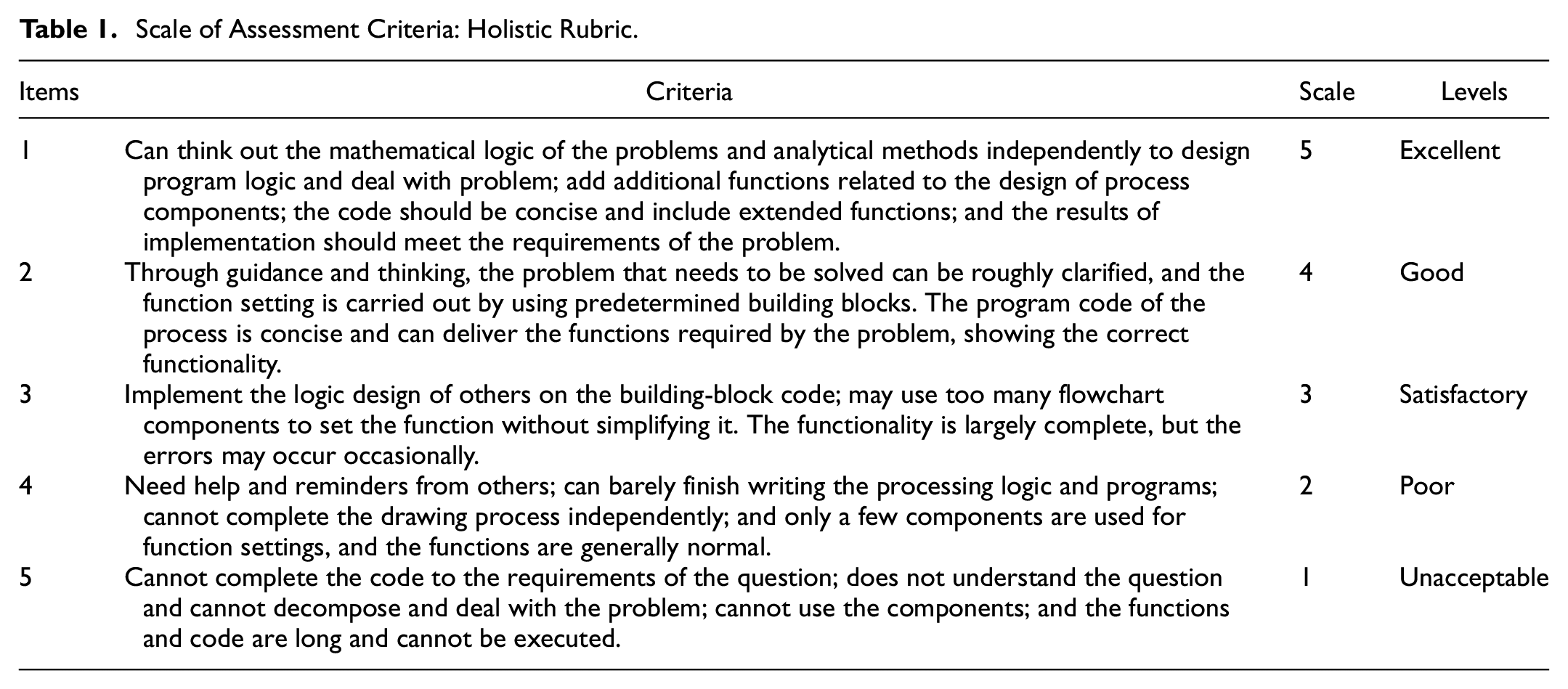
Through guided problem logic analysis and building block programming, the execution of this study is, with the power of peers in learning groups, to build students’ logic capacity in program design. The use of peer assessment methods is integrated into the problem-solving steps courses, and the steps are transformed into thinking applying programs to solve practical problems so that learners can learn and progress together through the power of their peers. Therefore, with such a curriculum plan, one must be familiar with the curriculum assessment criteria beforehand. Through repeated training on assessment and code of honor, one relies on self-assistance and peer support to achieve effective learning outcomes. Peer assessment was carried out according to the definition of teaching assessment in Tables 1 and 2.
Scale of Assessment Criteria: Holistic Rubric.
Assessment Criteria: Analytic Rubric.

The peer-assessment of the course is divided into the following stages:
(1) Assignment announcement and submission: All students must download the questions or assignment from the learning platform and submit them to the digital learning platform system within the submission deadline. After submitting the assignments, students are obliged to abide by the rules set by the course, carry out peer grading work, and carry out grading according to the grading criteria of the course planning and design.
(2) Assignment grading stage: After completing the assignment submission, the description of the assessment scale and the training criteria will be carried out in the course. After that, students will carry out assignment grading according to the evaluation criteria table of Tables 1 and 2. Through the implementation process, learners can clearly understand the teaching evaluation criteria which is the basis for the learning level progress index.
(3) Teacher’s grading: In each assignment, teachers must evaluate them and give feedback in accordance with the planned curriculum criteria. This is for the consistency of students’ and teachers’ assessment basis so they can compare the closeness of the students’ and the teachers’ answers to compare whether the student is approaching the correct learning direction. All assessment tasks are carried out on the digital learning platform. After the teachers’ professional assessment and feedback, learners can understand whether the assignment are correct, and then students can reflect on whether there is a gap in their answers.
(4) Peer grading: In each learner’s assessment task, the participating learners are required to allocate the number assignments to be assessed, and all assignment will be assessed and given feedback according to the given assessment criteria. This is to eliminate the unfair phenomenon caused by the emotional factors among learners. The digital learning platform system can be set up to deliver pre-assessed assignments which will be randomly selected from the submitted assignments so that the assessment can be conducted fairly. If the learner fails to complete the assessment and deliver feedback within the deadline, the student’s individual performance will be subject to a penalty of grade deduction.
(5) Self-assessment: The course in the study includes assignments for self-assessment. Subject to the planned assessment criteria, self-assessment of their own homework will be conducted. The assessment will analyze the gap between themselves and their peers. Failed to complete the self-assessment within the deadline, the student will also face the penalty of grade deduction; the system will not be able to send other assessments and will be regarded as unfinished assessment tasks.
(6) Assignment grades: When all the above assessments are completed, learners will receive a notification of their own learning effectiveness and can see their own assignment scores and the related feedback content, as well as the distribution of the whole class’s learning results and rankings, which include evaluation content and opinions given by others, as well as the other feedback on answers to the related questions.
Data Collection and Analysis
Peer assessment as a teaching mode has important pedagogical significance for student’s learning effectiveness (Petkova et al., 2021). Students who receive peer assessment teaching mode have greater learning effectiveness than students who do not receive this teaching mode (Hongli et al., 2020). In addition, setting standardized assessment criteria in peer assessment can help teachers and students to be consistent with the assessment mode, reduce the measurement differences between teachers and students on grade assessment, and increase the meaningfulness of comparing teacher and peer assessment scores (Hsiao et al., 2022). There are many empirical results in teaching and other educational fields that prove that using peer assessment in the educational field can serve as a formative practice, which helps to improve student’s learning outcomes (Double et al., 2020).
In our study, after peer and teacher assessments on homework or tests, data processing and performance analysis of learning outcomes must be performed; each student will score on several peers. The data analysis of the learning effect is divided into three parts. The first part is the presentation of the scores of teachers and learners. The close relationship between the average values is the similarity between the average scores of peer assessment and teacher’s assessment. The purpose is that from the closeness between the correct answers given by the teacher and the learner’s answer, one can observe the distribution of the learners’ multiple learning outcomes and find out the problems and their relevance between the learners and the teachers.
The second part is the relationship between learners’ self-growth in the learning process. It uses the average score of the peers as the numerator and the teacher’s score as the denominator. It calculates the degree of approximation between the learner’s achievement and professional ability and the teacher’s professional ability. The calculation is shown in equation (1), and the numerical range is shown in Table 3. It is relatively objective to calculate the degree of professional growth.
Table of Learner’s Professional Approximation Relationship.

The third part is the change relationship of the learner’s self-professional growth. It mainly finds out the degree of self-improvement of the learner in the learning process. The calculation method adopted is shown in equation (2); the numerical change is shown in Table 4. The last part applies statistics methods to analyze the learning level of students in building block programming logic design, explore the relationship between the learning effect of learning building block programming logic design, find out the reasons for and relationships of poor learning, and improve students’ learning effect and provide appropriate guidance.
Learner’s Self-Professional Growth Change.

Changes in the degree of approximation of learners’ professionalism: In order to better understand the learning gap and the degree of change between learners and teachers, it is necessary to calculate the closeness of the professional competence of the two. At the initial contact, the learners basically have no professional competence, while the teachers are professionally trained. After teaching practice, the professional competence of the learners will be improved, and there will be a certain degree of progress and gap in the professional understanding for the course. Therefore, by discussing the grading standards of learners and teachers, the difference in professional cognition between the two can be reduced. It also means that after learners go through the professional content instructed by the teachers, with the same basic level, one can explore how much closer students can get to the professional level and capacity of the teachers which indicates learners’ professional growth degree and distribution relationship.

The learner’s self-professional growth changes: After the learners learn through instruction, the basic level of self-learning will appear. After the benchmark for the first assignment or test is established, the self-professional growth can be checked through this benchmark. Comparing the differences in each inspection and calculating the extent of self-professional progress each time, learners can observe the progress or regression independently according to the difference in each inspection so they can actively discuss the problem point of self-learning in that section. Discussing the comparison of results of each scoring against the benchmarks and understanding whether there are different degrees of learning gap from the previous scoring allow learners to quickly understand their own learning status and growth rate. Teachers can also discuss whether the content of the current course has reached the teaching objectives and the core learning ability of the learners by multiple discussions on the learning cases.

This study transforms the results into a two-dimensional chart, which shows the score data of the professional ability gap between teachers and learners. Each blue dot represents the teacher’s evaluation score for each student, which is the teacher evaluation score. The student peer evaluation score is presented in orange dots. The relationship between the distribution of the graph is to observe the assessment placement analysis of learners (orange dots) and teachers (blue dot) and the relative relationship between their teaching and learning and find out the effect of using peer assessment teaching to improve learning in building block program logic design. Empirical research are conducted using multiple tests and assignments.
When this research is expected to be implemented, before the first assignment, learners went through the assessment criteria training. However, the overall distribution of the assessment by the learners will be scattered during the first try-out. The result can be divergent and not converge, As shown in Figure 2, the result of peer assessment for the first assignment is very different from the teacher’s evaluation. In the second assignment, as students already have experience in assessment, the overall distribution points will have a convergence phenomenon and gradually lean toward the teacher’s assessment results. The teacher’s average line may be quite different in the third assignment due to the change of the topic, but it is expected that the students have had two experiences which may make the distribution points closer to the teacher’s average. It is expected that in the fourth assignment, the results of teacher assessment and peer assessment will reach a certain degree of convergence and the distribution points are very close to the mean line, as shown in Figure 2. Through the analysis of the four assignments evaluation tracking in Figure 2, such results show that, consistent with the research goal of achieving learning outcomes, the professional growth of learners and teachers has reached a certain level. Meanwhile, such results show students’ learning effect and professional ability in a single course have gradually approached the professional degree of the teaching content.

Peer-assessment and teacher assessment approximation chart.
Results
The Impact of Teaching Results on Students
The learning effects of the experimental group using the Zuvio peer assessment teaching mode to carry out the Blockly process programming teaching and the control group using the traditional evaluation teaching mode to carry out the process programming course are analyzed separately, and then the teaching adjustment is carried out to improve the students’ ability in solving problem in the program steps, improve the students ability to professional courses of programming, use program design to solve practical problems, improve students’ interest in programming learning, and reduce their fear of the professional courses of programming.
Changes in Learners’ Professional Approximation Degree
The innovative teaching of peer assessment is integrated into the experimental group course. After the learners learned the professional content taught by the teacher and the practical operation practice of the group test, there will be a certain degree of progress and gap in understanding the professional content. To better understand the level gap against the teachers and the degree of learning changes, the approximation degree of professional ability of the two groups are calculated based on equation (1). The analysis chart of learner’s professional ability is shown in Figure 3: Learner’ professional approximation chart. It can be observed from Figure 3 that most of the gaps in the experimental group are greater than 0.75, which means that the students have roughly the same professional cognitive understanding as the teachers. Only three groups of students have a gap of less than 0.75, indicating that the learning effect has not improved as expected after teaching. The gap of seven groups in the control group is greater than 0.75, and the gap of the other eight groups is less than 0.75, indicating that the professional approximation growth of the control group is limited.

Learners’ professional approximation analysis.
Changes in Learner’s Self-Professional Growth
After the experimental group and the control group have been taught, group tested, and practical programming trained, the learners will have a basic level of self-learning. After the benchmark of the first assignment or test is established, the self-professional growth is checked and calculated based on the benchmark in equation (2). The growth analysis chart of the experimental group and the control group is made so that the learner can quickly understand the learning status and growth rate, as shown in Figures 4 and 5: Change analysis of the self-professional growth of learners in the experimental group and the control group. From the Figure 4, it can be analyzed that the experimental group, using innovative teaching methods, In the midterm, the gaps in the change of students’ professional growth are basically >1.0, indicating the learners have room for improvement in their professional ability. Only three groups of learners are <1.0 showing regression, and further improvement is needed. At the end of the term, the students’ professional growth rate has increased significantly, and the rate of progress is generally higher than the midterm gap, and only two groups of learners are less than 1.0, indicating further teaching improvement is required in terms of learning. The control group was taught by the traditional scoring method. From the Figure 5, at the midterm, the learner’s professional growth change data showed that five groups >1.0 showed improvement, ten groups were <1.0 showing regression. By the end of the term, seven groups had professional growth changes >1.0, and the other eight groups had professional growth rates <1.0, and there was no obvious progress between the midterm and the end of the term. Therefore, the students in the control group had significantly weaker professional learning outcomes than the experimental group.

Change analysis of the self-professional growth of learners: experimental group.

Change analysis of the self-professional growth of learners: control group.
Approximation of Teachers’ and Learners’ Assessments
After conducting innovative teaching for the experimental group, according to the midterm and final tests, the mean and standard deviation of peer evaluation and teacher evaluation can be obtained. The mean and standard deviation of peer evaluation in the midterm were 67 points and 9.87, respectively, and the mean and standard deviation of teacher evaluation were 58 points and 18.21, respectively. The mean and standard deviation of peer evaluation in the final was 70 points and 12.08, respectively, and the mean and standard deviation of teacher evaluation was 64 points and 16.82, respectively. The descriptive statistics are shown in Table 5. From the mean of teacher evaluation, it can be seen that the students in the experimental group who conducted innovative teaching have improved their learning outcomes, from 58.00 points to 64.31 points, with an overall average improvement of about 6 points, and the standard deviation has decreased compared to the midterm, from 18.21 to 16.82. It indicates that not only have the students’ scores improved, but they are also more concentrated, with less extreme scores occurring. From the mean of peer evaluation, it can be seen that from 67.23 in the midterm to 69.85 in the final. This shows that students affirm their own and peer learning outcomes improvement, which can also enhance students’ confidence in self-learning and increase their enthusiasm for learning.
Descriptive Statistics of the Teacher Evaluation and Peer Assessment.

Through the innovative teaching of the experimental group, peer assessment and teacher assessment were conducted on the midterm and final exams during the semester. The results were integrated into a two-dimensional chart. Figures 6 and 7: Peer assessment and teacher assessment approximation in midterm and final exams. The distributions in Figures 6 and 7 show the scoring data of the professional level gap between learners (orange dots) and teachers (blue dots). From Figure 6, it can be observed that although there is assessment criteria training in the course, learners’ overall assessment score distribution is still different from the teacher’, indicating students’ professional capacity is far from that of the teachers in terms of teaching content. As shown in Figure 7, the final test is conducted at the end of the semester. Students by then have experienced several assessments, and their overall distribution points will have a convergence phenomenon and approach the teachers’ assessment. This result shows that it is consistent with the expectation of this study. The professional growth of learners and teachers has reached a certain degree of consistency, showing that students have improved their best learning effects and professional capacities in innovative teaching.

Peer assessment and teacher assessment approximation in midterm exam.

Peer assessment and teacher assessment approximation in final exam.
In addition, according to the performance gap between the peer group’s scores and the teacher’s scores, the students’ and teachers’ score evaluation cognitive differences are analyzed, as shown in Figures 8 and 9, where A1 to A13 are the group numbers with corresponding colors. The larger the circle, the greater the difference in scores between groups. From the distribution of the circles in Figure 8, it can be seen that the scores obtained by each group in the midterm are quite scattered, and there are considerable cognitive differences between peers and teachers. Figure 9 shows the distribution of final grades. It can be observed that the distribution of the circles is quite concentrated and close to a straight line. It shows that after the implementation of the innovative teaching model for one semester, the students have made significant progress in the learning effect of this subject and the cognitive differences in peer and teacher assessments are small.

Cognitive differences in peer assessment and teacher assessment in midterm exam.

Cognitive differences in peer assessment and teacher assessment in final exam.
Conclusion
The data analysis results verified the hypothesis proposed in this study. During the study, the subjects are divided into the experimental group using Zuvio peer assessment to carry out the Blockly process programming teaching mode and the control group using the traditional assessment teaching mode to analyze which teaching mode can help learners improve their learning effectiveness to the best ideal state. Most of the values of learners’ professional approximation degree are >0.75, indicating students and teachers have the same understanding of the teaching goal; the placement points in the peer-to-peer assessment and teacher’s assessment approximation graphs show that it can be obtained that the learners’ assessment are closer to the teachers’ assessment at the end of the term, which indicates that integrating innovative teaching can improve students’ professionalism. At the same time, all data from the change of learners’ professional growth are positive, indicating both types of instruction inspire students to learn. It can be observed from the further analysis of the gap between learners’ professional growth changes that the data of the experimental group are basically >1.0, indicating the learners have room for improvement in their professional capacity. Only three groups of learners are <1.0 showing regression and needs to be further strengthened. In control group, half of the groups are >1.0 showing improvement, and half of the groups are <1.0 showing regression. The comparison shows the effect of innovative teaching is better that of the traditional teaching.
This study implemented a peer assessment mechanism in the programming course. The average and standard deviation of the experimental group students’ scores in the midterm and final exams showed that the students did improve their learning progress. Regarding standard deviation, the final score was smaller than the midterm score, indicating that the experimental group students had fewer extreme scores in the final exam and the overall scores were more concentrated. Therefore, the results of this study confirmed that incorporating peer assessment into the course as an innovative teaching mode can enhance students’ and teachers’ professional knowledge and skills benchmarks for the course, create innovative teaching materials and methods, and help students and teachers understand peer assessment methods and mechanisms. This will help improve students’ learning motivation and outcomes, increase students’ confidence in self-learning, and thus enhance students’ learning effectiveness in programming courses.
Research Contribution
This study explores teaching innovation for computational thinking in block-based programming, which can provide a teaching strategy reference for educators in the field of information technology.
This study uses the teaching interactive software Zuvio as the implementation tool for teaching innovation. The results prove that the interactive teaching platform can improve students’ classroom participation and learning performance.
This study combines peer assessment and self-assessment to conduct innovative teaching models. The results prove that peer assessment enhances students’ affirmation and confidence in self-learning and improves their learning outcomes.
Research Limitation
The research period of this study was only one semester, which was relatively short in terms of time samples.
The research subjects of this study were only 84 freshmen and sophomores, which was relatively small in terms of number samples.
The research subjects of this study had a lower proportion of males, and the impact of gender itself on learning information technology courses could not be clearly explored.
Future Research Suggestions
Based on the limitations of this study, future researchers conducting related peer assessment studies can use a longer time as the research period and collect more research data to ensure statistical accuracy.
Future researchers can also follow up on the topic of this study and explore the impact of gender ratio on the research results when applying peer assessment to information programming courses, and analyze whether there are differences in learning outcomes of information programming courses between males and females.
Footnotes
Author Contributions
T-CH and Y-HC: conceptualization and data curation. T-LC: methodology. T-LC and C-YC: software. T-CH, Y-HC, and J-CC: validation. T-CH: formal analysis, investigation, and funding acquisition. T-CH and J-CC: resources, supervision, and project administration. T-LC and T-CH: writing—original draft preparation, writing—review and editing, and visualization. All authors have read and agreed to the published version of the manuscript.
Data Availability Statement
The original contributions presented in the study are included in the article/supplementary material, further inquiries can be directed to the corresponding authors.
Ethical Approval Statement
Ethical review and approval was not required for the study on human participants in accordance with the local legislation and institutional requirements. Written informed consent from the [patients/participants OR patients/participants legal guardian/next of kin] was not required to participate in this study in accordance with the national legislation and the institutional requirements.
Declaration of Conflicting Interests
The author(s) declared no potential conflicts of interest with respect to the research, authorship, and/or publication of this article.
Funding
The author(s) disclosed receipt of the following financial support for the research, authorship, and/or publication of this article: This research was supported by the Fundamental Research Funds, grant number 605-52421090.
