




Abstract
This study examines factors hindering employee engagement, focusing on perceived workplace incivility and its relationship with work engagement. It also presents the mediating and moderating roles of emotional responses and coping mechanisms in the workplace to determine “why” and “when” employee engagement is destabilized. The cross-sectional study used 391 samples from the hotel industry; data were collected from the crew staff via self-administered questionnaires and analyzed using Smart PLS. The study’s outcome draws attention to perceived workplace incivility and its significant negative impact on work engagement. The results also reveal that employees’ emotional responses and coping mechanisms play significant mediator and moderator roles in the relationship between workplace incivility and work engagement. In terms of theoretical background, the study makes a novel theoretical contribution by applying Affective Events Theory (AET) when employees confront incivility that triggers emotional reactions and then shows how those reactions lead to adverse work outcomes and behaviors. The study outcomes have significant implications for strategic hotel industry staff and policymakers and provide insights for future researchers. Hotel management might consider this study helpful for generating a crew-supportive work environment and stabilizing employee engagement.
Plain language summary
This study looks at barriers to employee engagement, with a particular emphasis on perceived workplace rudeness and how it relates to engagement at work. It also discusses how emotional reactions and coping techniques play mediating and moderating roles in the workplace to ascertain "why" and "when" employee engagement becomes unstable. The study’s findings highlight the substantial detrimental effects of perceived workplace rudeness on employee engagement. The findings also show that the association between workplace incivility and work engagement is significantly mediated and moderated by employees’ emotional reactions and coping strategies. The study’s conclusions offer valuable information for upcoming academics as well as essential ramifications for legislators and strategic hotel business personnel. Hotel management may find this study helpful in creating a work climate that supports the crew and stabilizes employee engagement.
Introduction
A focus on work engagement reflects the recent attention given to job structures in academic circles and among researchers and scholars—particularly in the context of the tourism sector (Y. Guo & Hou, 2022). Work engagement must be generally regarded as an optimistic and job-related satisfaction mindset involving dynamism, commitment and interest (Nemțeanu et al., 2022; Schaufeli, Martínez, et al. 2002; Schaufeli, Salanova, et al. 2002). In the case of workplace scenarios, the employees feel themselves working well and fulfilling tasks when they are involved in the workplace based on physical, cognitive, and psychological factors (Kahn, 1990; Kulikowski, 2022). Gallup’s measurement scale of work engagement has stated that almost 87% of individuals at work do not become engaged in work tasks due to “global employee engagement crises” (Islam & Tariq, 2018; Mann & Harter, 2016). Likewise, work engagement represents an individual’s positive attitude, mindset and behavior in the workplace that further leads to positive outcomes (Yan & Donaldson, 2023).
Work scenarios comprise varied individuals and different mindsets, depicting positive and negative behaviors (Belschak & Den Hartog, 2009). Negative behaviors seem more prominent and antisocial, particularly workplace incivility, which includes rudeness, unsupportive acts, hatred and disrespect. These are considered costly for the organization and the individuals working in that organization (H. Jiang et al., 2017; Nasir et al., 2017). Many individuals from national (Javed et al., 2019; Shaheen et al., 2023) and international (Aryati et al., 2018) contexts report they have experienced workplace incivility.
Workplace incivility is a relatively novel spot of organizational behavior. It implies low-intensity rude, impolite or unusual conduct with an ambiguous intention to trouble or hurt the target; it is an antisocial scenario that violates mutual respect and workplace norms (Andersson & Pearson, 1999; Han, Harold, et al. 2022; Han, Yoon, et al. 2022). It involves lower usage of polite expressions, such as “Please” and “Thank you,” in workplace communication, particularly from disrespectful supervisors and coworkers, and includes harsh words and unkind emails to employees in the workplace (Algorani & Gupta, 2022). They might seem mild acts, but these uncivil behaviors hinder workers’ capacity to engage in the workplace with zeal and zest (Han, Harold, et al. 2022; Han, Yoon, et al. 2022). Meanwhile, developing coping mechanisms is the strategy individuals use to relieve unpleasant emotions and overcome stress (Peltier et al., 2022). Uncivil behaviors might be less aggressive, but they stimulate negative emotional responses among the targets (Ugwu & Nnamah, 2022).
Diverse hostility, like workplace incivility, social elimination, maltreatment at work and violence (Notelaers et al., 2019), leads to emotional responses and influences employee engagement in their work. Negative emotional responses can affect the employees’ engagement and coping mechanisms and produce an uncomfortable working environment. Although uncivil behaviors might not be so obvious and might not even intend to harm anyone (Andersson & Pearson, 1999), they violate the standard of respect at the interpersonal level. Consequently, they would affect employees’ welfare and engagement. Considering the scenario and the empirical evidence from the literature, Bekiari and Pachi (2017) have described the connection linking workplace incivility, stress, job exhaustion, and low job fulfilment (Lever et al., 2019).
The studies focusing on workplace incivility considered different fields: the healthcare and nursing sector (Hawkins et al., 2019; Lever et al., 2019), business entities (W. Jiang et al., 2019), as well as in academia (Ahmad et al., 2017). Although previous literature has given some attention to the tourism industry, there are few examples of research into workplace incivility among crew staff in the hotel industry and negative emotional responses in a mediating role involving workplace incivility and employee engagement. In some ideas, work engagement has been considered as an antecedent (Olugbade & Karatepe, 2019), in some a mediating construct (Wang & Tseng, 2019); other researchers have dealt with it as an outcome (Dai et al., 2021). However, most studies have been conducted on other divisions (Gupta & Shaheen, 2017; Najeemdeen, 2018; Sepdiningtyas & Santoso, 2017) and very few on the hospitality industry (Dai et al., 2021).
Prior studies illustrate that workplace incivility is quite common—especially in the healthcare sector, manufacturing concerns, academic and non-academic scenarios, industrial contexts, and nonprofit organizations (Robinson et al., 2019). The literature reports facts and figures, from diverse contexts, concerning workplace incivility. Almost 71% of individuals in the court system face incivility (Cortina et al., 2001); up to 75% of faculty in the higher education sector have reported incivility, as do 79% of workers in law enforcement (Caza & Cortina, 2007). The highest rates have been reported in the healthcare sector, with 85% reporting incivility or antisocial behaviors (Lewis & Malecha, 2011). These figures reflect a darker perspective on organizations, revealing the influences of uncivil behaviors that affect almost 98% of the individuals at work, who face such unbearable behaviors almost weekly (Smith et al., 2018).
The current study intends to bridge the gap and probe the influences of workplace incivility involving workplace engagement, investigating the mediator task of negative emotional responses and, finally, examining the boundary influence of coping mechanisms on the association between negative emotional responses and employee engagement. The context of the current study is the hotel industry in Pakistan.
Pakistan has excellent tourism possibilities with its beautiful, varied landscapes and distinct seasons (Sarwar & Muhammad, 2021). The tourism industry could potentially contribute billions of dollars to the Pakistani economy. Because of the current pandemic and socio-economic crunch, taking advantage of the expected economic benefits isn’t easy. In this study, the hotel industry has been selected to examine the influences of incivility and engagement, particularly in an era of uncertainty, when emotional responses are negative and coping mechanisms are not easy to apply. As well as the problematic pandemic situation, the context includes sensitivities related to law and Order due to political and religious scenarios. As in the past, the hotel industry has, for almost the last 2 years, been confronted with terrorist attacks, poor economic growth and socio-political conditions.
The study comprises the following main sections: a presentation of its theoretical stance, along with several hypotheses; details concerning the method and sources of data; a description and analysis of the data, with an explanation of the results; and an elaboration on the theoretical and practical repercussions. The final section outlines the study’s limitations and possible directions from the perspective of future research.
Literature Review
The following sections examine the literature and provide theoretical support.
Theoretical Background
Affective Events Theory (AET)
The study uses Affective Events Theory (AET) as a base. AET embraces the concept that aggressive incidents can provoke emotional responses, which, in turn, relate to behavioral and attitudinal work outcomes (Weiss et al., 1996). According to AET, (i) incidents that have their source in the work environment perform as emotional impetuses consequential in desirable and undesirable affective situations; (ii) affective situations are understood to be conductors for affect-driven outcomes; (iii) incidents are controlled through work environment characteristics as well as affective states, are also influenced by judgment-driven manners; and (iv) as a result, personality characteristics participate a boundary role in association connecting practical work actions as well as affective states (Ghasemy et al., 2020). Considering the foundations of AET, we can argue that when employees confront an uncivil incident, it stimulates their expressive reactions. Those responses further show negative work outcome behaviors (Bunk & Magley, 2013; Lei et al., 2020).
Furthermore, workplace incivility creates a hostile environment (Weiss et al., 1996). In response to any simple incivility or specific events in the work environment, employees can eventually experience discrete emotional states—for example, a worker might experience anger or irritation—and these diverse sets of sentiments, as a response to workplace actions, have different behavioral consequences ( Hoel et al., 2001; Lim et al., 2016). AET, therefore, looks at deviant behavior in terms of violating workplace respect and norms, which leads to employees’ feelings and responses expressed in work commitment (Rafiq et al., 2019, 2022; Wu et al., 2017). The current study runs parallel with AET and shows that workplace incivility acts as an organizational effect and that deviant behavior—a violation of workplace norms—leads to emotional responses in the form of expressive responses and coping mechanisms and affects work engagement.
Hypotheses Development
Perceived Workplace Incivility and Emotional Responses
In the region of unenthusiastic organizational behavior, workplace incivility is a reasonably recent concept described as “low-intensity, discourteous or impolite deviant workplace actions with vague intent to hurt the target as well as is in abuse of workplace standards for common respect” (J. Guo et al., 2022; Madhan et al., 2022). It causes a reduction in the use of essential polite words like “delight” and “acknowledge you,” instead introducing blunt and disrespectful language among the leaders and social group or the exchange of hurtful emails to workmates. The above-said actions might seem unimportant, but they silently harm apparent insider status, official affective commitment, and organizational recognition, resulting in reduced workplace engagement (J. Guo et al., 2022). In different open conflicts, likewise, workplace elimination, workplace maltreatment and workplace violence (Hershcovis, 2011; Kunkel et al., 2015), workplace incivility is less apparent and no plain intention to hurt others (J. Guo et al., 2022). It is associated with passive human-linked and job-related outcomes and goes against the fundamental norms of mutual respect. Workplace incivility creates a harsh official environment and negatively affects official performance, societal reputation and organizational reflection.
Workplace incivility can spread to the whole organization and, if not tackled correctly, can shoot up into severe workplace anger (Miner et al., 2018), eventually affecting an official significant spirited benefit (C. Porath & Pearson, 2013). Uncivil behaviors are intrinsically harmful to the firm and employees’ performance (Estes & Wang, 2008), resulting in an organization experiencing substantial losses, in monetary terms and employees (C. Porath & Pearson, 2013). Hence, workplace incivility is also primarily evaluated as a stressor, where the victim is inclined to encounter painful emotions like anger, guilt, embarrassment, and sadness (Han, Harold, et al. 2022; Han, Yoon, et al. 2022). Another study recommends that uncivil aggressive behaviors are linked with unpleasant reactions like anxiety, depression and stumpy self-esteem (Bowling & Beehr, 2006; Ugwu & Nnamah, 2022). P. Liu et al. (2021) report rude behaviors as exterior instigators that experience more irritation. On the other hand, Bunk and Magley (2013) show that targets of incivility are inclined to believe that their behaviors have resulted in such uncivil treatment.
Consequently, victims feel self-blame or guilt (Sunar et al., 2021). Additionally, confronting workplace incivility from colleagues—that is, being treated rudely or disrespectfully—can damage the targeted individuals’ emotions (Hershcovis et al., 2017). We range this research to an organizational setting highlighting that workplace incivility arises from discrete negative emotions among individuals. Keeping them in view, we can hypothesize that:
Emotional Responses and Work Engagement
Chang (2009) stated that adverse emotional effects might decrease psychological abilities and consequently diminish employees’ work engagement (Hakanen & Schaufeli, 2012). Undesirable emotions experienced at the workplace can also contribute to a desirable appraisal of the work and inspire coping behavior and flexibility in elaborating work engagement (Gorgievski & Hobfoll, 2008; Nemțeanu et al., 2022; Schaufeli, Martínez, et al. 2002; Schaufeli, Salanova, et al. 2002). Earlier studies supported Control Value Theory and investigated employees’ accomplishments and feelings and their association with motivational concepts. They found that unpleasant emotions tended to have a worse impact by damaging employees’ interest in inner motivation, limiting the availability of intellectual resources, and enabling their dependence on external guidance (Kulikowski, 2022; Yan & Donaldson, 2023). Moreover, it was suggested that these motivational paradigms and employees’ feelings of attainment are connected and can comprise pleasant and unpleasant response circles (Pekrun, 2006). Generalizing said proposals to the connection involving feelings as well as work engagement and can be expected higher levels of unpleasant feelings about the job would possibly decrease employee commitment (Y. Guo & Hou, 2022).
A contradictory course of causality is also imaginable. Less involved academicians also have low levels of mindset flexibility, are less prepared to spend effort and persevere when confronted with troubles and are not as likely to feel the judgment of significance and attentiveness to their employment. They might realize additional anxiety and unpleasant feelings (Hakanen & Schaufeli, 2012; Innstrand et al., 2011). The current research is put up an attempt to explain the association between discrete styles of undesirable emotions as well as work engagement; therefore, a study following the hypothesis that:
Perceived Workplace Incivility and Work Engagement
Incivility is linked with normative behavior that is opposed to the standards of civil behavior; it involves acting offensively and impolitely and represents an absence of esteem for others ( Cortina et al., 2001; Notelaers et al., 2019). According to Beattie and Griffin (2014), workplace incivility increases anxiety among employees when they must confront the challenge of uncivil activities. The undesirable adverse influence of uncivil behaviors on work commitment is particularly prominent in individuals with little self-evaluation (Olugbade & Karatepe, 2019). Earlier studies endorsed the significant affiliation linking perceived workplace incivility and work engagement (Beattie & Griffin, 2014; J. Guo et al., 2022; Y. Guo & Hou, 2022; Reio & Sanders-Reio, 2011). However, employees’ engagement with work can be increased through positive connections in an organization—for example, through support from peers and supervisors. The current research is putting up an attempt to elucidate the connection between uncivil behavior and engagement in the workplace. The study comes up with the following hypothesis:
The Role of Emotional Responses in Mediating Between Perceived Workplace Incivility and Work Engagement
Employees who experience negative emotions commonly display signs of stress and poorer work outcomes (J. Guo et al., 2022; Harold & Holtz, 2015). This depressing outlook, regularly convoyed by limited coping possessions (Schat & Kelloway, 2000), can be linked with their attachment to unenthusiastic emotional situations over the moment. These impressions can be distinguished effortlessly in employees’ past experiences, mainly those related to anxiety and despair (Namie & Lutgen-Sandvik, 2010). Furthermore, it is frequently visible that extra-sensitive persons seem extra reactive to harmful outcomes and negative emotions. One study reflects that uncivil and unfair treatment in the context of workers can trigger negative emotions—like adding fuel to the fire (Gui et al., 2022). Another study recommends that those employees initially direct their incivility on the way to uncivil coworkers in an outline of straight reprisal (Salin, 2003).
Negative emotional responses and feelings at work, such as those connected with uncivil behaviors, are likely to escort to negative results like turnover intention, harm employee well-being, and reduce work engagement (Reio & Sanders-Reio, 2011; Taheri et al., 2023; Yeung & Griffin, 2008). In line with AET, employees in an emotional state are inclined “to be inattentive under the influence of negative emotions.” These negative emotions eventually lead to adverse outcomes (C. L. Porath & Pearson, 2012). Emotions are particularly significant. After all, they indicate an immediate reply to diverse scenarios and incidents (Zapf, 2002) because they can happen to the spinning point in people’s lives, next to encouraging, motivating and bringing about a practical revolution in their work (Fox et al., 2001). Emotion acts as an intermediary role involving uncivil events and work engagement. AET suggests that negative feelings or responses mediate between the perception of workplace rudeness and work engagement. This current research sets out to check the intervene role of negative feelings, with regard to workplace incivility alongwith work engagement and so proposes the following hypothesis:
The Role of Coping Mechanisms in Moderating the Relationship Between Emotional Responses and Work Engagement
Coping mechanisms manage exact external and internal demands made on an individual. Literature reveals that coping behavior helps to address revenge, forgiveness, or reconciliation when a person feels victimized in the workplace (Aquino et al., 2006; Mikus & Teoh, 2022; Rolin et al., 2022). Coping helps respondents manage stressors with their mental abilities and ordinary routines (Glover et al., 2022). Gottlieb (1997) further claims that individuals remain consistent when they develop the ability to control repeatedly any chronically stressful situations. This study analyzes the role of coping behaviors concerning workplace incivility and engagement in the workplace. Past literature distinguishes between two types of strategy: (i) approach-oriented approaches, which involve cognitive as well as behavioral influences to resolve problems, such as problem-resolving otherwise looking for social support; (ii) avoidance-oriented approaches—for example, venting of feelings or sentiments, psychological disengagement and compensating behavior—all of which consist of efforts to overcome the issues (Carver et al., 2008).
Generally, those who suffer from incivility only rarely use positive approaches that are concentrated on the problem and usually at the initial stage of the procedure (Hogh & Dofradottir, 2001; Soral et al., 2022). These approaches might also be ineffective if employees recognize control or grip and the hopelessness of escape. Most victims choose to escape and overlook what has occurred to them (Dehue et al., 2012; Huang et al., 2022). In a few examples, coping approaches might even become aggressive, follow-on in the continuation of victimization (Aquino & Thau, 2009), and reduce employees’ work engagement. The present is very slight in the text about the job of coping mechanisms in terms of uncivil behaviors. This study focuses on three categories of coping strategies: task, emotion as well as avoidance coping. The coping strategies people use in the workplace can moderate the connection between negative expressive responses and work engagement. The hypothesis:
After the detailed discussion of existing literature along with theoretical support, this current research projected the mentioned research model in Figure 1.

Visual image of research.
Methodology
Sampling and Data Collection
The study used a quantitative research plan that reflected numerical figures and values gathered from the target population (Merriam & Grenier, 2019). The study proposed and tested hypotheses using a descriptive research design (Dulock, 1993). The study also extracted the primary data approach for analysis (Hox & Boeije, 2005) and used a non-probability sampling method for data collection from the target audience. In this perspective, the study used a convenience sampling technique to pick hotels and respondents that were readily and easily available for the study (Saunders et al., 2009). Convenience sampling is a non-probability sampling in which participants are chosen because they are easily accessible and available. It is frequently used when a more rigorous sampling method is difficult or impractical, such as when time and resources are limited. However, convenience sampling may be appropriate in some situations. It could be helpful in pilot studies, exploratory research, or studies focusing on a specific population subgroup.
Data were gathered from full-time restaurant managers, servers, front desk officers and chefs from hotels in different cities of Pakistan, including Lahore, Bahawalpur and Karachi. The selected hotels differed based on their food menu, quality standard and ranking. To confirm the validity of our study scales at the initial stage, we sent 30 surveys to 10 hotel participants as part of the pilot study. In response, we received 26 usable surveys. The original data about the respondents were collected after the approval of the targeted hotels. It took approximately 2 months to finalize the entire process of collecting data, which were gathered electronically (Google Form) and through survey questionnaires using the five-point Likert scale. Simultaneously, we collected 443 samples from supervisory and non-supervisory staff employed in different positions in the targeted hotels. Of the samples, 391 were finalized, and the remaining 52 were abandoned due to missing values.
Measures
The measures of the current study were adapted from existing research. “Perceived workplace incivility” described employees’ experiences of workplace incivility from coworkers or supervisors and was adapted from Cortina et al. (2001). The negative emotional response is incorporated in research as mediating construct. “Emotional responses” described the emotions—disturbed, hurt, annoyed and worried, harmed, depressed, shocked, stunned, scared, unhappy, irritated, saddened and embarrassed—and were adapted from Van Katwyk et al. (2000). The study moderating variable is “coping mechanism,” divided into three further magnitudes: Task, Emotion as well as Avoidance coping. The coping mechanism is adapted from Endler and Parker (1990) and McWilliams et al. (2003). Work engagement has been used to measure work engagement by constituting three magnitudes—vigor (vitality), dedication, and absorption—and adapted from Schaufeli, Martínez, et al. (2002) and Schaufeli, Salanova, et al. (2002). The study also used four control variables: gender; age; education; and organizational tenure.
Empirical Findings
The partial least square (PLS-SEM) is regarded as a modern tool for measurement purposes (Ali et al., 2018). Furthermore, PLS-SEM is seen as a flexible assessment instrument (Ringle et al., 2005). Hair et al. (2016) also demonstrated that PLS-SEM is highly recommended regarding data normality and lower data limits. Because of this functionality, the study suggested Smart-PLS software for analyzing, estimating and evaluating the hypothesis. Henseler et al. (2009) suggested the two-step method for calculating the study results. This method is also strongly recommended for analysis in social science research work (Henseler et al., 2009). The first step is represented as “measurement model evaluation” that explains the confirmatory factor assessment using convergent and discriminant validity. The second is denoted “structural model assessment.” This step consists of path analysis (direct relationship), indifference effect (mediation analysis) and the interaction term (moderation analysis).
Normality of Data
PLS-SEM is a non-parametric software used in estimation and analysis due to its lesser requirement for data normality (Hair et al., 2007). Therefore, it is pertinent to mention that the study did not run any analysis without estimating the normality of the data in the study. Munro (2005) recommended a check of data normality using kurtosis, skewness and histogram plots techniques in this scenario. The standard numeric value of normality of the data test falls between −2 and +2. The results declared that the value is accordingly threshold and data have been normally distributed. It means that data have no problem with normality. Therefore, additional investigation will be accomplished through the functionality of PLS-SEM.
Common Method Bias (CMB)
The study data were collected from crew staff of the hostel industry in a cross-sectional manner; therefore, data might be affected by the common problem of Common Method Bias (CMB). In light of the above case, a multicollinearity test should be performed to confirm the existence of common method bias in a data set (Kock, 2015). The standard value of the multicollinearity test falls under 3.3, confirming no CMB in the data. If the value exceeds 3.3, the data have collinearity problems. The study results concluded values of study variables were under 3.3 as per the threshold, and data had no CMB. Therefore, in this scenario, additional investigation will be accomplished through the functionality of PLS-SEM.
Measurement Model Assessment
As mentioned, the first stage consists of measurement model assessment through confirmatory factor analysis (CFA) using convergent and discriminant validity. In measurement model assessment, there is a focus on data reliability and validity and latent constructs’ internal items (variables). In addition, convergent validity is further distributed in evidence of factors loading, composite reliability, and average variance extract. Table 1 and Figure 2 showed that approximately all the factor loadings were higher than 0.70. Hair et al. (2017) stated that if loading values were more than 0.70, they are significant and accepted, as per the threshold.
Convergent Validity.

Note. Loading = factor loading; CR = composite reliability; AVE = average variance extract.

Measurement model assessment (visual presentation).
Moreover, the composite reliability draws attention to the internal consistency of the data set. Hair et al. (2014) emphasized that the threshold acceptance rate of composite reliability is 0.70. Table 1 and Figure 2 revealed that composite reliability figures exceeded 0.70 for all constructs and were accepted as per the threshold. Furthermore, the alpha technique also underlined the consistency of the data set. Hair et al. (2014) emphasize that the acceptance rate of the alpha value is 0.70. The results revealed that all constructs’ alpha value was more than 0.70 and accepted as per the threshold. In addition, the data’s internal validity should be checked using the average variance extract (AVE). Cheung and Wang (2017) defined the standard rate of AVE as 0.50. Table 1 and Figure 2 indicated that AVE figures were higher than 0.50 and accepted as per the defined standard.
The discriminant validity has been endorsed through Hetreotrait-Monotrait Criteria. Kline et al. (2012) stated that the standard threshold value of HTMT is lower than 0.85. Tables 2 and 3 revealed that all the study variables are also lower than 0.85. It means that discriminant validity as per threshold is accepted and statistically significant.
Discriminant Validity (HTMT Ratio).

Note. AB = absorption; AC = avoidance coping; DE = dedication; EC = emotional coping; ER = emotional responses; PWI = perceived workplace incivility; TC = task coping; VI = vigor.
Discriminant Validity (HTMT Ratio).

Note. CM = coping mechanisms; WE = work engagement.
Structural Model Assessment
The second stage is highlighted structural model assessment and consists of path analysis (direct relationship), indifference effect (mediation analysis), and the interaction term (moderation analysis). With the help of the bootstrapping route in partial least square (PLS-3), the analysis was accomplished (Ringle et al., 2005). The beta values, t-values, standard error, p-values and lower and upper limits confirmed the model’s fitness or acceptance from the perspective of significant and insignificant values. Table 4 and Figure 4 highlighted that perceived workplace incivility develops a significant relationship with the emotional response (β = −.432, t = 10.051, p = .000, LL = 0.370, UL = 0.514). Therefore, H1 is statistically supported. Moreover, the emotional response also significantly impacts work engagement (β = −.678, t = 14.019, p = .000, LL = 0.601, UL = 0.755). H2, therefore, is also supported statistically. Furthermore, perceived workplace incivility creates an affiliation among work engagement (β = −.104, t = 1.861, p = .032, LL = 0.004, UL = 0.184). Therefore, H3 is also supported.
Structural Equation Modeling (Path Analysis).
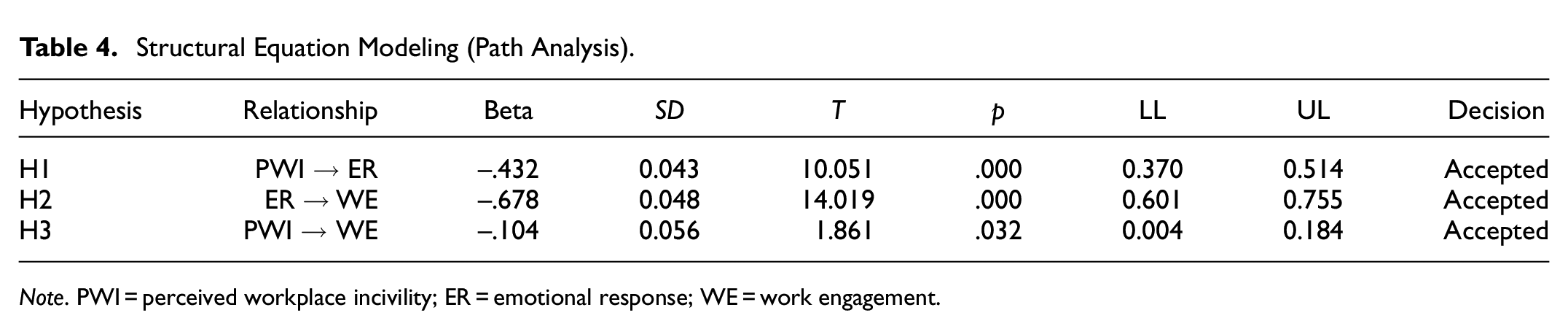
Note. PWI = perceived workplace incivility; ER = emotional response; WE = work engagement.
The study also explores the mediating responsibility of emotional response between perceived workplace incivility and work engagement. Table 5 and Figure 4 show an analysis of this mediation role. According to the results, the emotional response significantly mediates a task between perceived workplace incivility and work engagement (β = .293, t = 9.827, p = .000, LL = 0.251, UL = 0.349). It means that H4 is empirically supported. The study also aimed to establish the moderating position of coping mechanisms among perceived workplace incivility and work engagement. Table 5, Figures 3 and 4 highlight the moderation analysis. The outcomes show that coping mechanisms significantly mediate between perceived workplace incivility and work engagement (β = .098, t = 2.565, p = .005, LL = 0.034, UL = 0.156). Likewise, H5 is statistically supported.
Indirect Effect & Interaction Term (Mediation & Moderation Analysis).

Note. PWI = perceived workplace incivility; ER = emotional response; WE = work engagement; CM = coping mechanisms.

Interaction term (moderation analysis) visual presentation.
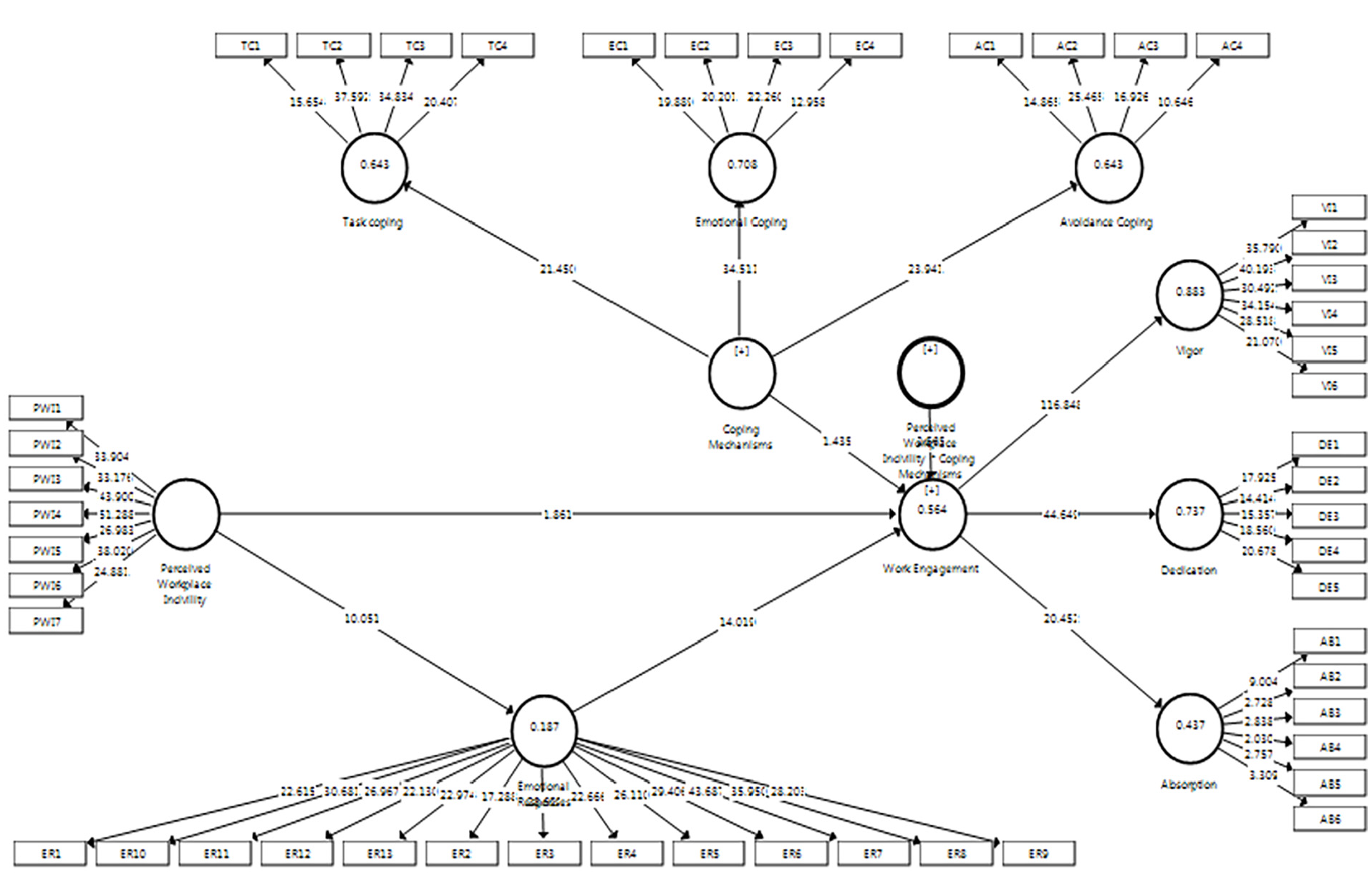
Structural model assessment (visual presentation).
Discussion and Conclusion
The study intends to bridge the existing literature gap by investigating perceived workplace incivility’s influences on workplace engagement and emotional response. This study also scrutinized the mediating job of negative emotional responses involving perceived workplace incivility and engagement. Finally, the study examined the moderating task of coping mechanisms that link negative emotional responses and employee engagement in the hotel industry. The study had five aims.
First, the study shows the impact of perceived workplace incivility on emotional response. Its results revealed that perceived workplace incivility significantly negatively impacts emotional response. Earlier studies showed a similar outcome. Workplace incivility can spread to the whole organization and, if not addressed, can develop into more severe forms of aggression in the workplace (J. Guo et al., 2022; Madhan et al., 2022; Miner et al., 2018), which eventually affects a firm’s competitive strengths (C. Porath & Pearson, 2013). P. Liu et al. (2021) reported that when experiencing uncivil behaviors from others, employees were more inclined to respond with anger. In contrast, Han et al. (2022), Ugwu and Nnamah (2022) and Bunk and Magley (2013) claim that intentions of incivility are too likely to reflect upon whether their performances have caused such uncivil behavior.
Second, the study highlighted the relationship between emotional responses and employee engagement in the workplace. The results verified that emotional responses significantly negatively impact work engagement. Existing studies also support these findings. Likewise, Nemțeanu et al. (2022) and Chang (2009) agreed that adverse emotional effects could reduce psychological availability and consequently diminish work engagement (Hakanen & Schaufeli, 2012). Furthermore, by inference, to the connection involving emotions with work engagement, it can be anticipated that the involvement of upper levels of unpleasant feelings in the workplace would possibly reduce their commitment (Kulikowski, 2022; Pekrun, 2006; Yan & Donaldson, 2023).
Third, the study examines the affiliation between perceived workplace incivility and work engagement. The results showed that perceived workplace incivility developed a significant negative association with work engagement. According to Y. Guo and Hou (2022) and Beattie and Griffin (2014), uncivil behaviors in the workplace increase anxiety among employees when they confront the challenge of uncivil behaviors. Workplace incivility is also a type of behavior that is inclined to be belittling; therefore, impolite conduct from the leader or colleagues will have an undesirable effect on employees’ observations of their atmosphere and have allusions to work commitment (Beattie & Griffin, 2014; Reio & Sanders-Reio, 2011).
The study also explores the mediating task of emotional response involving perceived workplace incivility and work engagement. The outcomes concluded that emotional response executed an affirmative mediating task between perceived workplace incivility and work engagement. Existing studies also showed that negative emotional responses at work, such as those connected with uncivil behaviors, are likely to lead to adverse effects on employee well-being, turnover intention and reduced work engagement (Gui et al., 2022; J. Guo et al., 2022; Reio & Sanders-Reio, 2011; Taheri et al., 2023; Yeung & Griffin, 2008).
Fifth, the study established the moderating job of coping mechanisms connecting perceived workplace incivility and work engagement. The results showed that coping mechanisms accomplished a considerable moderating effect involving perceived workplace incivility and work engagement. Earlier studies also supported these results and emphasized that coping behaviors help address revenge or forgiveness and reconciliation when a person feels victimized in the workplace (Aquino et al., 2001; Glover et al., 2022; Mikus & Teoh, 2022; Rolin et al., 2022). Coping mechanisms help respondents manage stressors, their mental abilities and ordinary routines in the workplace, and work engagement (Huang et al., 2022; Soral et al., 2022).
Overall, in its focus on the hotel industry, the study has drawn attention to perceived workplace incivility. It has underlined the impact of perceived workplace incivility on employees’ emotional response and work engagement and shows the impact to be significant and negative. The results also revealed that emotional responses and coping mechanisms have a significant role to play between workplace incivility and work engagement through their mediation and moderator tasks, respectively.
Theoretical Contribution
The current research makes a few promising additions to theory and examination. This research theoretically endorsed the limited efforts to clarify the connection between perceived workplace incivility and work engagement, the main prerequisite in the workplace. The study also theoretically elaborated on the mediating influence of emotional responses between perceived workplace incivility and work engagement. Likewise, the study also theoretically demonstrated the moderating task of coping mechanisms between perceived workplace incivility and work engagement. Further, in a collectivist culture like Pakistan, this research developed the sparse literature accessible on incivility in the workplace from Asian cultural perspectives. Finally, the study exhibited the boundary influence of three coping strategies; this research has significantly contributed to the theory in Pakistan’s hospitality industry. It also makes a theoretical contribution by applying AET; when employees are confronted with uncivil incidents, it prompts appraisal/emotional reactions, and these responses lead to hostile work outcome behaviors. In simple terms, incivility in the workplace eventually leads to employees experiencing discrete emotional states in response to specific events in the work environment.
Practical Implication
In parallel to the theoretical perspective, the study also contributed to practice. The research hypotheses have been tested in the hotel industry in Pakistan. The industry is responsible for improving employees’ present skills and serving its clients, but also significantly contributes to the development of the state and strengthens the economy. Like other sectors, the hotel industry in Pakistan must confront the challenge of workplace incivility. It has negative influences on both staff and clients. Therefore, it is essential to verify the extent of workplace incivility in the hotel industry, its potentially harmful effects on the association between supervisors and staff, and how it diminishes a hotel’s overall quality.
Given the lack of evidence about workplace incivility and emotional responses to it among the supervisory and non-supervisory staff of Pakistani hotels, the findings of this study are helpful for the government, managers, and policymakers, as it alerts them to changes that need to be addressed in the industry. Another essential feature of the study is that it provides a high-performing and reputable out-of-sample prognostic model. Policymakers in the hotel business will be able to develop applicable policies, supported by the composed data in this research but also founded on data not used in weighting our model. Our research aims to increase supervisors’ understanding of the nature of work incivility—particularly in terms of its influence in the workplace—by emphasizing they should focus not only on its effect on employee engagement but also its practical effects on their business. In conjunction with theoretical implications, the current study authenticated the applicability of AET in the context of the tourism industry.
Limitations and Future Directions
The current research has numerous limitations. First, we determined a single type of instigator of workplace incivility. In future studies, multiple sources of workplace incivility should be considered, as it would help to determine the potential influence of authority dynamics inherent in incivility between coworker and supervisor or customer-directed incivility (Christensen-Salem et al., 2020; Gui et al., 2022; Han, Harold, et al. 2022; Han, Yoon, et al. 2022; Walsh et al., 2021). Distinct sources of uncivil behaviors could reveal different impacts or might interact to influence employees’ work outcomes (Hershcovis et al., 2017). In this study, only one type of workplace aggression is examined; in upcoming research, different types of workplace aggression—for example, discrimination and micro-aggression—could be inspected in the tourism industry (Schneider et al., 2017).
Second, our study contributed by examining the use of coping strategies. In the future, research can play a significant role by targeting the other boundary conditions along with workplace incivility—such as the unique role played by the general and explicit social context (organizational climate); leader-member exchange; and trust—or the group chosen (Fatima et al., 2017). Diverse types of emotion were targeted in our study as mediators. In the future, other mediators could be considered, such as employee silence, self-efficacy and social acceptance (Jahanzeb & Fatima, 2018). At present, AET was the most supported theoretical viewpoint utilized in our study to explain uncivil behavior and its influences; in upcoming research, our theoretical perspective could be further drawn out—for example, with the support of social cognitive theory and self-determination theory—to explain and increase our understanding of action through diverse theoretical explanations (H. Liu & Xia, 2016; Rafiq et al., 2022). The current study focuses on tourism industry employees, which highlights another limitation. Future studies could be performed in other industry scenarios to highlight the links between workplace ostracism and emotions. In the current study, employees belonged to a developing economy: Pakistan. For a comparative study, future research could focus on developed countries . Finally, in the future, advanced methods (multiple samples, multiple studies and multiple measures could be considered to study phenomena related to workplace aggression (Fatima et al., 2017).
Footnotes
Acknowledgements
The authors would like to thank all the participating firms for their support in this study.
Declaration of Conflicting Interests
The author(s) declared no potential conflicts of interest with respect to the research, authorship, and/or publication of this article.
Funding
CThe author(s) received no financial support for the research, authorship, and/or publication of this article.

Availability of Data and Material
The data that support the findings of this study are available from the corresponding author upon request.