




Abstract
International research findings offer inclusive education teachers various pedagogical tools to support student diversity in inclusive classrooms to counter educational disadvantages. However, according to previous research, embedding research evidence in pedagogical practice at the classroom level is rare in schools. Our study explored Ghanaian teachers’ perspectives in 10 purposively selected inclusive Basic Schools in Ghana. The study focused on teachers’ frequency of use of Research-Based Information (RBI), the type of use of RBI, opinions about RBI, awareness of useful activities that facilitate the use of RBI, individual expertise, or skills necessary for RBI use in everyday practice, organizational factors that influence the use of RBI. The study identified non-use and minimal to moderate use of RBI in professional practice. Sources of RBI were mostly from non-scholarly journals because the schools did not subscribe to peer-reviewed journals, and teachers were not willing to use their financial resources to access close-ended journal articles. An independent t-test was not significant between female and male participants. However, a Pearson product-moment correlation to assess the relationship between the various factors about RBI use found positive associations between organizational factors and expertise and between awareness factors and expertise to use RBI. Education must promote increased adoption of RBI in professional practice to enhance educational quality for all students. This can be accomplished by building ongoing solid school-university partnerships to develop context-specific frameworks that support inclusive teachers to conduct and use more research in their practice.
Plain Language Summary
This study explored Ghanaian basic school teachers’ perspectives on the frequency of use of Research-Based Information (RBI), the type of use of RBI, opinions about RBI, awareness of useful activities that facilitate the use of RBI, individual expertise, or skills necessary for RBI use in everyday practice, organisational factors that influence the use of RBI. The study utilised a descriptive survey approach, and the findings identified non-use and minimal to moderate use of RBI in professional practice. Sources of RBI the teachers often utilised were mostly from non-scholarly journals because the schools did not subscribe to peer-reviewed journals, and teachers were not willing to use their financial resources to access close-ended journal articles. Female and male participants did not differ in their approaches to RBI use. However, we found positive relations between organisational factors and expertise and between awareness factors and expertise to use RBI. It is important to support teachers to increase adoption of RBI in professional practice to enhance educational quality for all students. This can be accomplished by building ongoing solid school-university partnerships to develop context-specific frameworks that support inclusive teachers to conduct and use more research in their practice.
Introduction
In the last 10 years, the education community has witnessed increasing global attention on research impact in school as a process to enhancing teacher effectiveness and quality learning outcomes for all students in mainstream and special schools (Clark et al., 2018; Department for Education, 2017; Rickinson et al., 2017). Policymakers, institutions of teacher education, school leaders, and teachers are beginning to understand that for education to impact society and address national issues, teaching and learning must be grounded in evidence or Research-Based Information (RBI) (Department for Education, 2017). The purposes of our study were to explore inclusive teachers’ frequency of use of RBI, the type of use of RBI, opinions about RBI, awareness of useful activities that facilitate the use of RBI, individual expertise, or skills necessary for RBI use in everyday practice, and the organisational factors that influence the use of RBI. Practical recommendations were made to improve the use of RBI to promote quality teaching and learning in inclusive schools.
The Benefits of Research-Informed Teaching in Inclusive Schools
According to international literature, inclusive education is an educational process focused on removing barriers to the participation of all students and increasing every student’s learning outcomes (UNESCO, 2017). Research-based information has contributed to improvements in inclusive education. Currently, the push for RBI use in education has focused policy on conducting educational research and translating the findings into tangible benefits for schools. Among the driving forces of these changes have been economic arguments about the cost-benefit of research funding (Brewer, 2013; Dimmock, 2016). Research, scholars argued, must translate into effective teaching and learning for all students (Prendergast & Rickinson, 2019; Walton, 2018). This goal has generated a need to understand better how teachers working in inclusive schools with diverse student populations draw on quality research evidence to teach for diversity. Effective use of quality research evidence in schools significantly impacts teaching and learning for diverse student populations (Department for Education, 2017; Prendergast & Rickinson, 2019). Nelson et al. (2017) describe research evidence as evidence produced through quality studies undertaken by universities or research institutions and published in books, reports, journal articles, and research briefs. Evidence use is the active engagement with research, and utilizing evidence gleaned from research to influence, transform, and improve macro and micro-decision-making and practice (Coldwell et al., 2017).
Some researchers have argued for a holistic conceptualization of research evidence use in education to include a critical analysis of the research evidence itself, education practitioners as users, the professional and school context, and the broader system context (Dagenais et al., 2012; Farley-Ripple et al., 2018). Previous research on evidence uses in Australian schools, funded by the Paul Ramsay Foundation in Australia (Rickinson et al., 2019), indicates that the uses of quality research evidence within schools in teaching programs can enhance teacher professional capabilities, but the most beneficial research projects for their school were ones that included a capacity building and professional learning dimension (p. 28). International research found that while most schools value research evidence, the actual use of research evidence in informing educational practices is minimal (Nelson & Campbell, 2017; Proctor, 2015; Williams & Coles, 2007). Education, student diversity, learning preferences, and teaching methodologies to meet these requirements are constantly evolving. Teachers in inclusive schools who understand and use quality research evidence are better placed to develop ongoing innovative and effective teaching methods to meet every student’s unique needs (Rickinson et al., 2019).
The value of research-informed teaching and teaching-informed research in inclusive schools must be included in teaching innovation discussions. The concept of inclusion is a school innovation strategy based on national and international policies to remove barriers to the participation of all students (Agrawal et al., 2019; Armstrong et al., 2010). Inclusive schools rely on various pedagogical and assessment techniques responsive to the dynamic complexity of students evolving nature for maximizing each student’s learning potential (Alves et al., 2020). Indeed, through ongoing research-informed practice, teachers in inclusive schools can test the efficacy of new pedagogical techniques beyond opinion-based practices. In addition, inclusive school teachers who understand and use research regularly in their practice have broader views about disability, diversity, and how to minimise barriers to learning in inclusive classrooms (Walton, 2018). The use of quality research evidence in inclusive education enhances the capabilities of schools and their professionals to transform teaching and learning for all students to perform at their highest potential (Gough et al., 2018). Florian and Spratt (2015) put it more clearly: Teachers’ self-awareness, knowledge and understanding of their own situated and contextual practices, especially in relation to equality and diversity and the ways in which this can pave the way for transformational teaching, is well documented in literature (p. 4).
In this sense, evidence in the literature serves as a valuable resource (capital) for teachers to bring innovation into their curriculum development and teaching.
This research offered an opportunity to investigate and understand the needs of schools to use quality evidence. These data are urgently needed to develop a new framework for professional learning to enhance teachers’ use of quality evidence and improve educational outcomes for all students. Higher education institutions are responsible for addressing the gap between quality research and its practical use in schools (Gough et al., 2018). Ultimately, we will know if our schools adopt transformative teaching and learning techniques that respond to equity and diversity. This knowledge can help us assist schools in embedding quality international research into the heart of the school’s operational system.
There is a plethora of evidence to support the idea that research improves practice, yet the amount of research evidence adopted in schools is limited in terms of how they are used to guide teaching programs (Gough et al., 2018; Vanderlinde & van Braak, 2010). Most school practices centre on theories, some of which have yet to see revisions for decades (Judkins et al., 2014). Research-informed teaching has often been treated as a linear activity. However, growing evidence indicates that research not only informs teaching but teaching also informs research, thus producing a dialectical relationship between research and teaching (Charles, 2018; Harland, 2016). Research, which provides a conceptual understanding of the complexity and intersectional factors impacting research engagement and research use in schools, can instigate a new line of inquiry and support for teachers to maximise the uses of research evidence (Judkins et al., 2014; Nelson & Campbell, 2017).
The Challenges of Embedding Research in Professional Practice in Inclusive Schools
Research from teacher education has demonstrated that what teachers have known through their education in teacher training colleges is insufficient to keep them in line with the rapid transformations occurring in education systems (Nutley et al., 2007; Prendergast & Rickinson, 2019). An area that has received considerable support is the encouragement of teachers to be researchers of their practice and to understand how to access and embed quality research in their school programs and practices (Judkins et al., 2014; Stoll, 2017). Despite this awareness and encouragement, research produced in universities and institutions of higher learning, while enhancing the ranking of those institutions, only sometimes translates into impact in schools (Rickinson et al., 2017). Therefore, Prendergast and Rickinson (2019) call for stronger research partnerships between schools and higher education institutions to develop teachers’ research skills and support them to be involved in research as co-constructors of research knowledge.
A previous Ontario study by Walker (2000) found that classroom teachers hardly read and use research papers to inform their professional practice. Everton et al. (2002) claimed that a great majority of participants in their study sample (96%) could not point to any research evidence upon which they based their professional practice. Similarly, another research in some UK schools reported 80% occasional and 60% non-users of research to inform their professional practice (Williams & Coles, 2007). Moreover, some scholars argue that inclusive education teachers derive high-quality pedagogical skills from research to meet the learning needs of all students (Bennison et al., 2020).
Research has provided evidence of awareness activities that promote the use of RBI by teachers in schools. These include the presentation of research findings tailored to teachers’ professional needs, the involvement of teachers in research projects (Lloyd et al., 2019), and the explaining of research results to teachers in ways they can easily understand. Additionally, opportunities should be created for teachers to discuss how to use research recommendations. By implication, teachers need to be in regular contact with academics who conduct school-based research, coupled with creating a nurturing atmosphere for teachers to discuss research-based information with colleagues (Lysenko et al., 2014). Florian and Spratt (2015) argue that “partnerships between schools and universities may offer a further opportunity for embedding equalities education practice” (p. 5). Involving teachers in professional inquiry and embedding research in their practice can open opportunities for exploring different barriers to learning, strategies that empower learners, and how to dismantle pedagogical injustices within inclusive education.
According to Joseph-Richard et al. (2020), developing teachers’ research-informed teaching mindset is critical to inviting teachers to willingly involve in practically oriented research to bring innovations to their teaching. It is also argued that a teacher’s ability to read and understand research publications (Brew et al., 2016), skills to use IT, such as the Internet and databases, ability to assess the quality of research-based information, and expertise in translating research findings to practice are essential for teachers to adopt research-informed practice (Perkins, 2019).
Besides individual expertise, researchers found that organisational factors such as available time to read a journal, time to apply and verify a new technique, and available facilities and technology can enhance the use of research in teacher professional practice (Lysenko et al., 2014). Furthermore, incentives, such as remuneration, honoraria, and lessening the workload, introducing flexibility with opportunities to challenge established norms and practices, are essential for promoting teachers’ research use in schools (Dagenais et al., 2012). Above all, a supportive environment coupled with the availability of qualified staff to support teachers is critical to their positive attitude toward research-led practice (Cousins & Walker, 2000; Lysenko et al., 2014).
The Research Context and Focus
This research was conducted in Ghana, a sub-Saharan African country located in West Africa in the Gulf of Guinea. The study was conducted in inclusive basic schools in the nation’s capital Accra. Basic schooling in Ghana comprises of 6 years primary and 3 years junior secondary education. Ghana introduced an inclusive education policy in 2015 to educate students with special educational needs in mainstream classrooms. Inclusive education is defined in the policy document as “ensuring access and learning for all children: especially those disadvantaged from linguistic, ethnic, gender, geographic or religious minority, from an economically impoverished background as well as children with special needs including those with disabilities” (MoE, 2015, p. 5). This definition situates inclusive practice in a broader educational reform to create responsive learning environments that meet the learning needs of all students toward achieving a more equitable society. The national inclusive education strategy mandates a free universal education from basic to senior secondary school, reinforcing the philosophy of education as a right for all Ghanaian citizens. The Ghanaian Inclusive Education (IE) Policy “is based on the value system which holds that all persons who attend an educational institution are entitled to equitable access to quality teaching and learning … [through effective] participation, friendship and interaction” (MOE, 2015, p. 1). All student teachers in Ghana must complete an independent capstone research project on a chosen educational problem as part of their course graduation requirements. The purpose is to develop the student teachers’ research mindset, critical thinking skills, and ability to apply research in solving challenging real-world problems.
Researchers argue that growing attention must be paid to how quality research evidence is used to inform professional practice (Darling-Hammond, 2017; Gough et al., 2018) because teachers who adopt evidence-based practice often transform their teaching to meet the needs of diverse students. Like many other countries, no research has explored Ghanaian inclusive basic school teachers’ perspectives on evidence use, sources of evidence, professional skills, and the organizational factors that support or impede evidence use in inclusive schools. The knowledge gleaned from this research can inform professional learning to support evidence use and innovative pedagogy in inclusive schools in Ghana. Indeed, a deeper conceptual understanding of research and its use within school contexts is needed to turn teachers’ everyday practices into the conscious development and implementation of effective teaching and learning. By so doing, schools and research institutions can maximise the gains of research and research impact and reduce the wasted resources involved in public and private investment in research that ends up on shelves or journals without reaching schools to influence practice (Dimmock, 2016).
Theoretical Framework
This research is grounded in Pierre Bourdieu’s interactive concepts of habitus, field, and capital. Using research evidence in schools constitutes an integral component of effective schools. According to Pierre Bourdieu (1985), change and the ability to adopt new practices depend on three critical tools: habitus, capital, and field. Capital represents resources in their various forms (cultural, economic, social, and symbolic) that support the educational change process (Bourdieu & Wacquant, 1992). Regarding this research, capital is concerned with deploying social, economic, and material resources to support research development, knowledge development, and using evidence in schools. The use of research evidence is underpinned by other resources (capital) such as time, space, and effort (Bourdieu, 1985).
On the other hand, habitus refers to “systems of durable, transposable dispositions, structured structures predisposed to function as structuring structures” (Bourdieu, 1977, p. 72). Other sources clarified habitus as inner dispositions involving thinking, feelings, beliefs, and values, which are visible through an individual’s present and future practice (Agbenyega, 2017; Maton, 2012). The relevance of habitus to this research is how school leaders’ and teachers’ values, beliefs, and dispositions influence their choices and uses of research evidence. Thirdly, the concept of “field” is explained as “historical constellations that arise, grow, change shape, and sometimes wane or perish, over time” (Wacquant, 2008, p. 268). The field of research evidence use is complex, evolving, and interactive. For example, it is a political and conceptual space with various players with varying attributes. These interactive conceptual tools offer an opportunity to understand how teachers and school leaders engage with their various forms of capital and habitus in the school field using research evidence to improve teaching and learning.
This study aims to understand inclusive basic school teachers’ value for and use of research evidence in schools to improve teaching and learning for all students. By understanding and enabling teachers to focus on quality research evidence use in inclusive schools, innovations in pedagogy can be developed to inform improvements in learning for all students. In this project, we aimed to determine how teacher volunteers from purposively selected schools in the Greater Accra Region of Ghana value, source and use research evidence in their schools.
The research questions explored in this investigation are:
How often do teachers embed different sources of RBI in their pedagogical practice?
How do teachers rate different purposes for the use of RBI in their professional practice?
How do teachers rate the awareness activities, individual professional expertise, and organizational factors that support the use of RBI in professional practice?
Are there any associations between organisational factors, awareness creation, and expertise to use RBI?
Method
The research data presented in this paper were collected from primary school teachers in 10 pilot-inclusive schools in the Greater Accra Region in Ghana. Inclusive schools in Ghana are mandated by policy to accept and apply evidence-informed pedagogical practices to cater to the needs of all students, particularly students with special education needs and disabilities (SEND). Arguably, embedding research in pedagogy enhances teacher expertise and professional practice in attaining inclusive education goals. Additionally, inclusive schools are learning spaces that combat exclusion. Therefore, teachers working in these spaces require complex understandings of curriculum design and implementation and to use research evidence in their practice.
Participants
Two sampling approaches were used to select participants for the study. First, purposive sampling was used to select 10 basic schools from two school districts in the Osu Klote and Ga South in the Greater Accra Region of Ghana. These schools are piloting inclusive education and, therefore, initiated inclusive training programs for their teachers on developing and using Individualised Education Plans (IEPs) to support students with disabilities in their schools. Basic Schools in Ghana include 6 years of Primary and 3 years of Junior Secondary education. Second, a comprehensive sampling was used to invite all 160 teachers in the 10 schools to participate in the study. Although 125 teachers agreed to participate in the study, only 95 (76%) of the teachers returned their questionnaires. The final sample consisted of 44 males and 51 females. Paper-based questionnaires were distributed to the participants since most teachers could not access internet resources.
Ethical Approval
Ethical approval for this research was obtained from the first author’s institution’s Research Ethics Committee (GPO-45-2020). All participants in this research received invitation letters, explanatory statements, and signed consent forms before participating in the study.
Research Tool
This study utilised the “Questionnaire about the Use of Research-Based Information (QURBI),” which was developed by Dagenais et al. (2008) to assess practitioners’ use of research-based information. The instrument’s psychometric properties were reported in a previous study (see e.g., Dagenais et al., 2008). The Cronbach’s reliability alpha of the full scale in the current study is .82. The reliability of the subscales in each domain measure is reported in the following sections.
Measures
Type and Frequency of Information Use
Type and frequency of information use were assessed through 10 items that focused on scholarly documents, professional publications, school evaluations, Internet, websites, multimedia, TV, radio, newspapers, pre-service training, in-service training, workshops, professional conferences, presentations, experts, and resource people. The frequency of use of these items were rated never = 0, 1 or 2 times = 1, 3 or 4 times = 2, 5 or more times = 3. These items achieved a Cronbach’s reliability α = .60. The low alpha value is due to the test length and dimensionality since only 10 items were assessed in this category.
Reasons and Frequency of Use of RBI
The frequency of using RBI to achieve a better understanding of issues in practice, satisfy intellectual curiosity, improve professional practice, reflect on attitudes and practices, justify, or validate personal professional decisions, resolve problems in daily practice or develop new activities, programs and guidelines were assessed through seven items. The items were rated from never = 0, 1 or 2 times = 1, 3 or 4 times = 2, and 5 or more times = 3 with Cronbach’s reliability α = .98.
Opinions on Use of RBI
Teachers’ general opinions on RBI use were assessed through 15 items. These items focused on the value teachers placed on research and the accessibility and feasibility of RBI in their professional context. The items were measured using Likert scales from strongly disagree (1) disagree (2), neutral (3), agree (4), strongly agree (5) with a Cronbach’s reliability α = .93.
Awareness Activities That Promote the Use of RBI
Awareness activities, such as the presentation of research findings tailored to teachers’ needs, involvement of teachers in research projects, clear and explicit recommendations from research, and opportunity for teachers to discuss research-based information with colleagues were measured through seven items using Likert scales from Ratings = strongly disagree (1) disagree (2), neutral (3), agree (4), strongly agree (5) with a Cronbach’s reliability α = .75.
Individual Professional Expertise
Professional skills, competence, and ability that facilitate teachers’ use of research-based information in practice were assessed through four items using Likert scales from Ratings = Strongly disagree (1) disagree (2), neutral (3), agree (4), strongly agree (5) with a Cronbach’s reliability α = .71. The low α value is due to the test length and dimensionality since only four items were assessed in this category.
Organisational Factors That Support RBI
Regarding organisation factors, eight items were used to assess established cultures, traditions, values, incentives, and physical and human resources that motivate teachers to use RBI. The items were measured using Likert scales from Ratings = Strongly disagree (1) disagree (2), neutral (3), agree (4), strongly agree (5) with a Cronbach’s reliability α = .97.
Data Analysis and Findings
The SPSS version 27 was used to analyze the data. The data were analyzed using descriptive percentages, means, and standard deviation analyses. Also, Pearson product-moment correlations were computed to identify associations between awareness factors and expertise and organisational factors and expertise to use RBI. An independent sample t-test was used to compare data by gender of practitioners, although no significant difference was found in the data based on gender.
The 95 participants in this study were made up of 75 classroom teachers, 7 school administrators, 5 principals, 6 support staff, and 2 professional staff. Among these professionals, 8.4% had pre-university certificates, 15.8% with undergraduate certificates, 60% had undergraduate degrees, 11.6% had master’s degrees, and 4.2% had university diplomas. The sample included 46.3% males and 53.7% females. Less than half of the participants (44.3%) had more than 12 years of working experience, and 22.1% had less than 4 years of working experience. Concerning the age of the participants, the majority (70.6%) were in the range of 30 to 49 years, 25.3% were in the range of 20 to 29 years, and 4.2% were 50 years and above.
Type and Frequency of Information Use
The findings indicate that the most common sources of RBI use five or more times by the majority during the last year were the Internet and Websites (50.5%), mass media such as radio, TV, and newspapers (52.6%), multimedia such as YouTube and video (53.7%) and pre-service training (52.6%). The least regularly used sources were scholarly documents and professional publications. Surprisingly, 61.1% and 49.5% have not used scholarly documents and professional publications in the last year. Another 50.5% never used professional conferences and presentations in their professional practice. However, nearly half (47.4%) utilized experts and resource people and (51.6%) used in-service training and workshops three or four times during the last year to support their professional practice (Figure 1).

Information type and frequency of use.
Participants were asked to identify the type of information they used in their everyday practice at work and how often they used those sources in the last year with ratings from never = 0, one or two times = 1, three or four times = 2, and five times or more = 3. Generally, the results showed very low mean scores toward the beginning point of the scale for non-use (M = 0.47) to moderate (M = 2.51), demonstrating teachers’ non-use of scholarly sources of RBI during the last year.
In addition, teachers were asked to identify the purposes for which they have used RBI at work and the frequency of use in the last year with ratings from never = 0, one or two times = 1, three or four times = 2, and five times or more = 3. Similar trends were noticed in the mean scores for the purpose and frequency of use of RBI. The mean scores ranged from very low (M = 0.94) to (M = 1.00). The results suggest that only a few teachers used RBI to understand pedagogical issues better or justify decisions in their professional practice.
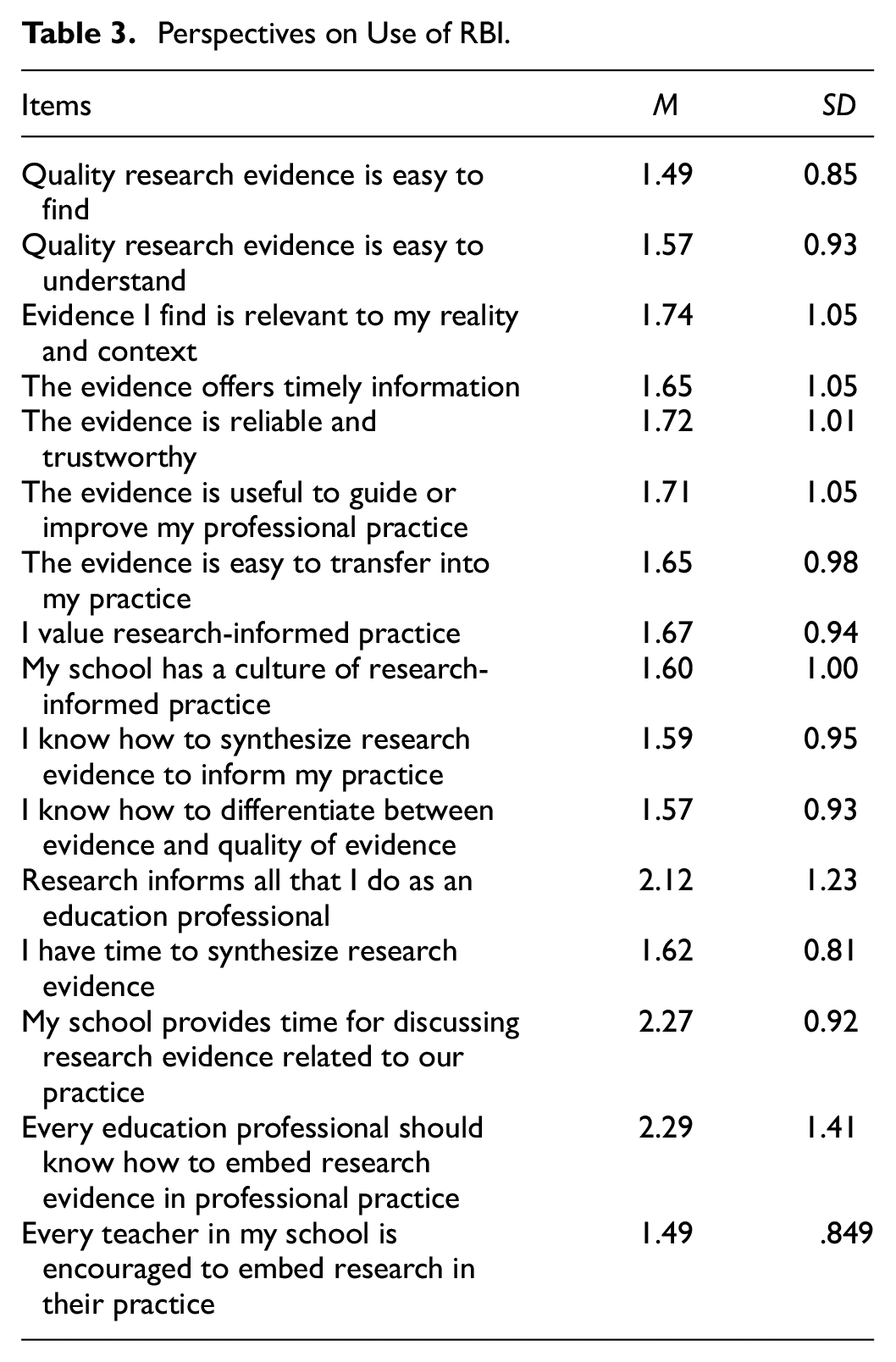
Further, we collected data on teachers’ opinions about research-based information with measures on a five-point Likert scale from strongly disagree (1), disagree (2), neutral (3), agree (4), to strongly agree (5). Low mean scores below three showed disagreement with the statements. The results in Table 1 suggest very low mean scores for most items ranging from M = 1.49 to M = 2.29. The indication is that the participants find research-informed practice challenging to implement professionally.
Frequency of use of IRB sources.

Also, participants were asked to rate the extent to which they agreed to some methods and strategies that would make them aware of research findings. Overall, the mean scores on awareness activities considered helpful to using RBI in professional practice were moderate (M = 3.17) to high (M = 4.17) (see Table 1). If these activities are provided, it could help the participants become aware of current research and how to embed them in practice.
Similarly, participants rated the extent to which they agreed that computer skills, the ability to read and understand research publications, the ability to assess the quality of research-based information and the expertise to translate research findings to practice are necessary for everyday practice. The results showed general agreement with these items, with mean scores from M = 4.03 to 4.11.
Participants also rated the extent to which they agreed that organisational factors such as established habits, traditions, incentives, values, and physical and human resources influence the use of RBI in daily practice. The results demonstrate that the mean scores were within the median range M = 3.67 to M = 3.78.
We used an independent samples t-test to explore the data and determine if female and male participants differ statistically in their response to any areas of use of RBI assessed. Our analysis found no significant differences, suggesting that the participants have similar experiences using RBI in the selected research schools.
Association Between Factors Informing the Use of RBI and Expertise
A Pearson product-moment correlation coefficient was computed to assess the relationship between the various factors of RBI use. The results indicated a significant positive correlation between organizational factors and teachers’ expertise at the 0.01 level (two-tailed), r = .364, N = 95, p = .000 and between awareness activities and expertise to use RBI, r = .317, N = 95, p = .002 at 0.01 level (two-tailed) (see Table 2). This means that increased organizational support and awareness activities, such as research training for teachers, can increase teacher expertise in using RBI (Tables 3 to 7).
Purpose and Frequency of RBI Use.

Perspectives on Use of RBI.
Awareness Activities Considered Helpful to Use RBI.

Skills Necessary to Use RBI in Everyday Practice.

Organisational Factors That Support Use of RBI.

Pearson Product-Moment Correlations of Factors and Expertise to Use RBI.
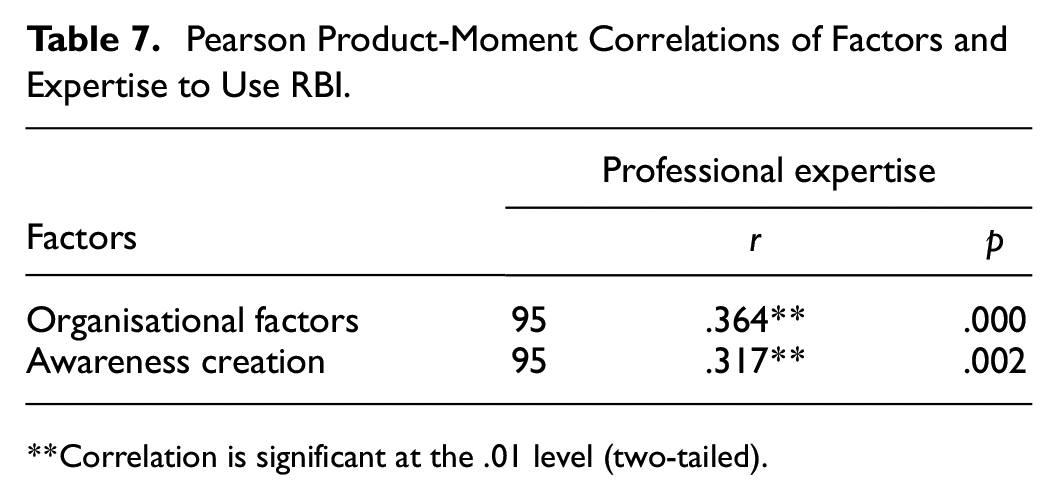
Correlation is significant at the .01 level (two-tailed).
Discussion
This study is the first to be conducted in Ghanaian inclusive schools to explore teachers’ opinions and use of RBI to inform their daily professional practice. Descriptive results showed that during the last year, teachers primarily used information from non-scholarly sources for their professional practice. For example, most teachers used the Internet, YouTube, videos, radio, and newspapers five or more times. However, none of the teachers used scholarly publications and journals. This is concerning because not all Internet and mass media resources are evidence-based and cannot be trusted. However, teachers’ frequent use of these sources in this study is not surprising, given that most basic schools in Ghana neither have library facilities nor subscribe to professional journals and scholarly publications. This is a significant problem not peculiar to Ghanaian schools and teachers because other studies also found limited research use among school teachers (Nelson & Campbell, 2017; Proctor, 2015; Williams & Coles, 2007). An earlier study in Ontario, Canada, found that classroom teachers hardly read and utilised research in their professional practice (Walker, 2000).
Regarding the skills necessary for teachers to use RBI, most teachers in this study agreed or strongly agreed that the ability to read and understand research publications (84.2%), skills required to use IT, access to the Internet and databases (86.3%), the ability to assess the quality of research-based information (84.2%), and professional expertise to translate research findings into practice (83.1%) are critically important. Concerning organizational factors, the majority of participants agreed or strongly agreed that the following are essential factors that could empower teachers to use RBI in their daily professional practice: available time to read a journal (70.5%), applying a new technique (69.5%), available facilities and technology (71.6%), incentives, such as remuneration, honoraria, and lessening the workload (71.4%), opportunities to challenge established habits and traditions (70.5%), organizational importance for professional development (71.6%), a supportive environment, human resources such as the availability of qualified staff (69.4%), and organised groups such as unions, granting agencies, and media (70.6%).
Regarding research question four, positive associations were found between organizational support for teachers and expertise and between awareness activities, expertise, and practice. The provision of available facilities and technology, incentives such as remuneration, honoraria, and a lesser workload, opportunities to challenge established habits and traditions, organizational importance for professional development, supportive environment, the availability of qualified staff, and organized groups, such as teacher unions can help teachers adopt scholarly sources to improve practice (Dagenais et al., 2012; Lysenko et al., 2014). As indicated in the study section, student teachers in Ghana complete an independent capstone research project on a chosen educational problem as part of their course graduation requirements. This training is expected to assist them in implementing research-informed practice in their schools. Surprisingly, the result of this study painted a different picture of RBI use. However, teachers cannot be solely blamed for not utilising RBI in professional practice because, as the findings indicated, institutional, organizational, and personal factors contributed to the lack of use of IRB.
Implications of the study
This study has important implications for the quality of inclusive education. Firstly, to breathe life and innovations into inclusive education and meet the needs of all students, inclusive school teachers must be empowered to access, synthesize, and use research to inform pedagogical practices (Prendergast & Rickinson, 2019; Walton, 2018). Secondly, although evidence-based practice is essential, not all information from the Internet, mass media, YouTube, and journals would count as credible evidence. According to Nelson et al. (2017), evidence produced through quality studies is published in edited books, peer-review reports, journal articles, and research briefs. By implication, using research evidence to inform inclusive education need to include a critical evaluation of the research findings. This requires practitioner expertise in evaluating evidence, the school’s ecology, and the system in which the evidence will be used (Dagenais et al., 2012; Farley-Ripple et al., 2018).
Thirdly, the implication of this study also connects to what Rickinson et al. (2019) found in their research on evidence use in Australian schools; that quality research evidence instigates pedagogical innovations and teacher professional capabilities. Consequently, capacity building through professional learning to use RBI must be built into the culture of each inclusive school. This supports the view of Booth and Ainscow (2011) that the development of inclusive schools must start with building inclusive school culture. Indeed, when inclusive schools demand practitioners to deliver equitable learning opportunities for all students, research becomes a central feature that must be built into pedagogical practice. Therefore, there is a need to develop teachers’ research-informed teaching mindset (habitus) so that they can willingly involve in school-based action research to improve education from within their context rather than practices imposed externally by policymakers and external researchers (Joseph-Richard et al., 2020).
Returning to Bourdieu’s concepts of habitus, capital, and field (Bourdieu, 1977, 1985), which formed the theoretical framework of this study, one important consideration is to focus on changing teachers’ pedagogical habitus (mindset) so that they can adopt new practices that are based on evidence. In this research, we conceptualized the habitus as inner dispositions that involve thinking, feelings, beliefs, and values of research-informed practice, which can be assessed through teachers’ daily practice (Agbenyega, 2017; Maton, 2012). Additionally, the participants in this study highly rated the need for resources and organisational support for increased use of scholarly sources. Bourdieu’s theory conceptualizes these resources as capital (Bourdieu & Wacquant, 1992), which is necessary for the operationalization of RBI in inclusive practice to attain. This study also uncovered the need for capital resources such as IT, school library, journal subscriptions, and access to the Internet to facilitate teachers’ use of RBI. In addition, the findings of this research point to other resources (capital) such as time, space, and effort and incentives for teachers to use RBI (Bourdieu, 1985).
The findings of this study reaffirm the need for examining educational fields in their complexity by considering the critical role of school-university partnerships in addressing the lack of evidence-informed practice in schools. In Bourdieu’s view, fields are spaces of “production, circulation, and appropriation and exchange of goods, services, knowledge, or status, and the competitive positions held by actors in their struggle to accumulate, exchange, and monopolise different kinds of power resources (capitals)” (Swartz, 2019, p. n.p). In addition, educational fields are politically structured spaces based on specific habitus and differential capitals. Along these lines, this study’s findings provide insights into ways to support field actors such as inclusive school teachers and school leaders to navigate barriers to their scholarship and develop and implement pedagogical innovations based on research evidence. When teachers as educational field actors develop dispositions that value research-informed practice supported with resources (capital), then the effects of fields of research on their inclusive pedagogical behaviour can be felt (Swartz, 2016). Many scholars found that teachers’ use of RBI depends on their expertise in reading, understanding, synthesising, and applying research to practice (Brew et al., 2016; Perkins, 2019). Besides individual expertise, researchers found that organizational factors such as available time to read a journal, time to apply and verify a new technique, and available facilities and technology can enhance the use of research in teacher professional practice (Lysenko et al., 2014). Furthermore, incentives, such as remuneration and honoraria, lessening the workload, and introducing flexibility with opportunities to challenge established norms and practices, are essential for promoting teachers’ research use in schools (Dagenais et al., 2012). Above all, a supportive environment coupled with the availability of qualified staff to support teachers is critical to their positive attitude toward research-led practice (Cousins & Walker, 2000; Lysenko et al., 2014).
The field of inclusive practice is complex and evolving. Therefore, through the ongoing application of research to inclusive education, teachers can better serve the learning needs of all students. Educational researchers must build strong partnerships with schools and involve teachers and staff in research projects. These projects must focus on pedagogy and school effectiveness for diversity. School teachers should also be invited to co-author publications with researchers when data have been collected in schools that involve teachers. Additionally, professional learning must help teachers develop expertise for searching and analysing quality evidence to inform professional practice. Advancing teachers’ research skills is part of building a reservoir of intellectual capital, which teachers can deploy to cater to student diversity, particularly those with SEND in inclusive schools.
Conclusion
This study on a purposefully selected sample of teachers working in inclusive schools in Ghana provides a snapshot of the use of RBI in daily professional practice. The results highlight the urgent need to offer organizational support to teachers to increase their skills in assessing, evaluating, and embedding quality RBI in their daily practice. Inclusive education is about removing barriers to participation for all students and increasing student achievement. Therefore, research-informed practice should be considered pivotal in any school transformation toward inclusive practice. The research may inform practice-based research, generating the need for school teachers in Ghana to be actively involved in research through school-university research partnerships to deepen their understanding of innovations in inclusive education. Future research should consider a large-scale study of all designated inclusive schools in Ghana to provide enough evidence to inform the Ministry of Education program plan to increase research-informed practice in all Ghanaian schools.
Limitations
This study has the following limitations. Firstly, the study employed a purposive sample of 10 inclusive schools. Although the schools were selected from two school districts, they do not represent the entire inclusive Basic Schools in Ghana. Therefore, the results need to be interpreted with caution. Secondly, the number of participants in the study is small to reach statistical power; hence, a qualitative component would have added a deeper meaning of RBI practice in the respective schools. This suggests that more research into RBI is needed to develop insights into evidence-informed practice and how teachers can be supported to increase research use in their pedagogical practices to enhance learning for all students.
Footnotes
Declaration of Conflicting Interests
The author(s) declared no potential conflicts of interest with respect to the research, authorship, and/or publication of this article.
Funding
The author(s) received no financial support for the research, authorship, and/or publication of this article.
