



Abstract
In the education decentralization processes, community participation in education governance has been argued to be essential for improving accountability to service beneficiaries. Therefore, this paper examined the perspectives of key actors on the impact of an educational decentralization policy on improving school quality education in Junior High Schools in Ghana. Participants in the study were 54 School Management Committee (SMC)/Parent-Teacher Association (PTA) members, 106 teachers, and 11 head teachers in 11 schools drawn from two districts in the Central Region of Ghana. Teachers filled out questionnaires and interviews were conducted with SMC/PTA members using a semi-structured interview guide and with 11 head teachers. The paper reveals that the education decentralization policy, with community participation at its heart, has given schools some autonomy in their decision-making process. However, the involvement of community members in school activities has been limited mainly to financing, with little emphasis on the decision-making process in school governance. The study recommends that there should be adequate support for communities to become more involved in the decision-making process, especially in implementing the School Performance Improvement Plan for Ghana to achieve Sustainable Development Goal (SDG) 4.
Keywords
Introduction
The decentralization of education has been accepted by stakeholders in many countries as one of the best solutions to improve education (Kamanda et al., 2016). Consequently, despite the surge in access to basic school, many countries in Sub-Saharan Africa (SSA) continue to have concerns with basic school completion rates (drop-out rates) and low attainment in national standardized examinations as persistent challenges (UNESCO, 2014). The Global Monitoring Report argues that devolving authority from the central government toward communities and schools provides an excellent platform to hold providers accountable and increase participation (UNESCO, 2014). Policy-makers and international development partners have advocated decentralization as a vehicle for improving the enrolment and retention of pupils, maintenance of school facilities, the learning environment, and the overall quality of education (Davies et al., 2003; World Bank, 2009). In the decentralization processes, community participation in education governance has been argued as essential for improving accountability to service beneficiaries. People in marginalized communities or rural areas stand a better chance of their concerns being heard if decision-making shifts to the community level (World Bank, 2009). However, the literature (Jeong et al., 2017; Walton, 2019) argues that the expectation that education decentralization would improve education quality has had many setbacks due to the various ways in which it has been implemented. Many countries have encouraged community participation through education decentralization, but failed to delegate authority to local communities (Yamada, 2014). Furthermore, in developing countries, the decentralization of education has resulted in devolution to individuals with limited experience and skills in school management and school curriculum implementation issues (World Bank, 2009). Nonetheless, despite the setbacks of education decentralization policies, these reforms have been argued as suitable to improve student learning outcomes and empower local communities to hold schools accountable for quality education (Leer, 2016; Rose, 2003). Community members’ involvement in school governance promotes teacher and student attendance and provides a mechanism that supports school quality, and strengthens accountability between schools and communities.
In Ghana, stakeholders in education have raised concerns regarding the quality of education in basic schools (Ministry of Education, 2018). Statistics on national standardized examinations indicate continuous poor student performance over the years (Ministry of Education, 2016b) despite efforts by the government to improve education quality at all levels. Many researchers have reported that greater community involvement in schools’ activities will help enhance school quality and the overall learning outcomes of students (Chikoko, 2009; Colley, 2014; Jeong et al., 2017). Furthermore, many SSA countries, including Ghana, have accepted that mobilizing communities to participate in school activities was an essential ingredient in their National Education Sector Plans (Chikoko, 2009; Colley, 2014; Sasaoka & Nishimura, 2010). The Ghana Education Strategic Plan underscores the enhanced involvement of communities and of regional and district education offices to improve education quality (Ministry of Education, 2016a). For two decades since the passing of national legislation on decentralization in the education system, the government launched various programs to increase the role of districts and communities in decisions about their local schools. Since then, there has been limited research (Ampratwum & Armah-attoh, 2010; Chapman et al., 2002; Essuman & Akyeampong, 2011) involving head teachers, teachers, and School Management Committee (SMC) / Parent Teacher Association (PTA) members to determine how community participation in school management has impacted on the quality of education. Furthermore, findings on whether education decentralization actually improves the quality of education at basic schools are inconsistent. For example, a study in Tanzania by Lindsjö (2018) shows that even the poorest households are burdened with education expenses. Since about half of the capitation grant does not reach the schools, the quality of education—as perceived by rural respondents—has not improved. In contrast, Yamada’s (2014) study of determinants of community participation in Ethiopia found that communities and teachers are motivated to improve education quality by mobilizing resources to improve school facilities, accommodations, and infrastructure. These findings are corroborated by Essuman and Akyeampong’s (2011) study in Ghana, where community members indicated their willingness to support school improvement resource mobilization activities. However, their participation in decision-making was limited to only a few “elite” community members.
As part of the education decentralization process, the government of Ghana implemented the Capitation Grant (CG) scheme in 2004 to abolish all forms of school charges to improve basic school quality. The scheme required schools to prepare School Performance Improvement Plans (SPIP) involving school management committee (SMC) members and schools to access the grant from the Metropolitan/Municipal/District education offices. Additionally, to strengthen school governance and community engagement and to promote quality education, all schools were required to form SMCs in addition to PTAs. These committees were expected to support the head teacher and teachers in the school’s general management. They must also help identify priority areas for school development and mobilizing community support to improve education delivery (Ministry of Education, 1994). A study in Ghana by Akyeampong (2009) indicated that rural and peri-urban communities had made the least progress as regards their involvement in schools’ curriculum implementation and school management. He attributed this poor progress to a lack of human capacity to contribute to these areas. Other studies have also studied the progress made by communities in the mobilization of resources to maintain school infrastructure. Various studies have been carried out in Ghana to examine the effect of GC on educational outcomes and delivery (Akyeampong, 2009, 2011; Ampratwum & Armah-attoh, 2010; Osei et al., 2009). However, these studies yielded inconclusive findings. What has not been explored in any of these studies is how head teachers, teachers, and SMC/PTA members perceive the decentralization policy. Head teachers, teachers, and SMC/PTA members are key actors in the implementation of this policy, but their perspectives on the decentralization policy and whether it improves quality education have not been given much attention in the education decentralization literature. A study exploring these actors’ views or perceptions of the use of the CG/SPIP and its impact on education quality will be necessary for policy redirection and practice in Ghana’s bid to achieve Sustainable Development Goal 4 (ensure inclusive and equitable quality education and promote lifelong learning opportunities for all).This study explores the perception of key actors in the school community of how the planning and use of the SPIP/CG impact education quality in Junior High Schools (JHS) in two districts in southern Ghana.
Research questions
The study seeks to answer the following research questions:
RQ1: What are participants’ views on planning and using the SPIP/CG to improve school quality?
RQ2: What is the impact of the SPIP/CG on education quality in schools?
Basic Education in Ghana
Currently, the school system in Ghana consists of the following levels: kindergarten (2 years), primary (6 years), Junior High School (JHS; 3 years), Senior High School (SHS; 3 years), and a tertiary level of 1 to 4 years. Basic education, comprising kindergarten, primary, and junior high school, has been free and compulsory (Ministry of Education, 2018) since abolishing school fees in 2004. In 2016 the current government made SHS also free for all JHS graduates. This study used head teachers and teachers in JHS schools, even though some had primary and JHS together as one school. A standard curriculum consisting of academic, vocational, and technical subjects is followed in basic schools. The same teaching qualification is required for teachers, even though instructional systems differ. At the primary level, a teacher teaches almost all subjects in a class, while in junior high school, subject teaching is practiced. The JHS teachers teach one, two, or three out of the eight subjects taught at the primary level. In some schools, subject teaching is also practiced at the upper primary level. Basic education is both continuous and terminal. JHS leavers who pass the Basic Education Certificate Examination (BECE) may continue their education in SHS; those who do not leave the school system. At the time of writing this paper, the government was planning a policy to cancel the BECE examinations for students to access the free SHS.
Conceptual Perspectives
Decentralization in education is shifting responsibilities to provide basic education from the central government to subnational governments or schools (UNESCO, 2013). This process of shifting responsibilities varies in scope and strategies based on the reorganization of financial, administrative, and service delivery systems. A growing body of research evidence indicates that the decentralization process and school autonomy improve education quality. Our definition of quality education is adapted from the Global Monitoring Report (GMR) in 2005, which defines quality education as a set of desirable features of learners such as healthy, motivated students, process (competent teachers using active pedagogies), content (relevant curricula), and good governance and equitable resource allocation systems (UNESCO, 2005). In this study, we found limited decentralization and community involvement in decision-making at the school level regarding financial and administration issues, even though community involvement is at the heart of a decentralization policy to improve quality education (World Bank, 2009).
Our conceptual consideration is adapted from a framework developed by Barnett (2013) for understanding community involvement and quality education in SAA countries. Barnett analyzed community involvement in Malawi’s primary schools by using SACMEQ data to explore the effect of community involvement and pupils’ achievements in Malawi. His framework provides a deeper understanding of the different modes of community involvement in schools in a developing country. The framework has three modes of community involvement: financing, learner support, and networking. Financing as a mode of community participation refers to communities’ contribution to schools in terms of resources to supplement the central government’s effort to improve service delivery. Such resources could be in the form of labor, in kind, or cash in the construction of school facilities, and motivation of teachers (either in kind or cash). This form of community involvement has been argued by many researchers as an “inactive” or “pseudo” involvement in a school’s decision-making process (Dunne et al., 2007; Essuman & Akyeampong, 2011; Rose, 2003). Learner support involves following up on homework at home, paying for extra lessons, and involvement in extra-curricular activities. Networking refers to improvement in school-community relations whereby SMCs and PTAs meet to discuss school improvement issues. In the literature, we find that financing as a mode of community participation has increased the rural-urban divide and gender inequalities. Communities expected to contribute more to school finance are often the poor communities (Dunne et al., 2007). Furthermore, some voices are heard above others in the SMC. For example, Yamada’s (2014) study in Ethiopia singled out the head teacher as a “powerful person” when it comes to decision-making at the school. We use these three modes of community involvement in school activities under the decentralization policy using the SPIP/CG initiatives to answer the research questions.
Policy Context: Educational Decentralization in Ghana
In Ghana, one of the policy programs to reach Universal Primary Education (UPE) is the education decentralization regarding finance and management of basic schools (Ampiah et al., 2013). Furthermore, the 1992 Constitution reiterates the relevance of decentralization in 22 departments, including the Ghana Education Service in the Local Government Act. Accordingly, in 1998 education decentralization began by devolving responsibilities and decision-making on resources to districts and schools (Ampiah et al., 2013). The central part of the decentralizing education reforms since 1987 was active community participation in education that has been advocated to improve the efficiency and effectiveness of education. SMCs and schools must produce School Performance Improvement Plans (SPIP) yearly to improve school governance and community engagement. The SPIP spells out important activities schools would undertake to improve teaching and learning, school management, and environment (Ministry of Education, 1994). The SPIP is a requirement for accessing the CG. In 2005, the CG scheme allocated an amount of GHS 3.00 (USD 0.67) per pupil to every public school; at the time of writing this paper, the CG was GHS 10 (USD 1.9) per pupil for the 2018/2019 academic year. Of this amount, 1 GHS is deducted and paid to Metropolitan/Municipal/District education offices to support sports and cultural activities in schools.
In practice, some aspects of educational decentralization have not been implemented. For example, districts have no independent sources of revenue but should implement policies enacted by the central government (Essuman & Akyeampong, 2011). This drawback is further exacerbated by slow and weak participation in school activities, as communities view their responsibilities as burdens. The central government controls and finances education delivery through designated institutions under the Ministry of Education (MOE) regarding education management and administration. The Ghana Education Service (GES) is the agency that manages basic and secondary schools, including technical and vocational institutions; hence GES is responsible for pre-tertiary education. Basic education is managed by the Regional Directors and District, Municipal, and Metropolitan Education Directors in the regions. The Director-General of GES coordinates their activities. At the district or local level, the District, Municipal, and Metropolitan Director of Education oversees the implementation of pre-tertiary education policies of the MOE. According to the educational decentralization policy, many decision-making processes are transferred to the district level; however, research shows that education delivery is still centralized, with many bureaucracies at the district, municipal, or metropolitan levels (Essuman & Akyeampong, 2011).
Method
Research Design
This study employed an explorative survey design and used the convergent mixed-method approach to study aspects of the educational decentralization policy in Ghana. This approach merges quantitative and qualitative data to provide a comprehensive data analysis. Both quantitative and qualitative data are collected almost simultaneously (Creswell & Creswell, 2018). Eleven basic public schools in two districts in southern Ghana were randomly sampled. There were six schools from Mfantseman Municipality and five schools from the Cape Coast Metropolis. Of the 11 schools, 6 were in urban and 5 in rural areas. In total, 106 teachers responded to a questionnaire, while one-on-one interviews were held with all the 11 head teachers of these schools. Furthermore, 54 SMC/PTA members were purposively selected to respond to a semi-structured interview guide in each of the 11 basic schools.
Instruments
Two instruments were designed to obtain data for the study: a questionnaire, a semi-structured interview guide, and a one-on-one interview guide for headteachers. We developed the questionnaire items based on literature and documents from the Ministry of Education (MOE). For example, items under “use of the SPIP/CG to improve education quality” were adopted from MOE documents on the use of the CG (Ministry of Education, 1994). The rest of the items were adapted from the literature on the abolition of school fees in SSA (Chikoko, 2009; Colley, 2014; Sasaoka & Nishimura, 2010). We administered the questionnaire to teachers in the selected Junior High schools in the two sampled districts. The questionnaire also sought information on the teachers’ personal data, views on planning and use of the SPIP/CG, and the impact of decentralization on education quality. The interviews with head teachers covered other issues concerning their roles in implementing the decentralization and their effect on education quality. The semi-structured interview guide completed by the SMC/PTA members concerned their roles in the decentralization process and their perspectives on education quality.
Data Collection Method
Data collection for the study began with a permission letter from the Cape Coast Metropolitan and Mfantseman Municipal Education offices, permitting us to go to the various schools to collect data. We started in the Mfantseman Municipality on September 20, 2016 and ended in the Cape Coast Metropolis on February 24, 2017. A team of three researchers administered the questionnaires to all teachers in the schools within 2 weeks. In each school, head teachers agreed to participate in the study. We contacted teachers to respond to the questionnaire after they had consented to participate voluntarily. The purpose and procedure of the study were explained to participants, so they knew what to expect. We drew participants’ attention to the consequences of the interviews and the confidentiality and anonymity of their participation. All head teachers in each school participated in the interviews. The return rate of the questionnaire was 100%. Arrangements to have SMC/PTA members respond to the interviews were made with the head teacher and the chairpersons of the SMC of each school.
Participants
There were 76 male and 30 female teachers, with the majority (43.4%) being 26 to 30 years of age. Seven of them were in the age range of 41 to 50 years while one was above 50 years, and the rest were in the age range of 26 to 40 years. A significant percentage (27.6%) of the teachers had a bachelor’s degree as their highest academic qualification; the rest had a Diploma in Basic Education, master’s degree, Certificate “A,” (certificate for post-secondary teacher training before 2003 in Ghana) and West Africa Senior Secondary Certificate Examination (WASSCE) as their highest academic qualification. Most (40.8%) of the teachers had 11 to 15 years of teaching experience, while the rest had 16 or more years’ experience. A few (9.2%) had taught between 1 and 5 years. All the teachers were professionals. There were more male (7) than female (4) head teachers. All of them had been head teachers between 1 and 10 years. More male (64%) than female (36%) SMC/PTA members participated in the study. The majority of these members (72%) had either secondary school or lower academic qualifications; the others had either a degree or post-graduate qualification.
Data Analysis
We used statistical techniques such as simple frequency counts, percentages, means, and standard deviations to analyze the questionnaire data into an urban and rural dichotomy. The interviews were analyzed using the grounded theory approach (Creswell & Creswell, 2018). Using Microsoft Excel, we employed thematic analysis to segment the data with preliminary codes, which were then used to search for themes across the interviews. These themes were informed by the direct quotes from the respondents that were reported in the results of the study. The teacher questionnaire was pre-tested in two schools outside the sample districts. The reliability coefficients were high for the three subscales (Cronbach’s α = .78, .81, and .74) for planning of the SPIP/CG to improve education quality, using the SPIP/CG to improve education quality, and impact of the SPIP/CG on education quality respectively. To ensure validity of the qualitative data, member checking and peer examination of data were employed (Merriam, 1998). Lastly, we discussed the key findings emerging from the interviews with participants to verify that they were accurate and true reflections.
Results
Views on Planning of the SPIP/CG to Improve Education Quality in Schools
The study requested the participants to share their views on planning the SPIP/CG in their schools to improve quality education. Responses from teachers in various schools (see Table 1) show that most teachers (69% in urban schools, 85% of the teachers in rural schools) believed that “planning and decision-making of the SPIP/CG with their head teachers” was satisfactory. Moreover, 85% of teachers in rural schools and 63% of teachers in urban schools were of the view that communication with their head teachers regarding working on the SPIP/CG was satisfactory. This scenario is similar to that of SMC and PTA members; for example, 86% and 64% of teachers in urban and rural areas respectively were satisfied with PTA’s planning and decision-making process concerning working on the SPIP/CG. Generally, as Table 1 shows, teachers in rural areas were more pleased compared with their counterparts in urban areas with the SPIP/CG preparation planning process in their various schools, irrespective of their location.
Teachers’ Views on the Process on Planning the SPIP/CG in Urban and Rural Schools N (%).
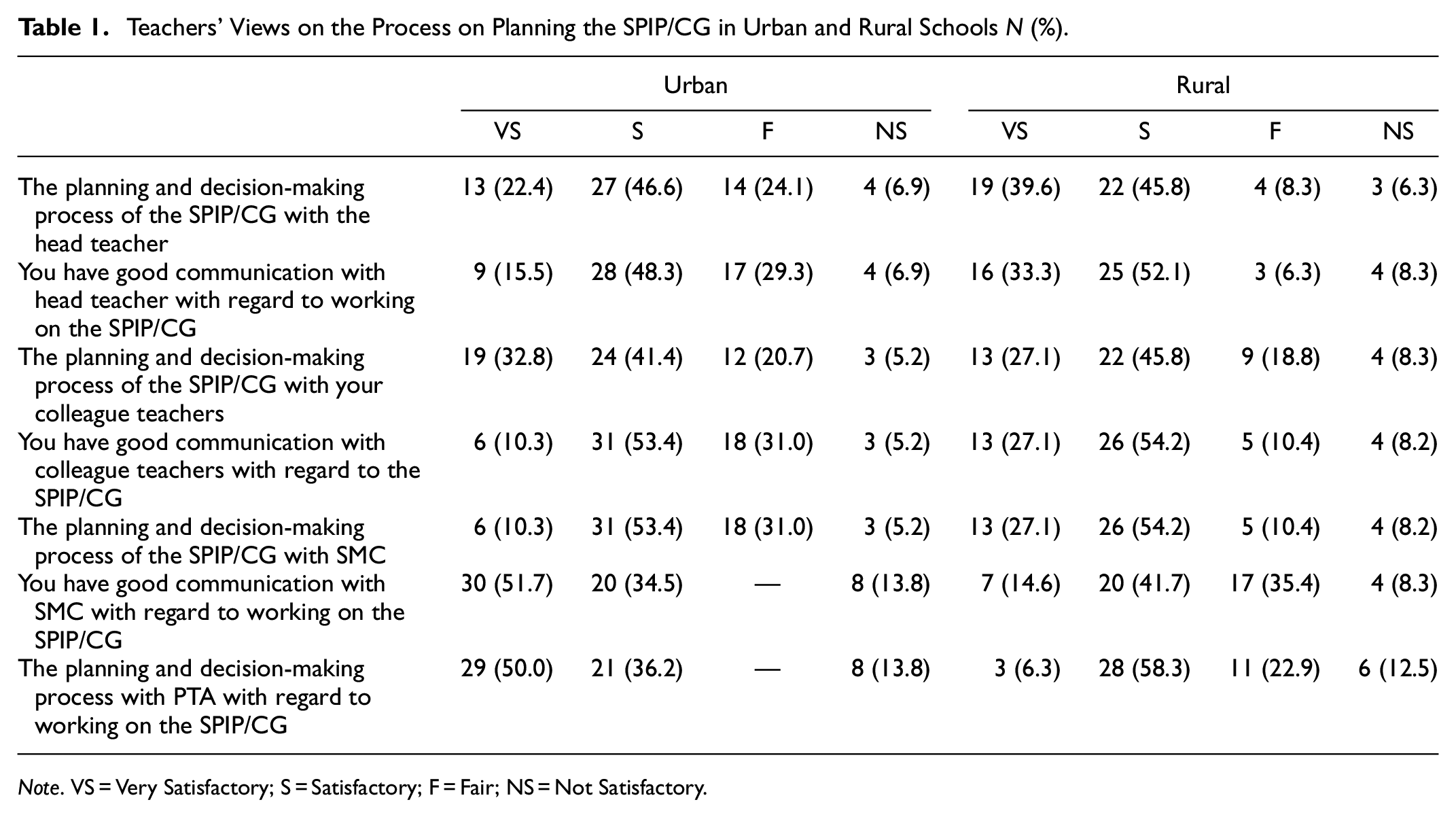
Note. VS = Very Satisfactory; S = Satisfactory; F = Fair; NS = Not Satisfactory.
The satisfaction with communication, planning, and decision-making with head teachers and SMC/PTA members is echoed in the following comments from three head teachers:
We (teachers and head teacher) have a meeting and sit down together to discuss the main points for us. I will see their priorities, discuss them considering the budget, and plan. Then we have PTA and SMC meetings. Sometimes we combine them for a meeting as some SMC members are busy, and some are both….then combine our views and take it to the district office (head teacher, urban school A)
I have a meeting with teachers first, and we sit together and discuss the items we need. Then we have PTA/SMC meetings, and it is usually joint meetings (head teacher, rural school A)
I call for a meeting, and we brief ideas, what we need, such as teaching and learning materials together. They have ideas, so we discuss, combine the ideas, and make a plan. Then we invite PTA and SMC members for a meeting to get them informed and signed. Most of the times, we have SMC and PTA meeting together (head teacher, rural school C)
From the extracts above, headteachers usually have consultative meetings to make their decisions before sharing with SMC/PTA members regarding the schools’ needs in planning the SPIP/CG. What sometimes happens, especially in rural areas if most of the SMC/PTA are not informed, they would question some of the decisions of the school.
Responses from SMC/PTA members on the planning process of the SPIP/CG in the schools are presented in Figures 1 and 2. Figure 1 shows that PTA/SMC members in urban schools strongly disagree that they are part of the participatory style of school management. In response to the statement, “I am more engaged in school activities since becoming a PTA member,” more than 40% of the members either don’t agree or never agree. A reasonable percentage of members (52%) disagree, and 42% never agree that the community should provide financial resources to schools when the public inputs fall short. This scenario is the same for members in rural schools. Figure 2 shows that the majority (62%) of the SMC/PTA members disagree that the community should provide financial resources for school management and other activities. Additionally, the members (58%) at rural schools disagree with the statement “I am part of participatory style of school management,” like their counterparts in urban schools. The responses from members of SMC/PTA resonate with a situation of passive membership where members think schools take the greater part of the decision-making process and implement them with their consent. Also, the members still believe that there is free education policy in Ghana and are not obliged to schools any financial contribution.

Views of SMC/PTA members in urban schools of decentralized activities in school.

Views of SMC/PTA members in rural schools on decentralized activities in school.
Views on the Use of the SPIP/CG in Improving Education Quality in Schools
The teachers were asked to respond to the use of CG in their various schools. Their responses are presented in Table 2, which shows that most teachers (96.5%) in urban schools rated the provision of teaching and learning materials as the top priority or very important in using the CG in their schools. This is followed by school facilities, which was rated the top priority by 41.4% of the teachers. Similarly, most teachers (70.8%) in rural schools rated the provision of teaching and learning materials as the top priority when using CG. This is followed by the organization of examinations in the schools. The table further reveals that 35.6% considered transportation important for teachers in all the rural schools. Transportation refers to funds used for the teachers and head teachers to travel on official duties and also to transport students to cultural and sporting events in their locality. The Ghana Education Service predetermines the items listed in Table 2; hence schools are free to spend on any of them.
Teachers’ Responses to the Use of the CG in Rural Schools N (%).

Note. TP = Top Priority; SP = Second Priority; VI = Very Important; I = Important; NI = Not Important.
Head teachers were asked how they made up for any shortage or delay in the government’s release of the CG to schools. The purpose of the CG is for schools to buy teaching and learning materials, make minor repairs, and implement enrolment drives to improve access and quality. However, comments from head teachers indicated that other extra-curricular activities, such as sports also drew heavily from the funds:
for sports events, and we take students to the venue by bus for 4-5 days and feed them, when we don’t have enough money, I pay by myself. It is about 300 GHC ($52). Also, when we do not have enough materials, particularly chalk, I also have to buy. (Head teacher, rural school B)
For sports events (going to stadium to compete with other schools in the circuit, playing football, volleyball, netball and some athletic - 100m, etc.) Students need to be fed, and we need a capitation grant, but it did not come. The activity is there and needed to carry out, and the money is not there. What can you do about it? I call for PTA meeting to borrow one idea. We sometimes do, but sometimes when we don’t have much money, somebody has to pay, and I do), 2 GHC x 2 days x 50 students = 200 GH
(Head teacher, urban school C)
For minor repairs of the school building. About 80 GHC. If we ask parents and SMC for contributions in terms of money, we have some procedures such as writing a letter to the district to obtain permission from the District Directorate. So I just paid for it. (Head teacher, urban school D)
The accounts of the headteachers show the burden of pre-financing activities on the SPIP when the release of funds to schools delay. This situation thwarts the efforts to improve quality education especially school s with very little resources.
Impact of SPIP/CG on Education Quality
Teachers’ views on the impact of the SPIP/CG on school quality in urban and rural schools are presented in Table 3. The results in the table show that most of the teachers (68.8%) in the rural schools believed that SPIP/CG had contributed to improving communication between the school and parents, while 48.3% of teachers in the urban schools confirmed this assertion.
Teachers’ Response to the Impact of SPIP/CG on the Quality of Education N (%).

This result is an indication of how the decentralization policy has attracted parents, especially in rural areas, to be informed and improved communication between them and teachers since they form part of the SPIP/CG planning process. In contrast, most teachers (70.7%) in urban schools affirmed that the statement that “the SPIP/CG has contributed to students’ learning achievement”, while (47.9%) of teachers in rural schools confirmed this assertion. This finding reflects the sustained involvement of parents in schools’ activities in urban areas that promote students’ learning compared to rural parents with low socioeconomic background hence their involvement in their children’s school activities is low. Similarly, of most teachers (75%) in rural schools believed that the SPIP/CG had contributed to the promotion of schools’ administrative efficiency and effectiveness compared with 51.7% of teachers in urban schools. However, as regards the promotion of school autonomy, 43.8% of teachers in rural schools disagreed, while 72.4% of teachers in urban schools agreed moderately or disagreed. The head teachers, however, believed the policy had reduced the school’s effectiveness:
…because the money is not coming, we use PTA money for what we need in place of the CG. Hence this does not help the administrative efficiency and effectiveness of our school (Headteacher, rural school A)
SPIP/CG is a very laudable idea, but because the money is not enough and forthcoming, it does affect my school’s activities negatively, as we already made plans for the year (Head teacher, urban school C)
These remarks from the head teachers suggest that the schools’ autonomy and administrative effectiveness, which were to be improved by the decentralization policy, were far from being reached, since schools depend mostly on parents to survive.
We also asked head teachers about the effect of the SPIP/CG on school quality during the interviews. From head teacher interviews, it is clear that the CG has not been forthcoming, thereby impeding some of the activities they undertake to improve the learning environment of their schools. For example, the delay in the release of the CG to schools impacts the schools’ efforts to improve quality:
…firstly, money is not sufficient, and secondly, the money is not forthcoming on time. So even we can make a plan but cannot implement it as planned. SPIP/CG’s idea is very laudable. But because the money is not coming, and it does affect my school’s activities negatively as we already made plans of the year (Head teacher, urban school E)
…So issues of CG are very serious. Inflation is also very high. So it is impossible to implement SPIP as we planned. We also need an expansion of the school building. At the moment, classes are all packed (Head teacher, urban school B).
The remarks made by the head teacher in urban school B suggest that during delays in the release of funds to schools, inflation increases the prices of items budgeted for; hence they cannot meet most of the school’s needs.
… the money is not coming, so we have to use PTA money for what we need to do using the CG, even for chalks. This does not help the administrative efficiency and effectiveness of our school. The same in the learning environment and school facilities, because the money is not here when we need it. What can we do about it? Very difficult (Head teacher, rural school D)
We have a good relationship with the community and parents. They support us through PTA levies of 9GHC (3/term), and this supports our school. We use them for sports events, drum repairs, PC repairs (not yet though), etc. We also have support from individuals, such as a local assemblyman. He gave us a box of notebooks and a used computer. He also supports one mock exam (Head teacher, rural school A)
The decentralization policy forbids schools to charge parents any form of fees; however, according to the accounts of the headteachers, parents pay PTA levies to support schools’ activities when the government delays the release of funds to schools.
Discussion
The decentralization process in schools requires schools to collaborate with communities, especially PTA and SMC members, to plan the SPIP to access the CG. From the results presented, there seems to be good collaboration among head teachers, teachers, and PTA/SMC members in planning for the SPIP to access the CG. This finding is not surprising, as the policy requires school staff to plan the SPIP with community members. However, the head teachers’ statements that they hold meetings with PTA/SMC together indicate that most PTAs/SMCs in some schools have become dormant and that only the chairpersons (who usually chair both the PTA and SMC) carry the responsibilities. This finding is corroborated by the responses from PTA/SMC members, who strongly disagreed with the statement that they were part of the participatory style of school management. This finding was similar in both rural and urban schools and is consistent with the literature (Davies et al., 2003; Rose, 2003; Yamada, 2014), which found that community involvement in schools’ activities has been relegated to a few “elites” in the community who are literate and have time to serve on behalf of the community.
Moreover, PTA/SMC members in urban schools believed communities should be providing financial resources to schools when public inputs fall short, unlike PTA/SMC members in rural schools, who believed they shouldn’t. This finding suggests that community members in urban schools, who have considerably more resources than rural school members, contribute more to school maintenance, examination fees, buying of supplementary readers etc., to complement the schools' efforts. This eventually breeds a deepening rural-urban “divide” as a result of the lack of capacity of local members and insufficient local resources in rural areas, thus compounding the already existing quality issues in rural schools (Atuhurra, 2016; Lindsjö, 2018). This finding is consistent with Essuman and Akyeampong’s (2011) study in Ghana, which stressed that rural communities had made the least progress in community involvement and resource mobilization for schools. Furthermore, there would be a heavy financial burden on rural and peri-urban poor households struggling to provide uniforms and other stationery to keep their children in school. This finding resonates with what Lindsjö (2018) found in Tanzania, where poor rural households had to pay specific fees to keep the school system functioning.
As regards the use of CG in schools, the findings indicate that schools in urban and rural areas rate teaching and learning materials as a top priority. This finding is consistent with one of the primary purposes of decentralizing the government (Ministry of Education, 2013). The provision of teaching and learning materials such as teachers’ notebooks, makers, poster colors, printing of examination papers etc., were the main fees levied from pupils (UNESCO, 2013). It is, therefore, correct that schools regard them as a top priority. However, according to head teachers, they sometimes spend funds on minor repairs, sporting, and cultural activities due to delay in the release of funds to schools. This finding is consistent with the study by Nampota and Chiwaula (2013), who found that school principals in Malawi spent more funds from the CG on other activities than teaching and learning activities. The principals spent money on school structures, maintenance of furniture, purchase of sports equipment, textbooks, the printing of examination papers and sanitation materials while spending less on teaching and learning materials.
The study further shows that teachers in urban schools believed the SPIP/CG had contributed to improving student learning achievement, while less than half (47.9%) in rural areas affirmed this assertion. The finding of Ampratwum and Armah-attoh (2010) showed that CG had no significant impact on the pass rate on BECE results of students in Ghana. Head teachers’ complaints about late release and insufficiency of the funds reveal the failure of the policy to improve education quality. Barnett’s (2013) study in Malawi, using secondary data on community involvement as the dependent variable, found a mixed bag of variations in pupils’ achievement in maths and English scores. Research by Clark (2009) found that school autonomy under the decentralization policy had a significant positive effect on student achievement. Also, various dimensions of education decentralization policies such as decentralized fiscal and teacher hiring practices in OECD countries’ have positive effects on learning outcomes. In contrast to this finding, our study found that even though the decentralization policy has allowed schools and communities to plan and use the CG to improve quality, delays in the release of funds and insufficient funds have negatively affected education quality, as recounted by the head teachers.
Where headteachers ask PTA/SMC members to contribute supplementary financial resources, the CG demonstrates the financing mode of community involvement (Rose, 2003) to the detriment of learner support that could improve the quality of education. The fact that some SMC/PTA members are involved in the planning of SPIP and other school activities also demonstrates networking as a form of community involvement, as indicated by Barnett (2013); however, this networking involvement was found to be limited to few members of the community.
Conclusion
The global agenda to improve the quality of basic education argues that devolving authority from the central government to communities and schools provides an excellent platform to hold education providers accountable and increase participation (UNESCO, 2014). The educational decentralization policy in Ghana has increased enrolment in schools. This has put pressure on school facilities (Akyeampong et al., 2007). The SPIP/CG under the educational decentralization policy was introduced to compensate schools for income loss due to the abolition of fees. Our findings show that the planning of SPIP to access the CG is participatory, even though this rests mostly on the head teacher and the chairpersons of SMC/PTA due to apathy and lack of capacity on the part of many parents. It is worth noting that the community involvement in the schools has been pseudo-involvement, as it does not make schools accountable to the community, which refutes the very fabric of the decentralization policy. Although PTA/SMC meetings are held regularly, schools do not have the professional will to help local communities to develop a sense of commitment to become involved in schools’ decision-making process and thereby to hold schools accountable for their work.
This study has further shown that even though community involvement has been touted to improve quality education in schools, schools mainly spend the CG on items such as school maintenance, sporting activities and transport; only what is left over is spent on the most important aspect of school quality (teaching and learning resources). This means that head teachers have the liberty to spend funds on items that improve school infrastructure instead of promoting quality teaching and learning. Resource mobilization, increased participation in decision-making, and collaboration between the schools and local communities do not necessarily work out as proposed by the policy. With players with limited capacity participating in schools’ decision-making, the policy becomes unproductive and mere rhetoric in our education decentralization discourse. As observed in the literature, evidence of the link between decentralization and improvement in education quality has been inconclusive. By means of the SPIP/CG, the decentralization policy has resulted in some limited involvement of local members in school activities; however, much of this involvement is limited to local “elites” and head teachers, which has resulted in apathy among other members who could also get involved. Therefore, we conclude that the decentralization policy of the government and of many other developing countries needs to be holistic to drive quality improvement as expected. In other words, the SPIP/CG alone cannot deliver the quality the policy aims for. As it is now, the policy to improve education quality seems to be a myth. In reality, some parents continue to pay fees levied by schools for printing examination papers and enabling sporting activities.
Therefore, we recommend that issues of power and diversity in community engagement be fused into teacher education reforms for teachers to be abreast with the need to support local communities in school activities. The Ministry of Education, Ghana Education Service, and the Local Government Ministry should collaborate to explicitly state the roles of SMCs and schools so as to ensure that communities are truly involved in school activities, and district education offices should have funds to support schools adequately.
Nevertheless, this current study has some limitations; a study of education decentralization (which places much emphasis on community involvement) should have involved other community members and district education offices in gaining a broader perspective on the issues affecting education quality. Furthermore, quality education as a measure of students’ learning outcomes during the decentralization process could not be captured as a variable in this study. Hence perspectives of key actors were used to measure quality education. Nevertheless, the findings of this study will be relevant to most teachers, schools, and other stakeholders in education in other developing contexts to inform policy and practice. Therefore, further research is needed to involve students, parents, education officers, and officials at the Ministry of Education to shed more light on the decentralization policy to inform policymakers in their efforts to draft a new bill on education decentralization in Ghana and other similar contexts.
Footnotes
Declaration of Conflicting Interests
The author(s) declared no potential conflicts of interest with respect to the research, authorship, and/or publication of this article.
Funding
The author(s) disclosed receipt of the following financial support for the research, authorship, and/or publication of this article: This paper is out of data collected for a project for school improvement practices at secondary education in Asian and African countries supported by a Grant-in-Aid for Scientific Research from the Japan Society for the Promotion of Science.
