




Abstract
The purpose of this study is to investigate the perception of visually impaired students, their peers without disabilities, and teachers about inclusive education, focusing on a second cycle educational institution in the Eastern region of Ghana implementing inclusive education for the visually impaired. In this study, we collected data from 23 visually impaired students, 27 students without disabilities, and 19 teachers in the inclusive school. Data were collected through semistructured in-depth interviews. This study followed a phenomenological approach, reporting findings from participants’ own words. The study findings revealed that visually impaired students and some teachers supported inclusion while a number of students without disabilities disliked the practice. Some teachers indicated that the idea of inclusive education is a good way to ensure equal educational opportunities. The study concludes that Ghanaian teachers in inclusive schools should be equipped with training to teach students with disabilities.
Introduction
Providing all students in general education classes with high-quality instructions, intervention, and support is a hallmark of inclusive education (Vorapanya & Dunlap, 2014). Inclusive schools have a collaborative and respectful school culture where students with disabilities are presumed to be competent, develop positive social relationships with peers, and are full participating members of the school community (Jelas & Ali, 2014; Lamichhane, 2017). The concept and philosophy of inclusive education gained international attention when the United Nations promoted the idea of Education for All at the World Conference on Education for All in Thailand in 1990. Furthermore, a policy statement on inclusive education emanating from the 1994 Salamanca Conference in Spain challenged all nations, schools, and educators to provide effective education for all students including those with special needs (Kuyini & Desai, 2007).
It has been estimated that 40.1% of the 737,743 persons with disabilities in Ghana are visually impaired (Ghana Statistical Service, 2014). It has also been revealed in Ghana that, in eight out of the 10 regions, over four in every 10 individuals with disabilities are visually impaired. Out of the 288,868 school-aged individuals with visual impairments in Ghana, only 6.5% have attended second cycle education while 40.1% have never had formal education (Ghana Statistical Service, 2014). This means that more than 260,000 individuals with visual impairments do not go through second cycle education in Ghana. Thus, most children with visual impairments are left behind and invisible in mainstream schools. This could be due to the lack of adequate economic and teaching resources to accommodate the needs of children with visual impairments (Ocloo & Subbey, 2008). Unlike the industrialized nations that have practiced inclusive education over a long period of time, the concept of inclusive education in Ghana is on the periphery. Ghana included the inclusive education model in the Education Strategic Plan of 2010-2020. Inclusive education was included in the Plan because it is a primary objective in education for the Ghanaian government. The main rationale for adopting this Plan was to include students with disabilities in general education classrooms. General classrooms are those attended by students without disabilities where they learn the national education curriculum (Lalvani, 2015). It was only in 2013 that Ghana drafted its inclusive education policy but not much has been done to implement the policy directives (Ministry of Education, 2013). Consequently, there appears to be a gap between policy intent and practice as some Ghanaian traditions have produced firmly established practices with negative views about persons with disability (Avoke, 2001; Singal, Salifu, Iddrisu, Casely-Hayford, & Lundebye, 2015), which have made inclusive education difficult to practice. Focusing on a mainstream public school in Ghana practicing inclusive education, this study sought to investigate the perception of visually impaired students, those without disabilities, and teachers about inclusive education. Another objective of this study was to understand the views about people’s attitudes toward the visually impaired in an inclusive school.
Inclusive Education in Ghana
Several educational policies aimed at implementing inclusive education in Ghana have been passed following the launch of the community-based rehabilitation program in 1992 which piloted inclusive education in 10 districts. Legislative and policy frameworks including the 1992 Constitution which allows for Free Compulsory Universal Basic Education, the National Disability Policy of 2000, the National Disability Act of 2006, and the Ministry of Education Strategic Plan (2010-2020) provide the foundation in support for inclusive education (Nketsia & Saloviita, 2013). The Strategic Plan envisions the achievement of inclusive education by 2020 by addressing the issue of segregation against persons with disabilities in educational institutions. The policy requires the Special Education Division of the Ghana Education Service to work in promoting equal access to educational opportunities for people with special needs. The school identified for this study is informed by these policy documents to provide equal educational opportunities for all students including those with disabilities. Training is provided to teachers teaching in inclusive schools to equip them with skills in teaching students with disabilities. The University of Education in Winneba and the University of Cape Coast have taken the lead role in providing inclusive education content to all teacher training colleges in Ghana. From 1990, all colleges of education in the country have course contents in developing skills in special education for teachers. These measures are to ensure that teachers have the skills, knowledge, and techniques to provide teaching in inclusive schools. This stems from the fact that the success of inclusive education largely depends on teachers’ knowledge and skills (Avramidis, Bayliss, & Burden, 2000). Although legislations and policies are an important part to promoting inclusive education, policy intentions need to be backed by competent and knowledgeable teachers (Kuyini, Yeboah, Das, Alhassan, & Mangope, 2016).
Previous Research
Several studies have been conducted to explore the general public’s view about inclusive education. Peck, Staub, Gallucci, and Schwartz (2004) revealed that most parents of children with disabilities held neutral or positive attitudes toward inclusive education prior to their child’s enrollment in the school. Out of the 389 participants, 64% were positive while 26% were neutral about the inclusion of their children with students without disabilities. Their study was conducted in six elementary schools in the suburban school district in the Pacific Northwest area of the United States. The schools identified for their study had a commitment toward a full inclusion ideology, this might have influenced the study findings (Peck et al., 2004). On the contrary, Matzen, Ryndak, and Nakao (2010) found that parents with children without disabilities perceived their children would be negatively affected when put in the same classroom with students with disabilities. In the same study, the parents of children with disabilities feared their children would be excluded from activities in the general classroom. These mixed results make it challenging to arrive at a consensus to support inclusive education. However, when teachers, parents, and school administrators understand the principles behind inclusive education then the practice is more likely to be successful (Peck et al., 2004).
Reviewing the attitudes of teachers toward inclusive education, de Boer, Pijl, and Minnaert (2011) posit that teachers are often negative or neutral toward inclusion due to the lack of resources and adequate training they receive. Studies in Saudi Arabia and the United States have shown that some students without disabilities do not like the idea of inclusive education because they feel that students with special education needs would not be able to keep up with lessons taught in class (Dare, Nowicki, & Felimban, 2017; Downing & Peckham-Hardin, 2007). Meanwhile, Bunch and Valeo’s (2004) study in Canada observed that students without disabilities tend to advocate for their peers with disabilities in an inclusive setting and they sometimes develop friendships. Moreover, some students without disabilities demonstrate some positive behaviors toward peers with disabilities that indicate inclusion. Such behaviors include offering friendship and support, help with school work, and valuing friendship over academics (Lalvani, 2015). As a result of this, students with disabilities feel welcome and “important” when their counterparts without disabilities in the regular classroom engage them in a friendly relationship (Peck et al., 2004). Thus, attaining a balance between the needs of students with disabilities and those without disabilities could yield positive results for the success of inclusive education. Furthermore, a study by Bailey, Nomanbhoy, and Tubpun (2015) in Malaysia revealed that most teachers were generally positive toward inclusive education. These positive attitudes toward inclusive education were found to depend on a full inclusive form of education where special educators are present (Siperstein, Parker, Bardon, & Widaman, 2007).
Teachers and school administrators in Ethiopia support the inclusion of students with disabilities in mainstream schools. However, lack of adequate training and resources pose a challenge to Ethiopia’s inclusive education (Franck & Joshi, 2017). Similarly, it has been revealed in South Africa that the lack of needed resources and proper management questions the implementation of inclusive education (Mphongoshe, Mabunda, Klu, Tugli, & Matshidze, 2015). In Ghana, most teachers in the Northern, Ashanti, and Central Regions are of the opinion that the deaf and blind should be put in special schools because they found it difficult teaching such students in the general classroom (Gyimah, Sugden, & Pearson, 2009). However, they are more positive toward students with moderate disabilities (Gyimah et al., 2009). This could mean that the effectiveness of inclusive education depends on the types of disabilities.
A study in Nepal revealed that teachers’ years of schooling and teaching experience is positively correlated to teaching adjustment when teaching students with visual impairments (Lamichhane, 2017). However, a Ghanaian study did not find any significant relationship between teaching experience and teaching style adjustment (Gyimah et al., 2009). Consequently, caution should be exercised when applying findings to the Ghanaian context because of the mixed findings. Furthermore, a study by Ocloo and Subbey (2008) revealed that some Ghanaian teachers have negative perceptions toward inclusive education due to inadequate training and resources. Therefore, when provided with adequate resources and training, the teachers are more likely to develop positive attitudes toward inclusive education (Ocloo & Subbey, 2008). Furthermore, a study from three colleges of education in Ghana revealed that although most of the teachers were introduced to the concept of inclusive education, just a few were prepared to teach children with special education needs (Nketsia & Saloviita, 2013). The teachers appeared to prefer inclusive educational strategies that were easier to apply (Nketsia & Saloviita, 2013). A review of existing literature from the United States, Asia, and Africa suggest that attitudes of teachers toward inclusive education seem to be influenced by the severity of disability and the lack of facilities to support inclusion (Bailey et al., 2015; Gyimah et al., 2009; Ocloo & Subbey, 2008; Peck et al., 2004). Generally, teachers find it difficult to meet the needs of students with severe disabilities in the general classroom and they think these students would impede the goals of inclusive education by lowering academic standards (Avramidis et al., 2000; Hsieh & Hsieh, 2012). This problem compounds when there is a lack of learning and teaching resources to support inclusion.
It appears most studies into attitudes to inclusive education in Ghana failed to consider the perception of students without disabilities, visually impaired students, and teachers simultaneously (Gyimah et al., 2009; Kuyini et al., 2016). Thus, this study hopes to achieve a collective understanding of the perception of these major actors toward inclusive education. By understanding their perception toward inclusive education, appropriate measures can be put in place to ensure the full inclusion of students with visual impairments.
Method
Study Purpose and Design
A qualitative approach was chosen to investigate students’ and teachers’ perception about this topic. Qualitative research is useful to explore into investigations where little is known and is useful in describing delicate and complex issues, such as those involving inclusion. Qualitative approach can also give voice to the voiceless and those who are not heard and help researchers “understand the world as seen by the respondents” (Patton, 2014, p. 21). A phenomenological approach was adopted to make sense of how people experience, describe, feel about, remember, and judge a particular phenomenon (Patton, 2014). Thus, the phenomenological approach allowed researchers to delve into detail participants’ experiences and perceptions about inclusive education in Ghana. Common themes in their narratives were identified and reported in the form of study findings (Padgett, 2008).
Data for this study were collected using semistructured interview guide. Interviews were conducted with students with visual impairments, students without disabilities, and teachers in an inclusive public school in the Eastern region of Ghana. Several factors influenced the selection of the school for this study. Most importantly, the school is the leading second cycle educational institution in Ghana providing inclusive education, thus enrolls students with disabilities into the general classroom. Furthermore, the school has been recommended for research into inclusive education in Ghana (Afari, 2013).
Eligibility Criteria
Both students with visual impairments and students without disabilities were expected to be in their final year of secondary education (senior high school). This criterion was used to ensure that the research participants had adequate knowledge and experience about inclusive education. This is because during this period of their study, most of the students might have had the experience of interacting with the students with visual impairments and have formed their perceptions about them. This measure lends credibility to the study findings. Furthermore, teachers who have taught in the school for more than 5 years were eligible for the study. Again, this criterion lends credibility to the study findings as teachers with more teaching experience in the school would have had significant experience in interacting with students with disabilities. Based on these criteria, 69 research participants were purposively selected from a total of 99 eligible participants. The remaining individuals eligible could not make time to participate in the study. The research participants included students without disabilities, visually impaired students, and teachers.
Data collection begun with the researchers establishing rapport and continued contacts with the gatekeeper, the head of the school. Contact with the gatekeeper was necessary to introduce the study and researchers to the school and to gain access to the research participants. Gatekeepers are used as an entry point and can also be used to determine the best participants who would have knowledge about the study (Given, 2008). The gatekeeper contributed in providing insights about the “right” teachers suitable for this study and also advised that the study focus on students in their final year as they had more experience on the topic. Furthermore, the gatekeeper enabled the researchers to access the students by introducing the researchers to the students at their classes. The researchers purposively identified the research participants during this stage. The purposive sampling was used because it helped the researchers identify participants with particular features that would allow a detailed exploration on the subject (Ritchie & Lewis, 2003). For example, the researchers selected teachers based on the experience they have had in teaching at the school. With the students, final years who were interested to participate in the study were asked to stay behind after school hours. Thirty-six students decided to stay behind and engage in the study. Establishing contacts, gaining access to the school and participants spanned 4 weeks.
Study Participants
This study was conducted with 69 research participants including 23 students with visual impairments, 27 students without disabilities, and 19 teachers. All students interviewed were in their final year of second cycle education. From Table 1, it can be argued that the Ghanaian educational system at the basic level does not provide the opportunity to promote inclusiveness since only four of the visually impaired students have had prior experience in inclusive education.
Participant Demographics (Students).

Source. Field data, 2016.
Data from the interviews showed that all the teachers had taught the first-, second-, and final-year students. Consequently, this gives the teachers a holistic view about how students without disabilities at different levels behave toward their counterparts with disabilities. Four of the teachers received training in special education by going through colleges of education.
Participant Demographics (Teachers).
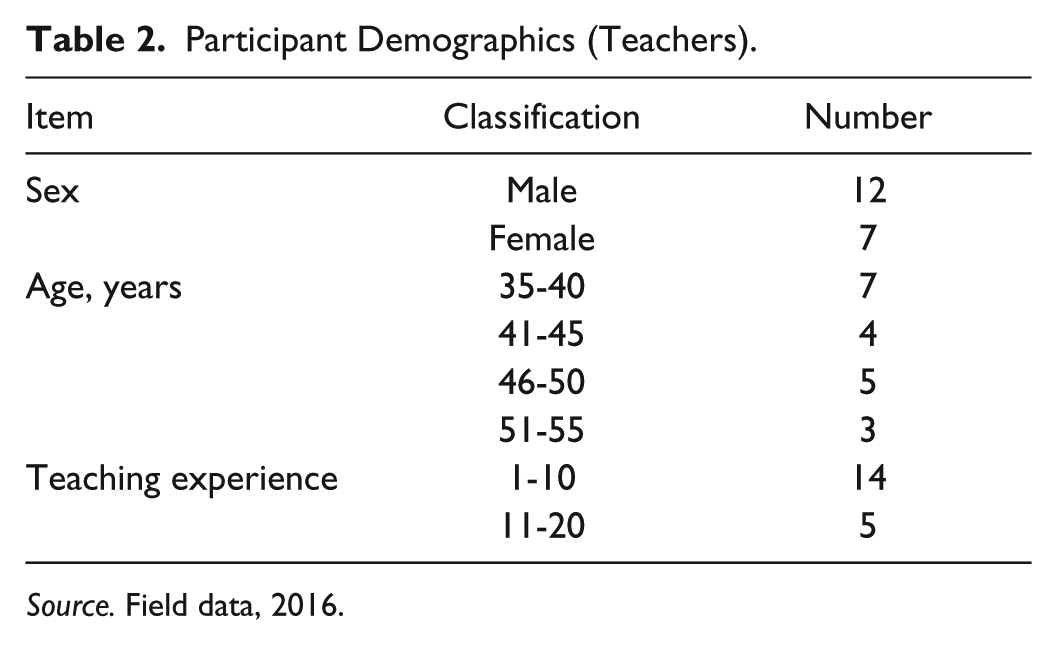
Source. Field data, 2016.
Ethical Considerations
This study delved into the private and social lives of students and teachers; consequently, there was the need to adopt measures that protected the rights, privacy, and welfare of the research participants (Berg & Lune, 2011). First, a written consent form was given to the head of the school to seek the school’s agreement with the research process. A consent form was read to the participants and they were given the opportunity to sign after introducing them to the study, indicating their voluntary participation. Consent forms were read aloud to the students with visual impairments for their agreement to participate in the study. Prior to commencing the interviews, the participants were assured of their anonymity and confidentiality.
Ensuring Qualitative Rigor
To ensure credibility and validity of the study findings, triangulation (by observer) and member checking were used (Lietz & Zayas, 2010). Triangulation by observer involves having more than one researcher analyze data to be sure that important ideas are not missing and to ensure consistency of the study findings with the research objectives. In doing this, all authors analyzed responses from the interviews independently to ensure that important information was not lost. It also ensured that the findings were consistent with the study’s objectives. Furthermore, the observer triangulation enabled the researchers to avert possible biases and inconsistencies in participants’ narratives and ensured that responses met the research objectives. On the contrary, member checking involves confirming the study findings by seeking feedback from the research participants (Padgett, 2008). To this effect, the researchers contacted seven participants with transcripts of the findings for their corroboration. The researchers could not access majority of the participants because the school was on vacation holidays during the period. Member checking has been identified by researchers as a valuable strategy for increasing trustworthiness in qualitative research (Lietz, Langer, & Furman, 2006).
Data Collection
Data were collected via face-to-face in-depth interviews with the 69 purposively selected research participants from January to May 2016. Interviews with the students were conducted at their classrooms after school hours. The classrooms were suitable for interviews with the students because all the students were boarders and could not make time for interviews at their homes. Interviews with the teachers took place at the teachers’ homes, the choice of research participants. The interviews, which averaged 60 min, were conducted with the help of a semistructured interview guide. Considering the nature of the study, semistructured interviews were appropriate since they provided flexibility (Marvasti, 2003; Ritchie & Lewis, 2003); hence, it allowed the researchers to probe into emerging insights and allowed participants to elaborate more on their responses. Moreover, the flexible nature of the interviews revealed multiple and divergent responses from the participants that enhanced the understanding of the topic under study (Marvasti, 2003). Questions asked in the interviews included students’ and teachers’ perception about inclusive education, students with visual impairments were asked to share their experiences of their daily meetings in the classroom, and they were also asked about their views on how teachers behaved toward them and whether (or not) the school environment was adequate to their needs. Furthermore, the teachers were asked to describe their feelings toward inclusive education. All interviews were conducted in the English language. Following participants’ consent, the interviews were audio recorded.
Data Analysis
The audio-recorded interviews were transcribed ad verbatim. In cases where names of persons or places were mentioned in the interviews that could be linked to the participants, pseudonyms were used. The thematic analysis was used to search for information to answer the research questions (Braun & Clarke, 2006). First, transcribed data were read and reread by the researchers to immerse self into data. Initial codes emerged following the researchers’ familiarity with the data. Codes including “integration,” “separation,” “discrimination,” “neglect,” and “belonging” were found from the data. Furthermore, the codes were collated into potential themes and the themes were refined to ensure they satisfied the research objectives. Themes that were organized under the research objectives were refined to ensure internal homogeneity; that is, to ensure that responses coded into a theme represented a coherent pattern. Some themes reflected similar ideas, thus, were collapsed into each other. Finally, given the exploratory nature of this research, codes containing less prevalent responses were not discarded but were revisited and some included for the study. The interview data were managed with the NVivo 10 qualitative software.
Findings
The study findings have been presented according to the research objectives: to explore the perception of visually impaired students, students without disabilities, and teachers about inclusive education and to identify the views about attitudes toward the visually impaired in an inclusive school.
Perception of Inclusive Education
Students with visual impairments supported the idea of inclusion. They argued that inclusive education helps bridge the discrimination gap that has existed between persons with and without disabilities. They opined that when they are mixed with students without disabilities, it gives them the opportunity to develop their potentials as they measure their academic achievements with their peers without disabilities: It is good to have all of us (both students with and without disabilities) together. We are able to learn from each other and share experiences. Sometimes we even do better than them in school, but they don’t recognise it because of our disability. But inclusive education is a good thing, it makes people know that we also have an ability to perform and find new opportunities. People change their mind about us when they see us doing this. (Visually impaired student, female)
Another student with visual impairment had this to say on how inclusive education benefits them: Yh, inclusive education is a good thing for us. It helps us to relate with the other students so that we don’t get isolated. You know, like we are also part of the community and stuffs like that. We also have rights to education like any other student and this opportunity is a way of having our rights. (Visually impaired student, female)
Some students with visual impairments viewed the practice of inclusive education as a way of claiming their rights to education. The visually impaired students argued that they had rights to education and the rights to learn in general education classrooms: “Yes, we have the right to study in an inclusive school, you know, education for all” (visually impaired student, male). Some of the students indicated that this makes people aware that both students with and without disabilities can study in the same school: This practice is a way of telling people outside that we are no different, you know. We are all in the same school studying the same subjects and we all pass. So, people will stop these discriminations and realise that there are no differences here. We are all equal in this school. (Visually impaired student, male)
Comments by the visually impaired students suggest that the practice of inclusive education has the propensity of promoting social acceptance, rights, and overcome discriminatory practices meted against persons with disabilities.
In relation to the practice of inclusive education, the students with visual impairments suggested that teachers should give them enough attention to enable them to be successful in the inclusive schools. They held that the teachers should make adequate time for them to meet their special needs. This is because the aides they use in their studies require time and attention. Moreover, because they could not see, their understanding of issues was also affected. A male student with visual impairment reflected on this: Yes, most of us are able to compete with them at the same level. But for us to be successful academically, the teachers have to give us special attention due to our needs. We don’t learn things fast like the others. But for me as an example, once I understand something it becomes part of me.
This suggests that it becomes the responsibility of the teacher to promote the education of such students. This becomes possible if the teachers are able to understand the peculiar needs of these students and address them accordingly.
Similarly, majority of the teachers held the view that the practice of inclusive education is a good approach to provide students with disabilities equal educational opportunities. They agreed that inclusive education is a means of acknowledging that impaired individuals have similar rights like persons without disabilities which should be respected: This form of education provides students with disabilities the chance to have quality education in an inclusive setting. It is also their rights, you know. It is important for us to respect them so we have them here. We like to teach them and they are welcome here. (Teacher, male)
It was their opinion that integrating students with disabilities into mainstream education empowers those with disabilities and urges them to forge ahead in all their activities: “including them with those without disabilities encourages them to surpass their peers” (Teacher, female). According to the teachers, students with disabilities can become successful in their activities when integrated with their peers without disabilities. Talking about how inclusive education promotes the rights of students with disabilities, a female teacher stated this: This system makes the disabled people know that we are all equal and have the same rights. When they get the chance to study in the same classroom with those without disabilities, they utilise it very well. Because they know lots of people like them don’t have this opportunity, so they work hard with this. Most of them here are good students. When you teach them, they respond accordingly. They are also humans, so they deserve quality education, just like everyone does.
This statement from the teacher shows the relevance of inclusive education for students with disabilities. When students with disabilities are given the opportunity to be in the same classroom with their peers without disabilities, they see this as a golden opportunity to make a good name for themselves and the society in which they live: You know, some of the visually impaired students are good. They see this a good opportunity to do something for themselves. Because of this they put in much effort. Some of them have good grades and are even doing well done the others. (Teacher, male)
However, few teachers did not agree with the practice of having the students without disabilities in the same classroom with the visually impaired. They indicated that the practice caused the slow pace of academics: Sometimes they cause the class lessons to go slow, it’s just because of how they learn. They need time to catch up with some things, so you need to take time for them. Look, it’s not their fault but it’s their nature so I guess we have to accept that they delay the class. (Teacher, female)
In line with their argument against the practice of inclusive education in the school, some of the teachers advocated for a special institution for the visually impaired as they stated that they could not keep up with the pace of normal classroom work. They argued that visually impaired students made their work difficult, because they required special attention: “They have to be sent to a special school because they require more time to learn” (Teacher, female). Teachers who held these views expressed concern that students with disabilities should not be denied of quality education; however, they should be taught with different methods and strategies. In stating his argument against the practice of inclusive education in the school, a teacher reflected on this: Again, the noise created by the braille impedes the progress and also it becomes difficult for us to move forward. They are very slow in math and this makes us (the teachers) slow, so we complained and they were separated from us. I believe that separating them is helpful for the disabled students as it will offer them the opportunity to study at their own terms and pace. I think this will help in their academic development.
From the teacher’s perspective, this shows how including students with visual impairments in the same classroom with their counterparts without impairments slows the teaching of mathematics.
Similarly, majority of the students without disabilities interviewed for the study were not happy about the practice of inclusive education. They were of the view that when students with disabilities are integrated with those without disabilities, the learning pace slows down and it impedes academic progress: It’s not good to have all of us together in one class. The visually impaired are unable to keep up with what we do in class so it slows as down. Most times the teachers will have to wait for them to finish whatever they are doing and this is not good for us. (Student without disability, male)
Some students without disabilities indicated that because they have been mixed with students with visual impairments in the school, they were unable to cover enough of their syllabi. One student without disability stated: They slow the progress in class so mostly we have only few classwork because the transcription from braille to prints delay and this causes a lot of hindrance. Because of this we have not been taught lots of things like the other school, but we will be writing the same final exams with those schools. (Student without disability, Male)
Another student added this: Mostly they slow down the pace and this makes the other classes move faster than us and mostly the syllabi are not finished on time. The students with disabilities do not learn fast so I don’t know why they have put us together. They use aides to learn and these aides do not help us, the aides interrupt progress. (Student without disability, female)
It appears that the students without disabilities were concerned about the slow progress of academic activities in their school. This is because they felt their peers in other schools without the inclusive system of education were moving faster with the syllabi than them: “other schools are moving ahead than us because we have the visually impaired with us” (student without disability, male).
Some students without disabilities were concerned that the practice of inclusive education had negative effects on their academic progress. According to them, they found it difficult to move on with their studies because their teachers wanted them to be at par with their visually impaired counterparts: Most topics are not taught in class because some teachers will wait for the visually impaired students to understand what we are doing before we move on to the next topic and this takes time, sometimes it never happens. So, some of us go for extra classes somewhere to study the things we have not been taught. So, I think inclusive education does not help us. (Student without disability, female)
Comments by the participants suggest few that teachers and students without disability failed to embrace the practice of inclusive education because they felt it slow academic progress. However, the visually impaired students and most teachers had different opinions as they believed that the practice of inclusive education promotes social acceptance, rights of the disabled, and prevent discriminatory practices. The contradictory opinion by the participants suggests the multifaceted nature of the inclusive education concept.
Views About Attitude Toward Visually Impaired Students
According to majority of the visually impaired students, their counterparts without disabilities did not show respect to them because they could not defend themselves when they were exploited. In stating how unfairly students without disabilities acted toward them in school, one visually impaired student stated: Especially in the dining hall, the students share the food in their favour due to the disadvantage of us being blind. This is not kind to us, because we cannot see they do things to us that are not good. Sometimes they serve as with very small fish and they take the big ones. When you take the food to the dormitory you will realise that there is no fish on your food. This is very bad. (Visually impaired student, male)
According to some visually impaired students, students without disabilities behave negatively toward them and this can have negative implications on how they form social relationships with their peers: Some of them do not treat us well. Because we are impaired. This is not good for us, you see. Because we cannot see they treat as badly. Some of them do not help us when we face difficulties understanding some things in class. They laugh at us because of this. (Visually impaired student, female)
Because visually impaired students are not treated fairly in school by their counterparts without disabilities, they may view the larger society as holding negative perceptions about them: “Looking at how they behave towards us, it makes us think that is how everyone in the community behave” (visually impaired student, male).
Another student with visual impairment reported on how teachers acted with discrimination toward them: They mostly try to push bad behaviours on us, an example is the washroom, anytime the place is messed up, they say it is we the visually impaired. Also, there was an instance a teacher came to the dormitory and the place wasn’t in good order, they said we were the cause. Meanwhile, we were in the same room with those without disabilities. (Visually impaired student, male)
This shows that not only do students without disabilities treat students with disabilities unfairly but teachers also exhibit negative attitudes toward students with visual impairments.
Other visually impaired students had this to say about how teachers acted toward them: Some of the teachers are not being fair to us. They say things about us, like they feel reluctant in making us understand the lesson and say it is because we would delay the class. (Visually impaired student, female) I was so sad when I witnessed a teacher slapped a visually impaired for a reason I don’t know. (Visually impaired student, male)
On the contrary, few of the visually impaired students recounted instances they received support from their colleagues who are without disabilities.
Hmmmm, is not all of them who doesn’t like us. I have a friend Joe anytime I need assistance he comes around to help me, especially with my homework and English Language writing. (Visually impaired student, female)
Nonetheless, some students without disabilities indicated that they supported students with visual impairments whenever they needed them and treated them equally without discrimination. According to the students without disabilities, most of the support they gave to students with visual impairments were related to academics: Oh, yh . . . we help them a lot with their home assignments. I use to help them with their tests at the dormitory. Sometimes I also help them go over what has already been taught in class. Just to make sure that they understand the things. (Student without disability, male)
They argued that students with visual impairments required time to study; hence, they speculated that students with visual impairments might have lagged in most subjects. Therefore, it became their duty to help them catch up with their studies. One student without disabilities recounted how she assisted a fellow student with visual impairments: Because they can’t see, I help them in reading and also this helps me to acquire something in our lesson notes, only that the time factor is a problem. You know, when I help them, it serves as a way of revising for me. So, I read the notes to them and we all try explaining it to our understanding. (Student without disability, female)
Another student without disability added this: I mostly help them a lot, especially I meet them on Sundays to give them further studies so they will catch up with time. I help them with Mathematics and Science, especially the ones that involve diagrams. Most of the teachers don’t take time to explain the diagrams even when they can’t see. So, this is the time I help them with that. (Student without disability, male)
The arguments above indicate the concerns students without disabilities have for the academic development of their peers with disabilities.
Discussion and Implications
This study explored the perception of visually impaired students, their peers without disabilities, and teachers about inclusive education. Participants’ views on attitudes toward the visually impaired have also been identified. The study findings revealed that students with visual impairments and some teachers supported inclusive education. This practice provided the visually impaired with the opportunity to measure their academic achievements with their peers without disabilities (Peetsma, Vergeer, Roeleveld, & Karsten, 2001). According to the students with visual impairments, inclusive education bridges the discrimination gap existing in Ghana. More so, it makes the general public aware that students with visual impairments are equally capable of achieving higher academic standards. To ensure this practice, students with visual impairments recommended that teachers in Ghana should be trained with the skills to be able to meet their needs, something lacking in Ghana (Agbenyega, 2007; Gyimah et al., 2009; Ocloo & Subbey, 2008). For the practice of inclusive education to be successful in Ghana, there is the need to train administrative leaders in public schools (Bai & Martin, 2015) and include courses on disability pedagogy for teachers in the various teacher training colleges in Ghana. Considering the desire of the students with visual impairment to be included in the mainstream, the Special Education Division in Ghana should put appropriate measures in place to ensure inclusion. Besides, there is evidence that practicing inclusive education in developing countries is cost-efficient and desirable (Artiles & Dyson, 2005).
Similarly, some teachers held the view that inclusive education is a good practice as it ensures that students with disabilities have access to equal educational opportunities as their peers without disabilities. Research has revealed that there are teachers who believe that inclusive education is a desirable practice and students with disabilities should have the right to be in general classroom (Bailey et al., 2015). The teachers in this study were of the view that students with disabilities see inclusive education as an opportunity to perform better than their peers without disabilities. As a result of this, they are sometimes better academically than their peers without disabilities. Considering the fact that these teachers have formed positive perceptions about inclusive education, it could be possible that they are able to develop teaching methods to accommodate the needs of the visually impaired students (Kuyini & Desai, 2007). Meanwhile, few teachers disapproved of inclusive education for the lack of training. Although the teachers had spent significant years (more than 6 years) in teaching at an inclusive school, it did not change their views toward inclusive education. This could be due to the fact that most teachers had not passed through Colleges of Education where courses on inclusive education are offered. This contradicts with Lamichhane’s (2017) study which found that teachers’ years of schooling and teaching experience is positively correlated to teaching adjustment when teaching students with visual impairments. The teachers’ main concern was that the inclusion of the students with visual impairments in the same classroom slowed the pace of academic work (Dare et al., 2017). This could be due to the lack of adequate resources to support inclusive education. Adequate resources and training should be offered to the teachers to develop their capacities to teach the visually impaired to help manage with the pace of academic work. For example, the teachers can be trained to teach the visually impaired how to use the braille machine to help the students keep up with academic work. Furthermore, the educational curriculum should be structured in a way to accommodate the needs of the visually impaired in an inclusive setting.
Moreover, some students without disabilities did not support the idea of inclusive education. This was a major concern to the students without disabilities as they felt their counterparts in other schools who do not practice inclusive education were covering much of the syllabi than they were, meanwhile they are expected to write the same final examinations for entrance into tertiary schools in Ghana. This corroborates with the findings of Downing and Peckham-Hardin (2007) which observed that students without disabilities felt the integration of students with disabilities into the general classroom could distract academic progress. Similarly, a Ghanaian study by Agbenyega (2007) found that including students with disabilities results in the incompletion of syllabi. It also appears that students without disabilities did not support inclusive education because most of them went through basic education without interacting with students with disabilities in the same school environment. Thus, inclusive education should be extended to all regions in all basic schools in Ghana to ensure that younger children learn the need for all students to have equal access to education.
The study findings showed some attitudinal barriers from students without disabilities. Essentially, students with visual impairments were not respected by their peers without disabilities. Generally, they were always accused of going against school rules as they were unable to stand up for themselves. This does not promote interest within students with visual impairments to achieve academic excellence. School authorities should implement regulations within the school to protect students with visual impairments. Nonetheless, the study findings suggest that other students without disabilities demonstrate positive attitudes to students with visual impairments by providing them with academic support. This has been echoed by Bunch and Valeo (2004) who argue that students without disabilities tend to develop friendship toward students with disabilities in inclusive settings. Although some students without disabilities disapproved of inclusive education, others accepted the practice and aided their visually impaired peers by providing them with academic support. The implication of this is that inclusive education could be successful with the introduction of the right approach to ensure that there is a balance between meeting the needs of both students with and without disabilities. This can be achieved by providing appropriate training to teachers in an inclusive setting.
Conclusion
Inclusive education in Ghana is a relatively new concept. Further research is needed to understand the current state of inclusive education within the country. These studies should consider avenues to provide preservice and in-service training to teachers in an inclusive setting. The study findings suggest that students with visual impairments and some teachers argue that inclusive education is a good practice. Moreover, some students without disabilities provided various support to their visually impaired counterparts. Majority of the research participants supported inclusive education except for some students without disabilities who disliked the practice. This could suggest that inclusive education has much to offer students with disabilities in Ghana. Consequently, inclusive schools in Ghana should provide special education training to their teachers to promote inclusion. Furthermore, inclusive education policy should include the need for students without disabilities to provide the needed support to students with disabilities to promote inclusive education. Considering the importance of teachers’ knowledge and skills in promoting inclusive education, research should focus on how such training could be provided to teachers.
Footnotes
Declaration of Conflicting Interests
The author(s) declared no potential conflicts of interest with respect to the research, authorship, and/or publication of this article.
Funding
The author(s) received no financial support for the research, authorship, and/or publication of this article.
