




Abstract
Given the high turnover rate of the nursing occupation, meaningful work may be the very reason why many nurses choose to stay in health care. However, it remains uncertain whether nurses’ meaningful work and the sources that contribute to meaningful work still well predict nurses’ occupational attitudes during the COVID-19. To answer these questions, applying the job demands-resources model as our overarching framework, this study examines the mediating role of meaningful work between its sources (i.e., autonomy support, and prosocial impact) and nurses’ occupational attitudes (i.e., occupational regret, and occupational turnover intention) during the COVID-19, with event strength as a moderator. A time-lagged design was adopted to collect survey data from 958 full-time Chinese nurses at three time points. The results show that during the COVID-19, perceived autonomy support and perceived social impact are still sources of nurses’ meaningful work and further affect their occupational attitudes, while the latter contributes more to meaningful work. The perceived event strength of the COVID-19 restrains the positive effect of meaningful work on nurses’ occupational attitudes. The findings of this study contribute to occupational attitude literature by revealing its antecedents and influencing factors in times of crisis.
Plain Language Summary
This large-sample survey study conducted during the COVID-19 found that nurses’ perceived social impact and perceived autonomy support contribute to their meaningful work and further reduce their occupational regret and occupational turnover intention. In addition, the perceived event strength of the COVID-19 was found to undermine the association between meaningful work and nurses’ occupational regret. Theoretically, findings of this study may draw research attention to the lack of understanding of the antecedents and occupational attitudinal consequences of meaningful work in times of crisis. Practical implications are provided to enhance nurses’ intention to remain in the nursing profession.
Keywords
Introduction
The 2020 State of World Nursing Report by the World Health Organization highlights a global shortage of nurses, with fewer than 28 million nurses worldwide and a deficit of 5.9 million. Africa, Southeast Asia, and other areas were most affected by this shortage. According to the Statistical Bulletin of China’s Health Care Development in 2020, which was published by China Health Commission, there were 4.70 million registered nurses in China, but the nation aimed to increase this number to 5.32 million by 2025, reflecting a significant gap in the nursing population. The shortage of nurses has significant impacts on the quality of health care provided to patients. For example, understaffing of nurses leads to increased patient mortality rates because low nurse-to-patient ratio results in less time spent caring for each patient (Musy et al., 2021). Besides, nurses who are overworked to compensate for the understaffing issue may experience stress and burnout, which may affect the quality of care they provide and increase the chance of making work errors (Poon et al., 2022).
Previous literature has summarized reasons for the large gap in the nursing population, which include workplace bullying (Holm et al., 2023), low income and low social status, lack of promotion prospects (Takase et al., 2016), high workload, high level of emotional labor, frequent overtime working, and rotational shift work (Gehri et al., 2023). To make nurses stay in their profession, organizational behavior scholars have tried to come up with possible solutions, such as demonstrating paternalistic leadership (Sungur et al., 2019), resolving nurses’ neuropsychological health issues (sleep disturbance, fatigue, and depression) (Ki et al., 2020), and providing opportunities for development and recognition from head nurse (Diehl et al., 2020). Among them, increasing nurses’ perception of meaningful work is considered to be an important approach to reducing nurses’ willingness to leave (Kallio et al., 2022; Xu et al., 2023). Meaningful work is the subjective experience in which one can understand and realize the significance of one’s work and have a sense of purpose from work, which widely exists in many occupations while varies in its levels among individuals (Rosso et al., 2010; Steger et al., 2012). According to the job demands-resources (JD-R) model (Bakker et al., 2003; Schaufeli & Bakker, 2004), job resources refer to physical, psychological, social, or organizational aspects of the job that are functional in achieving work goals, reducing job demands and stimulating personal growth, learning, and development. Meaningful work as a motivational characteristic of the job can be regarded as an important job resource that may reduce nurses’ turnover intention (Van der Heijden et al., 2018).
Recent literatures suggest that autonomy and beneficence are two robust psychological predictors of meaningful work (Martela et al., 2021; Martela & Pessi, 2018), which respectively directs toward self-oriented approaches (i.e., realizing and expressing oneself through work) and other-oriented (i.e., doing work that contributes to the “greater good” beyond one’s own benefits) approaches to increasing meaningful work (Rosso et al., 2010). Answering Martela and Pessi’s (2018) call, this paper respectively operationalizes autonomy and beneficence as perceived autonomy support at work and perceived prosocial impact of their work to empirically test their predictions on nurses’ meaningful work.
For health care professionals including the nursing community, the COVID-19 has been found to be a critical work incident (Meng et al., 2022) that may change one’s occupational attitudes. As highlighted in a recent review (Newman et al., 2022), research on employee vocational behavior in times of crisis is scarce. Some researchers believe that the COVID-19 has significantly enhanced the visibility of health care employees, especially nurses, who were often overlooked beforehand while now receive widespread public attention and high appreciation (Hennekam et al., 2020). Indeed, the COVID-19 witnessed a surge in social support for health care employees, especially nurses, who were elevated to hero status (Mejia et al., 2021). In this line, public recognition and praise may prompt nurses to have more positive attitudes toward their profession. In contrast, others suggested that the COVID-19 may increase healthcare employees’ turnover intention because they felt more helpless (Meng et al., 2022), and experienced greater job stress, state anger (Shah et al., 2021), and job insecurity during the COVID-19 (Mirzaei et al., 2021; Tang et al., 2022), all of which made them reflect and rethink whether they had chosen the right occupation. In this study, we focus on meaningful work and examine whether meaningful work and its sources can predict nurses’ occupational attitudes in face of the COVID-19, with perceived event strength as a potential moderator. To be specific, using JD-R model as the overarching framework, we propose a moderated mediation model to examine the mediating role of meaningful work between two sources of meaningful work (perceived autonomy support and perceived prosocial impact) and two kinds of occupational attitudes (i.e., occupational regret and occupational turnover intention) and the moderating role of perceived event strength of the COVID-19 between meaningful work and the two occupational attitudes. The theoretical model presented in Figure 1 illustrates the relationships between the proposed variables.

The theoretical model.
This research has several theoretical and practical implications. Practically, nurses are critical to the proper functioning of healthcare organizations, and nurses’ retention in the nursing industry is essential for the delivery of high-quality patient care. By examining the effect of meaningful work in reducing occupational regret and occupational turnover intention, we can gain insights into the approaches to promoting nurses’ retention, benefiting both healthcare organizations and patients. Theoretically, this study contributes to the occupational attitude literature. For one thing, most previous literature focused on organizational turnover intention rather than occupational turnover intention (Van der Heijden et al., 2018; Yousaf et al., 2015). For another, this study responds to scholars’ call for research on regret in the work domain (see Budjanovcanin et al., 2023). Second, by identifying the positive effects of autonomy support and prosocial impact on meaningful work during the COVID-19, this study presents an in-depth understanding of the factors that influence meaningful work in times of crisis. Finally, by examining the moderating role of the perceived event strength of the COVID-19 between meaningful work and occupational attitudes, this study answers our research question about whether the COVID-19 will facilitate or inhibit the positive effect of meaningful work on occupational attitudes.
Literature Review and Hypotheses Development
Job Demands-Resources (JD-R) Model Applied as the Overarching Theory
The overarching framework of this study is the JD-R model (Bakker et al., 2003; Schaufeli & Bakker, 2004), which states that each occupation has its own unique set of risk factors related to job stress that can be categorized into two categories, which are job demands and job resources. Job demands are defined as those physical, psychological, social, or organizational aspects of the job that require sustained physical and/or psychological efforts and are therefore associated with certain physiological and/or psychological costs. Job resources refer to the same four aspects of the job that are functional in achieving work goals, reducing job demands and stimulating personal growth, learning, and development. The JD-R model is built upon two underlying psychological processes that play a pivotal role in the development of job strain and motivation (Bakker et al., 2003; Bakker & Demerouti, 2007). The first process is referred to as the “health-impairment process,” where high job demands deplete employees’ mental and physical resources, potentially resulting in exhaustion and health issues. The second underlying process is of a motivational nature, indicating that job resources such as meaningful work possess either intrinsic (by fostering personal growth, learning, and development) or extrinsic (by serving as instrumental means to achieve work-related goals) motivational potential. This, in turn, leads to favorable work outcomes (Bakker et al., 2003; Bakker & Demerouti, 2007).
Meaningful work emphasizes the psychological aspect of the job, which encapsulates the mental and emotional states in which employees perceive their tasks as valuable, significant, and purposeful. Meaningful work involves having a sense of making a positive difference to the society and not being taken for granted in one’s work-related activities (Kahn, 1990). According to Hackman et al. (1975), when employees experience meaningfulness in their work, they are more likely to feel satisfied and thrive at work, which leads to enhanced intrinsic motivation and aligns with the function of job resources. Based on the motivational process described in the JD-R model as well as previous literature (Meng, Du, & Lin, 2023; Van der Heijden et al., 2018), meaningful work as a motivational characteristic of the job can be regarded as a job resource that may reduce nurses’ turnover intention and occupational regret.
Job resources and job demands may interact with each other and further affect employee work outcomes (Bakker et al., 2003; Schaufeli & Bakker, 2004). To be specific, job demands may inhibit the positive effect of job resources on employee outcomes since high job demands would deplete employees’ psychological resources, making it more difficult for them to access and utilize job resources (Caldas et al., 2021; Ten Brummelhuis & Bakker, 2012).
The Antecedents of Employee Turnover
Addressing the problem of high turnover rate of nurses has always been a challenge. Indeed, many studies have attempted to find the antecedents of nurses’ turnover and many models have been developed for this purpose. A comprehensive explanatory model has yet to be developed, whereas a common ground is that turnover behavior is a multistage process that includes attitudinal, decision-making, and behavioral components (McCarthy et al., 2007; Mobley et al., 1978). This study focuses on nurses’ attitudinal stage of turnover behavior. Specifically, we pay attention to two occupational attitudes of nurses, which are occupational turnover intention and occupational regret. Occupational turnover intention refers to individuals’ own estimated probability that they are permanently leaving the organization at some point in the near future (Meyer et al., 1993). Most studies pay more attention to organizational turnover intention rather than occupational turnover intention (Yousaf et al., 2015). The difference is that the former means that employees may stay in the same occupation but find a job in a different organization, whereas the latter means that employees completely change their industry (e.g., from nursing to gardening, shoemaking, consulting, etc.). This study focuses on nurses’ occupational turnover intention because choosing and developing a career involves a significant personal investment and is usually a long-term process, and leaving one’s career for good can be costly for the employee themselves, the organization, and the industry (Van der Heijden et al., 2018). Since turnover intention is the most accurate predictor of actual turnover behavior (Ajzen & Fishbein, 1975; McCarthy et al., 2007; Mobley et al., 1978), its antecedents in the nursing population have been extensively examined (Van der Heijden et al., 2018). A meta-analysis identified three major classes of determinants, including individual level factors (e.g., resilience, emotional intelligence, and self-efficacy), unit level factors (e.g., working conditions, job characteristics, and interpersonal relationship), and organizational level factors (e.g., organizational justice, organizational cynicism, and organizational support) (Kim & Kim, 2021). Although early work in this field has established a link between job characteristics and turnover, the impact of meaningful work on occupational turnover intentions was first reported until 2018 (Sun et al., 2019; Van der Heijden et al., 2018), and the impact of the antecedents of meaningful work on one’s turnover intention has been largely overlooked in existing studies.
Occupational regret is a new construct proposed by Budjanovcanin et al. (2019), which refers to “an enduring state of wishing that one had never entered one’s current occupation” (Wrzesniewski et al., 2006, p. 3). Dalal et al. (2010) has noted that “one emotion that is relevant to the workplace that is almost completely unaddressed in the organizational behavior literature is regret” (p. 398). Budjanovcanin et al. (2019, 2023) adopted this definition and added that the phrase “enduring” refers to the long-lasting nature of regret, which may be due to one’s inability or unwillingness to reverse the situation. This persistent regret continues throughout one’s career, which is unlike the short-term regret about a decision that can be undone (e.g., by changing organizations). Occupational regret stems from many reasons, such as misunderstanding the nature of work and having a low sense of identity with occupational values and goals. When left unaddressed, there would be negative implications (Budjanovcanin et al., 2023; Budjanovcanin & Woodrow, 2022). Few studies have examined the work-related antecedents of occupational regret, with the exception of Budjanovcanin and Woodrow (2022), who adopted a grounded theory approach and found that work environment is one of the triggers of occupational regret. Given that this conclusion did not get additional empirical support, enriching research on the work-related antecedents of occupational regret is of great theoretical importance. Considering that both occupational turnover intention and occupational regret involve possible negative emotions or attitudes employees may have toward their current occupation, this study attempts to examine the impact of work-related factors (i.e., meaningful work and its sources) on these two career attitudes within the framework of the JD-R model.
Sources of Meaningful Work
Autonomy support describes managers’ respect for employees’ perspectives, provision of alternative opportunities, and stimulation of self-initiation (Deci et al., 2001). Empirical studies indicated that meaningful work is positively influenced by the fulfillment of the three psychological needs, which are autonomy, competence, and relatedness (Martela et al., 2021; Martela & Pessi, 2018). When employees perceive autonomy support, they can be the agency of their own behaviors and experience satisfaction with self-determination which leads to meaningful work perception (Deci et al., 2017; Gagné & Deci, 2005). In contrast, supervisors’ control forces employees to think and behave in a specific way, which greatly frustrates their psychological needs and stops them from seeking work meaningfulness (Li et al., 2022). In the nursing industry, autonomy support gives nurses the freedom to decide how to achieve their personal goals, enhancing self-realization and then increase their understanding of the meaning of their work in a self-oriented pathway. The need of autonomy matters when responding to an emergency to save a patient’s life, coordinating care and triaging patients, and avoiding harm or negative consequences. Besides, meaningful work has been shown to be associated with professional autonomy in nursing, that is, nurses’ autonomy in performing and organizing work, clinical decision-making, and freedom to perform nursing care based on nurses’ own judgment (Both-Nwabuwe et al., 2020). Thus, we predict that:
H1. Perceived autonomy support is positively related to nurses’ meaningful work.
From the relational work design perspective, Grant et al. (2007) proposed the concept of “perceived prosocial impact” which describes the extent to which one perceives their actions to be beneficial to others, and argued that employees’ direct contact with their beneficiaries gives rise to greater perception of task significance and better job performance. In line with this perspective, prosocial impact may act as social cues at work and influence how employees view their work in terms of how significant their work is, and work meaningfulness might then result from it (Dutton et al., 2016). As proposed by Steger et al. (2012), the desire to make a positive impact on the greater good is the highest level of self-transcendence in the three-level model of meaningful work. Research has confirmed that varied forms of prosocial impact, such as offering help to others, would contribute to work meaningfulness perception (Allan et al., 2018). Evidence from varied cultures, occupations, and industries supports the idea that prosocial impact can be a source of work meaningfulness (Martela et al., 2021; Meng, Lin et al., 2023). Specifically, when it comes to nurses, van der Wath and van Wyk (2020) showed that lots of nurses are altruistically motivated to enter and remain in the nursing profession, the work of which exerts positive influence on larger social groups. As a result, nurses can experience greater meaningful work. Thus, we predict that:
H2. Perceived prosocial impact is positively related to nurses’ meaningful work.
Meaningful Work and Occupational Attitudes
Hackman and Oldham (1980) recognized meaningfulness as an important psychological status at work, which refers to the extent to which people invest themselves in their job roles and responsibilities. Drawing upon the JD-R model, meaningful work as a job resource is essential for personal growth (May et al., 2004), intrinsic work motivation (Steger et al., 2012), and work engagement (Canboy et al., 2023). Following this logic, we propose that the more nurses perceive meaningful work, the less occupational regret and occupational turnover intention they would have. First, some research has demonstrated that burnout can result in career choice regret (Lu et al., 2023), and meaningful work as a job resource has been shown to effectively reduce burnout (Allan et al., 2019). Second, greater meaningful work is associated with stronger sense of professional identity (Scanlan & Hazelton, 2019), which suggests that employees who perceive greater meaningful work tend not to regret their career choices. An enlightening qualitative study conducted on zookeepers in the U. S. and Canada revealed that deeply meaningful work made them stay in their profession. Zookeepers expressed their enthusiasm for the profession by stating that “I can’t think of anything that would cause me to leave” and “Even if I wasn’t getting paid, I would still be here” (Bunderson & Thompson, 2009, p. 35). Moreover, a large body of evidence suggests that meaningful work is associated with job satisfaction (Liu et al., 2021), more involvement in their work (Johnson & Jiang, 2017; Meng, Lin et al., 2023), reduced days of absence (Steger et al., 2012), and more commitment to their vocation and employer (Duffy et al., 2011). These empirical evidences suggest that employees are unlikely to change their occupation when they perceive their work as worthwhile, important, or valuable. On the contrary, previous research has shown that when employees feel that their jobs are meaningless, they would have the intent to leave (Sun et al., 2019; Xu et al., 2023). Thus, we predict that:
H3. Meaningful work is negatively related to occupational regret and occupational turnover intention.
The Mediating Role of Meaningful Work Between Sources of Meaningful Work and Occupational Attitudes
This study attempted to establish a link between sources of meaningful work and its occupational attitudinal consequences. Based on the above reasoning, when employees perceive their work activities as opportunities to be the agency of their behaviors or to make a positive difference in the lives of others, they will experience meaningful work and consequently reduce occupational regret and occupational turnover intention. In fact, scarce research has established a connection between the sources of meaningful work and employees’ occupational attitudes except for Sun et al. (2019), which found that social mission and shared vision could predict low organizational turnover intention through meaningful work. Complementing this pioneering study, this study attempts to examine the mediating role of meaningful work in the relationships between perceived autonomy support/perceived prosocial impact and occupational regret/occupational turnover intention. Thus, we predict:
H4. Meaningful work mediates the relationships between perceived autonomy support and occupational regret and occupational turnover intention.
H5. Meaningful work mediates the relationships between perceived prosocial impact and occupational regret and occupational turnover intention.
The Moderating Role of Perceived Event Strength Between Meaningful Work and Occupational Attitudes
For nurses, the COVID-19 has been a critical work incident, profoundly affecting various aspects of their professional lives (Newman et al., 2022). Accumulating studies have demonstrated that the COVID-19 is a highly stressful work event which causes heavy job demands (Meng et al., 2022; Mirzaei et al., 2021; Shah et al., 2021). For example, the COVID-19 creates an adverse physical work environment which requires sustained physical and psychological (i.e., cognitive and emotional) effort on the part of the employees, and is therefore associated with certain physiological and psychological costs (Bakker et al., 2003). To empirically examine the moderating role of critical work events or crises on the relationship between meaningful work and nurses’ occupational attitudes, we resort to the event system theory (EST) (Morgeson et al., 2015). EST states that individuals may encounter a myriad of events, not all of which are salient, and it is the perceived event strength that triggers varying degrees of information processing and subsequent work attitudes and/or behaviors. EST further asserts that when one perceives that an event is novel (i.e., a new or unexpected phenomenon), disruptive (i.e., which disrupts routines), and critical (significant in influencing one’s decision-making and actions), then the event becomes salient. When it comes to the COVID-19, nurses may have varied psychological interpretations and responses to it (Caldas et al., 2021; Lin et al., 2021; Liu et al., 2021). Some might perceive it as highly novel, disruptive and critical, while more experienced individuals, such as those who have dealt with previous outbreaks of diseases, may view its strength as relatively low.
We believe that nurses whose work is highly involved in the COVID-19 would face greater job demands. Firstly, the COVID-19 itself was a new coronavirus, and those nurses who had not gone through a similar event may experience fear and frustration. Research indicated that the emotional exhaustion resulting from fear requires additional resources for self-regulation, making it a significant job demand (Caldas et al., 2021). Second, during the COVID-19, the sudden surge in the number of patients requiring immediate medical attention compelled nurses to work long hours and assume additional responsibilities to manage the influx of patients (Shah et al., 2021). Lastly, the COVID-19 had a profound impact on the work and personal lives of healthcare professionals. Witnessing the suffering and death of patients led to severe death anxiety and insecurity (Xu et al., 2023). Moreover, being isolated from family for extended periods and high workload would cause work-family conflicts, significantly affecting nurses’ personal lives (Sahay & Wei, 2023). Taken together, the greater the degree of nurses’ involvement in the COVID-19 at work, the greater the job demands.
According to the JD-R model, job resources and job demands may interact with each other and further affect employee outcomes such as well-being, job engagement, and performance (Bakker et al., 2003; Schaufeli & Bakker, 2004). Research has found that the COVID-19 may deplete employees’ valuable psychological resources, making it more difficult for them to access and utilize job resources (Caldas et al., 2021). Therefore, the high job demands accompanied by high perceived event strength of the COVID-19 may inhibit the protective effect of meaningful work, and nurses’ occupational turnover intention and occupational regret might be significantly enhanced. Thus, we predict that:
H6. Perceived event strength moderates the relationships between meaningful work and occupational regret and occupational turnover intention, such that these relationships will be weakened at higher levels of perceived event strength of the COVID-19.
Method
Participants and Procedure
This study adopted the stratified sampling approach to ensure representativeness of the sample and to reduce sample bias. Specifically, the sample for this study was drawn from nurses from three hospitals in three representative provinces (i.e., Hubei, Jiangsu, and Xinjiang) in China. All three hospitals are Grade III Class A hospitals (i.e., the highest level in hospital classification in mainland China). As the first stratum of stratified sampling, these three hospitals are representative because Hubei Province was the hardest-hit area by the COVID-19, the hospital in Jiangsu Province assisted hospitals in Hubei province, and Xinjiang Province was least affected by the COVID-19 in China during data collection. The second level of stratified sampling was department because all three hospitals had multiple departments. The researchers received support from the directors of these hospitals and their human resource managers, who then contacted the head nurses in every department. Each hospital had an average of 1,000 nurses. We randomly invited 40% of the nurses as participants (approximately 1,200 nurses). Stratified sampling ensures that each stratum in the sample is fully represented, thereby improving the representativeness of the sample.
This study used paper questionnaires and collected responses on-site. Each questionnaire was accompanied by a cover letter that introduced the survey’s purpose to potential participants (i.e., nurses interested in the survey) and guaranteed the confidentiality of their responses. Nurses were asked to place their completed questionnaires in sealed envelopes, which were organized together by the research assistants and head nurses. We made unobservable marks on the envelopes to help match data collected from the three time points. However, we never collected any identifiable personal information of the participants, which makes it impossible for us to track each nurse’s actual turnover behavior.
To avoid common method variance, data were collected at three time points, with a 2-week interval. 1 At time 1 (T1, 20–28th May 2020), 1,328 nurses were invited to provide their basic demographics, perceived event strength of the COVID-19, perceived prosocial impact of their work, and perceived autonomy support from the head nurse, and 1,178 questionnaires were returned. At time 2 (T2, 1st–7th June 2020), the 1,178 nurses were asked to provide their perception of meaningful work, and 1,009 questionnaires were returned. At time 3 (T3, 14th–22nd June 2020), 998 nurses reported their occupational turnover intention and occupational regret. After eliminating mismatching and incomplete data, we finally obtained 958 questionnaires, with an effective response rate of 72.1%.
As for the demographics of our sample, the average age of the nurses was 31.85 years old (S.D. = 6.75), most of whom were married (72.1%). 71.6% had a junior college degree. About 55% had the “Nurse Practitioner” job title (i.e., a senior technical position within the nursing profession). 40.4% of the participants had worked 5 to 10 years, 26.4% less than 5 years, and 15.7% 10 to 15 years. 48.3% of the nurses worked on the frontline against the pandemic in the Hubei region, and 46.8% were not directly involved in the fight against the pandemic. 98.7% did not have any family members diagnosed with the COVID-19, and 94.3% did not have any friends diagnosed.
Measures
We translated the original English items into Chinese following a back-and-forth translation procedure (Brislin, 1980) to ensure the accuracy of our translation. In addition, we adapted some items to better fit the work context of nurses. All items were measured using a six-point scale ranging from 1 (strongly disagree) to 6 (strongly agree) to avoid neural responses. Descriptions of our measurements are presented below (see Appendix for all items).
Perceived Autonomy Support (T1)
Perceived autonomy support measures the extent to which an employee experiences autonomy-support from the leader, characterized by opportunities for self-motivation and self-regulation rather than being forced to behave in a certain way, as well as uncontrolled access to relevant information, options, and feedback (Deci et al., 1982). The brief version of the Work Climate Questionnaire (WCQ) developed by Deci et al. (2001) was adopted, which includes six items to measure nurses’ perception of autonomy support from their head nurses. A sample item is “The head nurse provided me with choices at work.” The Cronbach’s alpha was .97.
Perceived Prosocial Impact (T1)
Perceived social impact reflects the extent to which employees feel that their actions benefit other people. The three-item scale developed by Grant (2008) was adopted. A sample item is “I am aware of how my work will help others (e.g., colleagues, patients, and their families).” The Cronbach’s alpha was .92.
Perceived Event Strength of the COVID-19 (T1)
Perceived event strength of the COVID-19 measures the extent to which an employee perceives the COVID-19 as a novel, disruptive and critical work event. Specifically, novelty is the extent to which one considers the COVID-19 to be new and unexpected; disruption reflects the extent to which employees perceive that their existing tasks are interrupted by the COVID-19; and criticality gauges the extent to which they believe that the COVID-19 will significantly affect their long-term development (Liu et al., 2021). The 11-item scale developed by Morgeson et al. (2015) was adopted. Sample items include “When the COVID-19 pandemic first broke out, there was an understandable sequence of steps that could be followed (R)” (event novelty), “I think the COVID-19 requires me to change the way I do my work” (event disruption), and “The COVID-19 is an important work event for me” (event criticality). This variable was measured at T1 to reduce recall bias since it requires the nurses to recall their perceptions when the COVID-19 first broke out. The Cronbach’s alpha for the whole scale was .75.
Meaningful Work (T2)
Meaningful work reflects the extent to which individuals perceive their work as significant, making a contribution to the greater good, and fostering personal growth. The 10-item Work and Meaning Inventory (WAMI) developed by Steger et al. (2012) was used to measure nurses’ meaningful work. A sample item is “My work serves a very important purpose.” The Cronbach’s alpha was .87.
Occupational Regret (T3)
Occupational regret stems from regret, which refers to the negative emotions and feelings an individual experiences regarding their career choices or career path, typically stemming from a belief that their decisions were not optimal or did not yield the expected outcomes. The nine-item scale developed by Budjanovcanin et al. (2019) was adopted. A sample item is “I wish I had chosen a different occupation back when I was starting my career.” The Cronbach’s alpha was .84.
Occupational Turnover Intention (T3)
Occupational turnover intention measures the extent to which participants would prefer another more ideal job and the extent to which they intend to remain in their current occupation. Four items were developed based on Mobley et al.’s (1978) study to assess one’s occupational turnover intention. A sample item is “If I could get a good job, I would leave nursing as soon as possible.” The Cronbach’s alpha was .91.
Control Variables
Many demographics have been found to correlate with employee turnover intention (McCarthy et al., 2007). For example, Du Plooy and Roodt (2013) showed that elder employees (i.e., 50 years old and above) thought more carefully about quitting a job and married employees were less likely to develop turnover intentions compared to unmarried employees because they had more responsibilities toward their family members. Emiroğlu et al. (2015) found that people who have lower education level, longer tenure, and hold higher position have lower turnover intention. Besides, we believe that the extent to which nurses participate in anti-pandemic work may affect their intention to leave. For example, nurses who participated in front-line anti-pandemic work in Hubei province may experience greater difficulties at work and have a higher turnover intention than nurses who were not directly involved in fighting the pandemic. Besides, the turnover intention may be higher if a nurse had a family member or friend diagnosed with the COVID-19. Therefore, we controlled for age, education level, job title, work tenure, marital status, and the nurses’ information related to the COVID-19 (i.e., the extent of participation in anti-pandemic work, whether they have family members or friends diagnosed). Considering that more than 97% of registered nurses in China are female, this study did not collect their gender information.
Results
Preliminary Analysis
Table 1 presents the means, standard deviations, and correlations among the main variables. Perceived autonomy support is positively correlated with meaningful work (r = .49, p < .01), while negatively correlated with occupational turnover intention (r = −.31, p < .01) and occupational regret (r = −.35, p < .01). Perceived prosocial impact is positively correlated with meaningful work (r = .66, p < .01), while negatively correlated with occupational turnover intention (r = −.28, p < .01) and occupational regret (r = −30, p < .01).
Means, Standard Deviations, and Correlations.
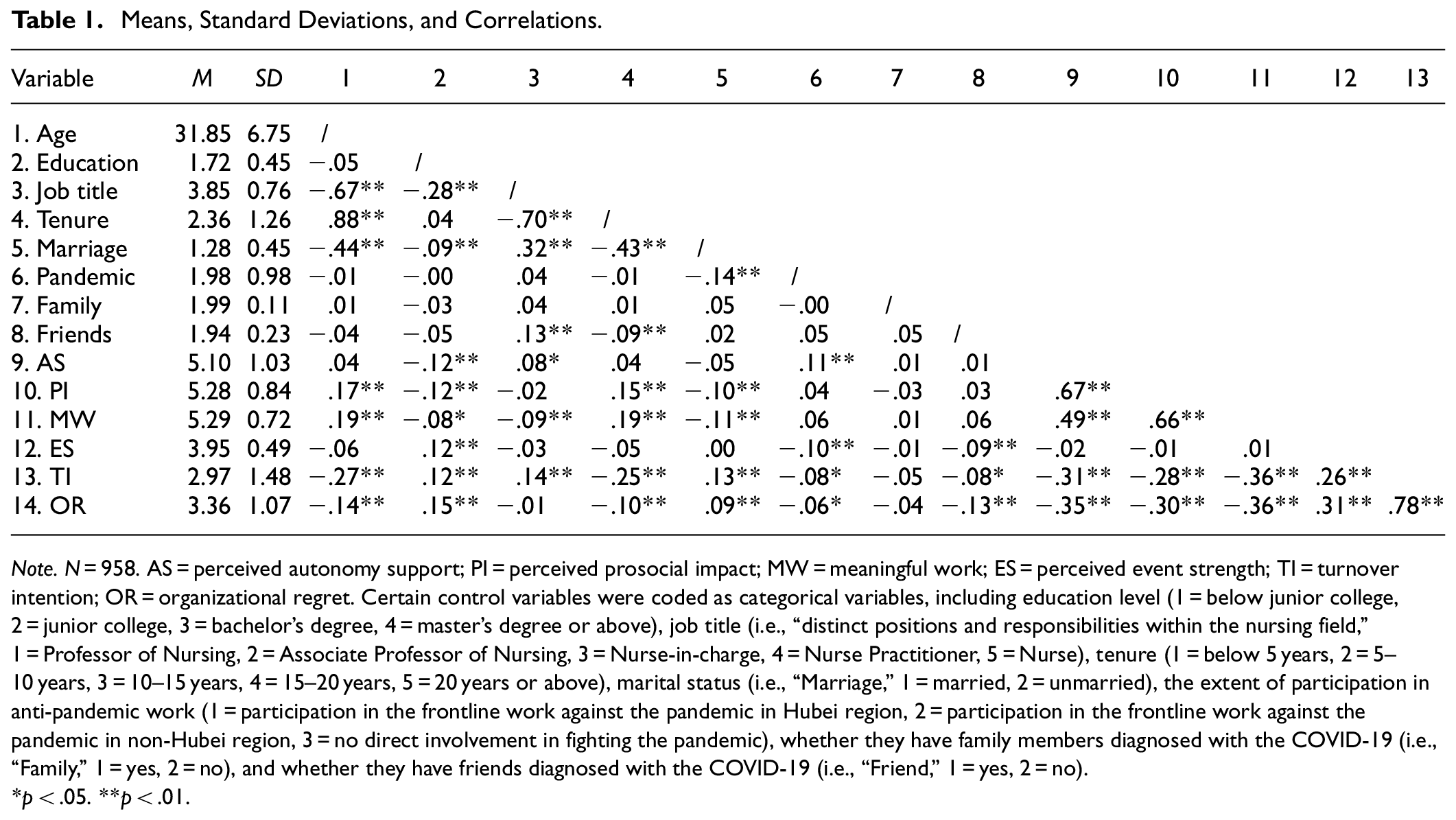
Note. N = 958. AS = perceived autonomy support; PI = perceived prosocial impact; MW = meaningful work; ES = perceived event strength; TI = turnover intention; OR = organizational regret. Certain control variables were coded as categorical variables, including education level (1 = below junior college, 2 = junior college, 3 = bachelor’s degree, 4 = master’s degree or above), job title (i.e., “distinct positions and responsibilities within the nursing field,” 1 = Professor of Nursing, 2 = Associate Professor of Nursing, 3 = Nurse-in-charge, 4 = Nurse Practitioner, 5 = Nurse), tenure (1 = below 5 years, 2 = 5–10 years, 3 = 10–15 years, 4 = 15–20 years, 5 = 20 years or above), marital status (i.e., “Marriage,” 1 = married, 2 = unmarried), the extent of participation in anti-pandemic work (1 = participation in the frontline work against the pandemic in Hubei region, 2 = participation in the frontline work against the pandemic in non-Hubei region, 3 = no direct involvement in fighting the pandemic), whether they have family members diagnosed with the COVID-19 (i.e., “Family,” 1 = yes, 2 = no), and whether they have friends diagnosed with the COVID-19 (i.e., “Friend,” 1 = yes, 2 = no).
p < .05. **p < .01.
Further, we conducted CFA to assess the discriminant validity of our focal variables. As shown in Table 2, fit indices for the seven-factor model (χ2/ df = 4.01; CFI = 0.90; TFI = 0.91; RMSEA = 0.05; SRMR = 0.07) are better than other alternative models, showing the distinctiveness of the seven constructs. Table 3 shows that each construct’s composite reliability (CR), average variance extracted (AVE), and square root value of AVE is greater than the reference value, proving good discriminant validity.
Comparison of Measurement Models.
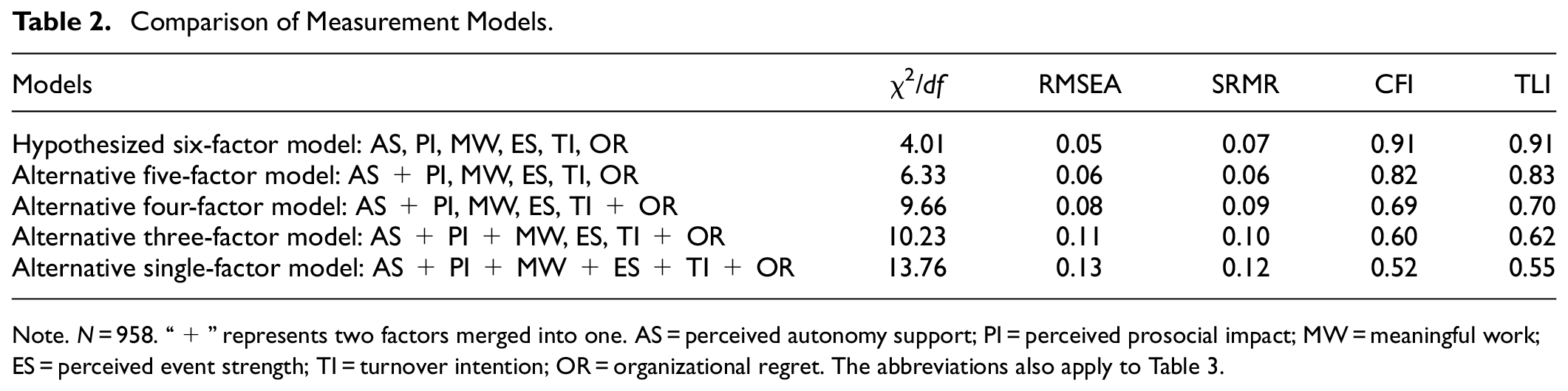
Note. N = 958. “+” represents two factors merged into one. AS = perceived autonomy support; PI = perceived prosocial impact; MW = meaningful work; ES = perceived event strength; TI = turnover intention; OR = organizational regret. The abbreviations also apply to Table 3.
Measurement Model Assessment.

Note. CR = composite reliability; AVE = average variance extracted; α = Cronbach’s Alpha.
Hypotheses Testing
The results of the path analysis were shown in Table 4. Perceived autonomy support is significantly associated with meaningful work (B = 0.07, p < .05, Model 2). Perceived prosocial impact is also significantly associated with meaningful work (B = 0.50, p < .001, Model 2), supporting H1 and H2. In addition, meaningful work is significantly and negatively related to organizational regret (B = −0.48, p < .001, Model 7) and occupational turnover intention (B = −0.62, p < .001, Model 4). H3 is thus supported. The bootstrapping results reveal that meaningful work mediates the relationships between perceived autonomy support and occupational regret (indirect effect = −0.03, 95% CI: [−0.08, −0.01]) and occupational turnover intention (indirect effect = −0.04, 95% CI: [−0.11, −0.01]). H4 is thus supported. Also, it significantly mediates the relationships between perceived prosocial impact and occupational regret (indirect effect = −0.24, 95% CI: [−0.29, −0.20]) and occupational turnover intention (indirect effect = −0.31, 95% CI: [−0.37, −0.24]). H5 is thus supported.
Results of Regression Analyses.

Note. N = 958. AS = perceived autonomy support; PI = perceived prosocial impact; MW = meaningful work; ES = perceived event strength; TI = turnover intention; OR = organizational regret.
p < .05. **p < .01. ***p < .001.
The interaction between meaningful work and perceived event strength on organizational regret (B = 0.21, p < .05) is significant, while the interaction between meaningful work and perceived COVID-19 event strength is not significantly associated with occupational turnover intention (B = 0.13, n.s.). Thus, H6 was partly supported. Simple slope analyses show that the negative relationship between meaningful work and organizational regret becomes weaker at higher levels of perceived event strength (B = −0.10, p < .05) than at lower levels of perceived event strength (B = −0.21, p < .01). The nature of this interaction is depicted in Figure 2. We accounted for the influence of control variables in all analyses, considering their known associations with the dependent variables. However, eliminating these controls did not alter the pattern of statistical significance observed in our findings.
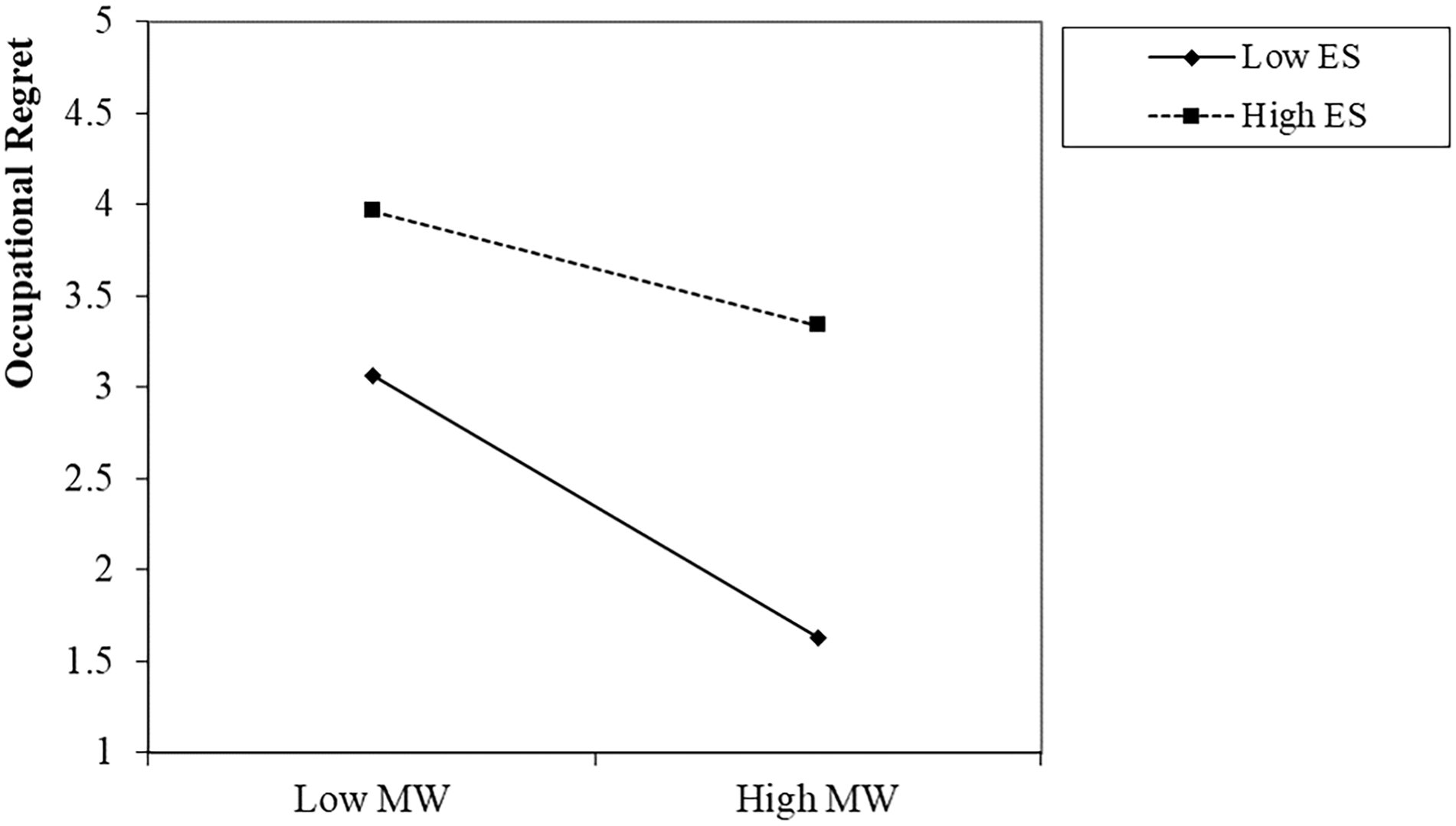
The moderating effect of the perceived event strength (ES) on the relationship between meaningful work (MW) and occupational regret.
Discussion
Theoretical Implications
Framing the study within the JD-R model and the meaningful work literature, the study aimed to advance existing literature by examining autonomy support and prosocial impact as two sources of meaningful work and the effect of meaningful work on occupational attitudes among a sample of nurses in China. Theoretically, a main contribution of this study is the finding that the impacts of the two sources of meaningful work are different in the context of the COVID-19. Previous studies showed that both autonomy support and prosocial impact contribute to meaningful work (Martela et al., 2021; Martela & Pessi, 2018). Meng, Lin et al. (2023) conducted a daily diary study with a sample of healthcare employees and found that before the COVID-19 took place, nurses were likely to experience meaningful work when they felt autonomy support and prosocial impact, both of which are important sources of meaningful work. In contrast, this study finds that the predictive effect of autonomy support on meaningful work was minimal, with a regression coefficient of only 0.07 (p < .05), while the predictive effect of prosocial impact was relatively large, with a regression coefficient of 0.50 (p < .001). We consider that the special data collection period (i.e., outbreak of the COVID-19) contributes to this finding. First, the greater good regarding social benefits facilitates high-level human development (Madden & Bailey, 2019). The pursuit of self-determination (i.e., autonomy) may remain a source of work meaningfulness for employees in general situations. However, in emergencies and crises (e.g., the COVID-19), nurses may perceive a stronger link between their work and the broader self-transcendent goal. Thus, the effect of autonomy support on meaningful work gets diminished. Second, in times of major disasters and catastrophes (e.g., the COVID-19, and Wenchuan earthquake), Chinese people living in the collectivist culture tend to obey unified dispatch and arrangements, so nurses tend to obey orders from their superiors and are less likely to make autonomous decisions.
Additionally, our study contributes to the occupational attitude literature by establishing a link between sources of meaningful work and employees’ career attitudes. Our results support the significant positive association between two sources of work meaningfulness (perceived prosocial impact and perceived autonomy support) and nurses’ occupational attitudes (lower occupational regret and occupational turnover intention) through meaningful work. To our knowledge, Van der Heijden et al. (2018) was the first to examine the role of occupational turnover intention within the JD-R framework. Our study complements this pioneering study by validating the effect of job resources (i.e., meaningful work) on occupational turnover and occupational regret. Since the construct of occupational regret was proposed, there has been limited research examining its antecedents (Budjanovcanin et al., 2019; Budjanovcanin & Woodrow, 2022). This study provides evidence that perceived meaningful work and its antecedents are negatively associated with occupational regret, which enriches antecedents of occupational regret (Budjanovcanin et al., 2019, 2023).
Finally, this study contributes to the existing literature on the relationship between meaningful work and occupational attitudes by investigating the situational role of the COVID-19. Our findings suggest that higher perceived event strength of the COVID-19 significantly weakens the negative effect of meaningful work on occupational regret, which answers the question we posed at the beginning of our study as to whether outbreak of the COVID-19 alters the predictive effect of meaningful work on occupational attitudes. While some studies pointed to the COVID-19 outbreak as making the nursing profession a heroic one, it was short-lived. The short-lived increase in social status came at the cost of extremely demanding and difficult work. As Hennekam et al. (2020) showed through a qualitative study of 164 healthcare workers, they were skeptical and incredulous about this heroization, believing that it would not be long-lasting, and they wished that the COVID-19 could have ended sooner and work could have returned to normal. In addition, this finding enriches the existing literature on the interaction effect of job demand and job resource on employee outcomes within the JD-R model. Previous studies provided empirical support regarding the boosting hypothesis in the JD-R model which suggests that job resources become more salient and are more important for employee work outcomes when job demands are high. Recent research pointed out that job demands and strain may lead to maladaptive self-regulation cognitions and behaviors (Bakker & de Vries, 2021). For example, individuals facing high job demands would find it more difficult to be concentrated and then generate negative emotions (e.g., anger, and irritation) which would narrow their thought–action repertoires (Bakker et al., 2023). This may create a poor situation for the motivational functions of job resources. Consistent with the findings of Caldas et al. (2021), we again found that the COVID-19 would bring about heavy job demands to health care professionals and may deplete their psychological resources, making it more difficult for them to access and utilize job resources. It is worth noting that the interaction between perceived event strength of the COVID-19 and meaningful work on occupational turnover intention was not significant. It is possible that although the occurrence of the pandemic caused nurses great work stress and negative emotions, and made them regret their initial career choice, the intention to leave was often held back by a combination of many practical factors. For example, due to the economic downturn, it was difficult to find a good job within a short period of time.
Practical Implications
This study provides practical implications that may help hospital managers understand how they can properly intervene to retain employees. We provide two ways to enhance nurses’ perception of work meaningfulness. First, to increase nurses’ perception of prosocial impact, managers should publicize the heroic image of “the angel in white” in multiple forms and facilitate interactions between nurses and those they personally helped through their work. More feedback could be solicited from the discharged patients and then be provided to the nurses. In this way, nurses may have a more profound understanding of the positive impact of their work on their beneficiaries’ lives and the social value of nursing.
Second, to improve nurses’ perception of autonomy support, organizations can implement training programs for head nurses that focus on developing leadership skills related to autonomy support, which include active listening, having empathy, effective communication, and providing feedback. Besides, head nurses should provide opportunities for nurses to make choices and exercise autonomy in their daily work. These practices bring about not only greater meaningful work but also greater well-being. Prior research has shown that autonomy support can satisfy employees’ autonomy need (i.e., individuals would feel voluntary and autonomous), and perceived prosocial impact can satisfy their relatedness need (i.e., individuals would feel more connected to others), and that the fulfillment of basic psychological needs further enhances individuals’ well-being (Martela & Ryan, 2016).
Finally, managers should be aware that the perceived strength of a critical work incident would undermine the association between meaningful work and employees’ occupational attitudes. Managers should take actions to reduce employees’ perception of the event strength. For example, providing clear and transparent information about the critical incident may reduce fears because rumors would strengthen nurses’ perception of the work event strength. Cultivating supportive environments is also helpful, such as by providing nurses with a safe work environment and mental health services and maintaining staffing levels and a stable workload.
Limitations and Future Directions
This research has several limitations. First, all data were self-reported in this study, and there might be a common method bias. Our design with a time-lagged measure of employee outcomes helps to reduce this bias. In future research, objective data (such as the actual occupational turnover rate of nurses) can be acquired to enhance the robustness of our conclusions. Second, despite having collected three waves of data, the study is not longitudinal in nature, as each variable was measured only once, making it difficult to infer a causal relationship. Longitudinal studies with similar research designs should be conducted to verify the findings. Finally, given the voluntary nature of nurses’ participation in the survey, the sample selection bias may exist. When introducing our research to the nurses, we indicated that our research aimed to improve the quality of nurses’ work life and their well-being. Besides, we worked hard to convince them that our survey was fully anonymous. Thus, those who were under great work pressure and experienced burnout might be even more willing to participate in our study, as they had a greater desire to improve their work life. Future studies with clever designs should be implemented to reduce the sample selection bias.
Conclusion
This large-sample survey study conducted during the COVID-19 found that nurses’ perceived social impact and perceived autonomy support contribute to their meaningful work and further reduce their occupational regret and occupational turnover intention. In addition, the perceived event strength of the COVID-19 was found to undermine the association between meaningful work and nurses’ occupational regret. Theoretically, findings of this study may draw research attention to the lack of understanding of the antecedents and occupational attitudinal consequences of meaningful work in times of crisis. Practical implications are provided to enhance nurses’ intention to remain in the nursing profession.
Footnotes
Appendix: Measurement Items of the Main Constructs in This Study
Acknowledgements
We would like to extend our sincere gratitude to the reviewers for their invaluable guidance and support throughout the review process, as well as to the participants who generously gave their time to make this study possible.
Authors’ Contribution
Meng L. and Du J. conceived of the presented research idea and theoretical framework. Meng L. and Wang X. contributed to the first and final version of the manuscript. Du J. and Lu X. carried out the questionnaire distribution and collection. Lin X. and Zhang X. analyzed the data. All authors discussed the results and contributed to the final manuscript.
Declaration of Conflicting Interests
The author(s) declared no potential conflicts of interest with respect to the research, authorship, and/or publication of this article.
Funding
The author(s) disclosed receipt of the following financial support for the research, authorship, and/or publication of this article: This study was supported by the National Natural Science Foundation of China [Grant number: 72271165], Humanities and Social Sciences Research Project of the Ministry of Education of China [Grant number: 22YJA630015], Shanghai Philosophy and Social Science Planning Project [Grant Number: 2021ZGL004], and the Fundamental Research Funds for the Central Universities.
Ethical Considerations
This study was reviewed and approved by the Ethics Committee of School of Business and Management, Shanghai International Studies University [IRB No. 2020BC015].
Informed Consent
Informed consent was obtained from all the individual participants included in the study.

Notes
Data Availability Statement
The data that support the findings of this study are available from the corresponding author [Juan Du,