




Abstract
Compared to other sectors, the restaurant industry has a high reliance on human resources through active interactions with customers. Therefore, it is important to identify job satisfaction among employees and satisfy their needs at work in order to provide high customer service. Until now, surveys have been the traditional method for measuring employees’ job satisfaction. Recently, numerous studies have analyzed employee job satisfaction based on extensive data collected directly from job portal websites. Therefore, it is necessary to verify whether the results of job satisfaction among employees derived from such methods have similar implications. This study compared the results of job satisfaction analysis using (1) 11,446 big data provided by former & current employees of the restaurant industry from a job portal website based on the two-factor theory and (2) A survey was conducted among 400 former & current employees. We found that only in big data, advancement opportunities & possibilities, and the compensation system significantly and positively (+) affected job satisfaction. In addition, current employees are more satisfied with advancement opportunities & possibilities than former employees only in big data. Thus, the big data and survey data analysis results differ. This can be attributed to the functionality and benefits of job portals. Therefore, it is necessary to consider the portal site’s functions, beneficial features, and online environment characteristics before using big data in the field of human resources.
Plain Language Summary
Purpose: This study based on the two-Factor Theory, this study aims to explore determinants affecting job satisfaction of former and current employees within the restaurant industry by using two analytical. Methods: (1) Big data analysis through the collection of a large amount of corporate data from Job Planet, a Korean job portal site (2) Survey data analysis through the collection of questionnaires with relatively small data. The above results derived from two different methodologies are compared and analyzed to see if their implications are compatible to one another. Conclusions: This study utilized both survey and review data analyses to explore factors affecting job satisfaction among former and current employees in the restaurant industry based on the two-Factor Theory. The results of such analytical methods were compared to detect any differences between them. Implications: The results of analyzing survey and review data were similar in many aspects with minor differences. This suggests that either survey method or big data analysis can be meaningfully used in different contexts. For example, in situations where it is challenging to collect data from a specific group of audience who have low access to Internet, researchers may choose to use survey methods to collect information directly from the participants. Limitations: This study only used ratings on reviews that belong to quantitative information. However, job portal sites provide not only ratings on job satisfaction but also text reviews which are qualitative. We suggest future studies to understand job satisfaction of employees using qualitative reviews and various other information as well.
Introduction
The restaurant industry has become highly competitive with a growing market, reinforcing the importance of services provided by each restaurant to customers in diverse ways (Wirtz & Lovelock, 2021). As the restaurant industry is a service sector in which customers and producers interact actively, it relies on human resources (HR) relative to other sectors. Therefore, companies thrive to retain competitive advantages by recognizing and providing their best services to satisfy customers. However, to improve the quality of services, which, in turn, increases customer satisfaction, the role of employees is of utmost importance (Karatepe & Sokmen, 2006). This implies that employees who are dissatisfied with their jobs would find it difficult to provide good services, which may lead to negative consequences, such as poor customer satisfaction and turnover (Brotheridge & Lee, 2003). Therefore, it is important to identify and enhance employees’ job satisfaction to ensure their willingness to provide satisfactory service to customers (Bellet et al., 2019). In addition, organizational members who are satisfied with their job are not only well positioned to provide satisfactory customer services but are also likely to show recommendation intention behavior that portrays their job favorably (Gross et al., 2021).
Having explored the factors influencing job satisfaction on the basis of the two-factor theory (Herzberg et al., 1959), previous studies have mainly used survey analyses through interviews or questionnaires (Alrawahi et al., 2020; Lo et al., 2016; Matei & Abrudan, 2016; Sanjeev & Surya, 2016). However, these types of methodologies using survey data pose the risk of incorporating the researcher’s intention or bias during the survey process, as well as having insincere or ambiguous answers from respondents (DeMaio, 1984). However, the advantage of a survey method is that it directly collects information from research subjects as it uses small amounts of data, allowing in-depth content analysis and easy identification of causal relationships (P. C. Huang & Huang, 2015) which explains its widespread use in various research fields.
With the rapid development of information and communication technology in recent years, there has been a higher prevalence of information sharing among online users (Morosan & DeFranco, 2016). Along with this trend, numerous former & current employees share information about companies on job portal websites. Using web crawling, it is possible to collect a wide variety of big data, including company reviews, ratings, welfare benefits, salaries, and interview questions written by current & former employees on job portal websites. As the data analysis solely beholds after the data collection, there is no room for researcher bias in the research process. Therefore, big data analysis has become a popular research method for analyzing employee job satisfaction based on company reviews written by former & current employees on job portal websites (Dabirian et al., 2017; Green et al., 2019; M. Huang et al., 2015; Moro et al., 2020). However, it is difficult to conduct and in depth big data analysis on social media because of the enormous amount of data, and the limitations of not having access to all data about the research interest. Moreover, big data analysis is limited in finding a clear causal relationship compared with other traditional methods that use smaller datasets (P. C. Huang & Huang, 2015).
Prior to the emergence of job portal websites, researchers had no choice but to rely on survey methods with a small number of former or current employees to understand job satisfaction. Conducting surveys remains a common method in situations where large amounts of data or no data are available online. However, big data focus on correlations between variables and do not capture specific causal relationships, leading to incorrect results. Nevertheless, research on big data-based job satisfaction is steadily being conducted in HR. Therefore, both big data analysis and traditional survey methods are essential tools for analyzing employee job satisfaction. However, it is necessary to determine whether the results derived from the two methods have similar implications. Using the two-factor theory, this study examines the factors that affect job satisfaction among former & current employees in the restaurant industry using two analytical methods: (1) big data analysis by collecting a large amount of company data from JobPlanet, a Korean job portal website, and (2) survey data analysis by collecting questionnaires with relatively small data. The results derived from the two different methodologies were compared and analyzed to determine if their implications were compatible to one another. This study aims to serve as a case study to verify the potential utilization of big data analysis in HR management.
RQ1: Are there similar implications or differences between the big data and survey data analysis results?
RQ2: Are there similar implications or differences between the big data and survey data analysis results regarding motivation and hygiene factors in the two-factor theory?
Theoretical Background
Two-Factor Theory
To gain a competitive advantage in the restaurant industry, it is important to enhance employees’ job satisfaction. Numerous studies have used the two-factor theory to identify the factors influencing job satisfaction. Although researchers have suggested several definitions of job satisfaction, it can be said that job satisfaction is a positive psychological state related to work performance (Locke, 1976; Poter & Lawler, 1968; Schneider, 2003). Employees who are highly satisfied with their jobs are more likely to stay with the company, while dissatisfied employees are more likely to leave (Chiaburu et al., 2022). This suggests that employees’ job satisfaction plays an important role in their turnover intentions and behaviors. When factors such as pay, advancement, relationships with a supervisor, responsibility, and autonomy do not meet expectations, employees are more likely to leave the company (Ayob & Saiyed, 2020). Therefore, it is crucial to ensure that employees’ job satisfaction is high because they are more likely to exhibit their best work performance (Price, 1972). The two-factor theory is a popular theory that facilitates the identification of job satisfaction in organizations.
As shown in Table 1, the two-factor theory consists of motivation & hygiene factors that influence job satisfaction and dissatisfaction (Herzberg et al., 1959). Motivation factors are correlated to an employee’s performance and represent the intrinsic factors of the job, including achievement, recognition, work, responsibility, advancement, and opportunity for growth. Although dissatisfaction will not occur if these factors are not fulfilled, attitudes toward one’s job will become more positive if they are fulfilled. In contrast, hygiene factors are correlated to the work environment, which reflects extrinsic aspects such as company policy, supervision, relations, working conditions, pay & benefits, personal life, status, and job security. Hygiene factors only reduce job dissatisfaction and do not create satisfaction.
Motivation & Hygiene Factor of the Two-Factor Theory (Herzberg et al., 1959).

Although there has been a steady stream of research supporting the two-factor theory, studies challenging it also exist. The limitations of this theory include an overemphasis on motivation factors over hygiene factors, especially interpersonal relations, salary, and status, which are not adequately addressed despite their importance (M. G. Evans, 1970; House & Wigdor, 1967). Centers and Bugental (1966) interviewed 692 current employees in Los Angeles, regardless of occupational and gender differences, and validated the two-factor theory. Saleh and Hosek (1976) utilized the two-factor theory to have managers in late adulthood recall both satisfied and unsatisfied work experiences in their younger years. The results showed that motivational factors influenced job satisfaction in the past, whereas hygiene factors influenced job satisfaction in the present. Prasad Kotni and Karumuri (2018) used the two-factor theory to analyze the job satisfaction of 150 current employees working in retail sales. The results showed that hygiene factors had a more significant impact on job satisfaction than motivational factors, contradicting the traditional two-factor theory. Sobaih and Hasanein (2020) also used the two-factor theory to analyze job satisfaction among employees working in five-star hotels in 10 countries. The results indicated that motivational factors have a negative effect on job satisfaction, while hygiene factors have a positive impact, suggesting that the two-factor theory may not apply to every organization or employee in different countries. Alrawahi et al. (2020) used this theory to analyze job satisfaction among healthcare workers and found that safety, workload, pay, advancement, recognition, and company policies mainly contributed to job dissatisfaction. In contrast, relationships with coworkers or supervisors and career development were found to influence job satisfaction, which is inconsistent with the existing two-factor theory.
The two-factor theory has been widely used in the field of job satisfaction, and is commonly regarded by researchers as offering practical and explicit solutions. It eases the understanding of the factors that motivate an organization’s employees and those that lead to dissatisfaction. In other words, it enables a detailed analysis of the satisfactory and unsatisfactory aspects of job performance and the work environment. Because of these advantages, many previous studies have analyzed employee job satisfaction on the basis of the two-factor theory. However, motivation & hygiene factors based on the two-factor theory differ across countries and industries (Hyun & Oh, 2011). Therefore, it is required to reanalyze the factors that influence job satisfaction in the food service industry (Sobaih & Hasanein, 2020). Additionally, previous studies that analyzed job satisfaction factors based on the two-factor theory used survey data, and few studies verified relevant theories based on big data collected from job portal websites. However, using survey data creates a social desirability bias problem, where employees may not share honest opinions because of confidentiality concerns. Therefore, big data analyses are required to supplement these surveys. However, few studies have verified relevant theories based on big data (Koncar et al., 2022). Additionally, many job seekers tend to trust information posted on job portal websites more than information from a given company. Therefore, this study aimed to identify motivation & hygiene factors associated with job satisfaction using big data from JobPlanet, a job portal website. Specifically, we investigated whether the motivation & hygiene factors comprising the two-factor theory would show the same big data and survey data analysis results.
Survey Data and Big Data Analysis
Surveys are direct methods of collecting information from research subjects and have been primarily used in most studies analyzing the factors that affect employees’ job satisfaction. For instance, Weiss et al. (1967) developed the Minnesota Satisfaction Questionnaire (MSQ), which contains 20 detailed factors divided into four categories to measure employees’ job satisfaction. Other representative measurement tools such as the Job Description Index (JDI) by Smith et al. (1969) and Job Diagnostic Survey (JDS) by Hackman and Oldham (1975) use survey data to measure job satisfaction.
Big data refers to large volumes of data being rapidly produced, including not only traditional quantified data, but also unstructured data such as texts, images, and videos (Gantz & Reinsel, 2011; Gordon, 2013). Big data analysis is efficient in examining a subject’s preferences or particular trends through the collection of information from consumers who use products and services online (George et al., 2014). Previous studies have examined employee job satisfaction by collecting diverse and large amounts of data from job portal websites (Dabirian et al., 2017; Green et al., 2019; M. Huang et al., 2015; Moro et al., 2020). This type of data collection method is advantageous for ensuring the representativeness of the sample, while users are more likely to provide details of their experiences and cases, as they protect anonymity compared to surveys (J. R. Evans & Mathur, 2005).
This study aims to verify the effectiveness of big data analysis in identifying employees’ job satisfaction by checking whether implications from both big data and traditional survey analyses are similar.
The survey and big data used in previous studies can be compared based on the characteristics listed in Table 2. Recently, there has been consistent research progress in HR regarding the analysis of big data collected from job portal websites (Dabirian et al., 2017; Green et al., 2019; M. Huang et al., 2015; Moro et al., 2020). Survey data analysis entails distributing an existing questionnaire and is thus suitable for large-scale surveys. Additionally, compared to other survey methods such as one-on-one interviews, questionnaire surveying requires less time and is inexpensive. Therefore, many existing studies have used surveys to measure job satisfaction. However, these surveys have several limitations. Subdividing and investigating survey items can be expensive and time consuming, and a problematic social desirability bias may arise (J. R. Evans & Mathur, 2005). Recently, it has been noted that many jobseekers trust and rely more on information posted on job portal websites by employees who have worked at a given company than on information sourced directly from the company itself. Given these job-seeker tendencies and their associated advantages, research analyzing big data collected from job portal websites is steadily being conducted. Additionally, collecting data from job portal websites ensures anonymity, thus minimizing social desirability bias. Therefore, the objective of this study is to compare big data and survey data analysis results to identify similar implications or differences. Based on our findings, we discuss the methods for utilizing big data and survey data in the field of HR.
Small Data Versus Big Data.

Research Model & Hypotheses
Research Model
This study analyzed the impacts of advancement opportunities and possibility, compensation system, work-life balance, company culture, and satisfaction with management on the job satisfaction of employees in the restaurant industry, as shown in Figure 1. We also checked for any differences in the impact depending on employment status and examined how overall job satisfaction affected recommendation intention.

Survey data and review data (big data) research model.
Referring to the factors of job satisfaction predefined in extant studies, this study selected advancement opportunities & possibilities, work-life balance, company culture, and management as the main factors for investigating the job satisfaction of former & current employees in the restaurant industry. In fact, the aforementioned factors are presented as part of the review on the Job Planet website; Therefore, we operationally defined these factors on the basis of the two-factor theory, after reviewing the existing literature. Then, we derived hypotheses to investigate how each sub-factor within the motivation & hygiene factors would play a role in job satisfaction.
Research Hypotheses
The Relationship Between Advancement Opportunities & Possibilities and Job Satisfaction
As advancement indicates the degree of vertical movement in an organization, satisfaction with advancement positively affects one’s job satisfaction: the more opportunities for advancement (Lee et al., 2022), the lower the turnover rate (Pergamit & Veum, 1999; Price, 1972). A. Brown et al. (2008) found that as employees perceive higher possibilities of advancement, their job satisfaction and security increase. Paarsch and Shearer (2000) suggested that promoted employees carry not only job satisfaction, but also high expectations for another advancement. Razak et al. (2018) revealed that a reasonable and systematic advancement system within an organization has a positive impact on job satisfaction and employees’ work performance. In contrast, employees dissatisfied with advancement opportunities or their systems are more likely to leave the company (Shields & Ward, 2001). Therefore, this study defines advancement opportunities & possibilities as part of the HR evaluation policy regarding employees’ satisfaction with the possibility of being promoted to a higher position. This leads us to make the following hypothesis:
The Relationship Between a Compensation System and Job Satisfaction
This prevents employee turnover and promotes work performance (Bustamam et al., 2014; Terera & Ngirande, 2014; Xavier, 2014). Kathawala et al. (1990) discovered that employees who demand higher salaries tend to be less satisfied toward their current salary, and thus have lower overall job satisfaction. In other words, an increase in salary or satisfaction not only plays a critical role in one’s overall job satisfaction but also ensures job security (M. Brown, 2001). In addition, if employees are not provided with adequate benefits or salaries relative to the input of labor, they feel dissatisfied with their job in terms of work attitudes, emotional states, and overall job performance, leading to unproductive HR performance (de Jonge et al., 2000; Hamermesh, 2001; Rynes & Gerhart, 2000). According to Asnoni et al. (2021), a fixed salary increases job satisfaction and decreases turnover intentions. In the service sector, in addition to salary, incentives increase job satisfaction and decrease turnover intention. We establish the hypothesis below by defining the compensation system as the cost of labor and one’s satisfaction with employee rewards.
The Relationship Between Work-Life Balance and Job Satisfaction
Work-life balance affects employees’ overall job satisfaction and the organization’s productivity (Keeton et al., 2007; Malik et al., 2010). According to Galea et al. (2014), flexible work arrangements help employees maintain a balance between their work and personal lives. In addition, when employees are given the autonomy to work at any time or anywhere other than the office, they are more satisfied with their jobs (Chung & van der Lippe, 2020; Kelliher & Anderson, 2010). In other words, policies regarding flexible work arrangements, in-house systems allowing employees to use annual leave voluntarily, and guaranteed working hours increase job satisfaction (Bloom et al., 2015; Van Wanrooy et al., 2013). Chimote and Srivastava (2013) claimed that a satisfactory work-life balance reduces employees’ unauthorized absence or turnover while also improving organizational productivity. However, because the classical working time system does not consider the differences in people’s abilities, it leads to inefficiencies in work performance; for example, people may waste time sitting even after their work is done, which is a reason for job dissatisfaction. (Liechty & Anderson, 2007). Thus, we define work-life balance as a sense of satisfaction with an autonomous and flexible work arrangement that provides an appropriate balance between one’s work and other aspects of life with the following hypothesis:
The Relationship Between Company Culture and Job Satisfaction
If the company culture aligns with employees’ values, employees will feel more comfortable with the work environment, which will enhance their job satisfaction (Chow et al., 2002). Furthermore, a collaborative culture positively impacts job satisfaction, while a hierarchical culture negatively impacts engagement (Brazil et al., 2010; Kim, 2020). In other words, a company with a participatory atmosphere and flexible communication yields higher employee job satisfaction, which is also reflected in organizational performance (Kim, 2020; McKinnon et al., 2003). Koustelios (1991) found a significant difference in job satisfaction depending on company culture: the more consistent the company culture is with employees’ expectations, the higher their job satisfaction. This study, we define corporate culture as an informal set of guiding principles that includes the beliefs, values, and culture formed through the interactions of employees, and set the following hypothesis:
The Relationship Between Management and Job Satisfaction
Trust between managers and employees not only increases employees’ job satisfaction but also organizational effectiveness (Bateman & Organ, 1983; Morgan & Hunt, 1994). However, employees who are mistreated by ignorant and violent leaders report low job satisfaction (S. Brown et al., 2015). These negative influences increase personal anxieties and psychological exhaustion, which decreases employee performance (Mitchell & Ambrose, 2007). The culture, regulations, and processes developed by management have a direct impact on employees’ attitudes (Purvis et al., 2001) and job satisfaction (Howard & Frink, 1996). According to Roethlisberger and Dickson (2003), employee attitudes would change by management’s attitude and behavior; with favorable management, employees’ satisfaction, sincerity, and loyalty to their jobs tend to increase (Miao et al., 2020; Specchia et al., 2021). In other words, if employees show respect for or are satisfied with management, their job satisfaction and work commitment will increase (Laschinger & Finegan, 2005; Sleebos et al., 2006). Therefore, this study establishes the following hypothesis according to the definition of management as the social relationship between the board of directors and employees, as well as the attitudes and behaviors of management.
Moderating Effect Regarding Former & Current Employees
Existing research has mainly focused on employee turnover intentions (Khapova et al., 2007; Lim & Parker, 2020; McGinley & Martinez, 2018). Turnover intention can be defined as the intention or idea of leaving one’s current company (Meyer & Allen, 1991), which refers to a psychological state that may manifest in future turnover behaviors (Meyer & Allen, 1991). However, although employees’ behavior can be predicted by their intentions, there are cases in which intentions do not always lead to actual behavior (Ajzen, 1991), implying that it is difficult to perceive intention and behavior as same. According to Pan et al. (2023), among job satisfaction factors, former employees consider management as most important, and current employees consider work-life balance and management as most important. Therefore, given the difference in job satisfaction factors that former versus current employees consider important, it is necessary to analyze former & current employees separately. However, few studies have examined the job satisfaction of both former & current employees. Consequently, we propose the following hypotheses:
The Relationship Between Job Satisfaction and Recommendation Intention
The higher an employee’s job satisfaction, the more likely they are to speak favorably about their job, which could lead to recommendations (Gross et al., 2021). If employees were to be mistreated by their supervisors, they would react in a hostile manner, but if they were to receive benefits or assistance, they would react positively and feel satisfied with their jobs (Gouldner, 1960; Lages, 2012). Such employees will recommend the company they work for or the job they perform to others (Lages, 2012; MacKenzie et al., 1998). Based on these studies, we propose the following hypothesis:
Data
This study used big data collected from the job portal website, JobPlanet. The survey analysis data was collected by administering surveys directly to former & current food service industry employees. Additionally, we performed path analysis using both JobPlanet and survey data to determine the effects of advancement opportunities & possibilities, compensation system, work-life balance, company culture, and satisfaction with management on job satisfaction. We also analyzed the effect of job satisfaction on recommendation intentions. In addition, we performed a multigroup path analysis to determine whether the job satisfaction of former & current employees differed.
Figure 2 shows JobPlanet data used for the big data analysis. The figure shows the five job satisfaction factors evaluated by former and current employees of companies featured on the job portal. Based on previous studies, this study classified the job satisfaction factors extracted from JobPlanet into motivation and hygiene factors. We collected review data (big data) from JobPlanet through web crawling, for which we used the Selenium library and the Beautiful Soup library in Python. Here, we specifically collected big data from companies within the restaurant service sector from January 1, 2014, to December 31, 2021. As shown in Figure 2, the collected data included a total of 21 restaurant companies’ current & former employees’ job satisfaction ratings on a 5-point scale, as well as detailed ratings on advancement opportunities & possibilities, compensation system, work-life balance, company culture, and management on a 5-point scale, and company recommendations. Employment status indicates whether the individual providing information is a former or current employee. While the rating of job satisfaction eventually reflects the job satisfaction of former & current employees, detailed ratings are separated into advancement opportunities & possibilities, compensation system, work-life balance, company culture, and management. All of these ratings are displayed on the JobPlanet review screen, which represents quantitative review information provided by former & current employees. Regarding company recommendation, former & current employees can choose between “I recommend this company” or “I do not recommend this company” to demonstrate their recommendation intention.
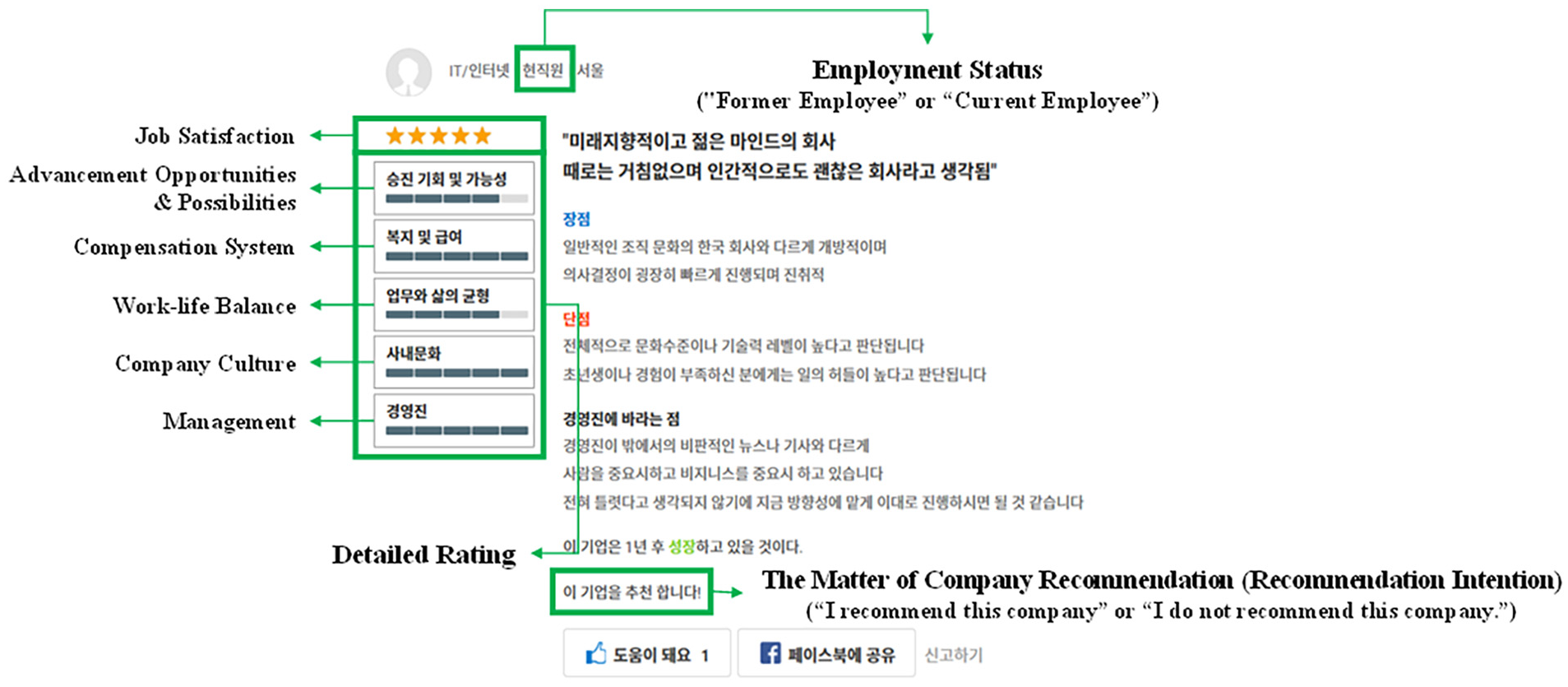
Example of job planet review data (big data) collection.
The survey data were created using a 5-point Likert scale based on existing research on job satisfaction, advancement opportunities & possibilities, compensation system, work-life balance, company culture, management, and company recommendations. We commissioned an online research company PMI to conduct an online survey of former & current employees in the restaurant industry through the online panel “WizPanel.”
Individual researchers interpret motivation and hygiene factors comprising two-factor theory differently. In existing studies, motivation factors included achievement, recognition, responsibility, and advancement, while hygiene factors included supervision, technical skills, salary, interpersonal relationships, and personal life. However, because this study used big data analysis from JobPlanet, the following five satisfaction factors were extracted from the job portal website, as shown in Figure 2: advancement opportunities & possibilities, compensation system, work-life balance, company culture, and satisfaction with management. Former & current employees of companies featured on the portal evaluated these factors. For big data analysis, the five aforementioned factors extracted from JobPlanet were divided into motivation and hygiene factors based on the two-factor theory. Furthermore, to compare the big data and survey data analysis results, we conducted a survey data analysis based on the responses to a questionnaire reflecting the five factors.
Result
Results of Survey Data Analysis
Factor Measurement Criteria
As shown in Table 3, the measurement criteria were constructed based on the existing factors and definitions used in previous studies, all of which were measured using a 5-point Likert scale.
Factor Measurement Criteria (Survey data).

Results of Path Analysis Using Survey Data
We commissioned PMI to conduct an online survey of former & current employees in the restaurant industry in October 2021 using the online panel “WizPanel,” collecting answers from a total of 400 people, including 200 current employees and 200 former employees. Table 4 presents the demographic characteristics of the participants. In terms of gender 267 were female and 133 were male, indicating that there were twice as many females as males, with males comprising only approximately 33% of the total number of respondents. Considering their ages, 34 were under 25 years old, 61 were between 26 and 30 years old, 62 were between 31 and 35 years old, 71 were between 36 and 40 years old, 57 were between 41 and 45 years old, and 115 were over 46 years old. Thus, the 46 + year age group had the highest prevalence. In terms of area, Seoul, Gyeongsang/Honam, Incheon/Gyeonggi, and Gangwon/Chungcheong/Jeju accounted for 148 (37.0%), 111 (27.8%), 97 (24.3%), and 44 respondents (11.0%), respectively, with the most respondents from Seoul. In terms of employment period, 47 respondents worked for less than a year, 112 respondents worked for 1 to 5 years; 125 respondents worked for 6 to 10 years; 53 respondents worked for 11 to 15 years; and 63 respondents worked for more than 16 years. Thus, the 6 to 10 year range of work experience was the most common. Regarding working hours per week, 113 respondents worked <40 hr, displaying the highest frequency, 64 worked 40 hr, 100 worked more than 40 hr but less than 45 hr, 49 worked more than 45 hr but less than 50 hr, and 74 worked more than 50 hr. Lastly, the highest education levels of the survey respondents were 130 high school graduates, 90 community college graduates, 172 4-year university graduates, and eight graduate school graduates.
Sample Demographic Information (Survey Data).

Table 5 demonstrates the results of exploratory factor analysis. In this study, Varimax Rotation was performed for the exploratory factor analysis. The overall reliability of the questionnaire is claimed to be adequate as the Cronbach’s α value turned out >.6 (Hair et al., 2006; Stuetzer et al., 2013; Wongpakaran & Wongpakaran, 2012). The goodness of fit of the model was significant, as its Kaiser-Meyer-Olkin Measure value was 0.949, and Bartlett’s chi-square value was found to be significant at a p-value of .001. We confirmed the validity of the measurement items since the exploratory factor analysis resulted in a total of seven factors having recommendation intention (four items), job satisfaction (three items), advancement opportunities & possibilities (three items), compensation system (three items), management (two items), company culture (two items), and work-life balance (two items) with their factor loadings above 0.5, in general (Fabrigar & Wegener, 2011). To construct the latent variables, it is generally necessary to have at least three measured variables for theoretical interpretation. However, given that previous studies used scales comprising as few as two items, this is not a significant concern (Chen et al., 2020; Kim, 2020).
Exploratory Factor Analysis (Survey Data).

The results of Pearson’s correlation analysis between the measurement factors are shown in Table 6, demonstrating a positive correlation between all the factors. The correlation coefficients between the factors were below .9, demonstrating no multicollinearity among the variables (Diamantopoulos & Siguaw, 2006).
Correlation Results (Survey Data).
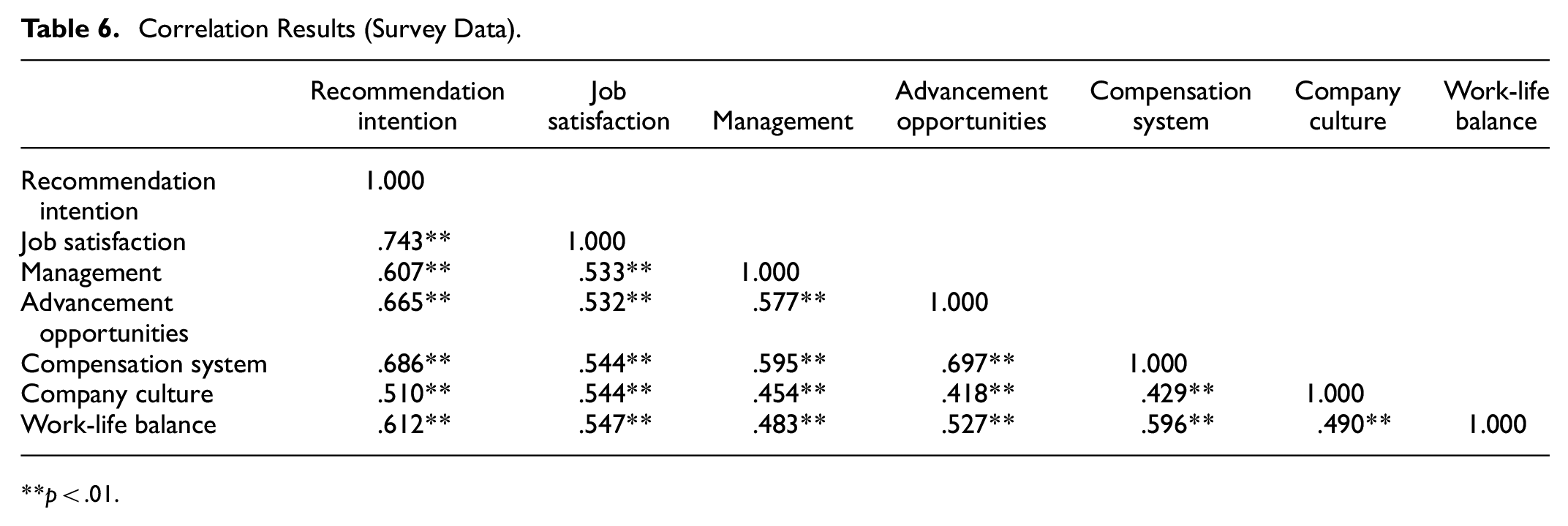
p < .01.
The results of the path analysis conducted to examine the factors influencing job satisfaction in the restaurant industry using survey data are shown in Table 7. The results show that work-life balance, company culture, and management had a significant positive (+) impact on the dependent variable, job satisfaction, and that these factors contribute to job satisfaction. However, advancement opportunities & possibilities, and compensation system were found to be insignificant. Therefore, hypotheses H1 and H2 were rejected, whereas H3, H4, and H5 were supported. Meanwhile, job satisfaction has a significant positive (+) effect on recommendation intention, meaning that the higher the job satisfaction, the higher the recommendation intention; thus, H7 is supported.
Path Analysis on Determinants of Job Satisfaction (Survey Data).

p < .001. **p < .01. *p < .05.
In this study, the moderating variables for former & current employees were categorical. Therefore, to analyze the between-group differences in job satisfaction, we used path and multigroup path analyses. Table 8 presents the results of the differences based on employment status. We found that work-life balance for former employees and company culture for current employees had a positive (+) influence on job satisfaction. We also found that job satisfaction has a positive (+) effect on the recommendation intentions of both former & current employees. However, the path coefficient values between groups are not significant, indicating that there is no difference between former & current employees; therefore, hypotheses H6-1, H6-2, H6-3, H6-4, and H6-5 are rejected.
Multiple Group Path Analysis on Determinants of Job Satisfaction (Survey Data).

p < .001. *p < .05.
Results of Big Data Analysis
Data Descriptive Statistics
In this study, we collected information using 5-points rating scale on job satisfaction, advancement opportunities & possibilities, compensation system, work-life balance, company culture, management as well as the data on recommendation from 11,466 former & current employees in the restaurant industry from January 1, 2014, to December 31, 2021, on JobPlanet (Table 9). It consisted of 1,454 reviews by former employees and 9,992 reviews by current employees, which implies that former employees were more willing to write reviews about their former company than those who still worked for the company.
Number of Reviews of Companies in the Restaurant Industry (Big Data).

Results of Path Analysis Using Big Data
The results of the Pearson correlation analysis between the factors from the big data are presented in Table 10. There was a positive correlation between these factors. The correlation coefficients between the factors were all below .9, indicating no multicollinearity between the variables (Diamantopoulos & Siguaw, 2006).
Correlation Results (Big Data).

p < .01.
Using big data, a path analysis was conducted to investigate the factors affecting job satisfaction in the restaurant industry, as shown in Table 11. Advancement opportunities & possibilities, compensation system, work-life balance, company culture, and management were all found to have a positive impact on the dependent variable, job satisfaction. Therefore, it is reasonable to insist that such factors contribute to job satisfaction; thus, hypotheses H1, H2, H3, H4, and H5 were supported.
Path Analysis on Determinants of Job Satisfaction (Big Data).

p < .001.
Table 12 shows whether there are differences of the path analysis by the employment status. Both former & current employees are more likely to be satisfied with their job as advancement opportunities & possibilities, compensation system, work-life balance, company culture, and management positively affect job satisfaction. However, only the advancement opportunities & possibilities had path coefficient values that are significant for both former & current employees. This suggests that the impact of advancement opportunities & possibilities on job satisfaction is higher for current employees than for former employees. Therefore, H6-1 is supported, H6-2, H6-3, H6-4, and H6-5 are rejected.
Multiple Group Path Analysis on Determinants of Job Satisfaction (Big Data).
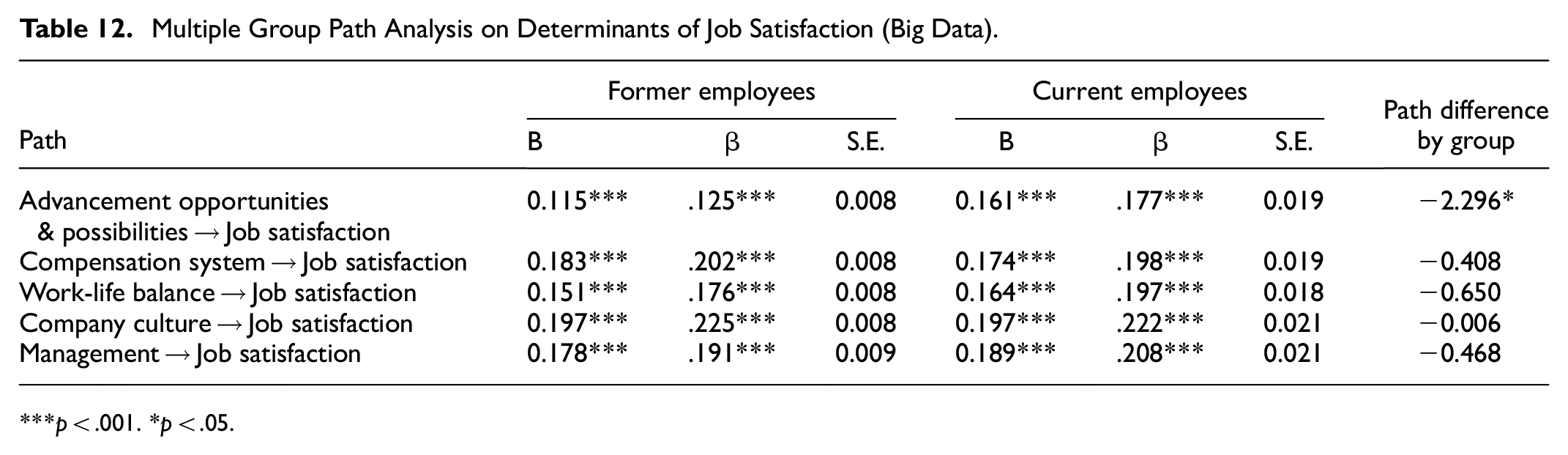
p < .001. *p < .05.
When using big data, the factors influencing recommendation intentions are categorical data. Thus, we used logistic regression analysis to examine the impact of job satisfaction on recommendation intentions. The results are presented in Table 13. Logistic regression analysis was conducted to determine the effect of job satisfaction on the recommendation intentions of former & current employees (Table 13). The p-values of the Hosmer-Lemeshow tests on former & current employees were .000, which is <.05, indicating that the model is inappropriate. Therefore, the moderating effect of job satisfaction was not significant, and H7 was rejected.
Effect of Job Satisfaction on Recommendation Intention (Big Data).

Discussion
This study used both survey and big data analysis to explore the factors that influence job satisfaction among former & current employees in the restaurant industry, based on two-factor theory. The results of these analytical methods were compared to detect any differences.
We found that, according to big data analysis only, advancement opportunities & possibilities, as well as the compensation system, significantly and positively (+) affected job satisfaction. Thus, advancement opportunities & possibilities function similarly to the motivating factors identified in the conventional two-factor theory and that contrasting results were obtained regarding the compensation system as compared to the hygiene factors postulated in the traditional two-factor theory. Furthermore, both big data and survey data analyses showed that hygiene factors, including work-life balance, company culture, and satisfaction with management, significantly positively (+) affected job satisfaction. These findings contradict the existing two-factor theory of hygiene factors, indicating that hygiene factors can also lead to job satisfaction. This confirms that the two-factor theory does not equally apply equally to employees across all industries and countries, and that hygiene factors do not necessarily lead to dissatisfaction (Sobaih & Hasanein, 2020). Additionally, these findings are consistent with Prasad Kotni and Karumuri’s (2018) and Sobaih and Hasanein’s (2020) assertions that hygiene factors positively influence job satisfaction. In addition, using big data analysis only, this study detected a moderating effect of employment status among advancement opportunities & possibilities and job satisfaction. Differences in satisfaction with advancement opportunities & possibilities between former & current employees were discovered, with current employees being more satisfied than former employees.
The reasons big data and survey data analysis results differ are as follows. First, former & current employees write reviews of a given company. Once their reviews are approved, they can view the reviews of other companies free of charge. Consequently, users may be incentivized to write good reviews so that they can view the reviews of other companies. Second, negative reviews may be suppressed by company requests, creating a data utilization problem. Third, because reviewers are anonymous, reviews may be faked for advertising purposes. Finally, big data-based information about company recommendations comprises binary data configured as “I recommend this company” or “I do not recommend this company.” Because of these data characteristics, big data and survey data analysis results differ, making it necessary to consider portal sites’ functions and beneficial features, as well as online environment characteristics before using big data in the HR field in the future.
Conclusion
This study employed a combination of surveys and big data analyses to explore the determinants that influence the overall job satisfaction of current & former employees in the restaurant industry. We collected and analyzed data on job satisfaction, advancement opportunities & possibilities, compensation system, work-life balance, company culture, management, and recommendation intention using 11,466 reviews from 2014 to 2021 from JobPlanet. The results of the analysis indicated that work-life balance, company culture, and management have a positive impact on job satisfaction in both the survey and big data. However, advancement opportunities & possibilities, and compensation system were not significant in the survey results. Furthermore, big data analysis shows that only the effect of advancement opportunities & possibilities on job satisfaction differs according to employment status (former vs. current). In contrast, although the effect of job satisfaction on recommendation intention was demonstrated in the survey analysis, it was not shown in the big data.
The academic implications of this study are as follows: First, the results of the survey and big data analyses showed relative consistency between the two methods, despite a few differences. Therefore, it is reasonable to claim that big data analysis is a useful method for understanding employee job satisfaction. As technologies for big data analysis are gradually improving, the prospect of their reliability is high in the future.
Second, this study carefully examined the differences in job satisfaction between former & current employees using employee status as a moderating variable. Although existing research has focused on employee turnover intentions, we recognized that intention is not always lead to behaviors and concluded that it is not reasonable to equate intentions with behaviors. Since we analyzed both former employees who quit the company and current employees who are currently working, we strongly believe that this study will contribute to future research on employee turnover and retention intentions.
The practical implications of this study include the following: First, the results of the survey and big data were similar in many respects, with minor differences. This suggests that either the survey method or big data analysis can be used meaningfully in different contexts. For example, in situations where it is challenging to collect data from a specific audience with low access to the Internet (Stephens-Davidowitz, 2018), researchers may choose to use survey methods to collect information directly from participants.
Second, we propose that both the survey and big data analyses show that work-life balance, company culture, and management have an impact on overall job satisfaction. Therefore, companies should recognize the importance of these factors. For instance, satisfaction with work-life balance can be improved by implementing a voluntary on- or off-site system or flexible working hours to help employees reconcile their work and life.
Despite these suggestions, this study has some limitations. First, the proportions of former & current employees used as control variables in the survey and big data analysis differed. Future research could examine these results using the same proportion of former & current employees to augment the findings.
Second, in the case of big data analysis, the subjects were unidentified, which means that their demographic information, such as age, sex, and education, could not be fully confirmed. Previous analyses of job satisfaction have shown that the results may vary according to demographic characteristics (Yeying et al., 2014). Therefore, it is critical to incorporate clear demographic characteristics of the participants in future analyses.
Third, the big data used in this study were collected between 2014 and 2021, whereas the survey data were collected in October 2021. These two analyses were not conducted within the same period or were separated into different periods. Therefore, future research should conduct a more sophisticated analysis by separating the time periods or considering the impact of events that occurred at a specific time.
Finally, this study only used ratings from reviews that contained quantitative information. However, job portal websites provide not only ratings of job satisfaction but also qualitative text reviews. We suggest that future studies understand employee job satisfaction using qualitative reviews and other information.
Footnotes
Acknowledgements
None.
Declaration of Conflicting Interests
The author(s) declared no potential conflicts of interest with respect to the research, authorship, and/or publication of this article.
Funding
The author(s) received no financial support for the research, authorship, and/or publication of this article.
Ethics Statement
Not applicable.

Data Availability Statement
Data sharing not applicable to this article as no datasets were generated or analyzed during the current study.