




Abstract
There are many factors which affect nurse satisfaction level. This study aimed to identify the impact of nurse scheduling management on job satisfaction in Army hospital. This study used cross-sectional approach with total sample of 102 nurses. The sample was selected through stratified random sampling method with inclusion criteria of inpatient nurse with minimum pre-clinic level and at least 1-year experience. Pearson correlation, t-independent, one-way analysis of variance (ANOVA), and double linear regression were employed to analyze data. The results indicated that there was significant correlation between the implementation of nurse scheduling management with all management functions on nurse job satisfaction level (p = .0001–.014). Organizing and controlling nurse schedule were the dominant factors affecting nurse job satisfaction level. Authors concluded that the management of nurse scheduling statistically correlated with nurse job satisfaction level. Nurse manager should have the capability to improve nurse satisfaction by optimizing the management of nurse scheduling, especially on organizing and controlling aspect.
Introduction
Nurse satisfaction is one indicator of the quality of health services in the hospital. Nurses’ satisfaction is emotional response and behavioral expression which reflects individual evaluation of his or her own performance, working life, and working environment (Özden, Karagözoğlu, & Yildirim, 2013). Job satisfaction emphasizes on affective side of employee as constellation related to attitude toward aspects of work (Lu, Barriball, Zhang, & While, 2012). Hence, job satisfaction focuses on individual’s feeling toward his own job. A nurse who is satisfied with his own job will provide benefits for hospital. Nurse may offer his loyalty and commitment to the hospital (Bae, Trinkoff, Jing, & Brewer, 2013; Robbins & Judge, 2013). Nurse’s performance would improve once he is satisfied with his working milieu (Koné Péfoyo & Wodchis, 2013). On the contrary, nurse’s dissatisfaction will affect the hospital. Hospital may lose its resources due to high turnover, absence, and sick leave (Legrain, Bouarab, & Lahrichi, 2015; P. S. Lin, Viscardi, & McHugh, 2014; Sari, 2014). In the end, the hospital will suffer losses due to poor performance.
A considerable number of nurses perceived low satisfaction with their own job worldwide. A survey conducted by Aiken et al. (2012) in 12 countries revealed that majority of nurses was dissatisfied with their job. Netherlands was identified as country with the lowest dissatisfaction level (11%) while Greece had the highest level of dissatisfaction (56%) (Aiken et al., 2012). Management of health system in Netherlands is better than in any other countries, which lead to lower dissatisfaction among nurses. A study conducted in United Kingdom and Netherlands revealed a lower satisfaction in patients as a result of lower performances among nurses (Aiken et al., 2018). However, studies also revealed lower satisfaction among nurses in various regions in Indonesia, such as 51.6% satisfaction rate in RSUD Solok (Saintika & Barat, 2017), and 57% job satisfaction in nurses at eight hospitals in Indonesia (Hariyati & Fujinami, 2017). Lu et al. (2012) emphasized that the number of nurses who dissatisfied with their job was higher than the opposite (Lu et al., 2012).
Experts had outlined factors affecting nurse’s satisfaction. Nurse satisfaction was affected by individual characteristics (including age, working experience, education level, and sex), salary, working environment, working condition, reward, support, carrier opportunity, and scheduling (B. Hayes, Bonner, & Pryor, 2010; P. S. Lin et al., 2014). Another study reported that job satisfaction was affected by career ladder, room type, culture, and social condition in working milieu (
The management of scheduling is a process of planning, organizing, staffing, actuating, and controlling of nurse working hours (Armstrong-Stassen, Freeman, Cameron, & Rajacich, 2015; C. Lin, Kang, Chiang, & Chen, 2015; Marquis & Huston, 2012). Centralized, decentralized and self-scheduling were types of scheduling process. In organizing a schedule, a nurse manager might apply one of those three types. Each type possessed particular strength and weakness (Koning, 2014; Maenhout & Vanhoucke, 2013; Wright & Mahar, 2013). Nurse manager should consider nurses’ competencies, number of nurses, flexibility, equality, and skill mix in managing the schedule (Chang, Chang, Kuo, Yang, & Chou, 2011; Numminen, Leino-Kilpi, Isoaho, & Meretoja, 2015; Rizany, Hariyati, & Purwaningsih, 2017; Satu, Leena, Mikko, Riitta, & Helena, 2013).
Scheduling is managing and allocating time to perform planned tasks (Legrain et al., 2015; C. Lin et al., 2015; Rahman, Mulyani, & Rizany, 2017) Thus, management of scheduling refers to process that involves planning up to controlling of management function performed by a manager in managing and allocating nurse’s work shift to provide nursing service to provide safety for patient (Rahman et al., 2017). Scheduling is categorized into three types that include centralized, decentralized, and self-scheduling. Shift scheduling for nurses may be centralized by nursing manager. Centralized scheduling may improve nurse’s satisfaction with shift work up to 34% and reduce cost up to l1% as well as allow implementation of mobilization of nurses to unit with understaffing issue (Wright & Mahar, 2013). Scheduling for nurses may also be decentralized by head nurse. A head nurse is responsible for planning shift and attendance based on nurses’ particular characteristics which facilitates decision making and improves direct care to patient (Maenhout & Vanhoucke, 2013; Parker, Eisen, & Bell, 2012). Moreover, nurse may perform self-scheduling without centralization and decentralization process. Self-scheduling process is performed by proposing work schedule to lower-tier manager and the manager will decide the scheduling according to requirement and need of the unit, hence provides flexibility in determining shift scheduling (Koning, 2014; Rönnberg & Larsson, 2010). But self-scheduling is very rarely implemented in Indonesia because nurses generally work full-time.
There are only few studies addressing scheduling shift in army hospital. The studies on scheduling shift were commonly conducted in general hospital. Zanaro and Kelley’s (2010) study revealed that nurse’s satisfaction was also associated with shift planning (Zangaro & Kelley, 2010). However, unspecified scheduling of shift explains about the management of shift itself. An army hospital is characterized by its organization system that authorizes instruction or command from upper rank to lower ranks. Furthermore, management of shift planning is yet to be fully explored, thus intrigue author to conduct a study on such matter.
Nurse scheduling system in Indonesia is still flawed. The results of preliminary study of in army hospitals were getten lack of attention to skill mix, number-oriented schedule, and lack of schedule evaluation process were among the major problems. These problems may result in family difficulties to find a nurse at evening and night shift. Hence, nurse is not available in the place when needed. A few studies revealed the influence of scheduling management from the aspect of planning, organizing, staffing, actuating, and controlling which included the scheduling type, competency, skill mix, and fairness. This study aimed to explore the impact of the characteristics (including age, working experience, education level, sex, marriage status, carrier level, type of salary), type of scheduling, and nurse scheduling management on nurse satisfaction in Army Hospital.
Summary of theoretical development of scheduling management is described in Figure 1 and conceptual definition about this research can see in Table 1. The hypotheses of the study are the following:
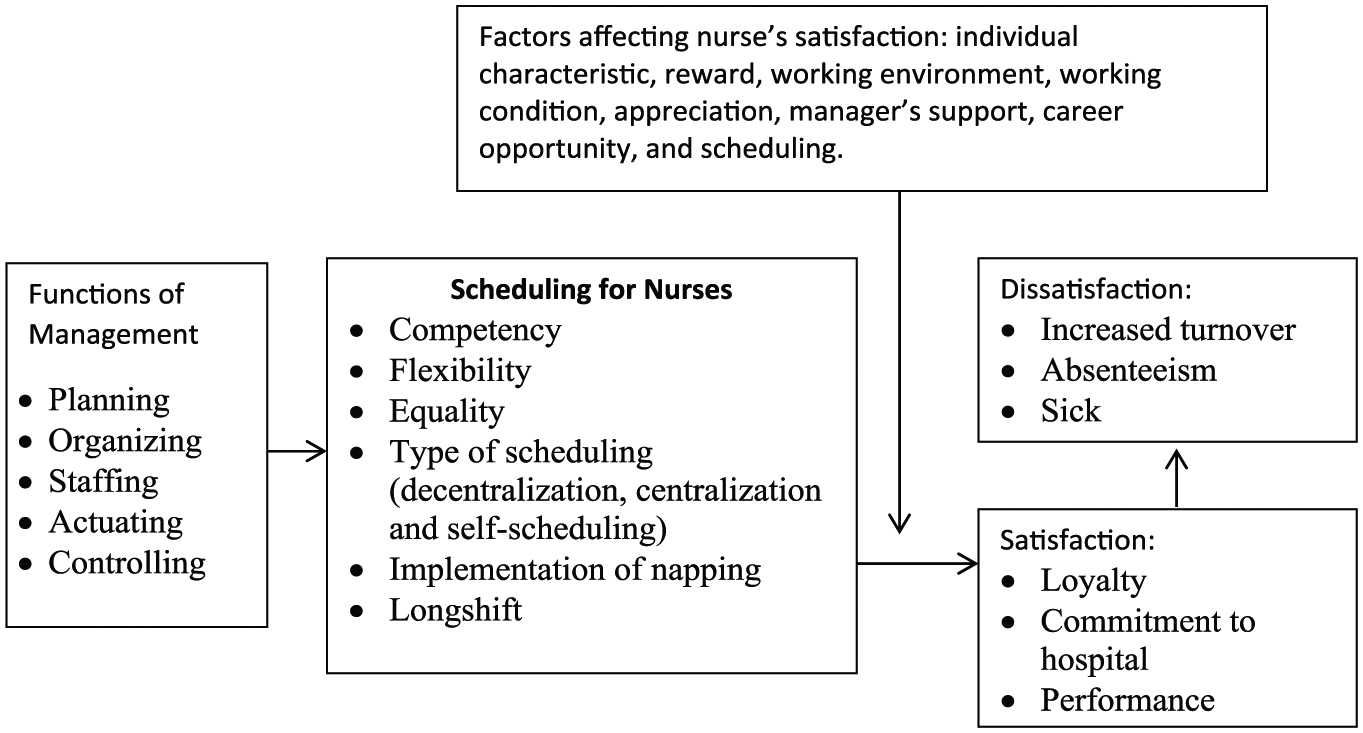
Nurse Scheduling Framework.
Conceptual/Operational Definition.

Methods
This study used cross-sectional approach with total sample of 102 nurses. The number of sample was based on Lemeshow formula with total population of 350 associate nurses which conducted in an Army Hospital in Jakarta. The participants were taken from inpatient nurses at Gatot Soebroto Army Hospital. The participants were selected through stratified random sampling method by considering their educational background (D3 and Ners). The inclusion criteria were inpatient nurse with minimum pre-clinic level and at least 1-year experience. Pre-clinic is career ladder for nurses with less than 1 year working experience.
Questionnaire of nurse satisfaction and implementation of nurse scheduling management were used as instrument in this study. Mines Job Satisfaction Scale (MNPJSS) was applied to measure nurse job satisfaction level from Minnesota Satisfaction Questionnaire/ MSQ (developed by Weiss et al. MSQ instrument consisted of 20 questions (not at all satisfied = 1, barely satisfied = 2, quite satisfied = 3, very satisfied = 4, completely satisfied = 5) with the result of validity and reliability of 0.56-0.83 and 0.91 (Özden et al., 2013; Weiss, Dawis, England, & Lofquist, 1967), respectively. Authors developed the questionnaire implementation of nurse scheduling base on theory on National Health Services, 2016 and Marquis and Houston, 2012 (Marquis & Huston, 2012, McIntere, 2016). The instrument of nurse scheduling management consisted of 19 questions with Guttman scale (Yes = 2 or No = 1) and 20 questions with Likert-type scale (never = 1, rarely = 2, often = 3, always = 4). The result of reliability test of items with Guttman scale showed alpha = 0.701, while items with Likert-type scale showed alpha = 0.900.
Pearson correlation, independent t test, one-way analysis of variance (ANOVA), and double linear regression analysis (α = 0.05) were applied to analyze the data with 95% confidence level. Pearson correlation was applied to examine the association between implementation of scheduling management for nurses (planning, organizing, staffing, actuating, dan controlling) and nurse’s satisfaction. Independent-t test was employed to identify the correlation between nurse’s marital status, sex, and satisfaction. One-way ANOVA was used to analyze educational level, salary, career ladder, type of scheduling, and nurse’s satisfaction. Double linear regression analysis was employed to identify the most dominant factor affecting nurses’ satisfaction. Then, double linear regression analyzes all variables of scheduling management and nurse’s characteristics that affect satisfaction rate.
Ethical Considerations
The study was approved by the Research Ethics Committee of the Faculty of Nursing at Universitas Indonesia (No. 150/UN2.F12.D/HKP.02.04/2017). The main ethical issues were respondents’ right to self-determination, anonymity, and confidentiality. Participants were provided with information regarding the study purpose and method, the right not to answer any question(s), or withdraw from the study at any stage without any penalty. Informed consent was obtained by all participants. The researcher was guaranteed the anonymity of participants in the study by removed any names and confidentifiable.
Results
Majority of participants were female (94 participants, 92.2%), diploma graduates (81 participants, 79.4%), with nurse career of third level (PK III) (47 participants, 46.1%), married (84 participants, 82.4%), and salary lower than Rp. 3,000,000 (34 participants, 33.3%) (Table 2). The average of nurse satisfaction level increased in conjunction with higher education level and salary. In other hand, nurse satisfaction level improved in first carrier level (PK I) as 71.14 and decreased at second carrier level (PK II) as 62.79. But, nurse satisfaction level improved again in third carrier level (PK III) as 69.53. Commonly nurse scheduling using decentralized (96 participants, 94.1%) dan Self—scheduling (6 participants, 5.9%), but centralized has not been felt by respondent (No participants). In education level, Nurses satisfaction level with BSN was higher than others (72.42), while nurses with high school of nursing have very low satisfaction. There was no significant correlation between age, sex, education level, marriage status, carrier level, type of salary, type of scheduling, and nurse satisfaction (α = 5%) (Table 2).
Difference of Job Satisfaction According to Demographic and Job-Related Characteristics.

The average of nurse age was 38.48 years, with the youngest being 21 years old and the oldest being 58 years old. The median of working experience was 15.71 years, with the shortest being 1 year and the longest being 36.3 years (Table 3). On the contrary, Table 3 implied a statistically significant and weak correlation between working experience and nurse satisfaction level (Table 3).
Correlation of Age and Work Experience to Job Satisfaction.

Note. CI = confidence interval.
Nurse satisfaction rate was 67.11 (67%), with the lowest perception at 41 and the highest at 100. This study result indicated that the rate of nurse satisfaction was below 90% (the minimum of service standard) and below the mean of Minnesota Satisfaction Questionnaire (MSQ) which is 75.4. However, nurse perception of the implementation of nurse scheduling had a better average score that was 95.59 (81% out of 114 participants). The result indicated that there was significant moderate correlation between the implementation of nurse scheduling and nurse satisfaction (p = .001; r = .435). Correlation between management function on scheduling and nurse satisfaction also significantly, (planning (r = .243; p = .014), organizing (r = .453; p = .001), staffing (r = .298; p = .002), actuating (r = .381; p = .001), controlling (r = .329; p = .001) (Table 4).
Correlation of Nurse Scheduling Management to Job Satisfaction.

Note. CI = confidence interval.
The result analysis of double linear regression of factors affecting nurse job satisfaction can be seen in Table 4. The result analysis revealed the formula: Z nurse satisfaction = − 15,237 + 8,992 × Organizing the schedule + 0,754 × Controlling the schedule.
The formula suggested that organizing the schedule had positive direction which implied that an increase in schedule organizing was associated with an increase in nurse satisfaction level. One point increase in schedule organizing would increase nurse satisfaction level by 8.992 times after all variables were controlled. Similarly, the actuating aspect in scheduling process also had positive direction. One point increase in schedule actuating would increase nurse satisfaction level by .754 times after all variables were controlled. This multivariate model revealed the R square of .246 which suggested that the formula was able to affect nurse satisfaction level up to 24.6% and the rest of 75.4% were affected by other factors, like planning, staffing, and actuating in scheduling.
Discussion
The study revealed a low satisfaction level which perceived by nurses. Previous study reported a low level of nurse satisfaction in several countries such as Netherlands (11%), the United States (25%), the United Kingdom (39%), and Greece (56%) (Aiken et al., 2012). Other study also reported that nurses’ job dissatisfaction in some hospitals in China was still 46.3% (n = 512) (Lu, While, & Barriball, 2007).
The low level of satisfaction may be resulted from various factors. In this study, nurses perceived a lower satisfaction level with salary and carrier development. A total of 28.8% nurses were dissatisfied with their salary and 35.1% of them were dissatisfied with their development opportunity. Previous studies reported that appropriate salary was associated with nurse satisfaction level (Al Maqbali, 2015; Curtis, 2008). Other research also affirmed the impact of carrier development on nurse satisfaction (Hariyati & Safril, 2018; Salem, Baddar, & Al-Muggatti, 2016).
Several nurses perceived ineffectiveness in the implementation of nurse scheduling management which took standard procedure of on call nurse, rotating the nurses, reward, and napping policy into account. Some nurses also provided nursing care for more than seven patients in each shift, especially in evening shift.
A simple and supporting policy is required for managing the scheduling process. Another study reported that the nurse scheduling process was also influenced by hospital policy (Mutingi & Mbohwa, 2015). Other literatures suggested a clear policy on systematic scheduling process must be established by hospital (McIntyre, 2016; Mwiya, 2008). The nurse–patient ratio more than 1:7 was associated with workload and burnout (Allen, 2013; Moore & Waters, 2012). N. Hayes (2012) emphasized that the ideal nurse–patient ratio was 1:5 with maximum of 1:7 (N. Hayes, 2012)
This study revealed a positive correlation between the implementation of the nurse scheduling management and nurse satisfaction. Previous studies also supported this result (Al Maqbali, 2015; P. S. Lin et al., 2014; M’Hallah & Alkhabbaz, 2013); a proper scheduling process was correlated with increases in nurse satisfaction. The nurse scheduling process allowed nurses to have a balance in professional and personal life (Beutell, 2010; Nelson & Tarpey, 2010). Nurse manager played a pivotal role in managing nurse scheduling process (Hariyati, 2014, Rizany et al., 2017).
Five management functions (planning, organizing, staffing, actuating, and controlling) in nurse scheduling process also showed a significant correlation with nurse satisfaction level. The function of planning gave direction to the future plan of resources (Armstrong-Stassen et al., 2015; P. S. Lin et al., 2014). In this function, nurse manager established policies to promote nurse satisfaction level (B. Hayes et al., 2010). Organizing function assigned nurses to work by complying with their job description, command, and structure which may result in perception of satisfaction with their own job (Al Maqbali, 2015; Dewi & Handiyani, 2016; B. Hayes et al., 2010; P. S. Lin et al., 2014). In staffing function, nurse manager arranged and managed nurses staff to work corresponding with their competencies which may generate a feeling of satisfaction with their job (Hairr, Salisbury, Johannsson, & Redfern-Vance, 2014; Lu et al., 2012). Actuating function through motivation and communication was associated with nurse satisfaction (Elprida, Pertiwiwati, & Herawati, 2016; B. Hayes et al., 2010). Finally, the controlling function performed by nurse managers will help in completion of management function through continuous supervision which may improve nurse satisfaction and reduce working stress (Beutell, 2010; Hoboubi, Choobineh, Ghanavati, Keshavarzi, & Hosseini, 2017).
The variable of working experience and nurse satisfaction level were demonstrated to have a significant correlation in this study. This finding confirmed the previous study which stated that nurse job satisfaction was affected by working experience (p = .006) in productive age (Al-Dossary, Vail, & Macfarlane, 2012; B. Hayes et al., 2010).
In this study, there was no significant correlation between education, career level, salary, and nurse satisfaction. However, authors also discovered that BSN graduates had a higher satisfaction level than diploma graduates. This result corroborated the previous study which stated that higher education level was correlated with higher satisfaction level (Al Maqbali, 2015; Khalifa, Shamari, Paulose, Ou, & Ngwakongnwi, 2015; Zurmehly, 2008)
The career level and nurse satisfaction indicated a fluctuating correlation. The first career level showed an improvement in satisfaction level, then decreased in the second level and improved again in the third level. Another study explained earlier that fresh graduate nurses had a higher satisfaction, then declined in the middle level and improved again in the specialist level (Ko, Kim, Yoon, & Sook, 2015). Other studies also reported that satisfaction level was reciprocated with raise in the career level (Baucom, 2012; Curtis, 2008). This study finding revealed that salary was correlated with nurse satisfaction, and experienced nurses with high salary had higher satisfaction level than fresh graduate nurses (Wilson, Squires, Widger, Cranley, & Tourangeau, 2008).
Organizing and actuating in scheduling process were identified as the most dominant factors affecting nurse satisfaction. This finding was corresponded with Army-based organizations. An Army hospital had command and coordination system with priority in discipline and consistency with the organization matrix, command-line, and strong coordination (Lang, Pfister, & Siemens, 2010; Zangaro & Johantgen, 2009) and the strength of organization matrix had an impact on the controlling function by nurse manager to nurses staff.
This multivariate model revealed the R square of .246 which suggested that the formula was able to affect nurse satisfaction level up to 24.6% and the rest of 75.4% were affected by other factors, like career ladder (4) and continuing professional development (4.37).
The lack of correlation between dominant factors and nurse satisfaction level was due to the possibility that nurse satisfaction is affected by other factors. Another study stated that tight schedule at Army hospital was not the sole factor that affect nurse satisfaction level but also manager support, working hour, working condition, and salary (Zangaro & Kelley, 2010). Tzeng, Chung, Lin, and Yang (2012) affirmed that life balance and salary contributed to a higher level of nurse satisfaction and reduce the risk of burn out at Army hospital (Tzeng et al., 2012).
Research Limitations
Some respondents late to returned a questionnaire because very busy and have limited time. This study has not yet identified nurse satisfaction in special wards such as outpatient, critical, and emergency room. The study did not consider public hospital, so it can describe how the top-down characteristics of army hospital can affect nurse satisfaction.
Conclusion and Recommendation
This study revealed a low nurse satisfaction level with salary and career development. The implementation of scheduling management with all management functions (planning, organizing, staffing, actuating and controlling) implied a significant correlation with nurse satisfaction level, in which organizing and controlling aspect of nurse scheduling were the dominant factors affecting nurse job satisfaction. Authors recommended for nurse managers to consider factors that may affect nurse satisfaction such as attending higher education (to BSN and/or MN) and improving the capability of management functions (planning to controlling) in nurse scheduling process. Nurse managers should proactively use their position in establishing scheduling policy, consider the nurse–patient ratio, and overtime. Nurse managers should emphasize the actuating function on providing information and remind all nurses on technical process of nurse scheduling management. In conclusion, nurse scheduling should be evaluated every 1, 6, or 12 months. Shift scheduling was evaluated in certain time interval to ensure the implementation was efficient and effective. If an issue in scheduling arises, the scheduling system should be improved so the nursing service will be improved as well.
Supplemental Material
Instrument – Supplemental material for The Impact of Nurse Scheduling Management on Nurses’ Job Satisfaction in Army Hospital: A Cross-Sectional Research
Supplemental material, Instrument for The Impact of Nurse Scheduling Management on Nurses’ Job Satisfaction in Army Hospital: A Cross-Sectional Research by Ichsan Rizany, Rr. Tutik Sri Hariyati, Efy Afifah and Rusdiyansyah in SAGE Open
Footnotes
Acknowledgements
The authors thank the Research and Community Engagement of Universitas Indonesia for funding support for research and publication.
Supplemental Material
Supplemental material for this article is available online.
Declaration of Conflicting Interests
The author(s) declared no potential conflicts of interest with respect to the research, authorship, and/or publication of this article.
Funding
The author(s) received no financial support for the research, authorship, and/or publication of this article.

Author Biographies
References
Supplementary Material
Please find the following supplemental material available below.
For Open Access articles published under a Creative Commons License, all supplemental material carries the same license as the article it is associated with.
For non-Open Access articles published, all supplemental material carries a non-exclusive license, and permission requests for re-use of supplemental material or any part of supplemental material shall be sent directly to the copyright owner as specified in the copyright notice associated with the article.
