




Abstract
This study aims to investigate the role of corporate social responsibility as a mediator between social factors and sustainable socially responsible purchases in the food industry of Sindh, Pakistan. To determine the findings of this study, a sample size of 250 is drawn from the study’s primary data. The department of purchasing is requested to voluntarily complete the questionnaire utilized in previous studies. The convenience sampling strategy and the snowball sampling strategy are considered for data collection. For data analysis, SmartPLS version 3 is utilized. This study revealed that corporate social responsibility partially mediates the connection between human rights, social welfare, and sustainable socially responsible purchasing. Nevertheless, the full mediation effect between safety and health for socially responsible purchasing has been uncovered. The novel finding of this study is that the mediation effect was not previously conducted a. However, the mediating role of corporate social responsibility and the food industry has been evaluated in the context of Sindh, Pakistan.
Plain Language Summary
Methodology: Data gathered from the Sindh food sector in Pakistan might provide important insights into the regional food distribution and consumption trends. Numerous uses for this data include market research, product development, quality assurance, and strategic planning for the government. The information may also assist in pinpointing areas where the food sector needs to improve and guide decision-making for firms, organizations, and legislators. In order to learn more about a sample of people’s attitudes, beliefs, behaviors, and other traits, the survey technique. Conclusion :The study collected primary data from employees in food manufacturing companies in Sindh, Pakistan using a survey method. The results showed that corporate social responsibility partially mediates the impact of independent variables such as human rights, safety and health, and social welfare on sustainable socially responsible purchasing. The findings of the study indicate that human behavior has a more significant impact compared to other variables, as demonstrated by its higher beta value. Practical Implications: The study has practical implications for the food manufacturing companies and stakeholders involved. These implications could be related to the importance of considering human behavior in sustainable socially responsible purchasing and the impact of corporate social responsibility on these decisions. Further research could be conducted to explore the practical applications of these findings. Based on the findings of the study, it is recommended that food company managers consider the following variables in their policies. By considering these variables, food company managers can improve their sustainable socially responsible purchasing practices and ensure that their policies align with the expectations of their customers and stakeholders.
Keywords
Introduction
Sustainable development is a concept that aims to balance economic growth, social well-being, and environmental protection in a way that meets the needs of the present without compromising the ability of future generations to meet their own needs (Basheer et al., 2022). It involves developing policies, practices, and technologies that promote long-term economic, social, and environmental sustainability (Liu et al., 2022). Sustainability is interlinked with supply chain management because the practices and decisions made within the supply chain can have significant impacts on the environment, society, and the economy (Asif, 2022). Sustainability concerns, such as reducing waste and emissions, conserving natural resources, and ensuring fair labor practices, must be integrated into supply chain management strategies to create a sustainable and responsible supply chain (Silva & Nunes, 2022). Sustainability can be achieved within organization with sustainable practices such as organizations can contribute to sustainability by adopting sustainable practices and integrating them into their operations, culture, and decision-making processes (H. Chen et al., 2022; Singh et al., 2022). Some examples of sustainable practices include reducing energy and resource consumption, promoting environmentally friendly products and services, minimizing waste and pollution, engaging in sustainable procurement, and supporting the well-being and development of employees and local communities (Paulraj et al., 2017; Sajjad et al., 2015). By implementing these and other sustainable practices, organizations can play a key role in advancing sustainability and creating a more sustainable future (Garst et al., 2017; Stoyanov, 2017).
In the past many studies have been conducted in context green purchasing. Ghosh (2019) likely studied the relationship between sustainable or green purchasing practices and firm performance. The study by Ghosh (2019), likely aimed to investigate how sustainable or green purchasing practices can influence various aspects of firm performance, such as financial performance, customer satisfaction, employee engagement, and corporate social responsibility. Similarly, Das (2018), likely conducted a study that explores the connection environmental practices in supply chain management (SCM) and firm performance. The study aimed to integrate different dimensions of sustainability, including environmental aspects, into the supply chain processes and assess the impact of these practices on firm performance. Jakhar et al. (2018), likely conducted a study that examines the relationship between lean manufacturing and green supply chain management (GSCM). The findings of the study may provide important insights into how organizations can improve both their operational efficiency and environmental performance by adopting lean manufacturing and GSCM practices. Mani et al. (2018) likely conducted a study that explores the relationship between supplier social sustainability practices and supply chain performance in India. The results of the study likely suggest a positive relationship between supplier social sustainability practices and supply chain performance, indicating that organizations that adopt socially responsible practices in their supply chain activities can enhance their overall performance.
Understanding how social dynamics affect sustainable, socially responsible shopping illuminate’s consumer behavior. Consumers worry more about the social and environmental implications of purchases (Cheung & To, 2019). This topic may help researchers and businesses understand what inspires people to purchase sustainably and socially. Many companies prioritize socially responsible shopping. CSR and sustainable supply chain management may improve a company’s image, attract socially conscious consumers, and increase long-term earnings (Meiryani et al., 2023). By examining CSR’s mediation role, researchers can help enterprises communicate their social and environmental actions to clients and utilize CSR as a competitive advantage. UN Sustainable Development Goals (SDGs) provide a global sustainability framework. Socially responsible shopping and CSR support various SDGs. Academics may suggest sustainable consumption and production solutions to social challenges and CSR’s mediation role. Industry, government, and civic society must collaborate on sustainability. Suppliers, NGOs, and other stakeholders may assist firms in improving CSR, sharing best practices, and encouraging socially responsible procurement. Collaboration increases influence, innovation, and a sustainable, inclusive economy. By studying social factors affecting sustainable, socially responsible purchasing and CSR’s mediating role, researchers and businesses can learn about consumer behavior, develop effective strategies, build stakeholder trust, and create a more sustainable and socially responsible business environment.
The relevant previous studies in the nearby developing countries’ literature are shown in the Table 1 and suggested the below research gap:
Summary of Previous Studies on Social Practices and Supply Chain Management and Gap Identification.

There are few contributions of this considering above recent literature review in the field of knowledge. First, in past environmental factors are studied context of supply chain management and overall firm performance. In the present study social factors and a key function of supply chain management purchasing have been studied. Second, social sustainably is studied in regard of developing country, India, and they suggested more study to be conducted in neighboring developing countries. Therefore, the focus of this study is Pakistan. Lastly, in past mediation effect is not be conducted in those studies. However, in the present mediating role of corporate social responsibility has been checked.
Therefore, the objective of this study is to examine the social factors that influence sustainable socially responsible purchasing and investigate the mediating role of corporate social responsibility (CSR) in food industry of Sindh, Pakistan.
The rest of paper follow as: Section 2, explains the theorical framework and hypothesis development. Section 3 elaborate the methodology of study; Section 4 discussed the results and discussion and finally conclusion.
Theoretical Framework and Hypothesis Development
Jean-Jacques Rousseau’s Social Contract theory, outlined in his work “The Social Contract” (1712–1778), suggests that individuals in a society come together to form a government through a mutually agreed-upon social contract. In this theory, the firm has the responsibility to promote the general welfare of both its citizens and its employees, and fulfilling this responsibility is considered an ethical obligation. The satisfaction of both customers and employees falls within this ethical responsibility, as they are both considered essential to the functioning and well-being of the society (Ahmed et al., 2020). Firms have a social responsibility to ensure ethical and sustainable practices throughout their entire supply chain, including in their purchasing operations (Toussaint et al., 2021). This includes ensuring that suppliers adhere to labor laws and standards, minimizing harm to the environment, and promoting fair and equitable treatment of workers. By having a responsible supply chain, firms can mitigate risks, improve reputation, and contribute to the overall well-being of society. Neglecting these responsibilities can lead to negative consequences such as damage to the environment, exploitation of workers, and harm to the reputation of the company. Consequently, businesses must prioritize social responsibility in all aspects of their operations, including purchasing (J. Chen et al., 2020).
As a result, the social component of sustainability is the main emphasis of Rousseau’s (1927) Social Contract theory. It contends that people in a society unite and create a government via a social compact that is collectively agreed upon with the intention of advancing the welfare of all society’s members (Loewe et al., 2021; Zhang & Ahmad, 2022). The idea places a strong emphasis on the government’s obligation to safeguard the welfare and contentment of both people and workers as well as to advance fairness, equality, and justice in all spheres of society. The idea hopes to establish social sustainability—a state of flourishing society—by doing this. According to Kruikemeier et al. (2020), the Social Contract theory offers a framework for comprehending the responsibilities of both people and governments in advancing the social component of sustainability.
Early in the 1980s, R. Edward Freeman published the initial version of the stakeholder theory. In his view, businesses must consider the interests of all their stakeholders, not just their shareholders, when making choices about their operations (Agle et al., 2008; Dmytriyev et al., 2021). According to Freeman, decision-making should consider the interests of a company’s stakeholders since they have a stake in its performance and results. The conventional idea that businesses only must answer to their shareholders is challenged by this theory, which also offers a more comprehensive framework for thinking about how business decisions affect society and the environment. Since the beginning, the stakeholder theory has grown in significance in the fields of business ethics and corporate social responsibility (Carroll, 2021).
Hypothesis Development
Elhoushy and Lanzini (2021), define the social dimension of purchasing as the social, cultural, and ethical variables that affect people’s and organizations’ purchase decisions. Personal values, beliefs, societal standards, and the impact of family, friends, and other social groupings are some examples of these variables. Additionally, it entails considering how choices about what to buy will affect society, considering things like fair trade, sustainability, and corporate social responsibility (Kolling et al., 2022). Companies and people that wish to make ethical and responsible purchases that are consistent with their beliefs and have a good influence on society must understand the social component of buying. Social buying, which emphasizes making sure that a company’s suppliers adhere to ethical, social, and environmental norms, places a strong emphasis on supplier compliance and human rights (Najjar et al., 2020). This covers, among other things, concerns with labor laws, environmental effects, and human rights. The goal of social buying is to advance ethical and sustainable business practices, and organizations that use it often seek to partner with vendors that share these ideals. socially conscious business practices, including in the buying department Numerous businesses include socially conscious principles into their buying practices (Beltagui et al., 2020). These policies emphasize suppliers that support the firm’s values and ethical standards and consider the social and environmental impacts of the goods and services being acquired. Supporting local communities, encouraging ethical workplace practices, and cutting down on waste and emissions are a few examples of social policies in buying. These guidelines assist businesses in upholding their social responsibility while enhancing their standing and connections with stakeholders, including clients, staff, and consumers (Fortunati et al., 2020).
Customers, workers, investors, and regulators are just a few of the stakeholders who often encourage social buying by raising expectations that businesses take responsibility for their social and environmental effect (Shafiq et al., 2020). Companies who fail to comply with these standards run the danger of losing the confidence and support of their stakeholders, as well as damaging publicity and possible monetary penalties. Companies may show their commitment to social responsibility and fulfill the expectations of their stakeholders by introducing socially conscious policies in their buying function (Al-Shammari et al., 2022). Companies may also enhance their reputations and forge closer bonds with their stakeholders by working with suppliers that possess similar values and ethical standards (Rhee et al., 2021). Due to the potential effects that the goods and services that businesses buy might have on their staff, clients, and communities, health and safety are now included in social buying (Stiles et al., 2021). To guarantee that they are not causing damage and are supporting the well-being of all stakeholders, businesses take health and safety regulations into account when making purchase choices (Addis et al., 2022). This can involve reviewing the materials used in products, verifying compliance with relevant regulations and standards, and ensuring that suppliers have adequate health and safety policies and procedures in place (Z. Chen et al., 2022). Social welfare also cannot be ignored with respect to social purchasing because social welfare is a crucial aspect of corporate social responsibility (Abu Al-Haija et al., 2021; Zhuang et al., 2022). In the context of social purchasing, companies consider the treatment of society in the supply chain when making purchasing decisions (Kannan, 2021; Rainero & Modarelli, 2021). This includes ensuring that suppliers provide fair wages, safe working conditions, and respect for workers’ rights, such as the right to form unions and the prohibition of forced labor. By promoting social welfare through their purchasing practices, organizations can improve the lives of individuals and contribute to a more equitable and sustainable world (M. Peterson et al., 2021; Sheth & Parvatiyar, 2021). Based on this literature review following alternative hypothesis:
H1a: Human rights positively related to sustainable socially responsible purchasing.
H2a: Safety & Health positively related to sustainable socially responsible purchasing.
H3a: Social welfare rights positively related to sustainable socially responsible purchasing.
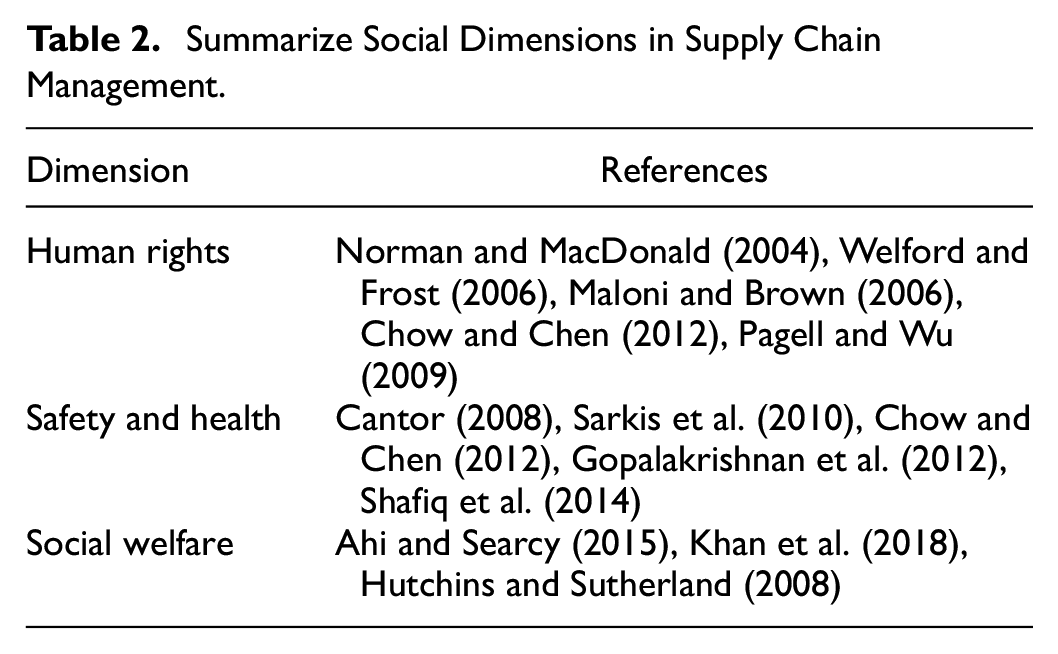
The above stated social dimensions relevant past studies are summarized in Table 2 below for better understanding the important of these dimensions in context of supply chain management.
Summarize Social Dimensions in Supply Chain Management.
Mediating Effect of Corporate Social Responsibility
According to Bowen (2013), “CSR refers to the responsibility of enterprises to make decisions and take actions that are not only in their best interests but also in the best interests of society. This responsibility is both ethical and economic and is grounded in the belief that a company has obligations beyond those to its shareholders and other stakeholders, and that it has an impact on the environment and society.” CSR is a charitable act by firms in order to achieve a competitive advantage into industry (Acharyya & Agarwala, 2022; Majeed et al., 2022). This is a common misconception about Corporate Social Responsibility (CSR). While some firms may engage in CSR activities as a means of improving their reputation or gaining a competitive advantage, true CSR is about companies fulfilling their obligations and responsibilities to society beyond just financial performance (Boesso et al., 2015; Kuah et al., 2022). CSR activities can include environmentally sustainable practices, ethical labor practices, community engagement and philanthropy, and fair business dealings. It goes beyond just being a charitable act and encompasses a company’s overall impact on society and the environment (Ahn et al., 2020; Latif & Sajjad, 2018)). Stakeholder theory is closely linked with the concept of corporate social responsibility (CSR). Stakeholder theory posits that a company has responsibilities to not just its shareholders, but also to all its stakeholders including employees, customers, suppliers, the community, and the environment (Janssen et al., 2015; Rather, 2020). CSR activities can be seen as a manifestation of a company’s obligations to its stakeholders and its commitment to balancing the interests of different stakeholder groups (Aljarah & Ibrahim, 2020; J.-I. Chang & Lee, 2020). By engaging in CSR, a company can demonstrate its commitment to being a responsible corporate citizen and contributing to the well-being of society and the environment (Kim & Kim, 2016; Park et al., 2022; Rivera et al., 2019). In addition, Clarkson’s stakeholder theory, proposed in 1995, argues that businesses and firms should consider the interests and needs of all stakeholders, not just shareholders, in their decision-making processes. According to this theory, a stakeholder is any group or individual who can affect or be affected by the actions of a business. By considering the interests of all stakeholders, a company can create value for both itself and society (Freudenreich et al., 2020). This approach to management contrasts with the traditional view that corporations should prioritize maximizing profits for shareholders above all else. Thus, following hypothesis are given:
H1b: Corporate social responsibility mediates relationship between human rights & sustainable socially responsible purchasing.
H2a: Corporate social responsibility mediates relationship between safety & health & sustainable socially responsible purchasing.
H3a: Corporate social responsibility mediates relationship between social welfare & sustainable socially responsible purchasing.
Methodology
In order to achieve the research objectives of this study, a two-phase approach was taken into consideration is given the Figure 1 below:

Research methodology steps.
Data gathered from the Sindh food sector in Pakistan might provide important insights into the regional food distribution and consumption trends. Numerous uses for this data include market research, product development, quality assurance, and strategic planning for the government. The information may also assist in pinpointing areas where the food sector needs to improve and guide decision-making for firms, organizations, and legislators. In order to learn more about a sample of people’s attitudes, beliefs, behaviors, and other traits, the survey technique, which is often employed to collect data, is utilized (Goddard & Villanova, 2006). A survey might be used to acquire data from customers, producers, or other industry participants in the context of the food sector in Sindh, Pakistan. According to Dörnyei and Csizér (2012), surveys may be a practical and economical technique to gather a lot of data quickly. To make sure the survey is valid and trustworthy and that the sample of respondents is representative of the population being investigated, it is crucial to carefully plan its design.
Various social media techniques, like Facebook, Twitter, Instagram, or online survey platforms, were used in this research. These techniques may be utilized to reach a broad and diverse community (Castronovo & Huang, 2012) quickly and inexpensively. By using social media, the survey may be able to reach a wider audience and get a more representative sample of data. The desired level of clarity, population variability, the level of confidence, and sample design all play a role in determining the sample size for the present study. In structural equation modeling (SEM), the sample size is important because it affects the power and accuracy of the model. According to Hair et al. (2014), a sample size from 200 to 500 or more is recommended for SEM in order to have enough observations to estimate the model parameters and ensure stable results. However, it is important to note that the appropriate sample size for SEM also depends on the complexity of the model, the number of variables, and the desired level of precision (Wolf et al., 2013). Therefore, in this study 250 sample size is taken for data analysis for concluding the findings of this study. The Sample size of 250 can provide sufficient power and accuracy for the data analysis in SEM, if it is representative of the population and meets the assumptions of the model.
Measurements
Discussing why research items were taken from earlier studies is more significant than developing a questionnaire for several reasons. Using and validating variable measurements in prior research gives confidence in their reliability and validity (Mamaril et al., 2016). Researchers may expand on existing knowledge and ensure the robustness of their results by using established measurements. Second, creating new variable measures takes time and resources (Mamaril et al., 2016). Adopting past study methods saves time and money, enabling researchers to concentrate on data gathering, analysis, and interpretation. Third, past research variable measurements are generally based on theoretical frameworks. These criteria allow researchers to build on current theories and enhance and refine field theories. Finally, using comparable variable measurements simplifies comparing results across settings, people, and time periods. It helps explain sustainable, socially responsible buying and CSR’s mediation. This research uses a five-item Likert scale with four items per variable.
The human right scale is developed from research of Baliga et al. (2019). The items are “Our firm does not engage in the child labor or sweatshop labor in manufacturing, Audits suppliers for non-employment of children and bonded labor, Our company has employee policy which incorporates human rights & protects claims and rights of aboriginal peoples or local community.”
The Safety & Health scale is developed from research of Baliga et al. (2019). Research items are given as “Our company adopt an environmental health and safety (EHS) policy and organization, Our company ensure availability of minimum health care facilities at organization locations, Our company ensure availability of minimum health care facilities at near to organization for local people & Our company provides our employee with training on health and safety issues.”
Social welfare variable is taken from the study of Baliga et al. (2019). Items are considered as “Our company conduct health camps in and around manufacturing facilities, Our company help the constructions of water conservation facilities in rural areas, Our company encourage employees to volunteer for local charitable works & Our company provide scholarships for meritorious wards of employees.”
Sustainable socially responsible purchasing factor is adopted from the study of Baliga et al. (2019). Research items are “Our company ensures that our suppliers provide their employee with protective equipment in hazardous areas, our company ensures that our suppliers provide a health and safety working environment for their employees, our company ensures that the our supplier do not use child labor or bonded labor, Our company monitor our supplier to ensure adherence to our social expectations.”
Corporate Social Responsibility variable is taken from the study of Kim and Kim (2016). Items are considered as “Our company would reduce its profits to ensure a clean environment, Our company seems to be environmentally responsible, Our company seems to make an effort to create new jobs & Our company seems to treat its people well.”
Results and Discussion
Common Method Variance (CMV)
The systematic mistake that may arise in research investigations when a single technique or instrument is employed to test several different variables is referred to as the common method variance (Kaltsonoudi et al., 2022). Therefore, the associations between the variables may be overstated, which may lead to incorrect findings. Researchers sometimes utilize different techniques or instruments to measure each variable in order to minimize common method variation, or they account for any confounding effects by statistically modifying the findings
S. J. Chang et al. (2020). It is advised to verify the common method variance since it may induce bias into study findings and result in erroneous conclusions (Fuller et al., 2016). Researchers may improve the validity and reliability of their results, raising the confidence in their conclusions, by detecting and adjusting for common method variation. A maximum explained variance of 44.9%, which is less than the 50% essential threshold, raises the possibility that the model is not adequately accounting for the whole range of data variation. This can mean that the model has to take into account more variables or factors, or that the factor structure needs to be adjusted.
Reliability
The consistency or stability of a study’s measurement is referred to as reliability (Souza et al., 2017). It describes the degree to which a measurement device or procedure yields consistent findings over time and under various circumstances. Reliability is crucial in research because it gives users assurance that the findings are accurate and consistent. A dependable measurement is one that consistently produces the same findings no matter who does it or when it is conducted. High dependability is a prerequisite for a measurement device or technique to be regarded legitimate, but it is not adequate in and of itself.
The reliability of a measuring tool or technique is often evaluated in research using composite reliability and Cronbach’s alpha. When evaluating the reliability of a composite or scale made up of many items, composite reliability refers to the overall consistency of a collection of measures (R. A. Peterson & Kim, 2013). Composite dependability has a value between 0 and 1, with a number nearer 1 signifying more reliability. The statistic known as Cronbach’s alpha, which was developed by psychologist Lee J. Cronbach, assesses the internal consistency of a scale or measure (Dunn et al., 2014). It runs from 0 to 1, with a number closer to 1 indicating more dependability. It is based on the correlation between the items on a scale and the scale’s overall score. A few 0.70 or greater is a frequently used cutoff for satisfactory dependability. The Table 3 below and figure for the current research show the reliability outcomes.
Construct Validity and Reliability.

Validity
The correctness and veracity of a measurement or research are referred to as validity (G. Winter, 2000). It refers to how well a measurement or research captures or measures the subject matter that it was designed to explore. A measurement or research is valid when it measures just what it is intended to assess and does not include any additional data or introduce bias (Higgins & Straub, 2006). To evaluate the reliability of a study or measuring tool, researchers often use a variety of techniques, including expert review, pilot testing, and statistical approaches. According to Alumran et al. (2014), the Average Variance Extracted (AVE) statistic may be used to evaluate the construct validity of a measuring tool. The device is measuring the construct more accurately if the AVE value is greater. According to a standard cutoff point of .5, the instrument should be able to explain at least 50% of the variation in the construct (Sarstedt et al., 2014). The findings for validity are shown in the Figure 2 and Table 3 below for the current investigation.

Model fitness.
Hypothesis Testing
Human Rights
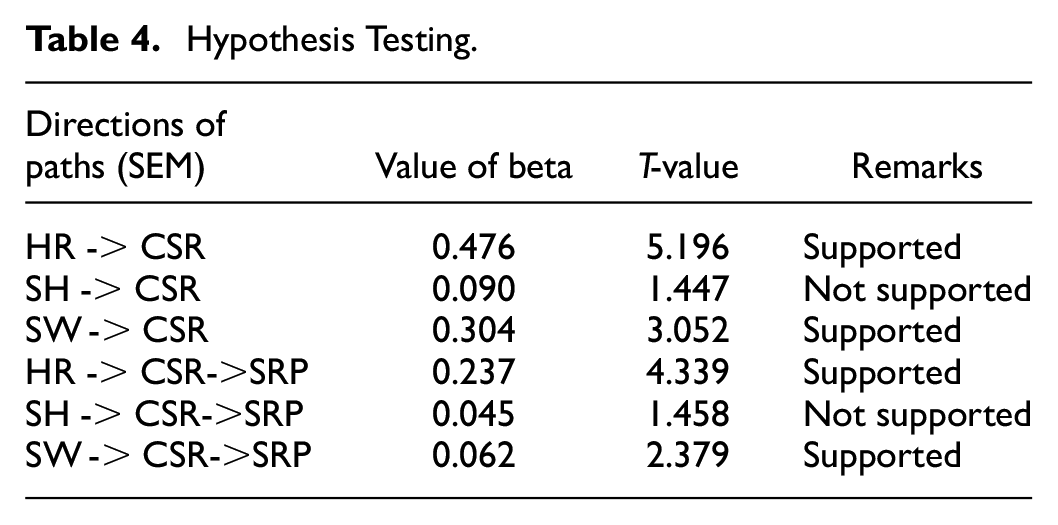
The findings show that human rights have a direct impact on corporate social responsibility and that indirect effects of CSR partially mediate the link between human rights and sustainable socially responsible purchasing in Sindh, Pakistani food manufacturing companies. The stated beta value and t-value for the direct impact are 0.476 and 5.196, respectively. Additionally, the beta value and t-value for the indirect impact of CSR on the link between human rights and sustainable socially responsible consumption are revealed to be 0.237 and 4.339, respectively. The link between human rights and sustainable socially responsible consumption may be significantly explained by CSR, according to the beta value and t-value, which are both substantial. As a result, the mediation effect is partly disclosed and H1a and H1b are supported. The results are shown in Table 4 and Figure 3 below.
Hypothesis Testing.

Structural equation modeling.
Findings are aligned with past studies such according to study of Welford and Frost (2006). Labor problems and worker rights are the region’s top corporate social responsibility concerns. CSR approaches reduce risks, attract and retain people, save money, and improve stakeholder relations. However, low resources and expertise, stakeholder awareness, and inefficient industrial processes hinder CSR projects in the area. Another study conducted by Wang and Chen (2012). The authors highlight the relevance of business sustainability and the necessity for a Chinese-specific measuring method. The researchers present a conceptual framework including environmental, social, economic, and governance components. They protected human and labor rights in social responsibility. Lastly, Chardine-Baumann and Botta-Genoulaz (2014) provide a methodology for assessing supply chain management methods’ sustainability. The framework contains KPIs to evaluate supply chain management methods. These factors include carbon footprint, waste management, labor conditions, supplier variety, ethical sourcing, and financial performance.
Safety and Health
The findings show that in food manufacturing companies in Sindh, Pakistan, both the direct and indirect effects of safety and health on corporate social responsibility are fully mediating the relationship between those two factors and sustainable socially responsible purchasing. The stated beta value and t-value for the direct impact are 0.090 and 1.447, respectively. Additionally, the beta value and t-value for the indirect impact of CSR on the association between safety and health and sustainable socially responsible buying are revealed to be 0.045 and 1.458, respectively. The association between safety and health and sustainable socially responsible buying is not well explained by CSR, according to a substantial beta value and low t-value. As a result, the complete mediation effect is evident and H2a and H2b are not supported. The results are shown in Table 4 and Figure 3 below.
The present study’s results are aligned with the study conducted by Diabat et al. (2014) found that five enablers dominate an industry’s activities: safety requirements, green practices, community economic well-being, health and safety problems, and employment stability. This research found that safety perspective enablers motivate SSCM adoption more than others. The research says identifying and tackling these enablers is crucial to promoting sustainable textile practices. The identified enablers may help textile firms adopt sustainable supply chain management and enhance environmental and social performance. Similarly, study by Shafiq et al. (2014). The research found six elements of social responsibility: community participation, health and safety, environmental sustainability, ethical sourcing, customer interactions, and stakeholder engagement. These dimensions indicate social responsibility factors that corporations should address in operations and stakeholder relations. Finally, Mani et al. (2016) said social concerns are especially troublesome in poorer nations, as health and safety difficulties hurt trade partners. This study aims to clarify supply chain social sustainability in developing countries by defining essential factors and assessing the results.
Social Welfare
The findings show that social welfare has a direct impact on corporate social responsibility and that indirect effects of CSR partially mediate the link between social welfare and sustainable socially responsible purchasing in Sindh, Pakistani food manufacturing companies. The stated beta value and t-value for the direct impact are 0.304 and 3.052 respectively. Additionally, the beta value and t-value for the indirect impact of CSR on the link between social welfare and sustainable socially responsible buying are revealed to be 0.062 and 2.379, respectively. A substantial beta value and t-value point to the importance of CSR in understanding the link between social welfare and sustainable socially responsible purchasing. As a result, the mediation effect is partly disclosed and H3a and H3b are supported. The results are shown in Table 4 and Figure 3 below.
Present study’s results are similar studies conducted in past such as Khan et al. (2018) examines stakeholder motivations for social sustainability in UAE healthcare supply chains. Understanding these motivators allows healthcare organizations and supply chain stakeholders to create social sustainability policies and activities that enhance social outcomes, notably healthcare social welfare. Furthermore, Ahi and Searcy (2014), social sustainability in supply chain management is becoming more important and requires credible assessment methodologies to analyze and monitor social challenges. The research seeks to illuminate social measurement in sustainable supply chains. The essay discusses measuring social concerns in sustainable supply chains. It emphasizes the relevance of social, environmental, and economic sustainability. Organizations may evaluate their social performance, improve, and create more socially responsible supply chains using proper assessment methods. Lastly, Hutchins and Sutherland (2008) examine social sustainability criteria and supply chain choices. It stresses that supply chain managers must weigh social, environmental, and economic issues while making choices. Organizations may improve their social performance and supply chain sustainability by taking the right steps.
Discussion
Businesses that value social responsibility and moral conduct in their daily operations often reap the benefits of a strong brand reputation, which may improve consumer loyalty and revenue. Primark was accused of exploiting child labor in India in 2008, which led to bad press and a decline in consumer confidence. Similar accusations of hiring suppliers that used child labor were made against British Home Stores (BHS) in 2012, which likewise had a detrimental effect on the company’s image. Social concerns are the ethical and moral issues that come up while managing relationships with suppliers, workers, consumers, and communities in the context of supply chain management. Worker rights, fair labor practices, and violations of human rights are only a few of these problems (Gavrilut,ă et al., 2022; Hoejmose et al., 2013). The influence of sustainable, socially responsible buying methods on supplier relationships was also studied by Ehrgott et al. (2011), using survey data from purchasing managers of US and German firms. Data from the study was used to determine the sorts of socially responsible business practices being adopted by organizations, as well as how these business practices affected supplier relationships. In research published by Klassen and Vereecke (2012) investigated the link between socially conscious supply chain management strategies and corporate performance. The research examined the effects of socially responsible supply chain management techniques on firm performance using data from a sample of Canadian manufacturing companies. The findings of this research indicate that businesses may enhance their general performance and reputation by using socially responsible supply chain management techniques. In addition, research was carried out by M. Winter and Knemeyer (2013) to investigate the connection between social concerns in the supply chain and company performance. The research found that businesses were more likely to suffer penalties if they neglected social concerns in their supply chain. The article also covers the effects of socially conscious purchasing on companies, such as the need for them to match the values and expectations of their clients with their practices and goods (Maignan et al., 2002; Velastegui-Montoya et al., 2022). Numerous previous research, such as Brammer and Walker (2011), Isaksson et al. (2010), Rane and Thakker (2019), Robinson (2010), and Tsolakis et al. (2021), have examined human rights in relation to social difficulties associated to making socially responsible purchases. Similarly, in earlier research like Bai et al. (2010) and Leire and Mont (2010), Safety & Health also remained a hot subject as the societal concern.
Conclusion
The study collected primary data from employees in food manufacturing companies in Sindh, Pakistan using a survey method. The results showed that corporate social responsibility partially mediates the impact of independent variables such as human rights, safety and health, and social welfare on sustainable socially responsible purchasing. The findings of the study indicate that human behavior has a more significant impact compared to other variables, as demonstrated by its higher beta value.
Theoretical Contribution
The research examined societal determinants that impact sustainable, socially responsible buying, emphasizing corporate social responsibility (CSR) as a mediating function. The research uses two major theories, the Social Contract and Stakeholder theory, to explain variable interactions. The Social Contract is a framework that holds corporations accountable for meeting societal demands. This idea suggests that socially responsible buying should include human rights, safety and health, and social welfare. Companies fulfill their social responsibilities and promote sustainable growth by considering these factors. According to stakeholder theory, firms should consider the demands of consumers, workers, suppliers, and the community. This idea suggests that social variables affecting stakeholders should be considered in socially responsible buying. Organizations exhibit stakeholder well-being and establish sustainable connections through addressing human rights, safety and health, and social welfare issues.
The study’s theoretical contributions are integrating these theories and corporate social responsibility mediation. Corporate social responsibility helps firms fulfill their social and stakeholder commitments. By practicing social responsibility, organizations promote sustained socially responsible buying and beneficial social benefits. The study’s results may help us understand how corporate social responsibility mediates societal variables that affect sustainable, socially responsible buying. This information may help organizations make ethical, sustainable, and stakeholder-satisfying buying choices. The study’s theoretical approach also informs sustainable supply chain management and corporate social responsibility studies.
Managerial Implications
First, managers should consider social concerns, including human rights, safety, health, and social welfare, while buying. By addressing these elements, companies may meet social expectations and promote sustainable development via buying. Second, managers should consider stakeholder interests and needs. Organizations may develop trust, improve relationships, and maintain partnerships with suppliers, consumers, workers, and the community by including stakeholder social elements. Thirdly, managers should choose suppliers based on their social performance and dedication to human rights, safety, health, and social welfare. Ethical sourcing and good social benefits along the supply chain help maintain socially responsible buying with socially responsible suppliers. Finally, the research shows that CSR mediates social variables and socially responsible buying. Managers should encourage and practice CSR in their businesses. Organizations may address social issues, meet societal duties, and make ethical buying choices by adopting CSR activities.
Future Research Directions
Every study has limitations, and it’s important to acknowledge them to understand the limitations of the study and its results. First, the study may have a limited sample size, which could impact the representativeness of the results. Second, the study only focuses on food manufacturing companies in Sindh, Pakistan, which may not be representative of the broader population. Third, the study used a survey method to collect data, which is subject to limitations such as self-reported bias and limited responses to open-ended questions. Lastly, the study only focuses on a specific aspect of sustainable socially responsible purchasing, and there may be other variables or factors that are not considered.
Footnotes
Declaration of Conflicting Interests
The author(s) declared no potential conflicts of interest with respect to the research, authorship, and/or publication of this article.
Funding
The author(s) disclosed receipt of the following financial support for the research, authorship, and/or publication of this article: This research was supported by the Intelligent Policing and NSRM Laboratory of Sichuan Police College, P. R. China (ZHKFYB2305).
