




Abstract
Before understanding customers’ perceptions of hotel CSR, it is important to understand service providers’ responses to hotel CSR because they are the key person to implement the CSR strategy. Therefore, this study investigates the structural relationship among multidimensional CSR performance, attitude, emotions, and resultant behaviors as perceived by hotel employees. In addition, moderating role of employees’ positional levels in the proposed model is evaluated. The findings show that environmental, ethical, and financial/economic domains consisting of hotel CSR performance effectively explain the resultant behaviors that follow. However, social/philanthropic and legal domains do not have considerable effects. The positions held by hotel employees partially moderate the relationships between the proposed constructs. The results of this study add important insights to the existing literature and help hotel practitioners better understand how multidimensional CSR causes positive attitudes, emotions, and behaviors and how the structural model changes depending on the position levels. These results are achieved by using the newly developed hotel CSR measurement scale, which was made through careful and rigorous six-stage procedures.
Introduction
Given the advantages that can be facilitated by corporate social responsibility (CSR), including the development of a positive brand image and the improvement of financial performance by engaging in socially and environmentally responsible initiatives, many businesses have recently come to understand the significance of CSR (Mozes et al., 2011). Hotel employees will feel proud of the hotel’s socially responsible activities and the public’s recognition of their contribution to society; thus, CSR boosts hotel employees’ dedication to the company and job satisfaction (Oh et al., 2021). In addition, hotel employees are crucial to the successful implementation of CSR initiatives (A. K. F. Wong & Kim, 2020), identifying how they view hotel CSR is essential to understand their attitudes and behaviors.
Several recent studies have demonstrated that CSR has various positive effects on hotel employees. Bibi et al. (2022) suggested that hotel employees’ perceptions of CSR have positive and significant effects on the satisfaction of their basic needs and self-esteem, which makes them more creative through hedonic and eudemonic happiness. Zhang et al. (2021) indicated that CSR plays a crucial and positive role in how hotel employees feel about safety compliance, safety participation, and safety adaption during the COVID-19 pandemic. Moreover, AlSuwaidi et al. (2021) suggested that CSR has a direct effect on hotel employees’ green behavior, which is partially mediated by employees’ personal environmental norms and wellbeing.
Although previous CSR studies in the hospitality field have highlighted the positive effect of hotel CSR, there remain research gaps. First, despite the growing number of hotel CSR studies, insufficient effort has been made to create and evaluate a measurement scale consisting of the multidimensional structure of hotel CSR, which reflects hotel employees’ daily opinions. Second, although previous CSR studies have explored micro-level employee-associated outcomes, efforts to analyze the effects of hotel employees’ perceptions based on the multidimensionality of hotel CSR are limited. Third, a few research has been conducted on the structural interrelationship between hotel employees’ perception of hotel CSR performance and resultant behaviors. Fourth, attempts to examine the effects of moderating variables, such as position levels in a structural model that manifests the role of hotel CSR performance, are inadequate (K. F. Wong, 2020).
Therefore, this study has three specific objectives to fill the aforementioned research gaps. First, this study clarifies the dimensionality of employees’ perception of hotel CSR and tests and validates the multidimensional scale of hotel CSR. Second, this study examines a structural model comprising multidimensional CSR, attitude toward CSR-implementing hotels, job satisfaction with CSR-implementing hotels, organizational commitment with CSR-implementing hotels, turnover intention, organizational citizenship behavior, and prosocial behaviors. Third, this study further identifies the influence of the employees’ position levels on the proposed structural model.
The multidimensional approach is one of the most significant contributions of the current study in hospitality literature because previous studies have mostly tested the influence of a one-dimensional CSR. More importantly, the multidimensional approach enables practical implications and strategic planning for future CSR initiatives. In addition, through a deeper understanding of their employees, the moderating role of position levels can also help hotel practitioners in creating CSR goals, mission statements, and various strategies, thereby maximizing the effectiveness of limited resources.
Literature Review
Domains of Hotel CSR
CSR conceptualization and measurement are required before testing the efficacy of hotel CSR. Carroll’s (1991) four-domain CSR framework, which includes economic, legal, ethical, and social/philanthropic domains, has provided a remarkable theoretical contribution to CSR conceptualization and measurement in the general industrial context. This theoretical framework and measurement have been used in the majority of studies in the hospitality literature (J. S. Kim et al., 2016, 2017; Xiao et al., 2017). However, Carroll’s theoretical CSR model has several weaknesses. First, the model has developed over 3 decades ago and no longer accurately reflects the rapidly changing hotel business environment. Second, the economic domain does not reflect corporate financial aspects. Third, an environmental domain should be added to the existing CSR measurement scale to assess employees’ perception of hotel CSR, because the scale fails to reflect employees’ increasing awareness of environmentalism, renewable energy, environmental protection, and preference for eco-friendly companies (Ettinger et al., 2018; Tamajón & Font, 2013; K. F. Wong, 2020). Therefore, this study seeks to address the present demands and desires of hotel employees. Consequently, a standardized scale can be used to examine the influence of employees’ perception of hotel CSR on their attitudes and behaviors.
Social Identity Theory (SIT) and Social Exchange Theory (SET)
Previous research has explored the positive effect of CSR implementation on employees’ attitudes and behaviors (He et al., 2019; Hu et al., 2020; H. L. Kim et al., 2017; Raza et al., 2021; Su & Swanson, 2019). SIT and SET are the fundamental theories used in this study. SIT suggests that employees may strengthen their self-esteem by categorizing themselves in groups and organizations based on similar ideas, interests, and social values (Stets & Burke, 2000). SIT can explain the positive effect of hotel CSR on employees’ attitudes toward CSR-implementing hotels (Maignan & Ferrell, 2001; A. K. F. Wong et al., 2021; Zientara et al., 2015). For example, hotel employees are likely to know if their hotel implements CSR and will usually try to match their own values with the hotel’s CSR initiatives (J. S. Kim et al., 2016). Furthermore, a CSR-implementing hotel tends to gain a positive corporate image and reputation (Lau et al., 2021; Martínez et al., 2014), which can make employees feel proud to work there and lead to a positive attitude and organizational commitment to the hotel’s CSR initiatives (J. S. Kim et al., 2016; Morgeson et al., 2013; Oh et al., 2021; Youn et al., 2018).
On the other hand, SET supports the connection between CSR and employees’ behavior based on the norm of reciprocity. Emerson (1976) suggested that SET can describe and simplify individuals’ evaluation of costs and rewards. The two types of exchange within the hotel organization are economic and social exchanges. Most of the time, an economic exchange between a hotel organization and an employee involves official contracts and money (Deckop et al., 2003). By contrast, a social exchange between a hotel organization and employee refers to intangible assets that cannot be measured by money (Shore et al., 2006). For example, a social exchange shows that employees are being treated well because of CSR activities and support; in return, hotel employees will behave positively (Cropanzano & Mitchell, 2005; Liu et al., 2021; Su & Swanson, 2019; Supanti & Butcher, 2019; Tian & Robertson, 2019) and do a better job (H. L. Kim et al., 2017; Shin et al., 2016).
Relationship Between Employees’ Perception of Hotel CSR and Attitudes Toward CSR-Implementing Hotels
A customer’s opinion of a hotel has become influenced by its environmental awareness and sustainability (Jiang & Gao, 2019; Kucukusta et al., 2013). Moreover, environmental and innovative issues significantly affect how employees perceive the overall effectiveness of CSR (H. Tsai et al., 2012). Chan and Hawkins (2010) found that using environmental management systems and ISO 14001 makes employees feel good about their jobs.
Social/philanthropic responsibility includes activities and actions that meet the needs of society (Carroll, 1991). Some marketing studies have determined that the social/philanthropic domain of CSR is one of the most important moral norms for businesses to follow, which is good for the community as a whole (Albinger & Freeman, 2000; Sen & Bhattacharya, 2001). However, analysis of the relationship between social/philanthropic responsibility and employees’ attitudes is scarce. Farooq et al. (2014) confirmed that the way CSR helps a community or society has a significant and positive effect on how employees feel about the organization. This finding is similar to what Y. K. Lee et al.’s (2012) study found: when employees highly value philanthropic CSR, they show a high level of trust and positive attitude toward the organization.
The legal domain is important in constructing CSR dimensionality (Harjoto & Jo, 2015; Park et al., 2014). Several studies have investigated the relationship between legal CSR and how employees feel about their jobs. E. M. Lee et al. (2013) claimed that the legal dimension of CSR is important and has a considerable effect on how employees feel about different CSR dimensions. J. S. Kim et al. (2016) and A. K. F. Wong and Kim (2020) confirmed that legal aspect of CSR has the most influence on how employees feel.
Although legal responsibility guides most societies, ethical responsibility goes beyond the activities that are not codified into law. J. S. Kim et al. (2016) found that ethical CSR has a positive effect on how employees feel about their jobs. Hsieh and Wang (2016) also confirmed that an ethical climate positively affects employees’ attitudes and behaviors. However, some studies (Y. K. Lee et al., 2012; Song et al., 2015) have determined that ethical CSR does not affect employees’ attitudes, such as with regard to organizational trust.
Although some studies (Closon et al., 2015; J. S. Kim et al., 2016; Y. K. Lee et al., 2012; Song et al., 2015; A. K. F. Wong & Kim, 2020) have investigated the relationship between economic CSR and employees’ attitudes, the results are mixed. J. S. Kim et al. (2016), Song et al. (2015), and A. K. F. Wong and Kim (2020) indicated that economic CSR has a positive and significant effect on employees’ attitudes. However, Y. K. Lee et al. (2012) argued that economic CSR only has an indirect significant effect on employees’ attitudes. Other studies (Closon et al., 2015; C. K. Lee et al., 2013) have reported that economic CSR has no significant influence on employees’ attitudes. This discrepancy in the results is due to the fact that different items have been used to measure economic CSR. Therefore, on the basis of these previous studies on the relationship between hotel CSR and employees’ attitudes, this study proposes the following hypotheses.
Hypotheses 1-1 to 1-5: Domains of hotel CSR, including the environmental (Hypothesis 1-1), social/philanthropic (Hypothesis 1-2), legal (Hypothesis 1-3), ethical (Hypothesis 1-4), and financial/economic (Hypothesis 1-5) domains, positively affect employees’ attitudes toward CSR-implementing hotels.
Relationships Between Attitudes Toward, Satisfaction With, and Organizational Commitment to CSR-Implementing Hotels
Rupp et al. (2006) and Khan et al. (2018) suggested that employees’ job satisfaction and organizational commitment will improve if they have a positive view of CSR practices. In a similar vein, Zhu et al. (2014) indicated that employees’ perceptions of CSR efforts affect their loyalty, with employees’ satisfaction acting as a mediator. In Bangladesh, Rahman et al. (2016) examined how employees’ CSR attitudes affect job satisfaction and organizational commitment. They discovered strong and positive relationships among employees’ CSR attitudes, job satisfaction, and organizational commitment. Thus, studies have confirmed the positive relationships among employees’ CSR attitudes, job satisfaction, and organizational commitment. On the basis of the above discussion, the following hypotheses are proposed.
Hypotheses 2-1 and 2-2: Employees’ attitudes toward CSR-implementing hotels positively affect job satisfaction (Hypothesis 2-1) and organizational commitment (Hypothesis 2-2).
Relationship Between Satisfaction With CSR-Implementing Hotels and Behavioral Intention
Some studies (Lapierre & Hackett, 2007; Murphy et al., 2002) have indicated that a high level of job satisfaction does not always lead to a better job performance or productivity; however, a high level of job satisfaction enhances employees’ organizational citizenship behaviors (Massoudi et al., 2020). In addition, most previous studies have shown that job satisfaction can be used to predict employee turnover rates (B. P. Kim et al., 2009; Yao et al., 2019). Moreover, when employees feel good about their job, they tend to more likely to engage in volunteerism (Kang et al., 2015), organizational citizenship behavior (Jung & Yoon, 2015), and social networking (Brissette et al., 2002). Specifically, job satisfaction is linked to prosocial behaviors because it makes employees feel more connected to the organization; it makes them more likely to act in an ethical and prosocial way and help others (Valentine et al., 2011). Thus, the following hypotheses are proposed.
Hypotheses 3-1 to 3-3: Job satisfaction in CSR-implementing hotels negatively affects employees’ turnover intention (Hypothesis 3-1) and positively affects employees’ citizenship (Hypothesis 3-2) and prosocial (Hypothesis 3-3) behaviors.
Relationship Between Organizational Commitment to CSR-Implementing Hotels and Behavioral Intention
Moreover, organizational commitment is important for understanding employees’ job-related behaviors, including turnover intention (Guzeller & Celiker, 2020; Kang et al., 2015; Kim et al., 2016). Demir (2011) reported that organizational justice and trust positively affect organizational commitment, whereas organizational commitment negatively affects organizational deviance. Employees with strong psychological attachment to their organization will engage in prosocial behaviors (Belschak & Den Hartog, 2010; Gagné, 2003; A. K. F. Wong et al., 2021). Ko et al. (2014) confirmed this relationship and suggested that organizational commitment significantly mediates the relationship between CSR perception and donation behaviors.
Hypotheses 4-1 to 4-3: Organizational commitment to CSR-implementing hotels negatively affects employees’ turnover intention (Hypothesis 4-1) and positively affects employees’ citizenship (Hypothesis 4-2) and prosocial (Hypothesis 4-3) behaviors.
Moderating Effect of Position Levels on Structural Equation Model
The position levels of employees are used as a moderating variable that influences organizational identity and commitment (Astley & Sachdeva, 1984). Sherer (1998) examined the perceptions of organizational characteristics from three levels of service employees (managers, supervisors, and line workers). The study found that the higher the position level is, the more positive individuals’ perception of the organization will be. This finding was supported by Ebeid (2010), who confirmed that managers are more interested in the effects and outcomes of CSR strategies compared with junior workers.
B. P. Kim et al. (2009) investigated how position levels affect the relationship between role stress and job satisfaction for hotel employees. The results revealed that role stress considerably affects the job satisfaction of supervisory employees more strongly than for nonsupervisory employees. In a similar vein, Chiang and Birtch (2008) examined how the position levels affected the rewards that should be used in the hotel industry in Hong Kong, proving that position levels significantly affect employees’ behavior. This argument was supported by Oh et al. (2021), who identified that job levels have a significant moderating effect on the relationship between employees’ perceived CSR and intrinsic work motivation. On the basis of these previous studies, the following hypothesis is developed.
Hypothesis 5: The signs of path coefficients differ across hotel employees’ position levels.
Methods
Measurement of Hotel CSR and Other Constructs
Most CSR studies in the hotel industry have only utilized the measurement scales used in general businesses. Thus, a new scale should be developed to measure hotel CSR. The scale used in this study to measure employees’ perception of hotel CSR was developed based on scale development studies (Choe & Kim, 2019; Churchill, 1979; DeVellis, 2017; Netemeyer et al., 1996). Specifically, six major steps were applied. First, measurement constructs were identified through the literature review and content analysis of CSR measurement studies and hotel corporate sustainability reports. The present study primarily accepted Carroll’s four-domain model, which has been widely adopted by other researchers (J. S. Kim et al., 2016, 2017; Y. K. Lee et al., 2012; Wong and Kim, 2020; Xiao et al., 2017), to develop a measurement scale of hotel CSR. In addition, environmental domain was newly added to hotel CSR studies, because eco-friendly policies have become an industrial trend. In this study, the environmental domain is defined as the responsibility of a hotel to protect the environment, save energy, and sustain the ecosystem.
Second, the wordings of original measurement items were modified, such that they would fit the hotel industry. Third, 10 hotel CSR experts were interviewed in depth to check the content validity of the items and identify new items that might have been missed. Fourth, to clean up the measurement items, a pretest was conducted with 40 doctoral students in hospitality and tourism management. Fifth, in a pilot test, 164 hotel employees in the United States with more than 3 years of work experience confirmed all the measurement items. By using the data from the main survey, the nature of the scale’s dimensional structure was determined after its reliability and validity had been checked. Then, the proposed hypotheses were tested using structural equation modeling (SEM).
Items used to measure the following variables were derived from previous studies: employees’ attitude toward CSR-implementing hotels (Han & Kim, 2010; Verma et al., 2019); employees’ satisfaction with the CSR-implementing hotel (Babin & Boles, 1998; Netemeyer et al., 1996); organizational commitment to CSR-implementing hotels (Kucukusta et al., 2013); turnover intention (Netemeyer et al., 1996); organizational citizenship behavior (Gao & He, 2017; Tsui et al., 1997; Van Dyne & LePine, 1998); and prosocial behavior (Gagné, 2003; Twenge et al., 2007).
Data Collection
The three conditions used as screening questions to select the exact samples in this study were as follows: hotel employees who had worked in the hotel industry in the United States for more than 3 years, currently working in a CSR-implementing hotel, and understood CSR practices. With the help of online panel companies in the United States, a self-administered online panel survey was undertaken because the cost and time of data collection were kept to a minimum (Granello & Wheaton, 2004). The main survey collected the responses of 653 participants who met the aforementioned criteria to join as target samples. Then, 20 questionnaires were removed because of insincere responses, such as selecting only one number throughout the whole questionnaire. For further data analysis, 633 questionnaires were used.
Results
Respondent Profile
On the basis of the frequency analysis, 58.9% of the respondents were male. The age groups were as follows: 30s (40.8%), 20s (34.0%), 40s (18.3%), and 50s (6.9%). About 55.1% of the participants had a bachelor’s degree. Most of the respondents were working at a supervisory level or below (69.5%), and 28.2% were at managerial levels. Nearly 60% of the participants worked for chain-brand hotels, and most of them (66.4%) worked in front-of-house departments. Most of the respondents were working in the hotel industry for 3 to 5 years (44.1%), followed by 6 to 9 years (31.3%), and 10 years or above (24.6%).
Exploratory Factor Analysis (EFA) of the Measurement Model (First Half of the Dataset, n = 317)
For cross-validation, the collected data were divided randomly into two datasets (Kline, 2016). For the first 317 data points, an EFA was conducted with principal axis factoring and promax rotation. As shown in Table 1, items with communalities below 0.4 and factor loadings below 0.4 were removed (Stevens, 1992). Factors with eigenvalues less than 1.0 were removed. Cronbach’s alphas ranged from .86 to .92 across all domains. The extracted five domains of hotel CSR were labeled “environmental,”“ethical,”“legal,”“social/philanthropic,” and “financial/economic.”Table 1 indicates that the other constructs generated a single-factor solution.
EFA Results for the CSR Scale and Other Constructs (n = 317).

Confirmatory Factor Analysis (CFA) of the Measurement Model (Second Half of the Dataset, n = 316)
The second half of the dataset (n = 316) was used in a CFA to confirm the factor structure found by the EFA. Overall, the CFA results indicated that the fit was satisfactory (χ2(986) = 1,891.84 [p < .000], CFI = .93, TLI = .93, RMSEA = .05, GFI = .80). The standardized factor loadings for each item ranged from 0.67 to 0.94; thus, all the measurement items were above the threshold value of 0.5 (Hulland, 1999). All average variance extracted (AVE) values exceeded .5, which verified convergent validity (Fornell & Larcker, 1981). All of the construct reliability values were above 0.85; thus, all items had values above the 0.70 thresholds (Hair et al., 2006). The AVE values for each construct were greater than the squared correlation coefficients for the corresponding inter-constructs, thereby confirming discriminant validity.
SEM
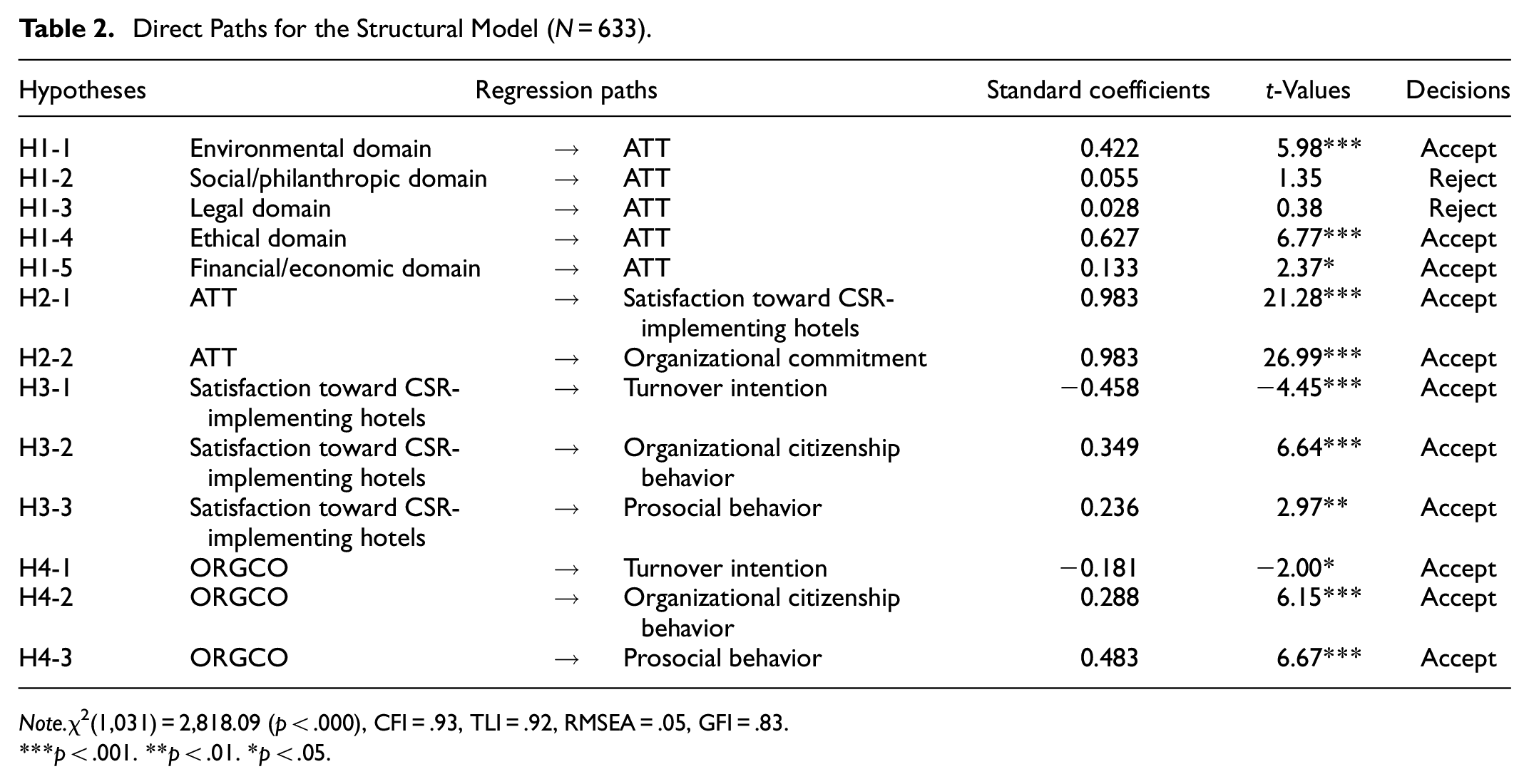
In Table 2, the SEM results show that the overall fit indices had a satisfactory level of fit. This study examined 13 direct relationships. A multi-group analysis was also conducted to investigate the moderating effect of employees’ position levels. The relationship between environmental domain and attitude toward CSR-implementing hotels (β = .42, t = 5.98, p < .001) supported Hypothesis 1-1. This result shows that employees who perceived high levels of environmental CSR felt good about CSR-implementing hotels. It is consistent with the results of previous studies (Chan & Hawkins, 2010; W. C. Tsai et al., 2012). Y. J. Kim et al. (2019) stated that green human resource management significantly affects employees’ eco-friendly behavior and environmental performance through their attitude. With the implementation of green practices that make employees happier (Bohdanowicz, 2005), environmental CSR has become important to hotel CSR.
Direct Paths for the Structural Model (N = 633).
Note.χ2(1,031) = 2,818.09 (p < .000), CFI = .93, TLI = .92, RMSEA = .05, GFI = .83.
p < .001. **p < .01. *p < .05.
Contradictory to this study’s expectations, social/philanthropic and legal domains had no significant effect on attitudes toward CSR-implementing hotels at the .05 level. Thus, Hypotheses 1-2 and 1-3 were not supported. As expected, ethical and financial/economic domains significantly affected attitudes toward CSR-implementing hotels (β = .63, t = 6.77, p < .001 and β = .13, t = 2.37, p < .05, respectively). Thus, Hypotheses 1-4 and 1-5 were supported.
Hypotheses 2-1 and 2-2 were tested by examining the relationship between attitudes toward CSR-implementing hotels, satisfaction with CSR-implementing hotels (β = .98, t = 21.28, p < .001), and organizational commitment to CSR-implementing hotels (β = .98, t = 26.99, p < .001). These results supported Hypotheses 2-1 and 2-2. The influence of satisfaction with CSR-implementing hotels and organizational commitment to CSR-implementing hotels on turnover intention was significantly negative (β = −.46, t = −4.45, p < .001; β = −.18, t = −2.00, p < .05). Therefore, Hypotheses 3-1 and 4-1 were supported.
The hypothesized relationships among satisfaction with and organizational commitment to CSR-implementing hotels and organizational citizenship behavior were significant at the .001 level (β = .35, t = 6.64, p < .001; β = .29, t = 6.15, p < .001). Finally, the relationships between satisfaction with and organizational commitment to CSR-implementing hotels and prosocial behavior were significant at least at the .01 level (β = .24, t = 2.97, p < .01; β = .48, t = 6.67, p < .001). Thus, Hypotheses 3-3 and 4-3 were supported (Figure 1).
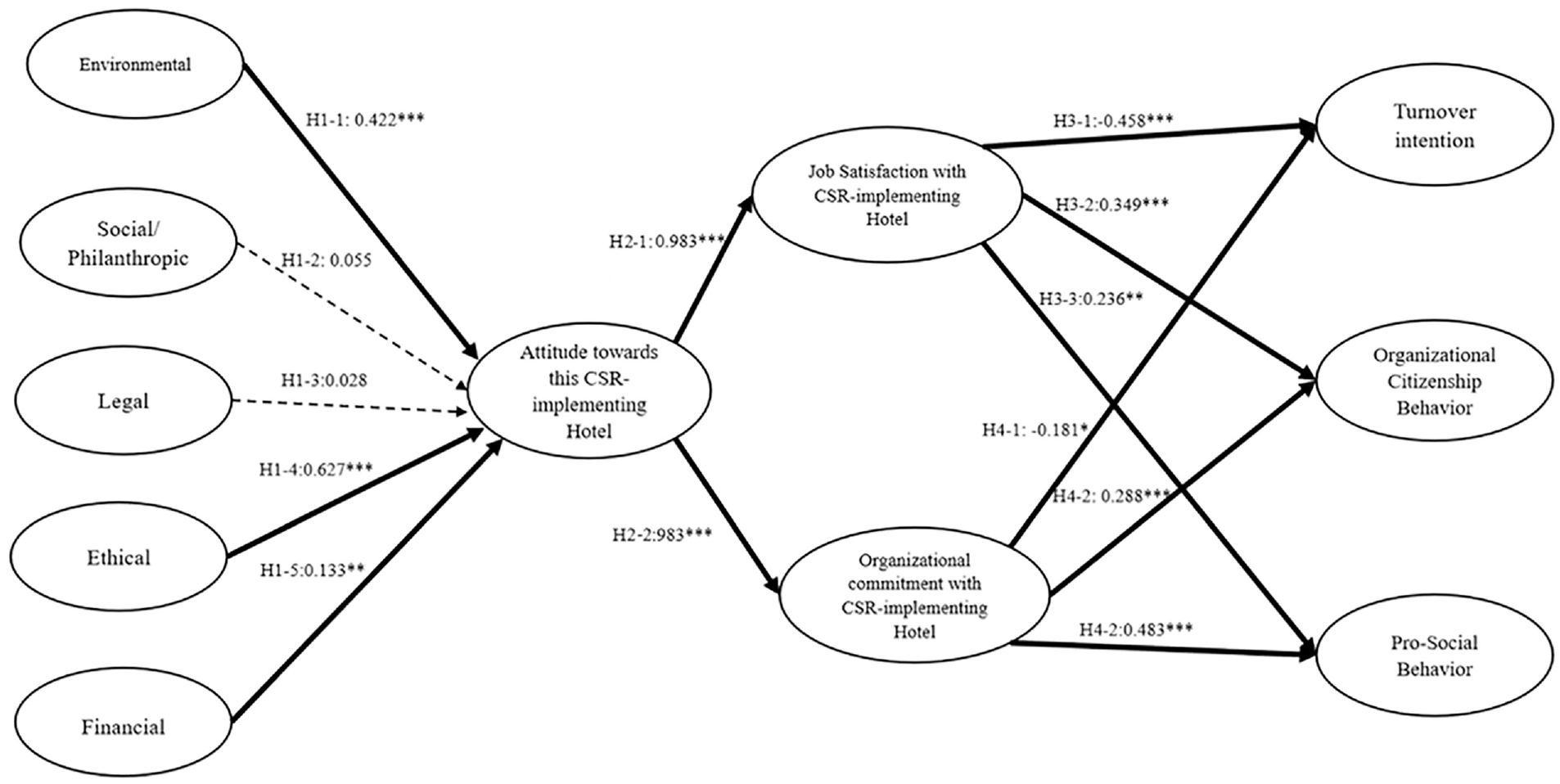
Direct paths of the structural model (N = 633).
Multi-Group Analysis
Multi-group analysis was conducted to examine the moderating effect of employees’ position levels (Hypothesis 5). Overall, 151 respondents were at an entry level, 289 were at a supervisory level, and 193 were at a managerial level. Before examining the moderating effect of employees’ position levels in the proposed model, a measurement invariance analysis was conducted to determine whether the measurement model showed the same results for all the three groups. First, the chi-square values of a non-restricted measurement model and a full metric invariance measurement model were compared. The chi-square test of the three groups showed significant differences between the nonrestricted model and the full metric invariance model (Table 3). As a result, the invariance constraints were released one by one based on the modification indices and parameter changes. Finally, the five-item partial metric invariance model was supported for further analysis (Steenkamp & Baumgartner, 1998).
Measurement Invariances for the Three Position-Level Groups.

Note. IN = invariance.
Chi-square difference test: Δχ2 (df) > χ20.01 (37) = 59.89; thus, the full metric invariance model was not supported.
Chi-square difference test: Δχ2 (df) < χ20.01 (32) = 53.49; thus, the partial metric invariance model was supported (with five items of invariance constraints released).
Chi-square difference test: Δχ2 (df) > χ20.05 (37) = 52.19; thus, the full metric invariance model was not supported.
Chi-square difference test: Δχ2 (df) < χ20.01 (32) = 53.49; thus, the partial metric invariance model was supported (with five items of invariance constraints released).
Chi-square difference test: Δχ2 (df) > χ20.01 (37) = 59.89; thus, the full metric invariance model was not supported.
Chi-square difference test: Δχ2 (df) < χ20.01 (32) = 53.49; thus, the partial metric invariance model was supported (with five items of invariance constraints released).
Figure 2 shows the direct path for the structural model of all the three groups. Then, structural invariance analysis was conducted using the partial invariance measurement model. Testing the baseline model (partial invariance measurement model) and the constrained model (full-path invariance model) indicated that the chi-square difference was significant across the groups, and all of the models showed a satisfactory level of model fit indices (Table 4). Hence, the paths between each pair of the three groups were different, or at least some paths were not equivalent.

Direct paths for the structural model (all three groups).
Structural Invariances for the Three Position-Level Groups.

Chi-square difference test: Δχ2 (df) > χ20.1 (13) = 19.81; thus, the full structural invariance model was not supported and the paths across the two groups were different.
Chi-square difference test: Δχ2 (df) > χ20.05 (13) = 22.36; thus, the full structural invariance model was not supported and the paths across the two groups were different.
As shown in Table 5, the results of the cross-group invariance test indicated that the entry- and supervisory-level groups had significant differences in 3 of the 13 paths. For the entry- and managerial-level groups, significant chi-square differences were found in 6 of the 13 paths. Finally, the supervisory- and managerial-level groups showed a significant chi-square difference in only one path. Therefore, with the moderating effect of employees’ position levels partially verified, Hypothesis 6 was partially supported. This finding is in line with previous studies, to some extent, in that position levels affect employees’ impression of the company (Chiang & Birtch, 2008; B. P. Kim et al., 2009).
Invariance Tests of Paths.

Note. ATT = attitude toward CSR-implementing hotels; ORGCO = organizational commitment toward CSR-implementing hotels.
Significant differences (Δχ2 (df) > Δχ20.1 (1) = 2.701).
Significant differences (Δχ2 (df) > Δχ20.05 (1) = 3.842).
Significant differences (Δχ2 (df) > Δχ20.01 (1) = 6.635).
Discussion
Some meaningful discussions of the above results are as follows. First, a significant relationship existed between ethical domain and attitudes toward CSR-implementing hotels. Thus, employees who perceive high levels of performance with regard to the ethical components of hotel CSR have positive attitudes toward those hotels. This result is confirmed by previous studies that demonstrated the positive effect of ethical CSR on how employees feel about the company overall (Hsieh & Wang, 016; Kim et al., 2016). Ethical CSR practices in a hotel make employees more loyal to their hotel because it makes them feel like they belong there and make them feel good about the hotel. One reason for this is that employees do not want to work at unethical hotels that do not care enough about their staff (Bowling, 2010; S. C. K. Wong & Li, 2015).
Second, a significant relationship existed between the financial/economic domain and attitudes toward CSR-implementing hotels. Hence, employees who perceive excellent financial/economic component CSR performance have positive attitudes toward CSR-implementing hotels. This finding is consistent with the results of previous studies that showed that financial/economic component of CSR is the backbone of CSR dimensionality (Carroll, 2016; Maignan et al., 1999). Therefore, hotel employees believe that long-term financial success and survival in competitive environments produce substantial rewards for a hotel and employees, such as financial by-products attributable to financial performance (e.g., year-end bonuses or stable employment environments; Cropanzano & Rupp, 2008).
Third, no significant effect was found in the social/philanthropic domain on attitudes toward CSR-implementing hotels. Therefore, although hotels do well in terms of social/philanthropic aspects, their hotel employees may not perceive favorable attitudes toward them. This result is incongruent with previous studies, which suggested that social awareness affects employees’ positive evaluation of CSR-implementing hotels (Farooq et al., 2014; Y. K. Lee et al., 2012). Hotel employees may consider the contribution to the community (e.g., charity donations) as a financial burden that hurts the hotel’s financial performance. Instead, they may believe that attaining financial CSR by offering incentives to stakeholders and exerting substantial efforts to increase the hotel’s growth can help more in formulating hotel employees’ positive attitudes.
Fourth, no significant relationship was found between the legal domain and attitudes toward CSR-implementing hotels. Contrary to previous studies (J. S. Kim et al., 2016; E. M. Lee et al., 2013), the finding indicated that employees who perceive higher levels of legal CSR have positive attitudes toward the hotel. This finding may be due to the fact that the legal CSR is mandatory, such that every hotel must comply, employees’ perceived legal CSR does not necessarily generate additional effects on their attitudes toward CSR-implementing hotels (Harjoto & Jo, 2015; Y. K. Lee et al., 2012; Park et al., 2014).
Fifth, positive relationships existed among attitudes, satisfaction, and organizational commitment to CSR-implementing hotels. The results showed that employees who have more positive attitudes toward CSR-implementing hotels are strongly satisfied and loyal to them. The results of this study are consistent with those that investigated other generic organizations, in that positive attitudes toward the employees’ company lead to job satisfaction (Rahman et al., 2016; Rupp et al., 2006) and further commitment to the organization (E. M. Lee et al., 2013; Yoon et al., 2016).
Sixth, significance was found regarding negative signs among satisfaction with and organizational commitment to CSR-implementing hotels and turnover intention. The results show that the higher levels of employee satisfaction and organizational commitment to CSR-implementing hotels make them less likely to quit their jobs. These findings are similar to what other studies have found: the higher levels of satisfaction and organizational commitment, the lower intention to leave (Kang et al., 2015; W. G. Kim & Brymer, 2011; J. S. Kim et al., 2016).
Seventh, significant relationships were found among satisfaction with and organizational commitment to CSR-implementing hotels and organizational citizenship behavior. The findings can be explained by a principle of reciprocity and SET, whereby employees perform well to reward their company for offering them a pleasant and satisfying work environment (Bowling, 2010; Closon et al., 2015; Cropanzano et al., 1997).
Eighth, positively significant effects of satisfaction with and organizational commitment to CSR-implementing hotels on prosocial behavior were found. The results indicate how hotel CSR affects employees’ prosocial behavior at the community level. These results extend the knowledge from the majority of previous studies in this field, which focus on how hotel CSR affects employees’ prosocial behavior within companies (Belschak & Den Hartog, 2010; H. Tsai et al., 2007; Xie et al., 2017).
Finally, the moderating role of position levels in determining how employees’ perceived CSR further affects attitudes and behaviors were found. Hotel CSR can be interpreted differently according to employees’ rank. Thus, hotel management needs to educate employees on the importance of CSR with the same material, regardless of their position levels.
Academic and Practical Implications
The findings of this study are important from a theoretical perspective. First, this study attempted to develop a hotel CSR scale that would work in the hotel industry. As addressed above, previous studies on hotel CSR have adopted scales made for general businesses without considering whether they could be used in the hotel industry. This study determined that employees’ perception of hotel CSR consisted of five dimensions: environmental, ethical, legal, social/philanthropic, and financial/economic. A hotel CSR scale can be measured by examining the dimensional structure.
This study also contributes to the CSR literature. The findings of this study agree with SIT and SET, and they can help in understanding the positive relationship between employees’ response to hotel CSR and their attitudes and behaviors (Supanti & Butcher, 2019). Different from most CSR studies that considered employees’ perceived CSR as a single domain (He et al., 2019; Su & Swanson, 2019), the model proposed in this study could determine how different subdomains of employees’ perceived CSR affect their attitudes and behaviors. Furthermore, this study is meritorious in that it empirically tested how position levels affect the proposed model. This extension provides a comprehensive understanding of how CSR affects businesses. Specifically, this study suggested that entry-level employees focus on legal commitment, whereas supervisory- and managerial-level employees focus on ethical commitment.
Finally, this study demonstrated that there exists a relationship between CSR and employee-related outcomes, including turnover intention, organizational citizenship behavior, and prosocial behavior. In contrast to previous studies that focused on the relationship between employees’ CSR perception and their behavior in an organization (He et al., 2019; J. S. Kim et al., 2016; H. L. Kim et al., 2017; Supanti & Butcher, 2019), this study examined the effect of employees’ perception of hotel CSR on their prosocial behavior in daily life.
This study also has several important practical implications. First, enhancing the performance of environmental CSR by implementing programs to protect the environment, save energy, and keep ecosystems healthy is essential. The findings of this study indicated that environmental CSR can predict employees’ attitudes toward CSR-implementing hotels. Investment decisions on environmental CSR should consider not only financial returns but also the effects on employees. Thus, hotel practitioners should emphasize their CSR efforts into protecting the environment (e.g., excluding endangered species from food menus, donating leftover food, adopting a paperless policy, and reducing bathroom amenities).
Second, employees, especially entry-level employees, should be reminded of the importance of legal CSR. This recommendation can be achieved by developing an honest work environment with the help of a clear employee handbook and regular training and inspections in each department. Hotel industry should ensure that employees can fulfill their duties in accordance with the law. Moreover, employees should not be forced to engage in unethical acts in the course of hotel operations. For example, employees should not provide inaccurate information to customers because of the sale target (e.g., forced upselling or misleading sales and marketing practices).
Third, when it comes to meeting ethical standards and the moral expectation of society, ethical CSR performance is a key factor in determining how employees act at work. Hotel management should make sure that employees’ rights are protected, including fair pay, no discrimination or harassment, no employer retaliation, and the prioritization of employees’ physical and mental wellbeing.
Fourth, employees who show positive attitudes toward CSR-implementing hotels tend to be more satisfied with their jobs, more committed to the hotel, and higher intention to perform prosocial behavior. Thus, given that hotel CSR implementation improves employees’ morals and spirits at work and in daily life, their satisfaction with their work environment is expected to help the community develop beyond the company.
Finally, the effect of employees’ perceived CSR on their attitudes toward CSR-implementing hotels depends on their position levels. Thus, hotel management needs to identify why employees in different position levels have varied ideas. They can change their CSR priorities by improving their CSR goals, policy, mission statement, and various practices. All employees should be educated and trained, such that they can all support their hotel’s CSR implementation. They should learn about the importance of CSR, how to exercise CSR practices through various meetings, and how to communicate with customers about the hotel’s efforts.
Conclusions, Limitations, and Suggestions for Future Research
Given that employees are the hotel’s internal customers, their responses to hotel CSR implementation should be understood. This study initially clarified the dimensionality of employees’ perception of hotel CSR and attempted to develop a valid and reliable measurement scale. Then, empirical analyses were conducted to test the relationship between employees’ perception of hotel CSR, attitude, and their resultant behavior. As addressed above, other paths, aside from two paths, were found to be significant. Thus, hotel CSR has a positive effect on employees’ attitudes and behaviors because they are working in CSR-implementing hotels.
Several limitations of this study warrant further investigation. First, this study used a sample of hotel employees in the United States to develop a hotel CSR scale. However, the measurement scale may differ across countries or companies with different organizational or historical cultures. Thus, the proposed scale must be verified in future studies. Second, although position levels were found to be a moderating variable, the moderating effects of other variables (e.g., personality traits or demographic variables) should also be identified. In addition, a cluster analysis should be conducted to identify the differences in employees’ demographic and career features between the clusters derived using the hotel CSR domains. Third, this study only explored the perspective of hotel employees. Different stakeholders may have various ideas about what CSR is and how it will affect them. Thus, future studies should integrate various stakeholders in developing a comprehensive conceptual framework that will add to the CSR literature.
Footnotes
Declaration of Conflicting Interests
The author(s) declared no potential conflicts of interest with respect to the research, authorship, and/or publication of this article.
Funding
The author(s) disclosed receipt of the following financial support for the research, authorship, and/or publication of this article: This article was supported by the research fund of Chris Ryan’s Academician Workstation in Hainan Province.
