




Abstract
This study is an attempt to explore the frequency of pragmatic content occurrence represented as three speech acts of requesting, refusing, and apologizing in global and local English Language Teaching (ELT) textbooks. Three global elementary ELT textbooks, namely Interchange, Top Notch, and American English File along with the local elementary textbooks of Iran Language Institute (ILI) Series, were examined for their pragmatic content. To analyze the pragmatic content of these textbooks, the researchers used three different frameworks. The results indicated that while both global and local ELT textbooks shared a sufficient number of speech acts of request and refusal, they failed to pay enough attention to the speech act of apology regarding its frequency and the strategies through which it is performed. To sum, the findings of this study highlight the differences in the frequency of different speech acts and the strategies used to perform them in global and local elementary ELT textbooks, which bear some implications for ELT textbook developers and language instructors.
Introduction
Second language acquisition requires some competencies that L2 learners should master to conduct a successful communication. When language learners attempt to express themselves in L2 context, they encounter some barriers with regard to pragmatic content of their utterances. This, sometimes, happens despite the learners’ ability to use the language properly at syntactic and semantic levels. In fact, even though they are highly proficient as far as grammar and lexis are concerned, L2 learners fail to express and interpret communicative functions in a particular context (Brock & Nagasaka, 2005). Crystal (1985) defines pragmatics as the study of language from the point of view of the users, especially of the choices they make, the constraints they encounter in using language in social interaction, and the effects their use of language has on other participants in the act of communication. (p. 240)
Given that, Glaser (2009) declares that high level of pragmatic competence in the target language has a constructive effect for successful communication within the L2 contexts. Owing to this, L2 learners need to be exposed to pragmatic content in their context of L2 learning.
ELT textbooks are among the various means used to provide L2 learners with pragmatic content represented in the speech acts such as request, refusal, and apology. According to Vellenga (2004), textbooks are among the most important instructional materials that have to be considered as the vital backbone for second/foreign language learning. As Diepenbroek and Derwing (2013) suggest, considering the significance of pragmatic knowledge in successful communication, material developers must give special attention to the important role of English Language Teaching (ELT) textbooks in promoting learners’ pragmatic competence in L2 classroom settings. Textbooks not only provide English as Second/Foreign Language (ESL/EFL) learners with grammatical and lexical aspects of the L2, but they also present pragmatic content that is necessary for the successful L2 learning.
Given the significant role pragmatic content plays in L2 material development for language learning, the purpose of this study is to explore how pragmatic content, represented as three speech acts of requesting, refusing, and apologizing, is distributed in global and local ELT textbooks. Whereas global ELT textbooks are prepared according to global norms and are instructed around the world, local ELT textbooks are prepared according to the norms of a particular EFL context. This research, then, is an attempt to measure the pragmatic content of both types of textbooks and finds out the differences, if any. Another concern of this study is to investigate the strengths and weaknesses of these textbooks in presenting pragmatic content.
Literature Review
Whether or not to include pragmatic content in ELT textbooks has been a matter of controversy. On one hand, Bardovi-Harlig (2001) states that textbooks cannot be considered as reliable sources of providing learners with pragmatic input and the inclusion of pragmatic content in ELT textbooks should be done with care as it requires analysis of authentic language. On the other hand, many researchers are of the opinion that pragmatic competence of L2 learners can be improved through instructional materials such as textbooks (e.g., Crandall & Basturkmen, 2004; Rose, 2005). Bouton (1994), for example, asserts that many pragmatic aspects of L2 such as conversational implicature can be learnt through instructional textbooks, and without them, the process of learning will be slow or even impossible. Koike and Pearson (2005) attribute another advantage in using instructional textbooks in pragmatic instruction. They believe that by using textbooks for instructing pragmatic content, language learners will have a higher chance of receiving feedback on linguistic features at pragmatic level. According to Koike and Pearson (2005), pragmatic acquisition is facilitated to the extent L2 learners have the chance to receive feedback on pragmatic issues. Given the importance of pragmatic competence in the process of L2 learning and considering the significant role that textbooks can play in improving learners’ pragmatic competence, it is of a great importance to review the literature for the studies which focused on the comparison among different ELT textbooks.
In an analysis of pragmatic content of ELT textbooks, Vellenga (2004) indicated that generally “a phrase or two” is concerned with pragmatic content in each page of common ELT textbooks. She also showed that “the distribution of speech act types across ESL and EFL textbooks did not appear to be patterned, nor based on frequency of speech act occurrence in natural language, and often seems counterintuitive” (p. 9).
According to House (1996), while grammatical and lexical items were usually contextualized in the texts, pragmatic content was always included in the textbooks in a de-contextualized format. Diepenbroek and Derwing (2013) demonstrated that textbooks tended to present pragmatic content in isolation and this usually caused problems in the process of L2 learning for several reasons. First, the significance of pragmatic competence in successful communication requires language learners to select among different linguistic choices with regard to the already taught pragmatic content. Consequently, de-contextualization usually leads to their difficulty in deciding the appropriate form–function relationship in authentic communication. Nguyen’s (2011) investigation could be a good example for this matter. In her research on evaluating the pragmatic content of the recently developed series of textbooks for Vietnamese upper-secondary schools, she found that there was not a sound relationship between the speech acts and their linguistic counterparts in these local textbooks. The second reason is that de-contextualizing pragmatic content may lead to learners’ inability to select an appropriate speech act in a specific situation due to nuance differences among different pragmatic structures (Cohen, 2005). Besides, textbooks sometimes misrepresent or oversimplify the appropriate pragmatic content in a particular situation (Crandall & Basturkmen, 2004).
According to Sheldon (1988), “textbook is the visible heart of any ELT program” (p. 237). As textbooks are vital sources of L2 learning out of the classroom, their roles in helping learners raise their pragmatic awareness becomes more significant in EFL contexts. As a result, many investigations have focused on ELT textbooks in EFL contexts.
In a research study, Nguyen (2011) surveyed pragmatic topics such as advising and apologizing in EFL textbook series. These topics were not included homogenously across different levels of the textbooks. The findings of her study also revealed that although the speech act of “opening a conversation” was included in all three levels of examined textbooks, the speech act of “closing a conversation” was not given the attention it deserved. According to Nguyen, maybe material developers consider conversation openers more complex than conversation closers for L2 learners of English.
In another study, Ekin (2013) examined how the speech act of suggestion was distributed in eight EFL course books. The results of this investigation indicated that up to 70.8% of strategies included in course books were about conventionalized forms. The findings further showed that suggestion strategies included at the pre-intermediate level were more than the ones included at the intermediate level.
Jiang (2006) conducted a study on the linguistic forms used to perform the speech act of suggestion in both real-life and ESL textbooks. She analyzed three recent and three old ELT textbooks so as to compare the distribution of the speech act of suggestion in the real-life language use and that of ELT textbooks. The results of her investigation showed that even though the new generation of textbooks included more structures regarding the speech act of suggestion, there was no difference between the recent textbooks and the old ones in terms of real-life use of this speech act. She concludes that it is a necessity for ELT textbooks to include background information about the structures of pragmatic content in real-life context.
In a 4-month study done in Korea, Kim and Hall (2002) investigated Korean children’s participation in an intensive reading program and its effects on their pragmatic competence. To gather the data, the researchers examined the number of words, utterances, and talk management features children used during some role-play sessions. The results of their investigation showed that reading books in general and intensive reading in particular could help learners develop many aspects of L2 pragmatic competence. In conclusion, they emphasized the significant role which ELT textbooks play in providing EFL learners with the chance to acquaint themselves with pragmatic content in the second language.
Due to the rising emphasis on the importance of L2 pragmatic content in successful communication and as ELT textbooks are one of the influential means to provide learners with linguistic features at pragmatic level, especially in EFL contexts, the purpose of the present study is to investigate the distribution of pragmatic content occurrence represented as three speech acts of requesting, refusing, and apologizing in global and local ELT textbooks. This study also aims to examine the strengths and weaknesses of elementary ELT textbooks in terms of their pragmatic content representation.
Research Questions
This study attempts to answer the following questions:
Method
Corpus
The elementary level of three global ELT textbooks, including Interchange by Richards (2005), Top Notch by Saslow and Ascher (2006), and American English File by Oxenden, Latham-Koeing, and Seligson (2008) along with the local elementary textbooks of ILI Series (Panel of writers, 2010), comprised the corpus of the present study. The elementary level of these series, each, was composed of two or three textbooks. It should be stated that the reliability of ILI elementary level has already been confirmed by a panel of experts in material design field. ILI textbooks are called local since a local panel of ELT experts design them on the base of local needs and norms. Moreover, for the sake of consistency and ease of analysis, the books comprising the elementary level of a particular textbook were regarded as one elementary book. For instance, American English File Starter and American English File One were combined together and were considered one elementary book, namely, American English File Elementary. Therefore, Interchange Intro and Interchange 1, Top Notch 2A and 2B, and three ILI Series Elementary textbooks were respectively regarded as Interchange Elementary, Top Notch Elementary, and ILI Series Elementary.
Data Analysis Framework
To analyze the distribution of three speech acts of requesting, refusing, and apologizing, three frameworks were used. As far as the frequency of the speech act of refusal was concerned, Beebe, Takahashi, and Uliss-Weltz’s (1990) framework was used. In their framework, Beebe et al. (1990) divided the speech act of refusal into two categories: direct and indirect. They also divided each category into some strategies. While a response to an utterance such as “I don’t think so!” is categorized as direct/non-performative refusal, responding to the same utterance by “I feel terrible . . .” is categorized as indirect/statement of regret. While there are two subcategories for expressions of direct refusal, expressions of indirect refusal consist of 11 subcategories (see Appendix A).
To obtain the frequency of the request speech act in the ELT textbooks, Blum-Kulka, House, and Kasper’s (1989) framework was adopted. Blum-Kulka et al. (1989) categorized the request speech act into three strategies, including direct strategies such as “Clean up the kitchen,” conventionally indirect strategies such as “Could you clean up the kitchen, please?” and non-conventionally indirect strategies such as “You have left the kitchen in a right mess” (see Appendix B).
To analyze the speech act of apologizing, a framework devised by Olshtain and Cohen (1983) was used. In this framework, the speech act of apologizing was divided into five categories of expression of apology, “I am sorry”; explanation or account of the situation, “the bus was late”; an acknowledgment of responsibility, “It is my fault”; an offer of repair, “I’ll pay for the broken vase”; and promise of forbearance, “it won’t happen again” (Appendix C).
Based on these three frameworks and by analyzing dialogue and conversation parts of the ELT textbooks, the frequency of the speech acts as well as the main strategies used for each of them were counted. Regarding the speech act of refusal, whether it was (a) direct and/or (b) indirect, and for the speech act of request, whether it was (a) direct, (b) conventionally indirect, or (c) non-conventionally indirect were specified. As far as the speech act of apology was concerned, the researchers used Olshtain and Cohen’s framework to see to what category each act of apology could be attributed. The four categories for the speech act of apology were (a) an example of an apology, (b) an explanation or account of the situation, (c) an acknowledgment of responsibility, and (d) an offer of repair. The following extract taken from Unit 7 of ILI Series (Elementary 1) is an example of direct request based on Blum-Kulka et al.’s (1989) request framework:
Waiter! I’d like the menu; please.
Here, You are, Sir.
The following extract taken from Unit 10 of Interchange (Intro) is an example of direct refusal based on Beebe et al.’s (1990) refusal framework:
You can sing really well.
Oh! Thanks . . . But you can, too.
Well, no. I can’t sing at all—but I can play the piano.
The following extract taken from Unit 2 of Top Notch (2A) is an example of expression of regret based on Olshtain and Cohen’s (1983) apology framework:
Sorry I am late. Have you been here long?
For about 10 minutes.
I am sorry. I got stuck in traffic.
Results
It is without saying that one of the problems existing in the corpus-based studies is the subjectivity which involves in the codification process. In this regard, the researchers conducted an inter-coder reliability to be sure about the consistency of the corpus analysis results. To do so, Krippendorff’s Alpha (KALPHA) was run. The result of the inter-coder reliability indicated a high index of reliability (r = .82) which could be tracked to the practices the researchers exercised on the frameworks prior to the final data collection and analysis.
The first research question of this study was concerned with the overall frequency of pragmatic content regarding three speech acts of requesting, refusing, and apologizing in global as well as local elementary ELT textbooks. Figure 1 shows the frequency of pragmatic content in four elementary ELT textbooks. As seen below, while Interchange Elementary has the highest frequency of pragmatic content (f = 75), American English File has the lowest frequency of pragmatic content (f = 20). Figure 1 also indicates that the local ILI Series Elementary has a higher frequency of pragmatic content (f = 44) than Top Notch Elementary (f = 40) and American English File.

Overall frequency of the pragmatic content regarding speech acts of requesting, refusing, and apologizing in elementary ELT textbooks.
The second question of this research study aimed to obtain the frequency of three speech acts within global elementary ELT textbooks. To this end, the frequency of each speech act was calculated based on the specified frameworks.
Table 1 demonstrates the frequency of the three speech acts in the conversation parts of the Interchange at elementary level. As is shown, while the speech acts of request and refusal are used respectively 34 and 32 times, the speech act of apology is only repeated nine times.
Frequency of Three Speech Acts in Interchange Elementary.

The frequency of the strategies used in each speech act can also be seen in Figure 2 below. As it can be seen, Interchange Elementary uses direct and indirect language almost with the same frequency.

Frequency of the strategies used in each speech act in Interchange Elementary.
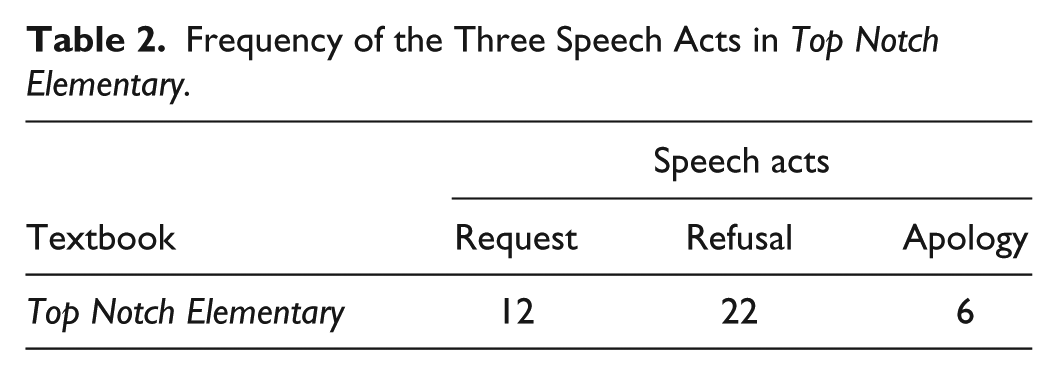
Table 2 indicates the frequency of three speech acts of requesting, refusing, and apologizing for Top Notch Elementary. As shown, the speech act of refusal has the highest frequency (f = 22) and the speech act of apology the lowest one (f = 6). Contrary to other three ELT textbooks, Top Notch Elementary has quite a low frequency with regard to the speech act of request (f = 12).
Frequency of the Three Speech Acts in Top Notch Elementary.
Different strategies of each speech act were also obtained by using the specified frameworks. As is shown in Figure 3, Top Notch Elementary uses more direct speech acts than indirect ones. While the most frequent strategy is direct refusal (f = 13), the least frequent strategy is indirect request (f = 3).
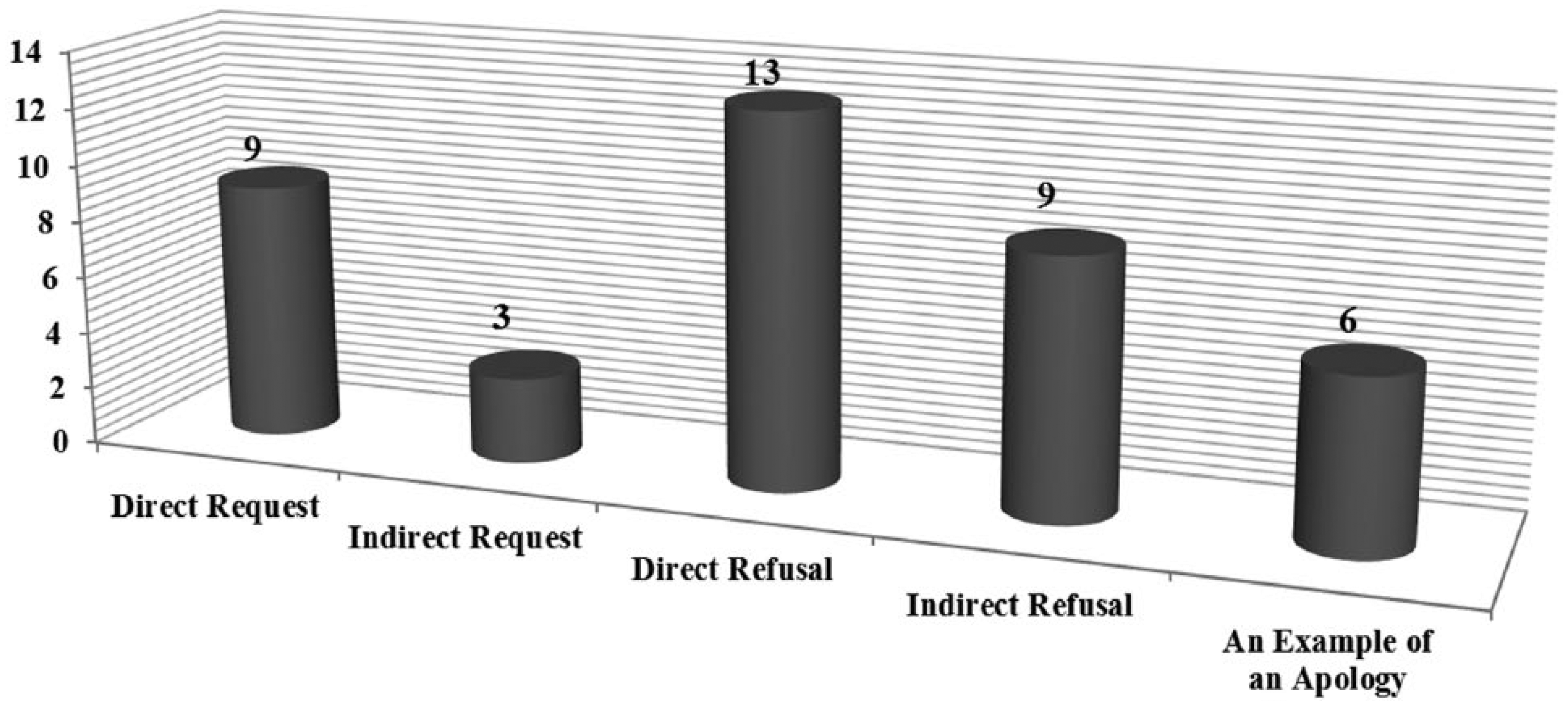
Frequency of the strategies used in each speech act in Top Notch Elementary.
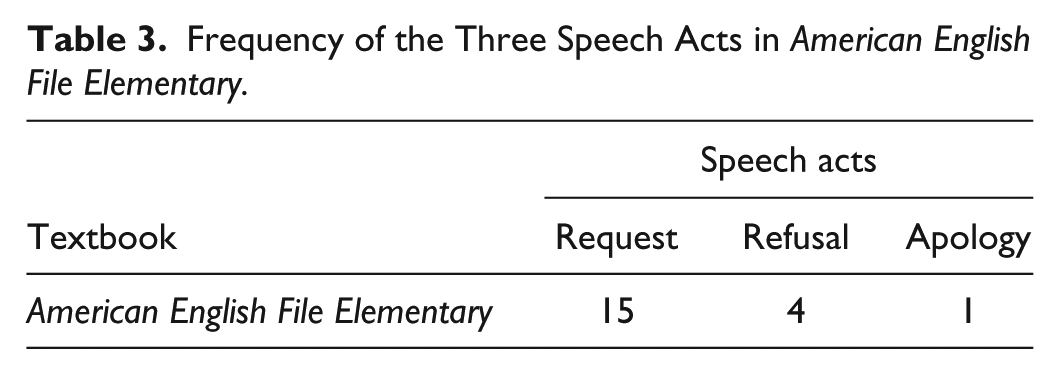
Table 3 presents the speech acts used in American English File Elementary. As indicated, the frequency of the speech acts of refusal and apology are respectively four and one, which suggest, unlike the other global textbooks, American English File does not give much attention to these two speech acts at elementary level.
Frequency of the Three Speech Acts in American English File Elementary.
The frequency of the strategies used for each of these speech acts is also presented in Figure 4. In comparison with Top Notch Elementary that only used three indirect requests, American English File Elementary used more indirect requests in its conversations (f = 8).

Frequency of the strategies used in each speech act in American English File Elementary.
The third question of this investigation was concerned with the frequency of pragmatic content represented in the speech acts of requesting, refusing, and apologizing in local ELT textbooks. For this purpose, ILI Series Elementary was analyzed based on the frameworks discussed above. Table 4 illustrates that, similar to Interchange Elementary and American English File Elementary, ILI Series Elementary has also emphasized on the speech act of request with a higher frequency (f = 22) than refusal (f = 17) and apology (f = 5) at elementary level.
Frequency of the Three Speech Acts in ILI Series Elementary.

Note. ILI = Iran Language Institute.
The strategies used for the three speech acts in ILI Series Elementary are shown in Figure 5 below. One thing that catches one’s attention is the high frequency of direct request (f = 20) and the low frequency of indirect request (f = 2).

Frequency of the strategies used in each speech act in ILI Series Elementary.
One more thing worth mentioning is that, concerning the strategies used for the three speech acts, none of the global and local textbooks include any of the following strategies: non-conventionally indirect refusal for the speech act of refusal, and an explanation for the situation, an acknowledgment of responsibility, and an offer of repair for the speech act of apology.
Discussion
The results of this study demonstrate that it is quite difficult to find a clear-cut pattern both across and within the global and local textbooks with regard to the inclusion of pragmatic content. As far as the frequency of the speech acts across the textbooks is concerned, except for Top Notch Elementary, which makes use of the speech act of refusal more than the speech act of request, request speech act has the highest frequency in the ELT textbooks. Given the inherent difficulty and the requirement of this speech act for a lot of “face-work” within different social contexts (Blum-Kulka et al., 1989), and considering the fact that the speech act of request is quite burdensome for elementary learners compared with advanced ones (Carrell & Konnecker, 1981; Walters, 1980), it is justified why these elementary ELT textbooks focus on this speech act with a high frequency. Compared with the low frequency of apology, the speech act of refusal also enjoyed a relatively high frequency in the ELT textbooks. This may be because of the face-threatening nature of this speech act. According to Ellis (2008), refusal speech act is usually used in response to a variety of illocutionary acts including invitations, offers, and requests. What makes this speech act even trickier is how the status of the interlocutors affects its appropriate use (Beebe & Takahashi, 1989). Consequently, like the speech act of request, L2 learners need to encounter a lot of refusal tasks in the dialogue and conversation parts of their textbooks so as to perform this speech act in various social contexts with interlocutors who have different power status.
Except for American English File Elementary that fails to emphasize the importance of this speech act, the other textbooks show a good frequency with regard to it. Nevertheless, according to the results of this study, both global and local textbooks fail to present the speech act of apology sufficiently and appropriately. Not only do they fail to include a sufficient number of apology speech acts, they also disregard the various strategies through which this speech act can be performed. Since different cultures may realize apology in different ways, poor attention within the textbooks may put L2 learners in trouble in the production and comprehension of apology. This should therefore be regarded as a weakness for the four textbooks. Others also believe low frequency occurrence of the speech act of apology in ELT textbooks usually lead to EFL learners’ difficulty in the appropriate use of it (Felix-Brasdefer, 2004; Gass & Houck, 1999).
Concerning the strategies used for each of the speech acts, although all the four textbooks only emphasized on the strategy of an example of an apology for the speech act of apology and disregarded an explanation or account of the situation, an acknowledgment of responsibility, and an offer of repair, with respect to directness and indirectness of the speech acts of request and refusal, no consistency was found both within and across the textbooks. These inconsistencies were also observed in other similar studies (Alemi, Roodi, & Bemani, 2013; Diepenbroek & Derwing, 2013). Diepenbroek and Derwing (2013) concluded that ELT textbooks usually failed to represent different options which students had to obey to perform a function. Owing to this, language instructors need to complement their textbooks with some authentic extracts; consequently, the students can have access to a better representation of the speech acts for the focus of a particular session.
One reason for these discrepancies may lie in material developers’ attitudes toward the role of ELT textbooks in L2 learning programs. On one hand, those who take Sheldon’s (1988) view that ELT textbook is one of the most important elements for successful language programs believe that effective ELT textbooks should cover all aspects of L2 including pragmatic content. In this view, as classrooms are thought to be an optimal place to equip language learners with pragmatic knowledge for future encounters (Koester, 2002), ELT textbooks should provide teachers with necessary examples of linguistic features at pragmatic level so as to help them optimize learners’ opportunities to promote their pragmatic competence. Naturally, material developers who share this viewpoint tend to include more features of pragmatic content in their textbooks. On the other hand, some such as Bardovi-Harlig (2001) argue that ELT textbooks should not be considered as reliable sources of pragmatic content in the classroom and cast doubt on the effectiveness of presenting learners with pragmatic content in ELT textbooks. Those who take Bardivi-Harlig’s view may focus more on linguistic features at syntactic and semantic levels, and more or less let the pragmatic aspects of L2 learning be automatically taken care of. Nevertheless, sometimes, especially in EFL contexts, ELT textbooks are the only means for providing learners with pragmatic content (Brock & Nagasaka, 2005).
The findings of the present study, with regard to strengths and weaknesses of global and local ELT textbooks, further suggest that, if we consider the frequency of pragmatic content as an indication of the efficiency of the textbooks at pragmatic level, Interchange Elementary is in a better position concerning the inclusion and distribution of pragmatic content represented as three speech acts of request, refusal, and apology, at least at the elementary level. Interestingly, in this regard, the other two global textbooks, namely, American English File Elementary and Top Notch Elementary, can be considered unsatisfying compared with the local ILI Series Elementary. One shortcoming of ILI Series Elementary, though, is that it overrates the strategy of direct request (f = 20), and has the lowest frequency with regard to indirect request (f = 2) among all the textbooks. Although research has shown that low proficient L2 learners tend to use more direct speech acts than indirect ones that are more frequently used by high proficient L2 learners (Ervin-Tripp, Strage, Lampert, & Bell, 1987; Faerch & Kasper, 1989; Hill, 1997), it is still not justified not to present elementary students with enough indirect speech acts.
Conclusion
The aim of this study was to investigate the frequency of pragmatic content occurrence represented as three speech acts of requesting, refusing, and apologizing in global as well as local ELT textbooks. To this end, three global elementary ELT textbooks including Interchange, Top Notch, and American English File, as well as the local elementary textbooks of ILI Series, were analyzed through three frameworks specifically designed for each of the speech acts. Based on the results of the study, although a few discrepancies have been found in the frequency of speech acts and the strategies used to perform them both within and across the global and local ELT textbooks, they also share many strengths and weaknesses regarding their coverage and distribution of pragmatic content. The findings of this study demonstrated the discrepancies existing among different ELT textbooks with regard to pragmatic content, thus the findings is along with that of Diepenbroek and Derwing (2013). The findings of the current study supported the hypothesis that ELT textbooks, both global and local ones, suffered from a pattern to include pragmatic content (Vellenga, 2004).
The present study suffered from a few limitations that should be taken into account when further research is designed. First, as this study only examined ELT textbooks at elementary level, it is not clear whether the strategies that were missing in elementary textbooks are included in higher levels or not. Further study is therefore necessary to examine the distribution of strategies for the three speech acts in intermediate as well as advanced ELT textbooks. Moreover, in this study, pragmatic content was examined only with regard to speech acts of requesting, refusing, and apologizing. Future studies can investigate the patterns of frequency for other speech acts.
The implications of this study are twofold. One implication is that as one of the most efficient ways of acquiring pragmatic competence in EFL/ESL contexts is through using ELT textbooks in the classrooms, it is of paramount importance for material developers to include different speech acts along with various strategies through which they can be performed so as to help L2 learners in promoting their pragmatic competence. The other implication of the present study is for language instructors. As discussed above, not all the speech acts and their strategies are sufficiently frequent and appropriately distributed in ELT textbooks. Therefore, it is the job of language teachers to fill these gaps whenever necessary, especially in EFL contexts where there is not enough exposure to linguistic features at pragmatic level.
Footnotes
Appendix A
Appendix B
Appendix C
Author’s note
At the time of this research the author Mobin Khanlarzadeh, was afiiliated to the University of Tehran, Iran. And now the author is associated with Imam Khomeini International University, Iran.
Declaration of Conflicting Interests
The author(s) declared no potential conflicts of interest with respect to the research, authorship, and/or publication of this article.
Funding
The author(s) received no financial support for the research and/or authorship of this article.