




Abstract
Individual differences can be found in every aspect of emotion, thinking, and behaving. The discovery of basic personality structure models was a watershed for highlighting the importance of individual differences and their outcomes. Different individuals have differences depending upon their personality; these personality dimensions are described in terms of other personality traits in a concise but complete manner. Following the intentions and outcomes of the study, two of them were conducted where; in the first one was carried out to find how the HEXACO model of personality traits will impact Humble Leadership? While the second study intended to explain the impact of Humble Leadership on employee engagement through the mediating role of felt obligations. Two hundred sixteen respondents (leaders and workers) of government sector organizations participated in the study. Results of our research indicated/suggested that Honesty–Humility, Agreeableness, Emotionality, and Conscientiousness significantly contribute to the development of Humble Leadership; however, extroverts and Openness have an insignificant and negative impact on developing a Humble Leader. The outcome of study 2 suggested that Humble Leadership and Employee Engagement significantly impact each other while Felt Obligation plays a significant mediating role in this relationship.
Plain Language Summary
The purpose of this study is to find the impact of personality trait model on humble leadership and then the impact of humble leadership on employee engagement through the mediating role of felt obligation. Survey method was conducted to collect data from leaders and employees of public sector organizations. Results suggest that felt obligation mediates the relationship between humble leadership and employees obligation. Based on findings this study concludes that in today’s knowledge-driven economy, bottom-up leadership approaches are more entirely suited and are desperately needed. Further, organizations should formulate the strategies that promote humbleness in the organization to generate positive employee-related outcomes.
Introduction
Empirical research over the past few centuries have been continuously shedding light on the importance of studies related to a leader and leadership styles for the betterment of organizations. While the literature of said variable is progressing eventually, different research has shown positive and negative dimensions of Leadership, and leadership theories have categorized new leadership traits. In this dynamically changing work environment, leaders are considered champions (Tangen, 2017), heroes (Raelin, 2003), chevaliers (Khurana, 2002), paragons and exemplars (Tallman, 2003); they are seen as ideals and worriers (Gabriel, 1997). Leaders have emerged as a savior for organizations continuously facing severe challenges with global change in work practices (Rost, 1991). In practical situations of the organizational scenario, the actions of many leaders are the reciprocity of heroic terms (Bligh & Schyns, 2007). Humility in Leadership is considered essential while working and managing many followers.
On the other hand, Humility is considered a type of personal frailty (Exline & Geyer, 2004), a leader’s intrinsic desire to serve in terms of foible (Malik, 2023; Parolini et al., 2009). According to the research of Collins (2007), most leaders use Humility toward followers at their workplace. He also suggested that organizations with high performance incorporated many essential characteristics; the most salient among all is Level 5 leaders who led great companies; is a kind of individual who is the combination of personal will and Humility.
Collins (2007) in his study also suggested that Level 5 leaders are not primarily focused on their success, but their goals are always aligned with the organization’s goals; their success always depends upon the organization’s success. Collins (2007) also suggested that employees in the workplace should be treated with Humility which significantly impacts their work-engaging behavior. Specifically, a humble leader can sustain the organization’s progress for extended periods (Ou et al., 2018). On the other hand, an organization can become a benchmark performer in that industry. If a humble leader leaves the organization or takes retirement still organization can sustain superior performance continues long past the tenure of the humble leader.
Vera and Rodriguez-Lopez (2004) argued that Humility plays an essential role in building organizational resilience and increasing organizational learning, which may directly impact overall organizational performance. The leadership process can be seen through the lens of Humility, which may show the new dimensions of a positive work environment and play an essential role in enhancing employee performance. Different personality traits may influence different leader effectiveness, mainly when framed for building competencies, which remains compelling (Kirkpatrick & Locke, 1996). The background revealed that several studies are available talking about leadership traits. However, since the concept’s inception, the literature identified that Humble Leadership was not tested by taking individual differences-related variables (Akhtar et al., 2022; Chirumbolo & Leone, 2010).
Moreover, several outcomes have been examined concerning Humble Leadership, but limited literature is available regarding the antecedents. Furthermore, the literature still does not posit which personality trait provides a strong link with the development of Humble Leadership. HEXACO personality model consists of six personality dimensions: Honesty–Humility, eXtroversion, Agreeableness, Consciousness, and Openness to experience. HEXACO personality model is used in the current study to identify the connections between personality traits and the development of Humble Leaders (Zhu et al., 2019). The study’s objectives are to clarify the impact of personality in the development of Humble Leadership vis-à-vis identifying the impact of Humble Leadership on employee engagement through Felt Obligation. Employee engagement is the core concern of the organization, and for this purpose, organizations are focusing on taking initiatives that lead to introducing programs for boosting employee engagement (Malik & Khan, 2020).
Humble Leadership can develop Felt Obligations feelings in their followers that further bridged to engage themselves in fulfilling their assigned tasks. Hence, the current study is conducted first to identify Humble Leadership’s development and then determine Humble Leadership’s impact on employee engagement through Felt Obligation. The study contributes and provides new insights in the literature concerning Humble Leadership as it is the first attempt to take the HEXACO personality model to identify its role in the formation of Humble Leadership. Moreover, it is also accepting and investigating the role of Humble Leadership in developing and increasing the work engagement tendencies in followers, specifically those working in the public sector. The literature revealed that work engagement is a burning issue in organizations and that organizations are focusing on overcoming the issue by implementing a perfect leadership style.
Literature Review
HEXACO and Humble Leadership
HEXACO personality model widely discussed six dimensions of personality where H = Honesty–Humility, E = Emotionality, X = eXtraversion, A = Agreeableness, C = Conscientiousness, and O = Openness to Experience. It extends the traditional Big Five personality trait where Honesty–Humility is included as the sixth dimension (Lee & Ashton, 2004). Ashton and Lee (2007) suggested that the personality space is better explained with six dimensions than five. Openness to Experience, Conscientiousness, and Extraversion are identical to the Big Five personality dimensions, while Honesty–Humility is a novel and unique factor in the six-dimensional structure. Honesty–Humility is characterized by sincerity, modesty, and a lack of greed. This novel personality dimension makes the HEXACO model distinct, which has no such dimension in the Big Five/Five-Factor models.
Anxiety, fearfulness, sentimentality, reliance, and emotional reactivity are qualities of Emotionality instead of self-assurance, toughness, and courage. This dimension resembles the Big Five Emotional Stability component in specific ways. Extraversion is comparable to Extraversion as described in the Big Five since it is associated with talkativeness, friendliness, and cheerfulness vs shyness, passivity, and silence. Agreeableness is defined as having a pleasant and easygoing personality and tolerance and kindness, as opposed to being irritated, contentious, and critical. This dimension’s content differs from that of the Big Five Agreeableness, notably in terms of its content of irritation, which are features of low emotional stability. Conscientiousness dimension in the link with Big Five personality model, described imagination, novelty, intellectual curiosity, creativity, and imaginativeness, describe Openness to experience. Latent inhibition is a brain mechanism that filters out superfluous visual and cognitive information in less receptive persons. Three dimensions of humility leadership (Owens & Hekman, 2012) indicate social interpersonal characteristics: a readiness to assess oneself truthfully, respect for others’ talents and contributions, and teach ability (Malik et al., 2022; Owens et al., 2013).
Humble Leadership refers to a leader’s interpersonal traits that assist them in communicating with subordinates and is defined by a desire to evaluate oneself honestly, teach ability and respect others (Owens et al., 2013). Leader humility is viewed as an interpersonal attribute shown in their behaviors that followers notice throughout social encounters. Humble leaders’ behavioral features, such as uttering a desire to analyze oneself without exaggeration, precisely reflect a precise, non-defensive, and objective self-examination (Exline & Geyer, 2004; Hassan et al., 2023; Nielsen et al., 2010). Humble leaders recognize the people’s strengths without feeling threatened (correct perception of oneself) and comprehend the value and contributions of their supporters (appreciation of others). Furthermore, they are receptive to innovative ideas, guidance, and information while demonstrating a strong desire to learn from others (teach ability) (Ali et al., 2020; Tangney, 2000). Based upon the characteristics, Honesty–Humility has the strength to influence and play an imperative role in the development of Humble Leadership, because some scholars define Humble Leadership as Humility.
Moreover, this personality trait of an individual works as a guiding mechanism to display Humble Leadership characteristics. The dimension of Humble Leadership, that is, Willingness to acknowledge one’s mistakes and limits, is related to Honesty–Humility because one remains honest to accept their mistakes and act accordingly. Hence, the leader remains conscientious about observing themselves to avoid mistakes in daily routine tasks in the organization. The other dimension of Humble Leadership, such as keeping Openness to advice, idea, and feedback, is showing leaders’ closeness with their subordinates which creates emotional attachment due to personality traits such as Emotionality. Due remains open relates to Openness to experience because these types of leaders are also trying to learn new things and grab new knowledge to guide their subordinates. So this personality dimension also has the strength to contribute to the development of Humble Leadership.
H1a: Honesty–Humility has a strong relationship with Humble Leadership
H1b: Emotionality has a strong relationship with Humble Leadership
H1c: eXtraversion has a strong relationship with Humble Leadership
H1d: Agreeableness has a strong relationship with Humble Leadership
H1e: Conscientiousness has a strong relationship with Humble Leadership
H1f: Openness to Experience has a strong relationship with Humble Leadership
Humble Leadership, Felt Obligation, and Employee Engagement
Social Exchange Theory supported the relationship of Humble Leadership and Employee Engagement while Felt Obligation played a mediating role between the relationships. Humble Leadership creates an environment where Humility is essential, so subordinates feel obliged and try to remain engaged in their work-related activities. Among the current and closely comparable bottom-up leadership styles, a study by Owens and Hekman (2012) extensively highlighted how the humble leadership notion is distinctive in three areas (behavior, process, and outcomes). So humble leaders highlight their followers’ strengths and contributions, freely admit their mistakes, limitations, and flaws, provide their subordinates psychological freedom, and stay involved with them. Owens and Hekman (2012) identified two key differences: (1) humble Leadership models the process of becoming for followers, and (2) the legitimization of uncertainty under humble Leadership, in which humble leaders openly acknowledge the uncertainties (limitations) that surround their leadership role, whereas other traditional leaders pretend to know everything (Ali et al., 2020).
Humble Leadership entails providing psychological freedom between leaders and subordinates, beginning role reversal between leaders and followers, promoting organizational flexibility, and encouraging a proclivity for small-scale adjustments. According to Aryee et al. (2012), Leadership affects performance by establishing cognition-based trust and team potency; however, leader humility’s influence was exerted through the contagion of behaviors, changing certain features of collaboration and regulatory-focus components of team functioning. Employees regard humble Leadership as a model of growth, leading them to believe that their improvement and growth activities are acceptable and essential (Owens & Hekman, 2012, 2016).
Additionally, it encourages people to approach possibilities (Rietzschel, 2011) and work toward their full potential. Furthermore, humble Leadership legalizes ambiguity, motivates staff growth, and promotes cultures of empowerment and autonomy by acknowledging one’s limitations and past mistakes (Ali et al., 2020; Ou et al., 2014; Yuan et al., 2018).
More effective commitment and job engagement emerge when workers emphasize work-related promotion (Akhtar & Lee, 2014). A focus on success, ideals, and gains in the workplace (Akhtar & Lee, 2014) acts as a “can-do” drive to overcome work-related hurdles and constraints. According to Wallace and Chen (2006), focusing on work-related promotion pushes employees to put in more effort to succeed, which may lead to increased employee resilience (Figure 1).
H2: Felt Obligation mediates the relationship of Humble Leadership and Employee Engagement

Framework.
Methodology
Research Design
The present study objectives were to identify the relationship of HEXACO with Humble Leadership and the impact of Humble Leadership on Employee Engagement with the mediating role of felt obligation. To meet the current study’s objectives, we split the model and carried out two studies. Both studies were conducted using a quantitative research design. In study 1, the current study identifies the role of the HEXACO personality model in developing Humble Leaders. The purposive sampling technique is used to select the potential respondents. For the collection of the data survey method through self-administrated questionnaire was used, and data were collected from the employees and their managers (leaders) of public sector organizations.
Study 1
Participants
Two hundred sixteen participants (Leaders/Supervisors) from public sector organizations were identified and selected to collect the response related to their personalities. Out of 216 participants, 17 were female, and 199 were male. The questionnaires related to Humble Leadership were filled out by their department managers. Overall, 230 questionnaires were distributed, and 218 were received back from the said employees who were asked to rate their leaders’ Humbleness. Out of 218 questionnaires, 216 were finalized for analysis because some had unattended items and other related issues.
Procedure and Data Analysis Techniques
The data in study 1 was related to the HEXACO personality model and Humble Leadership, where personality model related questions were filled by the leaders/supervisors. After collecting responses, each questionnaire was assigned a code containing the first alphabet of the name of leaders/supervisors. On the other hand, subordinates rated their leaders/supervisors for identification of Humble Leaders. On the questionnaire, it was mandatory to mention the name of leaders/supervisors, and after collection of the questionnaires all the questionnaires pinned together according to the code. In study 1, bivariate correlation and regression tests were run to determine which personality trait is contributing more for development of Humble Leaders. Prior to correlation and regression analysis EFA and CFA were obtained by using SEM- AMOS techniques. Data normality, validity, and model fit measures were also observed before going to further analysis (Malik et al., 2023).
Measures
HEXACO
HEXACO personality traits were measured by using 24 items scale (4 items per personality trait) of De Vries (2013). Honest- Humility as dimension of HEXACO was measured with four items with the elements of sincerity, fairness, greed avoidance and modesty. Emotionality contained fearfulness, anxiety, dependence, and sentimentality related items. Extraversion used items related to liveliness, social boldness, sociability, and social self-esteem. Agreeableness related items are categorized as forgiveness, gentleness, flexibility, and patience. Conscientiousness personality model related measure is consisting upon the items related to organization, diligence, perfectionism, and prudence. Lastly, Openness to experience enlist the items related to aesthetic appreciation, inquisitiveness, creativity, and unconventionality (Malik et al., 2023). All the items were measured at 5-point Likert Scale where 1 = strongly disagree and 5 = strongly agree.
Humble Leadership
Humble Leadership is a subordinate-rated scale where they rate their leaders/supervisors originally developed by Owens et al. (2013). It is nine items scale and participants rated each item from 1 (strongly disagree) to 5 (strongly agree).
Study 2
Participants
216 participants (followers/employees) from public sector organizations were selected to collect the response related to their perception of their leaders, felt an obligation, and employee engagement. Out of 216 participants, 157 were male, and 59 were female. Most participants had a graduation degree (94%), and most reported their age bracket from 30 to 35 (87%).
Procedure and Data Analysis Techniques
Study 2 data relates to the Felt obligation (mediator) and Employee Engagement (Dependent Variable). Using AMOS guidelines provided by Hair et al. (2014) were followed for data analysis. EFA and CFA were obtained with model fit measures and master validity to avoid data inconsistency. Moreover, regression analysis and mediation analysis were used to test the hypotheses.
Measures
Felt Obligation
Felt obligation was measured by using seven items scale of Eisenberger et al. (2001). It is an employee/followers-related scale used to assess employees’ felt obligation to care about the organization and help it reach its goals.
Employee Engagement
A self-reported questionnaire comprised of nine (9) was adapted from the study of Schaufeli et al. (2006) to measure employee engagement. Employees rated their work engagement on a five-point Likert scale starting from Strongly Disagree to Agree Strongly.
Results
Study 1
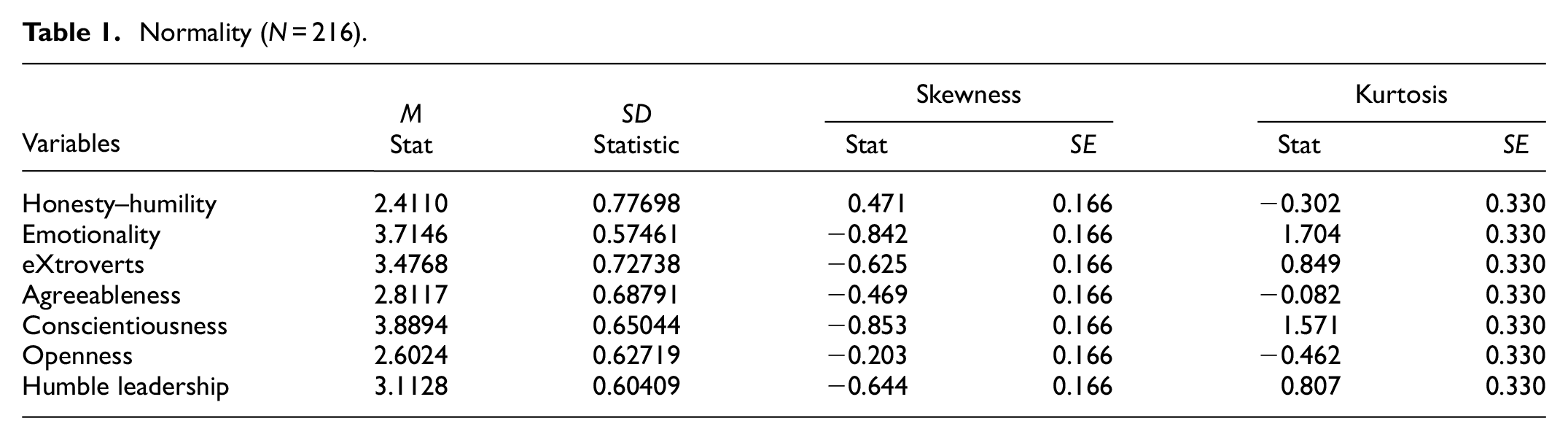
Table 1 represents Mean, Standard Deviation, Skewness, and Kurtosis values for checking the normality. Table 2 contained HEXACO model and Humble Leadership related values. The values are according to the range defined by different scholars and methodological experts. So it can be interpreted that the data mentioned against each variable is normal, allowing us to move for further analysis
Normality (N = 216).
Discriminant Validity (N = 216).

p < .05. **p < .01. ***p < .001.
Table 3 presented above displays the statistical measures of reliability, average variance extracted (AVE), and correlation stats. The data presented in Table 3 indicates that all the composite reliability values of the constructs are >.80, so no reliability concerns have been found in the data. Moreover, for the validity of the data, all the values of Average Variance Explained are >.50, so no validity concerns have been found in the data as stated by Hair et al. (2014). Furthermore, Table 3 is also shown the values for correlation among variables, and it has been identified that all the values are <.60, so the is no issue of Multicollinearity was found in the data.
Factor Loadings, Reliability, and Validity of Measurement Model (N = 216).

Table 3 displays the item-wise values of each construct used in the current study. It showed the loading of items and values related to the measurement model. All the values are according to the defined range. Table 3 also revealed Measurement model fit statistics and Incremental fit indices that are also allowing to proceed for hypotheses testing since all the values are in an acceptable range.
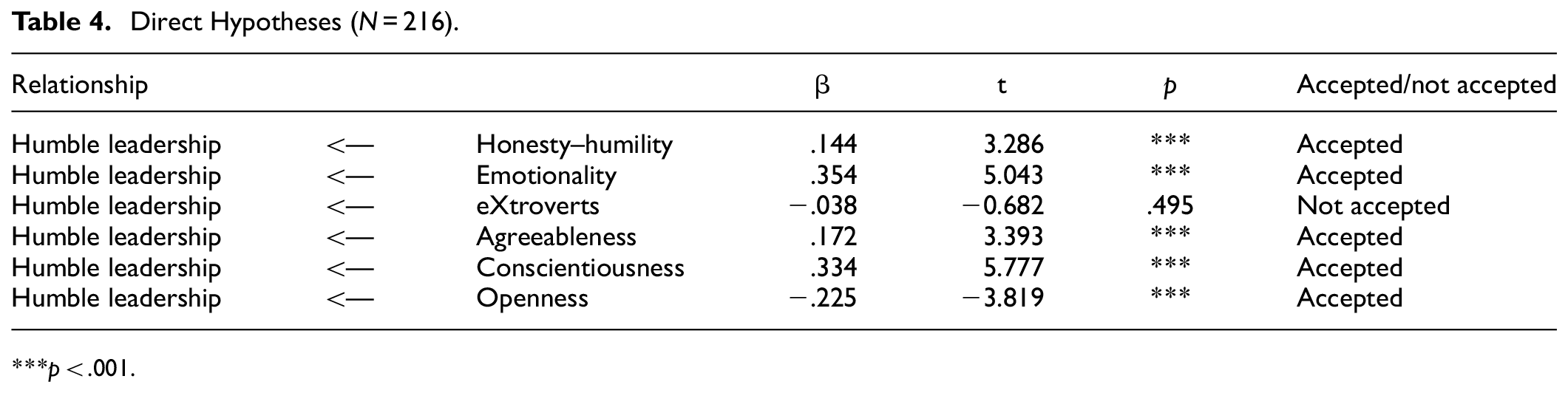
Table 4 and Figure 2 provided direct path coefficients where it has been identified that the Honesty–Humility have significant impact on Humble Leadership (β = .114, t = 3.286, p < .001), Emotionality have significant impact on Humble Leadership (β = .354, t = 5.043, p< .001), and Agreeableness- another personality dimension observed with having significant impact on Humble Leadership (β = .172, t = 3.393, p < .001). Similarly, Conscientiousness and Openness-related values also having significant impact on Humble Leadership. However, eXtroverts have insignificant impact on Humble Leadership because the values of t < 3, and p > .01 (see Table 5).
Direct Hypotheses (N = 216).
p < .001.

Path model of HEXACO and humble leadership.
Normality (N = 216).

Study 2
Table 6 shows the reliability stats, AVE, and correlation stats. It provides help to determine the discriminant validity and also shows the relationship among Independent, Dependent, and Mediating Variable. The value of Composite Reliability is .928; AVE is .601 for Humble Leadership. Employee Engagement (Dependent Variable) values of CR = .928, and AVE = .601. Felt Obligations Values of CR = .812, and AVE = .520.
Discriminant Validity (N = 216).

Table 7 shows the item-wise values of each construct considered for the analysis. Humble Leadership items loading was mentioned in the Study 1, Table 3. Whereas, the item wise loadings of Mediator, that is, Felt Obligation and Dependent Variable, that is, Employee Engagement were added in Table 7. Table 7 also contained Composite Reliability and Average Variance Explained (AVE) related values. The values are in the range as set by the Hair et al., (2014).
Factor Loadings, Reliability, and Validity of Measurement Model (N = 216).

Table 8 and Figure 3 obtained with the help of AMOS by using SEM techniques and guidelines. The results revealed that it could be assumed that Humble Leadership can directly or indirectly influence employee engagement. Since the direct effect of Humble Leadership on Employee Engagement is still significant even after Felt Obligation enters the model and the total (direct and indirect) impact of Humble Leadership on Employee Engagement is .475. That is, due to both direct and mediating effects of Humble Leadership on Employee Engagement, when Humble Leadership goes up by 1, Employee Engagement goes up by .475. The indirect (mediated) effect of Humble Leadership on Employee Engagement is −.102. That is, due to the indirect (mediated) effect of Humble Leadership on Employee Engagement, when Humble Leadership goes up by 1, Employee Engagement goes down by 0.102. This is in addition to any direct (unmediated) effect that Humble Leadership may have on Employee Engagement. So Felt Obligation is playing a role as mediator in the relationship of Humble Leadership and Employee Engagement.
Mediation Hypotheses (N = 216).

p < .000.
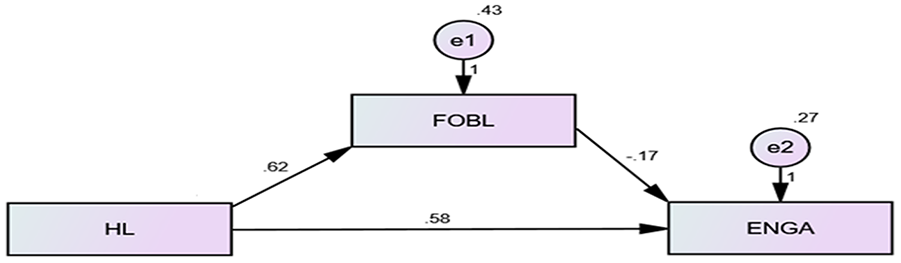
Mediation analysis.
Discussion
The present study sheds insight on the emerging field of bottom-up leadership and its implications for the HEXACO personality model, revealing that it has the potential to foster humble leadership. The present study is unique in its attempt to investigate and establish the factors that contribute to Humble Leadership, despite the abundance of existing literature on the subject. The primary aims of this study were to investigate the influence of HEXACO on the development of Humble Leadership, as well as to examine the effects of Humble Leadership on Employee Engagement, with a particular focus on the mediating role of Felt Obligation. The findings indicate that Honest-Humility, which is the fundamental trait of Humble Leadership, plays a key role in the cultivation of Humble Leaders. In relation to this, previous research has also employed the terms Humility and Humbleness interchangeably (Wright et al., 2017; Malik et al., 2023).
Tangney (2000) provided a description of Humility as both a trait and a state. However, the majority of existing literature has predominantly conceptualized Humility as a trait of individuals, as they consistently display behaviors across many situations. Consequently, individuals who exhibit such consistent behaviors are commonly referred to as being Humble. According to Wright et al. (2017), those who possess the trait of humility exhibit a diminished emphasis on self and an increased emphasis on others. This inclination toward others fosters honesty and cultivates a sense of humility toward them. The presence of humility inside the realm of intellectual pursuits has been found to have a greater impact on the development of leadership skills (Owens et al., 2013) and the maintenance of interpersonal connections (Davis et al., 2012). According to the categorization of Exline and Hill (2012), Humility is identified as a personality attribute that is associated with Humble Leadership. In nations characterized by the prevalence of robust religious observance, a significant proportion of persons endeavor to uphold principles of honesty and cultivate unselfish sentiments as a means of fostering humbleness toward others. The present study’s empirical findings and outcomes demonstrate a consistent alignment, leading to the conclusion that the development of Humble Leadership is highly influenced by Honesty–Humility. Abbasi et al. (2020) conducted a study in which they found a strong relationship between Honesty–Humility and the development of a certain personality trait (β = .74, p < .001). In their study, Malik et al. (2023) found a significant relationship between Honesty–Humility and the development of authentic leadership (β = .094, p < .001). The findings are consistent with prior research (Malik et al., 2023).
The findings of the present study indicate a significant influence of Emotionality on the formation and progression of Humble Leadership. Konrath, Corneille, et al. (2014) and Lawrence et al. (2015) have identified that individuals who exhibit other-focus tendencies are characterized by heightened emotional sensitivity. The development of sensitivity fosters a sense of humbleness, even in the presence of differing opinions, as those with profound sensitivity are inclined to respect and acknowledge differences (Watkins & Hook, 2016). Furthermore, it has been posited by scholars such as Morris et al. (2005) that there exists a significant correlation between awareness and emotional control, both of which are closely linked to the concept of Humility, which serves as the fundamental principle of Humble Leadership. Moreover, Humility is regarded as a mechanism for achieving moral excellence, which constitutes the ultimate goal of the constructive encounters with others and possesses an inherent capacity to foster Humbleness. In a collectivist cultural context, individuals tend to be significantly influenced by others, particularly those who exhibit traits of humbleness. Individuals make an effort to maintain composure and exhibit deference toward the viewpoints of others (Malik et al., 2023). The findings reveal a significant influence of emotionality on humble leadership. Previous research conducted by Malik et al. (2023) has demonstrated the significant influence of emotionality on the formation of authentic leadership (β = .35, p < .001). In a similar vein, the study conducted by Naz et al. (2021) revealed that emotionality exerts a substantial influence on several leadership styles, including the authentic style, with a beta coefficient of .47 and a statistically significant p-value of less than .05.
Similarly, Agreeableness is recognized as a noteworthy factor in the formation of Humble Leadership. It is widely acknowledged that individuals with pleasant personalities often exhibit greater humility due to their inclination to place importance on the perspectives of others (Nadelhoffer et al., 2017). Allik and McCrae (2002) recognized that agreeable individuals are trying to maintain relationships with others and such individuals turn out to be humble to others. Hence, Agreeableness impacts Humble Leadership because such leaders are helpful to others (LaBouff et al., 2012). Malik et al. (2023) found that agreeableness has significant impact on authentic leadership (β = .23, p < .05). The current study results revealed that agreeableness is having 17% role in the development of humble leadership.
The traits of conscientiousness and openness exert a notable influence on the concept of humble leadership. Conscientiousness is a personality trait characterized by a tendency to exhibit carefulness and diligence (Malik et al., 2021). Conscientiousness is characterized by a strong inclination to perform tasks with excellence and a sincere commitment to fulfilling commitments toward others. Within the realm of Leadership, conscientiousness is employed to ensure meticulous attention to the maintenance of relationships (Walumbwa et al., 2012). According to Liu et al. (2021), individuals with high levels of conscientiousness engage in moral evaluation, whereas those with low levels of conscientiousness exhibit traits such as unreliability, thoughtlessness, and carelessness, which are contrary to the characteristics associated with Humble Leadership.
Furthermore, persons who possess conscientiousness exhibit a heightened level of attentiveness toward intricate aspects, possess a robust moral compass, engage in intentional decision-making processes rather than relying on chance, and make choices guided by their personal sense of right and wrong (Judge et al., 2009). According to the findings of the present study, it has been demonstrated that Conscientiousness have the capacity to foster the development of Humble Leadership. The trait of openness is found to have a notable adverse effect on Humble Leadership, since persons who possess this trait tend to align themselves with the characteristic of displaying honest behaviors. Furthermore, those who possess the trait of Openness exhibit a propensity to actively seek out and embrace novel approaches in order to effectively accomplish their objectives. Within an organizational context, an individual who possesses the trait of Openness demonstrates adaptability and consistently modifies their work habits in response to the demands of the surrounding environment. Traditional working techniques are discouraged and instead, flexibility in adopting change is emphasized over humbleness. In nations and public sector entities that adhere to stringent norms and regulations, persons who do not align with the demonstration of humbleness are considered incongruous (Malik et al., 2023).
The result of the current study is aligned with the justification that Openness restrict Humbleness because of the qualities of such personality traits. Likewise, extroversion also has an insignificant impact on the development of Humble Leadership because they tend to think out loud and are generally more outgoing. Extrovert individuals are very open and willing to share their thoughts and feelings openly, even if they have different opinions that are not aligned with the qualities or characteristics of Humbleness. The results also suggest that the eXtroverts are not playing any role in developing Humble Leadership. Allam, (2007) also reported that personality of an individual is guiding the individual to come-up with certain attitude.
Humble Leadership theory explained that it has positive outcomes concerning followers or subordinates (Yang et al., 2019). The literature identified that Humble Leadership adopts the bottom-up approach, which motivates their followers (Malik et al., 2021, 2023; Malik & Khan, 2019). Because they are getting positivity from their leaders, the followers of Humble Leaders feel more obliged and reciprocate their leaders’ qualities, so they tend to engage in work-related activities (Zhou & Wu, 2018). The concept is supported by Social Exchange Theory broadly defines that the individual at the workplace displays the attitude and behaviors according to the organization’s initiatives (Yuan et al., 2018).
The current study also showed that humble Leadership and employee engagement have a significant relationship, mediated by felt obligation. Allam (2017) highlighted that the employee disengagement is real threat to an organization. Similarly, Al-Kahtani and MM (2022) identified that the HRM practices are playing imperative role in the development of positive attitude of employees. Thus, humble leaders, by acknowledging mistakes and limitations, recognizing the contributions and strengths of followers, and modeling teach ability can create an environment in which followers can feel obliged and fully engage in their work. The current study is identified that the humbleness is having significant but negative relation with engagement in the presence of obligation. These results are due to the culture of the country where most of the individuals are taking humbleness as for granted and less engaged themselves in work- related activities (Abid et al., 2015; Shah et al., 2019).
Theoretical Implications
From theoretical and practical lenses, leaders have always been portrayed as heroes, demigods, and superhuman saviors (Yukl, 2012). Top-down heroic Leadership may be considered beneficial. However, these study findings imply that in today’s knowledge-driven economy, bottom-up leadership approaches are more entirely suited and desperately needed (Lichtenstein et al., 2006). In line with these thoughts, the current study added HEXACO model as antecedent of Humble Leadership and identified the impact of HEXACO on the development of Humble Leadership. In the collectivist culture, Humble Leadership development is much more influenced by Honesty–Humility, Emotionality, Agreeableness, and Conscientiousness. In contrast, extroverts and Openness have an inverse impact on the development of Humble Leadership.
Moreover, rendering leaders’ intrapersonal (internal) states interpersonal, making self-awareness, social learning, emotional regulation, and teachability explicit and salient in the process of leader-follower interactions, appears to be a precise and effective way to raise this context of leadership development. Furthermore, leader humility seems to catalyze an exchange that mutually reinforces leader and follower developmental activities, which may have important implications for fostering “developmental readiness” between leaders and followers (Owens & Hekman, 2012). The current study tested mediating mechanism between Humble Leadership and employee engagement through felt obligation. It adds new insights to the theory of Humble Leadership by adding felt obligation that is working as a guiding mechanism to followers or employees of public sector organizations to engage in work-related activities.
Managerial Implications
These findings of the current study could have a variety of implications. To begin, our results highlight the significance of humble Leadership in fostering follower engagement. Humility is a desirable quality that can be learned and cultivated (Rego et al., 2017). As a result, leadership training and development programs should be available to help leaders understand and strengthen their Humility. Before training, the organization needs to identify the individual with personality traits such as Honesty–Humility, Emotionality, Agreeableness, and Conscientiousness because these traits are recognized as the antecedents of Humble Leadership. Second, our data imply that felt obligation plays a role in mediating the relationship between Humble Leadership and follower engagement. According to the literature, several acts by organizations and leaders, such as encouraging followers, praising their efforts, and creating trust and supporting connections, are excellent for developing obliged feelings (Burhan et al., 2023; Wang et al., 2018). Organizations should use the results of the current study and formulate strategies that promote Humbleness in the organization to generate positive employee-related outcomes.
Future Research Directions
Besides the research considering the antecedents and outcomes of Humble Leadership, some interesting future research avenues should explore to test the theory of Humble Leadership. First, the current research was carried out in a public sector organization with strict rules and regulations. Therefore, future research may consider private sector-related organizations to identify the true impact of HEXACO in the development of humble Leadership. Secondly, the study conducted in the Pakistani context with a highly collectivist and power distance culture raises the question of whether our findings can be applied to Western and other cultural situations. Thirdly, it was materialized that leadership-related research cannot test in isolation; instead, it should be carried out by including boundary conditions (Malik et al., 2021; Malik & Khan, 2019; Wang et al., 2018), so future research can consist of country culture as moderating variable. Finally, in the power distance culture, where individuals influence others, humble leaders might significantly impact negative work-related outcomes such as procrastination and non-work-related presenteeism (Akhtar & Faisal Malik, 2016) because their followers/employees use using leader’s Humbleness negatively. So, future researchers should also include negative behavior to investigate the phenomena.
Footnotes
Author Note
This research was conducted while [Saqlain Raza] was at [Shaheed Zulfikar Ali Bhutto Institute of Science and Technology (SZABIST), Islamabad, Pakistan]. He is now at [Plymouth Business School, University of Plymouth, UK] and may be contacted at [
Declaration of Conflicting Interests
The author(s) declared no potential conflicts of interest with respect to the research, authorship, and/or publication of this article.
Funding
The author(s) received no financial support for the research, authorship, and/or publication of this article.
