



Abstract
Student engagement is crucial for academic success, as well as for fostering connections with the learning environment. When students are emotionally and cognitively invested in their education, they are more inclined to remain motivated, excel academically, and develop a sense of belonging. However, numerous students face challenges with engagement, particularly when they lack the emotional resources to cope with daily academic pressures. This research examines whether instructing students in emotional regulation through cognitive strategies can enhance their overall engagement in school. To achieve this goal, a quasi-experimental study was carried out involving 54 high school students. The participants were randomly assigned to two groups: one group underwent a structured training program that emphasized cognitive emotion regulation techniques such as positive reappraisal and planning, while the other group acted as a control and did not receive any training. School engagement was assessed using School Engagement Scale prior to the intervention, immediately following it, and a month later. The outcomes based on post and postponed engagement scores were encouraging: students who engaged in the training program exhibited significantly elevated levels of engagement in both the immediate and follow-up evaluations compared to their counterparts in the control group. These results indicate that training initiative can produce a significant and enduring effect on how students relate to their educational experience. Instructing students in cognitive emotion regulation may serve as an effective method to bolster student motivation, resilience, and academic development particularly during the pivotal early years of high school.
Plain Language Summary
This study aimed to understand how a specific educational program could improve students’ engagement in school. Engagement here means how involved students are in their learning. To explore this, students were divided into two groups. One group (the experimental group) received the program, while the other group (the control group) did not. Both groups were assessed at three points in time: before the program started (pre-test), after it ended (post-test), and a few weeks later (follow-up test). The results showed that students in the experimental group became more engaged in school across all areas—thinking more deeply about their learning, participating more actively, and feeling more emotionally connected to school. These improvements were stronger than those seen in the control group.
Introduction
An individual faces stressful experiences throughout life situations, including school environment, which causes to experience a range of emotions considering the changes encountered in personal, social, and psychological aspects. The emotions a person has in a certain circumstance cause them to act in a number of ways that may or may not have an effect on their academic career. Therefore, emotion regulation strategies could be used to control emotions which are known as coping strategies (Atoum & Al-Adamat, 2024; Skinner et al., 2009).
Emotion regulation, as stated by Gross (1998) represents a complex process by which they influence the emotions an individual has since emotions are a multi-component process that develops over time, controlling them involves changing their dynamics and the way response components relate to the emergence of emotion. The term “cognitive emotion regulation strategies” describes how people control their emotions, particularly under pressure. These tactics focus on how an individual’s views about emotional experiences impact their emotions and behavior. According to Thompson (1991), cognitive processes can be crucial in managing emotions, and Garnefski et al. (2002) stress that these techniques influence how people perceive and react to emotional situations. While some tactics are beneficial and flexible, others could be detrimental or ineffective.
Garnefski et al. (2001) perception related to cognitive emotion regulation strategies lies in the idea that emotions have a biological basis and can affect these emotions, in addition to the way through which emotions are expressed. Emotion regulation includes a variety of external and internal processes that are in charge of monitoring, assessing, and adjusting emotional responses to meet personal objectives.
There are nine cognitive strategies that can be used in emotion regulation, according to Garnefski and Kraaij’s theory. Some are positive adaptive strategies (Positive reappraisal, putting into perspective, positive refocusing, refocusing on planning, and acceptance). Others are negative maladaptive strategies (Other Blame, self-blame, and Catastrophizing; Garnefski & Kraaij, 2006, Garnefski et al., 2007).
The importance of cognitive emotion regulation strategies lies in their important role in enabling individuals who are more likely to develop mental disorders in response to the negative life experiences to accept or control those experiences (Garnefski et al., 2001). Their importance also lies in their role in achieving balance between the emotional arousal that arises from an individual being exposed to a series of stressful experiences and the nature of the individual’s mental and emotional makeup, which helps in solving problems he faces, goals-achieving, mental alertness, and find meaning in life (Koohbanani et al., 2013).
One issue related to cognitive emotion regulation strategies, is school engagement since emotions and students’ ability to regulate them can affect how they behave inside the school and how well they achieve their academic goals. Many researchers pay close attention to school engagement since it is one of the variables that can be developed and improved to assess students’ commitment to school and motivate them to learn (Atoum & Al-Adamat, 2024; Omari & Atoum, 2023; Veiga et al., 2012).
According to Newman et al. (1992), school engagement is the psychological effort that the student put into their education and in understanding and mastering the knowledge and skills that the school seeks to enhance through curricular and extracurricular activities. It is defined by Lawson and Lawson (2013) as the motivation that drives students to engage in the learning activities both inside and outside of the classroom.
Moreover, school engagement encompasses three areas: behavioral engagement, which pertains to students’ involvement in school activities and positive educational practices such as completing assignments, attending classes, focusing on the learning process, exerting effort on learning tasks, achieving academic success, following school rules, and the lack of disruptive behavior. Cognitive engagement, which is characterized by the extent of mastery of learning tasks and students’ capacity for adaptable problem-solving via individual effort and self-regulation techniques. And emotional engagement, which is defined by the connection between students and the school, a feeling of belonging to it, favorable emotional responses toward the school, their peers, and teachers, along with an emphasis on feelings of interest and enjoyment (Atoum et al., 2019; Estévez et al., 2021).
Many studies confirmed the significance of school engagement on improving students’ academic performance (Pekrun et al., 2023; Rodríguez-Fernández et al., 2018). Students who do not show any interest in the school activities or who fail to complete any of the assigned work will show low levels of academic achievement. On top of that, high and positive levels of school engagement are associated with improving students’ mental and physical health in general; more engaged students tend to report higher levels of quality of life and life satisfaction (Atoum & Shalaefeh, 2018). Also, compared to students with low levels of school engagement, these students are also less likely to experience depression, anxiety, and social withdrawal (Furlong & Rebelez-Ernst, 2013), and students are reporting more academic burnout (Iuga et al., 2025).
Moreover, the process of emotion regulations is of great importance due to its important role in enhancing students’ ability to engage into school learning activities. In contrast to negative emotions, which have a detrimental effect, positive emotions are positively correlated with attaining school engagement. This was supported by De Neve et al. (2023), who stated that students’ behavioral and cognitive engagement and emotion regulation strategies are positively correlated and that emotion regulation plays a major part in the engagement stimulation process. Beside, positive academic emotions and school engagement are positively correlated, according to Al Qasabi and Ameen (2018).
A few studies focused on cognitive emotion regulation and school engagement. Al Qasabi and Ameen’s (2018) research, for instance, explored the connection between academic emotions and school engagement and reported a statistically significant positive relationship between academic emotions and school engagement. It also indicated a statistically significant negative relationship between negative academic emotions and school engagement. Additionally, Santos et al. (2021) tested the predictive capacity of emotion regulation strategies on students’ engagement. The findings revealed that higher levels of student engagement are positively associated with the use of adaptive emotion regulation strategies.
Furthermore, De Neve et al. (2023) found that psychometric network models have demonstrated that challenges in emotional awareness, emotional clarity, and the ability to utilize cognitive emotion regulation strategies are variably associated with behavioral and emotional engagement. In another study, De Neve et al. (2023) aimed to investigate the connection between emotion regulation strategies and cognitive and behavioral engagement within a group of high school students. The results indicated that there is a statistically significant positive correlation between the use of emotion regulation strategies and cognitive and behavioral engagement.
Saad et al. (2024) examined the connection between cognitive emotion regulation and school engagement in a sample of Egyptian secondary school students. The findings indicated a statistically significant relationship between cognitive emotion regulation and school engagement. Similarly, cognitive emotional reappraisal was found to be a positive predictor of academic engagement on a Chinese sample (Shi & Sun, 2025).
In a recent study, Çetinkaya and Haskan (2025) examined the connections among school resilience strength, cognitive flexibility, emotion regulation, and school engagement in high school students. The findings indicated that cognitive flexibility has a positive effect on emotion regulation, which subsequently improves school resilience and ultimately results in heightened school engagement, indicating an indirect relationship.
Despite the growing acknowledgment of the significance of cognitive emotion regulation in shaping students’ academic performance and emotional well-being, there exists a paucity of empirical investigations that have specifically scrutinized how structured training programs aimed at these strategies impact school engagement.
In light of the fact that previous research has not directly assessed the effects of emotion regulation strategies on student engagement within educational settings, this study seeks to evaluate the effect of a training program focused on cognitive emotion regulation techniques on enhancing engagement in school contexts. Moreover, no prior research endeavors have utilized a semi-experimental framework to examine these interconnected variables, nor has any study methodically evaluated the enduring effects of a training program that emphasizes cognitive emotion regulation strategies in promoting school engagement across behavioral, emotional, and cognitive dimensions. This underscores a pressing necessity for experimental research that addresses this critical intersection especially among adolescent demographics.
Problem of the Study
Many high school students find it challenging to remain engaged in their studies, which frequently results in diminished academic performance and, in certain instances, failure. This disengagement not only impacts grades but can also hinder personal growth, motivation, and the ability to adapt to the demands of school life (Abid et al., 2022). A significant factor influencing school engagement is the manner in which students manage their emotions. Difficulty in emotion regulation can adversely affect students’ behavior, concentration, and their capacity to fully engage in school activities. As noted by Abdul Wahab et al. (2017), unregulated emotions can disrupt a student’s equilibrium, whereas effective emotion regulation enables them to respond in a more constructive and confident manner. Additional studies indicate that positive emotions can enhance students’ motivation and improve their cognitive and behavioral responses in the classroom (Ahmed et al., 2013; Pekrun et al., 2017). Despite the recognized importance of emotion regulation in education, a notable gap persists: insufficient research has investigated whether training students in specific cognitive emotion regulation strategies can genuinely enhance their engagement in school. This study seeks to address that gap by evaluating the impact of such a training program on students’ feelings of engagement and their behavior within the school environment.
As researchers showed, high school students’ have poor levels of school engagement (Abid et al., 2022), which affects negatively the students’ levels of performance and academic achievement, leading many to failure in their academic career. This recommend the need into developing school engagement levels in order to develop students’ personalities, improve their academic proficiency, and help them generate responses that are appropriate for the situations they face, which will help them adjust to their academic lives later on.
Researchers found that students’ behavior affected by their emotions, as their inability to manage their emotions positively has a detrimental impact on their behavior. Thus, improving their emotion regulation ability enhances their capacity for constructive self-expression, as demonstrated by Abdual Wahab et al. (2017), who believe that emotions are able to highlight different reactions and expressions in the individual, which affect various aspects of his life. The individual becomes immersed in a state of emotional imbalance as a result of his incapacity to control them. In addition, positive emotions have been shown to improve students’ internal motivations and their cognitive and behavioral characteristics (Ahmed et al., 2013; Pekrun et al., 2017). Therefore, the current study sought to examine the effect of training on cognitive emotion regulation strategies in on engagement. More specifically, this study seeks to test the following hypotheses:
There are no notable statistical differences (α = .05) between the average scores of the experimental and control groups’ students’ responses on the post-academic engagement scale.
There are no notable statistical differences (α = .05) between the average scores of the experimental and control groups’ students’ responses on the follow-up academic engagement scale.
It is anticipated that the training program will improve students’ involvement in the classroom. In particular, it is expected that students who take part in the program (experimental group) will be more engaged than students who do not (control group). The three main facets of school engagement—cognitive, behavioral, and emotional—should all see improvements.
Significance of the Study
The theoretical significance of the study stems from the fact that it provides new information related to cognitive emotion regulation strategies and school engagement and it attempts to fill a theoretical gap by attempting to clarify the relationship between these two variables. It is also represented in light of the scarcity of previous research -to the best of the researchers’ knowledge- that sought to explore the effect of training on cognitive emotion regulation strategies on school engagement. In regard to the study’s practical significance, it stems from the potential benefits it may have in the fields of psychology and education. By implementing a set of cognitive emotion regulation strategies, specialists and those in charge of the educational process can use the findings to improve the levels of school engagement among students. Furthermore, school counselors may benefit from the activities that the training program provides to enhance students’ school engagement. The study also provides a training program whose effectiveness has been tested and can be administered to school students, which contributes to improving their level of school engagement.
Methodology
Method
A quasi-experimental approach was used through a pre-post-and delayed rests design for two groups, one experimental and the other is a control group.
Participants
All students in the 11th grade female students (n = 110) from a public school in Irbid-Jordan were given the opportunity to participate in this study and based on students and their families consent, only 54 high school students volunteered to serve in the present experiment. Volunteered subjects were divided randomly and equally into an experimental and control groups. Subjects (n = 27) in the experimental group received pre-, post-, and follow-up measurements along with a training program based on cognitive e emotion strategies, and the control group (n = 27) received pre-, post-, and follow-up measurements but remained in normal classes and did not participate in the training program. Sample size was consistent with guidelines in experimental and social science research. Several guidelines, including Sage Publications, suggested that each group should have between 15 and 30 participants while others suggest 30 subjects per group.
Instruments of the Study
First: Training program based on cognitive emotion strategies: The training program was developed based on relevant previous studies (e.g., Garnefski et al., 2007).
The program was based on the assumptions that achievement motivation and school engagement can be improved through training, and the existence of a causal relationship between cognitive strategies of emotional regulation and achievement motivation on the one hand and school integration on the other (Garnefski et al., 2007). The general goal of the training program was to provide the students with the opportunities to learn to control their emotions while dealing with a variety of situations and activities during the program. The training relied on a rational perspective based on ideas, beliefs, and mental images in the process of regulating emotional arousal and its level, and changing its negative path so that it becomes positive through using several strategies such as positive refocusing, acceptance, positive reappraisal, and planning (Garnefski et al., 2007).
The program tried to achieve the following objectives:
Introduce strategies for regulating emotions.
Develop achievement motivation, ambition, perseverance, competition, and organization.
Develop emotional control, impulse management, resilience, and self-control.
Explain the importance of achievement motivation and its role in the learning process.
Developing the skill of establishing positive relationships with others and explaining their effective role in achieving school integration.
Developing behavioral, cognitive and emotional school integration.
The program consisted of 18 training sessions, two each week, lasting 45 min each and consisting of a set of activities and tasks designed by the researchers. Each session was divided into three sequential and complementary phases. In the first phase, which takes approximately 5 min, students are prepared for the session to motivate them to participate, with a brief review of the concepts and skills acquired in the previous session to ensure cognitive linkage, and inform them of the objectives of the current session. In the second phase, which takes 30 to 35 min, pivotal activities designed based on the targeted cognitive strategies are implemented through a combination of interactive strategies that ensure that all students participate in the program for the benefit of all. In the final phase, which takes about 5 min, the main points of the session are summarized and students are given the opportunity to share their experiences and express their feelings.
The sessions included activities through worksheets, Power Point presentations, hypothetical situations, student issues, and others that contribute to achieving the goals of the program. It also used several strategies such as brainstorming, dialogue and discussion, cooperative learning, relaxation exercises, self-reflection, storytelling, interpretation of emotions, and role-playing.
Secondly: School Engagement Scale: This study used the 33-item Hart et al. (2011) scale of school engagement, which is divided into 5 domains: cognitive engagement (12 items), behavioral engagement (effort & persistence; 9 items), affective engagement (liking for learning; 5 items), affective engagement (liking for school; 4 items), and behavioral engagement (extracurricular activities; 3 items).
Validity and Reliability of the Scale in the Current Study
The scale validity: The original scale in English was translated by a specialist to Arabic and then back translated to English by another specialist to account for accuracy. After that, a jury of 13 faculty members specialized in counseling, educational psychology, and measurement were asked to give their remarks about the items’ and domains appropriateness and clarity for the current study. After taking the jury remarks into consideration, miner changed in re-wording was done and the final format of the scale remained 33 items but divided into three domains instead of five domains: where two domains were merged with other three domains based on jury recommendations. The two affective engagement (liking for learning and liking for school) were merged together, and the two behavioral engagement (effort & persistence extracurricular activities) were merged together since they are related.
To check validity criterion, Pearson correlation coefficient were used with a data collected from a special exploratory sample from the same schools but did not serve in either the experimental or control groups (n = 45). The present scale and the school engagement scale of Atoum and Al-Shalalfa (2018) were given to this special sample. The results showed a statistically significant positive correlation between them (r = .88, Sig. = 0.000).
The scale reliability: The data from a special exploratory previous sample data on the present scale was subjected to the Cronbach Alpha Coefficient for internal consistency reliabilities. Additionally, by re-administering the scale to the special sample 2 weeks after the initial administration, the retest consistency of the scale was confirmed. Then, the Pearson correlation coefficient was calculated between the two administrations. It was found that test-retest reliability for the scale’s total score was 0.92 and ranged between 0.79 and 0.90 for the domains. As for the internal consistency coefficient, it amounted 0.94 for the scale’s total score and ranged between 0.87 and 0.91 for the domains, and this is an indication that the scale has an acceptable level of reliability. Internal consistency coefficients were also calculated on the total sample. It ranged between 0.89 and 0.93 for the dimensions and was 0.95 for the whole scale.
Study Procedures
In order to achieve the aims of the present study, the following procedures were followed:
Preparing the school engagement scale in its initial form, and verifying its reliability and validity.
Obtaining official ethical community approvals to conduct the study by granted by the university. The subjects were not at risk during the data collection or during the program training sessions, rather they gained a lot positive skills from training. The sessions were conducted by a licensed psychologist, and subjects’ engagement and satisfaction were always monitored and reinforced.
Consent Form was approved by the Deanship of Research and were signed by the parents of the subjects.
Developing the training program based on cognitive strategies for emotion regulation based on Garnefski’s theory of emotion regulation.
Identifying the study sample by the available method which led to use all available students signed the consent form. Participants were divided randomly through a random table into the experimental and control groups. No other demographical variables were collected due to the small available sample and population or the nature of the study.
Applying the School Engagement Scale (pre-test) to the two groups after explaining to the students how to answer the items.
The whole training program was conducted by the second author who is qualified psychologist to ensure accuracy and consistency in delivering the activities to the students of the experimental group, in the school counselor’s room. The students of the control group did not undergo the training program and remained in their original school program.
Students in the experimental group were asked to agree not to discuss the content of training with control group members after they signed the participation consent form.
Applying the School Engagement Scale after the final session on the students of the experimental and control groups (post-measurement).
Applying the School Engagement scale after 1 month on both groups (follow-up measurement).
Results
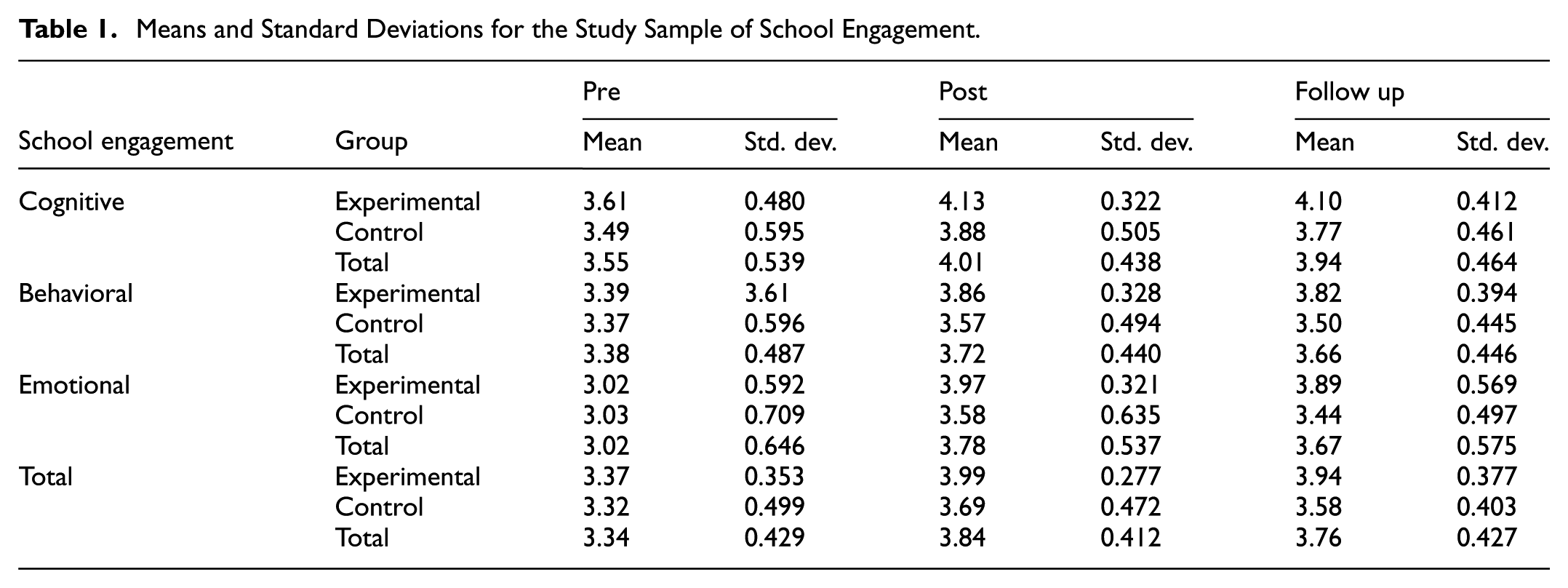
Means and standard deviations of the school engagement pre-, post-, and follow-up scores were calculated, as shown in Table 1. Also, Figures 1 to 4 showed graphs illustrating the mean scores of the general school engagement and its three domains for both experimental and control groups across three time points: Pre-test, Post-test, and Follow-up.
Means and Standard Deviations for the Study Sample of School Engagement.

Mean scores of school engagement for both experimental and control groups across three time points: Pre-test, Post-test, and Follow-up.

Mean scores of cognitive engagement domain for both experimental and control groups across three time points: Pre-test, Post-test, and Follow-up.

Mean scores of behavioral engagement domain for both experimental and control groups across three time points: Pre-test, Post-test, and Follow-up.

Mean scores of emotional engagement domain for both experimental and control groups across three time points: Pre-test, Post-test, and Follow-up.
Table 1 distinctly illustrates the variations in the performance means of the experimental group compared to the control group on the pre-test, post-test, and follow-up test of school engagement scores and all of their domains. Also, Figures 1 to 4 showed that the experimental group demonstrated clearly a steady increase in total school engagement and in all three dimensions (cognitive, emotional, and behavioral engagement) after the intervention and maintained high scores at follow-up. In contrast, the control group showed only modest improvements in the general school engagement and its three domains.
A Two-way ANOVA for repeated measures assesses the impact of the test (pre-test, post-test, and follow-up test) and the group (experimental and control groups) on the overall school engagement, as demonstrated in Table 2.
Results of Two-Way ANOVA for Repeated Measures for the Effect of the Test and the Group on the Overall School Engagement.

Table 2 indicates that the test has a statistically significant effect on the overall school engagement, which explains 52.2% of the variance. This shows the presence of statistically significant differences between the groups in the pre-post-follow up, and that the interaction between the test and the group in school engagement scores does not have a statistically significant effect. Moreover, it is verified that the Mauchly’s Test of Sphericity was not violated, as shown in Table 3.
Results of Mauchly’s Test of Sphericity.

It is noted from Table 3 that that the overall school engagement violates the Mauchly’s Test of Sphericity (Mauchly’s value is statistically significant). Therefore, the Huynh-Feldt test was used to adjust the effect (adjusting df). The effect of the test and the relationship between the test and the group on the study sample overall school engagement performance is seen in Table 4.
Results of Two-Way ANOVA for Repeated Measures for the Effect of the Test and the Relationship Between the Test and the Group on the Overall School Engagement.

Table 4 indicates that the test has a statistically significant impact on school engagement, accounting for 47.4% of the variance. This demonstrates the existence of statistically significant differences among the groups in the pre-post-follow-up, and that the association between the test and group in school engagement has a statistically significant impact (which accounts for 7.9% of the variance). This signifies that there are statistically significant variations between the groups in pre-post-follow-up. To determine the statistical significance of the effect of the test and group, as well as the relationship between the test and the group regarding the overall school engagement, Repeated Measures ANOVA was employed as illustrated in Table 5.
Results of Two-Way ANOVA for Repeated Measures for the Effect of Group and Test, and the Relationship Between Them on the Overall School Engagement (Linear).

Table 5 illustrates that there are statistically significant differences between the experimental and control groups regarding the pre-test, post-test and follow-up of school engagement based on the group (F = 6.56, p = .014, η2 = .12). The Eta-squared value (.120) signifies that the group variable accounts for 12% of the total variance in school engagement. Additionally, there are statistically significant differences between the experimental and control groups concerning the pre-post and follow-up school engagement according to the test (F = 44.6, p = .000, η2 = .482). The Eta-squared value (.482) indicates that the test variable accounts for 48.2% of the total variance in school engagement. There are also statistically significant differences between the experimental and control groups regarding the pre-post and follow-up school engagement considering the interaction between the test and the group (F = 5.97, p = .018, η2 = .111). The Eta-squared value (.111) demonstrates that the interaction between the test and the group accounts for 11.1% of the total variance in school engagement.
Post-Hoc Comparisons were performed utilizing the Bonferroni test to confirm the significance of the differences between the experimental and control groups in the pre-, post-, and follow-up school engagement, as shown in Table 6.
Multiple Comparisons Between the Means of the Study Groups on in the Pre-Test, Post-Test, and Follow-Up Test Analysis in Overall School Engagement.

Table 6 indicates the followings:
There are no statistically significant differences between the study groups’ pre-test school engagement (p = .679). As a result, the hypothesis that “The groups’ pre-analysis on school engagement shows no statistically significant differences at (α = .05)” is accepted.
There are statistically significant differences between the study groups’ post-test of school engagement, in favor of the experimental group that scored higher levels of school engagement (p = .008). As a result, the hypothesis that “The groups’ post-analysis on school engagement shows no statistically significant differences at (α = .05)” is rejected. In other words, the training program based on cognitive emotion strategies has a statistically significant effect on increasing the experimental group’s students’ level of school engagement.
There are statistically significant differences between the study groups’ follow up-test of school engagement, in favor of the experimental group that scored higher levels of school engagement (p = .002). In other words, there is continuity in the effect of the training program based on cognitive emotion strategies in increasing the level of school engagement among students of the experimental group.
Post-Hoc Comparisons were conducted using the Bonferroni test to verify the significance of the differences between the experimental and control groups in the pre-, post-, and follow-up test of school engagement, as indicated in Table 7.
Multiple Comparisons Between the Means of the Study Groups (Separately) on in the Pre-Test, Post-Test, and Follow Up Analysis in Overall School Engagement.
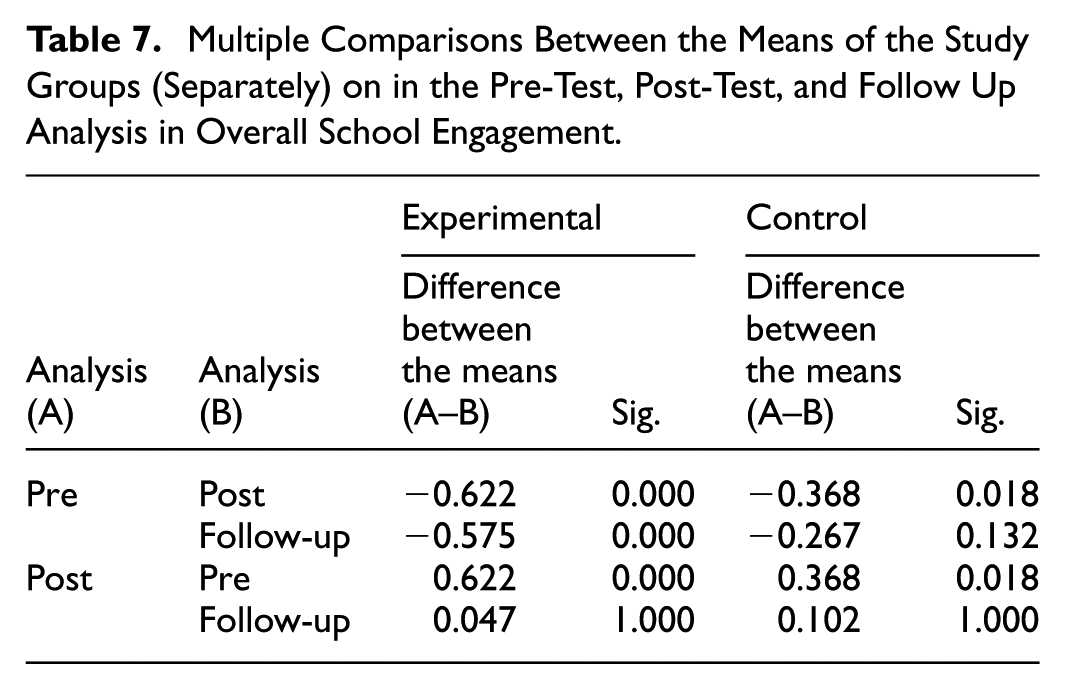
It can be noted from Table 7 that the post-test and follow-up of the experimental group are statistically and significantly higher than their pre-analysis in school engagement. This indicates that the training program based on cognitive emotion regulation contributed to raising the level of school engagement among students in the experimental group. The experimental group’s post-test and follow-up test in school engagement domains show no statistically significant differences, which indicates the ongoing effect of the training program in raising the experimental group’s students’ level of school engagement.
Discussion
The study’s findings revealed statistically significant differences (p = .05) in the pre- and post-analysis of school engagement, where the experimental group scored higher levels than the control group. This suggests that the training program based on cognitive emotion strategies has a statistically significant effect on increasing the level of school engagement among the experimental group’s students, and the stability of the effect of the training program in increasing school engagement among students of the experimental group. This result can be attributed to the fact that students who participated in the program are within a school and age group in which they develop a greater desire to build social relationships with others and to face their frustrations. Since cognitive emotion strategies includes positive refocusing, acceptance, positive reappraisal, and planning which are the strategies that the training program that was developed for this study focused on; this will be able to improve the school engagement indicators that Al Qadi (2012) pointed to in his study, which include students’ awareness of their abilities, having the desire to build social relationships with others, facing their life frustrations, and making them more excited for life, as a result of students focusing on positive experiences rather than negative ones and evaluating the experiences they encounter in a way that achieves personal and educational growth.
Additionally, one of the key factors that helped in increasing the levels of school engagement among students was the interactions that took place between the students and the trainer and between the students themselves during the administration of the training program. This was supported by Appleton et al. (2008), who stressed the possibility of improving school engagement through promoting positive behaviors and through social interactions, which in turn leads to the development of positive relations with peers, teachers, and others. The developed positive interactions allow experiencing positive connections with others, which also support the development of meaningful personal connections, which in turn promotes engagement.
The previous results are supported by many previous studies that demonstrated a statistically significant positive correlation between positive emotions in general and school engagement (Al Qasabi & Ameen’s, 2018; De Neve et al., 2023) and between emotion regulation strategies and school engagements (Çetinkaya & Haskan, 2025; De Neve et al., 2023; Saad et al., 2024; Zhoc et al., 2022).
Previous results are also corresponded with the findings of Santos et al. (2021), who observed that high levels of student engagement are connected to the application of adaptive emotion regulation strategies.
Adopting positive emotional regulations seem to be effective in school students beyond improving school engagement since good engagement in the school activities would have also a positive effect on other aspects on school such as good adjustment, high achievement, and less stress (Iuga et al., 2025; Pekrun et al., 2023).
The findings of the study demonstarted the significant value of training high school students in cognitive emotion regulation strategies, as the group that received training exhibited notably higher and more consistent levels of school engagement compared to the control group. By emphasizing techniques such as positive refocusing, acceptance, positive reappraisal, and planning, the program seems to enhance students’ awareness of their capabilities, their ability to manage frustrations, and their motivation to cultivate positive social relationships, all of which are crucial indicators of engagement recognized in prior research. These results align with recent studies that associate positive emotions and effective emotion regulation with increased engagement, suggesting that such interventions could provide broader academic and psychological advantages, including improved academic adjustment and general achievement.
Limitations
The results are determined by the following cognitive strategies for emotion regulation, which are positive refocusing, acceptance and receptivity, positive re-evaluation, and planning in developing both achievement motivation and school integration. Also, the results are determined by a limited number of samples from the first-year secondary school students (n = 54) in a government school who were selected by the available method (volunteering process) from a limited population, and then distributed to the study groups in a random manner using a random table due to the nature of the experimental training method.
Conclusions and Recommendations
The results indicate a statistically significant and stable effect of the training program based on cognitive emotion regulation strategies in developing the experimental group’s school engagement. In light of this result, the study recommends the following:
There is a need to replicate the study in similar schools and with long term examinations of the training program effect.
Calling on educational counselors and school teachers to hold workshops and arrange a set of extracurricular activities that incorporate Cognitive Emotion Regulation Strategies. These activities can improve students’ ability to employ these strategies in the different situations they face, thereby positively affects their academic and social lives. This approach can also improve the school engagement among students.
Further research is needed on the effectiveness of cognitive emotion regulation strategies in enhancing students’ behavioral, emotional, and social aspects, such as self-efficacy, goal orientations, and positive thinking. This program could be tested to reduce drop-out rates among students.
Footnotes

Ethical Considerations
The research was approved by the department of educational psychology ethical committee and the deanship of Research at Yarmouk University in 2024 under the number (IRB2023/551).
Consent to Participate
Informed consent forms were approved and used in the research. Yarmouk Univerity guidelines are compatible with Sage’s Guidelines for studies involving humans.
Author Contributions
Adnan Atoum: ideas—methodology—statistical analysis—Writing the paper. Ayat Bani Khaled: Data collection—previous studies- entering data to computer—Writing the paper.
Funding
The authors received no financial support for the research, authorship, and/or publication of this article.
Declaration of Conflicting Interests
The authors declared no potential conflicts of interest with respect to the research, authorship, and/or publication of this article.
Data Availability Statement
Data is available on request from corresponding author.*