




Abstract
There is evidence that emotion induced in the process of encoding impairs associative memory, yet the effect of post-encoding emotion on second language vocabulary learning remains largely unclear. An experiment was carried out to examine the effects of post-encoding emotion (positive, negative, and neutral) on learning of multidimensional vocabulary knowledge, that is, productive and receptive vocabulary knowledge in five aspects: orthography, meaning and form, grammatical function, syntagmatic association, and paradigmatic association. To carry out the study, 106 Chinese students voluntarily took part in the present study and they were randomly divided into positive group, negative group, and control group. After completing the vocabulary learning task and undergoing emotion manipulation by three video clips (positive, negative, and neutral), all participants sequentially took a multidimensional vocabulary test containing 10 subtests in a immediate, delayed, and post-delayed tests. The result showed a significant impairing effect of post-encoding emotion, especially positive one, on both item memory and associative memory under a longer retention interval, and no significant effect of post-encoding emotion upon semantic memory was found. Both theoretical and practical implications for second language vocabulary learning was put forward.
Plain Language Summary
The current study extends prior studies concerning the effects of emotion on episodic memory. Although prior studies have shown that post-encoding emotion enhances item memory, the current study provides evidence that post-coding emotion, especially positive emotion, impairs both associative memory and item memory under a longer retention interval. Further, the present study clarifies that learning burden also serves as a factor in measuring the effects of emotion upon episodic memory with evidence from the distinction in memory scores between productive vocabulary knowledge and receptive ones. It is also worth mentioning that post-encoding emotion has no impact on semantic memory considering the memory scores of multidimensional vocabulary knowledge tests as semantic memory refers to general knowledge not related to a particular event or an episode in vocabulary learning.
Keywords
Introduction
Theoretically, there are two major types of declarative memory: semantic memory and episodic memory (Ferbinteanu, 2019). Semantic memory is the type of factual memory that we have in common with everyone else—that is our general knowledge of the world such as the rising of the sun, and the mechanism of a running car. Episodic memory refers to the memory of an event or an episode during which we mentally travel back in time to an event from the past and try to remember various details about the event. It is a process with several steps: encoding, consolidation, and retrieval. The process of vocabulary learning also belongs to episodic memory, which may involve encoding, consolidation, and retrieval. The stage of encoding could be further divided into the following three steps: pre-encoding, encoding, and post-encoding. In this current study, we focuses on the effects of post-encoding emotion upon second vocabulary learning.
Episodic memory comprise two elements: item memory and associative memory. Item memory can be measured by free recall or recognition (Sharot & Yonelinas, 2008; B. Wang & Fu, 2010), referring to a stimulus or an event that has been encountered, while associative memory is the form of memory which represents relationship among items (Giovanello et al., 2006). The same is true with vocabulary learning. There are many degrees and aspects of knowledge to define what it means to know a word and vocabulary knowledge has been recognized as a multidimensional construct including the breadth and depth of vocabulary knowledge as well as receptive and productive vocabulary knowledge (Nation, 1990; Yamamoto, 2014). Concerning the relationship between memory types and vocabulary knowledge, item memory may refer to meaning and form of vocabulary knowledge while associative memory could relate to its collocation, that is, syntagmatic association, in a sentence. Vocabulary knowledge such as orthography, grammatical function, and paradigmatic association is our general knowledge concerning a target word, which relates to semantic memory.
Although a limited number of studies have shown that emotion induced during encoding has impact on second language vocabulary learning (Bisby et al., 2018), it is unclear whether post-encoding emotion affects vocabulary learning or not. Further, very little research has investigated the effects of emotion on multidimensional vocabulary knowledge, during the process of second language vocabulary learning.
Review of Literature
Effects of Emotion on Item Memory and Associative Memory
Previous studies have demonstrated that emotion has differential effects on item memory and associative memory. Emotion is found to boost item memory (Adelman & Zachary, 2013; Grider & Malmberg, 2008; Mather & Sutherland, 2009) but weaken associative memory (Bisby & Burgess, 2014; Madan et al., 2017; Murray & Kensinger, 2012; Touryan et al., 2007). For instance, in a study by Touryan et al. (2007), learners studied a visual object embedded in the periphery of negative emotional or neutral pictures. Results show that recognition memory, that is, item memory, was better for negative emotional pictures than neutral ones. Nevertheless, in terms of associative memory between items and peripheral information, neutral pictures scored better than negative ones, implying an impairing effect of negative emotion upon associative memory. According to Touryan et al. (2007), the reason for this may lie in the mechanism that emotional pictures have caught attention that could have been allocated to peripheral information, thus lowering its performance in memory test. Such a finding was confirmed by the replication experiment in a study by Bisby and Burgess (2014). In a word, converging evidence from past studies have shown that negative emotion impairs associative memory. Still, little is known about the impact of positive emotion upon associative memory.
To be noted, most previous empirical studies took the learning stimuli itself as the source of emotion and manipulated it accordingly in encoding. Thus, little is known about the effect of post-encoding emotion upon episodic memory. As is revealed in a recent study by Goldfarb et al. (2019), effect of acute stress upon item and associative memory differ during the different stages of memory cycle (encoding, post-encoding, or retrieval). Thus, further research on the effects of post-encoding emotion, whether negative or positive, contribute to a refined theory for the effects of emotion upon episodic memory.
Dimensions of Vocabulary Knowledge
Word knowledge is a multidimensional construct. Learning a word does not simply mean knowing a word’s meaning, but also includes the actual use of the word with its spelling, pronunciation, grammatical function, and collocation. Richards (1976) first proposed the construct of multidimensional vocabulary knowledge, followed by many researchers (Aitchson, 1994; McCarthy 1990; Miller 1999; Nation 1990, 2001; Schmitt 2000) with the intent of establishing a more complete lexical knowledge framework. Among them, the most detailed multidimensional lexical knowledge framework was proposed by the New Zealand linguist Nation (1990, 2001), which covers nine lexical knowledge components (spoken form, written form, word parts, form and meaning, concept and referents, associations, grammatical functions, collocations, restraints on use); Nation further subdivided each vocabulary knowledge dimension into receptive vocabulary knowledge and productive vocabulary knowledge.
Taken together, the “dichotomy” (known/unknown) adopted in the traditional sense of vocabulary learning has given way to a multidimensional vocabulary construct (X. Wang & Kong, 2014). However, traditional vocabulary testing often measure learners’ mastery of the form and meaning of the target word, that is, item memory, and vocabulary knowledge of a given word in other dimensions including associative memory are rarely measured, which motivates the present study.
Given the above research gaps, this study attempts to develop a multidimensional vocabulary knowledge test to examine the effects of post-encoding emotion (positive, negative, and neutral) on second language vocabulary learning in five dimensions of a target word: orthography, meaning and form, grammatical function, syntagmatic association, and paradigmatic association. Accordingly, the present study addresses the following research questions.
Research Questions
Are there any significant effects of post-encoding emotion upon episodic memory?
Do positive and negative post-encoding emotion differ significantly from each other in their effects upon episodic memory?
Do multiple aspects of vocabulary knowledge (i.e., item memory and associative memory) differ significantly from each other in the process of second language learning under the condition of post-encoding emotion?
Materials and Methods
Participants
A sample size estimation was calculated using G*Power Version 3.1.9.7 software. Using moderate parameters (power = 0.8, effect size f = 0.25), the analysis offered an estimate of a total sample size of 36. A total of 106 university undergraduates (91 female participants and 15 male participants) from Changshu Institute of Technology voluntarily took part in the experiment. 11 of them missed some of subsequent tests during the experiment and the final number of participants was 95 (84 female participants and 11 male participants; mean age = 21.18 years, SD = .684 year), which yielded a power close to 0.99. All participants were native speakers of Chinese as well as English majors who had about 12–13 years of English learning experience.
Stimuli
In the formal learning phase, a total of 10 pseudowords, that is, coined words, with its Chinese counterpart and a glossed sentence were selected as learning stimuli. A glossed sentence could demonstrate the pseudoword’s usage in terms of syntagmatic association, that is, its collation. Using the pseudowords could ensure that all subjects have no prior knowledge of the target words, thus eliminating the need for pre-tests. Among the 10 target words, there are 6 nouns and 4 verbs. This ratio (3:2) is in line with the proportional frequency of occurrences in the corpus (Kucera & Francis 1967). All of the pseudowords were two syllables and resembled English words phonetically and orthographically. Seven of the pseudowords were five letters long, and three were six letters long. The 10 pseudowords were ancon (dagger), cader (doze), dangy (boulder), denent (visage), faddam (abode), hodet (lane), masco (locomotive), pacon (sob), sagod (abhor), and tasper (crave).
The whole vocabulary test contains 10 sub-tests, which respectively measure receptive and productive vocabulary knowledge of five dimensions including orthography, meaning and form, syntagmatic association, paradigmatic association, and grammatical function. Five of the tests measured productive knowledge, and five measured receptive knowledge. In the process of vocabulary test, sub-tests 1–10 were implemented in a computer program with only one subtest appearing on the screen at one time in a specific test sequence, following the principle of measuring productive vocabulary knowledge first, and then receptive vocabulary knowledge, in order to avoid earlier tests affecting the participants’ answers on later tests. The first subtest, measuring productive knowledge of orthography, was administered to all of the participants with pre-recorded tape at one time because it involved aural cues spaced 12 seconds apart. The other nine subtests were presented in written form. Finishing the whole set of tests took approximately 10 minutes. Those pseudowords and their accompanying tests have been validated in prior studies (Webb, 2007), as described in the following:
Test 1: Productive knowledge of orthography. With pre-recorded video on the first subtest, all subjects heard each pseudoword pronounced twice and then had 12 seconds to type it out in the computer correctly. Any spelling mistakes would be marked incorrect. On all of the other productive tests, spelling was not a determining factor in the scoring if the response was acceptable.
Test 2: Receptive knowledge of orthography. On the second subtest the participants are required to choose the correctly spelled pseudoword accompanied with three distracters. The distracters were coined to resemble the pseudoword both phonetically and orthographically. The following examples are for the target words denent and tasper.

Test 3: Productive knowledge of meaning and form. On the third subtest, we employed a translation task to measure productive knowledge of meaning and form. The participants were provided with their corresponding Chinese meanings and asked to type its English pseudoword. The aim of this subtest was to confirm whether the participants could associate the L2 forms of the pseudowords with their L1 meanings. For example,
Different from the first two subtests, spelling was not the determining factor for a correct answer on this subtest. In the example above, close approximations of the pseudoword ancon (e.g., ankon, anken, or ancan) were scored correctly.
Test 4: Productive knowledge of grammatical functions. This was a sentence-making test. The participants had to make a sentence with each of those pseudowords. Grammatical accuracy is the determining factor for a correct answer. For instance, the pseudoword masco (locomotive) would have been scored as incorrect in The boy mascoed to school and correct in both The masco left the station late and It is a masco.
Test 5: Productive knowledge of syntagmatic association. On this subtest the participants had to produce L2 syntagmatic associates beside the pseudowords. For instance, for the target word masco, with its Chinese translation of locomotive, station, tracks, left, and arrived were the possible acceptable responses while clock, ate, and hard, would be scored as incorrect. Because the following subtest measured productive knowledge of paradigmatic association, Further, paradigmatic associates such as car, vehicle would also be scored as incorrect as the following subtest measured its paradigmatic associates. This was sufficiently explained at the preparatory stage of testing. Two native speakers of English assessed the responses with an inter-rater reliability of 94%.
Test 6: Productive knowledge of paradigmatic association. In this subtest, paradigmatic association refers to coordinates, superordinates, subordinates, antonyms, and synonyms, all of which would be scored as correct, while syntagmatic associates measured in the preceding subtest would be scored as incorrect. For instance, acceptable responses for masco (locomotive) are car, airplane, and vehicle. Two native speakers of English evaluated the responses, with an inter-rater reliability of 98%.
Test 7: Receptive knowledge of grammatical functions. In this subtest, a multiple choice test was employed to measure receptive knowledge of grammatical functions. The participants were offered three sentences containing the same pseudoword and they had to choose the correct one. For instance, if the learners knew that masco (locomotive) was a noun, they were supposed to choose sentence (a) as the correct answer in the following example. (a) It is a masco. (b) It mascoed. (c) It is very masco.
Test 8: Receptive knowledge of syntagmatic association. On this subtest, participants were required to choose the words that were most likely to appear in context with the pseudowords. All distracters were words that the participants were familiar with and had the same parts of speech as the correct answers, which was demonstrated in the following examples for the pseudowords tasper (crave) and pacon (sob).

Test 9: Receptive knowledge of paradigmatic association. On this subtest, participants were required to choose a paradigmatic associate of the pseudoword. All distracters were words that the participants knew well and had the same parts of speech as the correct answers. The following examples are for the target words denent (visage) and cader (doze).

Test 10: Receptive knowledge of meaning and form. This was a receptive translation test, requiring participants to recall rather than recognize meanings, which seems a bit challenging. For instance, the participants were required to type down its Chinese translation of dagger beside the pseudoword ancon.
ancon ____________
Three video clips with the same duration of 3 minutes were used respectively for the control, negative and positive groups. The video for the control group is about how to repair a CD-ROM drive, which is neutral with no elements of emotion involved. The video for the negative group was a violent assault on a pregnant woman by a man. The video for the positive group was a short play by three comedians. Previous study (Li et al., 2020; B. Wang & Fu, 2010) has already validated the three videos.
Design and Procedure
In the present study, a between-subjects design was employed with emotion group (negative, positive, and control, respectively for Groups 1, 2, and 3) being the independent variable and memory scores in the immediate, delayed, and post-delayed tests being dependent variables. Participants were randomly assigned to three emotion groups. Various steps and their duration were presented in Table 1.
Steps and Their Duration.

Note. The duration of the steps for tests (immediate test, delayed test, and post-delayed test) and other tasks were based on estimations, which may differ from actual duration participants took.
All the participants learned 10 target words within 8 minutes. Afterwards, a vocabulary test was conducted. The subjects knew that there was a vocabulary test, but they did not know the specific form of the vocabulary test.
After the immediate test, participants completed some irrelevant linguistic tasks as filler tasks until 5 minutes had passed. Then they rated their current mood and arousal on two scales ranging from 0 to 8 with 0 representing extremely unhappy and calm, and 8 representing extremely happy and aroused. After the above ratings, Groups 1, 2, and 3 watched a 3-minute positive, negative, and neutral video clip respectively. At the end of the video watching, participants reflectively rated their mood and arousal during video watching.
Participants performed some filler tasks again and finished some questionnaires concerning state and trait anxiety scale (Spielberger et al., 1983), arousal predisposition scale (Coren, 1988) as well as emotion appraisal and suppression scales (Gross & John, 2003). Almost 30 minutes had passed and participants rated their current mood and arousal before they took the delayed test. Two weeks later, they took the post-delayed test. Delayed test and post-delayed test are the same with immediate test.
Statistical Analyses
Statistical analyses were implemented using SPSS 26.0 with the significance value set at p < .05. Degrees of freedom would be adjusted accordingly where equality of variance is violated. Memory performance consists of scores of each aspect of vocabulary knowledge as well as the total score for each complete set of test. For emotion assessment, a 3 (time: pre-video, post-video, and pre-test) × 3 (negative, positive, and control) repeated-measures ANOVA was carried out on mood and arousal ratings respectively. For evaluating the effect of emotion on memory performance, a 3 (time: immediate, delayed, and post-delayed) × 3 (negative, positive, and control) repeated-measures ANOVA was administered on memory scores in the immediate, delayed, and post-delayed tests. Repeated-measures MANOVA was also administered upon each complete set of tests (immediate, delayed, and post-delayed) with each containing ten vocabulary knowledge tests. This method of statistical analysis complies with prior studies (for instance, Nielson & Lorber, 2009; Singh et al., 2013). Using repeated-measures ANOVA demonstrates how memory performance changes over time in three different emotion groups.
Results
Participants’ Characteristics
Table 2 presents participants’ characteristics elicited from the questionnaires, which include arousal disposition, emotion regulation, emotion suppression, trait anxiety, and state anxiety. As is shown in Table 2, participants in the three emotion groups did not differ significantly from each other in the five characteristics. Thus, any difference in memory performance of the three emotion groups has nothing to do with the differences in the above five characteristics.
Participants’ Characteristics.

Note. M/F stands for the ratio of male participants to female participants. Significance level is set at .05.
Manipulation Check on Emotion Elicitation
Repeated-measures ANOVA on mood ratings showed a significant main effect of time, F (2, 184) = 7.18, p = .001, ηp2 = .072, and a significant main effect of emotion group, F (2, 92) = 21.66, p = .000, ηp2 = .320. Nevertheless, these main effects were modified by a significant interaction between time and emotion group, F (4, 184) = 27.88, p = .000, ηp2 = .377. As is shown in Figure 1, participants in the negative group have significant decrease in mood ratings over time, F (2, 60) = 34.87, p = .000, ηp2 = .538. Mood at the post-video was significantly lower than that at the pre-video (MD = -2.452, p = .000) and pre-test (MD = −2.516, p = .000). There were no significant difference (MD = −0.065, p = 1.000) in mood between pre-video and pre-test. Also in Figure 1, participants in the positive group have significant increase in mood ratings over time, F (2, 66) = 19.01, p = .000, ηp2 = .365. Mood at the post-video was significantly higher than that at the pre-video (MD = 0.882, p = .000) and pre-test (MD = 1.294, p = .000); there were no significant difference (MD = 0.412, p = .225) in mood between pre-video and pre-test. For participants in the control group, there were no significant change in mood ratings between pre-video and post-video, t = 1.011, df = 29, p = 0.321, cohen’s d = 0.0115. Still, participants in the control group experienced consistent decrease in mood ratings over time, F (2, 58) = 3.50, p = .037, ηp2 = .108. It may be inferred that students in the control group might get increasingly bored during the experiment. Mood at the post-video had no significant difference with that at the pre-video (MD = −0.333, p = .962) and pre-test (MD = 0.500, p = .450). Mood at the pre-video was significantly higher than that at the pre-test (MD = 0.833, p = .017).
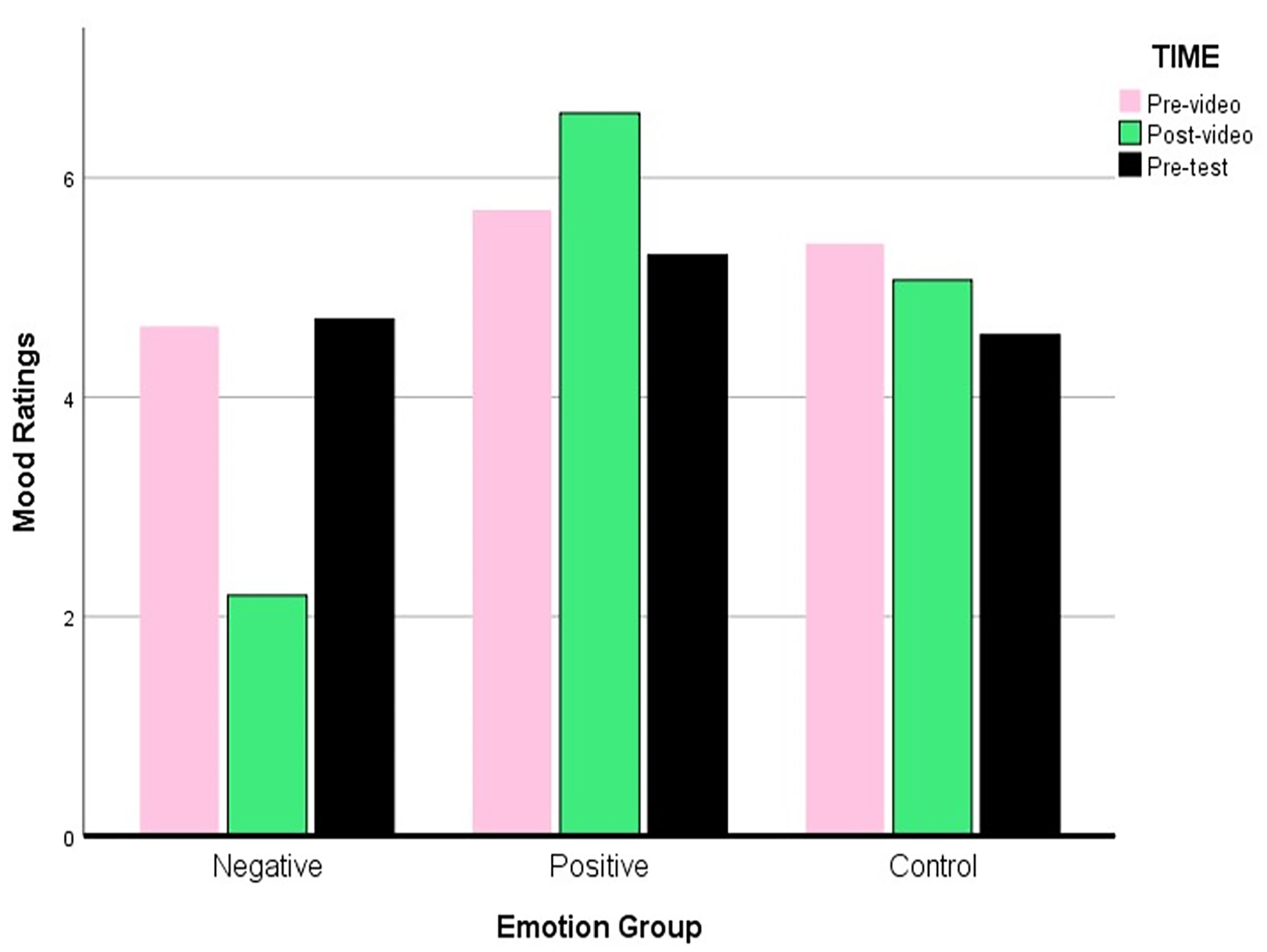
Mood ratings in three emotion groups.
Repeated-measures ANOVA on arousal ratings showed a significant main effect of time, F (1.848, 169.985) = 17.27, p = .000, ηp2 = .158, and a significant main effect of emotion group, F (2, 92) = 4.69, p = .012, ηp2 = .092. Further, there was a significant interaction between time and emotion group, F (3.695, 169.985) = 10.19, p = .000, ηp2 = .181. As shown in Figure 2, participants in the negative group underwent significant increase in arousal ratings over time, F (2, 60) = 32.16, p = .000, ηp2 = .517. Arousal at the post-video was significantly higher than that at the pre-video (MD = 1.839, p = .000) and pre-test (MD = 2.387, p = .000) yet there was no significant difference (MD = 0.548, p = .153) in arousal ratings between pre-video and pre-test. Also in Figure 2, participants in the positive group also experienced significant increase in arousal ratings over time, F (2, 66) = 4.17, p = .020, ηp2 = .112. Considering the moderate effect size, video for the positive group might not be amusing enough to greatly arouse participants. Yet arousal at the post-video represented a significant increase with that at the pre-video (MD = 0.706, p = .020) and pre-test (MD = 0.676, p = .025); there was also no significant difference (MD = −0.029, p = .908) in arousal ratings between pre-video and pre-test. Still in Figure 2, participants in the control group did not undergo any significant change in arousal ratings over time, F (2, 58) = 1.07, p = .349, ηp2 = .036.

Arousal ratings in three emotion groups.
Apparently, from the results on mood and arousal ratings in three emotion groups, emotion successfully performed the role of between-subject factor. Any difference in memory performance among the three emotion groups could be attributed to the intervention of emotion (positive, negative, and neutral).
Effect on Memory Performance
Repeated-measures ANOVA on total scores of three tests (immediate, delayed, and post-delayed) in three emotion groups (negative, positive, and control) demonstrated a significant main effect of time, F (2, 184) = 218.19, p = .000, ηp2 = .703, and a significant main effect of emotion group, F (2, 92) = 3.12, p = .049, ηp2 = .063. Further, there was no significant interaction between time and emotion group, F (2.386, 109.754) = 0.93, p = .411, ηp2 = .020. As is shown in Figure 3, total score in post-delayed test was significantly lower than that in immediate (MD = −34.047, p = .000) and delayed tests (MD = −35.544, p = .000). There were no significant changes (MD = −1.497, p = .204) in total scores in immediate and delayed tests. Also, total score in the positive group was significantly lower than that in the control group (MD = −8.541, p = .049). There were no significant differences in total memory scores between negative group and positive group (MD = 5.506, p = .345) as well as between negative group and control group (MD = −3.035, p = 1.000). Memorizing ten pseudowords with glossed sentences is not a daunting task for participants as they performed almost equally well (over 80 with a full score as 100) in immediate test and delayed test. Participants in the control group performed best, followed by negative group and positive group respectively.

Total memory performance in three emotion groups.
Also, the Repeated-measures ANOVA on total scores of three tests (immediate, delayed, and post-delayed) in three emotion groups (negative, positive, and control) incorporated gender as a covariate and demonstrated no significant interaction between time and gender, F (1.193, 108.535) = 0.051, p = .863, ηp2 = .001.
Repeated measures MANOVA was carried out on ten vocabulary knowledge subtests in immediate test, delayed test, and post-delayed test respectively. For immediate test and delayed test among three emotion groups (negative, positive, and control), there was no significant difference in the test scores of the participants on each dimension of vocabulary knowledge. Nevertheless, as shown in Table 3, there were significant difference in multidimensional vocabulary knowledge for post-delayed test among three emotion groups. Significant differences were found on the productive tests of meaning and form, F(2, 92) = 4.177, p = .018 < .05, ηp2 = .083, and syntagmatic association, F(2, 92) = 4.631, p = .012 < .05, ηp2 = .091; yet no significant differences were found on the corresponding receptive tests of meaning and form, F(2, 92) = 1.764, p = .177 > .05, ηp2 = .037, and syntagmatic association, F(2, 92) = 1.958, p = .147 > .05, ηp2 = .041. Further, memory scores on the tests of orthography, grammatical function, and paradigmatic association (whether receptive or productive) demonstrated no significant difference among the three emotion groups.
Multivariate Analysis for Post-Delayed Test.

Note. Maximum score = 10. PO = productive knowledge of orthography; RO = receptive knowledge of orthography; PM = productive knowledge of meaning and form; PG = productive knowledge of grammatical function; PS = productive knowledge of syntagmatic association; PP = productive knowledge of paradigmatic association; RG = receptive knowledge of grammatical function; RS = receptive knowledge of syntagmatic association; RP = receptive knowledge of paradigmatic association; RM = receptive knowledge of meaning and form. Significance level is set at .05.
Specifically, participants in the positive group scored significantly lower on the productive test of meaning and form than those in the control group (MD = −2.198, p = .015); there were no significant differences in the memory score on the productive test of meaning and form between negative group and positive group (MD = 0.797, p = .890) as well as between negative group and control group (MD = −1.401, p = .231). Also, participants in the positive group scored significantly lower on the productive test of syntagmatic association than those in the negative group (MD = −1.773, p = .049) and control group (MD = −2.010, p = .021); Participants in the negative group and control group demonstrated no significant difference (MD = −0.237, p = 1.000) in the memory score on the productive test of syntagmatic association.
Discussion
The present study was to investigate the effects of post-encoding emotion (positive, negative, and neutral) on second language vocabulary learning in five dimensions of a target word: orthography, meaning and form, grammatical function, syntagmatic association, and paradigmatic association. Concerning the three research questions put forward in the above section, answers are as the following:
For the first research question, indeed, post-encoding emotion demonstrate significant effect upon episodic memory instead of semantic memory among the process of second language vocabulary learning. Among the five dimensions of a pseudoword: orthography, meaning and form, grammatic function, syntagmatic association and paradigmatic association, meaning and form, that is, linking the L2 forms of the target words with their L1 meanings, apparently belongs to item memory, a type of episodic memory. The subtest of syntagmatic association, that is, producing or recognizing the L2 syntagmatic associates, measures associative memory, the other type of episodic memory. For instance, syntagmatic associates of the pseudoword of masco (locomotive) might be driver, station, highway, etc., which could be found in the accompanying glossed sentence “The driver got off the masco.” For vocabulary learning, semantic memory, the opposite of episodic memory, denotes the inherent general vocabulary knowledge such as a target word’s grammatic function based on its part of speech, paradigmatic association (including coordinates, superordinates, subordinates, antonyms, and synonyms), and even orthography, which are not particularly related to an event or episode of vocabulary learning and learners store inherently in their brains.
For the above second and third research questions, positive and negative post-encoding emotion did differ significantly from each other in their effects upon episodic memory. To be exact, positive group scored significantly lower than that the negative group and control group in associative memory, that is, productive knowledge of syntagmatic association. Further, positive group also scored significantly lower than the control group in item memory, that is, productive knowledge of meaning and form, with no significant difference among other groups though negative group scored modestly higher than positive group. Mastering productive vocabulary knowledge requires a larger cognitive load from participants than mastering receptive ones, as validated by Depth of Processing Theory (Craik & Loclchart, 1972) and Involvement Load Hypothesis (Laufer & Hulstijn, 2001). Emotion itself may suppress the processing of data and distract cognitive input, which may be otherwise used for the handling of vocabulary knowledge. As for the difference between positive emotions and negative ones, negative events relative to positive events lead to enhanced encoding of sensory detail and create greater similarity between the encoding and retrieval signatures (Li et al., 2020).
Considering the excellent performance of control group in all three tests, post-encoding emotion, especially positive emotion, has an impairing rather than enhancing effects on episodic memory (both item memory and associative memory) under a longer retention interval. One explanation might be that emotion might suppress processing of information unrelated to emotion (Gagnon & Wagner, 2016) and distract attention, which could otherwise be employed for cognitive consolidation during the process of second language learning. To be noted, memory scores in the immediate test and delayed test demonstrated no significant difference except for post-delayed test (two weeks later), which partially validated the prior study (Pierce & Kensinger, 2011) that negative emotion impaired associative memory under a short retention interval but enhanced it under a longer retention interval. Even though the productive knowledge of meaning and form (item memory) as well as syntagmatic association (associative memory) demonstrated significant difference in memory scores, no significant difference is found on its corresponding receptive knowledge of meaning and form as well as syntagmatic association. As we all know, productive vocabulary knowledge takes up more cognitive load than receptive ones. Learning burden might also be one factor in determining the effects of post-encoding emotion on second language vocabulary learning.
Contributions and Limitations
The current study extends prior studies concerning the effects of emotion upon episodic memory. Although prior studies (Liu et al., 2008; Judde & Rickard, 2010; Nielson & Arentsen, 2012; Nielson & Bryant, 2005; Nielson & Lorber, 2009; Nielson & Meltzer, 2009; Nielson & Powless, 2007; Nielson et al., 2005; Preuß & Wolf, 2009; B. Wang & Fu, 2010) have shown that post-encoding emotion enhance item memory, the current study provides evidence that post-coding emotion, especially positive emotion, impairs both associative memory and item memory under a longer retention interval. Further, the present study clarifies that learning burden also serves as a factor in measuring the effects of emotion upon episodic memory with evidence from the distinction in memory scores between productive vocabulary knowledge and receptive ones. It is also worth mentioning that post-encoding emotion has no impact upon semantic memory considering the memory scores of multidimensional vocabulary knowledge tests as semantic memory refers to general knowledge not related to a particular event or an episode in vocabulary learning. Also, multidimensional vocabulary knowledge tests are employed in the study, which could precisely measure the possible effects of post-encoding emotion upon L2 vocabulary learning and demonstrate the subtle difference among various vocabulary knowledge of a single target word.
The current study has at least three limitations. First, the formal learning phase with 10 pseudowords and their corresponding glossed sentences took 8 minutes. The length of allocated time could be halved in the future given the high memory scores of participants in the immediate and delayed tests. Reduced time length during encoding increases the difficulty of the learning task, which could better distinguish participants’ performance among three emotion groups in the subsequent immediate test.
Second, there are also some problems with the videos to induce emotion. Specifically, in the post-test interview with participants, some reported that the comedian play is outdated and not amusing enough since they have watched it many times long before, which was also verified by the moderate effect size of arousal ratings in the positive group compared with that in the negative group. A comic video that caters to participants’ taste and could make them burst into laughter is needed in future research. Also, though the three videos have the same time duration of 3 minutes, they still differ in a number of aspects such as presence of humans, contents, and attention engagement, which might have some impact upon mood and arousal ratings of participants.
Third, the imbalanced distribution of participants in terms of gender might also be tackled in the future researches even though no significant interaction between tests and gender was found in the current study, which had 84 female participants and 11 male participants.
Conclusion and its Implications
Contrary to prior studies (Liu et al., 2008; Judde & Rickard, 2010; Nielson & Arentsen, 2012; Nielson & Bryant, 2005; Nielson et al., 2005; Nielson & Lorber, 2009; Nielson & Meltzer, 2009; Nielson & Powless, 2007; Preuß & Wolf, 2009; B. Wang & Fu, 2010) that post-encoding emotion enhance item memory, the present study concludes that post-coding emotion, especially positive emotion, impairs both associative memory and item memory under a longer retention interval, and neutral condition most benefits vocabulary learning in terms of memory retention.
Findings from the current study have both theoretical and practical implications. Emotion induced after encoding is not ubiquitously beneficial for memory retention and future research that precisely clarify boundary conditions under which post-encoding emotion enhances or impairs item memory and associative memory is urgently needed.
Practical implications for English vocabulary teaching and learning is also found. In the era of globalization, a good command of English vocabulary is surely a pivotal task for a majority of learners in China. Cognition and emotion are two intertwined factors in the process of vocabulary learning and one cannot neglect the possible impairing effect of emotions (positive, neutral, or negative). Language instructors need to be cautious in employing such teaching strategy as emotion intervention like humor or restraint in classroom practice. Specifically, watching a laugher-provoking video or an anger-inducing one after vocabulary learning might impede memory retention under a longer retention interval. Further, a learner might be well-advised to keep emotionally neutral after the learning of English vocabulary. Yet positive psychology (Dewaele et al., 2019; Dewaele & Li, 2020; Y. Wang et al., 2021) asserts that positive emotion is vital to learners’ performance and achievement, and future studies are needed to clarify the effects of emotion on second language vocabulary learning.
Footnotes
Author Contributions
YL was responsible for implementing the experiment, collecting the data, and writing up the introduction, literature review, and research methodology; XW was responsible for conceptualizing the experiment, analyzing the data, and writing up the discussion and conclusion. Both authors made substantial and direct contribution to the current study and approved the submitted version.
Contribution to the Field
The current study extends prior studies concerning the effects of emotion upon episodic memory. Although prior studies have shown that post-encoding emotion enhance item memory, the current study provides evidence that post-coding emotion, especially positive emotion, impairs both associative memory and item memory under a longer retention interval. Further, the present study clarifies that learning burden also serves as a factor in measuring the effects of emotion upon episodic memory with evidence from the distinction in memory scores between productive vocabulary knowledge and receptive ones. It is also worth mentioning that post-encoding emotion has no impact upon semantic memory considering the memory scores of multidimensional vocabulary knowledge tests as semantic memory refers to general knowledge not related to a particular event or an episode in vocabulary learning.
Declaration of Conflicting Interests
The author(s) declared no potential conflicts of interest with respect to the research, authorship, and/or publication of this article.
Funding
The author(s) disclosed receipt of the following financial support for the research, authorship, and/or publication of this article: This study was sponsored by the research project of Jiangsu Social Science Fund Project, entitled “Research on Irrational Expression of Crisis Discourse” (Grant No. 21YYD001), Philosophy and Social Science Research Project of Jiangsu Education Department, entitled “A Study on the Evaluation, Influencing Factors, and Improvement Paths of the Psychological Capital Status of Post-00 College Students” (Grant No. 2023SJSZ0811), and Basic Foreign Language Education Research Project of Changshu Institute of Technology, entitled “A Study on the Regulation Mechanism of Professional Happiness of Foreign Language Teachers in Primary and Secondary Schools from the Perspective of Positive Psychology” (Grant No. 2022cslgwgy008).
Ethics Statement
The studies involving human participants were reviewed and approved by Academic and Ethics Committee of Changshu Institute of Technology. The patients/participants provided their written informed consent to participate in this study.

Data Availability Statement
The raw data supporting the conclusion of this article will be made available by the authors, without undue reservation.