




Abstract
The COVID-19 pandemic has led to unprecedented shifts in higher education worldwide. These sudden educational changes have the potential to accelerate the acceptance of online learning, or, conversely, to increase its rejection. The purpose of this experimental study is to examine students’ acceptance of and intentions toward the continued use of online learning, which was abruptly introduced by face-to-face universities due to the COVID-19 pandemic. To this end, responses to an online questionnaire from students at three face-to-face universities (N = 194) were analyzed using structural equation modeling. The study was based on the technology acceptance model (TAM), we also included other relevant factors, such as emotional aspects, feelings of uncertainty, security of the e-learning system, and satisfaction with educational technology. The results indicate that the uncertainty associated with COVID-19, emotional factors, and security did not significantly affect the students’ intention to use e-learning systems; however, these factors had a significant impact on students’ perception of satisfaction, which is a decisive factor that positively influences the process of adoption of e-learning systems. This study discusses noteworthy theoretical and practical implications for education that will help teachers and universities in decision making regarding the digital transformation process.
Plain Language Summary
Purpose: The purpose of this experimental study is to examine students’ acceptance of and intentions towards the continued use of online learning, which was abruptly introduced by face-to-face universities due to the COVID-19 pandemic. Methods: To this end, responses to an online questionnaire from students at three face-to-face universities (N = 194) were analysed using structural equation modelling. The study was based on the technology acceptance model (TAM), we also included other relevant factors, such as emotional aspects, feelings of uncertainty, security of the e-learning system and satisfaction with educational technology. Conclusions: The results indicate that the uncertainty associated with COVID-19, emotional factors and security did not significantly affect the students’ intention to use e-learning systems; however, these factors had a significant impact on students’ perception of satisfaction, which is a decisive factor that positively influences the process of adoption of e-learning systems. Limitations: This study discusses noteworthy theoretical and practical implications for education that will help teachers and universities in decision making regarding the digital transformation process.
Introduction
During the global COVID-19 pandemic, the educational system was forced to make radical changes. Universities all over the world had to rapidly transform their study programs, and courses were suddenly reorganized based on online classes.
The advantages of e-learning have been extensively studied over recent years; for example, they allow for flexibility in terms of time and location (e.g., Alzahrani & Seth, 2021; Choudhury & Pattnaik, 2020; Eringfeld, 2021), enable knowledge sharing and transfer (Al Rawashdeh et al., 2021), and provide various delivery methods for a wide range of learning styles (Moawad, 2020; Rusu & Tudose, 2018). In short, e-learning and educational technology have the potential to create new opportunities for education (Alzahrani & Seth, 2021; Choudhury & Pattnaik, 2020; Regmi & Jones, 2020). However, there are also certain risks that arise from the misuse of e-learning tools, inappropriate infrastructure, and lack of technical support, which can lead to a decline in their adoption (Mortazavi et al., 2021; Sawaftah & Aljeraiwi, 2018). Furthermore, according to Bakhtiar et al. (2018), emotions such as loneliness, fear, anxiety, or uncertainty can cause students to have negative attitudes toward e-learning. For all these reasons, and given that the pandemic created such a sudden and large-scale shift toward online learning, with unprepared educational institutions and inexperienced teachers and learners, it is important to investigate the adoption of e-learning in this context.
The main objective of this study is therefore to determine how the process of e-learning adoption in face-to-face universities was affected after the emergency situation experienced due to COVID-19. For this purpose, an approach based on the well-known technological acceptance model (TAM) is used (Davis, 1985, 1989; Venkatesh & Davis, 2000). Our analysis includes the key factors that affect the intention to use e-learning in this situation, such as the emotions and uncertainty associated with e-learning, the perceived security of the technological system, and the perceived satisfaction (PS) with e-learning and its tools. This approach and these factors have not been considered in other studies based on the TAM.
The paper is structured as follows: Section “Theoretical and Conceptual Background” contains a literature review and introduces the theoretical framework. Section “Research Model and Hypotheses” presents the model and the hypotheses. Section “Methodology” describes the research methodology, the instrument employed, the participants and the data collection process. An analysis of the data is presented in Section “Data Analysis and Results” and a discussion follows in Section “Discussion.” Finally, the paper ends with some conclusions that can be drawn from the study.
Theoretical and Conceptual Background
The Role of Educational Technology in the Pandemic
Before COVID-19, educational technology was already playing an important role in terms of supporting teaching and learning. However, the situation brought about by the pandemic made the use of educational technology essential: within a few months, technology went from being an additional complement to teaching to something that was completely indispensable.
According to Fındık-Coşkunçay et al. (2018), learning management systems (LMSs) are the most widely used applications to support online course activities. Many universities have been using LMS platforms for years. Before the pandemic, they were primarily used as content repositories; however, during and after the pandemic, higher education institutions discovered other functionalities, and more were subsequently developed or enhanced. LMSs include tools for specific instructional tasks and facilitation of course management, making them easy to use and effective in terms of time management (Al-Handhali et al., 2020).
Other widely used educational resources that proved to be extraordinarily useful in terms of supporting learning during the COVID-19 pandemic included video tutorials (Hernandez-Ramos et al., 2021; Pal & Patra, 2021) and social networks such as YouTube, Facebook, Instagram, Twitter, WeChat, Discord and Google+, among others (Ghounane, 2020). Above all, however, videoconferencing tools were introduced as the primary tools allowing students to adjust to these new teaching realities, as they offered an alternative for management, exposition, communication, tutorship, and evaluation (Nikou, 2020).
In addition, following the outbreak of the COVID-19 pandemic and in the face of the need for online classes, there was an unprecedented boom in the development and use of educational applications to motivate students and engage them in the learning process, such as Kahoot, Socrative, Quizziz, Mentimeter, Wooclap, Canvas, Padlet and Pear Deck, among many others.
Although all of these tools offer great possibilities in terms of teaching and learning, it is necessary to observe the changing dynamics of the learning environment, and educators must be prepared to adapt to these environments.
Technology Acceptance Model (TAM)
Adaptation and readjustment to new uses of technology suddenly became a requirement due to the COVID-19 pandemic. The increased need for e-learning in this situation also gave rise to a need to study how certain external variables may affect the acceptance and future intention to use online learning tools. The approach proposed by Davis (1985, 1989), called the TAM, is the most widely used model for evaluating the acceptance and adoption of different innovative technological elements. This model demonstrates how perceived usefulness (PU), perceived ease of use (PEOU), and attitude toward the use (ATU) of technology are decisive factors explaining user motivation.
Other studies have been carried out that have extended the TAM. Venkatesh and Davis (2000) developed a theoretical extension of the TAM known as TAM2, and Venkatesh et al. (2003) subsequently proposed the unified theory of acceptance and use of technology (UTAUT), which incorporated elements from eight outstanding models based on the TAM: the Reasoned Action Theory (TRA), the Technology Acceptance Model (TAM), the Planned Behavior Theory (TPB), the Innovation Dissemination Theory (IDT), the Personal Computer Utilization Model (MPCU), the Motivational Model (MM), the Combination of TAM and Perceived Group Beliefs (C-TAM-PGB), and the Social Cognitive Theory (SCT). Later, Venkatesh and Bala (2008) formulated a new extension called TAM3 that dealt with the role of interventions to support managerial decision making on the implementation of information technology (IT), and the need to understand how various interventions can influence the known determinants of IT adoption and use.
The TAM is a well-regarded and widely validated theory that has been applied by researchers in diverse areas and different ways. In particular, the TAM has been used to study the acceptance of technology within education (Granic & Marangunic, 2019; Marangunic & Granic, 2015). Examples of such technologies include YouTube (e.g., Maziriri et al., 2020; Yaacob & Saad, 2020), mobile technologies (e.g., Briz-Ponce et al., 2017; Qashou, 2021), cloud computing (e.g., Arpaci, 2017), and virtual labs and practical work (e.g., Estriegana et al., 2019). Researchers have used the TAM to explain and predict the continued intention to use web-based videoconferencing in the post-COVID era (Nikou, 2020). The TAM has also been employed to assess students’ acceptance of blended e-learning systems (e.g., Al-Azawei et al., 2017) and the acceptance of LMSs (e.g., Buabeng-Andoh & Baah, 2020; Yalcin & Kutlu, 2019). In short, the acceptance of e-learning and the acceptance of educational technology have been studied from multiple approaches, using different methodologies and models; however, there has been insufficient research on how the security of the use of technology, emotional factors (EFs) or the uncertainty associated with COVID-19 affects user satisfaction, the adoption process, and future intention to use an e-learning system. We therefore take this as the main objective of this study. This type of knowledge would be helpful in terms of providing faculty members with adequate information to take better decisions and proposing appropriate educational alternatives.
Research Model and Hypotheses
Based on previous research, we developed a theoretical model to understand the role played by several relevant factors affecting students’ acceptance of online learning and assessment in place of face-to-face studies due to the COVID-19 emergency. Structural equation modeling (SEM) was applied. Each of the hypotheses presented below corresponds to each path in the SEM. Davis (1989) defined the attitude toward using (ATU) for a new system as “an individual’s overall affective reaction to the use of the system,” while Venkatesh et al. (2003) defined the continuous intention to use a system (CIU) as “the degree of an individual’s belief in continuing to use such a system.” In addition, according to Ajzen (1991), “the more favorable students’ attitudes toward using a new system, the greater their use intentions will be.” Thus, our first hypothesis was that positive ATUs for online learning and assessment would be significantly associated with the CIU (H1).
Other studies, including most of the 145 articles reviewed by Yousafzai et al. (2007), also report a direct relationship between the PEOU, PU, and ATU, and have found that this behavioral intention exerts a significant influence on the CIU for a system. Davis (1989) gives a definition of PU as “the degree to which a person believes that using a particular system would enhance his or her job performance.” If students perceive that there are advantages in using e-learning resources, their ATU of these resources will be more favorable. Hence, our second and third hypotheses were that PU would be a significant factor in predicting the variance in students’ ATU of online learning and assessment (H2) and in the CIU of the students toward these learning tools (H3).
In addition, Davis (1989) describes the PEOU as “the degree to which a person believes that using a particular system will be free of effort.” It seems reasonable to assume that the easier it is for students to understand and use e-learning resources, such as a virtual classroom, videoconferencing system, social network, or online evaluation tool, the more positive their attitudes will be toward e-learning. Consequently, we hypothesized that the PEOU would be a significant factor in predicting variance in students’ ATU for an e-learning system (H4). We also hypothesized that a view of e-learning as easy to use would have a positive impact on the PU of e-learning tools (H5).
In the TAM proposed by Davis (1985, 1989), ease of use and usefulness are the two factors that influence technology usage behavior; however, other researchers have found that these factors are insufficient to analyze the acceptance and adoption of e-learning, and have proposed other external variables (e.g., Al-Azawei et al., 2017; Estriegana et al., 2019; Qashou, 2021). In this study, we therefore include other factors such as emotions, uncertainty, security, and satisfaction, which may be significant in terms of the acceptance of e-learning and educational technology in a situation such as that caused by COVID-19. To the best of our knowledge, these have not been included and analyzed jointly in any other studies.
Factors Affecting the Acceptance of Virtual Learning and Assessment in an Emergency such as COVID-19
Emotional factors
The emotional aspects of online learning and the importance of emotions in academic learning have been the focus of numerous studies (Bakhtiar et al., 2018; Hilliard et al., 2020; Mayer, 2020). Some authors, such as Tyng et al. (2017), have argued that emotions play a key role in student motivation, self-regulation, and academic achievement.
Despite the benefits of using online learning, some students may experience a variety of negative emotions, such as loneliness, fear, anxiety, or frustration (Bakhtiar et al., 2018). For instance, there may be negative emotions relating to being unable to deal directly with lecturers or peers, concern about not performing well, a fear of negative evaluation (Hilliard et al., 2020), or anxiety about the use of educational technology.
Feelings and emotions such as anxiety, fear, worry, anger, or boredom become intensified in critical situations, meaning that the impact of COVID-19 was a critical factor creating anxiety and uncertainty. This is a view shared by de Oliveira Araújo et al. (2020), who believe that anxiety and depression will grow significantly in such situations, intensified by uncertainties, which will have a negative impact on education. During the pandemic, students and teachers had to deal with the closure of educational institutions, this posed significant emotional challenges such as loneliness, anxiety, or frustration.
In addition to anxiety about the uncertainty of the situation and potential health problems, there were great fears of a strong economic contraction caused by the coronavirus outbreak. This meant that many students were also concerned about the economic situation and the costs of higher education.
Given all of this, we hypothesized that EFs would negatively impact the PU (H6), ATU (H7), and perception of satisfaction (PS) with online education systems (H8).
Uncertainty
Educational institutions around the world did not know how long the COVID-19 crisis would last and how it might affect students and faculty. Lecturers made different decisions, sometimes without clear guidance from institutional leaders, with the aim of moving forward in an interim situation that became prolonged. For their part, students faced mixed feelings of loneliness, fear, and uncertainty about what was going to happen with their classes or exams.
Experts have warned that the impact of COVID-19 on higher education will continue long after the outbreak has finally been controlled (de Oliveira Araújo et al., 2020). A lack of information and mistrust are the greatest sources of uncertainty, and these are the major causes of anxiety (Hilliard et al., 2020). Feelings of uncertainty and anxiousness are aroused under conditions of ambiguity about what will happen, or when something is unfamiliar. Both students and teachers feel uncertain about their own skills and level of knowledge, especially when faced with the need to use new tools or methods of study or assessment.
The uncertainty experienced by students during the COVID-19 pandemic affected their study trajectory (Ismaili, 2020). Following Hwang and Lee (2012), we note that uncertainty can be reduced through the influence of and communication with others, by observing others using a system, and through personal experience. However, under conditions of social isolation, such as those experienced during the COVID-19 pandemic, there is great uncertainty that tends to be increased by a lack of relationships and a lack of knowledge about how a course will be provided.
The role of uncertainty has been explored in a number of TAM studies. Girish et al. (2022) report a negative effect of uncertainty on attitudes toward and intention to use e-learning. Other authors, such as Tarhini et al. (2017), find that uncertainty has a moderating effect on the relationship between PU, PEOU, and the behavioral intention to use e-learning.
Hence, we hypothesized that the uncertainty caused by an emergency situation would negatively impact the PU (H9), PEOU (H10), and PS with e-learning and e-assessment (H11). We also anticipated that the associated uncertainty would significantly affect the EFs (H12).
Security when using technology
E-learning and distance education have now become routine due to the pandemic. Educational institutions have established the use of e-learning systems for teaching courses and assessment. However, some habitual practices give rise to problems and risks related to the use of e-learning technologies. The use of the Internet poses risks related to security and privacy, and this has been identified by Pham et al. (2018) as one of the main factors that measure the quality of an e-learning service. Some habitual e-learning practices that give rise to problems are the inappropriate sharing of information and digital content, failure to use strong passwords, and ignoring concepts such as identity, digital “footprint,” and digital reputation (Gallego-Arrufat et al., 2019). Another problematic aspect is the performance of LMSs when numerous accesses and downloads are requested (Ueda & Nakamura, 2016). The abuse of Information and Communication Technology (ICT) by students is also a matter for discussion: students use ICT constantly and in various ways in their everyday life, not only to study but also to entertain themselves individually or with their friends (Gairín Sallán & Mercader, 2018), and this can be an significant source of distraction and conflict. In other words, ICT, social networks and mobile phones can be “time thieves.” In addition, there is great concern in academic institutions about bullying and cyberbullying, especially by students at post-secondary education institutions.
Furthermore, in higher education, one of the main issues is guaranteeing identity and authentication. According to Khlifi and El-Sabagh (2017), the main challenge in terms of the security of e-assessment and the e-learning environment is how to authenticate students. Some universities have addressed this critical problem by using database authentication technologies in conjunction with a videoconference system and e-learning environments, in order to control unethical behavior during the e-assessment process. However, as in almost all new processes, there is a lot to do and much that can be improved.
A lack of confidence in the security of the system supporting e-learning or a lack of the necessary infrastructure can create a negative experience among learners, which conditions the acceptance of e-learning (Mortazavi et al., 2021; Sawaftah & Aljeraiwi, 2018). We therefore hypothesized that the perceived security of using online learning tools influences the PU (H13) and the PEOU (H14), and also influences students’ sense of satisfaction (PS) (H15).
Perceived satisfaction
Other authors have investigated students’ PS as a critical issue in better understanding learners’ behavioral intentions to use an e-learning system. The results obtained by Chiu et al. (2005) suggest that a user’s intention to continue using such a system is determined by satisfaction, and Al-Azawei et al. (2017) also found that satisfaction could predict whether learners would continue using e-learning, with weak effects from gender and learning style on satisfaction. In the same vein, Nikou (2020) reported that satisfaction was the most important factor in predicting teachers’ CIU for web-based videoconferencing in the post-COVID-19 period, and Han and Sa (2021) found that satisfaction had a positive effect on acceptance and intention to use online education. In a study by Estriegana et al. (2019), PS was found to be a factor that positively influenced ATU and behavioral intention to use virtual laboratory and practical work, and that satisfaction influenced the other two original TAM variables, PU and PEOU. Results presented by Weli (2019) indicated that satisfaction with the class and instructor influenced both PEOU and students’ intention to keep using Enterprise Resource Planning.
Based on previous studies, we hypothesized that students’ PS when using e-learning, e-assessment and their resources would positively impact their PU (H16), their PEOU (H17), their ATU (H18), and their CIU (H19) in regard to an online learning and assessment system.
The model in Figure 1 was developed based on an analysis of the literature reviewed above.
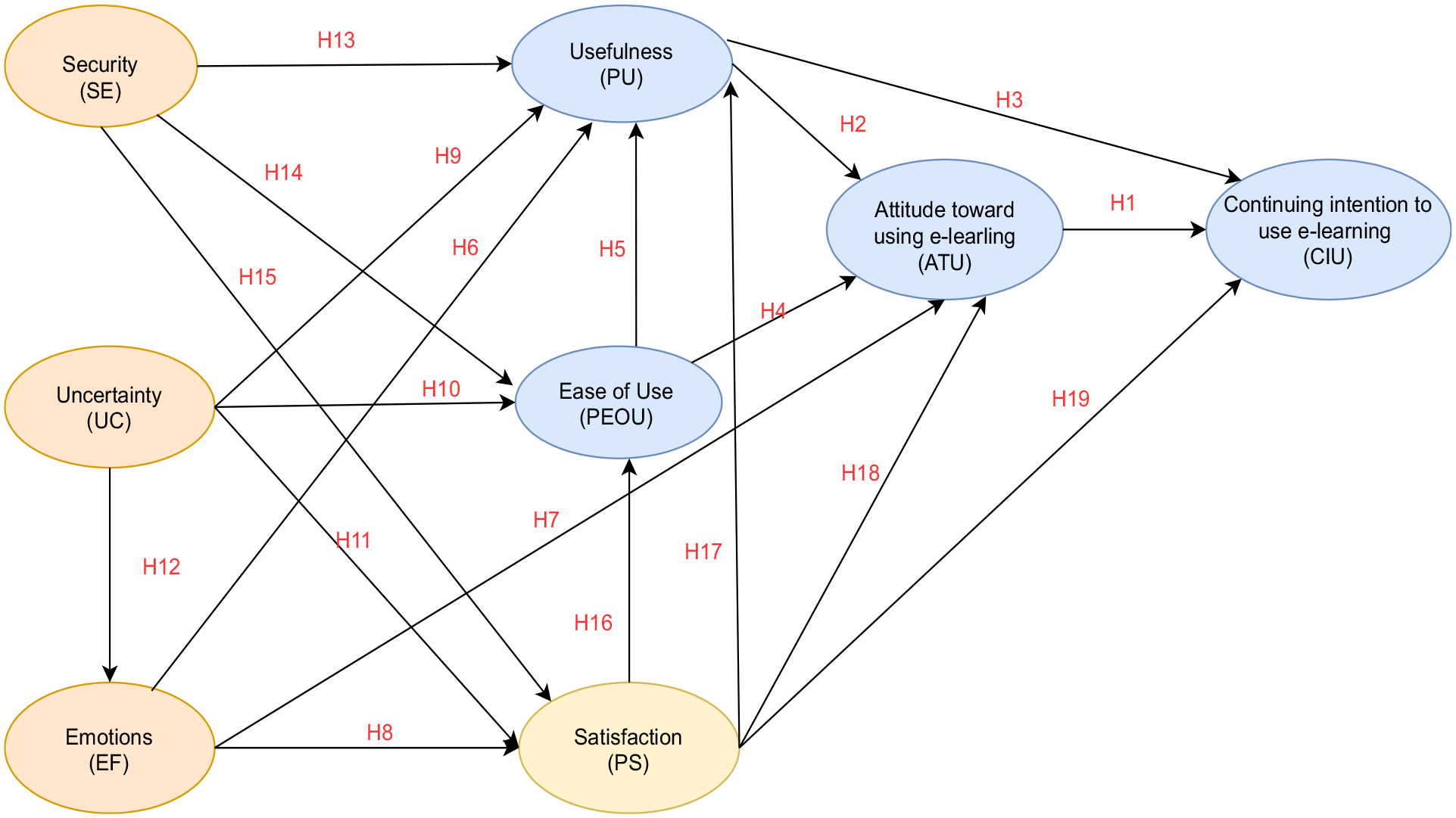
Structural model results (baseline model).
From the literature review, Table 1 was obtained, which shows how the variables were measured and the authors who inspired each one of them.
Questionnaire, Constructs, Variable, and Authors.

Methodology
Although our study included students from different universities, all of them were attending face-to-face courses of education where the main methodology used was the master class. However, after the emergence of COVID-19, they all moved to online classes. Similar tools were used for both delivery and online assessment: in the former case, videoconferencing was provided via the university’s LMS with real-time exposition from the instructor, and in the latter, the LMS’s assessment tools were used, including time-limited tests with random multiple choice questions, some open-ended questions, and assignment submissions. In this study, we explored how students accepted online learning and assessment and the related educational resources when these were suddenly imposed by the extraordinary situation created by the coronavirus pandemic. To carry out the study, an online questionnaire was designed to test our hypotheses. This questionnaire was developed following several criteria as guidelines, and it was adapted by considering other reviewed models, as recommended by O’Leary (2017).
Instruments
Items for each variable in the study were adapted from scales validated in previous studies. TAM scales for PU, PEOU, ATU, and CIU were measured using items adapted from work by Briz-Ponce et al. (2017). The questions on PS were adapted from Chiu et al. (2005), and had also been used by Al-Azawei et al. (2017). The questions used to measure the uncertainty experienced due to COVID-19 were based on work by Tarhini et al. (2017) and Al-Okaily et al (2020). Items used to evaluate the influence of EFs and perceived security of using the e-learning system and its resources were adapted from Briz-Ponce et al. (2017) and Dermo (2009).
The questionnaire used a five-point bipolar Likert scale (Likert, 1932). Responses ranged from one (“completely disagree”) to five (“completely agree”), following the method proposed by Hair et al. (2013), which is the most commonly used technique for measuring variables that are not directly quantifiable.
The questionnaire was implemented using simple, easy-to-understand questions, in order to minimize errors in the items related to variance. No research intentions or hypotheses were mentioned, items were clearly formulated, abstract questions or terms were avoided, all of the terms were familiar to the students, and there were no double-barreled items. The questionnaire was reviewed by several experts to ensure the suitability of the questions and to confirm that the statements were unambiguous and easy to understand. Some modifications were made as a result of their comments.
Participants and Data Collection
An analysis was conducted using data obtained from students at three public Spanish universities: The University of Alcalá and the University of Rey Juan Carlos, both located in the Community of Madrid, and the University of Extremadura, situated in the region that shares its name. A total of 194 students from three different universities completed the questionnaire (Table 2).
Geographical Setting and the Age of the Students.

Data were collected from the administration of a voluntary online questionnaire at the end of the second term of 2020 (January–June 2020). At the beginning of this term, a face-to-face learning system was used, but after the announcement of a state of emergency due to COVID-19, there was a sudden shift to confinement and online learning. The pandemic protocols for universities were consistent across all of Spain. What initially seemed to be a temporary solution ended up being a completely online learning and evaluation system.
Data Analysis and Results
A regression analysis of latent variables, based on the partial least squares (PLS) optimization technique, was carried out to build the model using SmartPLS 3.2.6. Hair et al. (2016) describe this technique as a multivariate method for testing structural models that estimates the model parameters and aims to minimize the residual variance of the dependent variables of the entire model. SmartPLS does not require any parametric conditions, and Hulland (1999) recommends it for small sample sizes.
Justification of Sample Size
To determine the sample size, the G * Power 3.0 program suggested by Hair et al. (2016) was used for a specific power analysis according to the specifications of the model (Cohen et al., 2001; Faul et al., 2007). To do this, it was necessary to specify the expected effect size (ES) and the significant values for alpha (α) and the power (β). In general terms, values of .05 for alpha and 80% for the power are acceptable. These three values were then used to calculate the sample size. In this case, a multiple regression study was conducted with four predictors, an average ES of 0.15, an alpha of .05 and a power of 0.95 (following Cohen, 1994) to obtain the sample size.
As a result of this analysis, the minimum sample size was calculated as 153 participants. Since our study sample consisted of 194 valid cases, the sample exceeded all criteria for performing an analysis of the measurement models and structural model.
Evaluation of the Measurement Model
According to Carmines and Zeller (1979), all standardized loads (λ) must be greater than 0.707. As can be seen from Table 3, all of the values meet this condition, meaning that the reliability of the individual items is adequate.
Outer Model Loadings.

Nunnally and Bernstein (1994) specify that the values of Cronbach’s alpha must be above .70 to ensure simple reliability of the measurement scales. Furthermore, as indicated by Werts et al. (1974), the composite reliability must have values greater than 0.7. From the results in Table 4, we can see that the models show a high level of internal consistency and reliability among the latent variables.
Cronbach’s Alpha Coefficients, Rho_A, Construct Reliability, and Average Variance Extracted AVE).

Following Fornell and Larcker (1981), the values of the average variance extract (AVE) must be greater than 0.50. An analysis of variance shows that all of the values are above the minimum acceptable level for validity (Table 5).
Discriminant Validity Matrix (Fornell-Larcker Criterion).

Henseler et al. (2015) state that the discriminant validity measures should be evaluated using the hetero-trait-multitrait (HTMT) method, for which a conservative criterion of 0.85 was used, which is associated with sensitivity levels of 95% or above. As shown in Table 6, all values were all less than 0.85, meaning that this requirement was fulfilled.
Discriminant Validity Matrix (Heterotrait-Monotrait Ratio Criterion).

Structural Model Analysis
Chin (1998) states that the PLS program can generate T-statistics for significance testing of both the inner and outer model using a procedure called bootstrapping, which requires a number of subsamples (5,000) of the original sample with replacement that, in turn, give the approximate T-values for significance testing of the structural path.
When the bootstrapping procedure was complete, the results showed that all the R2 values were within the range [0, 1] (Table 7). According to Falk and Miller (1992), R2 should be greater than 0.10 with a significance of t > 1.64 to ensure that the model reaches a minimum level of explanatory power. All of the values were greater than 0.10, indicating that the independent explanatory variables were adequate.
Structural Model Results.
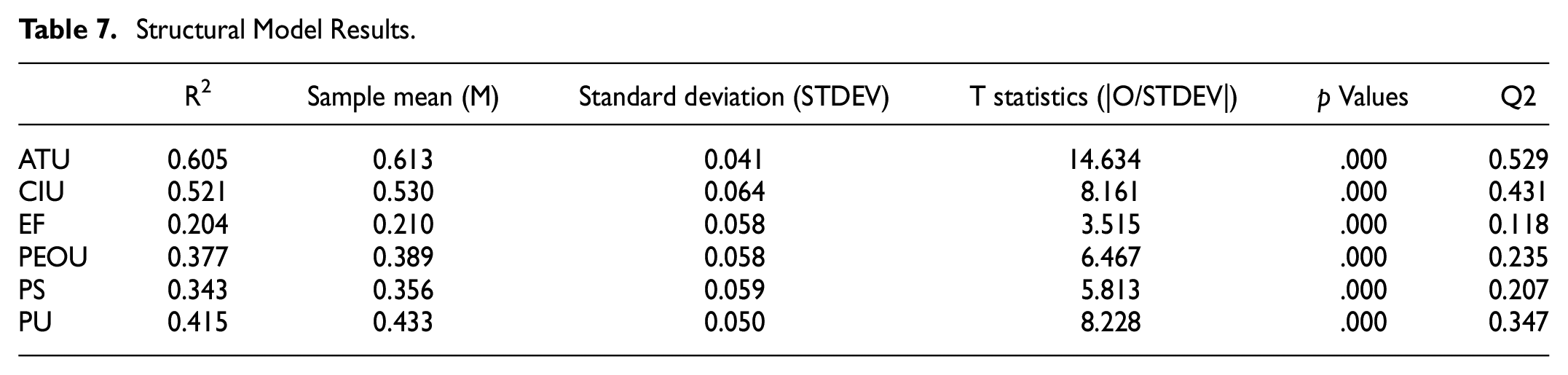
Table 7 shows the variance explained R2 in the dependent constructs, and Figure 2 shows the path coefficients for the model.

Results of testing the model significance ***p < .001.
The hypothesized relationships between constructs were estimated using standardized regression coefficients. In this approach, the algebraic sign is analyzed; if there is a change in the sign, the magnitude and statistical significance (T-statistics) is greater than 1.64 (t (4999), one-tailed test). The hypotheses were checked and validated, and the relationships were positive, mostly with a high level of significance, as shown in Table 8.
Structural Model Results.

Note. (0.05, 4999) = 1.645158499, t(0.01, 4,999) = 2.327094067, t(0.001, 4,999) = 3.091863446. ns. No significant based on t(4,999), one-tailed test. . Path significance using percentile bootstrap 95% confidence interval (n = 5.000 subsamples).
p < .05. ***p < .001.
However, when the percentile bootstrap was applied to generate a 95% confidence interval using 5,000 resamples, H3, H6, H7, H9, H10, H13, and H14 were not found to be supported, as their confidence intervals include zero (Table 8). The rest of the hypotheses were validated. All of these results complete a basic analysis of PLS-SEM in our research. The PLS-SEM results are shown in Figure 2.
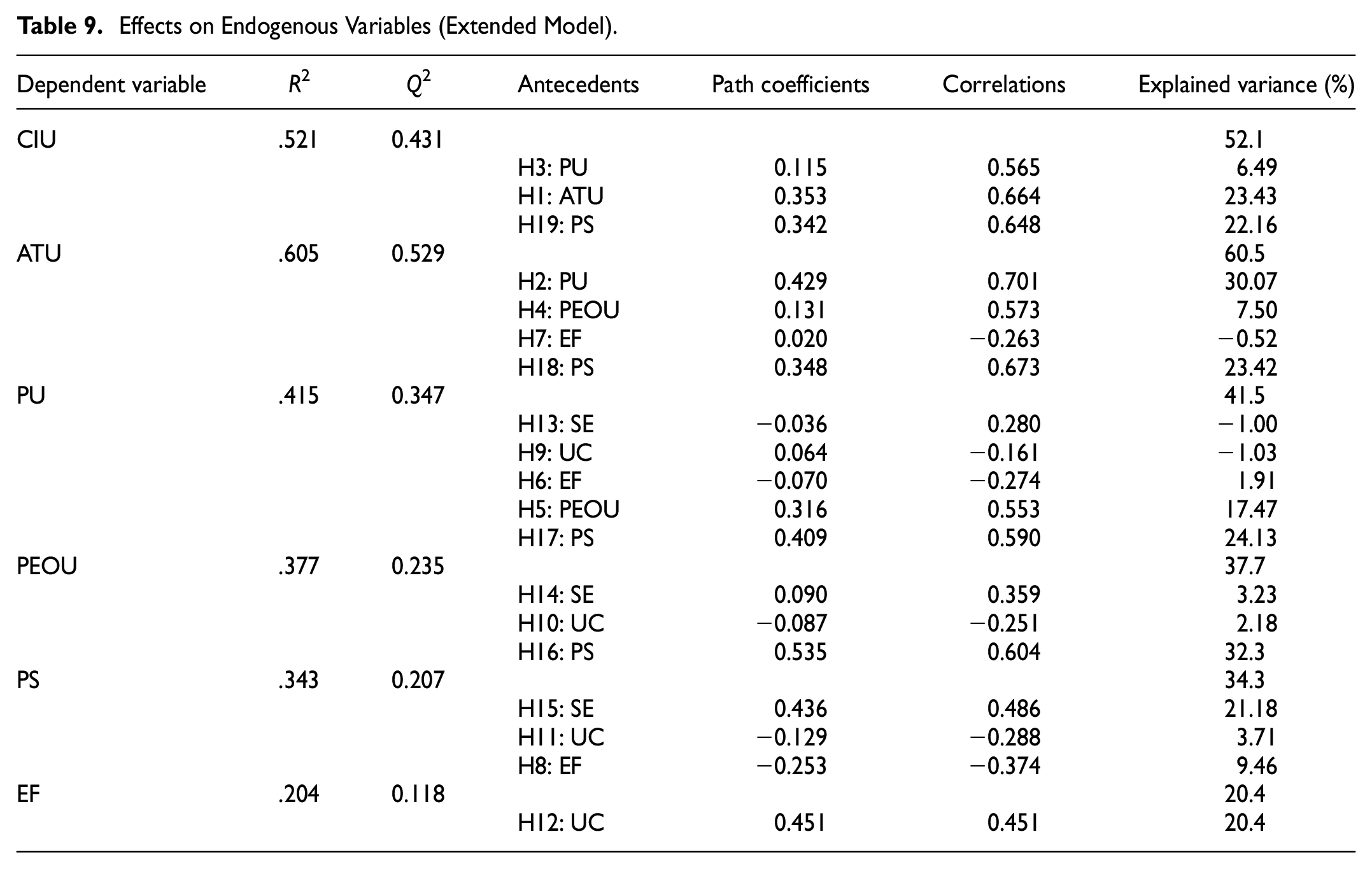
Finally, Table 9 shows that the R2 figures are satisfactory for almost all values, with the lowest value being 0.204 and the highest 0.605. The redundancy measures with cross-validation therefore indicate that the theoretical model has predictive relevance (Q2 > 0), since the higher the value, the greater the predictive capacity of the model.
Effects on Endogenous Variables (Extended Model).
Discussion
Educational institutions, lecturers, and students (with and without experience in online learning) have been subjected to a sudden, unprecedented change in the way they teach, learn, and evaluate, and to a large extent, this model is likely to be permanently adopted.
In this study, SEM was applied to explain students’ acceptance of the adoption of online learning and assessment within face-to-face universities, which were forced to make a sudden educational turnaround because of the COVID-19 pandemic. The structural model is based on the TAM, a widely used and effective model that has been applied in numerous investigations. The TAM includes usefulness, ease of use, attitude toward using and behavioral intention to use e-learning. In addition, we considered factors that were relevant in the context of the COVID-19 pandemic, such as EFs and the associated uncertainty, since according to several authors (e.g., Bakhtiar et al., 2018; Hilliard et al., 2020; Mayer, 2020) these have a negative impact on education. Furthermore, feelings and emotions were greatly intensified due to the situation arising from the pandemic. Another critical factor in this sudden expansion of online learning due to the pandemic is the security of the system supporting e-learning, which is one of the main factors conditioning the acceptance of e-learning (Mortazavi et al., 2021; Sawaftah & Aljeraiwi, 2018).
Finally, satisfaction with the use of e-learning and its tools was also included, as many authors see this as a critical factor allowing for better understanding of students’ behavioral intentions to use an e-learning system (Al-Azawei et al., 2017; Estriegana et al., 2019; Han & Sa, 2021).
The results support the explanatory power of the model under study. The simple and compound reliability values are acceptable, and the model shows a high level of internal consistency and reliability among the latent variables. The validity and discriminant validity values of the measurements are also acceptable. The relationships between variables are mostly very significant, and most of the hypotheses were supported. Except for H3, the hypotheses regarding the TAM (H1 to H5) were accepted.
As shown in Table 8, 23.43% of the CIU was explained by the ATU (H1). In turn, 30.07% of the ATU was explained by the PU (H2), and 7.5% by the PEOU (H4). The PEOU also explains 17.47% of the PU (H5). Based on these results, we can conclude that our proposed research model contributes to the existing literature related to the TAM (Davis, 1985, 1989; Venkatesh & Davis, 2000) and its extension, and has a robust construction.
Of particular note is that the PS significantly affected all factors of the basic TAM proposed by Davis (1989), in line with the findings of other authors such as Estriegana et al. (2019) and Weli (2019). The PS positively affected the PEOU (H16), explaining 32.3%, and the PU (H17), explaining 24.13%. The PS was also found to play a key role in the explanation of both the ATU (H18) and the CIU for the e-learning system (H19), explaining 22.16% and 23.42% of these variables, respectively. These results are in line with other research (e.g., Al-Azawei et al., 2017; Han & Sa, 2021; Nikou, 2020; Weli, 2019).
In light of these results, we can see that the need to virtualize learning in face-to-face universities due to the COVID-19 pandemic facilitated the adaptation of students to online tools (LMSs, videos, videoconferences, social networks, etc.), thereby creating a perception of satisfaction and confidence in regard to online classes, the knowledge gained, and the online evaluation system used to measure the learning process.
Students’ PS was positively influenced by the security they felt when using the online learning system and its educational tools, which accounted for 21.18% of PS. The perceived security of the e-learning system, the availability and accessibility of the technology, and the safety and protection of the information provided by e-learning tools (LMSs, videos, videoconferences, social networks, etc.) caused them to be perceived as useful, efficient, and offering sufficient protection for information and privacy. The PS was also influenced, in this case negatively, by the EFs and uncertainty around the pandemic, in line with the findings of Tarhini et al. (2017). These results show that 9.46% of PS was explained by EFs (H8) and 3.71% by uncertainty (H11). Online teaching can generate anxiety in students who are not used to this approach; they may feel confused and find it difficult to concentrate with all that is going on around them, and in particular may feel uncertainty regarding the continuity of learning, assessment and results. However, this influence, although significant, was not overly large, due to the ease of adaptation of students who were accustomed to technology of this sort. The satisfaction generated by the effectiveness of online tools and the other advantages of resources based on digital technologies, such as making the learning process more flexible (Alzahrani & Seth, 2021), can offer compensation to those facing problems and disadvantages. Other authors, such as Hwang and Lee (2012), claim that uncertainty can be reduced through the influence of communication with others, and that good relationships are essential in creating a safe learning environment, while confidence created through communication with peers and lecturers can reduce uncertainty, anxiety, worry, and fear.
Furthermore, as expected, uncertainty and EFs were highly correlated; uncertainty significantly affected EFs (H12), explaining 20.4%.
The remaining hypotheses were not accepted, meaning that EFs, uncertainty and perceptions of the security of the online learning environment and its educational tools did not significantly influence the PU and PEOU. This may be primarily due to the many advantages of online learning and technological learning tools, which provide independence, flexibility, and accessibility (Alzahrani & Seth, 2021; Choudhury & Pattnaik, 2020; Eringfeld, 2021), increase motivation (Moawad, 2020), and improve achievement by students (Al Rawashdeh et al., 2021). In addition, today’s students have grown up with technology and find it natural to use. Thus, emotions and uncertainty had little impact on the acceptance of e-learning in the unusual situation created by the COVID-19 pandemic. This digital generation of students has had a high level of training in technological tools and easily adapts to them: this is mainly due to the widespread use of mobiles, devices, and the many applications and social networks used to communicate or play, which provides greater confidence and ease of adaptation in new situations such as that generated by the pandemic. Regarding e-assessment, our findings echoed those of Dermo (2009), who found a positive inclination of students toward e-assessment; we discovered that students seemed to be more prepared and willing to take part in e-assessment as part of their university studies than lecturers and university managers, who were more reluctant and had more concerns about validity and reliability.
Conclusion
This study has focused on an analysis of the acceptance of and behavior toward educational technologies and e-learning, which were abruptly adopted as an alternative to face-to-face classes due to the emergency situation caused by COVID-19. Our approach was based on the TAM, a widely employed and validated model; however, we also considered other factors that became relevant in the context of the pandemic, in order to better understand students’ acceptance or rejection of online learning and assessment in these circumstances, and to explore how students’ behavior was affected by EFs, environmental uncertainty, the perceived security of the technological system, and the PS of using online educational resources.
Our results indicate the following. First, EFs and the uncertainty experienced by students in an emergency situation, such as the one caused by COVID-19, do not significantly affect the acceptance of and intention to use an e-learning system and e-assessment. This finding is due to the characteristics of this generation of digital learners, who are accustomed to using technology. Trust and institutional support have also been essential in reducing negative emotions arising in the online learning environment. Second, although these factors (emotions and uncertainty) negatively influence students’ PS, this effect is mitigated by the perception of security and trust in the online learning system. Third, students’ PS is a decisive factor that positively influences the original variables of the TAM, and hence the process of adoption and future use of the e-learning system and its educational resources. The students, digital natives who have accepted the use of technology as a way of life, found the use of technology and e-learning satisfactory, and this resulted in easy adaptation to e-learning.
The theoretical and practical implications for education that can be drawn from this study are as follows. Educational decision makers need to take action to improve the experience of and satisfaction with distance learning. Appropriate strategic plans should be developed, including improvements to distance education infrastructure and the adaptation of educational strategies and resources, taking into account accessibility, security and legal aspects related to data protection, recordings, etc. Such strategic plans must also address the adaptation of teachers and students to these tools and strategies.
Students can handle the technology and applications involved without problems; they have a high level of training and ease of adaptation to technological tools, and have the skills and capacity to access information and knowledge where, when, and how they want. However, they need to be properly guided to develop essential learning competencies such as critical thinking, creativity, and autonomy. Teachers may have more problems adapting to technology than students, and therefore need to be trained and equipped with new skills related to the appropriate use of technology and digital learning strategies.
Although the pandemic forced educational establishments to adapt suddenly, in unforeseen ways, this offers an opportunity for institutions and teachers to more effectively meet the needs, preferences, and expectations of the students of this digital generation.
Our work will be useful in terms of providing teachers and educational institutions with adequate information, which can help in making the best decisions about the educational system we want to build.
The study was subject to several limitations. First, the use of e-learning and associated resources was imposed under extraordinary circumstances, and the relationships between the variables may vary in a different context. Second, the total variance accounting for the dependent variables is not fully explained, and it is possible that some relevant predictors were excluded from the study. Third, although the sample met all of the criteria for performing an analysis of measurement and structural models, the study needs to be extended in order to generalize the results. Fourthly, the methodology for example, we used self-reported data, which may have the potential to lead to common method variance. The recruitment method also represents a limitation, since data collection was done through an online survey, which may lead to response bias.
Finally, another limitation of this study lies in its geographical context, as it was conducted exclusively within three public universities in Spain. It is important to emphasize the diverse COVID-19 protocols implemented in each country. In the case of Spain, in response to the pandemic, all universities suspended in-person activities from March 11, 2020, until the end of the 2019/2020 academic year. The national situation improved at the beginning of the 2020/2021 academic year, prompting Spanish universities to adopt a hybrid approach to education. It was not until the end of October 2021 that universities agreed to return to “normal/in-person” classes.
Therefore, it is recommended to replicate similar research, for example, in other European universities, to achieve a more comprehensive and comparative understanding of the situation. Furthermore, to enhance the generalizability of our findings and to explore various scenarios, other factors such as gender, age, and experience with e-learning systems should be incorporated. Additionally, the perspective of teachers should also be included. A longitudinal study would also be of interest to evaluate the acceptance and intention to use e-learning systems, considering the experience gained by both students and educators as a result of the COVID-19 health crisis.
Footnotes
Acknowledgements
Not applicable.
Declaration of Conflicting Interests
The author(s) declared no potential conflicts of interest with respect to the research, authorship, and/or publication of this article.
Funding
The author(s) received no financial support for the research, authorship, and/or publication of this article.
Ethics Approval
Not applicable.

Data Availability Statement
Data sharing not applicable to this article as no datasets were generated or analyzed during the current study.