




Abstract
This paper studied the impact of high-speed railway linesonagricultural outputin the regions along their routes. It also investigated the heterogeneity of this impactbased on the terrain characteristics. The results of empirical testsusing county-level data show that ahigh-speed railway line can bring higher agricultural “dividends” to counties along the line. Notably, low altitude areas and regionswith gentle terrain exhibit a more pronounced promotional effect on local agricultural output. High-speed railways mainly promote agricultural output by promoting the mechanization of agriculture in counties along the route, thus reinvigorating the agricultural population and the development of specialty agriculture. Ourfindingsprovide quasi-microscopic evidence of the potential benefits of transportation infrastructure construction to break down geographical barriers and facilitate production factor flow, and providesa theoretical basis for the economic spillover effects of high-speed railway construction.
Plain Language Summary
This paper studied the impact of high-speed railway lines on agricultural output in the regions along their routes. It also investigated the heterogeneity of this impact based on the terrain characteristics. The results of empirical tests using county-level data show that a high-speed railway line can bring higher agricultural “dividends” to counties along the line. Notably, low altitude areas and regions with gentle terrain exhibit a more pronounced promotional effect on local agricultural output. High-speed railways mainly promote agricultural output by promoting the mechanization of agriculture in counties along the route, thus reinvigorating the agricultural population and the development of specialty agriculture. Our findings provide quasi-microscopic evidence of the potential benefits of transportation infrastructure construction to break down geographical barriers and facilitate production factor flow, and provides a theoretical basis for the economic spillover effects of high-speed railway construction.
Keywords
Introduction
Infrastructure construction has historically played a significant role in shaping transportation costs and determining the layout of industrial economies. The emergence of high-speed railways (HSR), representing high-efficiency means of transportation across large regions, has become an important indicator to measure the social development in China. The extensive construction of HSR in China has dramatically reduced the geographical barriers between regions, and has changed the economy of cities along the routes. This efficiency improvement has facilitated more frequent and streamlined flows of people, resources, capital, and investments (Bian et al., 2018; J. Zhang, 2017; K. Z. Zhang & Tao, 2016).
According to Qin (2016), the availability of convenient transportation has led many people to migrate from villages, towns, and small-to-medium-sized cities along the railway to central cities, resulting in the “siphon” effect and urban polarization. This rural-to-urban migration (J. Zhang et al., 2021) has resulted in the “hollowing out” of rural areas (Li & Wang, 2020), leaving only vulnerable groups behind. The reduction of rural population would have a negative impact on the local economy. However, HSR also produces some positive factors, especially by creating conditions for the transfer of rural land resources, and the unified management of land (Dong & Huang, 2006). With the increase of the ratio of agricultural capital to labor, mechanized operation on agricultural land can promote the progress of agricultural technology and the improvement of technical efficiencies, thus increasing the scale income of farmers. In addition, although China’s current HSR system does not have the function of freight transport, the spillover of knowledge, technology, and other resources have achieved rapid dissemination with the help of HSR. This has strengthened the technological diffusion of scientific research and development to the agricultural sector (Y. F. Wang et al., 2020).
China is a vast country with great differences in topography and landforms among regions. The original purpose of HSR construction is to save transportation time between regions. Therefore, the government did not deliberately choose to build the HSR on the flat terrain of the plains. In mountainous and hilly areas, it is very difficult to use machinery for agriculture industrial production. For rice, wheat, tobacco, and other staple food crops that depend on the flat plains, how can the benefits brought by HSR be reflected? As for some high value crops, such as fruits, tea, oils, wood, and bamboo, they do not need to be planted in the plains. Will the output of these crops be negatively affected due to the loss of agricultural labor after the opening of the HSR? In other word, does the opening of a HSR promote the agricultural development of the areas along the route? Will this promotion be affected by terrain factors such as altitude, slope, and local main crop categories? Are there spatial and temporal effects on agricultural output in the surrounding areas along the HSR? All these questions are the research objectives of this paper.
The contribution of this study is that we investigate the impact of HSR, a large-scale infrastructure construction project, on agricultural output capacity using the county level as the research objective. This enriches empirical research on the externality of HSR. The economic gain of HSR not only should be evaluated by its revenue, but also its impact on the agricultural production along the line. This study enriches the research on the impact of a HSR on agricultural economy from the perspective of topography and geography. The previous research limited the sample to the eastern plains of China, and rarely conducted a nationwide investigation. This paper has expanded the scope to the whole country, and investigated the impact of HSR on different types of terrain from the perspective of geographical diversity, so as to integratethe study of HSR development into geographical constrained economics.
The rest of this paper is organized as follows. Section 2makes a concise review of the literature. Section 3 discusses the analysis framework and research hypothesis. Section 4 presents the methodology and data, and section 5 contains the empirical analysis and robustness tests. The final section summarizes this paper.
Literature Review
In a broader scope, the research on rural and agricultural development involving transportation infrastructure has a long history. The initial research can be traced back to Fogel’s (1962) quantitative analysis on the impact of American railways on economic growth. Easterly and Rebelo (1993) used transnational data to show that there is a stable and direct relationship between the stock of infrastructure such as transportation and agricultural economic growth. Binswanger et al. (1993) found through research on dozens of Indian states that infrastructure investment reduced logistics costs, increased farmers’ market participation, and promoted the substantive growth of agricultural production in these regions. Teles and Mussolini (2010) also confirmed that transportation construction improves agricultural productivity in Latin America. Camm (1970) made a detailed study on the development of the Australian railway system and the importance of the government’s railway policies relating to specific regions, pointing out that although the railway will stimulate agricultural production, it will also trigger market competition. Therefore, in the absence of protective legislation, the benefits brought by railway construction to agricultural development may be offset.
The studies on HSR impact on agriculture are relatively new. Only in recent years due to the rapid growth of HSR, it has gradually become a key area of concern in China. It should be pointed out that, worldwide, HSR is currently dominated by passenger transport, most of which does not have the function of freight transport. Therefore, it mainly affects the flow of people and information, which is different than the role of conventional railways regarding commodities. Some studies focus on the effect of HSR lines on the efficiency of the agricultural industry (Y. Gao & Wang, 2023; J. Zhou et al., 2021). For example, Y. F. Wang et al. (2020) using panel data of cities in the Yangtze River Delta, confirmed the growth effect of the HSR on the factor of agricultural productivity. They proposed that the construction of HSRs should be included in the Rural Revitalization Strategy, one of the national economic development strategies, to spur on urbanization and upgrade industrial infrastructure through the leverage effect of developing HSR. J. Zhang et al. (2021) explored the impact of HSR on agricultural labor immigration. Their empirical results show that the implementation of HSR systems has led to the transfer of local agricultural labor to non-agricultural industries by 3%. This positive effect mainly comes from the reduction of flow costs and the improvement of agricultural productivity. In addition, the operation of a HSR has also promoted the development of non-agricultural industries in rural areas. A. L. Yu and Zhou (2021) discussed the impact and mechanisms of HSR construction on the export of agricultural product processing enterprises. It was found that the introduction of a county-level HSR can promote the growth of local agricultural exports and have expansive export growth potential. Chen et al. (2016) explored the changes in the spatial layout of rural areas around the HSR station. Their study was based on a survey of residents in Tengzhou, Shandong Province. Using the systematic analysis method, the study pointed out that the construction of HSR lines is one of the main influencing factors for the evolution of the spatial layout of rural areas.
In addition, it was documented (Bian et al., 2019; Yan, 2020) that with the opening of a high-speed rail network, the central area strengthens its attraction to the resources in the marginal areas, and the resources, eventually converge to the central cities. This is the phenomenon of “polarization” relating to economic distribution. Agricultural resources (especially labor) have been transferred to the central area after the construction of transportation infrastructure. Correspondingly, whether the urban resources will flow to the rural areas along the line through the opening of HSR is a topic worthy of discussion.
The previous literature is more focused on the transfer of agricultural resources or the improvement of agricultural efficiency. Clearly, a more detailed analysis and discussion on a variety of fields within the agricultural context are needed. Complicating this need is the fact that agricultural output structure of different regions varies greatly due to different terrains. Not all regions are suitable for large-scale mechanical operation. For example, the planting of most cash crops (fruits, wood, and bamboo) does not depend on the plains. Therefore, the agricultural output value of different regions is affected differently by the presence of aHSR. In other words, HSR has a regional heterogeneity relating to agriculture. At present, some domestic studies focus on the sample areas in the eastern part of the country (such as the Yangtze River Delta), which makes the research depth insufficient. This paper attempts to make up for this in order to deepen the scope of the research.
We study the effects of a HSR system on the agricultural economy from the perspective of counties in China. We analyze the impact of the opening of HSR on the agricultural industry along the line by using data from the Chinese county statistical yearbooks, 2010 to 2019.This data is combined with the time of the opening of a HSR in each county. We use the difference-in-difference method (DID), propensity score matching (PSM), and other empirical methods to test the specific mechanism of this impact. This study found that regions with a HSR would have higher agricultural dividends, compared with regions without aHSR. The promotion effect is the most obvious for producing crops. In the areas with low altitude and gentle terrain, the opening of a HSR has a more obvious role in promoting local agricultural output. In general, the role of altitude is more prominent than slope for county agriculture along the HSR. The HSR mainly drives the increase of agricultural output value by increasing the mechanization of agriculture, the concentration usage of agricultural land, and the growth of specialty agricultural crops in the counties along the line. The farther away the county is located from the HSR, the smaller the industrial “bonus” obtained by its agricultural sector. Finally, in the counties that opened high-speed rail earlier, the promotion of agriculture is more obvious.
Theoretical Analysis and Research Hypothesis
According to Krugman’s New Economic Geography theory, there exists an effect of “economies of scale” between industry development and geography that influences the agglomeration of industries. Specifically, the uneven distribution of industries in space is a result of increasing returns to scale. This phenomenon is widely present in real economic life and can be applied to multiple fields. For example, if we isolate a village on a vast plain, no matter how hard the villagers work to make it stronger, they will eventually succumb to the fate of diminishing returns to scale. However, if we connect urban and rural areas through the development of transportation infrastructure, the situation will be different because urban resources can spill over. This allows for quick responses to new demands and standards in agricultural production through efficient transportation tools like HSR. With the popularity of HSR, agricultural labor productivity will continuously increase, resulting in higher benefits and achieving economies of scale. Furthermore, HSR promotes the openness of rural areas along its routes, facilitating the flow of external capital into these regions to provide adequate financial support for agricultural activities. In addition, the accessibility and location conditions of non-HSR counties are clearly inferior to those of HSR counties, which will drive the inflow of agricultural resource elements into HSR counties and lead to the reconfiguration of agricultural development resources between HSR and non-HSR counties.
As mentioned above, unlike the traditional transportation infrastructure, HSRs all over the world do not have the function of carrying goods due to cost considerations. Therefore, for rural areas and the agricultural sector, the rapid distribution of bulk commodities is not a benefit of HSR systems for their development. Instead, the benefits may come from the following aspects.
The first possible benefit of a HSR for a rural area is the centralized usage of land (Y. M. Wang et al., 2013; F. Z. Zhou & Wang, 2015). A HSR makes the traveling time between the vast rural hinterland and developed areas shorter, thus further accelerating the flow of the rural working population (Y. Z. Yu & Pan, 2019). For example, after the opening of the Shanghai-Kunming railway and the Chongqing-Guiyang railway in Yunnan and Guizhou province, the traveling time for these regions to go to Shanghai or Guangzhou has been reduced from >20 h to less than 10 h. It means that after the opening of a HSR line, the development of the non-agricultural economy in the metropolitan area has attracted agricultural workers leaving the land (J. Zhang, 2017; Zhu et al., 2019). The cross regional or cross industry exodus of this population has led to the abandonment of agricultural activities, the abandonment of land, and the decline of the land rehabilitation rate. However, this is bound to create conditions for the transfer of agricultural land management rights (Mao & Xu, 2015). When the property rights trading market of the agricultural land is gradually improved, it will help to solve the “fragmentation” of farmland property rights in the plain areas. The concentration of land usage will help to achieve the goal of improving agricultural output capacity through industrialization, and by promoting agricultural mechanization and small water conservancy projects.
Secondly, the promotion of mechanical technology and its diffusion to agriculture. The efficiency of agricultural technology has been improved by speeding up the process of technology diffusion through HSR. The fast transportation network enables the rapid popularization of new technologies (X. L. Zhang, 2012). The rapid connection has greatly enhanced the overall planning and integration of various elements of capital, technology, and information (Ma et al., 2020). Farmers have the opportunity to adapt to updated planting and breeding technologies, thus expanding the scope of new technologies, improving the input efficiency, and enabling agriculture to share the dividends brought by scientific and technological progress (M. Gao & Song, 2014). The vast capacity difference makes technology flow through rural and urban areas (D. Wang & Liu, 2020). Among them, HSR plays an important role as a medium. After the opening of a HSR, the convenience of round-trip transportation enables technical resources to go to the countryside. After the opening of HSR, the time distance within space can be shortened. Technical personnel can more frequently and smoothly go to rural areas to promote agricultural technology, and capital can more easily take root in rural areas, thereby introducing professional agricultural equipment to improve the level of agricultural mechanization. Through modern technology empowering agriculture, rural areas and farmers have realized the transformation of an endogenous development mode. The high efficiency of a HSR adds “wings” to the technological empowerment of agriculture.
Thirdly, the development of specialty agriculture can be facilitated through improvements in transportation infrastructure. With the construction of HSR, there is potential to change the planting structure of agricultural products, specifically promoting cash crop cultivation over food crops (Dong & Huang, 2006). Agricultural technology has a more significant impact on cash crops than on food crops (Han & Tan, 2004). The HSR will increase the passenger flow in the county by promoting the circulation of the population. In addition, the demand of tourists for agricultural products will be “activated” by the HSR through the promotion of rural eco-tourism, which effectively promotes the planting of local cash crops and accelerates the adoption of technology in agricultural production.
Based on the above analysis, this paper puts forward the following hypothesis:
Hypothesis H1: the HSR will improve the agricultural output capacity of the areas along the route, which is mainly reflected in the improvement of grain output.
The opening and operation of a HSR can enhance agricultural output capacity in county areas along the line through various channels. According to the agricultural location theory, geographical location is the main factor affecting the spatial selection of agricultural production. Rural agriculture development relies not only on the natural characteristics of the land, but also on the condition of the location (Yan, 2020). Specifically, the distance between the region and the central city (Thunen et al., 1966) is of obvious importance to agricultural production. Areas closer to the city are obviously more vulnerable to positive spillovers of technology and capital, thus effectively improving the efficiency of the local agricultural industry. However, the emergence of a HSR has greatly shortened the geographical distance, so the advantage of agricultural location becomes less important. However, China is a vast country with great differences in altitude and slope in various regions. The crops suitable for planting under various topographical structures are different, and not all crops can or are suitable for large-scale mechanized operation. Factors like the high altitude and temperature, complex and diverse landforms, rugged terrain, and seasonal variation, all limit the sustainable possible machinery to be used. For example, the Loess Plateau has thousands of ravines, fragmented terrain, serious drought, frequent agricultural disasters, steep water and soil loss, the vegetation is difficult to survive in, and it is even more difficult to plant crops. Therefore, the advantages and disadvantages of natural conditions are significant determinants for achieving high level or any mechanized development in agriculture. Although the opening of an HSR cannot solve such topographical challenges, mountain environments suit cash crops such as navel oranges, tea, and mulberry, which do not rely on the topographical structure. Therefore, the operation of HSR may have different effects on the areas mainly producing grain and the areas mainly producing cash crops along the line. Based on the above analysis, this paper puts forward the following hypothesis:
Hypothesis H2: in areas with different altitudes or slopes, the effect of HSR on the total agricultural output and the output of various agricultural products is different.
Modeling Design
Sample Selection
The data in this paper mainly involves three aspects: first, the stations and the opening date of a HSR line. The data comes from the national railway passenger train timetable published by the State Railway Administration and the Baidu Encyclopedia. The second source is the data of agricultural output and related influencing factors in counties across the country. The data are from the China County statistical yearbook. The third source is the data of the average altitude and average slope of each county. The former comes from thealtitude measurement data of the Baidu map. The slope is from the data set reported by You et al. (2018). This paper selected the period from 2010 to 2019 as the observation period. Although the Qinhuangdao Shenyang passenger line (the first HSR line in China) was completed in 2003, it was not until 2010 that China’s HSR system was put into massive operation. Domestic counties and districts are divided into intervention groups and control groups that are relatively matched, so as to be effectively used for the DID estimation.
As of April 2021, there are 2,843 county-level administrative regions in mainland China, including 977 municipal districts. Considering that the research is based on agriculture, most municipal districts often have little agricultural land, and the scale of agriculture is not substantial, so they are excluded from the study. In addition, some provinces and regions in the Baidu data source did not report the counties and regions within their jurisdiction in detail, and most of China’s HSR were built in the middle and eastern regions, so some marginal county samples in the western region were discarded. Finally, 1,474 county-level administrative regions were selected to form a 10-year period, thus a total of 14,740 observations were collected. The sample includes 79% of counties in China except for municipal districts. Table 1 shows the statistical results of the annual distribution of the samples, from which we can see that since 2010, the number of counties that have opened and operated high-speed railway lines in China has maintained a trend of rapid growth, and the proportion of the number of counties where high-speed rail passes through a local station regarding the total sample size has nearly doubled in 10 years.
Sample Distribution.

Model Setting and Variables
In order to test the impact of a HSR on the agricultural output along the line and the differences in regions, this paper adopts the difference-in-difference (DID) method, which was first introduced by Ashenfelter (1978). This technical method has a very good record in dealing with causality and controlling the endogeneity caused by policies. It can effectively eliminate the impact of unobservable individual effects on the outcome variables. The traditional DID method requires that the time point of policy impact is fixed at a certain time, so as to construct the treatment group with policy intervention and the control group without policy intervention. By controlling other factors, the difference of outcome variables between the two groups is compared. In this way the impact degree of policy intervention can be obtained. However, since the intervention policy mentioned in this paper is the opening of a HSR line, and this is a continuous event, that is, there are differences in the sequence of events that the research objects need be addressed. The staggered DID method should be adopted (Athey & Imbens, 2022). This method is different from the traditional DID technology. In the process of continuous intervention, the observation object of the control group in the early stage may enter the intervention group next. Therefore, the composition of the control group and the intervention group will continue to change, forming a new treatment group and control group. This paper designs the following model to investigate hypothesis H1:

The variable lnAgcit in model (1) is the logarithm of the added value of agricultural industry in county I in year t, and the output over the years has been modified using the price index in 2010. In order to investigate the sub groups of different types of agricultural products mentioned in the hypothesis, the dependent variables also include the Yuanvalue of the output of grain (lnCrop), oil (lnOil) and meat (lnMeat). These agricultural products have different requirements for land quality in the production process. Food crops such as rice or wheat need to be planted on flat land, while crops such as soybeans, rapeseed, and peanuts that produce oil, can be planted in mountains and hills. Meat comes from animal husbandry, and there is basically no requirement for flat terrain. Hsrctyit is the dummy variable of whether the county has a high-speed railway in t year, which is 0 before having the railway and 1 after having the railway active.
X is a set of control variables, including: (1) Rural registered residential population (lnPop), which is naturally the driving force for agricultural production; (2) Regional GDP per capita (lnGDPpc), the level of local economic development determines the scale of local agricultural investment and the degree of population outflow; (3) The added value of secondary industry (lnInd), industrial development is bound to form a relationship of resource competition with agriculture, which may have a negative impact on agricultural production, but may also form a benign interactive relationship; (4) Local general budget expenditure (lnFsc), which reflects the local support for agriculture; (5) The completed amount of investment in fixed assets (lnFix) can partly reflect the investment of local governments in rural infrastructure. The construction of roads, bridges, and water conservancy facilities in rural areas will help to change the ecology of rural areas and improve the efficiency of agriculture. γi�ηt and ε represent individual, period variable, and residual term, respectively. prv×η is the interactive term between the dummy variables of the province, autonomous region, and city, and the dummy variables of the year to which the county belongs. This controls the fixed effect of the change of the provincial level with the year. In Equation 1, we are concerned with the coefficient α1 of Hsrctyi. It captures the net effect of the opening of a high-speed railway line on the agricultural impact of counties along the line after stripping off other intervention impacts. If the coefficient is significantly positive, it can support hypothesis H1.
In addition, for hypothesis H2, considering that the DID results may be mixed with the impact of other policies, this may interfere with the results. In particular, the terrain of each region is different, and the impact of the opening of a HSR on the agricultural production of the counties along the line is different. Therefore, on the basis of DID, terrain (altitude and slope) should be introduced into the estimation equation as adjustment variables. Continuous variables should be used to replace dummy variables, so as to form two groups of DID models with adjustment items:


Atdi and Slpi in Equations 2 and 3 represent the average altitude and average slope of CountyI. The definition of other variables is the same as that in Equation 1. What we are most concerned about are the coefficients α1′of the interactive item Hsrctyit×Atdiandα1″ of Hsrctyit×Slpi. This captures the net effect of the terrain for the opening of a HSR on agricultural production in counties along the line after stripping other intervention impacts and considering conditions. We expected that the flatter the terrain is and the more ideal the agricultural conditions are, the more obvious the positive impact a HSRline is on agriculture. However, the greater the altitude and slope, the less ideal the agricultural conditions are. Therefore, in the empirical process, the values of Atdi and Slpivariables are the reciprocal of the two groups of original data. In this way, the greater the index value, the flatter the region is. The result is that if α1′(α1″) is significantly positive, assumption H2 can be supported.
On this basis, we further replace the variable with the output of several types of agricultural products for estimation tests. See Table 2 for definitions and descriptive statistics of all variables. The data shows that only 10% of counties have opened HSR in the sample period. Considering that we have excluded many county-level observation samples in marginal areas, this shows that the proportion of counties with opened HSR lines in China is much lower than 63.5% of the prefecture level cities with an open HSR line in Yang et al. (2021). This fully shows that China’s HSR mainly serves central cities rather than counties. Among the three types of output, the output of grain is much higher than that of oil and meat, which fully shows the output structure of China’s agriculture at this stage.
Variable Summary.

Empirical Results
Benchmark Tests
Table 3 shows regression results to test Hypothesis H1. Columns (1) and (2) report the impact of the HSR line on the local agricultural output value along the line. The coefficient of Hsrcty in both columns is significantly positive, which indicates that the opening of a HSR line can effectively promote the agricultural output capacity of counties along the line. Therefore, H1 is confirmed, which is consistent with the results of Y. F. Wang et al. (2020). After adding control variables to further control the economic and social characteristics of each region, the positive coefficient has not changed. This indicates that the sample allocation between the experimental and control groups is random (L. A. Zhou & Chen, 2005). In columns (3) to (5), we replaced the variable with the output of three agricultural products. The estimated results show that the three products have a positive correlation with the opening time of the HSR line. Among them, food crops have the most obvious promotion effect, followed by oil producing plants and meat, in that order. This also shows that compared with planting, the animal husbandry sector in the county is least affected by the opening of a HSR line. As the HSR line is mainly used for the integration of farmland and the feed required for pig breeding can be obtained partly through agricultural planting, the impact of a HSR will be relatively small for the animal husbandry sector dominated by grassland.
Benchmark Test Results.
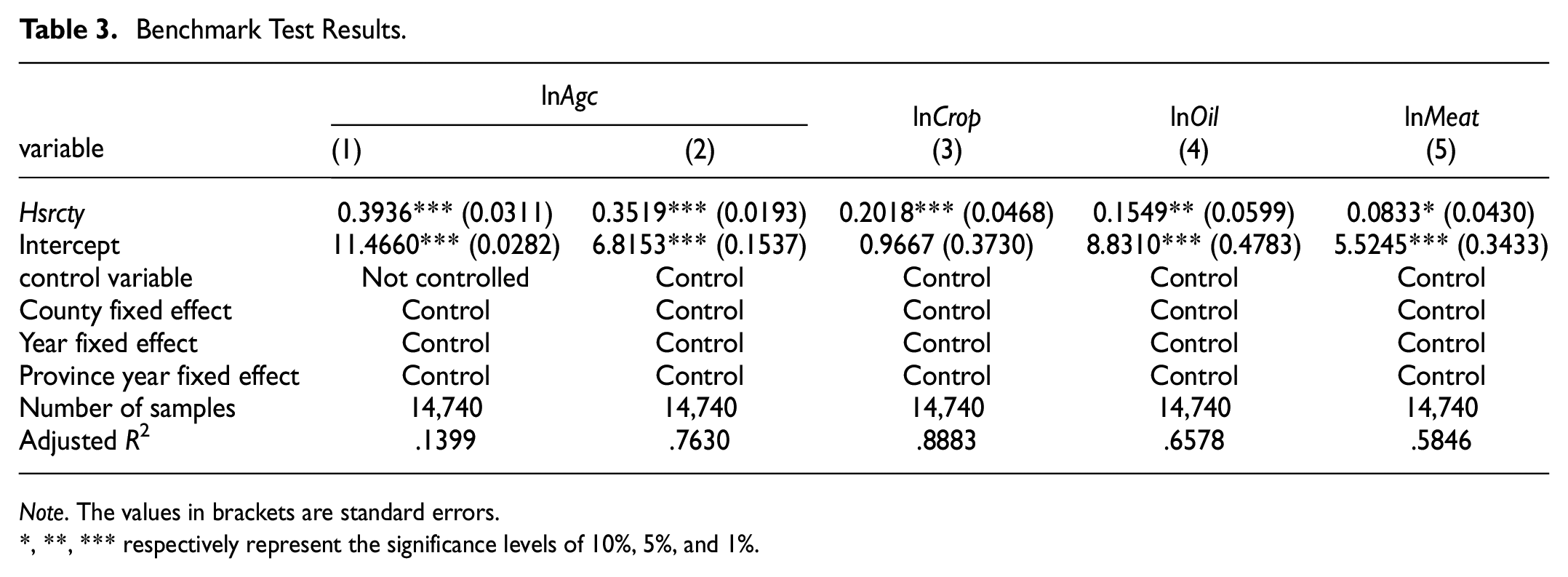
Note. The values in brackets are standard errors.
, **, *** respectively represent the significance levels of 10%, 5%, and 1%.
Next, we test hypothesis H2, which considers the role of regional terrain on the impact of a HSR on agriculture. As mentioned above, this paper takes the reciprocal of county altitude and slope as the variables for further investigation. Table 4 reports the DID estimation results after adding the above two groups of adjustment variables. The results show that in counties with low altitude and gentle slope, the positive impact of a HSR line and corresponding station on their agricultural output will be more prominent, which confirms hypothesis H2.
Benchmark Test Results With Terrain Conditions.
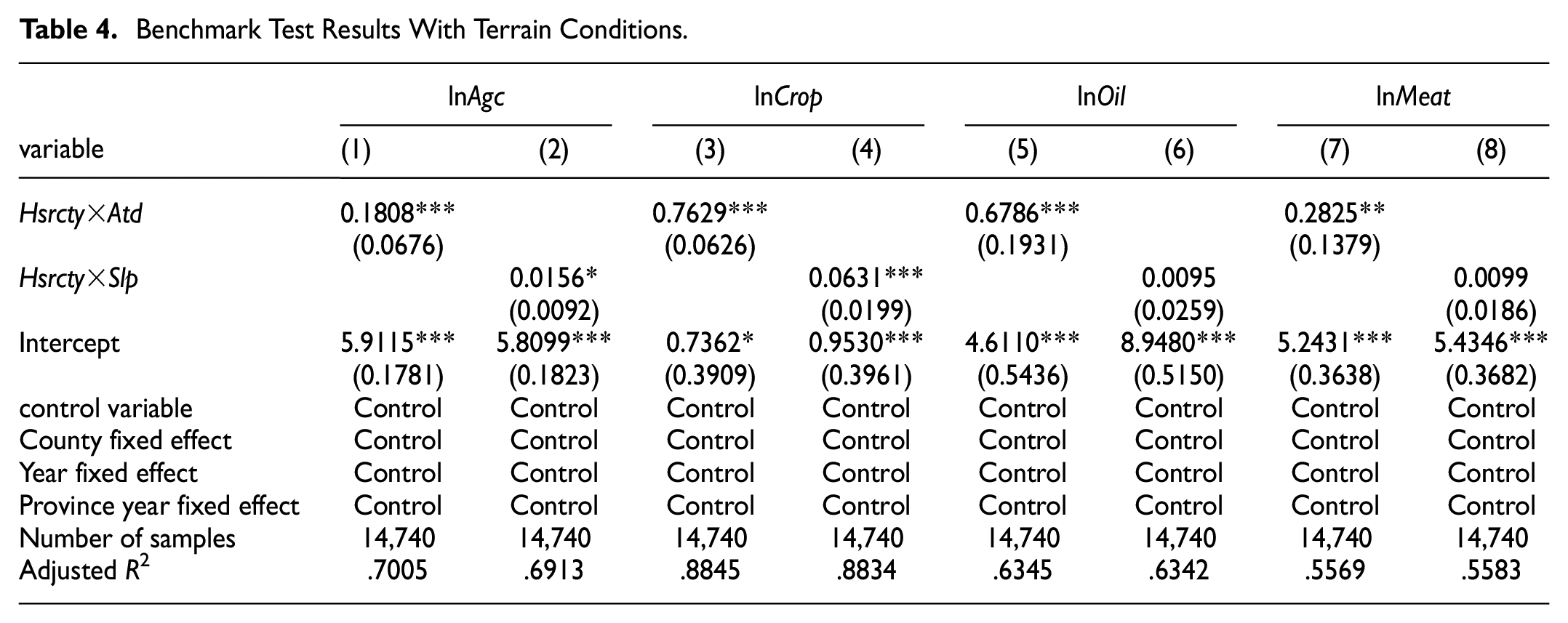
In the classification investigation of the three crops, it is also confirmed that the opening of a HSR can promote the local agricultural output in the low altitude and flat terrain areas. However, for the output of oil and meat, the coefficient is positive but not significant. Also, whether the terrain is flat or not seems to have no impact. Although the estimation results in Table 3 show that the opening of a HSR can promote the production of these products, combining this with the estimation results in columns 4 (5) to (8), we noticed that a low altitude area is better for agriculture production, and whether the terrain is flat may not be very important. In fact, the coefficient of the interactive term in column (2) is only marginally significant, which also confirms the conclusion that the altitude has a greater impact on agricultural production than the slope. After all, a large slope means a large altitude drop, and it will be more difficult for the construction of agricultural projects such as transferring water to the top of the slope.
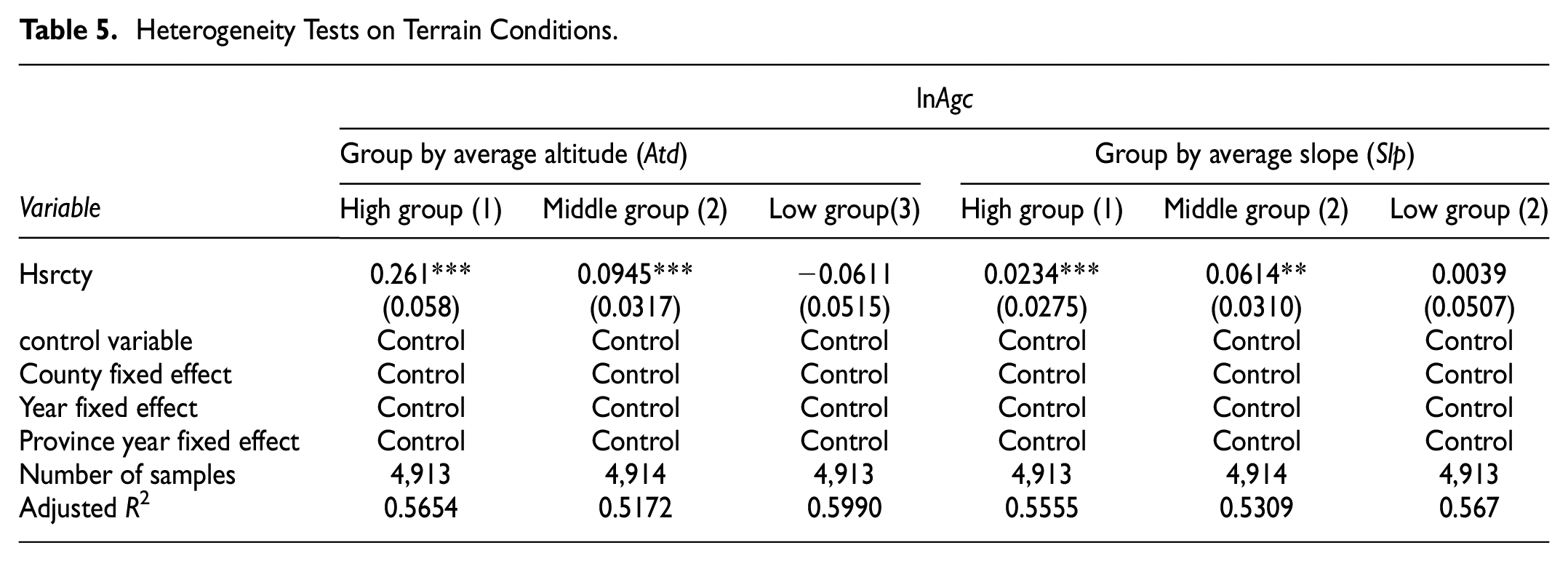
We further test H2 by grouping the counties according to the terrain (average altitude and average slope) in the county (Table 5). It can be seen from the estimated results that in the county group where the average altitude (slope) is lower (smaller), the role of a HSR in regional agricultural output is more obvious. With the increase of the average altitude (slope), the role of a HSR in promoting the counties along the line is gradually reduced to the two lower groups (i.e., the group with lower reciprocal altitude or slope), The agricultural output of counties along the HSR will not be significantly different from that of counties not along the HSR. This indicates that a HSR line will not have any impact on agricultural output in areas with high terrain and large slope. This is also confirmed in the estimated results in Table 4.
Heterogeneity Tests on Terrain Conditions.
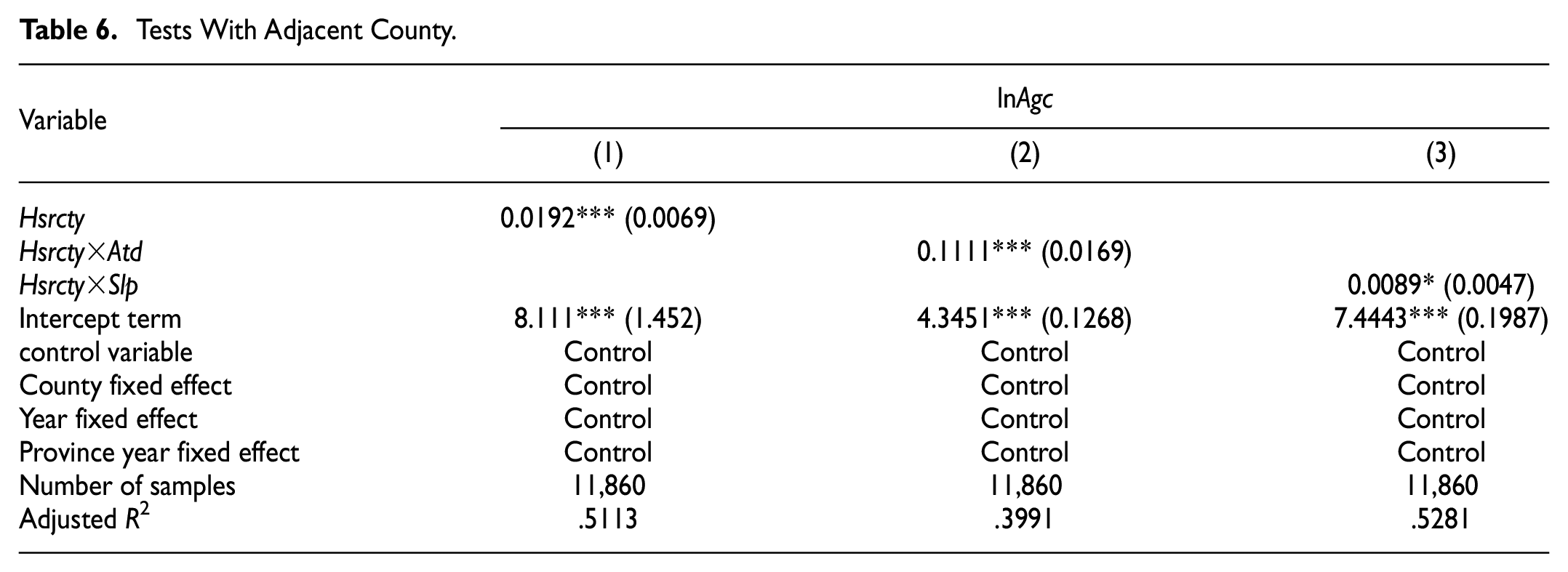
The HSR may also affect the economic production activities in the surrounding areas of the county where the HSR line is located. The distance from the HSR is another factor we want to investigate. People in the surrounding counties and areas not far from the HSR line can also travel to and from the HSR station in a short time. Therefore, the HSR may also affect the agricultural activities in the areas these people are from. Therefore, the actual impact of the HSR line may not be limited to the counties with HSR stations. It is necessary to examine it from a broader perspective. The agricultural situation of the counties adjacent to HSR stations will be investigated. Specifically, the counties bordering on the land with the HSR stations that have opened up over the years will be included in the intervention group year by year. But, counties with HSR stations (i.e., 286 counties with all HSR stations opened in 2019) will be excluded from the estimation process. In this way, only the impact of a HSR line on the agricultural output of the surrounding areas will be investigated. Accordingly, Tables 2 and 3 will be estimated again, Table 6 reports the results of this adjustment (limited to space, only the estimated coefficient of the agricultural output value is reported), with a total of 11,860 samples. From the observed values, it can be seen that the coefficients of the three groups of regression are still significant, but the coefficient values are greatly reduced. This means that if only the output value of the areas around the HSR county is compared with that of other areas, the effects of the HSR on agriculture in these areas will be greatly reduced. As the distance increases from the HSRstation, the effect of the HSR is gradually weakened until there is no impact.
Tests With Adjacent County.
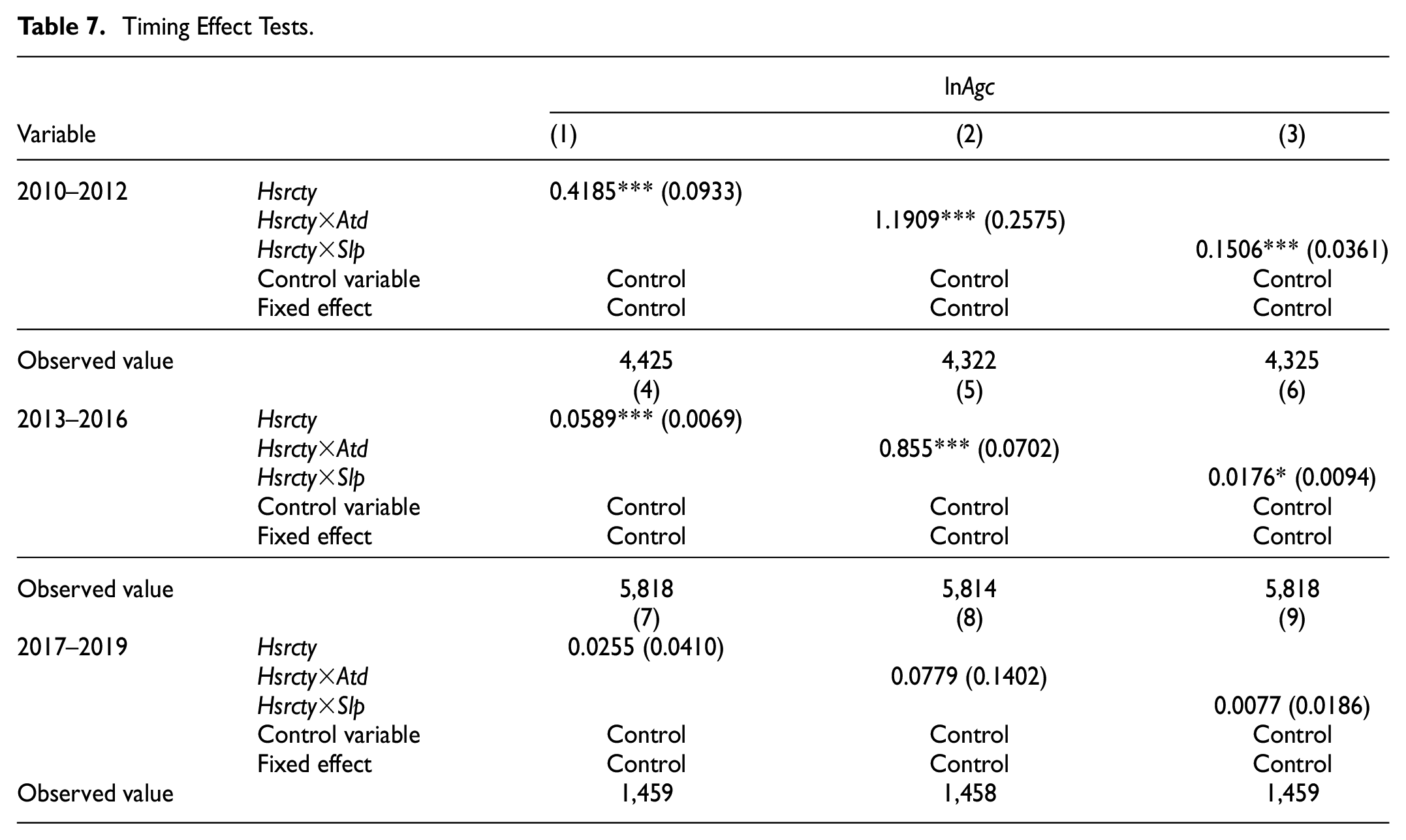
In addition, we investigate the dynamics of the “HSR–agriculture” effect, checking whether the impact of a HSR on agricultural production be different over time? We selected three time periods, 2010 to 2012, 2013 to 2016, and 2017 to 2019. As shown in Table 7, the six groups of coefficients in columns (1) to (6) are significant. Vertically, the positive estimated coefficient value in the first stage is larger than that in the second stage, while the coefficients in columns (7) to (9) are not significant, which means that with the continuous opening of HSRs, the “dividend” brought to agricultural production along the line is gradually shrinking or even being eliminated. This may be because the early opening of a high-speed rail system is mainly connected with dense population areas with a good geographical environment and ideal agricultural conditions. In these cases the promotion effect of a HSR system is more significant. However, in recent years, the newly build main lines are located in the central and western regions with a relatively poor geographic environment. Therefore, it is difficult for these regions to build large-scale mechanized agricultural systems. The result is difficulty for HSR to promote the agricultural output of these areas along the line. In fact, it may only lead to more population outflow. Even in the central and eastern regions, the HSR constructed more recently may not bring as much industrial effect as the lines that opened in the early stage. This idea also conforms to the law of diminishing marginal utility.
Timing Effect Tests.
Mechanism Test
As mentioned in the mechanism description above, HSR drives agricultural development mainly through three channels: continuous development after centralized land management, application of agricultural technology in industry, and growth of cash crop output. The previous benchmark tests have shown the last channel on the agricultural output. In this session, we test the first two mechanisms. For the circulation and concentrated operation of agricultural land, there is a lack of official data at the county level. We use the facility agriculture planting area(Fac) as a proxy indicator. Theoretically, only when the land has centralized management rights, can it be possible to develop massive machinery operations. According to the notice of the Ministry of agriculture on further supporting the healthy development of Facility Agriculture issued by the Ministry of Land and Resources in 2014, the land occupied by facility agriculture planting refers to the land used for production facilities for industrialized crop cultivation or aquaculture, reflecting the land area planted in large areas in rural industrialization. For agricultural technology, the power index of agricultural machinery index (Mac) is used as a proxy. Theoretically, the opening of a HSR should be significantly related to the two groups of variables, and ultimately affect agricultural output through the two groups of variables. We put these two groups of indicators into the estimation equation as intermediary variables, and the test results are reported in Table 8.
Mechanism Analysis.
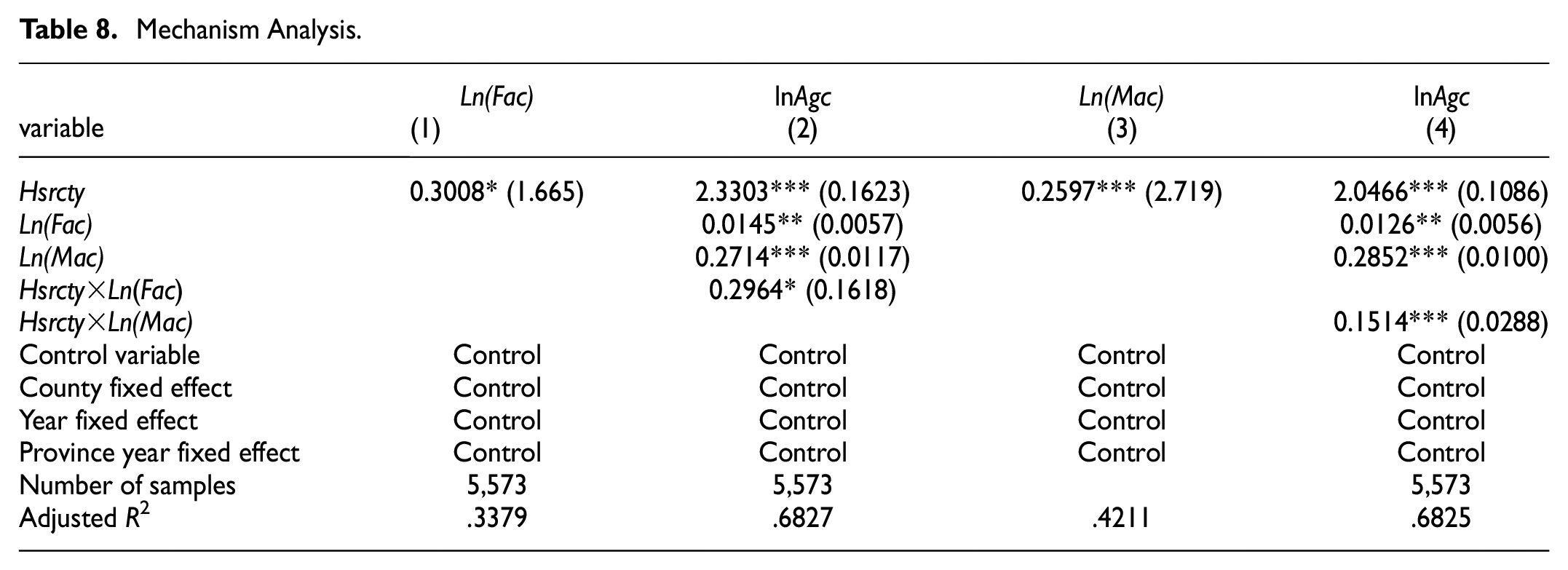
Columns (1) and (3) of Table 8 are the estimated results of the impact of a high-speed rail line on the planting area of agricultural facilities and the power of agricultural machinery. The results are significantly positive. Column (2) reports on the impact mechanism of a HSR line on agricultural output through large-scale concentrated land management. The interaction coefficient between the opening of a HSR line and the planting area of agricultural facilities is significantly positive. This indicates that the impact of concentrated land management on agricultural output in counties with a HSR line is greater than that in counties without a HSR line.
In column (4), it is reported that the opening of a HSR promotes the incorporation of agricultural machinery, therefore promoting agricultural output through the efficiencies of agricultural technology. It can be seen that the coefficient of Hsrcty×Ln(Mac) is also significantly positive, while the coefficient value of Hsrcty has decreased to a certain extent. The interaction term is positive, which shows that agricultural science and technology plays a role in promoting industrial output. Driven by HSR lines, new technologies have been extended and implemented into the agricultural industrial chain. Modern manufacturing has learned the lesson regarding the promotion of industrial transformation through the integration of agriculture.
Robustness Test
Parallel Trend Test
In this paper, the opening of HSR is regarded as an exogenous impact. The DID method used in the empirical test assumes the common trend. That is, if there is no HSR, the trend of agricultural output in the treatment group (county with HSR) and the control group (non HSR county) should be consistent. There will be no systematic difference. In order to test whether the agricultural output of the two groups meet the assumption of common trends before the opening of a HSR, we use the time analysis method to evaluate the dynamic effects caused by the opening of a HSR line. We set the following regression equation for the deformation of Equations 4–6:

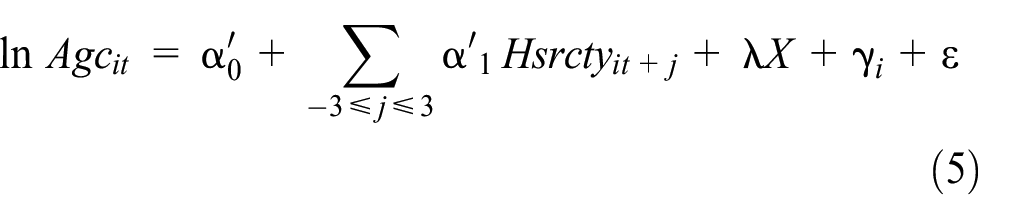
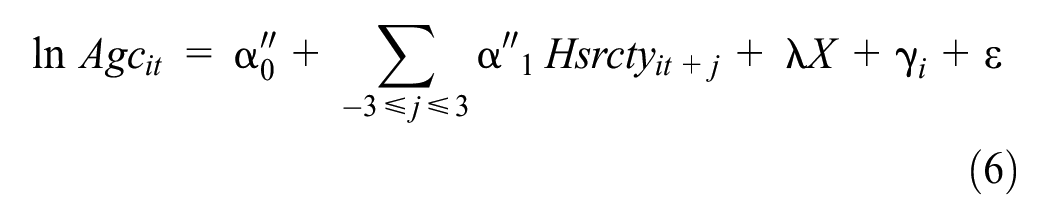
The time and provincial trend effects are deleted in the above three formulas. Hsrctyit+j represents the dummy variable in the year j before and after the opening of the HSR. In the year t + j after the opening of the county HSR,the value of the processing group is taken as 1, and other cases are 0. Taking the year of the opening of the HSR as the center, we examine the dynamic effects in the 3 years before and after the opening of the HSR. The evaluation of the effects of the HSR policy is based on the 3 years before the opening, Since the opening time of a HSR in each county is different, t + j represents different years for different counties. In Table 8, we report the OLS test results after controlling the fixed effect, focusing on α-3 to α3. From Table 9, it can be seen that the coefficient value in the 3 years before the opening of the HSR is not significantly different from 0, which indicates that the treatment group and the control group meet the assumption of parallel trend before the opening of the HSR. The coefficients of α0(α’0/α”0) to α3(α’3/α”3) are almost all significant (only α”3 is not significant), which indicates that a significant increase in agricultural output value as a whole really occurred after the opening of a HSR in the county.
Parallel Trend Tests.

Propensity Score Matching (PSM)
The parallel trend test results show that there is no significant difference in agricultural output between the counties along the HSR line and the counties not along the HSR line before the opening of the HSR. However, taking into account the large heterogeneity of agricultural economic development in different counties in China, and the terrain differences, it may lead to different agricultural output capacities in different regions. Therefore, random selection of the control group may cause the problem that there is a great congenital difference between the intervention group and the control group. In order to ensure the robustness of the results, we further use the propensity score matching method to solve this problem.
Due to the different opening times of a HSR in each county, this paper adopts the 1:1 nearest neighbor matching method with a matching half diameter of 0.01 at the county level, referring to the approach of J. Zhang (2017), using per capita GDP, GDP growth rate, population density, industrial structure, and agricultural land area as covariate, which makes the control group close to the treatment group. The DID method is used to re estimate Equations 1–3 as a robustness test. The estimation results are reported in columns (1) to (3) of Table 10. The estimation results of the three columns show that there are some minor changes to the coefficient of the interaction term and they are all significantly positive, which indicates that the estimation results of the previous tests are reliable. In addition, the PSM-DID regression of several types of agricultural products (grain, oil and meat) also supports the previous conclusions.
PSM-DID Tests.

Conclusion and Policy Recommendations
Based on the relevant data of China’s county economies from 2010 to 2019, this paper tests the impact of the opening of a HSR line on county agricultural output of counties along the line. The main conclusions are as follows: first, the opening of a HSR line can give the counties along the line more obvious agricultural dividends than other regions, and the agricultural output has been improved. This also confirms the law of economies of scale in the New Economic Geography theory. The urban agricultural resource spillover brought about by HSR promotes the progress and improvement of rural industries.Among them, the promotion effect of food crops is the most obvious, followed by oil, and meat. That is, cash crops are slightly less affected than food products. Secondly, in low altitude and flat terrain areas, the opening of a HSR has a more obvious role in promoting local agricultural output. The role of altitude is more obvious than that of slope to the county’s agricultural output along the HSR line. Thirdly, the effect of HSR on agriculture is mainly realized through the mechanization and continuous development after accelerating the land management and land transfer in counties along the line. The accelerated growth of agricultural production is also the effect of aHSR. Fourthly, the farther away from the HSR station in the county, the smaller the “bonus” of industrial development obtained by its agricultural sector. That is, the role of HSR in promoting agriculture along the line will be weakened with the distance increasing. Finally, the time dynamic test results show that the earlier a HSR opens in the county, its role in promoting agriculture is more obvious.
According to the above conclusions, we proposethe following policy implications.
First, the opening of HSR can promote agriculture development along the line, so the importance of technologic spillover in central cities driving the development of rural agriculture should be emphasized. We should take the opening of HSRs as an opportunity to accelerate the land transfer mechanism, and implement scientific and technological projects through the continuous development of landalong the line, so as to improve agricultural production efficiency and promote the development of agriculture.
Secondly, considering the impactof terrain on HSR’s effect on agricultural output, the driving effect may notapparent in some areas with high altitude and high slope. Therefore, during construction, to prevent the negative effect of accelerated population outflow after the opening of a HSR on the agricultural development of some remote areas, government departments are suggested to increase investment in areas with a poor geographical environment, in order to promote the local employment of rural labor and avoid the harm to agricultural production caused by the “siphon effect” in these areas.
Thirdly, although the agricultural dividend brought by HSR has declined in recent years, the HSR network is still expanding.Regions along the line should tap into their comparative advantages to create unique local agricultural or service products, such as eco-agricultural tourism, farm picking, and rural homestays.Convenient transportation can attract consumption from surrounding cities and arm agriculture with science and technology, enabling the development of new business models and formats to extend and expand the industrial value chain of agriculture.
Footnotes
Author Contributions
Conceptualization: T.X and L.D.; Data curation: X.Y and T.X.; Formal analysis: T.X. and L.D.; Investigation: T.X., X.Y., and L.D.; Methodology: T.X.; Project administration: L.D.; Software: T.X. and X.Y., Writing – original draft: L.D. and T.X.; Writing – review & editing: L.D, X.Y., and T.X. .
Declaration of Conflicting Interests
The author(s) declared no potential conflicts of interest with respect to the research, authorship, and/or publication of this article.
Funding
The author(s) disclosed receipt of the following financial support for the research, authorship, and/or publication of this article: This work was supported in part by the National Natural Science Foundation of China under Grant 72262015 and in part by the Department of Education of Jiangxi Province under Grant GJJ210522.

Data Sharing Statement
The data that support the findings of this study are available from the corresponding author upon reasonable request.