




Abstract
The agriculture, livestock, forestry, and fishing sectors are very important in Andalusia (Spain), being strongly focused on foreign markets, which has required them to make great efforts to improve their competitiveness. The aim of this work is to understand the interrelationships between the fruit and vegetables sector and the remaining sectors of the Andalusian economy, as well as knowing its multiplying effects on production, income, and employment. To this end, the input-output tables of Andalusia for 2016 will be used in order to know if it is a key sector and how it can help to establish economic policy objectives. Regarding forward linkages, the branches that most demand fruit and vegetable products are the industries related to other food products, and the preparation of canned fish and vegetables. In relation to backward linkages, they focus on the manufacture of basic chemicals, and other agricultural crops and services. Despite its importance in Andalusian agriculture, the fruit and vegetable sector is not considered a key sector according to the Rasmussen coefficients, as it is classified as an independent industry. The reasons may be that it uses few primary inputs, is poorly integrated with the rest of the productive sectors, and its production is destined to satisfy final demand (national and international). However, it generates an above average impact on the economy in most multipliers, being important for stimulating economic policy measures.
Introduction
The development of input-output tables is common in regional analysis, and in the case of Andalusia, it has a long history. Commencing in 1978 with the Western Andalusia table (Cádiz, Córdoba, Huelva, and Seville) prepared by the Institute for Regional Development of the University of Seville (1978) and Eastern Andalusia (Almería, Granada, Jaén, and Málaga) developed by the Department of Economic Policy of the University of Malaga (1978), respectively. In 1979, a third set was created by the Banco de Bilbao whereby it integrated the first two into a single set of tables. The 1980 tables were prepared by the Research Services of the Banco de Bilbao (1985) and the one for 1990 was prepared by the National Statistical Institute of Andalusia (1994). Since then, the Andalusian Institute of Statistics and Cartography has prepared them for the years 1995, 2000, 2005, 2008, 2010, 2015, and 2016.
The agriculture, livestock, forestry, and fishing sectors continue to be very important in the region, representing 6.82% of GVA at basic prices and 9.2% of equivalent jobs. The above notwithstanding, both average wages and labor costs are much lower than the total of the principal Andalusian economic activities (Table 1).
Distribution of Gross Value Added (GVA), Unit Labor Costs, Perceived Productivity, Average Wages and Salaries in Andalusia, 2016 (Thousands of Euros or Number of People).

Source. Own compilation based on data from the Andalusian Institute of Statistics and Cartography (2023).
According to the European System of National and Regional Accounts (SEC) the real estate activities sector includes the rental services of owner-occupied homes.
Average wages and salaries = Wages and salaries/Equivalent wage employment.
Unit labor cost = Remuneration of employees/Equivalent employee employment/Perceived productivity.
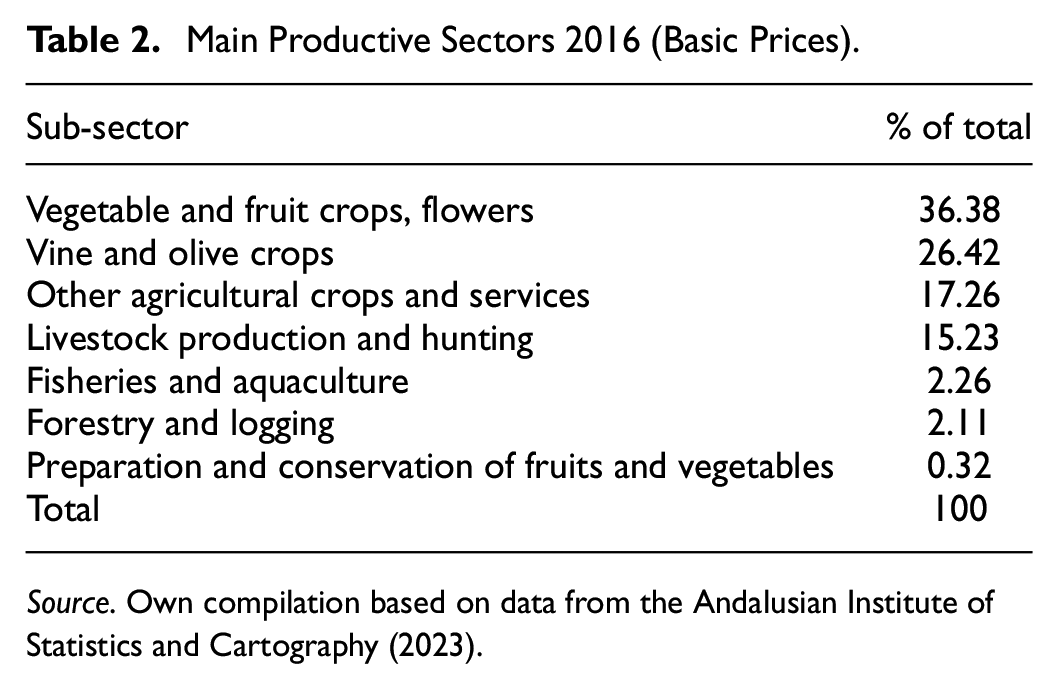
The main producer branch of the agriculture, livestock, forestry, and fishing sector is the cultivation of vegetables, fruits, and flowers with 36.38% of total production (Table 2).
Main Productive Sectors 2016 (Basic Prices).
Source. Own compilation based on data from the Andalusian Institute of Statistics and Cartography (2023).
As shown in Table 3, the production of vegetables in the province of Almería stands out, representing 88.60% of the total production in Andalusia, Cádiz is leader in the production of flowers and plants (24.70%), Huelva stands out for the production of citrus fruits (10.27%), and Granada produces the highest volume of tropical fruit (5.39%).
Percentage of Production of Agricultural Products by Andalusian Province and Region.

Source. Own compilation based on data from the Ministry of Agriculture and Fisheries of the Junta de Andalucía (n.d.).
Table 4 shows the supply and demand of the fruit and vegetable sector. It is worth noting that is a sector where household spending is very important and is heavily focused on exporting to the rest of the world. This focus on foreign markets has required the sector to make great efforts to improve its competitiveness, both in terms of product quality and the professionalization of the services offered.
Supply and Demand of the Fruit, Vegetable, and Flower Sectors (2016).

Source. Own compilation based on data from the Andalusian Institute of Statistics and Cartography (2023).
PAs and NPISH: Public Administrations and Non-Profit Institutions Serving Households.
Almería’s production under plastic is an international paradigm (Cantliffe & Vansikle, 2012; De Pablo Valenciano & Céspedes, 1996; Wolosin, 2008). Its development began in the 1950s and at present, the region is considered the largest exporting area of vegetables to Europe, in the winter months (from December to March) for products such as tomatoes (Figure 1), peppers, aubergines, strawberries and courgettes, and in summer months (from June to August) for melons and watermelons (Figure 2).

Total monthly intra-community and extra-community imports of tomatoes to the European Union.

Total monthly intra-community and extra-community imports of watermelons to the European Union.
Once the state of the sector has been analyzed, it is essential to be able to understand the linkages of the different branches, as well as their impacts. Leontief (1936, 1965) describes input-output tables as an analysis tool that focuses on the analysis of impacts and essentially measures the change that originates in production, employment, and income in the entire economic system of a region as consequence of a change in the final demand of a particular sector.
The fruit and vegetable sector has been the protagonist in the local development of the regions of Andalusia. In fact, the province of Almeria experienced the so-called “agricultural miracle” (De Pablo Valenciano et al., 2019), going from being a low-income territory with a rural exodus (depopulation) to an area of rapid growth and socio-economic development based on an endogenous development model centered on the intensive fruit and vegetable sector. Therefore, the aim of this work is to understand the interrelationships between the fruit and vegetables sector and the remaining sectors of the Andalusian economy, as well as knowing its multiplying effects on production, income, and employment. The study of the linkages between the sectors associated with the input-output analysis constitutes one of the fundamental aspects in order to be able to offer a more significant characterization of this sector in the Andalusian region. On the other hand, the input-output multipliers constitute a synthetic expression of the input-output model itself, as well as opening up other possibilities focused on impact analysis.
Methodology
For this study we take as a reference the input-output tables of the region of Andalusia for the year 2016 (latest available data). The input-output table studied is disaggregated into 89 productive sectors, of which the first four are related to the agricultural sector. Of these, sector I corresponds to the cultivation of vegetables and fruit. The regionalization method was made according to ESA-2010, it was approved by Regulation (EU) No. 549/2013 of the European Parliament and of the Council of 21 May on the European System of National and Regional Accounts in the European Union. ESA-2010 is consistent with the United Nations methodology, the 2008 System of National Accounts (SNA-2008), used in most countries of the world.
There are different instruments used to measure economic impact. Among others, we can highlight the General Computable Balance model (Dynamic computable general equilibrium model) (Tchouamou & Seetaram, 2018), Cost-Benefit Analysis (Hong et al., 2018), Contingent Valuation (Contingent Valuation analysis) (Guerrini et al., 2018), and the Input-Output Tables. When choosing a methodology, the available data, the type of approach to be carried out according to the type of event, the objectives to be achieved, the positive and negative aspects of each type of method, and the clarity and precision of the results obtained according to the type of instrument that is applied must be taken into consideration.
As a drawback, it is noteworthy that these coefficients are based on those averages, and therefore are sensitive to extreme values, which leads to them not adequately describing the structure of an industry and must be corrected by the variance coefficients (Hazari, 1970; Sonis et al., 1995).
Nevertheless, input-output tables, by their very nature, are very suitable instruments for the systematization of inter-industrial effects and their impacts on the economy (Miller & Blair, 2009; Schaffer, 1999).
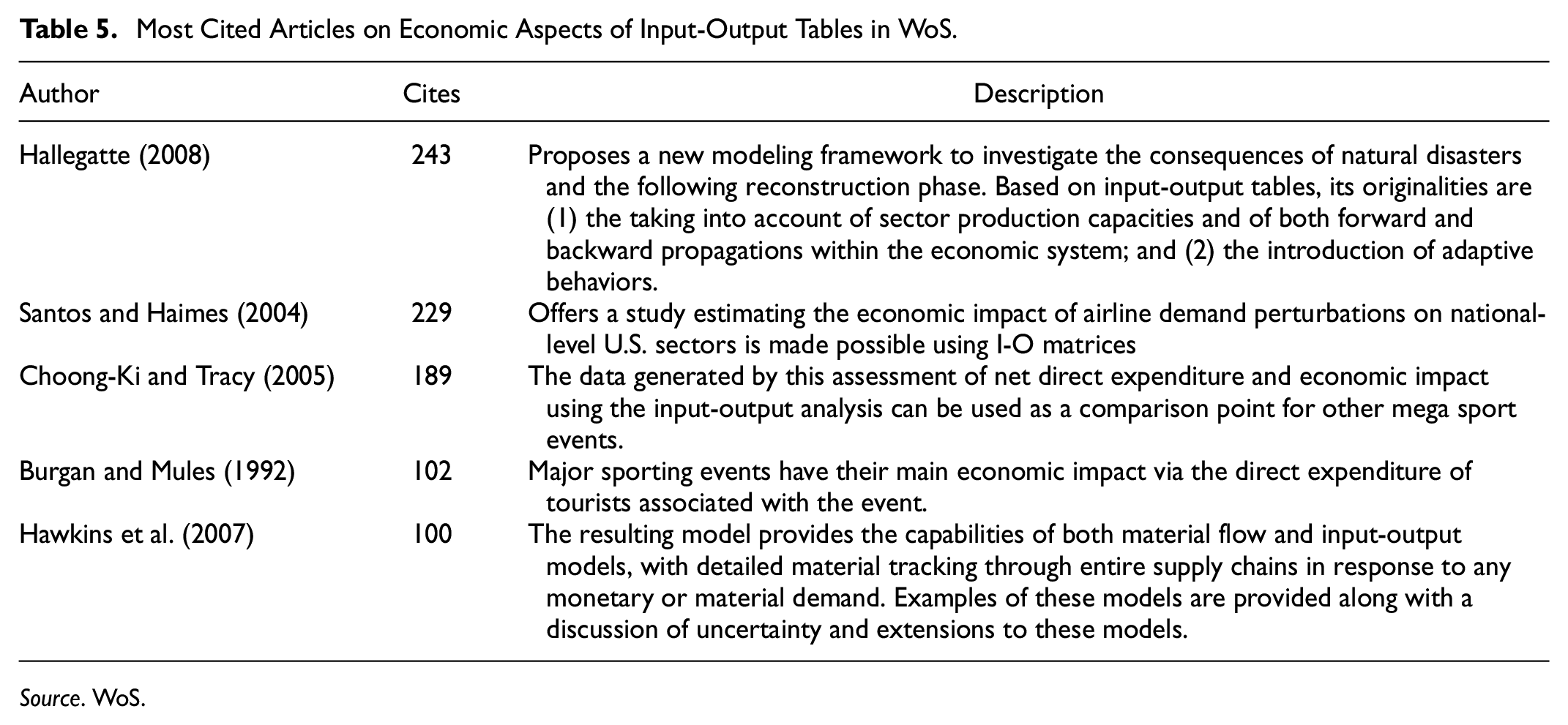
Taking the Web of Science database (WoS) as a reference, the most cited articles in relation to economic aspects are reflected in Table 5.
Most Cited Articles on Economic Aspects of Input-Output Tables in WoS.
Source. WoS.
Internationally, The use of this type of analysis in the fruit and vegetable sector can be seen in works such as that of Loizou et al. (2019), who study the impact of the primary sector and the reform of the Common Agricultural Policy on the local economy as a whole; the research by Coulibaly et al. (2021), which assesses the impact of the fruit and vegetable export industry on the local economy in Côte d’Ivoire, or the study by Jun et al. (2013) on the impact of the Korea-China Free Trade Agreement on the citrus industry in Jeju province.
In the case of Spain, this type of analysis has been widely used in the 1990s to study the agri-food sector for various regions. This is reflected in the work carried out in the Valencian Community (Álvarez-Coque & Enguídanos, 1999), Catalonia (Artis et al., 1994; Enciso & Sabaté, 1995), Extremadura (De la Macorra & Fernádez Núñez, 1995), Navarra (Iráizoz & Rapún, 1999; Rapún & Iráizoz, 2001), Andalusia (De Pablo Valenciano & Céspedes 1996; Rueda, 2000; Titos 1995), Aragón (Pérez & Feijoo, 1993), and the Basque Country (De la Grana & Azaceta, 1990; Santamaría Martínez et al., 1998).
In the present case, the most important subsector of the agri-food sector of Andalusia, that is, that of fruits and vegetables, will be analyzed. The direct linkages of the sector both forward and backward, the indices (Chenery & Watanabe, 1958) and the coefficients (Rasmussen, 1956) will be studied to analyze interdependencies, in addition, the impacts will be calculated using multipliers of production (I and II), income (I and II) and employment (I and II).
The backward linkage of one sector j with respect to another i is given by the ratio between the purchases that j makes of i and the volume of intermediate purchases of j:

The forward linkages of i with j will be given equally by the volume of sales from i to j and the total intermediate sales of i.

The Chenery-Watanabe (1958) indices are based on the existence of a degree of interdependence between one branch and the others, quantifiable by computing:
- The proportion of the production of a branch that is not directed to satisfying the final demand but rather to other industries and the proportion of its production that represents purchases from other industries. The first expresses the proportion that intermediate inputs represent over the total inputs of the sector, and therefore, the importance that its added value has within it, reflecting the degree of direct dependence of the sector on the system.

(j = 1, 2, …, n)
- The second is equal to the relation between the intermediate outputs of the sector and its total output, also indicating the proportion that the final demand supposes with respect to the total uses of the sector, also a reflection of the dependence of the economy on the sector.

(i = 1, 2, …, n)
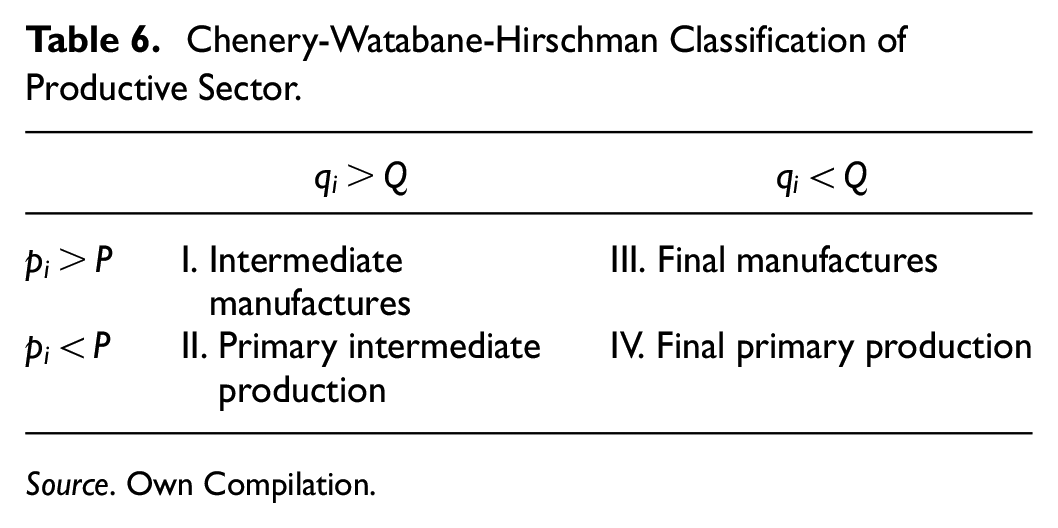
These coefficients indicate the weight of the value of intermediate purchases and intermediate sales in the value of the total product of the sector. In short, it represents a first approximation to the predominantly final or intermediate nature of the sector based on the direct connections of the system. From this data we can classify the productive sectors (Table 6).
Chenery-Watabane-Hirschman Classification of Productive Sector.
Source. Own Compilation.
Classification I, Intermediate manufactures, includes those activities considered secondary as Colin Clark (1940) points out, not intended directly for final consumption. These branches have a greater capacity to create forward (
Rasmussen coefficients (1956) are used to differentiate the characteristics of the branches based on their pull effects. Unlike the Chenery-Watanabe indices, they use Leontief inverse matrix coefficients.
Rasmussen coefficients are as follows:
The dispersion power coefficient is expressed as

Being n the number of branches
The sensitivity coefficient is defined as

It is also important to assess the dispersion of the effects and for this it is necessary to develop dispersion coefficients that link the standard deviation with respect to the mean.


From these coefficients and their dispersion capability we can classify the productive sectors (Table 7).
Rasmussen Classification of Productive Sectors.

Source. Own Compilation.
The advantage of Rasmussen indices is that they allow inter-industry comparisons to be made on the basis that partial averages (numerators) are normalized, relating them to the total average (Laumas, 1976).
Key industries are important when formulating questions about economic policy as they act as promoters of other industries and can thus to a general increase in productive activity.
Hirschman (1959), after comparing the Chenery-Watanabe indices and the Rasmussen coefficients, points out that the Leontief inverse allows us to calculate the repercussions of the direct and indirect effects of any industry, which would make this matrix more useful than that of technical coefficients, since the latter includes only direct relationships and not indirect ones.
The concept of a multiplier is used to estimate the total effects - the sum of the direct, indirect and induced effects - in an economy as a result of a change in final demand (e.g., an increase in sales) or a change in production total (e.g., by increasing production capacity).
There are a wide variety of multipliers, but in general they can be defined as the ratio between the total change in a certain variable and the initial change, usually in the final demand (or the income or employment that this implies) (Schaffer, 1999; Sonis et al. 1997).
To carry out this work, we will take multipliers into account, taking into consideration the extent of the measurement of the effects derived from the initial change. That is, we will differentiate between Type I and Type II multipliers.
These multipliers can be defined as follows (Miller & Blair 2009; Schaffer, 1999):
Multiplier Type I. This is the measure of the direct effect plus the indirect effect of a change in demand (sales) or production (capacity) divided by the direct effect. Direct effects are the changes in output, income, employment… associated with the immediate effect of a change in final demand or output of an industry (Li et al., 2019). Indirect effects, on the other hand, are changes in output, income, employment… as a consequence of increased production in industries that sell (backward linkages) relative to those in which the direct effect occurred (Yang et al., 2018).
Multiplier Type II. This is the estimate of the sum of the direct, indirect, and induced effects over the initial direct effects. Induced effects are the changes in household expenditure caused by changes in household income (generated by direct and indirect effects) (Torres-Pruñonosa et al., 2020).
In the case of this work, Type I and II multipliers of Production, Income and Employment derived from the Input-Output for Andalusia for 2016 will be applied.
The production multipliers are the following:
Type I
The Type I production multipliers of each sector will correspond to the sum of the elements in the corresponding column of the Leontief inverse matrix without including household accounts.
Hence,

With Aij being each one of the elements of the inverse of Leontief without including household accounts.
Type II
Just as with Type I production multipliers, Type II multipliers correspond to the sum of the elements of each of the columns of the Leontief inverse matrix, but in this case using the closed matrix including household accounts. It could be defined as the increase (direct and indirect) in output as a consequence of a unit increase in the final demand of sector j.
Thus,

With A*ij being each of the elements of the Leontief inverse matrix of the extended model.
The income multipliers are
Type I
The Type I, or simple income multiplier, indicates the capacity to generate income (added value) directly and indirectly in the system through an increase of one unit in the final demand of said sector.
In algebraic form,

Where
- IMRj is the Type I Income multiplier of sector j.
-
- vi is the income generating capacity (added value) per unit of output.
Type II
The inverse of the closed matrix directly provides us with the Type II income multipliers, determined for each sector by each of the elements in the last row of said matrix.
Thus, for sector j the algebraic form is:

Finally, the multipliers for employment are:
Type I
This multiplier expresses the direct and indirect needs of the employment factor derived from an increase in a unit of final demand in each sector.
The sector multiplier of Employment Type I (or Schaffer) is given by the expression:

Where
- IMej: is the Type I Employment Multiplier of sector j.
-
Type II
This multiplier is related to the total needs of the employment factor (direct, indirect, and induced).
In matrix terms this multiplier is

Results
Supply and Demand Linkages
Figure 3 shows the different linkages for the fruit and vegetable sector. In the case of forward linkages, the branches that most demand fruit and vegetable products are the industries related to other food products (0.5317) and the preparation of canned fish and vegetables (0.2727). In this case, the demanding industries are canning and frozen foods. In the case of backward linkages, they focus on the manufacture of basic chemicals (including agrochemicals) (0.2658) and other agricultural crops and services (0.2417). The result obtained is logical, given that the majority of fruit and vegetable production focuses on intensive greenhouse cultivation.

Principal direct linkages of demand and supply for the fruit and vegetable market of Andalusia (2016).
In the last 70 years, the agricultural sector in Andalusia has gone from mostly being family-run farms to being a complex and industrial-type agricultural operation. This has brought with it the installation of consolidated auxiliary companies that have significantly reduced dependence on the manufacture of intermediate inputs (De Pablo Valenciano et al., 2019). Examples of these are the companies involved in the manufacture of plastics, fertilizers, phytosanitary treatments, …, other crops and agricultural services (seeds and technical advice), wholesale and retail trade, collection and distribution of water, production and distribution of electrical energy, other types of land and pipeline transportation, repair of motor vehicles, oil refining, preparation, installation and finishing of works and construction of machinery.
From Table 8, it can be deduced that the most important sectors are the manufacturing of basic chemical products (26.59%), other agricultural crops and services (24.17%), wholesale and retail trade (8.14%) and the collection, purification and distribution of water (6.05%).
List of the 10 Sectors Representing the Highest Levels of Sales to the Andalusian Fruit and Vegetable Sector in 2016.

Source. Own Compilation based on IOTs for Andalusian Institute of Statistics and Cartography (2016).
Within the manufacturing of chemical products sector, the most significant manufactures are plastics destined for greenhouses, fertilizers, chemical treatments, and disinfection products. As for other crops and agricultural services, the most significant are seed companies and technical advisory companies. Within the seed sector, there is still a strong external dependence on countries such as the Netherlands (Rijk Zwaan), Israel (Sidewalk), and Germany (Bayer). It is a very dynamic environment given the strong competition that exists between multinational companies that use vast resources to provide important technological advances in obtaining new horticultural varieties.
Taking into account the Chenery-Watanabe indices, the results show the values of the previous linkages of the other sectors of the Andalusian economy derived from the 2016 IOTs (Input-Output Tables) of Andalusia are, for the fruit and vegetables sector, 0.3797 lower than the average for all sectors (0.4689). Likewise, in subsequent linkages, where the same situation described above is repeated, the values for the fruit and vegetable sector (0.1026) are lower than the average for the sectors of the Andalusian economy (0.3681).
This sector acts as a net supplier of intermediate inputs and taking into account that both forward and backward linkages are lower than the average for the economy, the sector, according to the Chenery-Watanabe classification, is characterized as final primary production. In other words, this sector uses few primary inputs.
Thus, it can be said that the fruit and vegetable sector, despite its importance both in terms of production and generation of GVA, is poorly integrated with the whole of the economic sectors of Andalusia, having a low volume of purchases in accordance with its production (or it carries them out through imports) and its production is mainly used to satisfy final demand. It is not a sector that has the capacity to stimulate others.
Results of the analysis of the Rasmussen coefficients and the dispersion value of their effects for the fruit and vegetables sector are 0.8095 and 0.9286, respectively. As these values are less than 1, and taking into consideration the classification of the Rasmussen coefficients (Table 7), we can consider this sector to be an independent industry, that is, it is scarcely linked to the rest of the sectors.
The values derived from the impact analysis are shown in Table 9.
Input-Output Multipliers of the Fruit and Vegetable Sector in Andalusia.

Source. Own Compilation.
The value of Type I production multiplier for the fruit and vegetable sector (1.3268) is lower than the average of the Type I production multipliers for all sectors (1.4580).
In the year studied, the values of the Type II income multipliers in the fruit and vegetable sector are higher than the average for the sectors.
The values of Type I employment multipliers in the fruit and vegetable sector are much higher than the average for all sectors.
Also, on this occasion, the values of Type II employment multipliers in the fruit and vegetable sector are higher than the average for all sectors, and as was the case for Type I.
From these results it follows that the fruit and vegetable sector in Andalusia has significant effects on production, employment, and income. This is symptomatic of the competitiveness of the sector at the level of the variables analyzed.
Discussion
Despite its importance in Andalusian agriculture, the fruit and vegetable sector is not considered a key sector according to the Rasmussen coefficients as it is classified as an independent industry. These are isolated sectors which do not cause significant pull effects in the economic system, nor do they react significantly to the pull effect, caused by variations in intermediate demand in other sectors (Schuschny, 2005). It should be borne in mind that this characterization of the Andalusian fruit and vegetable sector is similar to that of other Mediterranean regions, as is the case of the fruit and vegetable sector of the Valencian Community (Álvarez-Coque & Enguídanos, 1999; Morillas, 1995). This in contrast to key industries that are highly demanding of intermediate inputs and their supply and demand are widely distributed among the different branches and which in turn contributes to a considerable increase in economic activity (Haji, 1987; Hewings, 1982). The advantage of Rasmussen indices is that it allows inter-industry comparisons to be made on the basis that partial averages (numerators) are normalized, relating them to the total average (Laumas, 1976).
At the international level, the results obtained in this study are in line with other research in demonstrating the importance of the primary sector as a driver of socio-economic development of the local economy (Lampiris et al., 2018; Loizou et al., 2014, 2019; Sharma et al., 1999;). However, the work of Jun et al. (2013) shows that there are situations in which the substitution of primary sector production by imports from other countries in the context of a free trade agreement can have a positive impact on the local economy as a whole.
Other alternatives to the study of key sectors can be carried out by means of centrality measures based on network theory. These are based on the consideration of three complementary characteristics: total effects, intermediate effects and immediate effects. The term used for these measures is “multi-level indicators” and have the enormous advantage of making it possible to compare structures of different sizes and to approach the concept of key sector from a global and relational point of view (García et al., 2008). It has recently been applied to the identification of key industries in the complex structure of trade relations between the UK and the EU as a result of Brexit (Gallegati et al., 2019), but in this case complex network analysis techniques have been employed in addition to traditional Input-Output tools.
In this case, given the availability of the input-output tables for Andalusia for 2016, they were used to obtain the production, income and employment multipliers. This use is common in international organizations and for example the European Commission (2007) presented a document that aimed to contribute to the selection phase of the sectors that most contribute to the adjustment capacity of the EU economy, in what it refers to the supply of essential inputs to the rest of the economy, or ECLAC (Economic Commission for Latin America and the Caribbean) (Schuschny, 2005), which analyzes some topics about the input output model and its multipliers.
This type of local development model is a paradigm in terms of the leading role of agriculture as an engine of development in the region and has even been extrapolated to other parts of the world, such as Mexico (De Pablo Valenciano et al., 2019).
Conclusions
The use of input-output tables is a common instrument in regional analysis that has the virtue of being able to breakdown the economy into productive branches and, thus, has the ability to study one in particular, such as that of fruits and vegetables, a very important sector in the context of the Andalusian agri-food sector.
The fruit and vegetables sector cannot be considered key as it pertains to the sectoral linkages as a method to analyze the effects of changes in final demand in various situations and identify sectors that may be relevant to the functioning of the economy. In this case the results show that it is considered to be an independent industry. The reason for this is that it uses few primary inputs, is poorly integrated with the rest of the productive sectors and its production is destined to satisfy final demand (national and international). However, it should be pointed out that it generates an above average impact on the economy in most multipliers (with the exception of Type I production). These types of sectors, which have above average multipliers for all sectors, are important for stimulating economic policy measures. Thus, policy makers should take into account the relevance of the fruit and vegetables sector when stimulating the whole economy, especially in times of crude crisis such as the COVID-19 global pandemic.
Footnotes
Declaration of Conflicting Interests
The author(s) declared no potential conflicts of interest with respect to the research, authorship, and/or publication of this article.
Funding
The author(s) received no financial support for the research, authorship, and/or publication of this article.

Availability of Data and Material
The data used to support this study are free and publicly available from the European Commission.
Code Availability
Not applicable.
Funding
This research received no external funding.