




Abstract
Physical sensations arising from within the body are collectively referred to as interoception. This study aimed to develop and validate Japanese versions of the Interoceptive Accuracy Scale (IAS) and Interoceptive Attention Scale (IATS) that measure subjective indices of interoceptive accuracy and attention. To test our newly developed scales, we asked two groups of participants, 281 (Mage = 40.74, SDage = 8.75; 143 women, 137 men, 1 non-binary) and 395 (Mage = 40.69, SDage = 9.80; 203 women, 192 men), to complete a translated version of IAS and IATS studies, respectively. Both scales were found to have sufficient internal consistency and retest reliability. Correlations between physical sensation-related scales and IAS/IATS, as well as weak correlations between the IAS and IATS, were found to support construct validity of IAS and IATS. Finally, prospects for future studies based on these indices are discussed.
Plain Language Summary
This study aimed to develop and validate Japanese versions of the Interoceptive Accuracy Scale (IAS-J) and Interoceptive Attention Scale (IATS-J), psychological scales assessing beliefs regarding interoception (physical sensation). As results of two studies, IAS-J and IATS-J were suggested to have good reliability and validity. IAS-J and IATS-J are expected to contribute to revealing complex relationships between interoception and various psychological variables, such as emotion, cognition, and mental health. In the future study, relationships between these subjective indices and behavioral indices of interoception should be carefully examined.
Perception of one’s internal physiological state is referred to as interoception (Craig, 2002). This includes perception arising from within the body, such as visceral sensations (e.g., heartbeats or sense of hunger), some cutaneous sensations (e.g., pain or body temperature), and tension of skeletal muscles (Ceunen et al., 2016; Crucianelli & Ehrsson, 2023). Interoception is the necessary mechanism for one’s survival or environmental adaptation. In recent years, several studies focused on roles of interoception in psychological processes (Tsakiris & Critchley, 2016). Since interoception is considered an important process for one’s emotional experience (Barrett & Simmons, 2015), relationships among the intensity of one’s emotional experience (Schandry, 1981), intuitive decision-making (Dunn et al., 2010), and mental health (Khalsa et al., 2018) have been extensively discussed. Moreover, recent studies have indicated relationships with social cognition (Baiano et al., 2021), such as theory of mind (Shah et al., 2017) or perspective taking (Heydrich et al., 2020).
In the field of psychology, correlative relationships between individual differences in interoception and external variables are often examined to explore the role of interoception in psychological activities. Indices on examining individual differences can be obtained from experimental methods, including the heartbeat perception task (Schandry, 1981; Whitehead et al., 1977) or self-report questionnaires, such as the Body Awareness subscale of the Body Perception Questionnaire (BPQ-BA; Porges, 1993). Most of these indices are considered dispositions that rarely change in an individual (Ferentzi et al., 2018). In particular, self-report questionnaires have been adopted in numerous studies because they can measure an individual’s interoceptive awareness using a simple procedure. As these indices do not often correlate with each other, the perspectives of interoception measured by these methods may differ (Garfinkel et al., 2015).
Owing to these limitations, the Interoceptive Accuracy Scale (IAS) was developed by Murphy et al. (2020), while the Interoceptive Attention Scale (IATS) was developed based on the IAS by Gabriele et al. (2022) in recent years. Both scales meet the novel framework proposed for the classification of indices of interoception, namely, the 2 × 2 factorial model (Supplemental Figure S1; Murphy et al., 2019), which consists of the object of the measurement (accuracy or attention) and the method of measurement (objective or subjective). The IAS corresponds to subjective interoceptive accuracy in this model and the total score is used to measure this aspect (Murphy et al., 2020). The IAS includes items related to physical sensations, described as interoception or physical sensations related to activation of the brain area (e.g., the insula) associated with interoceptive processing. Murphy et al. (2020) reported good reliability and validity of this scale in six studies. In studies using the IAS, relationships between the IAS and higher awareness of emotion or lower alexithymia (difficulties identifying and describing one’s own emotions) have been widely reported (Gaggero et al., 2021; Ventura-Bort et al., 2021).
IAS is a measure of subjective interoceptive accuracy in daily life, unlike the confidence rating in the heartbeat counting task (Schandry, 1981). The degree to which an individual can perceive interoception is widely known to be measured by the objective performance of some tasks (e.g., heartbeat counting task). Subjective interoceptive accuracy is a self-reported belief in how well an individual can perceive interoception and mainly measured by confidence ratings in tasks measuring objective interoceptive accuracy or questionnaires. To the best of our knowledge, no other questionnaire directly enquires about subjective interoceptive accuracy. Although the Interoceptive Confusion Questionnaire (Brewer et al., 2016) is regarded as a psychological scale that corresponds to subjective interoceptive accuracy, its low internal consistency has been noted. Furthermore, the IAS can measure subjective interoceptive accuracy without being dependent on a specific receptor, whereas the confidence rating in the heartbeat counting task can measure only the perception of the signal transmitted from the heart. Based on these points, we focused on the IAS.
IATS corresponds to subjective interoceptive attention in the 2 × 2 factorial model. IATS items are worded to pair up with the IAS, and total score is defined for measuring interoceptive attention (Gabriele et al., 2022). Subjective interoceptive accuracy and attention are sometimes lumped together as “interoceptive sensibility” (Garfinkel et al., 2015). However, given that there is no correlation between these two facets (Murphy et al., 2020), it is necessary to separately develop an IAS and IATS.
Objective interoceptive attention indicates the degree of attention to interoception, which is measured using the experience sampling method or by specific tasks (e.g., Murphy et al., 2018). Self-report questionnaires, such as the BPQ-BA, are used to measure subjective interoception, namely, one’s belief about how much attention is paid to interoception. The BPQ-BA requires respondents to rate their own “awareness” of each physical sensation; however, it has been noted that correlation patterns between the BPQ-BA and IAS/IATS differ for those who interpret the word “awareness” as “belief about interoceptive accuracy” and those who interpret it as “belief about interoceptive attention” (Gabriele et al., 2022). Although the BPQ-BA is a dominant scale related to interoception, using it without considering its ambiguity may make exploring the concept of interoception difficult. Besides, Multidimensional Assessment of Interoceptive Awareness (MAIA; Mehling et al., 2012), another scale that measures subjective aspect of interoception, includes multiple factors of interoceptive awareness, “attention regulation” and “body listening,” which seem to correspond to interoceptive attention. However, MAIA does not include factors that correspond to the belief regarding interoceptive accuracy. Considering limitations of existing measures, IAS and IATS are not only significant in terms of measuring general and concrete interoception, but also in re-evaluating the nature of existing measurement methods.
We conduct two studies on the development and validation of Japanese versions of IAS and IATS (IAS-J, IATS-J). Following a similar process as original versions, which first developed and validated the IAS (Murphy et al., 2020) and then developed and validated the IATS in separate studies (Gabriele et al., 2022), we conducted Study 1 focusing on examining the relationship between the IAS-J and a number of indices. Study 2 was conducted for IATS-J using the IAS-J developed in Study 1. We also examined the existence of differences on factor structures from original versions. Following the finding that European American individuals have a higher score of heartbeat counting task than Asian individuals (Ma-Kellams et al., 2012), cultural differences of interoception have been suggested (Ma-Kellams, 2014). However, to the best of our knowledge, there is no research on cultural differences in perceptions by domain (receptor) of interoception (may appear in factor structures of IAS/IATS). Therefore we exploratory discussed cultural difference of interoception based on the data.
Study 1: Factor Structure and Validity of IAS-J
Study 1 aimed to examine the factor structure and validity of the IAS-J. Although its factor structure was not important (Murphy et al., 2020), we conducted preliminary factor analysis following the original version. To examine its construct validity, four existing measures were used. The first measure was Gotow Alexithymia Questionnaire (Galex; Gotow et al., 1999). The Galex is a scale that considers alexithymia tendency as a set of independent concepts. As appropriate interpretation of interoception has been claimed to underly emotion identification (Brewer et al., 2016), it has been reported that alexithymia tendency negatively correlate with task performance and belief regarding interoceptive accuracy (Gaggero et al., 2021; Murphy et al., 2018, 2020). Based on these findings, we hypothesized that “Deficit in identifying and expressing one’s own affect and physical sensations,” a subscale of Galex, has a negative correlation with the IAS-J.
The second measure was Shitsu-Taikan-sho Scale (STS) regarding alexisomia tendency (Arimura et al., 2012). Alexisomia is an extension of the alexithymia 1 and focuses more on physical sensation (Oka, 2020). Therefore, we hypothesized that, similarly, STS has a negative correlation with IAS-J.
The third measure was Five Facet Mindfulness Questionnaire (FFMQ), which is multidimensional measure of trait mindfulness (Baer et al., 2006). Considering that awareness of physical sensations comprises mindfulness (Hölzel et al., 2011), we hypothesized that the “observing (OB)” subscale, whose items overlap with the IAS, and the “nonreactivity nonjudgement” subscale, indicate that the tendency to not overestimate physical sensations positively correlates with IAS-J.
The fourth measure was BPQ-BA. In the 2 × 2 factorial model (Murphy et al., 2019, 2020), the BPQ-BA, which is treated as subjective interoceptive attention, is emphasized to be independent of the subjective interoceptive accuracy measured by the IAS. Therefore, we predicted that there would be a weak or no correlation between the IAS-J and BPQ-BA.
Methods
Participants
We conducted a survey of 300 people using crowdsourcing services (Crowdworks; https://crowdworks.jp/). To determine the required sample size, we referenced the criteria for factor analysis suggested by MacCallum et al. (1999), which states that good convergence occurs when items load on a few factors and high communality. The original version of the IAS has 21 items, two factors, and high communality (Murphy et al., 2020). However, considering that the result of the pilot survey for the pre-final version showed lower communality (Supplemental Table S1) and that the survey is conducted online (several invalid answers may arise), we set a larger sample size than the criteria set by MacCallum et al. (1999).
As an attention check, items described as “please select ‘disagree strongly’ in here” were inserted in scales with >12 items. Data of participants who failed to answer the attention check correctly and whose response time was extremely short (less than 3 min) were excluded. Finally, data from 281 participants (Mage = 40.74, SDage = 8.75, age range = 20–65; 143 women, 137 men, and 1 non-binary) were analyzed. The survey was conducted after ethical review by the Graduate School of Education, Kyoto University (CPE-495).
Measures
IAS-J
After obtaining permission from the author of the original version (Murphy et al., 2020), the IAS was translated into Japanese. We then used a translation service (Ulatus; https://www.ulatus.jp/) to back-translate the IAS and adjusted it based on feedback regarding whether the Japanese version is equivalent to the original version from the author of original version. Then, we developed the Japanese version of the IAS (IAS-J; Supplemental Figure S2).
The IAS-J comprises 21 items. As the IAS items are in the form of “I can always accurately perceive when ….,” each physical sensation is inserted into “….” For each item, the participants chose any one of the following: (1) strongly disagree, (2) disagree, (3) neither agree nor disagree, (4) agree, and (5) strongly agree. Higher scores indicate higher subjective interoceptive accuracy.
Gotow Alexithymia Questionnaire (Galex)
The Galex consists of two subscales: Deficit in identifying and expressing one’s own affect and physical sensations (DAP; e.g., I have physical sensations that I cannot understand well) and Deficit in fantasy and introspection (DFI; e.g., I seldom indulge in fantasies). For each item, the participants chose any one of the following: (1) strongly disagree, (2) disagree, (3) slightly disagree, (4) neither agree nor disagree, (5) slightly agree, (6) agree, and (7) strongly agree.
Shitsu-Taikan-sho Scale (STS)
STS consists of three subscales: Difficulty in identifying bodily feelings (DI; e.g., I do not feel tired), Over adaptation (OA; e.g., I do not take a rest even if I feel sick.), and the Lack of health management based on bodily feelings (LH; e.g., I have no idea how to take care of myself.). The participants rated the items on a scale of (1) strongly disagree to (5) strongly agree.
Five Facet Mindfulness Questionnaire (FFMQ)
In this study, the Japanese version that has 24 items (Takahashi et al., 2022) was used. FFMQ consists of five subscales: Observing (OB; e.g., I pay attention to sensations, such as the wind in my hair or sun on my face), Nonreactivity (NR; e.g., I watch my feelings without getting lost in them), Non-judging (NJ; e.g., I tell myself I should not be feeling the way I am feeling [reverse]), Describing (DE; e.g., I am good at finding words to describe my feelings), and Acting with awareness (AA; e.g., I find it difficult to stay focused on what is happening in the present [reverse]). For each item, the participants chose any one of the following: (1) never or very rarely true, (2) rarely true, (3) sometimes true, (4) often true, and (5) very often or always true.
BPQ-BA
The Japanese version of the Very Short Form (Kobayashi et al., 2021) was used in this study. For each item, the participants chose any one of the following: (1) never true, (2) rarely true, (3) sometimes true, (4) often true, and (5) always true.
Procedure
The survey was conducted using Qualtrics (https://www.qualtrics.com/jp/). Participants accessed the survey page via the URL presented in Crowdworks to complete the questionnaires. First, participants provided demographic data (age and sex). Subsequently, the participants completed the IAS-J and the other four scales so that construct validity was examined in a randomized order. The scales used have been described above. The participants were paid 300 yen as monetary compensation.
Statistical analyses were performed by “R,” the statistical analysis software. “Psych” package (Revelle, 2022) was used for calculation of internal consistency and exploratory factor analysis.
Results and Discussion
Factor Structure
To remain consistent with the original version (two-factor structure), an exploratory factor analysis with the maximum likelihood method and promax rotation was conducted assuming a two-factor structure (Table 1). Some items loaded on different factors from the original version. The cumulative contribution ratio was 0.40. Factor 1 seemed to reflect cutaneous sensations and Factor 2 seemed to reflect visceral sensations. Average Variance Extract (AVE) for factor 1 was 0.40, and that for factor 2 was 0.35. In the original version, only the total score was subjected to a correlation analysis because of the difficulty in theoretically explaining each factor. Therefore, in this study, the total score was also subjected to the following analysis. Although the factor loading for Item 1 (heartbeat) was lower than 0.35, this item was not deleted as heartbeat is a frequently used index in research on interoception (Khalsa et al., 2018). Although the factor loading of Item 7 (taste) was acceptable (0.42) in Study 1, its factor loading to IATS was considerably low (0.13; discussed in Study 2). Considering that the IAS is paired with the IATS (Gabriele et al., 2022), Item 7 was also deleted from the IAS-J.
Exploratory Factor Analysis for IAS-J.

Note. IAS-J = Japanese version of Interoceptive Accuracy Scale; Com = communality; F1 = Factor 1; F2 = Factor 2. The bold entries indicate to which factor each item was allocated.
Item 18 (low blood sugar) was revised to “tired” as this is not a daily-used expression compared to other items, and floor effect was relevant in the pilot survey.
Reliability
Cronbach’s alpha of the IAS-J was .91, indicating that the IAS-J had good internal consistency.
Construct Validity
Correlations among IAS-J and each scale are shown in Table 2.As predicted, IAS-J has negative correlations with DAP of Galex, DI, and LH of STS, which reflect the deficit of accurate awareness of physical sensation or emotion. However, IAS-J has a positive correlation with OB of FFMQ, the degree of awareness of such sensations. Correlations with NR and NJ were weak, whereas those with DE and AA were somewhat weak to moderately positive. The weak positive correlation with BPQ-BA, unlike the original version, may have been influenced by the ambiguity of the BPQ-BA content, as mentioned above. BPQ-BA was used as a measure of interoceptive attention; however, some of our participants may have interpreted “awareness” in the BPQ-BA as “awareness of accuracy,” similar with the previous study (Gabriele et al., 2022).
Mean Score, SD, and Correlations Among IAS-J and Each Scale.

Note. IAS-J = Japanese Version of Interoceptive Accuracy Scale; Galex = Gotow Alexithymia Questionnaire; DAP = Deficit in identifying and expressing one’s own affect and physical sensations; DFI = Deficit in fantasy and introspection; STS = Shitsu Taikanshou Scale; DI = Difficulty of identifying bodily feeling; OA = Over-adaptation; LH = Lack of health management based on bodily feeling; FFMQ = Five Facet Mindfulness Questionnaire; OB = Observing; NR = Nonreactivity; NJ = Nonjudjing; DE = Describing; AA = Acting with Awareness; BPQ = Body Perception Questionnaire. The bold entries indicate correlation coefficients that were statistically significant.
p < .05. **p < .01.
Study 2: Factor Structure and Validity of the IATS-J; Reliability of Both Scales
Study 2 aimed to examine the factor structure and construct validity of the IATS-J as well as the reliability of the IAS-J and IATS-J and their relationship. We conducted factor analysis following the original version (Gabriele et al., 2022). To examine construct validity of the IATS-J, six existing measures were used. The first measure was the IAS-J developed in Study 1. The IAS refers to subjective interoceptive accuracy in a 2 × 2 factorial model (Murphy et al., 2020), and it is claimed that IAS is independent of subjective interoceptive attention, which is reflected in the IATS. Therefore, we hypothesized that there would be a weak or no correlation between the IATS-J and IAS-J.
The second measure was the BPQ-BA. BPQ-BA assesses subjective interoceptive attention, similar to the IATS in the 2 × 2 factorial model (Murphy et al., 2020). Consistent with this account, positive correlation between BPQ-BA and original version of IATS was revealed (Gabriele et al., 2022). Therefore, we hypothesized that the BPQ-BA also has a positive correlation with the IATS-J.
The third measure was the Somatosensory Amplification Scale (SSAS), which assesses the tendency to experience somatic sensations as intense, noxious, and disturbing (Barsky et al., 1990). Based on the notion that those who overestimate a physical activity have higher interoceptive attention, SSAS has been used to validate the BPQ-BA, and positive correlations were shown between these scales (Cabrera et al., 2018; Kobayashi et al., 2021). In light of the previously reported relationships between SSAS and BPQ-BA (interoceptive attention), we hypothesized that SSAS has a positive correlation with IATS-J.
The fourth measure was MAIA. MAIA includes multiple factors such as the degree of trust interoception and control strategies, and several factors are related to interoceptive attention. We hypothesized that “attention regulation” (ability to maintain attention to the body) and “body listening” (the tendency to pay attention to gain information from the body) has a positive correlation with the IATS-J.
The fifth measure was the Pain Vigilance and Awareness Questionnaire (PVAQ), which assesses selective attention to pain (McCracken, 1997). PVAQ has been considered as a form of interoception (Khoury et al., 2018). The correlation between PVAQ and task performance regarding interoceptive accuracy was not significant (Schirmer-Mokwa et al., 2015), possibly because the PVAQ specifically reflects interoceptive attention. We hypothesized that the “attention to pain” factor of PVAQ has a significant positive correlation with IATS-J.
The sixth measure was FFMQ. Its OB subscale (tendency to pay attention to the inside or outside of one’s body) includes items that relate to interoceptive attention. Besides, it was reported that the effect of meditation on attention to physical sensations was most pronounced in OB (Fazia et al., 2021). Therefore, we hypothesized that OB has a positive correlation with IATS-J.
Methods
Participants
We conducted a survey of 400 people using crowdsourcing services (Crowdworks; https://crowdworks.jp/). To determine the sample size, we referenced the criteria for factor analysis suggested by MacCallum et al. (1999), as in Study 1. The original version of the IATS has 21 items and three factors, and its communality takes a wide range for each item; however, considering that the result of the pilot study indicated lower communality (Supplemental Table S2) and the survey is conducted online, we set a sample size of 400. Items described as “please select ‘disagree strongly’ in here” were inserted in scales with >12 items as attention check. Participants who failed to answer the attention check correctly and whose response time was extremely short (less than 3 min) were excluded. Finally, the data of 395 participants (Mage = 40.69, SDage = 9.80, age range = 20–70; 203 women, 192 men) were analyzed. While examining retest reliability, data from 363 participants (Mage = 40.97, SDage = 1.50, range = 20–70; 181 women, 182 men) with valid responses at two-time points were analyzed. The survey was conducted after ethical review by the Graduate School of Education, Kyoto University (CPE-515).
Measures
IATS-J
After obtaining permission from the correspondence author of the original version (Gabriele et al., 2022), we translated the IATS into Japanese. Then, we used a translation service (NAI; https://www.nai.co.jp/) to back-translate the IATS and adjusted it based on feedback about whether the Japanese version is equivalent to the original version. We then developed the Japanese version of the IATS (IATS-J; Supplemental Figure S3).
The IATS-J comprises 21 items. As IATS items are in the form of “Most of the time my attention is focused on whether ….,” each physical sensation is inserted into “….” For each item, the participants chose any one of the following: (1) strongly disagree, (2) disagree, (3) neither agree nor disagree, (4) agree, and (5) strongly agree. Higher scores indicate higher subjective interoceptive attention.
IAS-J
Participants answered the questionnaire in the same format as in Study 1.
BPQ-BA
Participants answered the BPQ-BA in the same format as in Study 1.
Somatosensory Amplification Scale (SSAS)
The Japanese version (Nakao et al., 2001) was used in this study. For each item (e.g., When someone else coughs, it makes me cough too), the participants chose any one of the following: (1) strongly disagree, (2) disagree, (3) neither agree nor disagree, (4) agree, and (5) strongly agree.
Multidimensional Assessment of Interoceptive Awareness (MAIA)
The Japanese version (Shoji et al., 2018) was used in this study. The Japanese version consists of six subscales: Attention regulation (AR; e.g., I can return awareness to my body if I am distracted), Body listening (BL; e.g., I listen to my body to inform me about what to do), Noticing (NT; e.g., I notice how my body changes when I am angry), Emotional awareness (EA; e.g., I notice how my body changes when I feel happy/joyful), Trusting (TR; e.g., I feel my body is a safe place), and Not distracting (ND; e.g., I distract myself from sensations of discomfort). Participants answered items on a scale from (1) never true to (6) always true.
Pain Vigilance and Awareness Questionnaire (PVAQ)
The Japanese version (Imai et al., 2009) was used in this study. This scale consists of two subscales that assess pain experienced in the past month: Attention to pain (AP; e.g., I am very sensitive to pain) and Attention to changes in pain (CP; e.g., I am quick to notice changes in pain intensity). Participants answered items on a scale from (1) never true to (5) often true.
FFMQ
Participants answered the FFMQ in the same format as Study 1.
Procedure
The survey was conducted using Qualtrics (https://www.qualtrics.com/jp/). Participants accessed the survey page via the URL presented in Crowdworks to complete the questionnaires. Participants first provided demographic data (age and sex). Subsequently, participants completed the IATS-J, IAS-J, and the remaining five scales so that construct validity was examined in a randomized order. Two weeks after the first survey, participants answered the same questionnaires. After each survey, the participants were paid 300 yen as monetary compensation.
Similarly to Study 1, statistical analyses were performed using “R.” In addition, “lavaan” package (Rosseel, 2012) was used for confirmatory factor analysis.
Results and Discussion
Factor Structure
To remain consistent with the original version (three factors) and for interpretability, an exploratory factor analysis with the maximum likelihood method and promax rotation was conducted assuming a three-factor structure (Table 3). Some items loaded on different factors from the original version. The cumulative contribution ratio was 0.48. Factor 1 seems to reflect sensations that have a socially negative meaning, Factor 2 seems to reflect muscle/cutaneous sensations, whereas Factor 3 seems to reflect sensations from the digestive organs. Average Variance Extract for Factors 1, 2, and 3 were 0.51, 0.42, 0.47, respectively. In the original version, only the total score was subjected to a correlation analysis because of the difficulty in theoretically explaining each factor. Therefore, in this study, the total score was also subjected to the following analysis. Although the factor loading of Item 1 (heartbeat) was lower than 0.35, this item was not deleted, given that heartbeat is a frequently used index in research on interoception (Khalsa et al., 2018). Item 7 (taste) was deleted because of its extremely low loading (0.13). Considering that the IAS is paired with the IATS (Gabriele et al., 2022), Item 7 was also deleted from the IAS-J.
Exploratory Factor Analysis for IATS-J.

Note. IATS-J = Japanese version of Interoceptive Attention Scale; Com = Communality; F1 = Factor 1; F2 = Factor 2; F3 = Factor 3. The bold entries indicate to which factor each item was allocated.
Item 18 (low blood sugar) was revised to “tired” as this is not a daily-used expression compared to other items, and floor effect was relevant in the pilot survey.
Confirmatory Factor Analysis for IAS-J and IATS -J
Confirmatory factor analysis was conducted for the IAS-J and IATS-J, in which Item 7 was deleted. The model assumed that the two factors suggested in Study 1 were fitted for the IAS-J, and that the three factors suggested in Study 2 were fitted for the IATS-J. Moreover, higher-order and bi-factor models were examined for both scales. The fit indices for each model are shown in Supplemental Table S3. Both scales showed best value fit indices in bi-factor model.
Reliability
To examine the reliability of both scales, Cronbach’s α at time 1 was calculated. Both scales showed good internal consistency (IAS-J: α = .92, IATS-J: α = .93).
The correlation coefficients between the two time points were calculated as indices of retest reliability. Retest reliability coefficients of IAS-J and IATS-J were r = .74 (p < .01) and r = .60 (p < .01), respectively. Although there are no clear criteria of reliability coefficients, it has been suggested that .70–.80 is a sufficient range for basic research (Kaplan & Saccuzzo, 2005). Furthermore, the meta-analysis that examined retest reliability in research conducted in Japan (Oshio, 2016) reported ρ = 0.76 as an estimated mother correlation coefficient. Based on this, it is regarded that IAS-J showed sufficient, while IATS-J showed slightly low retest reliabilities. As the IATS-J showed slightly low retest reliability, it was considered that the IATS-J might be a malleable scale.
Construct Validity
Correlations among the IATS-J and each of the scales were shown in Table 4. While no correlation was seen in previous studies (Gabriele et al., 2022), we found extremely weak but significant correlation with the IAS-J. As predicted, the IATS-J showed somewhat weak but positive correlations with the BPQ-BA, SSAS, BL of MAIA, AP of PVAQ, and OB of FFMQ. As these scales reflect the tendency to pay attention to physical sensations regardless of their accuracy, they would positively correlate with the IATS-J, which reflects mere attention to interoception.
Mean Score, SD, and Correlations Among IATS-J and Each Scale.
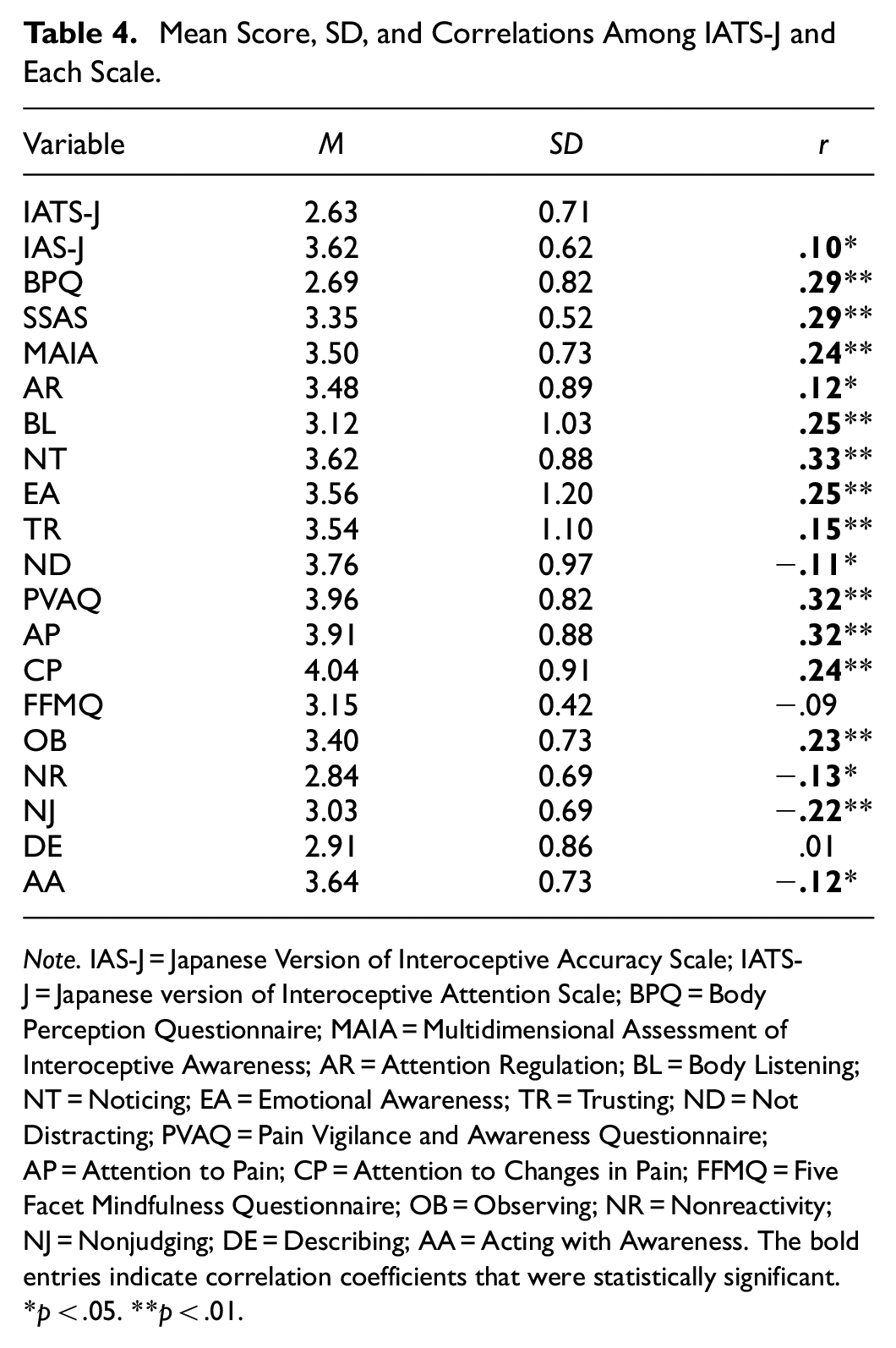
Note. IAS-J = Japanese Version of Interoceptive Accuracy Scale; IATS-J = Japanese version of Interoceptive Attention Scale; BPQ = Body Perception Questionnaire; MAIA = Multidimensional Assessment of Interoceptive Awareness; AR = Attention Regulation; BL = Body Listening; NT = Noticing; EA = Emotional Awareness; TR = Trusting; ND = Not Distracting; PVAQ = Pain Vigilance and Awareness Questionnaire; AP = Attention to Pain; CP = Attention to Changes in Pain; FFMQ = Five Facet Mindfulness Questionnaire; OB = Observing; NR = Nonreactivity; NJ = Nonjudging; DE = Describing; AA = Acting with Awareness. The bold entries indicate correlation coefficients that were statistically significant.
p < .05. **p < .01.
General Discussion
This study aimed to develop Japanese versions of the IAS (Murphy et al., 2020) and IATS (Gabriele et al., 2022) and to examine their factor structure, reliability, and validity. Two surveys were conducted to examine these scales. Results of each factor analyses showed, similar to original versions, that the IAS-J has a two-factor structure and the IATS-J has a three-factor structure. Additionally, both scales showed best fit indices for the bi-factor model that included each factor and a general factor. Following the original versions, reliability was examined for the total score on each scale, and both scales showed good internal consistency. Regarding test-retest reliability, the IAS-J showed a good value, whereas the IATS-J showed a slightly low but acceptable value.
The factor number of each scale was the same as that of the original version (Supplemental Table S4). Regarding the items of the IAS-J, Items 7 (taste), 12 (sexual arousal), 15 (muscle) and 19 (affective touch) were grouped as perception of interoceptive signals in the original version (Murphy et al., 2020), whereas those in the Japanese version were grouped as cutaneous sensations. This result suggests that Japanese participants perceived sensations such as taste, sexual arousal, muscle fatigue, or affective touch as sensations arising from a relatively shallow point of the body. Regarding the items of the IATS-J, Items 17 (pain without injury) and 21 (itchy) were grouped as attention to various interoceptive signals in the original version (Gabriele et al., 2022), but they were grouped as muscle/cutaneous sensations in Japanese version. This result also suggests that Japanese participants perceived them as sensations arising from a relatively shallow point of the body. Differences from original versions might be caused by cultural differences that was described as below, however, there is an another possible reason. It should be noted that items grouped different category from original versions of factor loadings was relatively low in original versions (IAS: 0.40–0.56, IATS: 0.39–0.54; Gabriele et al., 2022; Murphy et al., 2020) which may lead to these differences.
Factor loadings for Item 1 (heartbeat) in both scales and Item 7 (taste) in IATS-J were extremely low. In the light of cultural differences in interoceptive awareness (Ma-Kellams, 2014), we could get some insight from our results. For example, the frequent emergence of interdependent self-understanding, that is, the tendency to consider that the self is fundamentally tied to others in the Eastern world (Markus & Kitayama, 1991). Attention to interoception can be suppressed under interdependent self-understanding because attention to external information is promoted to maintain relationships with others. Heartbeat is not only perceived as interoception but also as a tactile sensation through skin vibration (Desmedt et al., 2018; Khalsa et al., 2009). Thus, under interdependent self-understanding, taste or heartbeat can be perceived relatively more strongly than other interoceptions. There is a possibility that relationships among heartbeat or taste and other interoceptive signals in Eastern cultures are weaker than in the West, resulting in low factor loadings. Although there are no published studies concerning the theoretical or empirical explanation for difference of awareness of interoception for each domain. Thus, that might be a meaningful area of future research.
Regarding the validity of the IAS-J, IAS-J negatively correlated with the scales, indicating difficulty of being aware of physical sensation, and positively correlated with higher awareness as expected. Considering that a negative correlation with alexithymia was also observed in the original version, the validity of the IAS-J was confirmed. Such a correlation pattern is also consistent with the hypothesis regarding alexithymia (Brewer et al., 2016)—a lack of interoception or accurate interoceptive awareness leads to confusion between bodily sensations and emotions. A weak positive correlation was also found with the NR of FFMQ, suggesting that accurate interoceptive awareness can prevent overly emotional meaning-making in response to changes in physical state. There was also a weak positive correlation between DE and AA. These results suggest that accurate interoceptive awareness underlies the ability to verbalize subtle sensations and become aware of the connection between one’s actions and physical states. A significant correlation between IAS-J and BPQ-BA might reflect interpretation of BPQ-BA, as mentioned in Study 1. Although it was only a weak correlation, this problem can be tackled by assessing participants’ interpretation for BPQ-BA quantitatively (Gabriele et al., 2022) and comparing across different cultural groups.
Regarding the validity of the IATS-J, IATS-J positively correlated with the scales, indicating attention to physical sensations, as expected. The correlation between IATS-J and IAS-J was significant but extremely weak. Contrary to expectations, the correlation between AR and MAIA was slightly low. This could be due to their different activities of attention, as the AR reflects the ability to pay attention to interoception, whereas the IATS reflects the tendency to pay attention to interoception in the natural state. Although not described as a hypothesis, the IATS-J showed weak negative correlations with the NR, NJ, and AA of the FFMQ. As indicated by the positive correlation with SSAS, excessive attention to interoception may lead to overly emotional meaning-making for changes in the physical state.
This is the first study based on a 2 × 2 factorial model (Murphy et al., 2019) in Eastern Asia. As the correlation between different factors (i.e., IAS-J and IATS-J) was significant, interoceptive accuracy and attention might not be perfectly distinguished in the culture of Eastern Asia. However, a correlation coefficient was extremely weak (r = .01); correlation patterns between the scales and validation scales differed across the two studies (e.g., correlations with mindfulness). Therefore, we argue that using IAS and IATS concurrently can enable elaborate discussion regarding relationships between interoception and other variables. As previously mentioned, the 2 × 2 factorial model (Murphy et al., 2019) consists of four indices based on a combination of what is measured (accuracy or attention) and how it is measured (subjective or objective). Further discussion is possible based on these indices. For example, it has been suggested that detecting changes in the physical state that are little more than noise can lead to depression or anxiety (Paulus & Stein, 2010) and that excessive attention with low accuracy can be a risk factor for mental illness. Owing to the difference between interoceptive accuracy measured by the heartbeat discrimination task (Whitehead et al., 1977) and interoceptive attention measured by BPQ-BA positively correlates with state/trait anxiety (Garfinkel et al., 2016), future studies using the IAS and IATS will help us understand the complex relationships between interoception and various psychological, behavioral, and physiological processes.
Although this study provides effective tools to measure interoception, a few limitations should be considered. First, although relatively low factor loadings may be considered as one reason of different factor structure from original versions, further studies on insight into the grouping of interoception for each domain may be warranted. Second, relationships with objective performance regarding interoception were not examined. Based on previous findings that suggest a medium positive correlation between the performance of the heartbeat counting task (Schandry, 1981) and the IAS (Murphy et al., 2020), it is important to examine how these behavioral indices or the IATS correlate with each other. Moreover, examining how the IAS and IATS relate to physiological measures that are considered to reflect interoceptive processes, such as heartbeat evoked potentials (Coll et al., 2021) and activity of the insular cortex in fMRI, will also be worthwhile (Critchley et al., 2004; Terasawa et al., 2013). Finally, surveys did not include items regarding current or previous diagnosis of psychiatric condition. Therefore, generalizability should be carefully assessed since the possibility of different results for specific populations cannot be ignored.
Conclusion
In the current study, two psychological scales that measure the subjective aspect of interoceptive accuracy and interoceptive attention were developed and validated. It was revealed that IAS-J and IATS-J have acceptable or good validity and reliability through two surveys. Notably, an extremely weak correlation among IAS-J and IATS-J scores suggested the importance of treating interoceptive accuracy and attention as separative trait. IAS-J and IATS-J are expected to contribute to revealing complex relationships between interoception and various psychological variables, such as emotion, cognition, and mental health.
Supplemental Material
sj-docx-1-sgo-10.1177_21582440231214639 – Supplemental material for Development and Validation of Japanese Versions of the Interoceptive Accuracy Scale and Interoceptive Attention Scale
Supplemental material, sj-docx-1-sgo-10.1177_21582440231214639 for Development and Validation of Japanese Versions of the Interoceptive Accuracy Scale and Interoceptive Attention Scale by Hikaru Koike and Michio Nomura in SAGE Open
Footnotes
Acknowledgements
We thank Dr. Jennifer Murphy for providing feedback during the back-translation process.
Authors’ Contribution
All authors contributed to the study conception and design. Material preparation, data collection, and analysis were performed by Hikaru Koike. The first draft of the manuscript was written by Hikaru Koike, and all authors commented on previous versions of the manuscript. All authors read and approved the final manuscript.
Declaration of Conflicting Interests
The author(s) declared no potential conflicts of interest with respect to the research, authorship, and/or publication of this article.
Funding
The author(s) disclosed receipt of the following financial support for the research, authorship, and/or publication of this article: This study was supported by JSPS KAKENHI Grant Number JP20K20863 and JP23K17641.
Ethics Approval
This study was performed in line with the principles of the Declaration of Helsinki. Approval was granted by the Ethics Committee of Kyoto university (Study 1: June 22th, 2022/CPE-495; Study 2: August 10th, 2022/CPE-515).
Consent to Participate
Informed consent was obtained from all individual participants and their legal guardians included in the study.
Consent to Publish
NA

Notes
Supplemental Material
Supplemental material for this article is available online.
Data,Materials and/or Code Availability
The datasets generated during and analyzed during the current study are available from the corresponding author on reasonable request.
References
Supplementary Material
Please find the following supplemental material available below.
For Open Access articles published under a Creative Commons License, all supplemental material carries the same license as the article it is associated with.
For non-Open Access articles published, all supplemental material carries a non-exclusive license, and permission requests for re-use of supplemental material or any part of supplemental material shall be sent directly to the copyright owner as specified in the copyright notice associated with the article.
