




Abstract
The preschool age is an important period in the development of children’s emotional abilities. The face and body are both vital carriers of emotional information and adults readily match the emotional cues coming from these two modalities. However, it is unknown whether preschoolers have this ability or not. In the current study, 36 preschoolers (22 boys, aged 44–73 months old) participated in an emotional facial and bodily matching test including angry, happy, and neutral expressions (Experiment 1) and an eye-tracking experiment (Experiment 2). The results show that: (1) preschoolers can accurately match three categories of facial and bodily expressions of emotion (all matching rates were above 93% in Experiment 1); (2) robust emotional matching was observed across conditions in Experiment 2. That is, the eye-tracking indexes including the total fixation duration, the first fixation duration, and the fixation count, all indicated that the preschoolers more thoroughly processed bodily expressions of emotion which were congruent to the facial expressions compared to incongruent bodily expressions of emotion. This study shows that the ability to match facial and bodily expressions of emotion develops at an early age. Preschool children have already reached a high level of this ability.
Plain Language Summary
The preschool age is an important period in the development of children’s emotional abilities. The face and body are both vital carriers of emotional information and adults readily match the emotional cues coming from these two modalities. However, it is unknown whether preschoolers have this ability or not. In the current study, thirty-six preschoolers (22 boys, aged 44-73 months old) participated in an emotional facial and bodily matching test including angry, happy, and neutral expressions (Experiment 1) and an eye-tracking experiment (Experiment 2). The results show that: (1) preschoolers can accurately match three categories of facial and bodily expressions of emotion (all matching rates were above 93% in Experiment 1); (2) robust emotional matching was observed across conditions in Experiment 2. That is, the eye-tracking indexes including the total fixation duration, the first fixation duration, and the fixation count, all indicated that the preschoolers more thoroughly processed bodily expressions of emotion which were congruent to the facial expressions compared to incongruent bodily expressions of emotion. This study shows that the ability to match facial and bodily expressions of emotion match develops at an early age. Preschool children have already reached a high level of this ability.
Introduction
The preschool age (3 –6 years old) is an important phase in children’s emotional and cognitive development (Carson et al., 2016; Chen et al., 2021; Courtier et al., 2021; Denham et al., 1997; Laible & Thompson, 1998). The development of the capacity to recognize emotions is conducive to the development of children’s prosocial behavior, empathic understanding and interpersonal relationships (Camras & Halberstadt, 2017; Laforge et al., 2018). It is also central to the notions of emotional competence and emotional intelligence (Martins et al., 2021). Emotion recognition is one of the most elementary emotion processing abilities of individuals. It is the basis and premise of more advanced abilities (Pahnke et al., 2020; Pons et al., 2003). Therefore, it is of great practical significance to explore preschoolers’ emotional cognitive abilities, by examining whether they can match emotional expressions from the face and the body. Typically developing individuals show an innate tendency to attend to faces (Reynolds & Roth, 2018). Infants as young as 3.5 and 7 months of age can recognize happy and sad facial expressions exhibited by a familiar and unfamiliar person, respectively (Kobayashi et al., 2020; Soken & Pick, 1999). After 1 year of age, children can identify different emotional faces (Y. M. Li et al., 2009). Children as young as 2 years of age demonstrate the ability to accurately identify facial expressions of various emotions, including happy, sad, angry, and scared (Parker et al., 2013). At 4 to 5 ages, children are able to accurately and reliably identify facial expressions of the six basic emotions (Humphries & McDonald, 2011; Q. Li & Feng, 2022). In terms of body processing, infants as young as 5 months of age process emotions from body posture (Bhatt et al., 2016). Neural responses of 8-month-old infants to images of body expressions were characterized by emotion-specific modulations (Pollux, 2021). children as young as 3 years reliably recognized the bodily expressions of anger, sadness, and fear at high rates (Nelson & Russell, 2011). At 4 to 5 ages, children were able to recognize the emotional bodies of the six basic emotions (Parker et al., 2013; Witkower et al., 2021). All the studies above have shown both face and body expression recognition increases rapidly in early childhood that and preschoolers can recognize emotions expressed by the face or body, independently.
To make sense of our social environment and ensure successful social interaction, we constantly try to read others’ nonverbal signals and infer their mental and emotional states. For that purpose, we rely heavily on information from the face and body (Lott et al., 2022). To make accurate emotional judgments, the information provided by these two sources needs to be integrated. Previous research has shown that people’s perception of facial expressions is biased toward the emotional expression being displayed by the body. This bias is so strong that it holds even when adults are instructed to base their performance only on faces (Hock et al., 2017; Kret et al., 2020). In addition, facial expressions in the “real world” are often ambiguous, and people use information from bodily expressions to infer the actual emotional states of individuals (Aviezer, Trope, & Todorov, 2012). When individuals are unable to match facial and bodily emotional expressions, this will likely affect their emotional judgment of others. Indeed, research has shown that when the face and body of actors showed inconsistent emotional expressions, the individuals’ reaction time in judging the emotions of the faces or bodies was longer and accuracy rates were lower (Kret et al., 2013; Wang et al., 2017; Zhang et al., 2019). In addition, in a study of developmental visual agnosia researchers found that patients were impaired at recognizing isolated facial expressions, but successfully recognized the bodies expressions (Aviezer, Hassin, & Bentin, 2012). However, their inability to integrate emotional faces and bodies leads to problems in understanding other people’s emotions and patients experience embarrassment and social anxiety, even though they show typical recognition of others from voice cues (Tsantani et al., 2022). But whether preschoolers can process this joint information, and whether they, for instance, can correctly match both emotion carriers, remains unclear. Correctly matching emotions from the face and body may be a more complex cognitive emotional ability than recognizing emotions from isolated faces or bodies and may be more difficult for them. Therefore, it is particularly important to study the matching ability of facial and bodily emotional expressions.
Previous studies mainly used Emotion Matching Task (e.g., Barisnikov et al., 2021; Salmon et al., 2013), Affective Knowledge Test (e.g., Denham, 1986; Morgan et al., 2009) and Kusche Emotional Inventory (e.g., Kusché, 1984; Miller et al., 2005) to explore preschoolers’ emotional matching ability, which mainly investigated preschoolers’ emotional understanding and their ability to match faces with different scenarios. Other researchers used face-matching paradigms (e.g., Barisnikov et al., 2021; Castelli, 2005), vocal/video cues (e.g., Loveland et al., 2008; Palama et al., 2022) or verbal labeling of facial expressions (e.g., Capps et al., 1992; Golan et al., 2018) to investigate emotional understand and matching ability of preschool children. In addition, the familiarization paired comparison preference procedure is often used to explore the emotion matching ability of infants (Hock et al., 2017; Ruba et al., 2020), to understand how humans developed the ability to integrate emotional information from different sources. Although these paradigms are widely used, they often ignore the important role of bodily expressions of emotion in emotional face perception. Many researchers believe that facial emotion plays a dominant role in individual emotion recognition (Bayet et al., 2018; Garcia & Tully, 2020; Watling & Damaskinou, 2020). Take online meetings (e.g., Skype calls) for example, people can accurately judge each other’s emotional state only by focusing on faces. However, this does not mean that faces alone are enough for emotional judgment. In addition to facial expressions, bodily expressions give us information about the action tendency of the individual (Kret et al., 2013). And, in bodily expressions, orientation and movement can be part of the expression and these parameters play a greater role than in facial expressions (Kret et al., 2020). For example, anger was associated with being in a quarrel and threatening to fight back, that is, by frontal body lean or movements, muscle tension, and the clenching of fists, taking a combative position (Kret et al., 2020). Happiness with encountering an old friend not seen in years and being very pleased to see, we embraced each other with open arms. In addition, when we are attacked and feel scared, we protect ourselves by putting our hands in front of our heads (De Gelder & Van Den Stock, 2011). During real life social interpersonal communication, the face and body tend to be both visible. The body is one of the important factors which would affect emotion recognition (Oh Kruzic et al., 2020; Zhang et al., 2019). In that case, emotional information provided by the body will affect the recognition and processing of the emotional information shown on the face (Kret et al., 2013; Mondloch, 2012; Oh Kruzic et al., 2020; Reschke et al., 2018). When the face and body of actors showed the same emotion, the recognition of the facial expression was facilitated; when the two were inconsistent, this interfered with the judgment of the facial expression (Meeren et al., 2005; Mondloch, 2012; Reschke et al., 2018; Van Den Stock et al., 2007; Zhang et al., 2019). Therefore, bodily expressions of emotion should not be excluded when exploring preschool children’s emotional matching ability.
Previous studies on emotion matching mainly involve the following four aspects: (1) Matching tasks. Previous emotional matching tasks were mainly in this form: a target stimulus (face, vocal, or word, etc.) was presented at the top of the page, then participants were asked to identify the face at the bottom (out of three faces) that showed the same expressions (Alonso-Alberca et al., 2012; Barisnikov et al., 2021; Golan et al., 2018). This helped to focus the participants’ attention on alternative answers and eliminate extraneous factors, thus determining whether the participants have the ability to emotional matching. However, few studies have taken this approach: presenting multiple stimuli simultaneously that need to be paired. Such a paradigm increases the difficulty of the task because it requires participants to eliminate interference, which will involve more complex and advanced cognitive processing. Therefore, compared with the previous tasks, the current task can be used to investigate preschool children’s emotional matching ability. (2) Indicators. Previous studies have judged whether preschoolers have emotional matching ability mainly by the accuracy rate, and there is no limit on the task completion time (Barisnikov et al., 2021; Golan et al., 2018; Salmon et al., 2013). This approach can be used to explore whether preschoolers are capable of emotional matching based on careful thinking. However, it is uncertain whether preschoolers can complete the task under the condition of limited time, which is related to the individual’s familiarity and processing degree of the task. And, in real life, emotional information often catches our eyes in a flash. Therefore, individuals need to quickly react to others’ emotional changes within a limited time (Yin et al., 2016), which is important in interpersonal communication. (3) Instruments. Paper-and-pencil tests and question-and-answer are the most commonly used methods (Israelashvili et al., 2021; Morgan et al., 2009; Salmon et al., 2013); In addition, a small number of studies have used ERP technology to explore the neural mechanisms of children during the emotional matching (X. Li, 2021; Ogren & Johnson, 2020; Vogel et al., 2012). However, few studies have used eye-tracking technology to explore the ability of preschoolers to match facial and bodily expressions, which is particularly important for exploring the emotional cognitive development course of preschoolers further. Eye tracking technologies are used to measure an individual’s eye movements and in turn to determine what they are looking at. By measuring several factors such as the duration of fixations inferences can be made about much cognitive processing the individual is giving to any part of the stimulus (McAlaney & Hills, 2020). The different gaze patterns—when and where the participants looked—indicated the information entering the visual system and the strategies adopted in emotion perception (Watanabe et al., 2011). Therefore, eye movement technology can be used to infer whether an individual has the ability to match emotions by measuring the processing of consistent and inconsistent emotional face and body (Hock et al., 2017). (4) Instructions. Explicit instructions are an important part of experimental tasks and can reflect the psychological process of the participants. In the absence of explicit instructions, the preschoolers could still complete the emotional matching task, which shows that the preschoolers can actively establish the relationship between the two, reflecting their matching ability reached a high level. Therefore, to explore the preschool children’s emotional face and body matching ability. We designed a behavioral experiment that presented multiple groups requiring emotional face and body matching. Meanwhile, based on the previous research paradigm (Calbi et al., 2017), we designed an eye movement experiment with time constraint and implicit instruction. Using eye movements is effective because it directly demonstrates the processing of facial expressions of emotions and bodily expressions of emotions matching in preschoolers (Ogren & Johnson, 2020). At the same time, due to the limited cognitive developmental level of preschool children (Bai et al., 2021), the adoption of eye-tracking technology can not only reduce their cognitive load, but also enable them to concentrate on completing experiments. Therefore, the adoption of eye-movement tracking technology is helpful to provide more abundant empirical evidence for revealing the developmental characteristics of preschool children’s emotional cognition.
In the current study, participants first participated in an emotional facial and bodily matching test including angry, happy, and neutral expressions. In addition, they took part in an emotional matching eye-tracking experiment, where we analyzed participants’ looking patterns on bodily expressions of emotion congruent/incongruent with the emotion facial categories. Previous research has shown that preschoolers can recognize facial and bodily expressions of emotions respectively (Balas et al., 2018; Parker et al., 2013). Therefore, we hypothesized that preschoolers could match facial and bodily expressions of emotion with the same emotion category. Children integrate social information from a variety of sources starting quite early in life. For example, 6.5-month-olds are also sensitive to the correspondence between emotions in faces and bodies: When exposed to happy, angry, or sad emotions in faces/bodies, they looked longer at the matching than nonmatching emotion subsequently portrayed by the other stimulus type (Hock et al., 2017). While this may reflect that infants are aware of the correlation between facial and bodily emotional information solely at a basic featural level, this information paves the way for a later understanding of the meaning of emotions (Hock et al., 2017). For preschoolers, not only can they match emotional faces with sounds and words (Cross-Modal Matching), but also complete emotional matching tasks in different situations, such as expression-situation matching task (Barisnikov et al., 2021; Salmon et al., 2013). In addition, when happy and angry vocalizations and body movement videos were presented in an upright position, preschoolers preferentially looked at the emotionally congruent body (Heck et al., 2017). All these indicate that preschool children’s emotional matching ability has developed to a certain level. Therefore, we assessed the key hypothesis that preschoolers could achieve a high level of facial and bodily emotional matching. In other words, immediately following the faces, preschoolers looked longer on average at the matching bodies than at the mismatching bodies (Hock et al., 2017; Rigoulot & Pell, 2012). We expected that preschoolers could perform matching tasks under time constraints and implicit instructions.
Method
Participants
According to a sample size calculated using G*Power 3.1.9 software (Faul et al., 2007), the total number of participants required is 34 when the effect size is set to 0.25 and the expected power value is 0.8. For the current study, a total of 36 preschoolers (22 boys), aged 44 to 73 months (M = 62.02, SD = 5.73), were included from a kindergarten. They were right-handed, had normal vision and were reported to be healthy. The research was carried out according to the ethical principles regarding human experimentation laid down in the “Declaration of Helsinki.” Therefore, before commencement, informed written consent was obtained from all participants’ legal guardians. The study was approved by the local research ethics committee.
Materials
Three categories of facial expressions of emotion (anger, happiness and neutral) were taken from the Visual China database. The emotional faces were standardized with Photoshop so that only the internal features including the eyes, nose, mouth and cheeks were retained. The gray scaled images were 400 × 570 pixels, 300 dpi. A total of 60 pictures of emotional faces were created, 20 for each of the three emotion categories, half male and half female. Bodily expressions were selected from The BEAST (bodily expressive action stimulus test) and included Anger (n = 22), Happy (n = 20) and Neutral (n = 24) (De Gelder & Van Den Stock, 2011). Chinese adults can accurately recognize body emotions (anger, fear, happiness, sadness, neutral) in the BEAST gallery (He et al., 2016). Photoshop was used to crop them all to 210 × 310 pixels,72 dpi.
Thirty preschool children (14 boys and 16 girls) aged 46 to 74 months (M = 62.80, SD = 7.60) were selected from a kindergarten to validate the stimulus materials. All images were presented randomly on a table in front of the participants. The participants were instructed to categorize the emotion expressed in the face on an answering sheet in three alternative-forced-choice taskS (anger, happiness, neutral) (De Gelder & Van Den Stock, 2011). Then the degree of agreement (confidence) of emotions was rated on a 5-point scale (from 1 being very disapproving to 5 very much agreeing) based on the categories of emotional judgment. The bodily expressions of emotion were also evaluated on emotion categories. We also asked participants to judge whether the actor was Chinese or not. The results are shown in Table 1. In addition, we calculated the identification rating of facial and bodily emotional images: the percentage of the total number of raters who thought the image belonged to these emotional categories (Gong et al., 2011). On the whole, no matter facial emotional pictures or bodily emotional pictures, the identification rating of the pictures is higher than 75%, as shown in Table 2.
The Categorization and Confidence of Facial Expressions of Emotion; the Categorization and Regarded as Chinese Rate of Bodily Expressions of Emotion (M ± SD).

Proportion of Identification Rates of Emotional Facial and Bodily Pictures (%).

The results of this validation study indicate that the emotional images selected are easy for preschoolers. Further, there is consistency between emotional expression and recognition. Importantly, most preschoolers believed that the bodies belonged to Chinese people. Thirty emotional faces and 30 body images were selected from the emotional images (10 anger, 10 happy, 10 neutral), 24 of which were used for the emotion matching experiment (eight anger, eight happy, eight neutral) and six for the eye tracking experiment (two anger, two happy, two neutral). Half of the stimulus material showed male and half female models. Examples of experimental materials are shown in Figure 1.

Examples of experimental materials.
Apparatus and Procedure
An SMI RED500 eye tracker was used to record the eye movements of participants. The eye tracker was controlled by a Dell computer and has a tracking screen resolution of 1,680 × 1,050 pixels. The evaluation accuracy of the eye tracker system is 0.5° of visual angle. In this study, the sampling frequency was 120 Hz, the participants’ eyes were calibrated at five points by watching a red dot moving on the screen, and fixation was determined to last for at least 100 ms at a 1° viewing angle.
Behavioral Experiment (Experiment 1)
Prior to the eye tracking experiment, the participants were asked to perform facial and bodily expressions of the emotional matching test. First, children were presented with a set of photos (a total of eight groups) on a table in front of them, including three showing facial expressions of emotion and three bodily expressions of emotion (all containing three emotions: anger, happiness, neutral). Then the children were told: “Dear little friend, there are three pictures of faces and three pictures of people who can’t see the face on the table in front of you. Please answer, which of these three facial expressions is consistent with the expression shown in the body of the other picture.” The correct rate was recorded. The behavioral experiment lasted about 5 min. Its procedure is illustrated in Figure 2A.
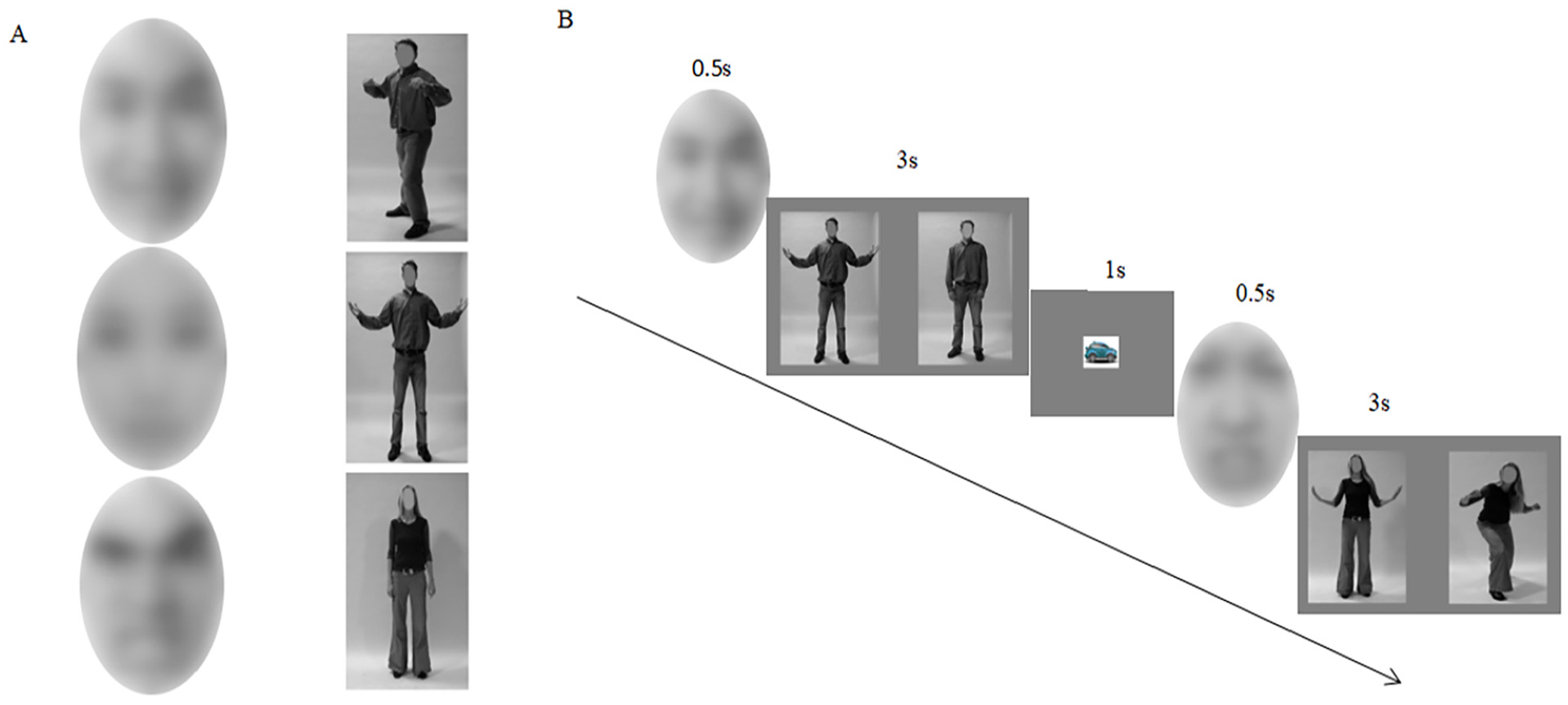
(A) Trial outline Experiment 1; (B) Trial outline Experiment 2. The resource of the human model images is the same as in Figure 1.
Eye-Tracking Experiment (Experiment 2)
The eye-tracking study was a passive viewing task and comprised of a 3 (Emotion categories: anger, happy, neutral) × 2 (Emotional category congruence: congruent, incongruent) within-subject design. The stimuli were presented in a pseudo-random and balanced location on the screen. First, a facial expression of emotion was presented, then two bodily expressions, one of which was consistent with the emotion categories of the presented face, and other was inconsistent with the emotion categories of the presented face. For example, after presenting an angry facial expression, there were four situations in which two bodily expressions were presented: angry (left) and happy (right) body emotions, angry (left) and neutral (right) body emotions, angry (right) and happy (left) body emotions, and angry (right) and neutral (left) body emotions. After one set of stimuli was presented, a gray screen appeared with an animated picture in the middle to attract the children’s attention. The eye-tracking experiment included 24 trials and lasted about 2 min.
The experiment was carried out in a quiet and bright environment with the cooperation of kindergarten teachers. The participants sat on a chair 55 to 65 cm away from the display screen, and the height of the chair was adjusted depending on the children’s length. Implicit instruction: The preschoolers were told to look carefully at the pictures presented on the screen. After a five-point visual calibration of the eye-tracker, the stimulus material was presented. An illustration of the process is shown in Figure 2B.
Areas of Interest
A rectangular area of interest tool of SMI Begaze software was used to define the two body images presented simultaneously in each trial as the area of interest (AOI), Figure 3. Eye-tracking measures are shown in Table 3.

the area of interest is indicated with a red line. The resource of the human model images are the same as Figure 1.
Eye-Tracking Measures.

Statistical Analyses
SPSS 22.0 was used to conduct statistical analyses.
Experiment 1
A One-way ANOVA was run to analyze the data of the behavioral experiment. The emotion categories were the independent variable, while matching accuracy was the dependent variable.
Experiment 2
A 3 (Emotion categories: anger, happy, neutral) × 2 (Emotional category congruence: congruent, incongruent) repeated measures ANOVA and a simple effect analysis were run to analyze the data of the eye-tracking experiment. The data of all subjects were included in the statistics, except the data that were three standard deviations above the mean and missing, which accounted for 0.04% of the total data. Emotion category and emotion category congruence served as independent variables, while eye movement indexes (total fixation duration [TFD], fixation count [FC], and first fixation duration [FFD]) were the dependent variables.
Results
Correct Rates of Emotion Matching of Preschool Children
Correct rates of emotion matching of preschool children are shown in Table 4. We divided preschoolers into three groups (N = 3,528, respectively) according to their age, and conducted a 3 (Age: 44–48, 49–60, 61–73 months ) × 3(Emotion categories: anger, happy, neutral) analysis of variance. The results showed that the main effect of age was not significant, F(2, 33) = 1.19, p = .31, ηp2 = 0.07. The main effect of correct rates of emotion matching was not significant, F(2, 66) = 0.46, p = .63, ηp2 = 0.01. The interaction between age and correct rates of emotion matching was not significant, F(2, 66) = 0.85, p = .49, ηp2 = 0.49. This suggests that children have acquired the ability to match emotional faces to body parts by as early as 44 months. In addition, we noticed that some children performed at the ceiling in one or more conditions (N = 11) and this could have dampened potential differences between conditions. After removing these 11 preschoolers and rerunning the ANOVA (in a sample of 25 children), F(2,48) = 2.39, p = .1, ηp2 = 0.09, there still was no significant difference in the matching difficulty of the three different emotions.
Correct Rates of Emotion Matching of Preschool Children (%).

Eye-Movement Processing Characteristics of Preschoolers’ Emotional Matching
Total Fixation Duration (TFD)
Table 5 shows the statistics of eye movement indexes when participants processed emotional body expressions. A repeated measures ANOVA showed that there was no main effect of emotion category on total fixation duration (TFD), F(1, 35) = 1.28, p = .28, ηp2 = 0.035. The main effect of emotional category congruence was significant (see Figure 4), F(1, 35) = 54.64, p < .001, ηp2 = 0.61, that is, participants looked longer at congruent (M = 1,329.41, 95% CI [1,227.36, 1,431.45]) compared to incongruent(M = 789.67, 95% CI [710.58, 868.76]) bodily expressions. Further, a significant interaction between emotion category and emotion category consistency, F(1, 35) = 3.21, p = .049, ηp2 = 0.084, The simple effect analysis showed that this pattern was consistent for all three emotion categories, albeit a bit weaker for happiness (ps < .001, 95% CI [464.09, 796.19]; 95% CI [294.96, 611.97]; 95% CI [353.08, 718.10]).
The TFD, FFD and FC of Preschoolers’ Emotional Priming (M ± SE).


The total fixation duration of preschoolers on bodily expressions of emotion under the condition of the congruent and incongruent emotional category (***p < .001).
First Fixation Duration (FFD)
There was no main effect of emotion category, F(1, 35) = 1.46, p = .24, ηp2 = 0.04. The main effect of emotional category congruence was significant, F(1, 35) = 22.38, p < .001, ηp2 = 0.39, and the FFD of the participants on the congruent bodily expressions (M = 257.01, 95% CI [240.60, 273.43]) was significantly longer than the incongruent bodily expressions (M = 228.02, 95% CI [214.17, 241.86]). The interaction between emotion category and emotion category congruence is significant (see Figure 5), F(1, 35) = 4.07, p = .022, ηp2 = 0.10. The simple effect analysis showed that the FFD for congruent bodily expressions was significantly longer than that for incongruent bodily expressions under the facial emotion stimulus of anger and happiness (p < .001, 95% CI [32.45, 71.42]; p = .045, 95% CI [0.50, 42.15]), while there was no significant difference between the FFD for congruent and incongruent bodily expressions under the facial emotion stimulus of neutral emotion (p = .21).
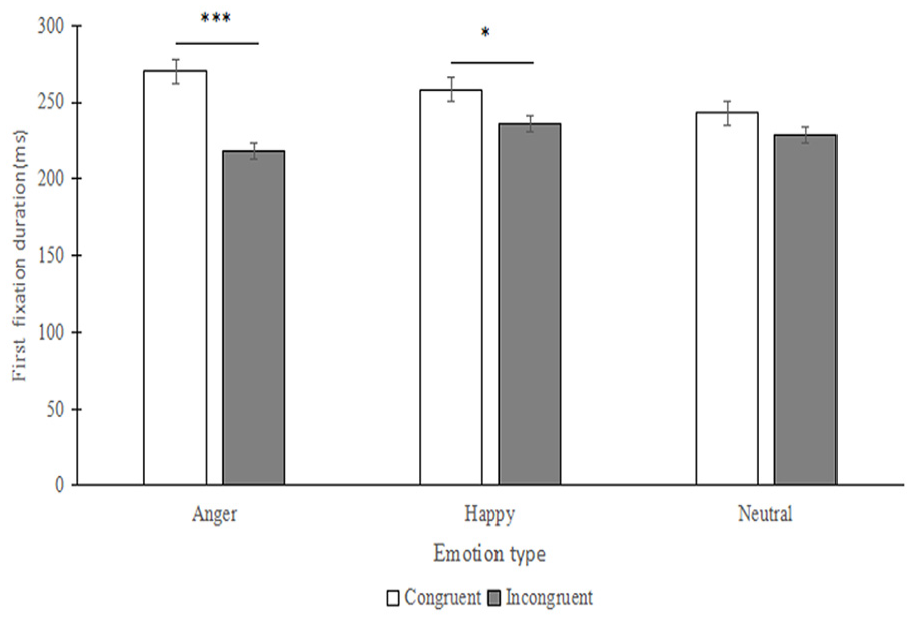
The first fixation duration of preschoolers on bodily expressions of emotion under the condition of the congruent and incongruent emotional category (*p < .05; ***p < .001).
Fixation Count (FC)
The main effect of the emotion category was not significant, F(1, 35) = 2.2, p = .121, ηp2 = 0.059 . The main effect of emotional category congruence was significant (see Figure 6), F(1, 35) = 62.67, p < .001, ηp2 = 0.64, that is, the fixation count of the congruent bodily expressions (M = 4.91, 95% CI [4.57, 5.25]) was significantly more than that of the incongruent bodily expressions (M = 3.22, 95% CI [2.93, 3.52]). The interaction between the emotion category and emotion category congruent was not significant, F(1, 35) = 1.86, p = 1.65, ηp2 = 0.05.

The fixation count of preschoolers on bodily expressions of emotion under the condition of the congruent and incongruent emotional category (***p < .001).
Discussion
In contrast to online meetings where the focus is on the face, people convey emotions through the body and face at the same time in a face to face interpersonal communication. When the emotional content or valence carried by body and face is inconsistent, it will affect the individual’s interpretation of emotions (Reschke et al., 2018; Zhang et al., 2019). But the premise is that individuals can match the facial and bodily emotional expressions. Whether preschoolers have this ability is unclear. Therefore, the main goal of the current study was to explore preschoolers’ ability to correctly match facial and bodily expressions of emotion. For this purpose, we designed a behavioral experiment and an eye-tracking experiment. Although previous studies have explored the emotional matching ability of preschoolers (Barisnikov et al., 2021; Golan et al., 2018; Salmon et al., 2013), there is a lack of research on the matching of facial and bodily expressions of emotion, as well as the emotional matching ability. The current research not only expands the scope of the research on preschoolers’ emotional matching, but also adopts a new paradigm to explore preschoolers’ emotional matching ability. The current study shows that preschoolers can recognize isolated expressions of emotion from the face and body, and that they also have the ability to correctly match the facial and bodily expressions, regardless of the displayed specific emotion (Experiment 1). Therefore, this result shows that preschool children’s emotional facial and bodily matching ability already reached a high level comparable to adults’ levels (X. Li, 2021). The finding extends what has been observed in children in previous studies. There is ample evidence supporting our hypothesis.
Experiment 2 used an emotional matching eye-tracking design to explore preschoolers’ ability to match facial and bodily emotions. On the whole, as predicted, preschoolers were able to perform emotional matching tasks in the context of time constraints and implicit instructions. In the context of quickly presenting facial expressions of emotion, the finding that the fixation duration, fixation counts and first fixation duration, preschoolers’ processing of bodily expressions of emotions consistent with the category of facial expressions of emotions (congruent condition) were significantly longer/greater than those of the incongruent condition. This indicates that the emotional matching ability of preschool children has reached a high level, and they can complete tasks relatively easily. Studies show that children acquire the terms required to label basic emotions and categorize positive and negative emotions as early as 2-3 years of age (Widen & Russell, 2003), and that the ability of emotion recognition and categorization develops rapidly with language development (Conte et al., 2019). In addition, in the early school years, children’s theory of mind has a qualitative leap, they become aware of hidden emotions, realizing that an individual can feel one emotion yet display another (Wellman, 2018). The acquisition and development of these abilities are closely related to their emotional matching ability and promote each other (Conte et al., 2019). The findings of this study confirm this further.
Experiment 2 shows that fixation duration and count on bodily expressions of emotion which were congruent with the facial expression were longer and more frequent than those on bodily expressions of emotions which were incongruent with the facial expression. This suggests that preschoolers can perform emotional matching tasks well. In addition, the first fixation duration for the bodily expressions of emotion consistent with the category of facial expressions of emotion was significantly longer than the incongruent bodily expressions under the facial expression stimulus of anger and happiness. However, it is worth noting that in the neutral facial expression condition, there was no significant difference between the first fixation duration for congruent and incongruent bodily expressions of emotion with the category of facial expressions of emotion. This indicates that under the matching of neutral facial expressions, the emotional matching does not appear in the very short time after the bodily expressions are presented. With the increase in processing time, emotional matching appears again. One possible reason for this is that individuals have an attentional bias toward emotions (for a review, see Hu et al., 2018; Van Rooijen et al., 2017). When emotional stimuli appear, people tend to show an acceleration of attentional orientation, and compared with neutral stimuli, emotional stimuli will attract attention and are processed faster (Hu et al., 2018; Trujillo et al., 2021). In the present study, we used pictures of static bodily expressions as the experimental material. In the neutral bodily expression pictures, the actor’s arms are naturally drooping. While in the pictures of the happy and angry bodily expression, the actor shows the arms raised in a “hug” or “cheer” position and clenched his fists in a combat position respectively (De Gelder & Van Den Stock, 2011). Thus, it can be seen that the neutral expressions of emotions were less attractive. Emotional attention bias is an early automatic response (Bradley et al., 1997; Trujillo et al., 2021), and it is easy to be masked by the follow-up task. Therefore, the preschoolers may have been influenced by the emotional attentional bias under the neutral facial emotional stimulus. Then, under the influence of the experimental task, they quickly completed the matching task. This indicates that implicit guidance has been playing a role. In addition, the preschoolers may have been influenced by the emotion matching and emotional attentional bias under the angry and happy facial emotional stimulus, at the same time, but emotion matching plays a dominant role. This indicates that preschool children can actively establish the association between facial and bodily emotions, reflecting their emotional matching ability reached a high level.
In addition, our study acts as a bridge: connecting the developmental trajectory from infancy to adulthood. In studies of infants, 5-month-olds exhibited a preference between sex congruent (face and body of the same sex) versus sex-incongruent (face and body belonging to different genders) images (Hock et al., 2015). 6.5-month-olds were familiar with happy, angry, or sad emotions in faces or bodies and tested with the opposite image type portraying the familiar emotion paired with a novel emotion. Infants looked longer at the familiar emotion across faces and bodies (Hock et al., 2017). Although this does not reflect that the infants have the relevant knowledge of emotional matching, it does suggest that the infants are sensitive to the correspondence between perceptual features of emotional faces and bodies (Hock et al., 2017). On the adult side, needless to say, adults already have the knowledge and ability to match emotional faces and bodies. Whether preschoolers have this ability is unclear. This study found that by at least 3.7 years of age, children already have the ability to match emotional faces and bodies, and reach a high level of emotional recognition. However, only three emotions are involved in this study. In the future, several emotions (e.g., Sad, surprised) should be added while exploring the matching ability of emotional faces and bodies of children aged 1 to 3. This will not only improve the developmental trajectory of emotional face and body matching from infant to adult, but also contribute to the understanding of individual emotional recognition and development.
However, some limitations of the present study should be mentioned. First of all, our stimulus materials show people who are acting, but not genuinely feeling emotions. And, we can only measure emotions to a certain extent, indirectly, and can never get a truly complete and accurate picture (see Kret et al., 2020). Therefore, this may be the fundamental factor influencing the results of the study. Secondly, in the current study, we did not collect some behavioral responses of the participants, such as response time during the emotional matching task. Meanwhile, we did not assess other cognitive abilities, such as inhibitory control and working memory, which might be important influencing factors. The important thing is, we found that although the emotional attention bias would be masked by the follow-up task, it would have a significant impact on individual’s emotion recognition and processing. These findings may help to more accurately study the influencing factors of preschoolers’ emotional development and formulate educational strategies.
The current study extends findings of preschool-aged children’s recognition of emotional faces and bodies. Encoding nonverbal cues in a social situation can include gathering information from both an individual’s face as well as body posture (e.g., Abo Foul et al., 2022; Heck et al., 2017; Van Den Stock et al., 2007). Identifying that a person is feeling angry based on his or her arms being folded across the chest or feeling sad based on his or her slumped shoulders can assist with deciding what to do or say next in a certain situation (Parker et al., 2013). More importantly, the ability to synthesize the emotional information collected, is critical for preschoolers to be successful in establishing and maintaining their high-quality peer relationships. The task of emotion matching requires more cognitive processing than having to recognize a single, isolated expression of emotion, say, a facial expression. Exploring the matching ability of facial and bodily expressions of emotions in preschoolers, the current study expands the scope of research on emotional matching. The aim of these studies was to increase the understanding of preschoolers’ emotional and cognitive, and provide an empirical basis for promoting the development of these skills. Further research should be carried out to determine the influencing factors of preschools’ emotional cognitive ability and to provide better educational programs for its development. At the same time, we should further explore the neural mechanism of emotional face and body integration in preschoolers, to expand people’s understanding of their emotional cognitive development. In addition, the longitudinal development of emotion matching ability from infancy to early childhood should also be explored (Ogren & Johnson, 2020), which can further increase our understanding of how emotional processing develops starting from birth.
Footnotes
Declaration of Conflicting Interests
The author(s) declared no potential conflicts of interest with respect to the research, authorship, and/or publication of this article.
Funding
The author(s) disclosed receipt of the following financial support for the research, authorship, and/or publication of this article: This study was supported by grants from the National Social Science Foundation of China, Grant/ Award Number: 20CSH069. MK is supported by the European Research Council (Starting grant #804582).
Ethical Approval
The study was conducted in accordance with the Declaration of Helsinki, and approved by the Psychology and Education Research Ethics Committee of Minnan Normal University (protocol code 20210920001, 20 September 2021).
Informed Consent Statement
Informed consent was obtained from all subjects involved in the study.

Data Availability Statement
All the data for this study will be made available upon reasonable request.