




Abstract
We conducted two experiments to determine how the combination of task relevance, loss framing, and psychological distance affects changes in construal level, emotion intensity, and purchase intent. Experiment 1 investigated how construal level fit between the loss and proximal frames affected emotion intensity and purchase intention for skin beauty items among 217 female students in their 20s using the construal matching hypothesis (CMH). Experiment 2 examined how changes in construal level caused by the combination of task relevance and loss framing affect purchase intention among 41 female students in their 20s. We discovered that combining the loss and proximal frames boosted the emotional intensity of worry and raised purchase intention for low-concept marketed products. Meanwhile, the loss frame message produced a high construal level through self-affirmation in individuals with high task relevance, lowering purchase intention for advertising that emphasized tangible facts. We provide an in-depth discussion of the implications and limitations of our findings, as well as future research prospects.
Plain language summary
We believe that our study makes a significant contribution to the literature because we discovered that combining the loss frame with the proximal frame boosted the emotional intensity of worry and raised purchase intention for low-concept marketed products. Meanwhile, the loss frame message produced a high construal level through self-affirmation in individuals with high task relevance, lowering purchase intention for advertising that emphasized tangible facts.
Introduction
Construal level theory (CLT) is gaining popularity in the realms of psychology and marketing for its attempt to explain the relationship between mental construal and psychological distance (Fiedler, 2007; S. J. Lee, 2019; Soderberg et al., 2015). CLT distinguishes between high and low construal based on the psychological distance to a given message; high construal indicates a strong interest in abstract aspects of the message, whereas low construal indicates a focus on concrete information (Fujita et al., 2006; Trope & Liberman, 2010). Message components are divided into three factors: topics, design, and processing styles (S. J. Lee, 2019). In this study, we examine psychological distance and loss frame, which is a design sub-factor, and how their combination affects emotion intensity and construal level. Furthermore, we tested how the combination of task relevance and loss frame can prime a high construal based on self-affirmation theory (SAT).
Construal Level Fit Between the Distal/Proximal and Gain/Loss Frames Based on CLT
According to Trope and Liberman’s (2003, 2010) CLT, while receiving a message from an incident or object, there are variances in construal level based on perceived psychological distance. CLT categorizes construction levels as high construal and low construal. The primary features of the information are represented as abstract, schematic, and decontextualized in high construal. However, low construal indicates that the subject focuses on ancillary characteristics of the object or situation and depicts it as tangible, unstructured, and contextualized (Liberman & Trope, 2008).
When an individual is psychologically separated from an object or incident (e.g., temporal, spatial, social, and low hypothetical distance), they adopt an abstract mindset (high construal); when they are in close proximity to the object, they interpret it at a more concrete, detailed level (low construal; Trope & Liberman, 2010). Amit et al. (2009) adjusted social distance by giving a message to a domestic “in-group” and an international “out-group.” They discovered that the socially proximal and remote groups had high and low construals, respectively. Similarly, when participants felt that a video was shot in a remote area, they used more abstract language to describe the behaviors in the video (Fujita et al., 2006). A meta-analysis on the effects of psychological distance on construal level showed a medium-sized effect (Soderberg et al., 2015).
S. J. Lee (2019) classified message components as topic, design, and processing styles, claiming that the combination of each component’s subfactors assisted in defining the construal level. The message’s assertions or beliefs are referred to as the topic, and its subfactors are classified as concrete (low construal) versus abstract (high construal) or familiar (low construal) versus unknown (high construal). Design is a strategic manner of presenting a topic that uses tactics such as emotional appeal or narrative; its subfactors include spatial/temporal/probability distance (proximal [low construal] vs. remote [high construal]) and emphasizing loss (low construal) versus gain (high construal). Finally, processing styles refer to the cognitive processes that occur in reaction to the communication rather than a physical component of the message. The subfactors of processing styles are emphasizing negative emotion and problem-focused coping (low construal) versus positive emotion and emotion-focused coping (high construal).
Messages that combine high construal subfactors are more effective than those that do not (Higgins, 2000; A. Y. Lee et al., 2010). When people are primed with an emotion-focused strategy (high construal), they are more likely to show participatory behavior when exposed to a message emphasizing values and desirability (Han et al., 2016). Semin et al. (2005) found that participants with a promotion focus showed stronger intention to participate in exercise when presented with a message with dispositional nouns (e.g., “Sports also increases your endurance”) compared to one with specific active verbs (e.g., “You can endure more if you exercise”). Moreover, pairing a proximal time frame (low construal) with a loss frame (low construal; for example, “Every day, a significant number of people succumb to heart disease”) was more effective at increasing awareness of cardiac risk compared to the pairing of a remote time frame (high construal) with a loss frame (e.g., “Every year, a significant number of people succumb to heart disease”; Chandran & Menon, 2004). This implies that a message becomes more persuasive when the subfactors of topic, design, and processing style are at the same construal level.
For health-related advertisements in daily living, most design components are low construal. For example, one might commonly encounter a commercial where an East Asian person talks about how they used to suffer from numerous diseases when they were severely obese, such as hypertension, hormone disorders, psychiatric disorder, lung disease, and gastrointestinal disease. However, as they started using the “ABC” exercise device to get healthy, they achieved their present, fantastic figure. The message mentions the risks of severe obesity; therefore, the design component presents a loss frame. As the model is East Asian, Westerners who encounter the commercial would experience greater psychological distance, whereas East Asians would be more likely to feel psychologically proximal. For this commercial, combining the loss frame (low construal) with the proximal frame (low construal) will make the viewer more likely to purchase the “ABC” product because the construal levels are consistent.
Self-Affirmed Messages of Gain and Loss Frames
People have an inherent incentive to protect their self-worth and integrity. Therefore, when their integrity is threatened, they will engage in various behaviors to restore their damaged self-worth (Harris, 2011; Steele, 1988). People will react differently to failure after losing a contest, such as blaming their luck, traveling, or watching a movie to brighten their mood. However, according to self-affirmation theory (SAT), these behaviors are ways to restore one’s values and integrity. Thus, one’s belief in their value is crucial in predicting and understanding human behavior. Early SAT studies concentrated on defensiveness and task relevance. To summarize the findings, heavy smokers had a stronger tendency to ignore the message that “cigarettes cause cancer” compared to people who were not heavy smokers (Berkowitz & Cottingham, 1960). Kunda (1987) found that participants who consumed more caffeine assumed that caffeine was less likely to cause breast cancer, and Liberman and Chaiken (1992) also observed similar results. Hence, there is a discrepancy in the tendency to trust information between groups with high task relevance (e.g., heavy smokers, heavy drinkers) and those with low task relevance. A threat to one’s self-image causes a defensive, self-serving attitude that negatively affects message acceptance and awareness (Ditto & Lopez, 1992; Dunning et al., 1995; Kunda, 1990).
In summary, when an individual receives frightening information, they will assume a defensive posture to retain a positive self-image. When an individual’s self-image is reinforced by something other than threatening information, there is less need for this defensive posture in reaction to frightening information, which is the second element of SAT (Steele, 1988). Thus, individuals with high self-affirmation can better buffer stressful situations and use psychological resources to remove themselves from the threat (Steele et al., 1993). Self-affirmation assists the individual in systematically mitigating and accepting harmful information or stimuli rather than always avoiding them (Correll et al., 2004).
According to Sherman et al. (2000), when coffee addicts were shown authoritative research that coffee could cause breast cancer, the self-affirmed group of coffee addicts showed stronger agreement with the message than those who were not self-affirmed. In another study of binge-drinking females, participants who had experienced self-affirmation were more open to information about the negative relationship between alcohol and liver health, and their alcohol consumption decreased (Harris & Napper, 2005). In meta-analyses, self-affirmation had small-to-moderate positive effects on intention and behavioral change (Epton et al., 2015; Sweeney & Moyer, 2015).
Loss in a message can affect participants’ self-affirmation. Depending on how often the individual participates in health behaviors (or whether task relevance is high or low), the loss frame can become a self-affirmed loss frame. For example, the message “Lack of regular exercise accelerates skin aging” has a loss frame. However, participants who regularly participate in exercise might think, “As I exercise regularly, my skin aging will be delayed”; therefore, this can be considered a self-affirmed loss frame. Previous studies have used messages with threatening, negative content as a loss frame (Chandran & Menon, 2004; Pounders et al., 2015; White et al., 2011). Nevertheless, there is little research on self-affirmed loss frames that may be formed depending on the participant’s level of activity. Further research will be necessary on this new approach to loss frames.
Relationship Between Self-Affirmed Messages and Construal Level
Moran and Eyal (2022) proposed the construal matching hypothesis (CMH) to explain the relationship between emotion elicitation and construal level. The primary notion behind CMH is that lower construal emotional intensity declines with distant perspective and abstract processing, whereas higher construal emotional intensity lessens or may even rise with distant perspective and abstract processing. In a self-distanced perspective (e.g., third-person perspective: “David was angry”), the intensity of basic emotions such as anger and sadness (low construal emotions) is reduced. However, the intensity of self-conscious emotions such as guilt and shame (high construal emotions) is reduced less (e.g., first-person perspective: “I was angry”; Katzir & Eyal, 2013). Bornstein et al. (2021) found that the intensity of basic emotions, such as anger and fear, increases during concrete versus abstract processing, while that of self-conscious emotions, such as guilt and shame, decreases during concrete versus abstract processing, which provides support for CMH.
Basic emotions (e.g., anger, fear, disgust, sadness, joy, surprise) are instinctual and innate from a developmental and biological standpoint (Ekman, 1992; Izard, 1971). When people experience incidents based on concrete qualities related to immediate results that contribute to the aims of pleasure, nourishment, and survival, basic emotions are established (Takahashi et al., 2008). Self-conscious emotions (e.g., guilt, humiliation, embarrassment, and pride) emerge later than basic emotions (Izard, 1971) and are largely felt by humans (Hart & Karmel, 1996). Self-conscious emotions are distinguished by their close relationship to self-awareness and self-appraisal (Beer & Keltner, 2004; Leary, 2007). An individual experiences self-conscious emotions when they assess their behaviors concerning identity goals (e.g., “What kind of person do I want to become?”) or social rules and expectations (e.g., “What do other people expect of me?”). High construal accompanies this appraisal because it requires a distanced perspective from oneself, considering overall self-expression, the viewpoints of others, moral principles, group interests, and long-term interests (Agerström & Björklund, 2009; Giacomantonio et al., 2010; Karsh & Eyal, 2015). Research has shown that joy (Karsh & Eyal, 2015), pleasure (Agerström et al., 2012), core disgust (Moran et al., 2021), anger (Agerström et al., 2012; Bornstein et al., 2021), sadness (Agerström et al., 2012), and fear (Bornstein et al., 2021) are strongly related to low construal. Conversely, people experience self-conscious emotions such as pride (Karsh & Eyal, 2015), shame, and guilt (Agerström et al., 2012; Bornstein et al., 2021) when they engage in a high construal.
Self-affirmation leads to more abstract forms of thinking (Schmeichel & Vohs, 2009, Wakslak & Trope, 2009) and is more effective for responding to threats when operating within a high construal (Wiesenfeld et al., 2017). Providing people with opportunities to reaffirm their value and strengths in other areas has been reported to increase construal level and help reduce the harmful effects of concrete forms of self-threat (Cohen & Sherman, 2014). Therefore, emotions induced by self-affirmation are found to be self-conscious emotions that can produce a high construal level.
Strengths and Hypotheses
Based on the aforementioned findings, loss frames can influence participants’ self-affirmation. Depending on the participant’s participation in health behaviors, loss frames can even be transformed into self-affirmed loss frames; however, there has been little research on this topic. Although traditional loss frames primed a low construal (S. J. Lee, 2019; Pounders et al., 2015; White et al., 2011), self-affirmed loss frames may prime a high construal. In this study, we intended to test this method systematically, which could aid in developing means to encourage healthy behaviors.
First, in Experiment 1, we revalidated CMH by testing the effects of construal level fit between a loss frame and a proximal frame on purchase intention. The specific research hypotheses are as follows.
H1: The intensity of low construal emotions (e.g., worry) primed by a loss frame will increase when paired with a proximal frame and decrease when paired with a distant frame.
H2: Pairing a loss frame and a proximal frame will prime a stronger low construal, which will increase purchase intention regarding an advertisement promoting feasibility.
In Experiment 2, based on CMH, we investigated whether construal fit between a loss frame and a proximal frame more strongly induced a self-affirmed frame. We also analyzed whether the combination of self-affirmed loss and proximal frames would reduce purchase intention for an advertisement emphasizing feasibility while increasing it for an advertisement emphasizing desirability and value. The specific research hypotheses are as follows.
H3: Based on SAT, participants with high task relevance (HTR) will show stronger acceptance for a message with a loss frame compared to those with low task relevance (LTR).
H4: Participants primed with self-affirmed loss and proximal frames will show reduced purchase intention for advertisements that emphasize feasibility.
H5: Participants primed with self-affirmed loss and proximal frames will show increased purchase intention for advertisements that emphasize desirability and value.
Experiment 1
Methods
Participants
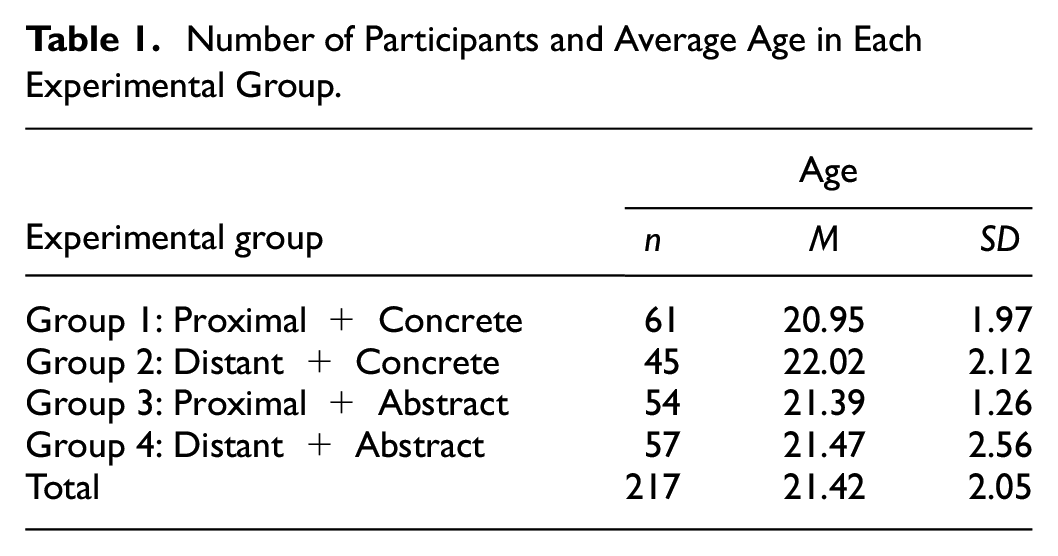
This study included 217 female students in their 20s who did not regularly wear facial masks. The distribution of participants is shown in Table 1 for each combination of psychological distance and advertisement type (concrete vs. abstract). Although there were 228 total participants, 11 were eliminated due to incomplete responses; the remaining 217 were included in the study. Four different types of questionnaires were created and delivered at random to assign individuals to each group.
Number of Participants and Average Age in Each Experimental Group.
Measurement Instruments
Message Belief and Worrying
To measure message belief and worrying, with reference to Napper et al. (2009), we used one question on message belief (“How much do you trust the presented research results?”) with a 7-point Likert scale (1 point: “Not at all”—7 points: “Very strongly”) and another question on worrying (“If reading the research results made you worried, how worried were you?”) with a 7-point scale (1 point: “I wasn’t worried at all”—7 points: “I was very worried”).
Psychological Distance
Psychological distance was measured using two statements (1: “I feel close to the research participants”; 2: “I feel like I am friends with the research participants”), each scored on a 7-point Likert scale (1 point: “Strongly disagree”—7 points: “Strongly agree”).
Construal Level
The advertisement in Figure 1 provides concrete information about the characteristics and ingredients in the product, while that in Figure 2 contains abstract information about value and reasons for using the product. To verify whether the content of these advertisements reflected a high or low construal, with reference to Shin et al. (2020), we measured the construal level using two statements (1: “The advertisement explains how the mask can help in concrete terms”; 2: “The advertisement explains the value of using the mask”), each scored on a 7-point Likert scale (1 point: “Strongly disagree”—7 points: “Strongly agree”). In our analysis, the score for Question 1 was reversed so that a higher mean score would correspond to a higher construal level.

Concrete advertisement.

Abstract advertisement.
Mask Purchase Intention
To measure participants’ purchase intention for the facial masks after reading the advertisements in Figures 1 and 2, we adapted three statements from Shin et al. (2020) to suit the contents of our study (1: “After reading the research results and the advertisement, I intend to purchase the facial masks”; 2: “After reading the research results and the advertisement, I intend to look for more information to purchase the facial masks”; 3: “After reading the research results and advertisement, if necessary, I want to purchase the facial masks”). Each statement was scored on a 7-point Likert scale (1 point: “Strongly disagree”—7 points: “Strongly agree”).
Control Variables
To verify whether extraneous variables that could affect the results were being controlled, we measured message belief, skin type (dry vs. oily), skin sensitivity, and perceived skin satisfaction. Message belief was measured using the question “How much do you trust the presented research results (message)?” scored on a 7-point Likert scale (1 point: “Not at all”—7 points: “Very strongly”). The questions to measure skin type, skin sensitivity, and perceived skin satisfaction were developed with an expert panel (one skin beauty expert and one health psychology expert). Skin type was measured using three statements (1: “I don’t feel much facial skin tightness when I don’t apply moisturizer”; 2: “My forehead and cheeks are moist 2–3 hours after washing and applying lotion or moisturizer”; 3: “My cheeks are shiny 2–3 hours after applying moisturizer”). Skin sensitivity was also measured using three statements (1: “I often have skin trouble, itchiness, or a stinging sensation when I remove makeup”; 2: “I often experience itchiness, a stinging sensation, or redness when I apply sun cream to my skin (face)”; 3: “I often get skin trouble when I use something other than my usual products”). Finally, perceived skin satisfaction was measured using two statements (1: “I think I have relatively good skin (face) compared to my friends of a similar age”; 2: “I am generally satisfied with my skin (face)”). All statements were scored on a 5-point Likert scale (1 point: “Strongly disagree”—5 points: “Strongly agree”).
Research Procedure
The message provided in this study used a loss frame. Specifically, as shown in Figures 3 and 4, participants were shown mock research results stating that skin damage and the risk of skin disease increase in people who do not use facial masks. To vary the psychological distance, the message content was the same, but the mock research participants were in their 20s in Figure 3 and 50s in Figure 4. As the participants in our study were female students in their 20s, Figures 3 and 4 represent the proximal and distant conditions, respectively.

Message with loss and proximal frames.

Message with loss and distant frames.
After reading the message in Figure 3 (or Figure 4), the participants responded to the questions about worrying and psychological distance and looked at the advertisement in Figure 1 (or Figure 2). Subsequently, the construal level for the advertisement and the purchase intention for facial masks were measured. Finally, the control variables were measured, and the experiment was concluded. After the experiment, the participants were told that the contents of the message had been created artificially for this experiment. Prior to the experiment, this whole process was approved by an institutional review board.
Methods of Analysis
A MANOVA was used to confirm that the participants had been randomly divided between the four groups, and independent samples t-tests were used for manipulation checks for the psychological distance and construal level. A two-way ANOVA was performed to test whether the construal fit between the loss frame and the distant (or proximal) frame had effects on worrying and facial mask purchase intention. The statistical significance level was .05.
Results
Randomization Test
A MANOVA was used to check whether there were any differences between the four random groups in covariates that could affect the dependent variables (e.g., message belief, skin type, skin sensitivity, perceived skin satisfaction). As shown in Table 2, the results were not statistically significant (Wilks’ Lambda = 0.929, F(12, 555.89) = 1.31, p = .205). This demonstrates that the 217 participants were randomly distributed between the four groups.
Basic Statistics and MANOVA Results for the Control Variables (Experiment 1).

Note. F(12, 555.89) = 1.31, Wilks’ Lambda = 0.929, p = .205.
Manipulation Check
As a manipulation check for the construal level and psychological distance, independent samples t-tests were used. According to the findings, Figure 1 primed participants with a low construal, emphasizing concrete information about the product, whereas Figure 2 primed participants with a high construal, emphasizing abstract information, such as potential value after using the product (MFigrue 1 = 3.36 (SDFigure 1 = 1.38) versus MFigrue 2 = 4.33 (SDFigure 2 = 1.50), t(215) = 4.96, p = .000). Furthermore, the mean perceived psychological distance to the message in Figure 3 was 4.35 (SD = 1.38), whereas the distance to the message in Figure 3 was 3.65 (SD = 1.26), a statistically significant difference (t(215) = 3.90, p = .000).
Relationship Between Loss Frame-Induced Worrying and the Proximal Frame
Based on CMH, if worrying induced by the loss frame (low construal) showed fit with the proximal frame (low construal), the worrying emotion should intensify. We tested this using an independent samples t-test and found that participants who read the loss frame message with a proximal psychological distance (construal level fit) showed stronger worry emotion than those who read the more distant message (lack of fit), which supports Hypothesis 1 (MFit = 4.18(SDFit = 1.49) versus MDiscrepancy = 3.40 (SDDiscrepancy = 1.43), t(215) = 3.92, p = .000).
Effects of Fit Between the Loss and Proximal Frames on Purchase Intention
When a loss frame is paired with a proximal frame, it is predicted to prime a stronger low construal, increasing purchase intention for advertisements that emphasize feasibility. To test this effect, we used a 2 (Psychological Distance: proximal vs. distant) × 2 (Construal Level: Concrete vs. Abstract) between-subjects ANOVA. There was a statistically significant interaction between psychological distance and construal level (F(2, 213) = 4.80, p = .030, Selva2 p = .022), and the interaction graph is shown in Figure 5. Low construal was primed more strongly in participants who felt psychologically closer (proximal frame) to a threatening message (loss frame), resulting in the highest purchase intention for the advertisement emphasizing concrete information. This supports Hypothesis 2.

Purchase intention by psychological distance and construal level.
Discussion
Experiment 1 investigated the applicability of CMH to threatening messages that encourage the purchase of health products. Moran and Eyal (2022) discovered that in settings of remote perspective and abstract processing, low construal emotional intensity decreased. In line with earlier findings, our data revealed that the low construal emotion of “worry,” caused by a loss frame, increased in emotional intensity the most in the condition of proximal psychological distance, whereas it decreased in the remote condition. We investigated whether matching a loss frame with a proximal frame more firmly primed a low construal using CMH for purposes other than emotional intensity. We found that the loss-proximal frame pairing resulting in the highest purchase intention for an advertisement emphasizing concrete information, demonstrating that CMH was useful in explaining the strengthening of the construal level. These results support previous findings, in which the combination of two or more frames with the same construal level was more effective at changing behaviors and intentions (S. J. Lee, 2019).
The loss frame message acted as threatening information because the individuals in our study did not often utilize facial masks (i.e., LTR). However, for participants who used facial masks regularly (HTR), the loss frame message could be regarded as self-affirming rather than frightening. Experiment 2 investigates if the loss frame message produces self-affirmation in participants with HTR and, using CMH, whether the proximal frame induces more self-affirmation due to its construal fit with the loss frame.
Experiment 2
Methods
Participants
This experiment was conducted on 41 female students in their 20s. There were 21 participants who did not regularly use facial masks (LTR) and 20 participants who regularly used facial masks (HTR). The mean age of the participants was 20.98 years (SD = 3.36). For the HTR group, we selected participants who had continually used facial masks at least twice per week for the last 3 months. The participant questionnaires were divided into four types (group 1 (n = 9): HTR + proximal, group 2 (n = 11): HTR + distant, group 3 (n = 10): LTR + proximal, group 4 (n = 11): LTR + distant) and randomly distributed among the participants.
Measurement Instruments
Message belief, worrying, psychological distance, construal level, facial mask purchase intention, and the control variables were measured using the same questions as Experiment 1. The additional measured variable in Experiment 2 was message acceptance. This was measured, with reference to Napper et al. (2009), using a single question (“How much do you agree with the research results, stating that failure to use a facial mask regularly will lead to skin injury and skin disease”), which was rated on a 7-point Likert scale (1 point: “Completely disagree”—7 points: “Completely agree”).
Research Procedure
The loss frame and psychological distance manipulation use the same messages as Experiment 1. Participants read the message in Figure 3 (or Figure 4), responded to the questions about message acceptance, worrying, and psychological distance, and read the advertisement in Figure 1, after which their facial mask purchase intention was measured. Finally, the control variables were measured, and the experiment was concluded. After the experiment, participants were informed that the message content had been artificially created for the experiment. Prior to the experiment, the whole process was approved by an institutional review board.
Methods of Analysis
A MANOVA was used to check that the participants had been randomly divided between the four groups, and independent sample t-tests were used as a manipulation check for self-affirmation. A two-way ANOVA was used to analyze how test relevance modulated the effect of construal fit between the loss and distance (or proximal) frames on worrying and facial mask purchase intention. The statistical significance level was .05.
Results
Randomization Test
A MANOVA was performed to check whether there were any differences between the four random groups in the covariates that could affect the dependent variable. As shown in Table 3, the results were not statistically significant (Wilks’ Lambda = 1.02, F(12, 90.24) = 1.02, p = .438). This shows that the 41 participants were randomly distributed between the four groups.
Basic Statistics and MANOVA Results for the Control Variables (Experiment 2).

Note. F(12, 90.24) = 1.02, Wilks’ Lambda = 0.714, p = .438.
Differences in the Effect of the Loss Frame Message Depending on Task Relevance
As shown in Table 4, the effects of task relevance on message belief were not statistically significant (t(39) = 1.53, p = .136). However, the HTR group showed higher message acceptance (39) = 2.04, p = .048) and lower worrying at a marginally significant level (t(39) = 1.95, p = .058) compared to the LTR group, supporting Hypothesis 3. Although message belief showed no statistical difference between the HTR and LTR groups, message acceptance and worrying showed statistically significant differences, indicating that loss frame messages have different effects depending on task relevance.
Differences in the Loss Frame Effect Depending on Task Relevance.

Note. HTR = high task relevance; LTR = low task relevance; CI = confidence interval; LL = lower limit; UL = upper limit.
Conversion of the Loss Frame from Low Construal to High Construal
In Experiment 2, a 2 (Psychological Distance: proximal vs. distant) × 2 (Task Relevance: HTR vs. LTR) between-subjects ANOVA was used to test whether there was a conversion from low construal to high construal when the loss and proximal frames were paired in the HTR group. There was a marginally significant interaction between psychological distance and task relevance (F(1, 37) = 2.38, p = .131, Selva2p = .061), and the interaction graph is shown in Figure 6. When the HTR participants received the threatening message (loss frame) at a closer psychological distance (proximal frame), they were primed with an even stronger high construal and thus showed lower purchase intention for the advertisement emphasizing concrete information, partially supporting Hypothesis 4.
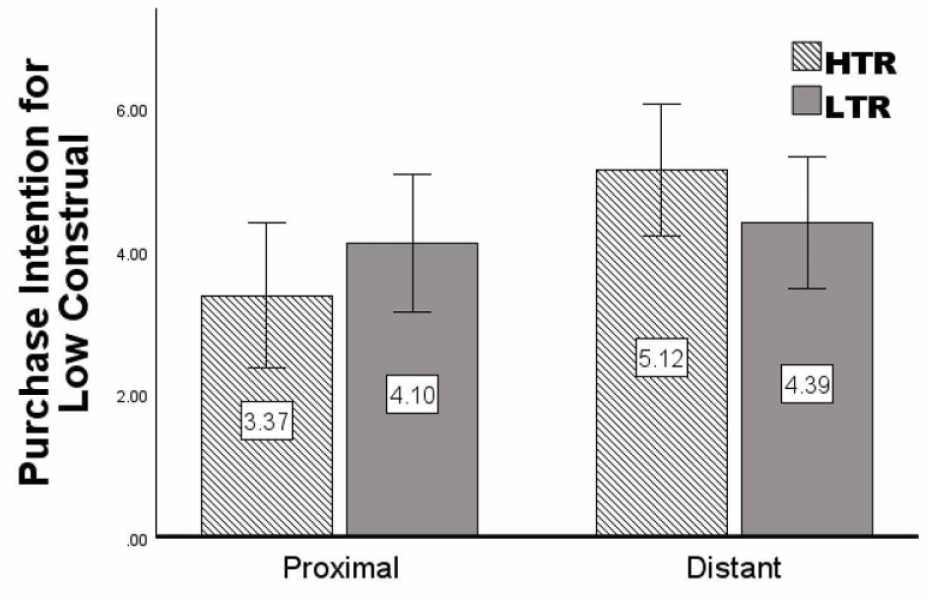
Purchase intention for low construal by psychological distance and task relevance.
An experiment was also conducted on 49 participants (HTR = 22 persons, LTR = 27 persons) investigating purchase intention about the abstract advertisement in Figure 2. However, as the 2 (Psychological Distance: proximal vs. distant) × 2 (Task Relevance: HTR vs. LTR) interaction was not statistically significant (F(1, 45) = 1.28, p = .265, Selva2p = .028), this has been omitted from the results (Hypothesis 5 was not supported).
Discussion
Self-affirmation reduces defensive attitudes and allows individuals to judge negative information systematically (Epton et al., 2015; Sweeney & Moyer, 2015). The HTR participants in this study showed high acceptance of the threatening message because it acted to affirm their self-worth, and this resulted in decreased worrying. Conversely, the threatening message caused increased worrying among the LTR participants, and their low acceptance of the message may have been a means of preserving their self-worth. In Experiment 1, pairing the loss frame with the proximal frame induced a stronger low construal, resulting in the highest purchase intention for the advertisement emphasizing concrete information. However, the opposite results were observed in Experiment 2. In other words, pairing the loss frame with the proximal frame actually made the high construal stronger among HTR participants. One explanation for this is that the loss frame induced self-affirmation in the HTR participants, and when paired with the proximal frame, based on CMH, the self-affirmation effect was even stronger. These results are consistent with previous studies in which self-affirmation induced a high construal level (Schmeichel & Vohs, 2009; Wakslak & Trope, 2009).
General Discussion
The two experiments above revealed two new findings. First, based on CMH, having design subfactors of the same construal (e.g., construal fit between loss frame and proximal frame) strengthens the construal level of an object. Previous studies had shown that the combination and interaction of two components (topic, design, processing style) through construal fit can induce positive behavioral change and increase intention (Chandran & Menon, 2004; Kim & Nan, 2019; Pounders et al., 2015; Zhao et al., 2015; Zhao & Peterson, 2017). Kim and Nan (2019) showed that participants exposed to a vaccine advertisement combining a distant temporal frame (high construal) and non-narrative information (high construal) showed higher vaccination intent than people exposed to an advertisement combining a distant temporal frame (high construal) with narrative information (low construal). Semin et al. (2005) reported that participants with a promotion focus (high construal) showed stronger intent to participate in exercise when shown a message with dispositional nouns (e.g., “Sports also increases your endurance”) compared to one with specific active verbs (e.g., “You can endure more if you exercise”). Although previous studies considered the construal level fit between pairs of factors, we investigated the construal level fit between three factors, with an advertisement emphasizing concrete information (low construal) using loss (low construal) and proximal frames (low construal). We observed that construal level fit strengthened the construal level of the object, demonstrating the applicability of CMH for reinforcing construal level.
Second, utilizing a loss frame, the construal level of a message can be converted from low to high depending on the task importance for the viewer, and the strength of this conversion can be raised based on CMH. Several researches have shown that loss frames prime a low construal (Chandran & Menon, 2004; Pounders et al., 2015; White et al., 2011), and Experiment 1 results confirm these statements. Experiment 2 demonstrated that depending on task relevance, a loss frame might be altered from a low to a high construal, and the theoretical justification for this can be found in SAT. Self-affirmation occurs more readily in a high construal, and it reported to induce abstract thinking (Schmeichel & Vohs, 2009; Wakslak & Trope, 2009; Wiesenfeld et al., 2017). When an individual reaffirms their self-worth, they show a less defensive attitude and systematically inspect and accept threatening information (Easterbrook et al., 2021). The LTR group perceives the loss frame message as threatening information and shows lower message acceptance than the HTR group; for the HTR group, the loss frame message is an opportunity for self-affirmation, which shifts them into a high construal. The pairing of a loss frame with a proximal frame primed the HTR group with an even stronger high construal, resulting in the lowest intention to purchase from the advertisement emphasizing concrete information (low construal).
Our findings show that when a message is constructed with a loss frame, to promote engagement in health behaviors, it is essential to prepare a customized strategy that accounts for the task relevance of the intended audience. For an audience with HTR, the loss frame could prime a high construal; to strengthen this effect, the topic, design, and processing style should be selected to match the construal level of the loss frame. However, if the advertisement’s content is also low construal, it could limit the positive effects on health behaviors. If the goal is to use a loss frame to suppress behavioral change (e.g., smoking abstinence) in a participant with HTR, it is preferable to construct a message with a low construal level for the topic, design, and processing style to fit the loss frame’s construal level. When creating the warning text on cigarette packaging, it would be incorrect to provide a specific list of the negative effects that cigarettes might cause, followed by the advice, “Stop smoking to live a happy life.”
Another approach to CLT research is to investigate the connections between different psychological variables. Using this approach, low construal was found to promote self-control and goal-oriented performance (Fujita & Carnevale, 2012; Fujita & Roberts, 2010), whereas high construal was found to enhance performance in relation to intrinsic goals, which align with overall self-worth and interests (Zhang & Zhang, 2022). Our findings provide a more nuanced explanation of changes in health behavior by merging CLT and SAT, which aligns with recent developments in CLT research.
Based on the obstacles and limitations we discovered during our investigation, we suggest the following recommendations for further research. First, a limitation of our study is that it has a low overall statistical power. One factor for the limited statistical power in Experiment 2 was the difficulty in enrolling female students who frequently use face masks twice a week. In future studies, it would be desirable to select a topic that allows for several participants to be selected while still including participants with HTR (e.g., exercise participation). Given that the abstract advertisement result (n = 49) did not reach statistical significance, it will be worthwhile to conduct a duplicate study on purchase intention regarding an abstract message targeting regular exercise participants, which would allow numerous participants with HTR. We combined many theories in our investigation, especially CLT and SAT. Weiner (2010) proposed attribution theory, which claims that the degree of attribution after success or failure impacts feelings such as pride, shame, and expectancy. In circumstances of low pride and expectation with high shame (high construal) due to incorrect attribution after failure, offering low construal feedback can reduce the intensity of feeling. More research combining attribution theory with CLT is necessary.
Footnotes
Declaration of Conflicting Interests
The author(s) declared no potential conflicts of interest with respect to the research, authorship, and/or publication of this article.
Funding
The author(s) received no financial support for the research, authorship, and/or publication of this article.

Data Availability Statement
The data the support the findings of this study are available from the corresponding author upon reasonable request.