



Abstract
Drawing on construal-level theory, this study explored how a sense of psychological distance from an accident influences people’s willingness to help victims. We conducted a scenario experiment with a sample of 81 Japanese undergraduates. Participants were presented with a short scenario describing an accident that happened on either a distant or a nearby mountain. The results show that the greater the distance perceived by participants from the accident, the more likely they were to infer negative traits about the victim at an implicit level. However, the more they inferred negative traits at an implicit level, the more likely they were to attribute the cause of the accident to external situational factors, at an explicit level. Finally, explicit external causal attribution aroused greater sympathy for the victim, resulting in an increased willingness to help. This discrepancy between implicit and explicit inferences was discussed in terms of cognitive elaboration, in which people engage in helping behaviors when they feel responsible for the fate of the victim.
Keywords
Japan was greatly affected by the Great East Japan Earthquake on March 11, 2011. Many Japanese people volunteered to aid restoration efforts after the earthquake; the financial contributions amounted to 4,400 billion yen in 2012 (“Three Out of Four Citizens Donate,” 2012). Meanwhile, although the Japanese government donates to other countries that suffer from earthquakes, Japanese individuals donate less. This may imply that people are less willing to help those in distress who are geographically distant compared with those nearby. This article addresses this by drawing on construal-level theory (CLT; Gilead et al., 2018; Liberman & Trope, 2008, 2014; Trope & Liberman, 2003, 2010) and demonstrates that psychological distance from an accident affects how individuals form causal attributions through both implicit and explicit inferences, in turn determining the willingness to engage in prosocial behavior for victims.
Prosocial Behavior and Social Identity
People tend to aid those in trouble. Such helping behavior is called prosocial behavior. Prosocial behavior is defined as voluntary behavior intended to help or benefit others (Carlo, 2014; Eisenberg et al., 2006; Eisenberg & Fabes, 1998). Although people often desire to help those in trouble, they may be less willing to help others in distress who are far away compared with those nearby. For example, greater distance from a disaster area results in lower media coverage, in turn generating less helpful contributions from individuals (Simon, 1997). Stephan et al. (2011) illustrated that perception of greater distance from a target reduces familiarity; these geographically distant individuals are thus less likely to allocate resources to the target. One reason people are less likely to help distant victims is the accompanying decreased estimate of the effect of assistance with distance, resulting in reduced willingness to help (Touré-Tillery & Fishbach, 2017).
In general, less aid for distant rather than near victims has been examined from the perspective of social identity. Research has shown that people are more likely to help fellow community members (Hornstein, 1972, 1976) or injured strangers who are in-group rather than out-group members (Levine et al., 2002). Similarly, Wegner and Crano (1975) have found that individuals are more likely to assist disadvantaged individuals if they belong to the in-group.
The arousal cost–reward model (Dovidio et al., 1991) explains why people are more likely to help in-group than out-group members and suggests that the categorization of others as in-group members leads to perceptions of similarity, feelings of greater closeness, and increased feelings of responsibility for the welfare of others (Dovidio et al., 1991). Bruner et al. (2014) indicated that the positive feeling toward the in-group enhances the in-group’s cohesion toward a group task, such as team function and performance, inducing prosocial behavior toward in-group members. A feeling of ties with an in-group results in an in-group’s cohesion as a social relationship, causing antisocial behavior toward intergroup members.
As seen above, individuals are more likely to help in-group than out-group members, but people do not always provide aid for in-group members. Self-categorization theory (Tajfel & Turner, 1979; Turner et al., 1987) claimed that social identity moves along a continuum, from more subordinate (e.g., personal identity), to intermediate (e.g., subgroup identity) and finally, more superordinate levels (e.g., human identity). Greenaway et al. (2011) showed that appealing to common humanity decreased the willingness to engage in collective action for in-group members. Similarly, Levine et al. (2005) found that the salience of superordinate identity induces people to help both in-group and out-group members but not those who do not have a common social identity; the salience of subgroup identity serves to benefit those who are perceived as in-group members in helping situations. As such, levels of perceived social identity would determine prosocial behavior toward victims.
How a victim’s social identity is viewed is determined by the psychological distance from the victim. Psychological distance is defined as the subjective experience wherein the target is either close or far away (Trope & Liberman, 2003, 2010). Glasford and Caraballo (2016) indicated that psychologically distant victims were more likely to be viewed as a superordinate identity and less likely to be viewed as subgroup identities than psychologically near victims. Compared with psychologically near victims, collective action for psychologically distant victims is less, as is familiarity. Decreased collective action for distant victims, relative to near victims, was also explained by the tendency to view victims at a more superordinate level. Taken together, we would be less likely to help distant victims, regardless of whether the victims are in-group or out-group members. For in-group members, psychological distance from an in-group victim would determine a view on the victim’s social identity, in turn determining the willingness for prosocial behavior toward the in-group victim.
Prosocial Behavior and Psychological Distance
In addition to one’s perception of the victim’s social identity, prosocial behavior is also determined by the cause of the event that led to the need for help. Karasawa (2010) claims that causal attribution and responsibility implicitly involve moral judgment. Weiner et al. (1982) proposed locus (whether the cause is perceived as residing internally or externally to the actor), stability (whether the cause is perceived as temporary or relatively enduring), and controllability (whether the cause is subject to volitional influence) as properties of causes. Weiner et al. (1982) also found that causal attribution is linked to feelings of pity, anger, and guilt. Feelings of pity are evoked by negative events that are perceived as uncontrollable and for which the cause of the event is attributed to the environment of the target. Meanwhile, feelings of anger and guilt are exhibited when the negative event is perceived as controllable, with the cause internal to the target. In addition, feelings of anger and sympathy toward a victim inhibit and prompt, respectively, prosocial behavior toward the victim (Weiner, 1980). Similarly, a target having control over an outcome is one of the several key determinants of the extent to which the target is held responsible for the outcome (Shaver, 1985). When people perceive that a target has executed negative behavior (e.g., criminal behavior) of his own free will and not coercion, they increase punitiveness toward the target (Lerner et al., 1998). Together, it is possible that when the cause of an accident is attributed to external factors, such as a victim’s situation, feelings of pity and sympathy toward the victim are aroused, thus resulting in prosocial behavior toward the victim. Similarly, it would be expected that when the cause of an accident is attributed to a victim’s internal trait, feelings of pity and sympathy toward the victim would not be aroused, thus inhibiting prosocial behavior toward the victim.
The CLT, proposed by Trope and Liberman (2003, 2010), suggests that psychological distance is assumed to affect the way individuals represent information. Psychologically near events would be represented more in terms of their incidental, specific, and unique features (low-level construal). Psychologically distant events would be represented more in terms of their essential, general, and prototypical features (high-level construal) because high-level construal is more likely to remain unchanged regardless of one’s distance from the object. As such, forming and understanding abstract concepts enables one to mentally transcend the currently experienced object. Furthermore, according to CLT, the relationship between psychological distance and the level of construal is overgeneralized, causing people to continue to form high- and low-level construals, respectively, for distant and near events, even when information about the event is known and reliable.
For person perception, global traits constitute a high-level construal of behavior, whereas information about concrete aspects of the situational context constitutes low-level construal. For example, Henderson et al. (2006) and Nussbaum et al. (2003) demonstrated the effect of psychological distance on correspondence bias, which is the tendency to attribute the cause of an actor’s behavior to corresponding personal dispositions despite the behavior being situationally constrained (e.g., Gilbert, 1989; Gilbert & Malone, 1995; Jones & Harris, 1967). These studies demonstrated that perceivers drew stronger corresponding attitude inferences from psychologically distant behaviors that were situationally constrained, compared with psychologically near behaviors. Mentovich et al. (2016) also found that psychological distance attenuated the weight of target-specific features in judgments about targets. Therefore, the cause of psychologically distant behaviors is attributed to the actor’s internal trait.
Many studies on person perception have revealed that perceivers infer an actor’s trait both explicitly and implicitly. While explicit inferences are made to form an impression or decide about others, implicit inferences are assumed unintentionally and unconsciously (Uleman, 1999; Uleman et al., 1996, 2008). When observing the behavior of others (e.g., “John got an A on the test”), people spontaneously (unintentionally and unconsciously) infer traits about the target person (“John must be smart”) and the situation in which he or she exists (“The test John took must have been easy”; Ham & Vonk, 2003; Todd et al., 2011). These occurrences are called spontaneous trait inferences (STIs) and spontaneous situation inferences (SSIs), respectively. Previous research has revealed several characteristics of STIs. For example, STIs do not require a conscious and explicit goal of forming impressions (Uleman et al., 1992). In addition, STIs are linked to specific actors in memory (Carlston & Skowronski, 1994; Todorov & Uleman, 2002) and represent attributional knowledge about actors and reflect inferential processes rather than mere associations (Carlston & Skowronski, 2005; Crawford et al., 2007). Such spontaneous inferences are assessed through various paradigms, such as a false recognition paradigm (McKoon & Ratcliff, 1986; Van Overwalle et al., 2012).
Recently, several studies have examined the effects of psychological distance from behaviors on spontaneous inferences. Rim et al. (2009) and Taniguchi and Ikegami (2018a, 2018c) revealed that perceivers formed more STIs from psychologically distant relative to psychologically near behaviors. Taniguchi and Ikegami (2018b) also showed that perceivers formed more SSIs from psychologically near than psychologically distant behaviors. In sum, psychological distance from a behavior affects causal attribution for both explicit and implicit inferences.
From the above discussion, it is possible that when perceivers believe that an accident occurred in a distant location, the cause of the accident may be attributed to a victim’s internal disposition and the victim’s carelessness spontaneously inferred. In turn, these attributions may inhibit the arousal of feelings of pity and sympathy, resulting in decreased prosocial behaviors toward the victim. Meanwhile, when perceivers believe that an accident occurred in a near location, the cause of the accident may be attributed to a specific aspect of the situational context, leading to spontaneous inferences regarding uncontrollability. These attributions may arouse feelings of pity and sympathy, resulting in increased prosocial behaviors toward the victim. Therefore, this study aimed to verify these hypotheses.
Past research has assumed that internal and external causal attribution are two poles of a single dimension. As such, if the cause of an event is not attributed to an internal attribute, the cause is attributed to an external factor (e.g., Henderson et al., 2006; Nussbaum et al., 2003). However, scarce research has been conducted on the relationship between internal and external causal attributions. Likewise, although Ham and Vonk (2003) and Todd et al. (2011) showed that STIs and SSIs co-occur, it has not been revealed whether STIs and SSIs have a dichotomous relationship. As mentioned above, if STIs and SSIs are induced by psychological distantness and psychological proximity, respectively, STIs and SSIs should have a dichotomous relationship. In this study, we discuss issues regarding the dichotomy of internal (trait) versus external (situation) attributions (inferences) in terms of psychological distance from an accident.
Psychological Distance and the Two-Process Model
As discussed previously, when people observe others’ behaviors, they infer their dispositions at both implicit and explicit levels. According to the three-stage model (Gilbert, 1989), implicit inferences occur first, with explicit inferences then developing based on these. Peoples’ implicit inferences, therefore, tend to influence their explicit inferences. For example, Olcaysoy Okten et al. (2019) demonstrated that when perceivers spontaneously inferred positive traits about an actor, they also positively evaluated the actor at an explicit level. When perceivers spontaneously infer negative traits about an actor, they also negatively evaluate the actor explicitly. McCarthy and Skowronski (2011) also demonstrated that people’s STIs formed about an actor that reflect an attribution creation process are used to explicitly predict the actor’s future behaviors.
Given that spontaneous inferences and explicit evaluations are linked, when perceivers believe that an accident occurs in a distant location, they may spontaneously infer traits of a victim and explicitly attribute the cause of the accident to the victim’s internal attributes based on STIs. Such internal attributions would also inhibit feelings of pity and sympathy and would induce one to predict that the victim will repeat the same behavior, resulting in reduced prosocial behaviors toward the victim. Likewise, when perceivers believe that an accident occurred in a nearby location, they may spontaneously infer situations and explicitly attribute the cause of the accident to external factors based on SSIs. Such external attributions would then induce feelings of pity and sympathy, resulting in increased prosocial behaviors toward the victim. The discussion thus far is presented in Figure 1.
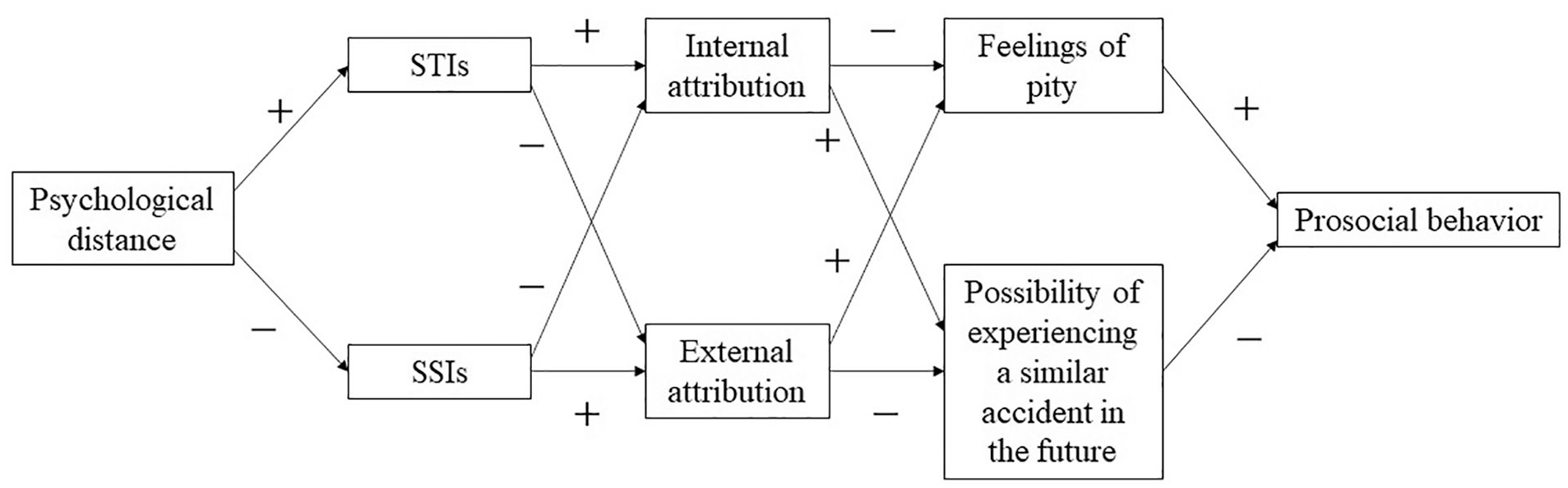
The model of hypotheses in this study.
In this study, we examined the effects of psychological distance from an accident on prosocial behavior, as shown in Figure 1. We formulated the following hypotheses:
Method
Overview
We conducted the experiment individually with each participant. We first presented participants with a short scenario describing an accident on either a faraway or nearby mountain. Subsequently, their STIs and SSIs were measured using a recognition probe paradigm (McKoon & Ratcliff, 1986; Van Overwalle et al., 2012). Explicit inferences were also measured using self-report questionnaires wherein participants answered whether the cause of the accident could be attributed to internal or external factors and rated their willingness to help. Finally, they indicated the degree of psychological distance experienced by the accident.
Participants
Eighty-one Japanese undergraduates (44 women and 37 men, M = 18.76 years, SD = 0.77) participated in partial course credit. They were randomly assigned to one of the two experimental conditions: far or near from an accident. One participant was excluded from the analysis because of flaws in the experimental procedure. The study was approved by the Research Ethics Committee of the Graduate School of Literature and Human Sciences at Osaka City University (approval number: 27-01). The participants provided written informed consent before participation.
In this study, we invited students to participate in our experiment during their course on introduction to psychology. However, limited people consented to participate in our experiment, and we were unable to recruit more people. As such, there was a relatively small number of participants.
Experimental Materials
A short scenario describing an accident on a mountain was designed to imply both trait and situational factors associated with the incident. To choose the stimulus words for the recognition probe test, we conducted a pretest questionnaire wherein 73 participants were presented with the scenario (without geographical distance information) and a list of 20 trait (e.g., “careless”) or 21 situational words (e.g., “unhappy”). Half of the participants (N = 36) were asked to rate on a 7-point scale (1 = not at all, 7 = extremely) to what extent each word described the victim. The other half (N = 37) were asked to rate the extent to which each word described the situation. Based on these results, we selected for the main study seven trait and seven situational words that met the following criteria: (a) mean descriptiveness rating was higher than a midpoint (ps < .001) and (b) mean descriptiveness ratings did not differ between trait and situational words, t(70) = 0.86, p = .39. We also selected seven trait and seven situational words with mean descriptiveness ratings that were lower than the midpoint (ps < .001) as unrelated control words. In addition, we devised 28 filler words that were included in the scenario. The scenarios and stimulus words are listed in Table 1.
Scenario and Stimulus Words Used in the Experiment.

Procedure
The instructions and materials for the experimental tasks were presented on a computer screen, with the presentation of stimulus items and the recording of participant responses being controlled by a computer programmed with Inquisit 4. To measure spontaneous inferences, a modified procedure described by McKoon and Ratcliff (1986) was used. Participants were told that the study was investigating how individuals make social judgments about an accident. Half were informed that the accident happened in Ben Nevis (in England; far condition), and the other half were informed that it occurred on Mt. Ibuki (in Japan; near condition). During the study task, participants were reminded of the distance, following which they viewed a blank map of either Ben Nevis (far condition) or Mt. Ibuki (near condition) for 2 s each on a screen with a banner across the bottom labeled either “The accident happened in the Highlands of England” or “The accident happened in Maibara city of Shiga.” A scenario describing an accident on a mountain with an illustration of the victim and information on the distance manipulation was then presented for 50 s. After completing the study task, participants completed a mathematical calculations for 5 min and a jigsaw puzzle for 25 min as filler tasks to thoroughly clear information from their short-term memory.
Next, the participants engaged in a recognition task wherein they were presented with a single word accompanying a picture of the victim. Their task was to indicate, as quickly and accurately as possible, whether the probe word was part of the scenario in the study task. First, a focal point for gazing was presented for 500 ms, with a stimulus word and picture of the victim, then presented on the screen until a response was made. Half of the participants were instructed to press the key labeled “old” (F) or “new” (J), respectively, if they believed that they had or had not seen the word; the other half were instructed to do the opposite. After they pressed either key, feedback on their response accuracy was provided for 200 ms, and the next trial began automatically.
The recognition task consisted of 56 trials. In 28 of them, seven implied situations, seven implied traits, seven unrelated situations, and seven unrelated trait words were presented. The correct response to these words was “new.” In the remaining 28 trials, filler words were presented in a random order, to which the correct response was “old.” If participants spontaneously inferred traits or situations when reading the given scenario, it became more difficult for them to indicate that the implied trait or situational words were not part of the scenario. Accordingly, correct response latencies for these implied words were longer than for unrelated words when STIs or SSIs were made during the tasks.
After the recognition task, we assessed the participants’ explicit judgments about the accident. Participants were asked to rate their willingness to help using a rating scale from 1 (not at all) to 7 (extremely) and to indicate how much they would contribute to save the victim (1 = no contribution; 2 = ¥1 to ¥499; 3 = ¥500 to ¥999; 4 = ¥1,000 to ¥1,499; 5 = ¥1,500 to ¥1,999; 6 = ¥2,000 to ¥2,499; 7 = ¥2,500 to ¥2,999; 8 = ¥3,000 to ¥3,499; 9 = ¥3,500 to ¥3,999; and 10 = more than ¥4,000). If participants chose “10,” they were asked to indicate the amount of the contribution. Following this, using a rating scale from 1 (0%) to 11 (100%), participants then estimated the amount that they felt the family of the victim should pay for the rescue. Next, using a scale from 1 (not at all) to 7 (very much relevant), they rated the degree to which each of the following statements was relevant to the cause of the accident: (a) incomplete preparation for mountain climbing, (b) indiscretion of the victim, (c) bad luck, and (d) the situation in which the accident happened. Causes (a) and (b) indicate internal causal attributions, whereas (c) and (d) indicate external causal attributions. They also rated the degree to which they felt sympathy (1 = not at all, 7 = extremely) and the likelihood that the victim would encounter a similar accident again (1 = not at all, 7 = very likely). They also indicated their degree of psychological distance from the accident (1 = very near, 7 = very far). Finally, as part of their personal information, participants indicated the frequency of contributions they had made in the past to accident victims, their frequency of experiences with climbing, and their amount of knowledge on climbing. Finally, participants were asked to report on their introspection around the experiment. They were then thoroughly debriefed and asked to sign permission forms for the use of their data.
Data Analysis
Data were analyzed using SPSS (Windows version 22) and AMOS Graphics software (Windows version 22.0.0).
Results
Manipulation Check
None of the participants were suspicious of the true purpose of the experiment. Participants in the far condition perceived a greater psychological distance from the accident (M = 4.85, SD = 1.64) than those in the near condition (M = 4.15, SD = 1.31), t(77) = 2.08, p < .05, d = .35. In the recognition task, the proportion of correctly recognized filler words was calculated for each participant. The data of one participant were excluded because their proportion of correct recognitions was lower than the chance level of .50, indicating that they did not attentively read the scenario in the study task. The mean proportion of correct recognitions for the filler words was 0.79 (SD = 0.09), which significantly exceeded the chance level, t(78) = 28.44, p < .001.
The frequency of contribution and amount of knowledge about climbing did not differ significantly between the far and near conditions, t(77) = 0.59 (far), 0.25 (near), ns; d = .13 (far), .06 (near). In addition, the number of climbing experiences did not differ between participants in the two conditions, χ2(1) = 1.01, ns. Given that the participants’ experiences regarding these factors were homogeneous across the two conditions, we will not discuss them further.
Regarding implicit inferences made, the response latencies of the trait and situational words were used for the final analysis. Incorrect (“old”) responses to these words were excluded from the analyses (9.6%). Response latencies that deviated more than 3 SDs from the overall mean were also excluded (1.4%). The difference scores were computed for each participant by subtracting their response latency on the unrelated words from that of their implied trait or situational words such that the score indicated the net amount of their STIs or SSIs. These scores were used as dependent variables in the subsequent analyses (Table 2). A 2 (Psychological distance: Far vs. Near) × 2 (Stimulus word: Trait vs. Situational) mixed ANOVA was conducted. The main effect of the stimulus word was significant, F(1, 77) = 25.73, p < .01,
Descriptive Statistics in the Experiment.

Note. STI = spontaneous trait inference; SSI = spontaneous situation inference.
Regarding the explicit inferences, the measures of causal attributions were used as follows. Incomplete preparations for climbing and indiscretion of the victim were combined into one measure for internal causal attributions, r = .48, p < .001, while bad luck and the situation wherein the accident happened were combined into one measure for external causal attributions, r = .23, p = .042. The amount of contributions rated on a 5-point scale was transformed into a monetary amount using the midpoint of each interval (e.g., if they selected “2 = ¥1 to ¥499,” the answer presented was “¥250”). Descriptive statistics for the explicit inference variables in the far and near conditions are presented in Table 2. To compare each index between the two conditions, a t test was conducted; there was no statistically significant difference found for each index, t(77) = 1.41, ns.
Effect of Psychological Distance on Inferences
First, to see whether STIs and SSIs and internal and external causal attributions were trade-offs, we conducted correlational analyses. The correlation between STIs and SSIs was not significant, r = −.08, ns, indicating that STIs and SSIs were formed independently. Meanwhile, the negative correlation between internal attribution and external attribution was marginally significant, r = −.20, p = .08, indicating that internal causal attribution and external causal attribution were trade-offs.
Second, given that psychological distance affects both implicit and explicit inferences (Henderson et al., 2006; Rim et al., 2009; Taniguchi & Ikegami, 2018a, 2018b, 2018c) and that explicit inferences are made based on implicit inferences (Gawronski & Bodenhausen, 2011; Gilbert, 1989), we conducted a path analysis using a hypothetical model (Figure 1). This explored how psychological distance affects people’s judgments of victims of adverse events. The model fit the data, goodness-of-fit index (GFI) = .97, adjusted goodness-of-fit index (AGFI) = .92, comparative fit index (CFI) = 1.00, root mean square error of approximation (RMSEA) = .00, 90% confidence interval (CI) = [.00, .031], Akaike information criterion (AIC) = 80.45 (Figure 2, upper panel). However, we adopted a modified model (Model 1, Figure 2, bottom panel) because the fit index (AIC) of the path model was greatly improved by excluding some of the nonsignificant paths by trial and error, GFI = .97, AGFI = .93, CFI = 1.00, RMSEA = .00, 90% CI = [.00, .096], AIC = 43.35. The results revealed that psychological distance positively (though marginally) predicted STI formation, β = .20, p = .071. However, unexpectedly, STIs positively and significantly predicted external causal attributions at an explicit level, β = .22, p = .046. Conversely, consistent with our expectations, SSIs negatively (though marginally) predicted explicit internal causal attributions, β = −.19, p = .084, although they were unaffected by psychological distance. Therefore, Hypotheses 1 and 2 were partially supported. Moreover, at an explicit level, internal causal attributions negatively predicted sympathy toward victims of adverse events, β = −.34, p = .001, whereas external causal attributions positively (though marginally) predicted sympathy, β = .20, p = .061. Finally, sympathetic feelings negatively and significantly predicted the estimated amount that participants felt the victim’s family should pay for their rescue, β = −.38, p < .001. However, sympathetic feelings predicted neither willingness to help the victim nor donation amount. In addition, none of the correlations between the estimated amount that participants felt the victim’s family should pay for their rescue, willingness to help the victim, and donation amount were significant, rs < .18, ps > .11.

The upper and lower models indicate the results of the path analysis in the hypothetical and adopted models, respectively (Model 1).
To confirm the validity of Model 1, we tested several alternate models. First, Haidt (2001) contended that people’s moral judgments are determined by their intuition and that moral reasoning occurs to justify these judgments. Considering this, spontaneous inferences may determine people’s helping behaviors directly; explicit causal attribution processes may then occur to justify their intuitions and helping behaviors. To test this possibility, we constructed Models 2 and 3 (Figures 3 and 4). Haidt (2001) also mentioned that moral-based emotions involved in one’s moral intuitions develop first, directly causing moral judgments. For example, feeling anger in response to an accident activates one’s blaming cognition (Quigley & Tedeschi, 1996). To test these claims, Models 4 and 5 were analyzed (Figure 5 and 6). The model fit statistics from the six models are presented in Table 3. Models 2 and 4 show a good fit with the data, while Models 3 and 5 show an acceptable fit. However, the AIC index of the hypothetical model was better than that of the other models, with Model 1 having the best AIC index. Considering these results, we adopted Model 1.

The results of the path analysis in Model 2.

The results of the path analysis in Model 3.

The results of path analysis in Model 4.
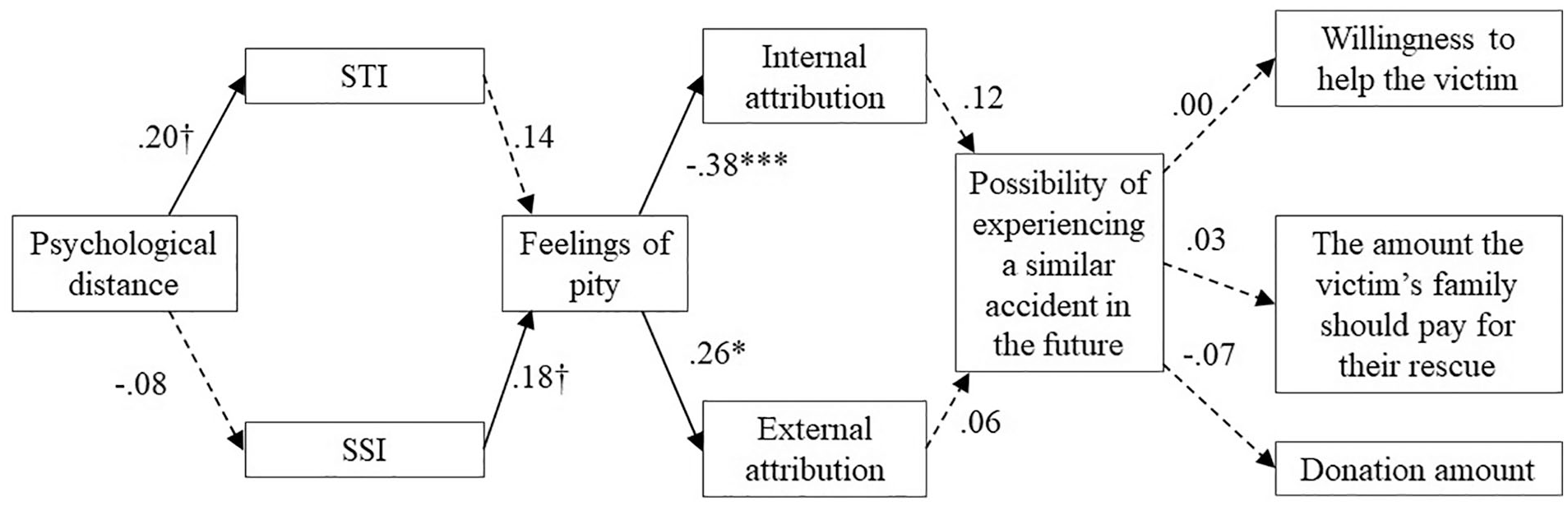
The results of path analysis in Model 5.
Fit Indices for the Empirically Derived Path Models.

Note. GFI = goodness-of-fit index; CFI = comparative fit index; AIC = Akaike information criterion; RMSEA = root mean square error of approximation; CI = confidence interval.
Discussion
This study investigated how experiencing psychological distance from an accident affects a person’s implicit and explicit inferences regarding the event, as well as how these factors coordinate in influencing one’s willingness to help the victim. The results indicate that prosocial behavior is determined by causal attribution. The results of the path analysis showed that greater internal and greater external attributions led to decreased and increased sympathy for the victim, respectively. Increased feelings of sympathy also led to lowered assessments of the amount that the victim’s family should pay for their rescue, denoting participants’ prosocial attitudes. This is consistent with the attribution theory described by Weiner (1980; Weiner et al., 1982).
Prosocial attitudes were not influenced by distance from the accident, likely because the effect of psychological distance on causal attribution was corrected. In this study, participants were more likely to form STIs for the victim when they perceived the distance from the accident as far rather than near. This is consistent with views regarding CLT (Gilead et al., 2018; Liberman & Trope, 2008, 2014; Rim et al., 2009; Taniguchi & Ikegami, 2018a, 2018c; Trope & Liberman, 2003, 2010). Perceiving psychological distance from an accident automatically induces people to represent the accident by high-level construals, such as the actor’s trait. However, in this study, explicit causal attributions were not directly influenced by psychological distance. Moreover, contradictory to our prediction, STIs provoked explicit external situational attributions. McCarthy and Skowronski (2011) and Olcaysoy Okten et al. (2019) claimed that implicit inferences and explicit judgments correspond, and explicit judgments are formed based on implicit inferences. Our results were inconsistent with these claims.
However, the three-stage model (Gilbert, 1989) assumed that perceivers implicitly infer an actor’s trait; the inferred trait is subsequently corrected by considering situational information at an explicit level. Similarly, Gawronski and Bodenhausen (2011) argue that the degree of cognitive elaboration—the amount of thought devoted to an attitude object—determines the correspondence between implicit and explicit inferences. When cognitive elaboration during the judgment about an event is low rather than high, implicit and explicit inferences show stronger relations. Higher degrees of cognitive elaboration reduce the correspondence between implicit and explicit inferences. For example, when the participant’s need for cognition is high, the correspondence between implicit attitude and explicit judgment regarding a target decreases (Florack et al., 2001). Lerner et al. (1998) also revealed that when perceivers are responsible for their decisions, accountability attenuates the carryover of anger to attributions. In our study, the participants were aware that their judgments would greatly influence the victim; therefore, they were strongly motivated to judge correctly. As a result, the effect of psychological distance on willingness to engage in prosocial behavior would be attenuated.
Much research suggests that perceptions of greater distance from a target reduce prosocial behavior toward the target (Bruner et al., 2014; Glasford & Caraballo, 2016; Hornstein, 1972, 1976; Levine et al., 2002, 2005; Simon, 1997; Stephan et al., 2011; Touré-Tillery & Fishbach, 2017). However, considering the results of this study, the tendency that perceivers be more likely to help a near rather than distant victim may be limited to less important prosocial behaviors that do not directly influence the lives of the victim. Unfortunately, these arguments are solely based on speculation because this study did not measure the degree of need for cognition and cognitive elaboration and did not compare the importance of prosocial behavior with that of other studies. The attenuation of the effect of psychological distance relative to the degree of cognitive elaboration or importance of prosocial behavior must be examined.
Many studies indicate that a sense of psychological distance from an object affects how it is construed (e.g., Trope & Liberman, 2010), but no research has examined whether the effect of this psychological distance on one’s construal level is inhibited. This study indicated that although implicit inferences about an accident are affected by psychological distance, the effects of the latter on the former are corrected in explicit judgments when the perceiver feels responsible for the target being judged. As such, it is suggested that psychological distance does not always determine the mode of representation of a target, and the effect of psychological distance on representation is sometimes attenuated by other factors, such as the importance of judgment and cognitive elaboration. These findings offer new insight into the relationship between implicit and explicit inferences in social judgment.
As mentioned previously, research on social identity indicates that psychologically distant victims are more likely to be viewed as having a superordinate identity and are less likely to be helped compared with psychologically near victims (e.g., Glasford & Caraballo, 2016). However, considering these results, the perception of the victim’s social identity may not affect prosocial behavior when prosocial behavior affects the lives of the victim. Future research must investigate the relationship between the level of social identity and prosocial behavior by manipulating the importance of the latter.
We also examined whether STIs and SSIs have a trade-off relationship; the relationship between internal and external attributions was similarly examined. Consequently, internal and external attributions exhibited a trade-off relationship at the explicit level. Perceivers attempted to integrate these two inferences explicitly because they were motivated to be consistent. People usually consider consistency a desirable characteristic and are motivated to maintain it (Cialdini, 2009). Therefore, perceivers would attribute a cause to internal or external factors at an explicit level. Conversely, STIs and SSIs occurred independently at the implicit level, with psychological distance affecting STIs but not SSIs. Todd et al. (2011) indicated that even when these inferences are contradictory, STIs and SSIs co-occur because implicit inferences appear unintentionally and are uncontrollable. In this study, psychological distance did not affect SSIs. In contrast, Taniguchi and Ikegami (2018b) revealed that when perceivers were presented with a scenario of criminal behavior, psychological proximity facilitated SSIs, but psychological distance did not affect STIs. It is thus suggested that—although psychological distantness and proximity induce STIs and SSIs, respectively—SSIs will not be inhibited even if STIs are formed, and vice versa. Furthermore, it depends on the type of behavior whether psychological distance affects STIs or SSIs. The current results at least suggest that STIs and SSIs are integrated only at an explicit level to maintain consistency.
Limitations and Future Studies
In our study, the stage at which the corrective process occurred remains controversial. Although psychological distance influenced people’s STIs, the effect was relatively weak. It is inferred that cognitive elaborations inhibit the effect of psychological distance on participants’ development of construal around the target. When perceivers form critical judgments about the victim that determine their life, they are strongly motivated to judge accurately and carefully. The effect of psychological distance on implicit inferences may then be alleviated by this motivating factor.
In this study, the number of participants was fewer than desirable; thus, the effect of psychological distance on spontaneous inferences may not have been sufficiently detected. To examine our hypothetical model, the required sample size was 418 (MacCallum et al., 1996). We calculated the effect size of structural equation modeling (SEM) in this study, and the power for the test of close fit was 0.26 (MacCallum et al., 1996). Although the fit indices for the hypothetical model were good, care must be taken in generalizing the results of this study. Previous studies have indicated that implicit inferences are not affected by processing goals or cognitive resources (Todd et al., 2011). Recently, Olcaysoy Okten et al. (2019) also demonstrated that multiple STIs are formed simultaneously, even when information contrary to STIs is provided immediately after STIs are formed from the initial behavior information. Future research should use a larger sample size to examine whether the effect of psychological distance on spontaneous inferences is inhibited by cognitive elaboration or not and whether our results are replicable in other types of cases involving social judgments.
It should be noted that our findings were limited to the Japanese population. The literature on cultural psychology has suggested that the inference process in human perception differs depending on cultural background. For example, some empirical studies have demonstrated that Japanese people are more likely to focus on the situation wherein the target behaved and produce SSIs compared with European Canadians (e.g., Lee et al., 2017). Wan et al. (2019) also showed that Chinese people tend to form SSIs more than STIs. Meanwhile, North Americans tend to prefer an analytical thinking style, whereas East Asians tend to prefer a holistic style (Nisbett et al., 2001). Future research should compare analytical and holistic thinking styles in terms of how implicit inferences (either STIs or SSIs), which are affected by psychological distance, are corrected in explicit inferences.
Finally, in support of Hypothesis 3, our results showed that at an explicit level, greater internal and external attributions, respectively, led to decreased and increased sympathy for the victim. Increased feelings of sympathy also led to lowered assessments of the amount that the victim’s family should pay for their rescue. This was highly consistent with Weiner’s attribution theory (Weiner, 1980; Weiner et al., 1982) and the Japanese notion of familism. In familism, Japanese people believe that the family must take full responsibility for their relatives’ problems, such as ensuring their employment, nurturing, and caregiving for their elders (Yoshinaka & Shimizuike, 2014). Considering such familism in Japan, it is implied that the more sympathy the perceivers feel for the victim, the less likely they are to urge the family to take responsibility for the accident.
In this study, we used three items to measure prosocial behavior. Although sympathy indirectly determines one’s helping behaviors, such as estimating the amount that the victim’s family should pay for their rescue, it does not relate to more direct helping behaviors, such as an increased willingness to help the victim or donate. There could be a couple of reasons for this. Lewis et al. (2019) examined how severity and number of misfortunes affect responses to a victim, and found that a higher level of severity led to stronger empathic reactions and increased willingness to donate but that this effect was less clear if the number of misfortunes claimed by a victim is few. One could say that a single unfortunate event, as was in the present experiment, did not sufficiently evoke willingness to help and donate. In addition, as Lewis et al. (2019) mentioned, it was probable the transformed measure of donation had some problem in statistical power as well.
Alternatively, this may be because the participants in this experiment were all undergraduates who did not earn their own money and were therefore unable to offer any increases in monetary donations depending on their degree of sympathy for the victim. In future research, the relationship between sympathy and donations offered to victims should be examined across different age groups. In addition, three items that we used to measure prosocial behavior could not be combined into a single scale because the indicators of these items differed. To increase validity of the measure of prosocial behavior, it is needed to review the measure of prosocial behavior.
Footnotes
Declaration of Conflicting Interests
The author(s) declared no potential conflicts of interest with respect to the research, authorship, and/or publication of this article.
Funding
The author(s) received no financial support for the research and/or authorship of this article.
Ethics Statement
The Ethical Review Committee of the Graduate School of Literature and Human Sciences at Osaka City University approved the ethics of this study (approval number: 27-01).
