




Abstract
Distinctive characteristics of land reclamation have formed strong attractions, which inspired people’s curiosity and tourist motives. As a unique and essential resource of tourism activities, land reclamation with its highly patriotic spirit and eclectic heritages presents tremendous value in the Chinese tourism industry. However, there is no comprehensive evaluation system of land reclamation tourism (LRT). To solve this research problem, in this study, we delimit the connotation of land reclamation and propose the classification and resources evaluation system of LRT based on the combination of resource characteristics and tourism mode. The classification, balancing the concerns of unit tourist resources, and comprehensively integrated resources while highlighting the principles of universality and practicality, can be classified into two main types, 10 sub-types, and 46 base types. On this basis, the tourism resource evaluation indicator system of land reclamation resources has been built from the aspects of the value of land reclamation culture and tourism resources, natural and social environment, regional development conditions by the methods of Delphi, and analytical hierarchy process (AHP). The empirical research results of Xinjiang Production and Construction Corps (XPCC) provide us with a specific weight distribution prospect of the classification and evaluation system. The conclusions proposed a new way and method to evaluate LRT resources and provided a necessary reference basis for LRT development.
Keywords
Introduction
Land reclamation is a long-established land system, historically known as the “station farm system.” Together with the “well-field system” and the “equal-field system,” it is called the three major land systems in ancient China (Wang & Zhou, 2011). Zhang (2010) believed that land reclamation is a border fortification campaign that combines land reclamation activities with border guarding activities. It includes the directly state-organized participants, like the national army and agricultural settlement people, and the indirectly policy-guided participants, such as the inland agriculture migrants. As an important national policy for national border governance, land reclamation played a vital role in maintaining national unity, border stability, national integration, cultural identity, and the smooth flow of the Silk Road in history (Liu & Liang, 2019; Zhang, 2018a). Xinjiang is the most typical area for land reclamation in China within all the boundaries. The incomparable features of the area lie in its long-lasted duration, broad involved scope, multi typed activities, and highly benefited effect of the land reclamation activities (Zhang, 2010).
The Xinjiang Production and Construction Corps (XPCC) first proposed the theme brand concept of “land reclamation tourism (LRT)” in 2007 (The State Council Information Office of the People’s Republic of China, 2014). It is one of the XPCC developed life service industry contents in its 12th 5-Year Plan. The way of building up a world-class tourism brand of LRT is to put the cultural connotation communication, evaluation, and self-renewing into effect through a series of cultural processes such as idea creation, image modeling, brand building, value blending, media communication, contact appreciation, consumer experience and other processes of the culture reclamation. The theme brand of LRT takes “land reclamation culture” as the core. It encompasses diverse tourism functions, distinctive cultural characteristics, an ideal ecological environment, excellent infrastructure, and optimized product structure. It has built a first-class domestic and internationally well-known tourist destination for the XPCC.
Early studies of land reclamation mainly focus on modern cultures of land reclamation, that is, the concepts, characteristics, functions, and transitions of modern land reclamation culture (Xing, 2013), as well as the heritage, non-heritage protection, inheritance, and industrialization on it (Huang & Xu, 2011; Xue & Shang, 2014). Since 2000, the research has gradually turned to the cultural characteristics of agriculture settlement and various cultural phenomena in different historical periods since the Western Han Dynasty (Bai & Zhang, 2014; Sun, 2011). However, the academic community has not paid enough attention to LRT development, and the existing research is still at the initial stage. Research on Xinjiang’s LRT and resource development and utilization mainly focus on the connotation, characteristics, and development models of cultural tourism resources (Wu & Xuan, 2007; Zhang & Yang, 2020), tourist satisfaction and loyalty (Wang, 2019; Yang & Bai, 2018; Zhang, 2018a), structural optimization of symbiosis development space (Zhang, 2019), and the tourism resource attraction (Feng, 2020). To sum, the methodologies are mainly based on qualitative research, focusing on sorting out and introducing resources, while quantitative research is still lacking. Only a few contemporary researchers have begun to use linear regression and other statistical methods to quantitatively analyze the farming’s tourism resources, products, and spatial structure.
Due to LRT resources’ unique profile and characteristics, there is an urgent need to build a targeted classification system for LRT resources to judge better the essential characteristics of resources and the development and utilization value. The academic area has paid little attention to the classification and evaluation of cultural resources for LRT. It has not established a targeted, universal, and operable resource classification and evaluation system. This paper attempts to propose a classification scheme based on the combination of the natural resources and the tourism mode through the analysis and definition of the components and characteristics of cultural tourism resources. Based on this classification, an indispensable quantitative evaluation system will also be put forward to facilitate scientific management and effective resource development.
China’s national tourism resource evaluation standard applies to evaluating various tourism resources (Wang et al., 2018). While the “universality” of the standard inadvertently obliterates specific cultural tourism resources’ distinctive or single characteristics by giving them a low score. Heretofore, studies of cultural tourism resources evaluation have gone through three stages of development: qualitative description, quantitative evaluation, and comprehensive evaluation (Xu et al., 2014). This paper draws on the achievements of previous scholars’ studies on cultural tourism research (Sun et al., 2010; Wang & Zhou, 2011), while based on the characteristics of LRT attempts to use analytic hierarchy process (AHP) and Delphi method to build a comprehensive evaluation model and evaluation index system of LRT. This way enables the judgment of the LRT resources’ evaluation according to objective reality. After the theoretical discussion, this paper further provides an empirical study that takes the XPCC as the research object, investigates and evaluates the total value of its LRT resources, provides a reference for the development of LRT, and formulate a scientific development strategy for it.
Definition and Classification of Land Reclamation Resources
Definition of Land Reclamation Culture
The purpose of land reclamation is to guard and stabilize the border politically, thrive and revitalize the border economically, and integrate multicultural culturally (Liu & Liang, 2019; Zhang, 2018a). From this point of view, this article believes that the land reclamation culture refers to a culture system of the unique connotation that developed from series culture collision, fusion, and vicissitude processes. The processes went through a long period ever since the central government of the Han Dynasty carried out the agricultural settlement practice in Xinjiang (Sheng et al., 2020). Within this period, land reclamation has been acted as a culture media that enables agricultural settlement migrants to bring in, communicate, and adapt their home culture into Xinjiang’s physical and societal environment.
At the end of the processes formed the above land reclamation cultural system with unique connotation, which refers to a fusion of regional culture with Han culture as its main feature. This culture includes the military and civilians’ production methods, lifestyles, customs and habits, management systems, ideological concepts, religious beliefs, literature, arts, etc. Xinjiang has a rich cultural connotation. It shows the intangible landscapes, values, management systems, and other intangible landscapes of the ethnic groups in the reclamation area at various levels, as well as various types of reclamation sites, ruins, ancient cities, buildings, modern cities, farms, cultural relics, and works of art (Yang et al., 2014). Such material landscapes are distinctive, with inestimable historical, cultural, and spiritual values.
Definition of LRT Resources
The land reclamation culture is a culture accumulated by the long-term life of the military and civilians who guarded the frontiers and the country in the past (Sheng et al., 2020). The culture of land reclamation continues in Xinjiang, forming independent characteristics and charm, which stimulates the curiosity of tourists and triggers tourism interest and motivation. As an essential resource for tourism activities, the land reclamation culture and its heritage have enormous value for the development of the tourism industry. The rich cultural connotation of land reclamation is the core element of tourism product competitiveness. The unique characteristics of the land reclamation culture constitute the creativity and characteristics in the production of tourism products and become the internal basis of the layout of Xinjiang’s tourism industry.
China’s national standard “Tourism Resources Classification, Investigation, and Evaluation” (GB/T18972-2003) defined a widely accepted concept of tourism resources as: “various things and factors that nature and human society can attract tourists, develop and utilize them for tourism, as well as generate economic benefit, social benefit and environmental benefit from it” (General Administration of Quality Supervision, Inspection, and Quarantine of the People’s Republic of China, 2003). Accordingly, this study defines the LRT resources as historical relics and land reclamation culture phenomenon with distinct border guarding history and agricultural settlement spirit and the achievement of agricultural settlement civilization. It is generated from the practice of the central government in Xinjiang since the Han Dynasty. It has the function of attracting tourists, developing tourism, and generating economic, social, and environmental benefits.
The LRT resources must be attached to a particular tangible object or intangible expression. It is the part of cultural resources that appears as a carrier of reclamation culture (Zhang, 2018b). For example, the spiritual culture of reclamation is people’s general views and fundamental views on the reclamation of the border. It reflects people’s understanding of land reclamation and border stability, regional economic development, cultural identity, and national integration. If only the consciousness exists in people’s minds, it cannot form tourism attraction and be used for tourism development. Only if the land reclamation spirit is manifested by tangible carriers such as cities, groups, and construction facilities created by people, or intangible carriers such as poetry, folk songs, customs, festivals, etc., can the conditions for tourism development be met.
Classification Scheme of LRT Resources
According to China’s national tourism resource evaluation standard, cultural tourism resources can be divided into four categories, that is, historical relics, buildings and facilities, cultural activities, and tourist commodities (General Administration of Quality Supervision, Inspection, and Quarantine of the People’s Republic of China, 2003). In comparison, this classification arrangement bears certain disadvantages in investigating and developing tourism resources, such as the overlapping problems of the types, the fuzzy boundaries of the types, and the lacking types of the non-material cultural heritage categories. Therefore, based on the primary connotation of the land reclamation culture and the resource characteristics of the land reclamation cultural tourism resources and follows the scientific, systematic, universal, practical principles, this paper attempts to build a three-level classification system of the land reclamation cultural resources. The three layers are “main category,” “subcategory,” and “basic category.”
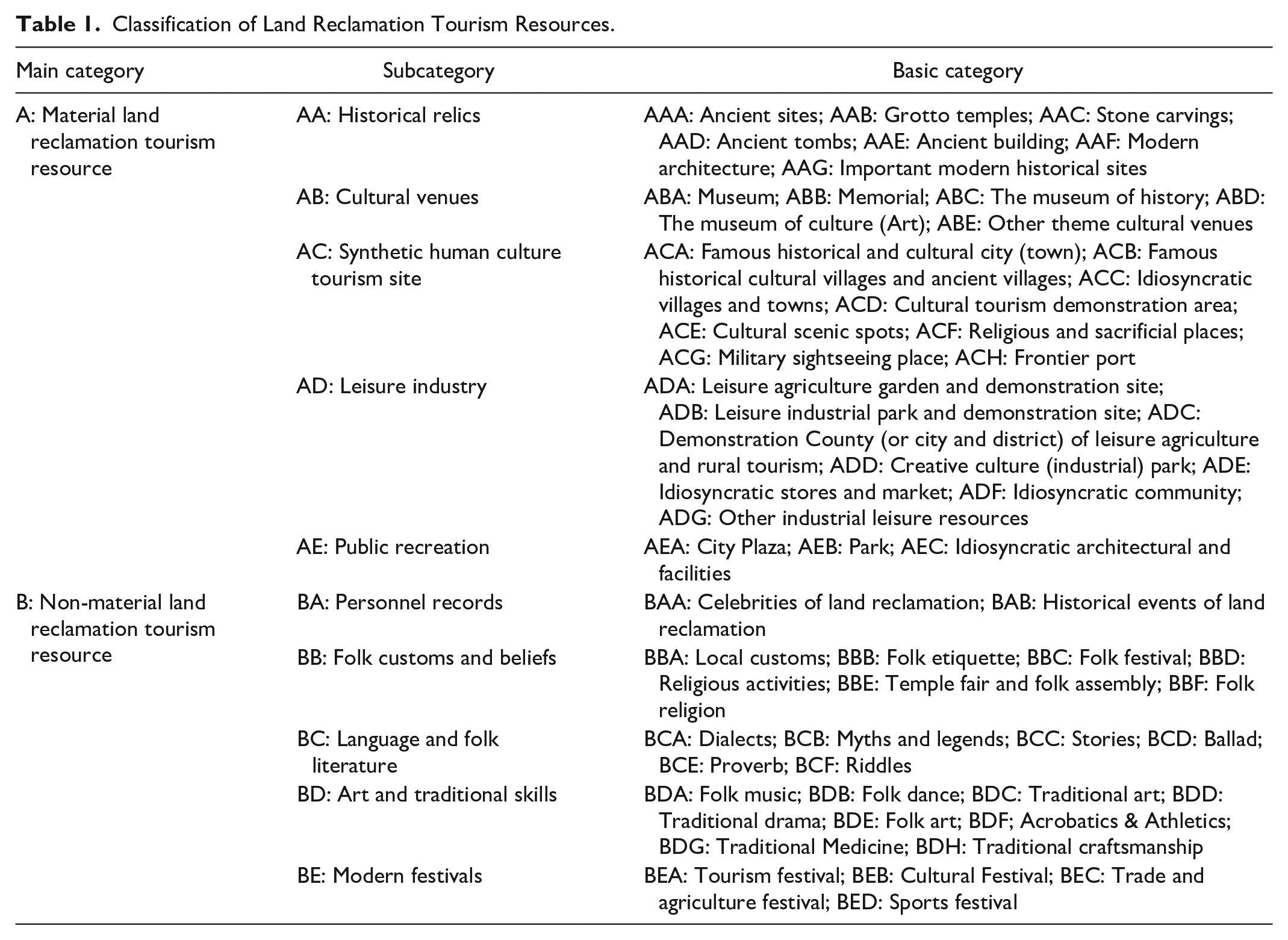
Specifically, researchers first divide resources into material and non-material cultures in the “main category” layer. The problem was primarily resolved by the “lacking types of the non-material cultural heritage categories” problem. Then, 10 subcategories have been granted within the second layer according to the state of resource occurrence and dominant factors. The material category is divided into five subcategories: historical relics, cultural venues, synthetic human culture tourism sites, leisure industry, and public recreation. The non-material category is also divided into five subcategories, that is, personnel records, folk customs and beliefs, language and folk literature, art and traditional skills, and modern festivals. Finally, as shown in Table 1, 56 basic types were given into the third layer according to landscape units and their causation.
Classification of Land Reclamation Tourism Resources.
Construction of Comprehensive Evaluation Index System of Land Reclamation Tourism Resources
Research Methods
The evaluation of cultural tourism resources is a long thriving research topic. Its research methodology and its research content experienced an evolution stage from qualitative to quantitative, single to multiple, subjective to objective. Firstly, to date, there are rich researches on the value evaluation of cultural tourism resources such as ancient capital city tourism resources (Wu et al., 2012), scientific and technological tourism resources (Tao et al., 2009), marine cultural resources (Lehman, 2018), rice terraces tourism resources (Li et al., 2016; Tian et al., 2015), and tea cultural resources (Feng et al., 2013), etc. However, no scholars have conducted a rigorous and in-depth exploration of the value of cultural tourism resources. Secondly, at the level of the evaluation subject, a growing studies, shifting from the initial reliance on expert experience-based judgment (Harvey & Fischer, 2014) to multiple evaluation criteria (Puška et al., 2019), gradually pay more attention to the cognition of residents, developers, and other stakeholders as well as the experience perception of tourists. Third, at the level of evaluation programs, scholars mainly emphasize market leadership, such as tourists’ recognition of resource display methods or content (Morrison et al., 2005), tourists’ pleasure (Su et al., 2016), and taste perception (Kim et al., 2021). Besides the above achievements, a few contemporary scholars also explored quantitative evaluation schemes for tourism resources and proposed evaluation indicators such as development conditions and development benefits and the region’s characteristics where the resources are located, showing a noticeable trend of indexing and modeling.
Combining qualitative and quantitative methods can obtain more objective and scientific research results (Dai, Feng, et al., 2020; Dai, Zhang, et al., 2020). This article employs a research methodology that combines the AHP with the Delphi method by drawing from other scholars. First, the Delphi method is used to conduct the first round of expert consultation to select and determine the evaluation indicators of the LRT resources. Then use the AHP for the second round of expert consultation to compare and rank the relative importance of each index level. After summarizing the evaluation results of each expert, the relative importance judgment matrix of each evaluation index is obtained, and the analysis is carried out according to the level. Based on the principle of the research method, the square root method is used to calculate the weight of each indicator, and an indicator system for the evaluation of LRT resources is established. Determining the indicators’ weights plays a crucial role in the evaluation model. Good weights should reflect the fairness and efficiency of evaluation. Fairness reflects the objective manifestation of the importance of the evaluation object and mainly involves the accuracy of the evaluation. The evaluation efficiency reflects the evaluation order of the objects, mainly related to the degree of evaluation discrimination. The statutory power of AHP is mainly to compare the indicators of the same level and the same type on level by level and give a paired comparison matrix, which fully reflects the opinions of experts and reduces the subjectivity.
Selection of Evaluation Indicators
In this study, the comprehensive evaluation of the land reclamation cultural tourism resources is taken as the target layer O. System layer A includes the value of land reclamation’s historical-cultural, sightseeing and recreation (A1), the natural and social environment (A2), and the exploitation condition (A3). Each A system layer is subdivided into project layer B and indicator layer C. First, this article uses the Delphi method (Dalkey & Helmer, 2009) to interview eight experts from geography, tourism, culture, and land reclamation history. Then, we conduct the first round of expert consultation screening to determine the evaluation indicators of cultural tourism resources in land reclamation cultural tourism. According to the importance of the indicator, five levels are given to score the candidate indicators, that is, “not important,” “generally important,” “relatively important,” “very important,” and “absolutely important.” The corresponding scores of each level are 1, 3, 5, 7, and 9. After summarizing the scores of all experts’ questionnaires and calculating the importance scores and rankings of indicators at all levels, 28 indicators were chosen out of the initial 31 indicators. As shown in Table 2, only indicators that received all experts’ “more important” appraise and gain more than five score results can be selected into the evaluation indicator system.
Comprehensive Evaluation Factors of Land Reclamation Tourism Resources.

The characteristics of the indicator system are: (1) Fully consider the resource characteristics of cultural tourism resources for land reclamation and evaluate the value of resources from the aspects of history, culture and art, social sentiment, politics, and viewing and recreation. (2) In terms of development conditions, fully consider the factors of the source market and pay attention to the characteristics of resource brands. (3) Take into account the resource monomer, resource combination status, and comprehensive resources. (4) Formulate scientific and reasonable factor weight calculation methods and assignment criteria to improve the objectivity of resource evaluation.
Weight Assignment
In this study, AHP (Saaty, 1980) was used for the second round of expert consultation. Experts compare the relative importance of each level of indicators to obtain the relative importance judgment matrix of each evaluation index. Then, the researcher calculates the weight of each index to establish an evaluation index system of cultural tourism resources for land reclamation.
Construction of comparison judgment matrix
The researcher designed the questionnaire based on the evaluation index system of the cultural tourism resources for land reclamation obtained previously (Zhang, 2018a, 2018b) and named it “Expert Consultation Form for the Allocation of the Comprehensive Evaluation Weight of Cultural Tourism Resources in Xinjiang.” Through mail or face-to-face interviews, 20 experts and scholars in tourism, geography, reclamation history, and culture are invited to conduct a comprehensive analysis based on their subjective evaluation of the indicators. These experts and scholars come from the Tourism Development Research Center of the Institute of Ecology and Geography of the Chinese Academy of Sciences, Xinjiang Agricultural University, Shihezi University, Tarim University, Xinjiang Military Reclamation Museum, and other institutions. According to the scale method of 1 to 9 (Table 3), the experts compare each index pair by pair, assess the relative importance of each relevant element in its corresponding level, and obtain the judgment matrix (i, j = 1, 2. . ., N). This matrix should satisfy the condition that bij > 0; bij = 1/bij, and bii = 1 (i, j = 1, 2, 3, . . ., n).
Estimation Scale.

Weight calculation method
(i) Based on Saaty (1980) and other previous studies (Chen et al., 2017; Yu et al., 2020), this paper cited the numbers 1 to 9 and their reciprocal as the scale to design the questionnaire. According to the results of expert scoring, a geometric average is used to determine the pairwise comparison matrix for the final weight calculation. Using the AHP, results of the second round of consultation by 20 experts are summarized and calculated as shown in Table 4.
Index Weight of Land Reclamation Tourism Resources.
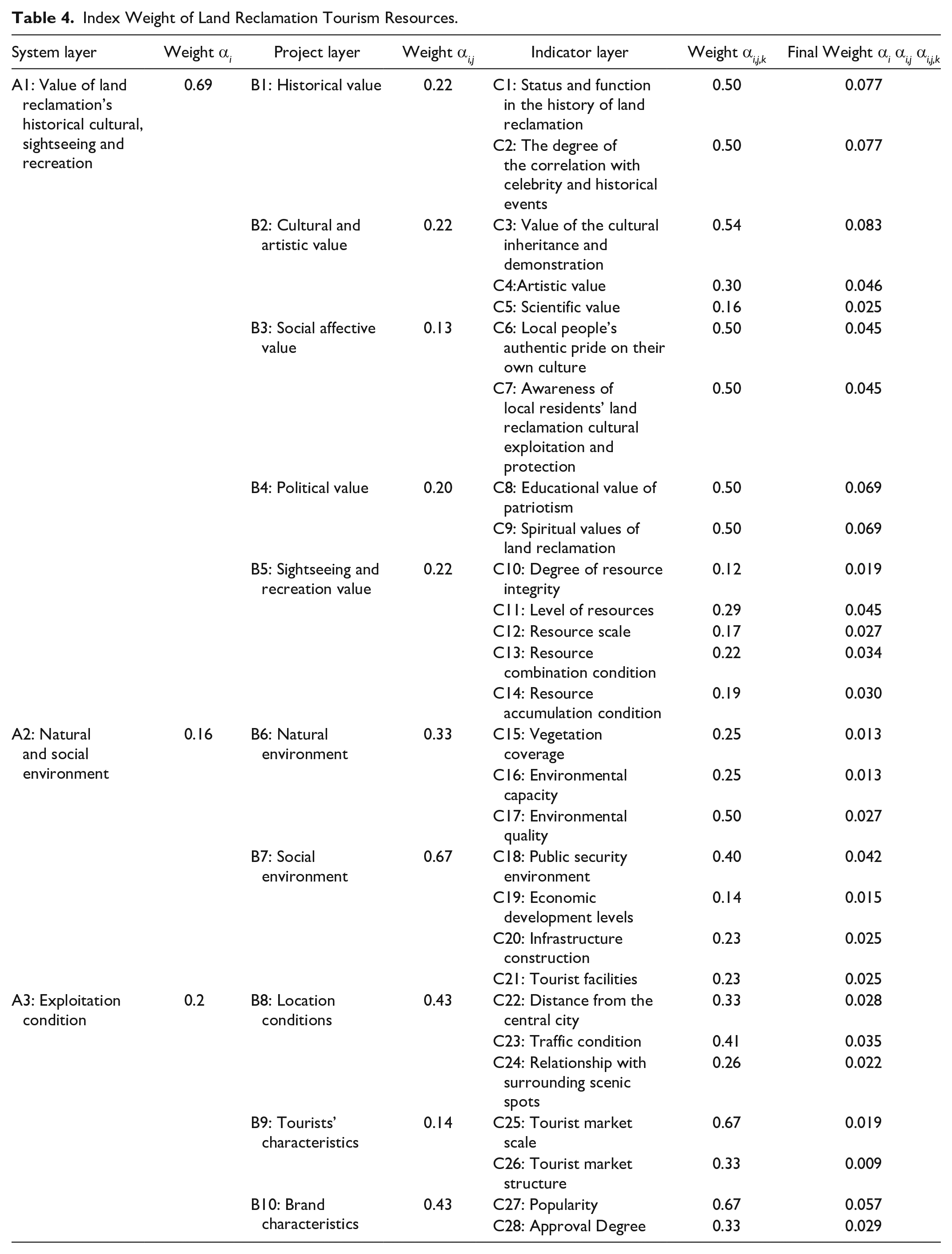
According to Table 4, among the systematic layer factors that affect the comprehensive value of the cultural and tourism resources of land reclamation, the highest weighting value is the “value of land reclamation’s historical-cultural, sightseeing and recreation (A1)” value (0.69), followed by the “exploitation condition” weighting value (0.2) and the “natural and social environmental” weighting value (0.16). Therefore, factor A1 plays a significant role in evaluating the cultural resources of land reclamation culture. It is the material basis for attracting tourists and the primary consideration for the LRT resources. In contrast, A2 and A3 can be seen as the limiting factors for LRT development.
Among the five sub-level indicators of A1, higher weighting values appear among the historical value (0.22), cultural and artistic value (0.22), sightseeing and recreation value (0.22), and political value (0.2). The social affective value gains a relatively lower weighting score compared with others. It means that in the development of cultural tourism resources in land reclamation, we must focus on digging out the historical value, cultural inheritance, and demonstration value of the resources that are mainly attractive to tourists to improve the appreciation of the resources.
Among the two sub-level indicators of “natural social environment (A2),” the social environment index gains a higher weighting value of 0.67. It means that a stable social security environment is the primary constraint in developing LRT. On the other hand, in the three sub-level indicators of “exploitation condition (A3),” location conditions and brand characteristics present an equal significant score.
Restricted by the geographical distribution conditions of the XPCC and other factors, the location conditions of many land reclamation cultural resources are not in their optimal configurations. With the addition of inactive publicity, land reclamation is still a mysterious existence for most people, and this may become the main obstacle to the development of LRT.
According to the final weight analysis of each indicator, we can see that the “status and function in the history of land reclamation (C1),” “the degree of the correlation with celebrity and historical events (C2),” “value of the cultural inheritance and demonstration (C3),” “educational value of patriotism (C8),” and “spiritual values of land reclamation (C9)” gain relative high scores among others. This result suggests that to exploit and develop LRT, we should focus on protecting and exploring land reclamation’s historical and cultural value to fully reflect the spirit of land reclamation and realize its educational function for the long run.
Empirical Research on the Evaluation of Cultural Tourism Resources of Xinjiang Production and Construction Corps
Research Field
As of the end of 2014, the XPCC had an area of 70,600 km2 and 1,244.77 thousand hectares of arable land (Figure 1). From the end of 2019 to the beginning of 2020, the XPCC has a permanent population of 3,248,400, making it one of the largest reclamation areas in the country. Except for 2009, the XPCC’s tourism revenue maintained a continuous growth momentum from 2005 to 2019 (Figure 2), despite large fluctuations in the growth rate and a decline in the growth rate of the tourism industry in recent years. By 2019, the XPCC has received 33,879,300 tourists throughout the year, an increase of 35.52% over the previous year. The total tourism revenue was 20.704 billion RMB, an increase of 40.84%.

Reclamation distribution of XPCC (Yao & Hu, 2011).

Tourism revenue and its growth rate in XPCC between 2005 and 2019.
Data Source
In July and August 2017, the researchers conducted a fieldwork investigation on Xinjiang Production and Construction Corps’ 32 A-level tourist attractions and 14 star-level farmhouses in Xinjiang. During this period, interviews and questionnaire surveys were also conducted to the staff members, tourism managers, and farmhouses operators in each corps division and government departments in XPCC. Later, from July to October 2019, the researchers collected research data from scenic areas such as Tumushuke History Museum of Xinjiang’s Land Reclamation, General Museum, Xiaobaiyang Post, Sun Longzhen Mausoleum, and other scenic spots. Conclusively, 38 land reclamation cultural tourism resources have been selected out of 44 A-level scenic spots, 33 star-level farmhouses, and other scenic spots as the research objects. A total of 700 questionnaires were distributed by purposeful sampling, and 627 valid questionnaires were retrieved. The survey includes 24 tourism administrative staff, 92 scenic spots and farmhouse managers and operators, 21 experts from Xinjiang universities familiar with land reclamation of cultural-scenic spots, 33 first-line guides, and 530 tourists.
Analysis of Survey Data
The questionnaire involved all the indicators in the evaluation system of land reclamation cultural tourism resources, accompanied with the fuzzy scoring principle for the rating. In order to facilitate the questionnaire survey, we use a 10-point rating system and set five levels for the respondent to choose from (Table 5).
Grade Values of Appraisal Factors for Cultivating and Guarding Tourism Resources.

Data calculation and rating
The process of the research data calculation and rating are as follows. First, this study normalizes the average score of each indicator in the indicator layer of the questionnaire and sets these data as the original rating data. Secondly, as shown in Table 5, we use the final weight to weight the normalized scores of the corresponding indicators of step 1 and then calculate the total score of each scenic spot. According to the classification system in Table 1, the 38 tourism resources selected in this study can be divided into historical relics (AA), cultural venues (AB), synthetic human culture tourism site (AC), and leisure industry (AD). Based on this classification, while applying the criteria of Table 6, this study divides the comprehensive development level of cultural tourism resources in Xinjiang into three levels. It ranks them in a descending order named Level I, Level II, and Level III, respectively. The specific ratings, types, and scores are shown in Table 6.
Ratings, Types, and Scores of LRT Resources of XPCC.

Analysis of evaluation results
(1) Quality structure feature analysis of land reclamation cultural tourism resources.
According to Table 6, there is 6 Level I resource monomers in terms of quality features, accounting for 15.8% of all cases; 20 Level II resource monomers, accounting for 52.6%; and 12 Level III resource monomers accounting for 31.6%. Judging from the comprehensive evaluation results, a total of 26 Level I and Level II resources have higher development values. In the midst of these, cultural venue resources (AB) have higher popularity and overall qualities, and leisure industry (AD) and synthetic human culture tourism site (AC) are abundant in tourist resources. All of them are appertain to the category of excellent development potential which should be paying more effort to exploit it. As an incomparable feature resource of the XPCC, the cultural venues (AB), such as XPCC Land Reclamation Museum and Memorial Hall of 359 Brigade, etc., possess great historical, social-emotional, political, and recreation values, which can be seen as a prominent brand of Xinjiang land reclamation tourist resources.
The synthetic human culture tourism site (AC), represented by Qinggeda Lake Scenic Area and 185 regiments White sand Lake Scenic Area, has higher popularity than other resources. This reputation, combined with their excellent geographical location, enables them to maintain vast while stable sources of the market customer. The leisure industry (AD) resources represented by Impression Lanbo Bay Ecological Tourism Park and Yipahan Lavender Tourism Base also hold comparatively higher popularity. The distinctive point is that they have much more scientific research and ornamental values. On the other hand, although the resources of historical relics (AA) represented by the First Land Reclamation Company and 186 regiment Longzhu Mountain Scenic Area get a relatively low popularity and have a single structured small market, it bears great potential to become the most prominent tourist resources in Xinjiang. Therefore, it should be set as the vital target of exploitation of land reclamation cultural tourism resources by XPCC in the next stage.
As demonstrated above, the classified four types of resources, that is, AA, AB, AC, and AD, present a featured distribution pattern on the three levels of the rating. As shown in Figure 3, cultural venues (AB) are more concentrated in the high-level resource groups, while the leisure industry (AD) is more attached to the third level. Meanwhile, all types of resources account for a certain proportion in Level II.
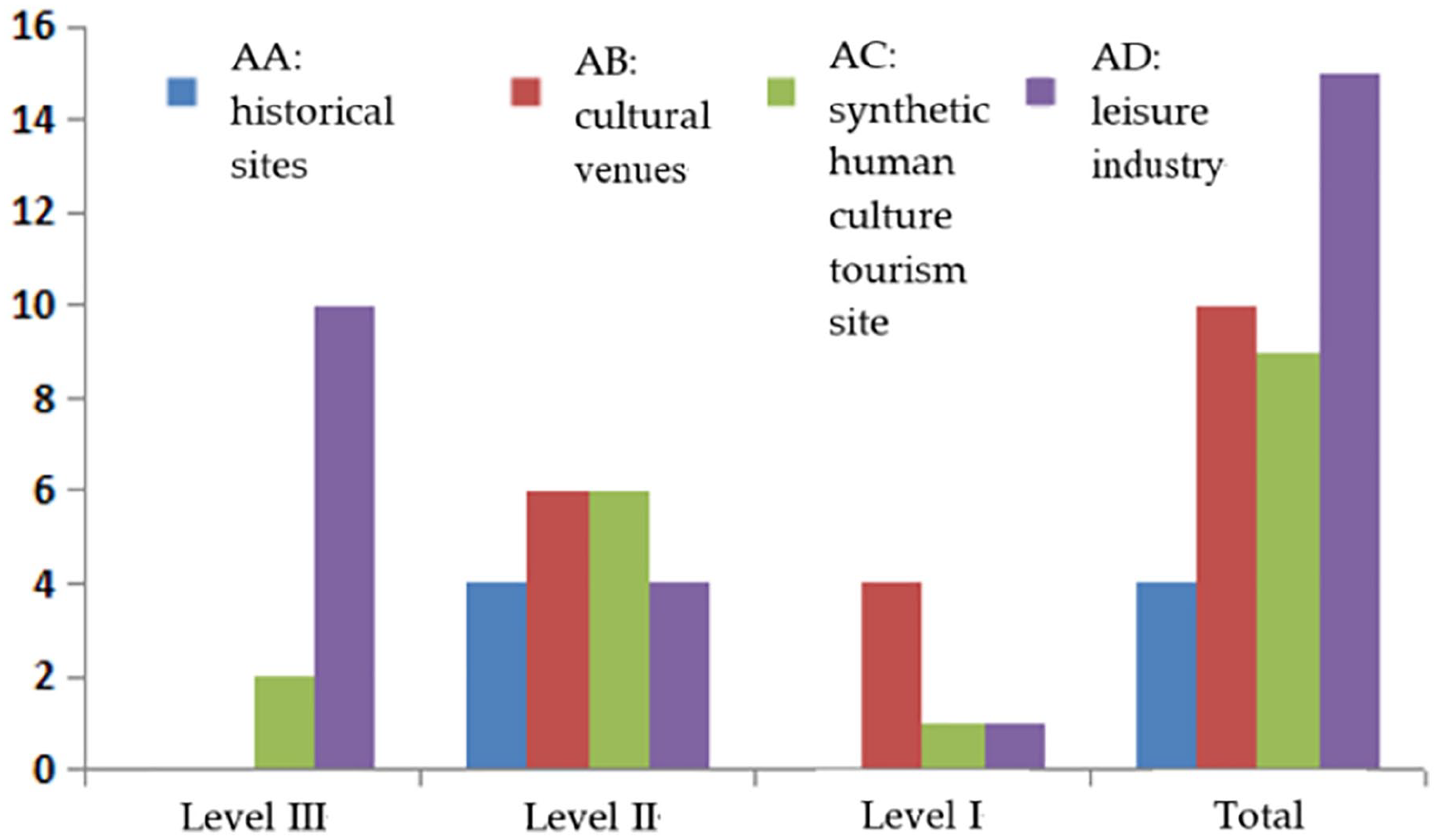
The quality structure of the cultural and tourism resources of the XPCC.
(2) Type and quantity structure analysis of land reclamation cultural tourism resources.
Regarding the number of land reclamation tourist resources, the leisure industry (AD) occupies the most considerable portion of all resources, roughly accounting for 39.5% of all cases. The proportion of historical relics (AA) is the smallest, accounting for 10.5% of the total. Cultural venues (AB) and synthetic human culture tourism sites (AC) are in the middle, accounting for 26.3% and 23.7%, respectively. This result reflects an uneven developed tourist industry pattern of XPCC’s land reclamation cultural tourism resources, which mainly focused on the leisure industry (AD) and cultural venues (AB). The calculated total score of each type of land reclamation tourist resource reflects the difference in the total amount and scale of each resource type. While for the overall grade features of each type, we calculate average values of each type are employed to reflect the truth. Figure 4 shows that cultural venues (AB) resources have relatively high scores in terms of total scores and average values, which reveals that these tourist resources possess both quality and quantity advantages. While the total score is the highest for leisure industrial tourist resources, the average values are at the bottom, which reflects a quantity advantage and quality disadvantage of the tourism resources.

Evaluation of the overall type of LRT resources in XPCC.
(3) Spatial distribution features of land reclamation cultural tourism resources.
The spatial distribution of XPCCs’ land reclamation cultural tourism resources presents an obvious imbalance distribution pattern over the whole field. The research area covers the whole region of XPCC. The LRT resources mainly concentrate in the north area, leaving the south part of the area underdeveloped. Specifically, the northern part of Xinjiang has developed rapidly in recent years and gained a gradually improved popularity under its superior geographical features. Likewise, relying on its distinct characteristics, such as the unique land reclamation culture, various types of tourism resources, and enduring development, tourism resources in Xinjiang got fully exploited and well developed, embodied as a set of fully equipped tourism facilities, highly appreciated and well-known scenic spot.
The XPCC has excellent potential for development, and the tourism development of each regiment is relatively balanced, which realizes the differentiated development path of “one regiment focus on one product.” Because of its excellent environmental quality, high-quality tourism resources, and advantageous geographical location adjacent to the famous scenic spot Kanas, it has become one of the critical areas of the XPCCs’ tourism development layout. The west and north parts of Xinjiang Urumqi city’s rural regions mainly focus on its leisure industry’s development to meet the huge market demand. In particular, rural tourism has an extensive layout and has gained rapid development compared with the rest. Nevertheless, the most well-developed southern LRT resource area has a relatively high comprehensive monomer resource evaluation score, the quantity of the resources is minimal.
To sum up, the exploitation and development of LRT resources in northern part divisions in Xinjiang, by virtues of its special locational, economic, and social environmental conditions, gain much more success than the southern part. These days, the northern part has witnessed a rapid growth of the LRT industry and constantly expanding the scales of resource exploitation. It is mainly manifested in the characteristics of the scaled reception capacities, the emergence of the incipient local tourism brand, the gradually strengthened policy support, and the high enthusiasm of local government staff and employees in participating in tourism development.
In contrast, due to the constraints of the social security environment, tourism development in South Xinjiang has reversed and shrunk. Besides, in the investigation process, it was found that some large scenic spots are in a state of semi-closed or closed, showing a dim future of their further development. The reason for that can be ascribed to the low enthusiasm for tourism development, lack of professional tourism talents, insufficient investment, poor management system, and unclear positioning of the tourism resource exploitation and development in South Xinjiang. In addition, the level of operation and management ability and the relationship between local military and civilians are also acting as the main factors that restrict the development of land reclamation cultural tourism in Xinjiang.
Conclusion and Suggestion
Discussion
The Xinjiang Production and Construction Corps has rich cultural resources for reclaiming, and it is a standout practice area for the integration and development of culture and tourism. The use of traditional national standard classification and evaluation schemes in China cannot reflect the reliable authentic value of the cultural resources of farming and cultivation. It will also ignore the real needs of tourists, leading to the dilemma of a “non-genuine market,” a market with reasonable prices but non-exist buyers, or “ineffective supply” in development. Based on defining the concepts of land reclamation cultural and LRT resources, this paper tentatively proposes a classification scheme based on the combination of the natural resources and tourism mode. By comprehensively considering the value of land reclamation’s historical-cultural, sightseeing and recreation, natural and social environment, and exploitation conditions, an initial comprehensive evaluation index system for land reclamation cultural and tourism resources was constructed, using the weight analysis carried out by AHP.
Conclusion
Since AHP-Delphi is a sophisticated and widely-used research method (Chen et al., 2017; Feng et al., 2013), the results obtained from this method adopted by the study are relatively satisfactory. Grounded on the AHP, it can be known that among the system-level factors that affect the total value of land reclamation cultural tourism resources, the historical-cultural land reclamation, and the viewing and recreation value demonstrate the most significant weight value (0.69), which occupies a dominant position in the evaluation of the cultural tourism resources of the farming. It is the fundamental tourism resource that attracts tourists. The weight value of the natural and social environment (0.16) and the weight value of development conditions (0.15) are relatively low. Compared to other tourism resources studies (Feng et al., 2013; Sun et al., 2010; Wang et al., 2018; Wu et al., 2012), this study proposed classification and evaluation system provide several theoretical guidance for the further investigation, classification, evaluation, planning, and development of land reclamation cultural tourism resources.
As Yang et al. (2020) mentioned, rural settlement consolidation has a critical role in facilitating the transformation of human settlement and land-use transition. Identifying the key stakeholders and their main concerns is crucial to align rural planning and policymaking effectively. Based on the above theoretical framework, an empirical study was conducted on LRT resources of XPCC. Compared to previous studies about reclamation tourism (Feng, 2020; Wang, 2019; Zhang & Yang, 2020), the contribution of this study is that the evaluation and analysis results provide XPCC a much more efficient and scientific approach for their further exploitation and development of the LRT industry. The results also facilitate each division of XPCC to recognize its features and market positioning in the LRT industry to realize a more reasonable tourism layout and in-depth tourism exploitation and development. More to say, the research results hold significant practical implications on the promotion of land reclamation culture protection and rational exploitation, consolidation of the sense of national identity, social harmony, and national unification.
Limitations and Suggestions
Due to the complexity, intersection, and dynamic nature of land reclamation cultural resources, formulating a more scientific and reasonable classification scheme requires more empirical studies to sophisticate the scheme based on unremitting practical applications. This article constructed an evaluation index system of the land reclamation cultural tourism resources by integrating the advantages of cultural tourism resource evaluation, tourism scenic spot quality rating, and tourism regional development evaluation index system. While, in terms of selecting proper evaluation factors and indexes and determining the appropriate quantitative analysis methods, more research and improvement should be taken on this area. Furthermore, the empirical research on XPCC will be better improved by a more significant number of data samples as well as a practical application inspection.
Footnotes
Acknowledgements
The authors would like to thank the comments of anonymous reviewers, the associate editor, and the editors of SAGE Open.
Declaration of Conflicting Interests
The author(s) declared no potential conflicts of interest with respect to the research, authorship, and/or publication of this article.
Funding
The author(s) disclosed receipt of the following financial support for the research, authorship, and/or publication of this article: This research was funded by the Chinese National Social Science Foundation (Grant number 16CGL028), the High-Level Talents Research Project of Shihezi University (Grant number RCSK2018C06), the Humanities and Social Research Fund of Shandong Jiaotong University (Grant number R201709), and the Doctoral Research Startup Fund of Shandong Jiaotong University.
Ethical Approval
This research is not applicable for an ethics statement for animal and human studies.
