




Abstract
Life stories are considered an inexhaustible source of information, which serves for the development of leadership elements and is a determining factor for raising the awareness of leadership members to understand the nature and existence of personal values, which then leadership members can use in a process of decision-making. We aim to bring insights into the process of collaborative decision-making and its linkage with personal past experiences divided into four life-story aspects. We used a semi-structured interview with managers positioned in the top hierarchical line in the organization, and we used the critical incident technique to prepare the questionnaire. We analyzed our empirical data by using the qualitative thematic method of analysis. The main finding is that valuable leadership development elements are contained in the life stories. The new insight is also that life stories are a new path to influence and develop the awareness of the values and purpose of a leadership member.
Introduction
The effective development of leadership members’ awareness and purpose is critical to have a successful collaborative decision-making process. Awareness and purpose represent a leadership member’s meaning-making system and the leadership member’s perception of their positive and negative personal values that generate productive/nonproductive actions in a decision-making process (Steffens et al., 2021). The performance of leadership members within a decision-making process is determined by their level of awareness and purpose to provide complex solutions (Sparrowe, 2005). Purpose to expose authentic values, enriching personal awareness and purpose is essential (Weiss et al., 2018). The outcome of showing authentic values in a decision-making process implies selecting collaboration as a working methodology to achieve a specific goal (Loci & Peterlin, 2021). Preceding research studies by Day (2000), Steffens et al. (2021), Loci (2017), Gardner et al. (2005), and Sparrowe (2005), all see leadership members’ awareness and purpose as essential to be authentic and that Shamir (2005) and Shamir and Eilam (2005), describe that life experiences are the source of developing their authenticity.
This research study takes place within public organizations and with a specific focus on municipal institutions. According to Vavrek et al. (2014), the municipality is a public organization that deals with local government and has defined power and obligations, which are regulated by special regulations and laws. The public and private organizations differ “based on certain basic concepts of organization that include goals, goods and services, resource ownership, organization structure and design, leadership and managership, decision making and organization culture” (Khan & Khandaker, 2016, p. 2874). These concepts of organization suggest that strategic management in public organizations is not immutable or inherited, because the members of the leadership must adapt their leadership strategies to the tasks they have in front of them, the environment of the organization, and the public demands for the transformation of situations (Alford & Greve, 2017; Allison, 2012).
It is therefore strategically beneficial for leadership members and scientific practitioners in the field of leadership to understand how leadership members’ awareness and purpose can be developed over time so that leadership members in a public organization can have their strategies steadily applied in practice. Development of personal awareness and purpose may be achieved by using different forms of gathering new information, whether formal (academic knowledge) or informal learning (other sources of knowledge) process (Louw et al., 2012). Loci and Peterlin (2021) suggest that an experienced story may be integrated into the meaning-making system of a leadership member and used to develop his/her awareness and purpose. Events may be integrated within the four categories of life stories identified as sources of information. In the beginning, the content of life stories may be integrated unconsciously by a leadership member, but in time the meaning of the content of these life stories is reached, in which the person becomes aware of how and where it should be used in concrete cases.
The purpose of this research was to study how leadership development elements are contained in the life stories of leadership members. The research insights were on the meaning of life stories and the explanation of their categorization on the development of leadership members’ awareness and purpose. The objectives of the paper were, firstly, to advance and integrate the literature of the life stories within the scope of leadership development. Secondly, to explain how leadership members’ awareness and purpose are contained in the life stories. And, finally, to understand the lived experiences of leadership members and their effect on critical collaborative decision-making incidents.
The leadership members’ awareness and purpose and the methods applied will first be defined. Thereafter, live-story aspects and the development of personal awareness and purpose will be analyzed. We will present the section of the research design and the findings, discussion, and some of the limitations will be presented.
Leadership Members’ Awareness and Purpose
Watts et al. (2019) argue that how individuals feel and understand a life story in the moment of telling it because the stories a leader has selected to tell emphasize the leader’s self-awareness and his/her form of leadership style. Kelley and Bisel (2014) argue that life stories involve the thinking process more than memory. Weischer et al. (2013) describe how life stories express the storyteller’s identity, including his/her core values and his/her meaning-making system. Eilam-Shamir et al. (2017) state that life stories describe the character of e person. Boal and Schultz (2007) state that individuals, through telling a story, tend to connect all information from past experiences to justify themselves in the present. Shamir (2005) argues that individuals use life stories as a source of their identity development by analyzing and revising life stories over time.
The Development of Leadership Members’ Awareness and Purpose
The model of this article, as presented in Figure 1, describes how life experiences are shaped by specific external characteristics of a life story. Those experiences create a worldview that creates the awareness of a leadership member’s values and purpose, shaping how individuals behave in a collaborative decision-making process. This first part relates to authentic leader development because the complex process is studied at the individual level. The process of collaboration with others in the decision-making process is related to collective leadership development as an outcome of that collaborative decision-making, which is part of the collective level.

Leadership development elements contained in life-stories.
The subject of this article is a process that must be analyzed at different levels (Loci & Peterlin, 2021). This process of leadership development is explained after the analysis at the individual level of the events in which the person has been a participant throughout his life, and then continuing with the analysis at the collective level for the construction of personal values and the way they are used by the person in a collaborative decision-making process.
Leadership development is a broader concept to study and is not specifically related to the development of a leadership style. Within this concept, various specific processes related to the development of a leadership member at both individual and collective levels can be analyzed (Day et al., 2014). At the individual level, the structure and development of personal values such as confidence, knowledge, skills, goals, vision, and so on are studied, while at the collective level, collective activities (behavior, discussion, respect, peer recognition, etc.) are studied that are mainly related to the collaboration of the person with others within the organization (Day, 2000; Loci & Peterlin, 2021).
External characteristics shape a life story. A life story is defined as an event in which a person has been a participant and uses its information as experience gained from the past (Shamir, 2005, 2011). A life story is a single event in a given context at a specific time. A significant number of past events form a life-story aspect. The content of a life story is the information that resembles the information of one of the four life-story aspects which he/she has already acquired and develop his/her meaning-making system (Loci & Peterlin, 2021).
The worldview outcome of life experiences means that the person who has been part of many events within the same context manages to connect the information and thus create a worldview of issues the person is examining (McCauley & Palus, 2021). This worldview is not derived from the information of only one event; it is a combination of information from many events, and the person examines an issue from the prism of different analyses by comparing information to provide arguments and avoid giving only opinions where there is no argumentative basis. The achievement of having a worldview does not mean that it is a universal worldview. It is valuable for analyzing and finding a solution for only one specific issue (Marcy, 2020).
Awareness of values and purpose means that the person becomes capable of participating in a collaborative decision-making process only if he/she manages to be aware of the structure of his/her values and goals (Taylor et al., 2019). If the interpretation of a worldview is clear and eloquent, the person is understood to be aware of his/her values and goals. In contrast, if the person fails to construct and interpret a world of meaning to decipher a specific issue, then the person is not considered to be aware of his/her values and goals (Steffens et al., 2018). Therefore, leadership development advancement depends on leader development (Solansky, 2010).
The Role of Life Stories in Developing Leadership Members’ Awareness and Purpose
A broad variety of life stories are present in real life (Watts et al., 2019). An individual can be affected by numerous and diverse life stories, including songs he/she heard, movies he/she watched, TV shows, biographies, documentaries, and other sources. These life stories are delivered to the public audience as stories representing successful leaders, politicians, singers, actors, businessmen, businesswomen, and so on. The direct (being present at the event) or indirect (reading or listening) participation of a person in certain events does not mean that it is done only for entertainment reasons. However, studies have explained that a person’s participation voluntarily or accidentally in these events will produce positive or negative consequences for a person, including effects on his/her level of motivation, being influenced, becoming part of an ideology, the possibility of being manipulated, and so on (Loci & Peterlin, 2021; Watts et al., 2018).
Personal experiences are the basis of the formation and development of the meaning-making system of a person. As a result, personal experiences are the source of shaping leadership members’ awareness and purpose, which they could present in the form of their knowledge, skills, beliefs, and vision (Shamir, 2005; Shamir & Eilam, 2005; Shamir & Hooijberg, 2008; Loci & Peterlin, 2021). The concept of life stories is not defined in its final form yet (Shamir, 2005). It is a good opportunity for all those interested in different scientific disciplines to contribute to its definition so that it can then be used to explain some social situations in organizations. Therefore, a significant contribution was made by Loci and Peterlin (2021) by describing the concept of life-story as part of a whole presented as the four life-story aspects. The reason for that division is the lack of similarity in content and its meaning and their role in the formation of the leadership members’ values and purpose.
The current focus of scientists on leadership development is not on the lives of leaders but on the texts that describe their lives (Ligon et al., 2008; Watts et al., 2018). Scientists use the narrative approach to leaders’ autobiographies that will describe how individuals feel and understand a life story in the moment of telling it because the stories a leader has selected to tell emphasize the leader’s self-awareness and his/her form of leadership style (Watts et al., 2019). This method was used to understand the personal values of leadership members including their feelings, thoughts, vision, and acts, which makes it possible to analyze and interpret reality based on his/her core values shaped by the information derived from life experiences (Shamir, 2005; Shamir & Eilam, 2005; Shamir & Hooijberg, 2008).
Personal narratives of leadership members are formed by their thinking system and less by their memory (Kelley & Bisel, 2014). The personal narrative has to do more with the meaning of a specific event (in the past) in the present than with showing facts about that event. Individuals tend to tell a story based on their perceptions and to build meaning about that event based on their beliefs and understandings (Shamir & Eilam, 2005). It assumes that life stories a leadership member has experienced in the past are linked with each other, but it does not mean that one new story can not affect directly the meaning of other stories that have happened within the same context (Boal & Schultz, 2007). Narrators select only the essential parts of the story and avoid parts with less interest at the time of the last event (Sternberg, 2008).
Life stories provide a picture of a person’s present (Eilam-Shamir et al., 2017). Each person has authentic personal narratives because individual life stories express the storyteller’s identity, including his/her core values and his/her meaning-making system (Weischer et al., 2013). Through telling a story, individuals tend to connect all information from past experiences to justify themselves in the present (Boal & Schultz, 2007). Therefore, individuals use life stories as a source of identity development by analyzing and revising life stories over time (Shamir, 2005).
A leader’s core values are developed based on the development of life stories (Sparrowe, 2005). Leaders correlate information obtained from one story to judge the situation of another story and thus continue systematically (Dufresne & Fisher, 2002). Leaders may be affected by difficult family circumstances, high parental expectations, and their past experiences in leadership roles since their childhood, and this personal life background affects how they perceive information obtained in the past and how they use this information in future events (Shamir et al., 2005).
Research Design
Research Approach
We used a qualitative research design. A qualitative research approach was a beneficial way to collect adequate data for the topic we studied, and this method supported the achievement of our research objectives. The advantage of using qualitative methods was that we directly gathered raw data from interview participants. The truth of the data we collected is subjective because these are experienced constructs shaped by the process of collaboration that was developed between us as researchers and the interview respondents (Louw et al., 2012).
The interpretive paradigm formed the basis of the research design, the selection of research methods, and the life course approach. This paradigm brings new insight by understanding how people’s worldviews (life-story aspects) are formed and what those worldviews mean (Tomaszewski et al., 2020). Semi-structured interviews (Rabionet, 2011), the critical incident technique (Bott & Tourish, 2016; Chell & Pittaway, 1998), and thematic analysis guided the data capture, analysis, interpretation, and conclusions.
Research Ontology Epistemology
We, as the researchers and the truth of our conclusions are related to each other. It cannot be claimed that there are valid and indisputable terms in the social world, including names, concepts, and labels, which we could use to define what is correct and what is not correct accurately. Therefore, the reality, in this case, is a result of our opinion and the level of our awareness of the issues. All existing knowledge is formed due to the use of experiences in a conscious form. This scientific research perspective is relative by nature and can be understood only by the person. Therefore, in the social sciences, it cannot be concluded that true objective knowledge can be achieved.
Research Setting
Municipal institutions are public organizations where the interview participants are in the role of directors. They were elected by the head of the municipality who was elected by the people of that specific region during the process of local elections. This research process included in total seven regional municipalities such as the municipalities of Prishtina, Mitrovica, Peja, Prizren, Ferizaj, Gjilan, and Gjakova. These municipalities have some more responsibilities than other smaller municipalities.
Sampling
The sampling strategy was a purposeful sampling maximum variation approach (Coyne, 1997). We chose to use purposive sampling because almost all types of sampling within the spectrum of qualitative research can be classified as purposive sampling (Sandelowski, 1995). Purposive sampling was necessary to carry out our studies because through it we managed to interview people in positions with executive power and who are positioned in high hierarchical lines with a broad general knowledge of the topic and with a large spectrum of experiences (Coyne, 1997). The maximum variation sample allowed us to select respondents with different personal values and life experiences (Patton, 2015).
For this article, we used interviews of 20 directors of seven regional municipalities who are positioned in executive and leadership positions within municipal institutions, each of whom has different responsibilities because they led different departments and the cities in which they operate are not the same.
All the respondents differ from each other, including in their professional backgrounds and life backgrounds. The specter of departments available to select were departments of economy, strategic planning, and sustainable development, agriculture, the inspection, cadastral, public services, protection and rescue, capital investments and contract management, urban planning, property, finance, culture, education, health, social welfare, integration and diaspora, and administration. All participants have been in the position of director for more than two years from the moment of taking him/her in the interview.
The respondents have been in high hierarchical positions and decision-making positions where their main responsibility was the development of strategies for the development and transformation of the respective municipalities for the departments they represent. These respondents have a limited mandate, and within that time frame, they must compile strategies and simultaneously implement them, unless a strategy is unprecedented in the long term, which means it will go beyond the previous period of 4 years. Usually, people who have a rich history of experiences, from every aspect of life, are selected for this position. Therefore, they were adequate people for our study because the differences between them were wide, but also the content of their values and experiences was quite rich.
Data Collection Methods
The semi-structured interview is a hybrid method that provides the opportunity for both structure and flexibility (Shirani, 2015). We used semi-structured interviews to gather empirical data. Because our article falls within the realm of the social sciences, we chose to use semi-structured interviews because this method is suitable for our scientific research. We collected data from our respondents, each describing numerous incidents of collaborative decision-making. The critical incident technique was a perfect opportunity for us to understand the reason for the action, behavior, and other psychological and social elements expressed by the respondents in that particular event (Bott & Tourish, 2016). Through this method, we were able to understand from the respondent the context, the problem to be solved, the decision reached, how it was reached, and so on. Then we connected personal experiences and their actions or behaviors in that collaborative decision-making process.
Recording of Data
The majority of interviews were used to have further analyses of the topic of this article. The existing original recording and transcripts were stored and can be used for further analyses or if checking was required.
Data Analyses
We chose to use thematic analysis to analyze the data from the interviews. We used thematic analysis to understand the facts, opinions, worldviews, and personal values, including beliefs, visions, goals, knowledge, and so on, of the respondents. As a result, after the process of analyses of transcripts, we state the interesting quotes relevant to the research objectives of this article.
Quality of Data
Taking into account the positivist perspective of scientific research, which is related to the reductionist approach, focusing on the generalization of social reality into theory and laws, interpretive research aims to interpret social reality by delving into the context, but through a subjective perspective. Therefore, researchers’ interpretations are made by deeply contextualizing the issue, not generalizing social realities into theories and laws. The interpretive analysis is considered subjective and dependent on the type of experience. Thus it is considered from the perspective of positivist thinking to be less rigorous. Interpretive research does not apply the same ontological and epistemological assumptions to clarify a social reality as positivist research. In contrast to positivist research, which applies reliability, validity, and generalizability to interpretivist research, according to Stahl and King (2020), some other criteria are offered to justify the rigor of data. Dependability, credibility, confirmability, and transferability are used in interpretive research.
Dependability means that two researchers reach the same conclusions for the same study using the same data. This is a form of the same reliability used in positivist research. To achieve dependability, we have provided ample details for the issue we have studied and its context, offering to independently authenticate their interpretive inferences (Stahl & King, 2020).
Credibility means that the readers of our study have accepted our findings as both grounded and reliable. This term is similar to that in positivist research, which is used for internal validity. Similarly, we have shown the credibility of our research through the demonstration of data triangulation, in which we used different techniques and methods of data collection. We also have provided transcripts, some records, and information on theoretical and methodological activities, making the data easily accessible for verification in any independent audit to be (Stahl & King, 2020).
Confirmability means that respondents can verify our findings independently at any time. This is the same form used in positivist research, called the notion of objectivity. The paradigm that we have used, which is an interpretive paradigm, does not allow me to consider that our conclusions are objective reality, because the data that we collected are simply the experiences of the respondents as told by them, and thus can be considered to be a subjective reality (Stahl & King, 2020).
Transferability means that our findings can be used to generalize to other settings. This term is similar to external validity, which positivist researchers use. We have provided extensive details of the context in which we conducted our empirical study, and readers can easily understand that these findings can be used in other settings (Stahl & King, 2020).
Likewise, the protection of human subjects is vital to a researcher (Singer & Levine, 2003). We have presented the primary and secondary data gathered from the process of qualitative interviews and other materials (e.g., academic articles, books, etc.) with honesty and integrity. During our research, we respected human rights, including the right to privacy and autonomy of participants. Similarly, “the participant has the right to refuse to participate, and if the participant consents to participate, the participant retains the right to withdraw” (Ross et al., 2010, p. 40) to not affect his/her image among the community of the organization for which he/she works.
Findings
Leadership Members’ Awareness and Purpose Development Process
Based on the data collected, we have reached the point that the development of leadership members continuously progresses or regresses because it has a starting point of development that does not end as long as the person lives. Leadership development as a process is continuous and very dynamic. This dynamism occurs due to participating in many life experiences during lifespan. Leadership development, at the individual level, is the information obtained from a person’s participation in events that are not within the same context of life (Figure 2).

Two levels of leadership development.
The complexity of leadership development at the individual and collective levels also is a result of changing the sources of information, which affects the change of worldviews that the individual will have about a specific issue. Leadership values do not have steady development but vary by changing their form, producing different realities. A person’s core values constantly change over time due to changing sources of information (life stories). One director from the municipality of Peja pointed out: My experiences throughout my life have taught me how to make progress without making big mistakes, so I am more alert in situations. (Director D7, personal communication)
The level of leadership development can be negative or positive. The decrease or increase in the level of leadership development occurs due to the sources of information (life stories) that a person is supplied in a specific context or phase of his/her life.
Information acquired by a leadership member from different life events does not retain its original form because the content of information varies with changing circumstances, and each leadership member begins to compare new information with his/her current information and, at the same time, begins to modify or adapt new information according to his/her standards or personal interests. Leadership members will interpret information according to his/her current worldview of that issue, and this worldview is not static. However, it may change when the leadership member receives new information from other new sources of information.
Based on the data we collected from the respondents, Table 1 presents the steps that explain how leadership development is contained in life stories (Table 2).
Anonymous Names, Roles, and Organizations of Directors.

Source. Own work.
The Steps Explaining How Leadership Development is Contained in Life Stories.
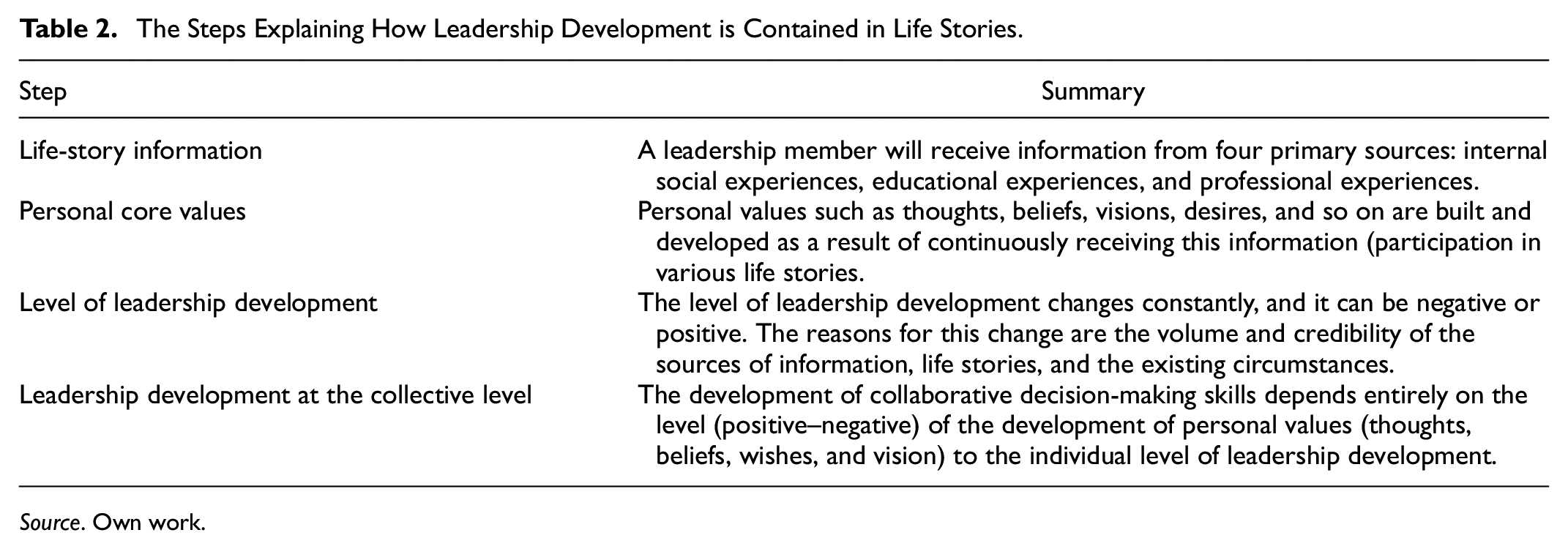
Source. Own work.
To understand how leadership development elements are contained in life stories, we focus on explaining life stories based on data collected from semi-structured interviews with 20 principals; through our questionnaire, we divided the nature of events into four categories of life-story aspects. Thus, we elaborate on the benefits to a leadership member of developing his/her leadership elements while experiencing personal events from these four aspects of life stories.
An aspect of life stories is a person’s worldview during the process of his/her analysis of specific issues in the future. This worldview is formed by a considerable amount of information processed by events within a specific content category. The information when it is learned necessarily must be an integrated part of a person, so it becomes an integral part of a person’s inner values and then can be used in any case. An aspect of life stories is the information that is integrated into the cognitive skills of a leadership member, and then he/she can deliver it again. As a result, this information can be reintegrated into another form by someone else. The information needs to move, and a personal life-story aspect is only a stationary point, where it waits to continue on its journey. Information always exists, but events are the moments that enable a person to receive it.
Based on the data obtained, we concluded that our skills, knowledge, beliefs, and thoughts are just copies of what we did when the information achieved us. Inner values can be transformed by understanding new information that is integrated into a person when he/she participates in a specific event in the future. Therefore, inner values are continuously transformed, consciously or unconsciously. We concluded that inner values are shaped by the information taken from a person’s childhood, and his/her inner values can be advanced in the future but will not change their form. Therefore, life stories provide unlimited opportunities for a person to change his/her inner values to adapt to the dynamics that will become apparent within a given context. Based on the data we collected from our semi-structured interviews, the four life story aspects are defined as follows:
internal social experiences are all events that take place within the family environment with and through other family members;
external social experiences are the information obtained from events that take place within the society of the city in which a person lives (local perspective) and beyond, during visits to different parts of the world (global perspective);
professional experiences are all events that take place within the work environment in all organizations in which the person has been employed; and
educational experiences are information obtained from events that occur within the educational environment, including schools of all levels and other educational institutions.
The following sections present the codes formed from the text of the transcripts of our semi-structured interviews.
Life-Story Aspects That Contributed Toward the Development of the Leadership Members’ Awareness and Purpose
This article focuses broadly on explaining aspects of life stories. Aspects of life stories are the meaning of the entirety of several life stories that occur within a specific context. Therefore, the definition of aspect in this article describes a group of life stories that appear as dynamic life processes within a given context (Shamir, 2005). There are four different aspects of life stories, for the reason that the information within certain aspects of life stories is different compared with the information from other aspects of life stories (Loci & Peterlin, 2021). Similarly, even the methodology to analyze each of these aspects is different. Therefore, each of these aspects has different elements that are unique in shaping and interpreting individual personal values at the collective level of leadership (Shamir & Eilam, 2005) (Table 3).
The Four Aspects of Life Stories.

Source. Loci and Peterlin (2021).
The experiences within the environment of the family are all the information that emerges from the development of events within the environment of a family, only with close family members such as parents, brothers, sisters, children, wife, husband, and grandparents, and the person in question has been present for a small part of that event or its entirety. The person’s presence within an event is necessary because this type of information would be more complete, including the emotional side of experiencing the event, but also the possibility that through personal contribution and direct involvement, the person can extract the information from a specific event.
The member creates a sense of belonging—A family consists of its members, and each member plays a unique role in putting the family’s function of fulfilling the interests of all members. This category, derived from two themes compiled from the codes found within the text of interview transcripts, means that the person creates his/her worldview of family belonging. From this entity, the person begins to create the first personal values, some of which are inherited, whereas others are formed from the beginning. The person understands his/her belonging and begins to behave within the norms developed through decades within that family. In every place or situation, the person presents his/her family values precisely. As a result, he/she begins to understand the difference between acceptable and unacceptable behavior toward others. Furthermore, personal negative or positive behaviors are based on his/her family affiliation, bringing to mind the values with which he/she is surrounded within the family entity from which he/she has grown since childhood. One director from the municipality of Prishtina pointed out: I feel like everyone wants to abandon me or boycott me, I have no reason, but the trauma I got from my parents’ divorce has caused me confusion in my relationships with others. (Director D-3, personal communication)
External social experiences are all events that occur within the society in which the person develops his/her life, and also include events that are not limited to the society in which the person lives. The person can participate in these events in two ways: directly and indirectly. The direct form involves the person’s presence during the development process of these events, and the indirect form means that the person understands these events from the media or other persons.
The person creates his/her own identity and his/her broader belonging—The person, during his/her engagement within a social circle, builds and develops an identity, which can be authentic or improvised. The person creates his/her own identity and his/her broader belonging. One director from the municipality of Prizren pointed out: I tried to avoid some personal characteristics in order not to be negatively prejudiced by others. (Director D11, personal communication)
If the social values of the people in the place where the person lives are approximately the same as his/her values, then the person is more authentic when presenting him/herself to others, whereas if personal values are different from the values presented by the people where the person lives, the person tends to improvise their identity, trying to adapt to the existing circumstances within society. The person begins to perceive his/her role within a broader affiliation that contains a wider variety of interests, a lower level of tolerance, and a much more dramatic change in the general values of society. Because people move from one place to another, social values also transform.
All events that take place within the space of the organizations in which a person has worked so far are considered to be the aspect of professional experiences. The initiators of these events are all members of the organization and other persons related to the work activity that this organization promotes. In this environment, the person should be directly involved, which means that he/she should perform specific tasks determined by his/her position.
The person behaves and acts according to a systematic structure that regulates and maintains his/her responsibilities and rights within the environment in which the person operates—In addition to the obligations directly related to his/her employment contract, the person employed within an organization has several other obligations that define their right during the operation process. These rights are defined by the laws of the state, the municipality, and the organization in which the person is employed. The person is not obliged to act beyond the competencies described to him. To exceed the competencies, he/she first must obtain permission from the other person to whom those competencies fall. Therefore, during the decision-making process, if the person does not have management competence, he/she is not allowed to make decisions. One director from the municipality of Gjakova pointed out: I do not engage in work not foreseen in my contract, even if it is voluntary. The reason is that for duties that are not under my competence, the responsibility in case of failure or success would not be addressed accurately. (Director D-19, personal communication)
Participation in decision-making processes is done only to the extent that allows the tasks described in his/her contract. The person is not required to do more than that for which he/she has the knowledge or skills, but it does not stop him/her from seeking the development of new values if these pieces of training are related to the range of tasks he/she has to perform within the organization. These regulations and other official documents also protect the person from any abuse, manipulation, or other injustice that may be done to them that would prevent them from doing so.
Events within the aspect of educational experiences are all those events that take place within educational institutions, such as schools of different levels. The person is involved in these events directly, with his/her participation, and not through other forms. Therefore, the person engages during discussions within a lesson and other moments within these institutions.
Developing cognitive abilities and skills—The person within an educational institution has the opportunity to develop his/her cognitive abilities, receiving information first from a variety of scientific sources. Then, the person can measure using various forms of estimating the percentage of information that he/she has stored in his/her memory, including from discussions, presentations, exams, and various experiences. Then the person has the opportunity to advance by creating innovative ideas based on logical arguments, dividing these ideas into activities and practical work later. All interaction between administration, professors, and students is done to achieve intellectual advancement so that the person can evaluate a specific issue in practical life through a more complex prism of the evaluator.
Discussion
This article aims to bring new insights into how leadership development elements are contained in the life stories of leadership members. The study shows that life stories contributed to the enhancement of the leadership member’s purpose and values. Little empirical evidence was found in understanding how life stories may have a crucial role in the enhancement of leadership members’ awareness of values and purpose. Specifically, the identified aspect of life stories is considered a contribution of this article.
Weiss et al. (2018) state that a leader acts by expressing him/herself according to his/her thoughts, knowledge, feelings, and goals. If a leader does not know his/her values or is confused about them, he/she fails to behave in an authentic form. Consequently, he/she cannot express him/herself authentically at the collective level. Weischer et al. (2013) mention that a person’s authenticity is related to his/her values and not to the imitation of the values of other persons. The leader cannot progress in building his/her capacity to interact with others unless he/she can be authentic in action. Avolio et al. (2004) confirm that a person is authentic when he/she is aware of his/her values. According to Steffens et al. (2016), being aware of personal values by using them effectively means that the person is aware of personal potential while interacting with others and can identify their deficiencies and reach precise conclusions about how to improve them in the future. Penger and Černe (2014) argue that a person should be able to process the information about him/herself (values, beliefs, goals, and feelings) and have a well-formed identity, acting according to identity values. Neider and Schriesheim (2011) reveal the person’s condition regarding being aware or unaware of his/her values by emphasizing that the person should be his/her true self; a person is a true self when he/she manages to appear according to the values that he/she possesses, whether they are negative or positive. Furthermore, to be an authentic self, the person first must understand his/her values to avoid being confused in a decision-making process.
Our study findings confirm those from the literature that leadership skills and knowledge cannot be developed if the person does not focus on understanding his/her core values. Being aware of personal values means that the person first must identify his/her desires, goals, knowledge, and skills. he/she must understand his/her vision. Eventually, he/she can know how to act in leadership processes. The awareness of a leadership member is measured also by the understanding he/she has of the existing gaps and where he/she should invest more in him/herself:
the person knows how to set his/her priorities in terms of both personal and professional life;
the person is aware of the limits of his/her core values;
the person is aware of the advantages of his/her core values;
the person expresses greater self-confidence while participating in a decision-making process by not being confusing, passive, and destructive concerning the process;
the person knows how to connect and harmonize personal knowledge, skills, beliefs, thoughts, goals, and vision; and
the person knows how to become authentic (act, behave, think, analyze, etc.) at any place, moment, and process in his/her life.
Acting based on external values and not being aware of the existence of personal values means that
the person is not clear about the path to be followed to achieve a certain goal;
the person fails to understand the difficulties of the process and how to overcome the obstacles (feel confused, stressed, unmotivated, a failure, not competent, etc.);
the person needs the help of others, failing to contribute authentically; and
the person will no longer be able to be impartial during the case analysis process and identify the level of success of resolving it.
Conclusion
This article is related to studying factors that lead to the development of leadership elements. The main objective of this article was to bring new insights into the collaborative decision-making process and its linkage with personal past experiences divided into four life-story aspects. Analyzing the contribution of the identified aspects in this article to the development of awareness of personal values and purposes may have a significant effect on the development of leadership members in a complex process of decision-making. There are many areas in which the scientific community can further their research in the future. All the areas mentioned in this section proposed to the scientific community for further research are in both levels (individual and collective) of leadership development. Specifically, research studies in the future proposed here must provide deepened knowledge about the identified aspect of life stories, collaboration among leadership members in decision-making, and their interrelation to explain leadership development as a complex process of these elements.
The study sample included only participants in one country, the Republic of Kosovo. Including a diversity of participants from different countries in the sample could produce additional valuable information for the study. The culture, life perspective, lifestyle, educational system, political issues, well-being, and other factors that differ between countries could be a prominent alternative for validating data collection. Similarly, participants who were part of our sample are from the public sector, and we did not include any from the private sector.
Footnotes
Declaration of Conflicting Interests
The author(s) declared no potential conflicts of interest with respect to the research, authorship, and/or publication of this article.
Funding
The author(s) disclosed receipt of the following financial support for the research, authorship, and/or publication of this article: This work was supported by the Slovenian Research Agency, Program P5-0364—The Impact of Corporate Governance, Organizational Learning, and Knowledge Management on Organizations in Ageing Societies.
