




Abstract
By applying the broaden-and-build theory of positive emotions to the context of volunteering, we investigated how gratitude is associated with individual (subjective well-being) and organizational (volunteer retention) outcomes through the positive thought–action repertoires of prosocial motivation and volunteer engagement. The data of 924 Chinese volunteers (mean age = 35.7 ± 9.1 years, 26.2% males) from voluntary organizations were collected through an online survey. The indirect effects of gratitude on subjective well-being and retention were analyzed through structural equation modeling performed using Mplus. Gratitude was revealed to be associated with subjective well-being and retention through indirect pathways involving (a) prosocial motivation, (b) volunteer engagement, and (c) a sequential pathway from prosocial motivation to volunteer engagement. Our findings indicate that grateful volunteers tend to exhibit increased intention to help others and actively devote themselves to volunteering, which can contribute to personal and organizational resources.
Introduction
The beneficial effects of gratitude on individual outcomes (e.g., well-being and mental health) have been widely studied. Gratitude is beneficial for improving physical health (e.g., sleep quality and blood pressure) (Boggiss et al., 2020), mental health (e.g., perceived stress and depression)(Komase, Watanabe, Hori, et al., 2021), and well-being (e.g., life satisfaction and happiness) (Portocarrero et al., 2020). Positive function of gratitude has been revealed in the organizational setting (Fehr et al., 2017). Employees who exhibit higher levels of gratitude are more likely to engage in service recovery behaviors (Wang et al., 2020), organizational citizenship behaviors (Ford et al., 2018), and organization-serving behaviors (Madrigal, 2020). Although the associations of gratitude with outcomes have been reported in numerous studies, how gratitude is associated with consequences is not examined with simultaneously considering individual and organizational outcomes. On the basis of the broaden-and-build theory of positive emotions (Fredrickson, 2013), we investigated how gratitude is associated with subjective well-being and retention, which are important individual and organizational outcomes, through positive thought–action repertoires (i.e., prosocial motivation and volunteer engagement) in the context of volunteering. The positive effects of gratitude on well-being and retention are helpful for sustained volunteerism and volunteer management, which are crucial for both volunteers and voluntary organizations (Alfes et al., 2016; Jiménez & Fuertes, 2005).
Gratitude, Subjective Well-Being, and Retention
In positive psychology, gratitude is considered to be a crucial character strength. Gratitude is treated as individuals’ affective trait or grateful disposition, which is the tendency to appreciate the things and people in one’s life (Kubacka et al., 2011; McCullough et al., 2002; Q. Wu et al., 2022). Studies have investigated the moral functions of gratitude and indicated that individuals with higher levels of gratitude are more likely to remember the benevolence displayed by others and respond to others by engaging in moral or prosocial behavior (Madrigal, 2020; McCullough et al., 2001). Numerous studies have revealed that gratitude is an antecedent of individual (e.g., life satisfaction and self-esteem) and organizational outcomes (e.g., job satisfaction and organizational commitment), and associations have been identified between gratitude and such outcomes (for an integrative review, see Locklear et al., 2023). Gratitude is positively associated with subjective well-being and retention, which are key individual and organizational resources respectively. A meta-analytic review revealed that gratitude exhibits a moderate-to-strong correlation with well-being (Portocarrero et al., 2020). The association between gratitude and subjective well-being (e.g., life satisfaction and positive affect) has been widely reported (Xiang & Yuan, 2021; Yang et al., 2021). Gratitude is positively associated with organizational commitment and negatively with employee turnover intention (Garg et al., 2021; Zhao et al., 2023).
The positive role of gratitude in promoting volunteering behavior and encouraging volunteerism has been reported in volunteer settings (Naqshbandi et al., 2020; Oosterhoff et al., 2022). Positive association has been revealed between gratitude and volunteering/helping behavior (Oosterhoff et al., 2022). Volunteers who experience greater gratitude are more likely to participate volunteering behaviors. Because the maintenance of a volunteer force is crucial for ensuring sustained volunteerism and organizational development (Garner & Garner, 2011), volunteer retention is a major concern for voluntary organizations. Volunteer retention reflects the extent to which volunteers intend to continue volunteering (Vecina et al., 2012). On the basis of the aforementioned findings, we hypothesized that gratitude is positively associated with subjective well-being and retention in the context of volunteering.
Potential Indirect Roles of Prosocial Motivation and Volunteer Engagement
The broaden-and-build theory of positive emotions (Fredrickson, 2003; Fredrickson, 2013) provides theoretical support for investigating the mechanisms underlying the indirect roles of prosocial motivation and volunteer engagement in the aforementioned associations. This theory posits that positive emotions broaden individuals’ positive thought–action repertoires, thus widening the array of their thoughts and actions; this, in turn, facilitates the development of physical, psychological, and social resources. Through the application of this theory, several studies have investigated how gratitude assists individuals in expanding their thoughts and actions and developing resources, such as life satisfaction and organizational commitment, that are relevant at the individual and organizational levels (Chang et al., 2022; Kaniuka et al., 2021; Zhao et al., 2023). For example, gratitude helps to increase individuals’ mindfulness—the state of open and receptive attention to their present reality, which promotes life satisfaction (Xiang & Yuan, 2021). Gratitude is positively associated with organizational commitment through leader–member exchange and coworker exchange (Zhao et al., 2023).
Researchers have applied the broaden-and-build theory of positive emotions (Fredrickson, 2003; Fredrickson, 2013) to investigate the beneficial effects of positive emotions on volunteer outcomes (Jiménez & Fuertes, 2005; Paxton et al., 2020). Positive emotions (e.g., pride, happiness, enthusiasm, and hope) are positively associated with volunteers’ intention of remaining in service in the long term (Jiménez & Fuertes, 2005). Previous findings and the broaden-and-build theory indicate that gratitude may contribute to the development of the personal resource of subjective well-being and the organizational resource of volunteer retention through the positive thought–action repertoires of prosocial motivation and volunteer engagement, which are two key elements in the volunteering process.
Prosocial motivation refers to the individuals’ altruistic motivation to support and help others (Grant, 2007), and it is a major antecedent of subjective well-being and retention (Carlo et al., 2005; Dill et al., 2016). Prosocial motivation is positively associated with life satisfaction, positive affect, and retention (Cox et al., 2018; Kwok et al., 2013; Vecina & Fernando, 2013). Volunteers with higher levels of prosocial motivation are more likely to exhibit the intention to continue volunteering (Y. Wu et al., 2016). Prosocial motivation can be enhanced by gratitude (Kong & Belkin, 2019; Oliveira et al., 2021). Gratitude exerts a positive effect on prosocial behavior by increasing prosocial intention (McCullough et al., 2008). Gratitude intervention is helpful for improving prosocial motivation (Naito et al., 2005; Oliveira et al., 2021). Given the beneficial effect of gratitude on prosocial motivation, gratitude may be associated with subjective well-being and volunteer retention through prosocial motivation.
The concept of work engagement (Bakker, 2011; Schaufeli et al., 2006) has been employed to volunteer context (volunteer engagement), which refers to involving in and committing to volunteer work with dedication, work absorption, and vigor (Traeger et al., 2023; Vecina et al., 2012). Volunteers who are highly engaged in volunteering activities tend to exhibit high levels of well-being (e.g., satisfaction and relaxation) and volunteer retention (Alfes et al., 2016; Chao et al., 2022; Huynh et al., 2014). Individuals who consistently maintain active engagement in volunteer work tend to perceive greater senses of mastery and purpose in their lives and exhibit a greater likelihood of continuing volunteering (Elias et al., 2016; Lee et al., 2021; Vecina et al., 2012). Studies have identified a longitudinal association between gratitude and engagement in education and work settings (Qing et al., 2021; Zhen et al., 2021). Grateful individuals tend to be highly engaged in their work (Komase, Watanabe, Sasaki, & Kawakami, 2021), and gratitude is positively associated with school teachers’ job resources, which in turn increase their work engagement (Nicuţă et al., 2022). These findings indicate that gratitude may be associated with subjective well-being and volunteer retention through volunteer engagement.
Several studies have reported that prosocial motivation leads to volunteer engagement (Omoto et al., 2010; Schroer & Hertel, 2009; Shantz et al., 2014). When people are motivated to engage in prosocial behavior, they are likely to consistently act with vigor and dedication. High levels of prosocial motivation lead to increased volunteer engagement, resulting in volunteers spending more time in volunteering (Shantz et al., 2014). Individuals with prosocial motivation tend to exhibit high levels of self-motivation for accomplishing prosocial tasks through self-regulation (Ryan & Deci, 2000). Therefore, gratitude may be indirectly associated with subjective well-being and volunteer retention through a sequential pathway from prosocial motivation to volunteer engagement.
The Present Study
The present study simultaneously considered the effects of gratitude on both individual and organizational outcomes and investigated the mechanisms underlying these associations. On the basis of the broaden-and-build theory of positive emotions (Fredrickson, 2003; Fredrickson, 2013), we examined the indirect roles of prosocial motivation and volunteer engagement in the associations of gratitude with subjective well-being and volunteer retention in the context of volunteering. The hypothesized indirect pathways were as follows: gratitude → prosocial motivation → subjective well-being/volunteer retention, gratitude → volunteer engagement → subjective well-being/volunteer retention, and gratitude → prosocial motivation → volunteer engagement → subjective well-being/volunteer retention. Figure 1 presents the hypothesized model including all the pathways.

The hypothesized model.
Method
Participants
The present study included volunteers aged ≥18 years (age range, 18–76 years; mean age, 35.7 years; standard deviation [SD], 9.1 years). A total of 967 volunteers registered and completed an online survey. After the participants aged <18 years (n = 43) were excluded, a total of 924 volunteers (242 males, 26.2%) were finally included in this study. Of the included participants, 77.1% were married, and 77.3% had a high school or higher level of education. The average monthly household income of the participants was 12,166.74 RMB (SD = 21179.82; approximately US$ 1,696). The average volunteering hours in the last 12 months was 42.37 (SD = 93.87).
Procedure
Convenience sampling was performed. We collaborated with agencies in Zhuhai, China, to issue announcements to recruit participants. Volunteers from voluntary organizations were invited to complete an online survey. Before the participants completed the survey, they were informed of the study objective, research procedure, and the measures that would be taken to maintain the confidentiality of their data. Thereafter, they provided informed consent. The present study was approved by the Research Ethics Committee of the Department of Psychology at Beijing Normal University. The participants were awarded volunteering credits as an incentive for completing the questionnaire.
Measures
Gratitude
Gratitude was measured using the Gratitude Questionnaire—Six Item Form (GQ-6) (McCullough et al., 2002). This scale is commonly used to assess individuals’ grateful disposition and tendency to appreciate the things, people, and events (e.g., “I am grateful to a wide variety of people.” and “I have so much in life to be thankful for.”). GQ-6 comprises six items, which were rated on a 7-point Likert scale ranging from 1 (strongly disagree) to 7 (strongly agree). We reverse-coded two items before calculating the participants’ mean scores. In the present study, the Cronbach’s alpha value of this scale was .78.
Prosocial Motivation
Prosocial motivation was assessed using the Values Function Subscale of the Volunteer Function Inventory scale (Clary et al., 1998), which measures individuals’ motivation to engage in behaviors that reflect altruistic and humanitarian values. This subscale comprises five items, which were rated on a 7-point Likert scale ranging from 1 (not at all accurate) to 7 (extremely accurate). Some examples of the scale items are “I am genuinely concerned about the particular group I am serving.” and “I am concerned about those less fortunate than me.” Higher mean scores indicate higher levels of prosocial motivation. In the present study, the Cronbach’s alpha value of this scale was .81.
Volunteer Engagement
Volunteer engagement was evaluated using the nine items adapted from the Utrecht Work Engagement Scale (Schaufeli et al., 2006), which includes three dimensions of vigor, dedication, and absorption. Engaged workers are energetic and resilient when they work, associate their work with positive experiences (e.g., pride and enthusiasm), and are capable of focusing on and immersing themselves in their work. Studies have adapted this scale to the context of volunteering (e.g., the replacement of the word “work” with “volunteering work”) and used them to explore topics related to volunteering (Traeger et al., 2023; Vecina et al., 2012). The items of the adapted scale were rated on a 7-point Likert scale ranging from 1 (never) to 7 (always). Some sample items are “At my volunteer work, I feel bursting with energy.” and “I am immersed in my volunteering activity.” Higher mean scores indicate higher levels of volunteer engagement. In the present study, the Cronbach’s alpha value for the whole scale was .93, and those for the dimensions of vigor, dedication, and absorption were .84, .84, and .83, respectively.
Subjective Well-Being
Subjective well-being was assessed using the Satisfaction With Life Scale (SWLS) (Diener et al., 1985). SWLS comprises five items rated on a 7-point Likert scale ranging from 1 (strongly disagree) to 7 (strongly agree). Some sample items are “In most ways my life is close to my ideal.” and “So far I have gotten the important things I want in life.” Higher mean scores indicate higher levels of subjective well-being. In the present study, the Cronbach’s alpha value of the SWSL was .87.
Volunteer Retention
Volunteer retention was evaluated using the volunteer retention scale developed by Garner and Garner (2011), which is used to assess volunteer retention in specific organizations and individuals’ positive predisposition toward volunteering in general. This scale comprises eight items rated on a 5-point Likert scale ranging from 1 (strongly disagree) to 5 (strongly agree). Sample items are “I plan to volunteer for this organization in the future.” and “I will tell others about the positive experiences that I had volunteering for this organization.” Higher mean scores indicate higher levels of volunteer retention. In the present study, the Cronbach’s alpha value of this scale was .95.
Statistical Analyses
Statistical analyses were performed using SPSS (version 24). The indirect effects of gratitude on subjective well-being and volunteer retention were evaluated through structural equation modeling, which was performed using Mplus (version 8.3). The accuracy of the hypothesized model was assessed using the following indices: χ2, root mean square error of approximation (RMSEA < 0.08), standardized root mean square residual (SRMR < 0.08), and comparative fit index (CFI > 0.90) (Kline, 2015). The analyses were adjusted for participant demographics (i.e., age, sex, educational level, marital status, and monthly family income) and volunteering hours in the last 12 months. The direct and indirect effects of gratitude were estimated using bias-corrected 95% confidence intervals (CIs; percentile intervals with 5,000 resamples). Effects were considered to be significant if their corresponding CIs did not include a zero value.
Results
Table 1 summarizes the descriptive data (e.g., mean, standard deviation, and bivariate correlations). Positive correlations were identified among gratitude, prosocial motivation, volunteer engagement, subjective well-being, and retention.
Descriptive Statistics and Correlations Among the Key Variables.

p < .001.
The hypothesized model exhibited an acceptable model fit (Figure 2; χ2 (12), p < .001, CFI = 0.960, SRMR = 0.030, RMSEA = 0.067 with 90% CI [0.051, 0.084]). Gratitude was indirectly associated with subjective well-being through prosocial motivation (b = 0.056, SE = 0.017, 95% CI [0.021, 0.103], β = .043), volunteer engagement (b = 0.036, SE = 0.010, 95% CI [0.017, 0.063], β = .027), and a sequential pathway from prosocial motivation to volunteer engagement (b = 0.056, SE = 0.011, 95% CI [0.035, 0.084], β = .043). Gratitude was directly (β = .103, SE = 0.015, p < .001) and indirectly associated with volunteer retention through prosocial motivation (b = 0.023, SE = 0.006, 95% CI [0.010, 0.040], β = .042), volunteer engagement (b = 0.030, SE = 0.007, 95% CI [0.015, 0.046], β = .055) and a serial pathway from prosocial motivation to volunteer engagement (b = 0.047, SE = 0.006, 95% CI [0.035, 0.062], β = .085). Independent variables accounted for 13.7% and 43.6% of the variance in subjective well-being (r2 = 0.137, SE = 0.021, p < .001) and retention (r2 = 0.436, SE = 0.025, p < .001) respectively. Table 2 presents the coefficients of the direct and indirect effects of gratitude on volunteer retention. None of the covariates was associated with subjective well-being or volunteer retention.
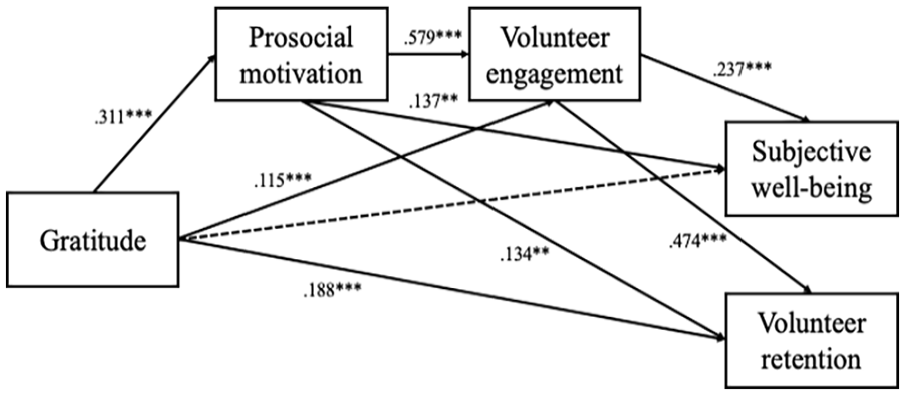
Paths and standardized path coefficients for hypothesized model.
Direct and Indirect Effects of Gratitude on Subjective Well-Being and Retention.

Note. G = gratitude; PM = prosocial motivation; VE = volunteer engagement; SW = subjective well-being; VR = volunteer retention.
Discussion
Our findings revealed that gratitude was positively associated with subjective well-being and volunteer retention through pathways involving prosocial motivation, volunteer engagement, and a sequential pathway from prosocial motivation to volunteer engagement. These findings confirm the positive effects of gratitude on individual and organizational outcomes and elucidated the related mechanisms of volunteering process. In the present study, gratitude was positively associated with subjective well-being and volunteer retention through prosocial motivation. This pathway is supported by previous findings that grateful people tend to exhibit prosocial motivation (Fredrickson, 2001) and that people with prosocial tendencies exhibit high levels of subjective well-being (Vecina & Fernando, 2013). Gratitude broadens people’ perspectives, and in this broadened state of mind, they focus on positive experiences and develop adaptive cognition (e.g., intent of helping others) and dispositional prosocialness, all of which can improve their self-evaluation, self-efficacy, and satisfaction with life (Cuadrado et al., 2016; Kwok et al., 2013; Li & Li, 2022). In the present study, in addition to subjective well-being, gratitude was revealed to associated with retention through prosocial motivation. This finding corroborates those of other studies that have reported the effects of positive emotions and prosocial motivation on retention (Cox et al., 2018; Jiménez & Fuertes, 2005; Y. Wu et al., 2016). Our finding indicates that grateful volunteers are more likely to develop prosocial motivation to support others; this contributes to sustained volunteerism because volunteers who are motivated by prosocial values tend to join organizations that reflect these values (Garner & Garner, 2011).
Our findings with regard to the indirect pathways involving volunteer engagement indicate that gratitude is associated with subjective well-being and volunteer retention through volunteer engagement. Consistent with the findings of other studies, which have indicated that gratitude is positively associated with active engagement in multiple domains (e.g., education and work) (Qing et al., 2021; Zhen et al., 2021), our findings revealed that gratitude motivates volunteers to engage in community service, devote themselves to volunteering activities, and commit to volunteering. This finding indicates that interpersonal mechanisms underlie the effects of gratitude on outcomes (Badri et al., 2022; Kersten et al., 2022). Gratitude helps individuals develop social bonds and improve their well-being, which leads to sustained volunteerism. Individuals who are inspired to feel grateful are highly likely to engage in prosocial activities and maintain relatedness (Tian et al., 2016; Yu et al., 2020). When such individuals become highly engaged in volunteering activities, they tend to find satisfaction in their lives, commit to volunteering, and continue volunteering (Alfes et al., 2016; Vecina et al., 2012). Our findings indicate that gratitude promotes prosocial behavior and helps to create positive experiences during volunteering, thereby enhancing volunteer well-being and leading to sustained volunteerism (Alfes et al., 2016; Chao et al., 2022; Komase, Watanabe, Sasaki, & Kawakami, 2021).
We identified one sequential pathway (prosocial motivation → volunteer engagement) in the indirect effects of gratitude on subjective well-being and volunteer retention. Volunteers with higher levels of gratitude exhibit higher levels of subjective well-being and intention to continue volunteering by activating prosocial motivation and volunteer engagement. This finding indicates that positive emotions promote volunteering process (Doidge & Sandri, 2019; Jiménez & Fuertes, 2005). Gratitude promotes prosocial motivation, volunteer engagement, and volunteer retention, which are key elements in the sequential stages of volunteering process (i.e., antecedents, experiences, and consequences) (Omoto et al., 2010).
Our findings are consistent with those of relevant studies on the association between prosocial motivation and engagement (a thought–action strategy) (Castanheira et al., 2016; Shantz et al., 2014). Volunteers who are altruistically motivated to help others tend to be highly engaged in volunteering activities and enjoy the positive experiences. Increased engagement can ensure that individuals gain positive feedback and perceive the importance of their contribution, which enhances their subjective well-being and ensures sustained volunteerism (Chao et al., 2022; Vecina et al., 2012). The findings of the present study contribute to the understanding of the mechanisms underlying the effects of positive emotions on individual and organizational outcomes in the context of volunteering.
Limitations and Future Research
The present study has several limitations. First, because of the cross-sectional design of our study, we could not identify any causal associations among the study variables. Accordingly, future studies should investigate such associations among key variables and the roles of prosocial motivation and volunteer engagement in mediating the associations between gratitude and volunteer outcomes at various levels. Second, the present study used only self-reported and retrospective data, which increased the risks of social-desirability bias, self-report bias, and common method bias (Podsakoff et al., 2012); a gap may be present between the measured beliefs and attitudes of individuals and their actual behaviors. To ensure the validity of our results and control for the effects of the aforementioned biases, future studies should employ different research methods (e.g., semi-structured interview) and data collection approaches (e.g., third-party reporting). Finally, because we only collected data from the residents of a single city in China, our findings may not be generalizable to other populations. In addition, the data were collected through an online survey, which may be a difficult format for older adults and may have been the reason for the absence of older adults in our sample. Because culture may influence how individuals experience and express gratitude (Tudge et al., 2015), the effects of gratitude on volunteer outcomes may vary across cultures. Therefore, future studies are warranted to validate our theoretical model in cohorts including people belonging to different age groups, organizations, and cultures.
Implications
Despite the aforementioned limitations, the present study has several key theoretical and practical implications. It elucidated the mechanism underlying the associations between gratitude and various consequences by simultaneously considering multiple levels of volunteering outcomes (personal and organizational resources). Our findings expand the broaden-and-build theory of positive emotions to the context of volunteering and reveal that gratitude promotes the development of the personal and organizational resources of well-being and volunteer retention through the volunteering process (i.e., prosocial motivation and engagement). Grateful volunteers tend to develop prosocial motivation and engage in volunteering activities, which in turn increase their life satisfaction and ensures sustained volunteerism.
In practice, voluntary organizations can promote volunteer well-being and sustained volunteerism by cultivating positive emotions, particularly gratitude, among volunteers. To improve the gratitude of volunteers and other related context-specific outcomes (Kersten et al., 2022), human resource managers should design programs and employ methods (e.g., gratitude journals, volunteer training, and mentoring programs) that increase the overall gratitude or specific gratitude toward an organization (O’Connell et al., 2018; Stegen & Wankier, 2018); such methods would improve the likelihood of positive personal and organizational outcomes. In addition, volunteer program managers should enhance the positive emotions of volunteers by assigning tasks that align with their interests and skills, imbuing tasks with meaning, acknowledging the initiative of volunteers, and expressing gratitude for their contributions (Jiménez & Fuertes, 2005). Nonprofit organizations should incorporate emotional elements into their mission statements, promotional materials, and communications to thereby encourage engagement in volunteer work (Paxton et al., 2020).
Footnotes
Declarations
This manuscript is not under review elsewhere and the results have not been published previously or accepted for publication. This manuscript has been seen and approved by all authors.
Declaration of Conflicting Interests
The author(s) declared no potential conflicts of interest with respect to the research, authorship, and/or publication of this article.
Funding
The author(s) disclosed receipt of the following financial support for the research, authorship, and/or publication of this article: This work was support by the Start-Up Fund of Beijing Normal University [310432101].
Compliance of Ethical Standard Statement
The questionnaire and methodology for this study was approved (approval number: 202109100042) by the research ethics committee of the Department of Psychology at the Beijing Normal University before data collection.
Consent to Participants
Informed consent was obtained from all participants included in the study.

Data Availability Statement
The data are not publicly available due to ethical, legal, or other concerns