




Abstract
This bibliometric study investigates the publishing trends and patterns along with top authors, countries, organizations, nature of collaboration, and sub-areas of library leadership literature published from 1959 to 2022. The Scopus database was used for data extraction, and 500 relevant records were selected. The data were analyzed using Microsoft Access, Microsoft Excel, VOSviewer, Biblioshiny, and CiteSpace software. The results highlighted that the United States of America was a global trendsetter in library leadership research, being the top contributing country (313, 62.6% publications). They also identified the top productive author (Martin, J.), top-cited author (Ole Pors, N), top organization (University of Punjab, Pakistan), most preferable sources (Journal of Library Administration) and top-cited article (“Supporting Digital Scholarship in Research Libraries: Scalability and Sustainability” by Vinopal J). The highest research productivity was recorded in 2019, with 42 publications (8.4%), followed by 37 (7.4%) publications in 2018 and 2021. Furthermore, 270 publications (54%) on library leadership were published during the last decade (2011–2020). This study informed that most of the published literature on library leadership was general, following a solo authorship trend (314), with less collaborative research (n = 186) and a significant number (n = 148) of non-cited documents. The critical areas of future research identified in this study, including transformational, ethical, participative, and humanistic leadership, need to be investigated. The study suggests that emerging digital and virtual leadership areas should also be examined along with the areas with limited literature. To the best of our knowledge, this is the first comprehensive bibliometric study to present a holistic picture of the library leadership literature.
Keywords
Introduction
Leadership has been a central element in libraries throughout the history of librarianship. Library leaders have been guiding libraries and helping them evolve to remain relevant and align with the changing needs of users since ancient times. They have faced various challenges, such as the evolution of written materials from parchment to papers, the printing revolution, the digital revolution, and now the technological revolution. Revolutionary leadership has always created opportunities to stay relevant throughout these changes. Nowadays, a library director/chief librarian/library dean is considered to be in a leadership position. Hernon and Pors (2013) opined that since the library is part of a large institution, a library director may be a leader within the library but not within the institution. Hence, a library leader plays a crucial two-fold role within the library and with the top institutional leadership to facilitate, manage, and fulfill the information needs of library users. Certain traits in these leaders help them to handle various situations amicably and to cope with the challenges presented by technology, budgetary constraints, identity crises, human resource challenges, leadership crises and users’ changing information behavior (Ashiq et al., 2018, 2019, 2021).
Although leadership in libraries is a long-standing phenomenon, there is limited literature available on the topic in librarianship (Ameen, 2006; Ashiq et al., 2019, 2021), with the majority of studies focusing on librarians’ challenges, issues, and skills, as well as racial or marginalization issues based on race, gender, and social class (Ashiq et al., 2021; Jaeger et al., 2016; Jones et al., 2022). The literature has also not adequately captured the emergent trends and developments in library leadership, especially in light of digital advancements and changing user expectations (Kennedy, 2018; Koltay, 2019). Moreover, there has been insufficient study of the intersection of leadership and diversity, particularly in the context of bringing change and innovation in libraries (Jaeger et al., 2016), highlighting the need for research that examines the experiences and challenges encountered by leaders from diverse backgrounds. In addition, the continuous and ongoing transition of leadership to digital leadership has transformed traditional library leadership practices to effectively manage and leverage digital technologies (Okuonghae & Achugbue, 2022; Shahbazi & Hedayati, 2016). It entails adapting leadership strategies, abilities, and a digital mindset to cope with the challenges and opportunities presented by the digital age, related specifically to bibliometric studies on library leadership. There are few journal-specific bibliometric studies on leadership, management, and organizations (Singh & Chander, 2014; Zupic & Čater, 2015) and only one bibliometric study on library leadership (Srirahayu et al., 2020). Åström and Hansson (2013) conducted a survey and explored the effects and role of bibliometric practices in Sweden. They reported that implementing bibliometric practices is a step toward expanding the traditional service role in academic libraries. This role is helpful for library users and widens the profile of information professionals. Srirahayu et al. (2020) conducted a bibliometric study on academic library leadership using Scopus databases. The data were searched from the titles using keywords such as “leader*academic library.” The study found 71 relevant articles from 1981 to 2019. However, the search term used in the study was quite limited and narrow. It covered only a few aspects of leadership and could not obtain the maximum and most relevant results. Addressing these gaps would improve our comprehension of leadership in the library and information science profession, which would inform future research, policies, and practices in this field. Critical bibliometric aspects include authorship patterns, research collaborations, productive organizations, primary factor analysis/relationship, and author networks. The analysis based on citation, co-citation, and co-occurrence analyses was completely missing from the study. Furthermore, no bibliometric tool was used for advanced and interesting analysis.
Singh and Chander (2014) conducted a bibliometric study on the publication trends of the scholarly journal “Library Management” from 2006 to 2012. The study revealed that the single-author authorship pattern prevailed in 190 (56.55%) out of 336 articles. The top three contributing countries were the United States of America, Australia, and the United Kingdom, with 59, 46, and 41 articles, respectively. They also highlighted that most of the published papers were related to library management, library services, knowledge management, human resources management, and staff professional development. Furthermore, most contributions were from universities (267, 79.64%) and colleges/institutes (26, 7.43%). Single-digit frequencies were reported from national, special, and government departments and associations. A need was highlighted for conducting a bibliometric study using a comprehensive search strategy to understand the long-standing phenomena and research trends of library leadership. Hence, this study examines the publishing trends, research patterns, and top researchers/institutes/countries producing research on library leadership. The study also highlights the literature on library leadership’s publishing and lacking trends.
Research Questions
i. What are the publishing and citation trends on library leadership?
ii. What are the most influential authors, countries, organizations, and journals producing research on library leadership?
iii. What are the authorship, collaboration patterns, and highly cited articles on library leadership?
iv. What keyword analysis informs about the type of research being conducted on library leadership?
Literature Review
Leadership is the most explored area of research in the social sciences (Gill, 2006) and is often used in the management sciences. According to Stogdill (1974), several definitions of leadership have been put forth by many authors, but a cohesive understanding of the topic has yet to be developed. Leadership has been applied in various disciplines, subjects, and fields over time, and this contextualization has been affected by the situation’s environment, culture, context, and needs (Giesecke, 2007; Riggs, 2001). Moreover, the concept of leadership is subjective in nature, uncertain, and multidimensional (Brundy, 2018; Harrison, 2018; Hicks & Given, 2013; McMenemy, 2008; Rost & Burns, 1991; Wong, 2017). Rost and Burns (1991) investigated more than 100 definitions of leadership. They reported that leadership is based on some preferred traits and competencies that influence the followers toward achieving the mutual goals of the organization. According to Ryan (2010, p. 2), “Leadership is like a muscle; the more you train, the stronger you get.”
Understanding Leadership in Librarianship
Library leadership encapsulates the notion of a person serving as the head of the library and directing the staff to perform various library-related tasks and activities, predominantly for the benefit of library patrons. Leadership is regarded as the central and most important factor in determining professional success. However, leadership in librarianship needs to be more emphasized, practiced, and revered in the discipline (Ameen, 2006; Ashiq et al., 2018). Effective and visionary leadership has become a global concern for the LIS profession (Ashiq et al., 2021; Wilson & Corrall, 2008). The headship approach still dominates the concept of leadership in librarianship. There is a lack of a comprehensive understanding of the concept due to its multifaceted, multidimensional nature and the rapidly changing environment (Wong, 2017). Hernon (2017) has defined the term “leadership” as referring to a person who instructs team members in a group, leads, influences, manages change, inspires, empowers, and sets examples for the accomplishment of common objectives.
Despite this complexity, library leadership is a topic of growing interest among professionals, and LIS professionals anticipate that the demand for effective leadership skills will increase in the coming years (Hicks & Given, 2013; Saleem & Ashiq, 2020). Library administrators play a crucial role in enhancing an institution’s operations and services. Digital information sources have supplanted the libraries’ monopoly on authentic information sources. However, libraries continue to support their users’ learning and scholarly communications (Adil et al., 2022). The primary function of librarians is to connect information consumers with information sources, which remains unchanged (Williamson, 2008). In this transition period, the library’s executives serve as the trendsetters for the staff. In the 21st century, a successful leader shares power, develops strong relationships, involves employees in decision-making, motivates them, and focuses on the organization’s goals and objectives (Bolin, 2022; Saleem & Ashiq, 2020). Winston and Patterson (2006) define a leader as a person who trains, equips, influences, and motivates followers to achieve mutual objectives. “Leadership is not a singular entity; it can arise from a variety of sources and assume a variety of forms. It is not an abstraction, but rather a trait rooted in individuals who provide its vitalizing energy and direction” (Mariz et al., 2011). Multiplicity is the essence of leadership, but leaders also possess certain qualities that make them leaders. A leader is collaborative, has knowledge of the organization’s structure, knows his employees, and comprehends the environment. A leader is also self-aware and self-critical, always moving forward and never retreating. The leader of today and tomorrow contemplates constant change, comprehends it, accepts it, and takes it into account in technology, environment, human, organization, and technical development. Aslam (2018) defined a library leader as a visionary who anticipates future requirements, trends, and user demand and plans accordingly to achieve this vision.
Change, Innovation, and Leadership in Libraries
The “change” has been the most discussed topic in the LIS field for the past two decades. New technologies and the spread of trade worldwide have brought on this change. The 21st century has changed how information is made and shared, resulting in a major paradigm shift in the field of library and information sciences. Ashiq et al. (2021) and Wong (2017) stated that globalization, different types of users, and digitization have changed how libraries provide services. Stewart (2017) investigated the research on library leadership since the year 2000 and reported that the libraries were going through a “period of accelerated change” (p. 2). Ashiq et al.’s (2021) review of the literature on library leadership showed that leaders needed to be visionary, creative, and have good communication and social skills to support a collaborative and flexible culture in their institutions. Overall, these changes are an expansion of library services and librarianship. Just like when books written on stone, leaves, parchment, and clay were replaced by printed paper in the printing revolution, they are now made available online through a shift in technology. Libraries are now getting bigger and changing.
The library leadership has a pivotal role in managing this change and ensuring that the libraries stay relevant and meet the needs of their users. They can achieve this by encouraging innovation and vision. The person in charge of a library is the one who inspires and pushes the people who work there to serve the needs of modern library users. Since the name of the job is changing, so is the role of the people in charge of libraries. Similarly, Wong and Chan (2018) pointed out that the rapid growth of technology poses difficult problems for university libraries that cannot be fixed with ready-made solutions. So, it is important to discover new ways to address these problems by giving library leaders new roles. There needs to be a user-focused, creative, and collaborative culture to serve diverse and modern library users. Overall, this change moves leadership toward digital leadership, which means that the standard leadership roles and practices in libraries are being changed, spurred by digital technologies and resources. It includes the use of digital tools, methods, and skills needed to make library services more innovative and open to everyone in the digital age. In order to be a digital leader in librarianship, librarians need to be able to handle and organize digital collections. They also need to be able to use technology strategically in all parts of the operation of the library, user engagement, and library services. It takes librarians to change their way of thinking and learn new skills so they can adapt to the changing information landscape and meet the changing needs of library users in a digital society.
Methodology
Bibliometric analysis was applied to investigate the publishing trends and patterns in library leadership literature worldwide. In this regard, the Scopus database was chosen to extract the relevant data on library leadership. Scopus is the largest indexing and abstracting global database of scholarly literature. Additionally, Scopus can provide complete bibliometric data via a simple extraction process, suitable for a comprehensive bibliometric analysis. A comprehensive search strategy was framed, limiting to “authors” keywords and title fields to extract the maximum and relevant data. The following search query was used in the title and author keyword fields of the advanced search option of the Scopus database:: ( AUTHKEY ( “leadership” OR “leadership skills” OR “leadership challenges” OR “leadership development” OR “leadership training” OR “leadership traits” OR “leadership attributes” OR “library leaders” AND “Library” OR “academic library” OR “University Library” OR “College Library” OR “public library” OR “national library” ) ) OR ( TITLE ( “leadership” OR “leadership skills” OR “leadership challenges” OR “leadership development” OR “leadership training” OR “leadership traits” OR “leadership attributes” OR “library leaders” AND “Library” OR “academic library” OR “University Library” OR “College Library” OR “public library” OR “national library” OR *libraries* ))
The query resulted in 542 total records. The query was limited to document type and included only articles, reviews, books, book chapters, and conference papers. Irrelevant document types (30 records), such as editorials, short surveys, notes, and errata, were excluded as these types of documents did not go through a peer-review process. Furthermore, only the literature in the English language was selected for this study. The authors also did not put any filters based on the type of library, languages, or time to achieve a comprehensive view of library leadership. The bibliographic information of these records (507) was retrieved on 21st May 2022 for scrutiny. Two researchers (one after one) read the title and abstracts of all the records. The third author again repeats this process to ensure the relevancy and reliability of the data. This practice helped to discard seven irrelevant records. Finally, 500 records were selected for data analysis and visualization. The data analysis was performed using Microsoft Access, Microsoft Excel, VOSviewer, Biblioshiny, and BibExcel software. The variations found in the names of affiliated organizations, authors, source titles, and countries were unified to achieve the accuracy and consistency of facts and figures.
Data Analysis and Findings
There are specific terms used at various places in the data analysis section. T.P. refers to total publications, T.C. refers to total citations, PNC means publication not cited, TCP stands for total cited publications, C/P is average citations per publication, C/CP represents the average citations of cited publication, and IF is the impact factor.
Major Document Types on Library Leadership Literature
The data analysis reveals that the research article has been the most popular document type, with 410 (81.12%) publications,2,218 citations, and 5.41 average citations per document. The review research papers have been the second significant document type with 48 (11.27%) publications, 402 citations, and 8.38 average citations, followed by book chapters with 27 publications and 16 citations, conference papers with 9 publications and 11 citations, and books with 6 publications and 17 citations.
Yearly Publishing Trends
Figure 1 shows the chronological distribution of global library leadership literature from 1959 to 2022. There were 500 publications, with an average growth of 7.81 publications per year. The first research paper on library leadership was recorded in 1959. The second research paper was published in 1981 after a significant gap of 21 years, followed by the third and fourth publications in 1987 and 1990, respectively. The highest research productivity was recorded in 2019, with 42 (8.4%) publications, followed by 37 (7.4%) publications in 2018 and 2021. Interestingly 270 (54%) of total research on library leadership has been published during the last decade (2011–2020). Moreover, this millenium has witnessed significant growth in the library leadership literature as 471 (94.2%) documents have been published from 2001 onward. A similar pattern has been observed with regard to the citations. They have been increasing continuously since 2001. The maximum number of citations (n = 197) was recorded in 2011.
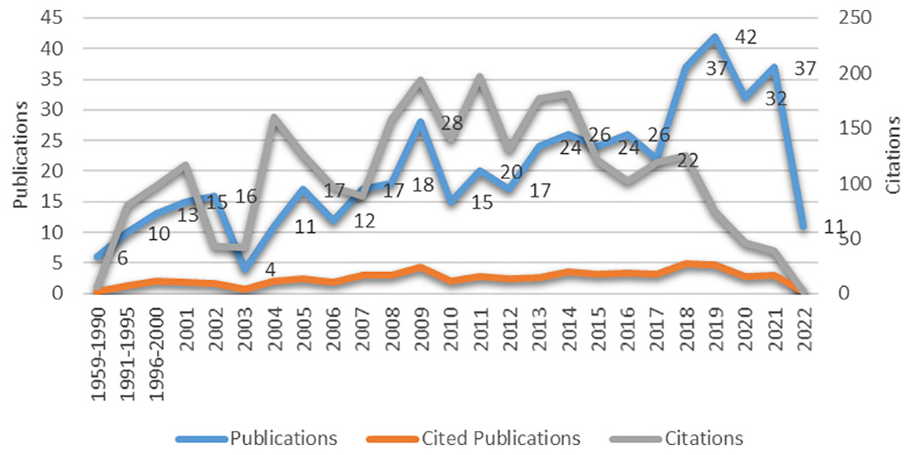
Chronological distribution of library leadership publications and citations.
Prolific Authors on Library Leadership Scholarly Literature
Table 1 reveals the top-ten most prolific authors, their affiliations, and their citation scores. Author “Martin J” from Middle Tennessee State University, USA, is first on the list with 10 publications and 54 citations, closely followed by Fitzsimmons G. from Bryan College, Dayton, USA, with nine publications and 22 citations. On the other hand, Ashiq M from Islamabad Model College for Boys, Pakistan, is the third most productive author in the library leadership domain with six publications and a citation score of 39. Ole Pors N received the highest citation score of 86 and an h-index of 5, followed by Gustav Johannsen from the University of Copenhagen, Denmark, with 70 citations and an h-index of 4, and Mahmood, K with 55 citations and an h-index of 3. Five authors, ranked sixth to tenth, produced only four publications each. Notably, all prolific authors have a significant period between their first and most recent publication, except Aslam M, though ranked last on the list, has produced four publications in 2018–2019.
Most Prolific Authors.

Note. TP = total publications; TC = total citations; FPY = first publication year; RPY = recent publication year, PlumX metrics (elaborated under “data analysis” and “finding”)
Highly Productive Countries
Table 2 depicts the top 10 highly productive countries in terms of publications. There are three countries with over 20 publications. The United States of America is at the top of the list with 313 publications (62.6%),17,191,269 citations, and 5.49 average citations. However, out of these 313 publications, 89 items have not been cited yet. The United Kingdom stands in the second position, with 27 publications (5.4%), 182 citations, and 6.74 average citations, followed by Canada with 25 publications (5.0%), 142 citations, and 5.68 average citations. It is interesting to highlight that Denmark has produced only nine publications; however, it has the highest average citations (11.78%). In contrast, India is at the bottom of the list, with eight publications and only five citations.
Top 10 Highly Productive Countries.

Note. TP = total publications; TC = total citations; PC = publications cited.
Highly Productive Organizations
Table 3 highlights the top 10 prolific institutions globally in library leadership research. The University of the Punjab, Pakistan, has produced 11 research papers with 84 citations and an average citation score of 7.64. It is closely followed by the Middle Tennessee State University, USA, and Simmons College, USA, with 8 papers each and 33 and 124 citations, respectively. Simmons College, USA, has accumulated the highest citations (124) and average citation score (15.50). Among the 10 most productive organizations, a significant number of the organizations (5) are American. It indicates that the USA is leading in the library leadership research domain. Results in Table 2 also support this finding.
Top 10 Highly Productive Organizations in Library Leadership Research.

Note. TP = total publications; TC = total citations; PlumX Metrics (elaborated under “data analysis” and “finding”).
Preferable Publishing Source
One hundred twenty-five sources/journals have published 500 scholarly publications in the library leadership domain from 1959 till 2022. Almost half of the (246 of 500, 49.2%) publications have been published by the top 10 sources (Table 4). Further, 346 of the 500 (69%) papers have been published by the top 25 journals/sources. The analysis shows that the Journal of Library Administration is at the top of the list with 63 publications, 524 citations, a 1.6 cite score, and an h-index of 13, followed by the Library Management with 53 publications, the highest citations (551), a 2.0 cite score, and an h-index of 13. Interestingly, all sources listed in Table 3 are either affiliated with the U.K. (5) or the USA (5).
Top 10 Most Preferred Journals in Library Leadership.

Note. TP = total publications; TC = total citations; IF = impact factor; PlumX metrics (elaborated under “data analysis and finding”).
Authorship Pattern in Library Leadership Literature
The data analysis shows that the single authorship pattern is prevalent, as 62.8% (n = 314) of the research papers have been published by a solo author, followed by two authors (n = 108, 21.6%), three authors (n = 47, 9.4%), and four authors (n = 20, 4%). Collectively 831 authors have contributed 500 papers to the library leadership literature. The highest average citation per publication of 7.02 is recorded for a two-author collaboration, followed by three-authorship (6.15) and single authorship (4.85).

Countries Collaboration Network
Figure 2 highlights the world collaboration map for the library leadership literature published globally. There have been 74 collaborations worldwide in this research area. Figure 2 illustrates the top 15 collaborations in the library leadership literature. Regarding research collaboration with one country, the maximum collaboration in five papers has been observed between Saudi Arabia and Pakistan. It is followed by three collaborations between Hong Kong and Japan, Jamaica and Trinidad and Tobago. On the other hand, in terms of research collaborations with different countries, the USA has produced 10 papers with Australia (2), Canada (2), Hong Kong (2), Japan (2), and the U.K. (2). Likewise, the United Kingdom (U.K.) has 10 research collaborations with five countries; two research collaborations each with Denmark, Germany, Romania, Spain, and the USA. Overall, there have been limited collaborative publications in library leadership.
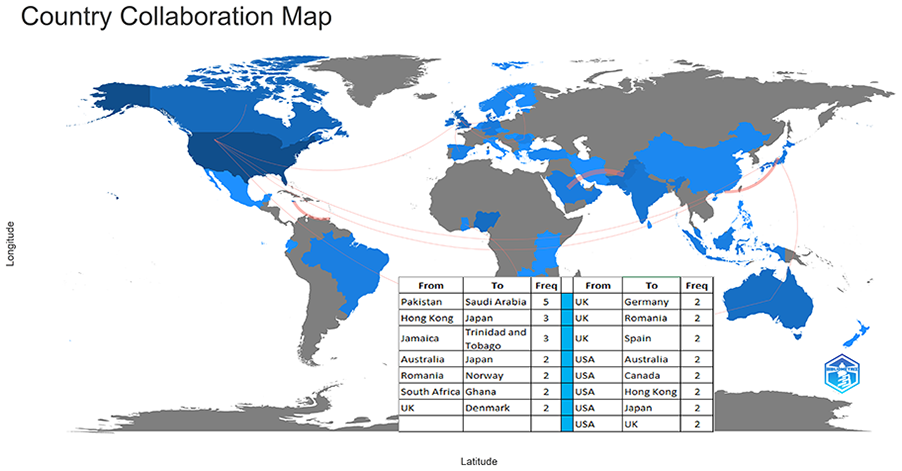
Country collaboration network on library leadership literature including top 15 collaborations.
Highly Cited Articles
Table 5 exhibits the top 10 highly cited papers on library leadership. The articles with a maximum of 63 citations to a minimum of 29 citations have been published between 1994 and 2013. Six articles were published in two journals, the Journal of Library Administration (3) and Library Management (3), followed by two in Library Trends (2) and one each in College and Research Libraries and Reference Services Review, respectively. The article “Supporting digital scholarship in research libraries: Scalability and sustainability,” authored by Vinopal J., appeared in the Journal of Library Administration in 2013 and ranked first among all highly cited articles with 54 citations. It is followed by the article written by Mason F.M. entitled: “Learning To Lead: An Analysis of Current Training Programs For Library Leadership” with 52 citations and published in Library Trends in 2004. Similarly, “Should Your Library Have an Innovation Strategy?” by Rowley J and “Relationship Among Leadership Style, Organizational Culture and Employee Commitment In University Libraries” by Awan MR appeared in Library Management in 2011 and 2010, respectively. Both received a citation score of 45. However, the data analysis does not show any logical pattern of citation accumulation.
Top 10 Highly Cited Articles.

The authors’ keyword table depicts the 25 most prominent keywords based on their occurrence (Table 6). The table also shows how the different subject areas have evolved over three decades. Leadership has been observed as the most prominent research area, with 209 occurrences. Similarly, “academic libraries,”“libraries,”“library management,”“management,”“public libraries” and “library leadership” are the other research areas that have received significant attention in the library leadership literature. However, during 1995 to 2000, “leadership” was the only research domain that received some attention. On the other hand, professional development, leadership style, transformational leadership, leadership development, library leaders, succession planning, organizational change, and mentoring are some areas that need further attention and could be potential future research areas.
Authors’ Keyword Analysis.

Figure 3 illustrates the keyword analysis of library leadership literature. A minimum of seven occurrences of seven keywords were selected. Of 904 keywords, 31 meet the threshold based on their occurrences and total link strength. These 31 keywords consisted of five clusters. The color of the clusters indicates the associational link with other keywords. The keyword “leadership” emerged as the most used keyword (occurrence: 209; total link strength: 326), followed by academic libraries (occurrence: 80; total link strength: 148) and libraries (occurrence: 49; total link strength: 76).

Authors’ keyword analysis relationship through VOSviewer software (minimum number of occurrences: three) consisted of seven clusters.
Additionally, Figure 4 shows the latest keyword trends in library leadership literature (1959–2009, 2010–2017, and 2018–2022). The latest trends show that the keywords “leadership,”“academic libraries,”“library management,”“management,” and “library leadership” have been the dominant research topics in the library leadership literature.

Top 10 authors’ keywords covering three durations (1959–2009, 2010–2017, and 2018–2022) generated through ScientoPy software.
Three-Factor Relationship Model (Countries, Authors and Keywords)
Figure 5 presents the relationship between three significant factors of the library leadership literature. It shows the associational link among major contributing countries (left), authors (center), and their preferred keywords (right). The five authors (Fitzsimmons G, Ole Pors N, Lo P, Linehan M, Ashiq M, and Rahman SU) from four major countries (USA, Pakistan, Denmark, and Ireland) have a strong relationship. Furthermore, they prefer to publish work on library leadership with seven keywords (leadership, library management, academic libraries, libraries, public libraries, librarians, and library leadership).
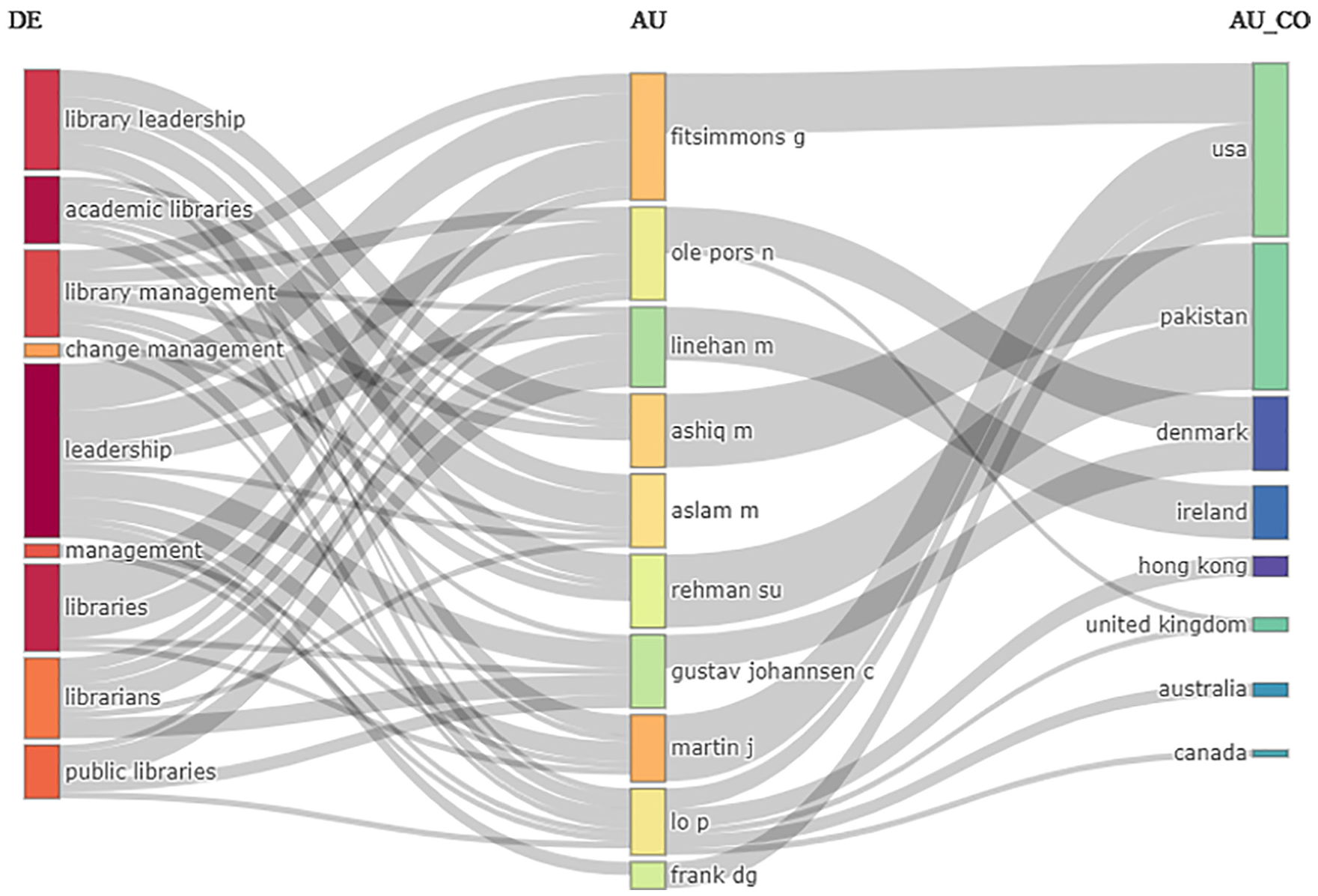
Three field plot of countries (left), authors (center), and keywords (right) on library leadership literature generated through Biblioshiny software (RStudio).
Discussion
This bibliometric study aimed to examine the publishing trends and patterns seen in the literature on library leadership. The Scopus database was chosen for this purpose. The study framed a comprehensive search strategy and extracted bibliographic and quantitative data from 500 records indexed in Scopus.
Publishing and Citation Trends on Library Leadership Research
It was found that the research article (410 publications and2,218 citations) was the most prominent document type in library leadership literature out of five major document types (article, review, book chapter, conference proceedings, and book). However, review articles obtained higher average citations than the articles (8.37 per document by review and 5.41 by the article). It indicates that researchers preferred to publish their findings in articles, but the review articles had a higher impact on the scholarly community in the library leadership domain. This finding is supported by earlier studies (Khan et al., 2020; Mahmood et al., 2021), which reported that review articles obtained higher citations because they summarized the results from various studies.
The first publication on library leadership was indexed in Scopus in 1959. After a substantial gap, the second publication was indexed in 1981, followed by the third and fourth in 1987 and 1990, respectively. After that, increasing publishing trends have been observed in library leadership literature (Figure 1). The first two decades of the 21st century highlight a remarkable growth in library leadership research, as around 94% (n = 471) of publications appeared in that duration. Likewise, the citations in library leadership have continuously increased, especially between 2004 and 2018. However, there were limited publications on library leadership worldwide. A total of 500 publications over 60 years is not outstanding. Various studies have reported that leadership in librarianship remains a neglected area of research (Ashiq et al., 2021; Hicks & Given, 2013; Saleem & Ashiq, 2020; Wong, 2017). Some studies have reported that library leadership remains sacred (Ameen, 2006). Limited research has been done on this vital area of research (Ashiq et al., 2019, 2021). One reason could be that the library is part of an institution, and a library director may be a leader in the library rather than in the institution or group. Moreover, library directors / chief librarians are not considered leaders as they are not the sole head of the institutions. Libraries are part of larger institutions, and library leaders must convince the higher authorities before taking any significant steps in the libraries. Since the advent of the 21st century, which has heralded a global technological revolution, most LIS researchers have focused on the effects of the technological revolution on librarianship. However, it is crucial to understand that only leaders can change and transform organizations and individuals.
Top Countries, Authors, and Organizations
The United States of America was identified as the major contributing country (USA), with the top productive author (Martin, J.), top-cited author (Vinopal J; and Mccormick M), most preferable source (Journal of Library Administration) and top-cited article (Supporting Digital Scholarship in Research Libraries: Scalability and Sustainability). Pakistan had the top organization (University of Punjab, Pakistan) from a developing nation. These results have highlighted the USA as the global trendsetter in library leadership research. The top 10 countries’ data has revealed that the top five countries, the USA, UK, Canada, Nigeria, and Australia, contributed more than 79% of the publications (398 out of 408). In contrast, the USA alone contributed 62.6% (246) of the publications. Singh and Chander (2014) discovered that the top three contributing countries to library leadership publications were the USA, Australia, and the United Kingdom, with 59, 46, and 41, respectively, in one of the core journals of library leadership (Library Management Journal). It indicates that developed countries have been publishing most of the research on leadership. However, developing nations such as Nigeria and Pakistan are emerging countries actively publishing library leadership literature.
Denmark has contributed only nine publications, but its average citation rate (11.78 per document) is better than any other country (American articles have 5.49 average citations per document). The primary reason behind the low citations of American publications was the presence of the highest number of non-cited documents (PNC = 89). It is quite surprising as this is the highest number (PNC = 89) compared with the documents produced by any other country. This has revealed that visibility and easy access to scholarly literature is crucial to sharing ideas, international collaboration with peers, and obtaining citations.
One hundred twenty-five sources/journals have published 500 scholarly publications in the library leadership domain from 1959 to 2022. The publications ranged from a maximum of 110 from the top 10 organizations to a minimum of five publications. The University of the Punjab, Pakistan, has emerged as the top-performing organization, with 11 publications and 84 citations. Overall, this is a low publication count from any organization, especially when the coverage period is more than 60 years. This finding supports the results of earlier studies that leadership has been a neglected area. Furthermore, leadership in the digital era has rarely been a research focus. Researchers consider this fact as one of the main reasons that libraries are lagging in bringing transition and change in libraries to cater to the modern needs of library users (Ashiq et al., 2021). Digital leadership is the ability to successfully lead and navigate the digital age by using technology, digital tools, and data to drive organizational change, innovation, and success (Okuonghae & Achugbue, 2022). Digital leaders know much about digital technologies, their effect on library strategies, processes, and how users feel about them (Shahbazi & Hedayati, 2016). They show that they know how to use digital tools and platforms, analyses and data insights, and adapt to rapid technological changes (Okuonghae & Achugbue, 2022; Shahbazi & Hedayati, 2016). To be a digital leader, a library leader needs to help their organization develop a digital attitude and a culture open to change, collaboration, and continuous learning.
Additionally, the researcher’s top 10 preferable sources to publish their work on library leadership belonged to only two countries, the USA (5 sources) and the U.K. (five sources). The Journal of Library Administration was the top source, with 63 publications. However, only two impact factor sources were found at the fifth and tenth rank [Journal of Academic Librarianship (IF = 1.24) and Library Trends (IF = 0.84)], respectively, in the top 10 list, and had significant average citations (Table 5). It has highlighted that writing in journals with a high impact factor is the best way to garner more citations and improve exposure to the vast global research community (Gul et al., 2020; Rashid et al., 2021).
Authorship and Collaboration Patterns
The authorship patterns in the library leadership scholarly literature informed that the single-author pattern dominated with 314 publications, followed by two authors (108 publications) and three authors (47 publications). It shows that most researchers investigating library leadership disliked collaborations. Singh and Chander (2014) studied authorship patterns and reported that the single-author pattern had prevailed, with 190 articles (56.55%) out of the 336 articles published in the Library Management Journal between 2006 and 2012.
Interestingly, documents emerging from collaborative research had more citations than those authored by a single author. The average citation of two authors’ publications was 7.0 per document, followed by three authors (6.15 per document) and single-author pattern documents (4.85 citations per document). Furthermore, there was poor collaboration on library leadership literature at the countries’ level. The United States of America has been the most prolific contributor to research in this domain, with a remarkable number of publications (246, 62.6%). However, it is ranked 11th in the world collaboration network (Figure 2). It demonstrates that the co-authors in most of the American publications were also American. The top collaboration occurred between Pakistan and Saudi Arabia (frequency = 5). This meager number of publications demonstrates and emphasizes the need for increased collaboration between institutes and nations and the exchange of ideas among contemporary researchers worldwide.
Keywords and Sub-areas of Leadership Research
Nine hundred four authors’ keywords were identified for the 500 documents of library leadership literature. Most of the work on library leadership has focused on academic libraries. The top three sub-areas were leadership (frequency = 209), academic libraries (frequency = 80), and libraries (49), respectively. It indicates the limited literature on library leadership and, more importantly, that the published work was general in nature. The frequencies of keywords in the following areas showed that several sub-topics of leadership in librarianship had been ignored. These include areas such as leadership development (11), “succession planning” (9), “Training” (9), “organizational change” (8), “Mentoring” (8), “Change Leadership” (8). Some studies informed that the leadership styles in libraries were autocratic (Rafiq Awan & Mahmood, 2010); hence, the innovative ideas from the staff were not usually incorporated or appreciated. Some crucial areas/leadership styles still need to be explored, such as transformational, ethical, and participative leadership. Digital and virtual leaderships are other evolving research areas in business research and should be addressed in librarianship. Humanistic leadership is another important area for library leadership. According to Ashiq et al. (2019), a humanistic approach is a belief based on values that informs the issues, and problems with subordinates can be resolved through sympathy, dialog, and understanding.
Implications of the Study
Theoretical Implications
The study demonstrates that library leadership remains an under-researched subfield within library and information science (LIS). The results highlight the need for increased scholarly attention and investigation of leadership in the library context, particularly transformational, participatory, ethical, and humanistic leadership. These areas highlight the significance of leadership styles that promote positive change, encourage collaboration and employee participation, promote ethical decision-making, and prioritize the well-being of library staff and users in light of the changing needs and expectations of the library profession.
Overall, the United States of America has emerged as a global leader in library leadership research, indicating the importance and influence of American contributions to this field. This recognition further enlightens and recommends joint research projects among international researchers and practitioners, promoting cooperation and knowledge exchange among developed and developing countries. The study identifies research gaps, such as the absence of collaborative research on library leadership, the dominance of single-author publications, and the limited number of country-level collaborations. Effectively addressing the complexities of library leadership necessitates collaborative research efforts and multidisciplinary approaches, which are highlighted by these disparities.
Practical Implications
This study emphasizes incorporating transformational, ethical, participatory, and humanistic leadership practices into library leadership professional development programs. Libraries can create positive transformation, collaboration, ethical decision-making, and employee well-being by concentrating on these characteristics, improving overall organizational success.
Current library leaders and mid-career library professionals aspiring to leadership positions must adapt to the digital age by gaining digital leadership competencies. Libraries should invest in training programs and resources to assist leaders in efficiently navigating and leveraging technology, ensuring that digital transformation is aligned with strategic goals and improves library services. The study advocates filling gaps in the research through practical activities. Library organizations can help and encourage scholarly collaborations to examine underserved areas of library leadership. Organizations can promote the exchange of knowledge, best practices, and new approaches to leadership within the profession by supporting joint research activities.
Limitation and Future Research Direction
The current study is limited to one indexing and abstracting database (Scopus) and keywords used while framing search queries. It should be noted that even though Scopus is a comprehensive and extensive database, it does not represent all published literature on the topic. Other indexing and abstracting databases may yield more significant results/records on library leadership literature published globally.
Some sub-areas of leadership with limited literature should be further explored, such as transformational, ethical, and participative leadership. The neo-emerging areas like digital leadership and virtual leadership should also be examined in the library and Information Science (LIS) discipline, as some universities have multiple satellite campuses. Digital and virtual leadership could be significant areas of future research. Humanistic leadership is another crucial area for future research.
Conclusion
This bibliometric study has found 500 documents indexed in the Scopus database on library leadership, published over 60 years (1959–2022). This fact reveals that library leadership is a neglected area of research in the LIS discipline. The United States of America emerged as a global trendsetter in this area of research. The USA has been the most prolific contributing country with the highest number of publications (313, 62.6%), top productive author (Fitsimmons G), top-cited author (Hernon P), leading organization (Simmons College, USA), most preferable source (Journal of Library Administration), and top-cited article (Supporting Digital Scholarship in Research Libraries: Scalability and Sustainability). The results of the study also highlight the limited nature of collaborative work on library leadership. The single-author pattern was the most prevailing authorship pattern, with 314 publications out of 500. There were only 74 entries of country-level collaboration. Pakistan and Saudi Arabia (frequency = 5) had the most collaborations. It reveals the need for collaborative research on library leadership, primarily focusing on transformational, ethical, participative, and humanistic aspects of leadership. Some neo-emerging areas like digital and virtual leadership also have an enormous scope for collaborative research within and among countries. The authors found some review articles on library leadership and one bibliometric study examining some aspects of academic library leadership.
Moreover, no previous study has conducted a comprehensive bibliometric analysis of the published literature on this topic. Thus, our findings provide a baseline against which the future development of library leadership can be assessed. Moreover, we hope our findings can guide future research on various aspects of the topic.
Footnotes
Acknowledgements
The authors would like to thank AlMaarefa University, Riyadh, Saudi Arabia, for supporting this research.
Declaration of Conflicting Interests
The author(s) declared no potential conflicts of interest with respect to the research, authorship, and/or publication of this article.
Funding
The author(s) disclosed receipt of the following financial support for the research, authorship, and/or publication of this article: The authors would like to express their gratitude to AlMaarefa University, Riyadh, Saudi Arabia, for providing funding to do this research.
