




Abstract
The article focuses on leadership challenges in adaptation to Information and Communication Technologies (ICTs) in African libraries. It identifies and discusses the need for adequate leadership styles and behavior in the bid to adapt effectively to new technologies. Online survey, observation arising from personal professional practice experience, personal communication, and interview methods were used to gather data for the study. Older library professionals, many of whom are still very visible across the leadership strata of libraries, were found to exhibit diverse attitude to the adaptation to ICTs deployment and use in their libraries. Some library leaders and older generation professionals were discovered to react somewhat negatively to changes in technology used in their libraries, preventing the younger professionals from performing to full capacity, and generally showing nonchalance to new technologies. Proper training and retraining, mentoring, and harnessing the synergy of ideas, with respectful communication from new generation library professionals, was found to be desirable. Change management workshops and implementation of standard ethics of the profession are recommended, while emphasis is put on the need for library professionals to overcome their technophobia and take leadership in adapting to move the library and information profession forward.
Keywords
Introduction
Utilization of Information and Communication Technologies (ICTs) brings about challenges to information access in libraries, and requires librarians to learn and apply new skills on a daily basis, other than the traditional one of flipping through card or book catalogs, registering library users manually, charging and discharging library materials in and out at the circulation desk and answering reference queries. The more usual services nowadays are provided electronically or online through Online Public Access Catalogs (OPACs), online registration of users, reference services, and so on. The nature of the roles of librarians is therefore changing, and so are the professional codes of ethics.
New skills necessary are those of negotiating license agreements, database management, computer literacy, and a host of others. Along with traditional ethical conflicts, libraries are faced with the new challenges of providing equitable access to their library collections’ (Haliso, 2011; Ikem & Ojo, 2003). The fact that librarians have been early adopters of technology which has increased their ability to provide services to their patrons has been reiterated by Mathews and Pardue (2009). These skill sets are evolving with the technology required. Library professionals are sometimes reluctant to change from their normal routines especially when the change involves using new technology (Adekunle, Omoba, & Tella, 2007); yet, human resources are a key factor that should be developed in the change to new ICTs in libraries.
In African libraries, there is lack of adequate infrastructure to support new technology, poor funding for new technology acquisition, and low technology use. In addition, leadership issues keep cropping up in libraries as the different leadership styles of the managers of the library keep affecting staff who have to keep adjusting to each successive leader. As a matter of fact, the claim is that libraries have been “over-managed and under-led” (Riggs, 2001).
The quality of leadership in libraries can contribute to employees’ satisfaction level (Leysen & Boydston, 2009) and different leadership styles make or mar the library. Shared leadership and teambuilding as leadership strategy (Cawthorne, 2010) is considered ideal by some scholars, while others, however, see library leadership as more of having the ability for being persuasive of those they lead (Aho & Bennet, 2010). Duren (2013) researched library leadership and concluded that transactional and transformational leadership styles are effective, especially with leaders employing competent communication skills. In addition, Management by Objectives as a participative method can support the handling of major changes (Duren, 2013).
Leadership behavior is another issue that has been explored. Leadership behaviors according to Raimi-Akinleye (2010) are of four types—directive clarifying leader behavior, supportive leader behavior, participative leader behavior, and achievement-oriented behavior—and they are needed to bring about employee engagement and satisfaction. Directive clarifying leader behavior is directed toward followers’ expectations and is used to give specific guidance and clarify policies, rules, and procedures. Supportive leader behavior is geared toward followers’ needs and preferences and is expressed in the leader showing concern for followers’ welfare and creating a friendly supportive work environment. Participative leader behavior encourages participation of followers in decision making and work-unit operations, seeking the opinion of followers. Achievement-oriented behavior is geared toward performance and encourages excellence in performance, making the followers more assertive and striving for higher standards.
Because leadership behaviors are “like house paint that shows off the beauty of a house,” and are “signs and symbols of the organization that point out the direction in which the leaders are dreaming of going” (Raimi-Akinleye, 2010, p. 79), they are leadership factors that have an implication for library management especially in deploying ICTs in libraries. The leadership dimension in management and adaptation to ICTs in the libraries is therefore the focus of this article.
Statement of the Problem
Several attempts at library automation in many African libraries are usually dominated by a litany of challenges ranging from limited competence to deploy the ICTs, to inadequacy of funding, poor infrastructure for electricity as well as relative high costs of the technologies. Limited competence to deploy the ICTs is definitely a great challenge often faced. This is also compounded by the fact that rapidity of technology changes is so high that before the mastering of the use of one type of technology, another newer one is out. The tendency therefore is to go to the new technology without mastering the older one.
There seems to be a challenge gap which is as important as any of the highlighted challenges. This has to do with the undercurrent of distrust between the older professionals and the more ICT compliant younger professionals. While the older professionals who are usually at the helm of affairs have very limited capability for technology utilization, the younger librarians who are usually more ICT vibrant are not trusted enough to manage ICT-related projects by the older ones. More importantly, many of the older librarians with very limited ICT utilization capability feel threatened by their younger colleagues with regard to displacement from their position. Many are unable to adapt to the “affronts” of their counterparts and this state of affairs has a way of affecting policies and plans for the deployment of information technologies in many libraries.
Objectives of the Study
The objectives of this study were as follows:
to find out what leadership styles are necessary to ensure proper adaptation to ICT in libraries;
to find out what leadership behaviors are necessary to ensure proper adaptation to ICT in libraries;
to find out what solutions can be proffered to the leadership problem; and
to discuss the implications of the library leadership problems among information professionals and how this impacts on the deployment of information technologies in many University libraries in Africa.
Answers to the following research questions were therefore sought:
Method
A combination of personal communications in semistructured interviews of librarians in different libraries in Africa, online questionnaire survey, and observation method were used in gathering data for the study. This was coupled with literature search from primary sources and personal experience of the researchers. The Surveymonkey online software was used to administer a 10-item questionnaire to 100 respondents from different types of libraries in Sub-Saharan Africa. The survey was conducted between March and July 2013 with reminders sent intermittently to the respondents of the questionnaire during the period to get them to take the survey. Twenty librarians were also interviewed during the period.
Findings
Online Survey
At the end of the stipulated period of data collection, 43 respondents had taken the survey. Nineteen were female (44.2%) and 24 male (55.8%). The age distribution of the respondents as presented in Table 1 shows that a total of 24.6% of the respondents were below the age of 40, very many (75.4%) being 41 years and above. Twenty-one percent (9) of those in majority were aged 41 to 45 years.
Age Distribution of Respondents.

The respondents were asked what leadership styles they felt were necessary to ensure proper adaptation to ICT in libraries. They were to tick as many as applied. Teambuilding leadership style was most favored by majority (88.4%) of them and Sharing leadership style was next ranked necessary (65.1%) followed by Exemplary leadership style (58.1%), Persuasive leadership style (39.5%), Assertive leadership style (32.6%), and least favored, Benevolent leadership style (14%). Two (4.7%) respondents stated that Transformational leadership style was necessary and one (2.3%) said ability to take calculated risks is a style that could be adopted.
The leadership behavior necessary to use in ICT adaptation was demanded from the respondents who were to choose as many as applied (see Figure 1). The results showed that participative leadership behavior was felt to be most needed by 88.4%, supportive leadership behavior (72.1%), achievement-oriented leadership behavior (62.8%), and delegation of duty leadership behavior (58.1%) was ranked in that order, with the least preferred being clarifying leadership behavior (53.5%).
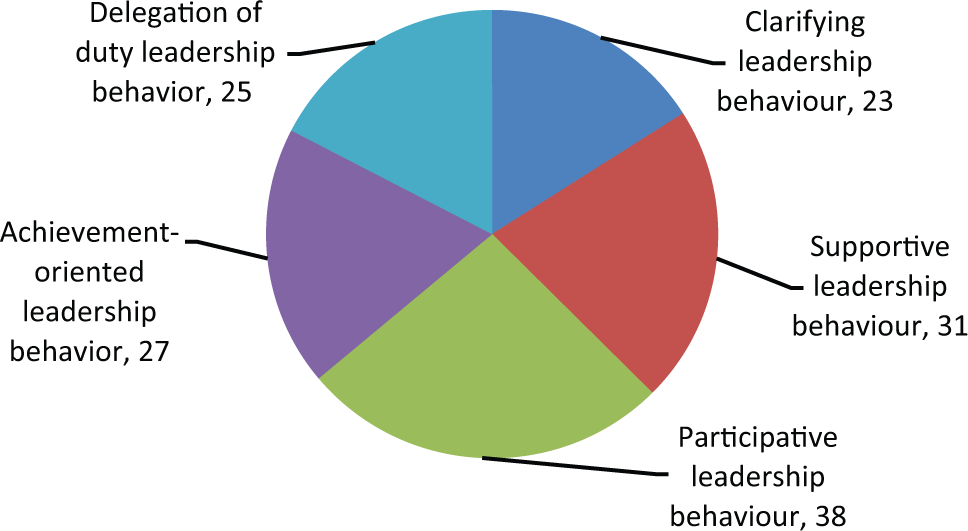
Leadership behavior necessary for adequate ICT adaptation.
Majority (86%) of the respondents suggested Openness to new ideas, then Leaders training themselves to use the technology properly (81.4%), allowing those with adequate technology know-how to do the job (79.1%), understanding the language of technology (60.5%), and only a few suggested using consultants to do the job (18.6%) and preventing subordinates from using the technology (9.3%) as solution. One respondent suggested that “policies or procedures that will assure subordinates that leaders are really committed to the adaptation of new technology in the library should be formulated” while another suggested “bringing as diverse a team together” as other possible solutions.
This question required respondents to tick as many as applied. The results are presented in ranked order of response in Table 2. About half of the respondents felt that there is cordial relationship between the older and younger generation of library professionals in ICT deployment. An equal number (48.7%) opined that the older mentor the younger in new technology deployment, the younger mentor the older in new technology deployment and that the older are afraid of losing their jobs to the techno-savvy younger ones, respectively. Least supported is the view that there is distrust of the competency of the younger professionals use the technology appropriately.
Relationship Between Older and Younger Professionals in Technology Adaptation.

Six of the respondents however gave other suggestions as follows: “We are complementary as there is a synergy in the work which is in perfect harmony. New technologies are always based on past practices and the younger are included”; “We are very small and are all the same younger generation in my library”; “In a well structured circumstance, there should be sharing”; “Pass. I am not sure what constitutes younger and older”; “Age does not necessarily determine the expertise”; “There is usually no room for relationship because the person assigned to deployment does it all.”
Respondents’ opinion was sought in two open-ended questions on solutions to resistance to new technology. One of the questions was on solutions if the resistance was from library leadership, and the other was on solutions if the resistance was from staff other than library leadership. All respondents, except one, proffered solutions which are presented in Tables 3 and 4.
Solutions to Technology Resistance From Library Leadership.

Note. ICT = Information and Communication Technology.
Solutions to Technology Resistance From Staff Other Than Library Leadership.

Note. ICT = Information and Communication Technology.
LinkedIn Survey
The opinions of a few more persons were sought from the LinkedIn social media over a 2-week period during the study. Five responses were received. They are as follows:
Coming from the field of behavior analysis, and combining that with what I have seen during the last 10 years using e-learning platforms and training faculty and staff in their use, I would like to give you some ideas:
Don’t push or require mandatory use of the technologies. Instead, try to engage them in a way that is not threatening. For example, ask them what things they would like to accomplish faster or easier. Try to identify a trusted peer who would be more willing to use technology, and tell this person to motivate his or her colleagues. Bring a presenter that could act as a role-model for the group. This person may be someone from their own field, someone who they can trust and who will identify with them. Have this person illustrate how technology can be of help in their work. Show them how using technology is not something that you or the institution are making up, but rather something that people (users, clients) are demanding. You can use a survey, interviews, newspaper articles, and other sources.
Shaping of a new behavior has to be done in small steps. Always ensure that each step is attainable. Start with something that is very easy; introduce the computer to do other things other than work, such as entertainment or something related to their particular interests. Use computers to communicate among them; watch out for situations (competition, for instance) that can be perceived as a threat. Let them have fun! I hope this helps.
I am a very slow learner in using computer. I need an empathetic, patient and helpful computer trainer who can go through with me step by step to make me really understand what I am doing. So far, I have not found one yet. I have only met trainers who always make feel stupid and frightened to move any button as any move that I make might lose my data! The answer to me is that we need a lot of understanding, inspiring, kind and helpful computer trainers to introduce new computing technologies for doing the library work.
Changing one’s behaviour is not an easy task. It is a challenge and you need to analyze the existing situation and understand the constraints. I have done some references on technology acceptance models when I was introducing e-learning to my faculty. There are various models which were developed by researches. But the most commonly used method is Technology Acceptance Model developed by Davis. According to his theory the user’s attitude towards the new technology is mainly influenced by the following two factors:
Perceived usefulness—Using this specific application system will increase the job performance. Perceived ease of use—target system/techniques to be free of effort and efficient than the existing system.
There is very little you can do for those who resist new technology, some will come along and others will continue to resist and think it will disappear with time. The fact is technology is here to stay and those who resist will be left behind. I have come across those in my more than 20 years working in research and academic libraries. If you can inculcate above two factors to their mind their attitude will change and they will motivate to learn and use. You cannot be a success without their cooperation.
People will always resist change. The best option is, Do it yourself first. Lead the way. Let them realize how easy it makes things for you, how important it is. And do all this without saying a word to the staff: just make them realize looking at you work. Slowly, but surely, they will accept the new system. And don’t forget: it doesn’t matter if you have struggled walking the new path alone, you must remove stones and speed breakers from the path when others start walking on it!
Respondents’ general opinion on technology deployment in African libraries was sought. Their response is presented in Table 5. Three respondents did not make any comments on the issue. The general consensus mainly expressed is that there is resistance to technology mainly by leaders and this has created problems. Many of the respondents also see positive relationship between the younger and older professionals, calling for more effort at training and educating staff in using new ICTs.
General Opinion on Technology Deployment in African Libraries.

Note. ICT = Information and Communication Technology.
Interviews and Observation
Of the 20 librarians interviewed, however, it was found that the older generation (i.e., those who had spent more than 20 years in service [25%]) was often averse to changes in the library system, and performing library operations. They lamented the fact that the new technologies were eroding professional librarianship practice. The newer generation (those who had spent between 5 and 20 years in librarianship [75%]) mostly had received ICT training but a number of them (45%) complained that they had little opportunity to use their skills because the leaders (library management) did not believe in changing from the old ways to new ICTs.
Some of the newer professionals (15%) narrate experience of being sent on courses abroad to learn how to utilize new technology, but on returning are not given opportunity to use skills learnt from the training they went for. They are rather posted to work in sections of the library totally different from that in which the training would be useful. Some others have the experience of being employed because of their vast experience, yet face a situation where the technology being deployed in the library is not used but the equipment are just covered up redundant.
In a particular case described by a respondent, the intervention of the new staff recruited in using the new technology was frowned at in the section in the library because the sectional head did not know how to use the technology and was against its use. The new staff in question was marked down from then, and had promotion delayed for many years in spite of being the most hardworking and productive staff. In this instance, the technology know-how was seen as an affront and a threat! This sectional head eventually was forced to learn how to use new technology, but an injustice had already been perpetrated.
Some older professionals (35%) expressed willingness to change, but needed institutional support for training. They, however, complain of nonencouragement by library management in terms of sponsorship. Where they have trained themselves without institutional support, they resent using their acquired skills for the benefit of the workplace.
Yet another finding was the fact that many Heads of libraries were not knowledgeable about using new technologies, and did not really feel that they needed to know, or that it was a disadvantage for them. They preferred the old methods and justified their nonchalance by quoting that they have only a few years to retire and cannot be bothered learning new things. This helpless resignation to whatever level of nondeployment to new ICTs by the library leadership was a common reaction among the older professionals.
In addition, it was observed that more than half of the newer professionals do not make any effort to do something about bringing their suggestions or grievances about the way and manner deployment of ICT is being handled in their library to the attention of their library head. They were skeptical about the reaction they would get if they made suggestions. They were not ready to lose their jobs and therefore kept quiet even in the face of frustration and dissatisfaction. They preferred to hope for a time when they would get a better job in a library where they would be allowed to freely use their ICT skills without fear of the library leadership.
A few of the librarians interviewed (20%) believed that it was high time library leaders moved closer to the younger generation of professionals so that the profession could move forward. In their opinion, library leaders staying “up there” on their high pedestal without listening to their workforce down below were not beneficial to the library system and librarianship as a profession.
It was also opined by about a quarter of the respondents that ethical issues emerge from distancing to create more problems. For instance, the distancing of the library leadership encourages the younger professionals either to keep their ideas to themselves or to sell their ideas to third parties (e.g., consultants) outside the library who then bring the ideas back to the library management who have to pay for these ideas. If there was no distancing, the cost to the library would have been eliminated.
It was a bit shocking to find out in this study that some library leaders had been somewhat tyrannical in their leadership approach and had thereby brought about situations where their subordinates would scamper to hide and allowed them to go past rather than approach them about burning issues. “Would you dare speak to them about changes?” “Rather not!” as a few remarked. They, however, expressed some joy that there were notable changes in leadership style in their library as nowadays one can walk up to the library head and discuss ones ideas freely. This change is a very welcome one.
Another finding was that there is the older librarians’ fear that they would soon be displaced before their retirement due date, by the younger librarians. This fear creates subtle reactions to younger librarians in the workplace, as hidden resentments and frustrations bring about unnecessary friction. Fear of their jobs being taken over and them being rendered irrelevant causes this. They tend to believe that the library system would not be able to continue without them and that the system was likely to collapse without their administrative expertise. These factors made them hostile especially when considering new technology use issues.
Discussion of Findings
Teambuilding leadership is highly favored in African libraries from results of this study. This corroborates Cawthorne’s (2010) position that teambuilding leadership is desirable, and opposes Aho and Bennet’s (2010) position that persuasive leadership is best as less respondents felt persuasive leadership is good in the deployment of technology in libraries. Transformational leadership was suggested by a very few. This is as opposed to Duren’s finding concerning transformational and transactional leadership in times of change in libraries.
The leadership behavior considered best in technology deployment in libraries was the participative leadership behavior. This is in tandem with Raimi-Akinleye’s (2010) view concerning participative leadership behavior in particular though supportive leadership behavior and achievement-oriented and delegation of duty leadership behavior were also perceived to be good. It seemed that a combination of many types was indicated, by the fact that even the least suggested type—clarifying leadership behavior—was supported by about half the respondents.
It was revealed from the interviews that a sizable number of library professionals in leadership positions in Africa are shy of ICTs. They do not have the technical know-how or expertise and only a few of them admit this lack. They rather pretend that they know and slow down or ground the work in their section of the library. Some admit their lack of expertise and allow their deputies or younger colleagues who are more techno-savvy to handle ICT-related issues in their libraries.
The problem of leadership in ICT adaptation lingers, however, as the leaders do not know, and so how do they mentor the younger ones? Mentoring is identified as a problem in the nonadaptation or slow adaptation to ICT. This view came mostly from the younger generation of librarians, most of whom had less than 5 years experience on the job. They also saw lack of opportunities for training on the job as a challenge they are facing and explained that usually, the decision to send staff for ICT training is done according to seniority and therefore they were not usually considered.
Younger generation librarians are also scared of putting their ideas forward for fear of being tagged “renegades,” being victimized or even dismissed from service. As suggested by many of the online respondents of the study, there need to be mentoring of different kinds, even reverse mentoring if necessary. This finding corroborates Oladele and Oyelude (2010) who emphasized mentoring in career progression of librarians. Mentoring should be practiced in technology adaptation.
It was also gathered that library leaders’ distancing of themselves from members of their workforce poses peculiar problems in ICT adaptation, in ICT adaptation. They create a wide gap and make themselves unapproachable such that there is no opportunity for feedback from the lower and middle management level of library management. As posited by some researchers, there has to be feedback on whatever new technologies are adopted in libraries and workplaces in general (Abu & Ogenekohwo, 2003; Agboola, 2001; Dobbs, 2010).
Some solutions to problems of resistance to technology adaptation are that leadership should undergo refresher course or training for all leaders on the new technologies. The leadership needs to be enlightened, sensitized, persuaded, and should read more on the topic to be abreast with what is happening around. There should be advocacy for change and technology adoption through dialogue.
It was revealed that communication in the library is very important and leaders who want to be successful must not ignore this. Communication is a two-way process, thus if information is put across, the giver of information must take time to listen to the reaction to what has been sent out. Listening is a skill for leaders to acquire. It is an attribute exhibited when there is participative leader behavior in the library leadership (Raimi-Akinleye, 2010). Respectful communication should be emphasized to achieve better results especially from the younger to the older.
Another issue found to be germane in ICT adaptation is the issue of ethics. The ethics of the profession comes to play in this instance as it is unethical for library professional to take ideas out and sell to outsiders who in turn sell to the library. It is just as unethical for a library leader not to mentor a younger one, or give the younger one a chance to grow. Perhaps the older generations of library leaders need to be mentored on the ethics of bringing up the younger generation of library professionals! As Oladele and Oyelude (2010) posited, librarians need help in their career progression, and mentoring has some inherent ethical issues which can be addressed through policy articulation at the level of individual libraries. Change management workshops should be organized to help leaders and followers adjust to the new that is constantly being introduced to them.
Conclusion
Leadership issues in libraries are very important when deployment to ICTs is to be considered. The spoken and unspoken policies that have been used prior the change in the system should be brought forward and all the stakeholders should consider and weigh the issues critically. Before the commencement of the proposed changes, the top and middle managers in the library system especially should be made to see the need for change, the need to adapt, and the need to learn, even from younger ones if need be.
Mentoring programs should be a sine qua non as what one person knows should be freely shared with others. The fear of the younger taking over the elder’s job should be removed. If there are secure retirement plans in libraries, the will to hand over to the next in line will be the best a librarian can offer. Leaders should mentor the younger ones (the mentees) and in this process, the mentor is also learning from the mentee in a two-way mentoring process. Thus, the activities of the younger generation will be channeled in a positive direction.
Library leaders should undergo training and retraining programs to update their professional and managerial skills. Change management workshops should be encouraged for them and they should be ready to remove stumbling blocks from the way of the newer generation. The key point is to have a listening ear, and close the distance between them and the rest of the library workforce. With the right infrastructure, human and material resources in place, libraries will provide a leading edge in the technology and information world.
Footnotes
Declaration of Conflicting Interests
The author(s) declared no potential conflicts of interest with respect to the research, authorship, and/or publication of this article.
Funding
The author(s) received no financial support for the research and/or authorship of this article.