




Abstract
This research paper seeks to understand whether the current basic endowment insurance policy has properly played the role of supporting the elderly needs through intergenerational support within the family. Theoretically, there are problems of the imbalanced structure of pension security, retirees’ comparatively higher pension and the low-level security of young people’s in-service income, and drawbacks of the existing endowment insurance system, both have a certain causal relationship with “gnawing the old.” Data on China’s family tracking survey in 2016 (CFPS2016), Probit model, IV and PSM robustness testing methods were also used to study the relationship between parents’ pensions and their grownup children’s “gnawing-the-old” behavior. The results show that: (1) Compared with young people from families without pension income, those with pensioned parent(s) will less possibly choose to work; the parents’ financial assistance behavior would restrain the children’s intention to work and increase the possibility of “gnawing the old”; (2) Neither the amount of pension income nor financial assistance given to the children is significantly related to young people’s “gnawing the old”; (3) Young people’s “gnawing the old” behaviors are different according to their parents’ professions and living areas; (4) The gap between parents’ pension income and children’s in-service income also adds to the causes of “gnawing the old.” The policy implications of these findings are discussed particularly the formulation of a scientific mechanism for pension income.
Introduction
In recent years, much attention has been paid to the performance evaluation of the endowment insurance system (Chun-shu, 2012; Sheng & Yuan, 2017; Shilin, 2010). However, it is impossible to comprehensively evaluate the effect of a system by analyzing its influence merely on retirees and ignoring the interactions between generations. The transfer of wealth between generations has a certain impact not only on the parents and children but also on the implementation of effective public policies (Christophers, 2018; Williams, 2017). Caldwell (1976) perceived intergenerational wealth flows (including material wealth flows and non-material wealth flows) exist between parents and children in a family. The intergenerational upward transfer of finance can be regarded as the children’s fulfillment of their “obligation to provide for” their parents and the intergenerational downward transfer of finance can be understood as the parents’ voluntary support to their children (Tsai & Wang, 2019; Zhu, 2016). However, when children become dependent on their parents and begin to ask for support to ease financial or living challenges they may be considered as “gnawing the old” (Fengrui, 2019; C. Wang, 2016). The phenomenon of “gnawing the old” is quite prominent. Regardless of age and educational background, “gnawing” has become a popular behavior among young and middle-aged people and a research hotspot in social economics (Fengrui, 2019).
“Gnawing the old” is a phenomenon that occurs when parents continue to provide economic support and daily care to the children. Generally (in China) it refers to children (adults) who are out of school, have normal labor or living ability, but due to the social and economic challenges have to rely on their parents to provide all or part of their living expenses (N. Yu, 2007). The concept of “gnawing the old” by adult children is similar to “NEET”: dropping out of employment, education, or training for young people between 15 and 24 years old, which is normally used in other countries (Gutiérrez-García et al., 2018; Odoardi, 2020; Zudina, 2022). As part of the family wealth, the pension of the parents forms the support for the child or children through the intergenerational financial downward transfer. But when the child relies on this kind of parents’ support and begins to claim this kind of economic or life support, it may be as “gnawing the old.”Modigliani (1988) and Kotlikoff (1988) find that the economic and material resources that parents transfer to their children account for a considerable proportion of their family wealth. The foundation of young people’s “gnawing the old” is “having something to gnaw.” That is to say, only with the premise that their parents have a good economic foundation and income source can young people “gnaw the old” (Zudina, 2022). However, existing studies have rarely tapped the economic reasons for “gnawing.” firstly, the most essential prerequisite for parents to provide their children with financial support and daily care is the economic circumstances of their parents. Implying that the foundation of “gnawing the old” is the amount of wealth the parents have over their life span (Caroleo et al., 2020). The reason some young people have gradually developed the habit of “gnawing the old” is that their parents can afford to provide the needed financial support to them (G. Liu, 2015). Secondly, with the continuous expansion of the coverage of pension insurance in recent years, the parents have a stable pension and income and thus a considerable part of parents’ retirement income and savings become the material basis of “gnawing the old”.
In 2020, it was shown that more than 60% of Chinese are affected by “gnawing the old,” 30% of young people live on or benefit from “gnawing the old,” and more than 65% of families have problems with “gnawing the old” (H. Li, 2021). Youth employment has become the main contradiction in the labor market. By 2020, the number of “only-child” in China is about 180 million, and China’s aging population has continued to increase with many pension problems as far as the only-child policy is concerned (S. Liu et al., 2020). “Gnawing the old” does not only negatively affect the young people’s ability to achieve personal and survival goals but importantly increases the economic burden and psychological pressure of parents, affecting the living standards and quality of life of age-parents (Song et al., 2019).
The current old-age endowment insurance system involves intergenerational distribution and based on the payment rate, employees hand in part of their income as the pension for the retirees in the same period. However, the reality is that some of the parents who need to be better provided for are being “gnawed.” What can the retired parents give their children? Why do the children rely more and more on the “gnawing the old”? How does the basic endowment insurance system contribute to “gnawing the old”? To provide answers to these questions, this paper discusses whether the current China endowment insurance system has properly played the role of supporting the elderly. First, whether the pension owned by parents in Chinese families properly plays the role of supporting the elderly, or whether the pension income of the father’s generation will affect children’s employment choice through the intergenerational transfer of family finance, leading to the phenomenon of “gnawing the old”? Second, whether the economic assistance from the father’s generation will weaken their children’s enthusiasm to participate in employment, and how the total pension income and the total financial support affect the employment of the children? Third, what is the heterogeneity of the influence of parents’ different occupational backgrounds, and living areas (urban and rural, Eastern, non-eastern) on their children’s employment choices? Fourth, whether the income gap between the generations will lead to “gnawing the old”? The answers to the above questions will not only help us to grasp the current disadvantages of the pension system at a macro level, evaluate the policy performance effects of the endowment insurance policy, to find structural problems in it to provide impetus and support for updating policies and improving social pension security system but also help us to analyze the essential reasons of “gnawing the old” in families and the impact of “gnawing the old” on young people’s employment.
This research paper has the following contributions. First, previous studies on the drawbacks of the endowment insurance system mainly focus on its adverse consequences on economic development (Autor et al., 2007; Jing et al., 2020; Zhao & Lu, 2018) and pay little attention to the social problems it may cause, and so this paper examined the causal links between endowment insurance system and the social problem of “gnawing the old” to understand the performance of this policy. Second, the existing literature analyzed the causes of the “gnawing the old” phenomena mainly from aspects of social tradition, economic environment, and personal reasons (Wu, 2015; N. Yu, 2007; L. Yu et al., 2016), but did not explore in depth what is being “gnawed” or the material basis of “gnawing.” Hence this paper utilizes the imbalances of intergenerational income distribution between parents’ relatively high pension income and children’s relatively low working income in some groups and regions to explain “gnawing the old,” and thus brings more causal factors into the horizon of “gnawing-the-old” research. Finally, this paper provides practical advice for policy-making and reform concerning pensions, since the pension income provided by pension insurance will affect the employment decision-making and labor supply of young people through “gnawing the old,” deviating from the expected impact of pension insurance on retired people, thereby crippling several young people’s will to work.
Literature Review
Introduction of China’s Basic Endowment Insurance
China’s old-age insurance system has undergone several decades of reform and development. The coverage of old-age insurance has become increasingly extensive, including employees of state-owned enterprises and the public sector, private enterprise employees, urban and rural residents, and flexible employment groups. China has established a multi-level social old-age security system: the first, basic endowment insurance is arranged as a whole by the country, and compulsory. It includes basic endowment insurance for urban workers, social endowment insurance for urban residents, and new rural social endowment insurance; Secondly, enterprise supplementary endowment insurance, also called enterprise annuity. Enterprise complement endowment insurance is the policy that the country (China) has developed for implementation. There is also auxiliary endowment insurance that was established for enterprise workers and is based on one’s actual economic strength. This system provides endowment security for enterprise workers. Thirdly, the individual deposit endowment insurance is voluntarily undertaken by the worker and is a kind of complementary insurance form where the selection of agency organization is voluntary. The worker can pay individual savings endowment insurance premium according to their salary income level. It helps reduce the burden of state pension, but the development of individual deposit endowment insurance in the country still lags, and even a lot of people don’t understand this kind of endowment insurance.
Basic endowment insurance as an important content of the social insurance system in China is arranged by the state as a whole. The enterprise and worker will share the endowment insurance cost jointly according to a certain proportion respectively, employees can receive a certain amount of pension every month when they reach the legal retirement age. As the coverage of pension insurance continues to expand, and both parents have stable pensions and fixed incomes, pension accounts for an increasing proportion of family wealth. The goal of the basic endowment insurance is to increase the income of the elderly, improve the happiness of retirement life, and promote the realization of the goal of “providing for the elderly” in China. However, N. Yu (2007) found that the living standards of retired people did not improve their happiness index and that a large number of retirees were not satisfied with their life quality because their pension income was occupied by their children.
The Factors to the Behavior of “Gnawing the Old”
Undoubtedly the abnormal “gnawing the old” phenomenon has caused various effects and this was highlighted by N. Yu (2007) that a considerable number of retirees are not satisfied with their quality of life because their retirement income is occupied by their children’s “gnawing the old” behavior. Utilizing CHIP2007 data, it was confirmed that the situation of gnawing the old leads to retirees’ re-employment and the “retirement-without-rest” phenomenon (L. Yu et al., 2016). Some researchers have also revealed the causes of “gnawing the old” from many aspects. First of all, gnawing may be an active behavior of parents. Representative viewpoints include Becker’s (1991) altruistic model and Cox’s (1987) exchange model. The former believes that parents’ financial transfer is purely out of affection and blood relationship, regardless of whether their children pay back or not. The latter believes that parents’ financial support to their children when they are young is out of investment consideration, expecting their children to have corresponding returns and companionship when they are old. In addition, along with China’s economic transformation and development, there are reforms in many fields like education, health care, and housing. While the overall economic level has been greatly improved, it is however accompanied by increasingly high costs of living and work pressure. Also, the rapid rise of housing estate prices out-speeds the rise of wages, which constantly disturbs the young generation, especially those living in the first- and second-tier cities (Wu, 2015). Lastly, others think that gnawing is becoming an active dependent behavior of adult children. To meet the needs to form a new family, they tend to seek financial support from parents to purchase a house or support education and some even seek parents’ help to finance their consumption and the education expenditure of their children (Semyonov & Lewin-Epstein, 2001; Wolff, 2006). So, many factors will lead young people to choose to “gnawing the old,” but among these factors, whether the parent has enough pensions and whether the provision of financial help will affect the employment of the children has been less explored. Thus, it can be said that much attention has not been paid to the causal relationship between the basic endowment insurance and “gnawing the old.”
The Relationship Between the Basic Endowment Insurance and Offspring’s Employment
Some scholars hold that the public policy may contribute to “gnawing the old.” This was discussed by H. Chen and Zeng (2013) who used the PSM-DID method to evaluate the policy performance effects of the “New Rural Endowment Insurance” as a way to reduce the burden of children’s duty to provide monetary support to their parents. They emphasize that this can be a potential reason for “gnawing the old” (H. Chen & Zeng, 2013). M. Chen (2015) analyzed the relationship between family wealth and the labor supply time of children by using Heckman’s three-stage estimation method and found that the direct wealth transfer from parents to children will significantly reduce the children’s working time and that children from wealthy families prefer jobs not requiring hard work. Also, it has been indicated that relatively stable family income can provide a material basis for their children to “gnaw the old” (Wu, 2015). Also, endowment insurance for urban enterprise employees will encourage people to reduce the labor supply level and encourage employees to retire earlier (Z. Liu et al., 2019). Dustmann and Micklewright (2001) used the intergenerational altruistic transfer model to study the effect of parental allowance on the labor supply of children and found that economic assistance significantly reduced children’s labor participation. That is to say, when parents’ income condition is good, it will be conducive to the downward transfer of family intergenerational finance (Sa & Luo, 2018). Therefore, it can be seen that the endowment insurance policy may not only provide the material basis for “gnawing the old,” but also reduces children’s responsibility to provide for their parents and has an impact on the labor supply and employment choice of the offspring.
Basic Endowment Insurance Benefits Differ in Different Regions and Groups
Although a multi-level social pension system has been established, there are still some unbalanced problems to be solved, such as regional segmentation, population classification, system differentiation, unequal treatment, and unbalanced system development mainly reflected in regional differences (Jiang & Wang, 2012; Lin, 2002; Ouyang-Qiong, 2011; X. Wang, 2018; L. Yang & Ning, 2013). For example, there is a huge gap between government subsidies for basic old-age insurance for rural and urban employees. In terms of benefits, in 2017, the per capita basic pension of retired urban workers was 2,876 yuan/month, while the per capita basic pension of the elderly in villages was only 126.7 yuan/month, a gap of more than 22 times (Xie, 2017). There are obvious regional differences between urban residents’ pension levels in China. the pension per capita in the eastern region is higher than that in the western region and higher than in the central region (D. Chen & Sun, 2019; Shen & Deng, 2015). G. Liu (2015) found in her empirical study that the comprehensive development level of urban and rural endowment insurance in eastern China is relatively high, while the development of central and western China and northeast China lags behind. Shen and Deng (2015) found that the per capita pension in the eastern region was higher than that in the western region, the pension level in the western region was higher than that in the central region, and the unbalanced development degree in the eastern region was higher than that in the central and western regions. Jiang and Wang (2012) found in their study that social security is unfair to rural areas in many aspects, and the economic fairness and imbalance of urban and rural social security are prominent. Xue and Zeng (2019) found that there was a huge gap between the basic pension of employees and residents, and the pension insurance treatment was essentially unfair. At the same time, the continuous existence of the dual-track system and the urban-rural dual welfare also contributed to widening the pension treatment gap between different groups. The retirement expenses of retired public servants are still borne by the state finance and shall be paid as you go, so there is still an unfair phenomenon in pension security treatment of employees of government organizations, public institutions, and enterprises (Guo & Xu, 2020; Zhang & Li, 2016). Cai and Yue (2020) found that public sectors occupy the largest share of pensions in China, and that is also the most unfair item in all social security transfers. Based on the above analysis, it can be predicted that when the pension income becomes the economic basis of “gnawing the old,” the differences between the parents’ occupation and living area lead to the degree of “gnawing the old” of the children. Wu (2015) finds the risk of urban elderly being “gnawed” is significantly higher than that of rural elderly and that the elderly who were once employees of state-owned enterprises or collective enterprises are more likely to be “gnawed” by their children than those who engaged in agriculture, forestry, animal husbandry, and fishery. Also, Tian et al. (2016) found that parents’ marital status, education level, and income level were directly related to the amount and proportion of intergenerational wealth transfer.
On the whole, due to the “multi-track system” of endowment insurance (Zang & Li, 2021), there is a large gap between pension benefits and downward transfer of intergenerational wealth among insured families of different regions and groups, which leads to the difference in employment choices of children of different insured families. Pensions protect the “basic” retirement conditions of people, and thus retirees seldom have large expenditures such as housing purchases and high consumption, and it is not justifiable that their pension income is close to or even higher than the income level before retirement. The relatively high pension provides the opportunity for their children to “gnaw the old.”
Theoretical Analyses and Hypothesis
Relatively High Pension in Groups and Regions Providing a Material Basis for “Gnawing the Old”
Since 2005, the national pension level has risen for 16 consecutive years. On average, it has risen faster than payrolls of on-the-job staff, bringing rapidly increased income to retirees. On the other hand, the absolute pension amount of people who retired from governmental institutions has always been higher than that of those from private enterprises. Moreover, retirees from governmental institutions have both basic pension and occupational annuity, while retirees from private enterprises have only a basic pension and no enterprise annuity, so there is a big gap between the two groups of retirees’ incomes. Also, the difference in pension replacement rates between groups is obvious. Due to the “two-track system,” the pension replacement rate of state-owned enterprises and the public sector is far higher than that of the private sector and enterprise employees in the same period. On the whole, the gap in pension security between the two groups is obvious, and state-owned enterprises and public sector employees can receive a relatively higher pension after they retire, which provides potential economic support for their children.
From the perspective of different regions, there are obvious gaps between the amounts of basic pension per capita in urban and rural areas, and eastern central, and western regions. It is obviously against the core spirit of the endowment insurance system for retirees in some groups and regions to receive an excessively high pension. This kind of differential treatment will not only impact the balance between income and expenditure of the endowment insurance fund but also may trigger a series of social problems. Retirees Groups and regions with higher pensions are more likely to economically aid their children, and hence facilitate young people to “gnawing the old” and make it a more serious problem. That logic reflects a causal link between excessively high pensions and “gnawing the old.”
On-the-Job Employees’ Low Income Propelling “Gnawing the Old”
High Payment Rate of Endowment Insurance Lowering In-Service Income
A considerable number of low-income people unwillingly join the “gnawing the old” group. But these low-income “gnawing” people have to deal with high living costs with currently low working income. One of the reasons for their low disposable income is that endowment insurance payment occupies a considerable proportion of their total income. China is one of the countries with the highest endowment insurance rate in the world. The legal total payment rate of the basic endowment insurance system for urban employees is 28%, with enterprise payment accounting for about 20% and individual payment for 8% respectively. This rate is higher than those in almost all developed countries, compared with 12.4% in the United States, 9.9% in Canada, and 9% in South Korea. Setting a high payment rate for enterprises will increase the labor cost, which will be transferred to the employees, leading to a further decline in the actual income of employees. Ma and Gan (2014) found that after controlling the sample selection, enterprises will squeeze out 0.6% of employees’ wages when the payment proportion of endowment insurance contributed by enterprises increases by 1%. In other words, that payment proportion increases the labor cost of enterprises, and enterprises take measures to transfer part of the cost in form of reducing employees’ wages, resulting in a reduction of employees’ current disposable income.
From the perspective of the life cycle of residents, the setting of a high payment rate is not appropriate for many low-income groups. Endowment insurance requires payment at present and cash security at retirement. The high payment rate seriously affects the cash income at work and reduces the disposable income of employees in the current period. However, low-income groups tend to pay more attention to immediate benefits and immediate paybacks. The setting of the payment rate will affect the behavior choice of a large number of people, especially those who have just started careers, faced with greater pressure of living costs at this age stage. To them, the payment of endowment insurance takes away part of their income, giving possible impetus to their “gnawing the old.”G. Wang and Li (2016) found that the low-income group faces a higher pressure from the payment of endowment insurance and that the low-income group, more concerned about current survival problems, has no urgent demand for endowment insurance. Also, it was reported that the low-income group took on a higher proportion of endowment insurance payments, indicating that endowment insurance plays a reverse income distribution role among different income levels (S. Li et al., 2019). The higher the proportion of personal contributions at work, the higher the corresponding pension income; but the pension payment is implemented after retirement. At this phase, most retirees have nearly no problems maintaining living standards or need to buy a new home or car, that is, their consumption demand is shrinking, so the pension income accumulated by retirees can mostly be transferred to their children through intergenerational wealth transfer, inevitably leading to the “gnawing the old” behavior. On the one hand, most of the middle- and low-income groups need to pay high endowment insurance fees and deal with great current survival pressure; while on the other hand, the government’s security for retirees in the same period is gradually improved, and the distribution of pension insurance fund pool to retired groups is unbalanced, which will increase some employees’ disappointment. The psychological imbalance brought about by this contrast will affect young people’s employment choices and enthusiasm to work and breed the idea of “gnawing the old.”
Parents’ Pension Surpassing Young People’s In-Service Income
It is worth noting that many young people’s in-service income is less than their parents’ pension. Especially for those whose parents used to work in governmental systems or institutions, their parents’ current or expected pension income and their in-service income form an obvious contrast. The imbalance between the in-service income and the retirement income is likely to cause young people’s psychological resistance to work and dependence on their parents, that is, parents can support their children’s everyday living, providing a “parents-can-afford” guarantee signal (Sa & Luo, 2018), affecting their wage expectations and employment decision-making. Even when some parents realize the income gap, they may voluntarily encourage their children to “gnaw the old.” However, in families where parents worked as ordinary employees in enterprises or live in rural areas and receive a comparatively plain pension after retirement, with retirement income, the parents may only manage to narrowly maintain their living standard as before retirement, if not aided with upward financial transfer from their children. Under such circumstances, young people rely on hard work to maintain their living due to their sense of responsibility to parents and their financial constraints, hence reducing their expectation of “gnawing the old.”
Based on the above discussions, this paper puts forward the following hypothesis:
Hypothesis 1: Compared with families without a pension, families with a pension have a higher probability of grown-up children’s “gnawing the old.” Compared with families with economic assistance to children, those without will positively affect their children’s employment tendency.
Hypothesis 2: The larger the pension amount parents received, or the financial assistance amount provided, the more possible they will weaken their children’s willingness to work and thus “gnawing the old.”
Hypothesis 3: Compared with children whose parents worked in private enterprises, rural areas, and non-eastern regions of the insured population, children whose parents worked in public institutions, urban, and eastern regions are more likely to “gnawing the old.”
Hypothesis 4: The bigger the downward gap of intergenerational income (the more parents’ pension income surpasses children’s in-service income), the more likely the children are to “gnaw the old.”
Data and Empirical Models
Sampling
This research is based on the data of Chinese Family Panel Studies (CFPS) in 2016. The CFPS baseline survey was started in 2010. Since then, three rounds of full sample follow-up surveys were conducted in 2012, 2014, and 2016. The baseline sample of CFPS covers 25 provinces/cities/autonomous regions, representing 95% of China’s population. CFPS2016 is the fourth-round survey of Chinese Family Panel Studies, with 14,019 valid family-level samples and 36,892 valid individual samples collected. Based on the samples completed in 2014, the CFPS2016 tracking rate at the individual level reached 82%. It can be seen that the CFPS database has a wide range of geographical representation and large-sample properties. China’s current retirement system sets the legal retirement age at 60 for men and 50 for women. This paper used families whose parents have retired as the research object. By combining data and screening variables, samples with missing key variables were eliminated, and finally, the observed values of 4,650 households were left.
Survey Data
The survey data generated a questionnaire containing 1,095 pieces of variable information for each adult but did not combine family members’ information. The data processing steps of this research are as follows: Firstly, since the research object is grownups’“Gnawing the old” situation, young people who answered, “yes” to the question of “Are you a student?” were excluded from the samples; secondly, one-to-one matching was conducted in the adult database according to “personal ID,”“father’s sample code in the survey” and “mother’s sample code in the survey” to form family-level sheets of data; finally, after screening and deleting the variables,4,650 family samples were obtained, accounting for 33.17% of the initial samples.
Variable Definition
Dependent variables in this paper are as follows: (1) “The grown-up children are employed or not (SJ),” In this paper, the definition of adults (above 18 ages) are those not in school and not employed, and already working (regardless of whether living with their parents or not) but still receive their parents’ financial support and daily care—“gnawing the old,” in the form of virtual variables; (2) “Grown-up children’s working time per week (ST)” is used to measure the children’s working hours in a week; (3) “ Grown-up children’s work income (SI)” is used to describe the annual income of the children, using absolute value form.
The main Independent variables in this paper are: (1) “The parent (s) has a pension or not (PHP)” in form of a dummy variable (we consider the respondents who have participated in the basic endowment insurance as having pension income); (2) “Parent (s) total pension (PTP)” in form of absolute value, introducing the amount (yuan) of pension received by the interviewees every month after tax; (3) “Parent(s) provides financial assistance or not (PHA)”; (4) Parent(s) provides a financial aid amount (PPA). (5) “Grown-up children’s work income is less than parental pension income or not (GAP)” in the form of a dummy variable. This variable uses “the average annual wage income of the sub-generation - the average annual pension income of the father-generation” to represent the gap between the in-service income of the children and the pension income of the parents. If the gap is a negative number, the variable is assigned as 1, otherwise, it is 0.
Referring to the research results of H. Chen and Zeng (2013), Sa and Luo (2018), the control variables selected in this paper include child factor variables such as gender, age, education level, number of children in offspring, and health status of parents, parents’ income (relatively high, logarithmic standardized treatment in regression). The variables are defined in Table 1
Variables Definition.

Model
This paper mainly uses the Probit model for fitting regression. To estimate the parameters more accurately, a robust standard error is used. The model is set as

The dependent variables are SJ, ST, and SI, the main independent variables can be replaced by PTP, PHA, PPA, and GAP respectively according to different research problems, and Xi is the control variable. At the same time, when analyzing the influence of parents’ having or not having pension on the employment of the grown-up children, adding control variables cannot completely solve the problem of missing variables, for the endogenous problem needs to be considered, and the results of direct Probit regression may be biased and inconsistent. To control the impact of this problem on the accuracy of model fitting, IV and PSM robustness testing methods were used.
Descriptive Statistics
The main purpose of the empirical part of this study is to explore the impact of the parents’ pension on their economic assistance to their children and to make it clear whether this assistance produces a “signal” effect to affect the employment choice of their grown-up children. Table 2 shows the proportions of families whose parents provide financial assistance to their children and of families whose children have no work in cases of having a pension and not having a pension respectively. It can be seen that families with a pension are more likely to provide financial assistance for their children, and the employment performance of their children is worse than that of those whose parents have no pension.
Influence of Parents’ Having or not Having a Pension.

Table 3 shows the descriptive statistical results of relevant variables. As shown in Table 3, the employment probability of children from families that can receive a pension is 83.7%, 5.4% lower than that of the children from families without a pension, and those children’s average annual wage income is 12,000 yuan,3,000 yuan less than that of their counterparts without pension; For children from families that can receive a pension, their probability of obtaining financial assistance from parents is 22%, and the amount of economic assistance provided by parents is 451.9 yuan per month, respectively 5.1% and 73.7 yuan higher when compared with the children from families without pension. Table 3 also shows that families with pensions tend to pay more attention to education, which may be related to family income and other factors. The average annual income of the father’s generation of a family with a pension is nearly twice as much as that of the family without a pension.
Descriptive Statistical Results of Variable Grouping.

Table 3 also lists the statistical results of the variables when the parents are divided into groups by urban and rural areas and by their occupational background. In urban areas, the proportion of parents participating in endowment insurance is 52.3%, while that of rural parents is 57.4%, 5.1 percentage points higher than the former. However, comparing the pension amounts of the two groups shows that the average pension received by the parents in urban areas is 1,000 yuan per month, while that of the interviewed parents in rural areas is only 157.2 yuan. It can be seen that because the national endowment insurance policy is more emphasized in rural areas the coverage of endowment insurance in rural areas may be broader than that in cities and towns, but there is a huge gap in pension per capita between urban and rural areas, indicating that in rural areas of China the level of pension security provided by most insurance projects is limited, obviously lower than in urban areas. The average annual income of urban parents is 5,483 yuan, which is twice that of rural parents. In terms of parents providing or not economic assistance for their children and the amount of financial assistance, the probability and amount of urban parents’ assistance are significantly higher, but at the same time, the probability of employment, working hours, and wage income of urban children are of lower value, which shows that in urban areas, the comparatively higher pensioned parents tend to give more support to their children, and this kind of family intergenerational financial transfer behavior may form a negative signal that the parents can afford the excessive assistance to their children, affecting the children’s employment choice and employment performance. This is also the case with the comparisons between families where the parents worked in state-owned enterprises and public sector and families where the parents worked in the private sector and enterprises, the former possessing more pension and annual income, and more often providing economic assistance of higher amounts for their children, whose working hours and wage income are less than the counterparts of the latter. The descriptive statistical results of eastern, central, and western regions (Divided according to the National Bureau of Statistics standards) also show that the average pension level of insured people in the eastern region is higher than that of those in the central and western regions (Table 4), but their offspring’s employment performance is poor (National Bureau of Statistics of China, 2022). Descriptive statistical results confirm that fathers who received more pensions will give more economic support to their children, which easily conveys a negative signal of “affordable gnawing the old” to offspring, thus affecting the employment choice and performance of their children.
Descriptive Statistical Results of Variables by Eastern, Central and Western Regions.

Empirical Results and Analyses
Parents Having a Pension and Providing Economic Help Increase the Likelihood That Children Will “Gnawing the Old”
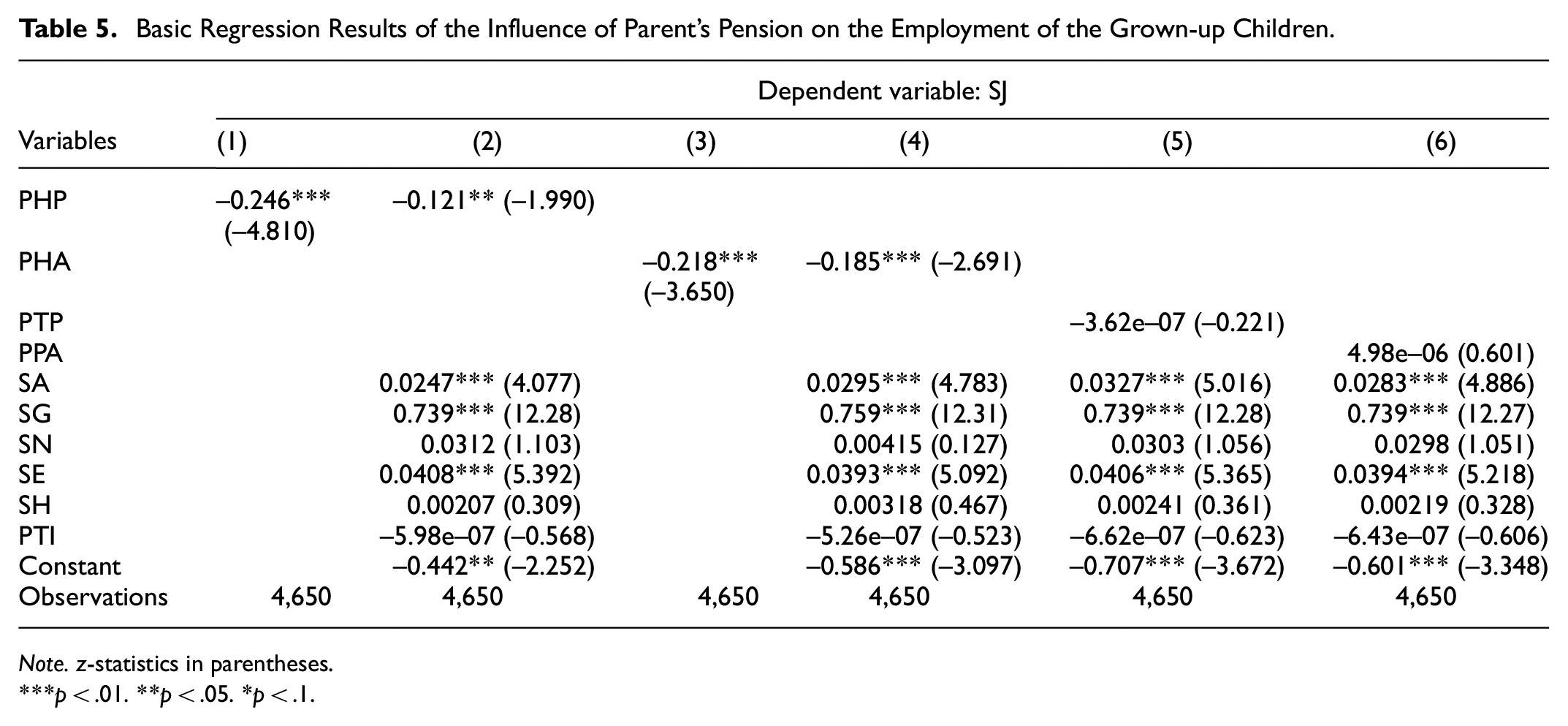
The regression results of the influence of paternal pension on the employment of offspring are shown in Table 5. The regression results of columns (1) and (2) show that regardless of whether control variables are added, the coefficient value of “PHP” is always significantly negative, that is, parents’ having pension income is negatively related to the possibility of their children’s employment. It preliminarily shows that families with a pension do affect the employment intention of young people, and through calculation, the ratio accurately predicted by the model is up to 85.77% indicating that the results are relatively reliable. The regression results in columns (3) and (4) show that parents’ behavior of providing financial help has a significant negative impact on children’s employment, and also weakens their enthusiasm for employment. It shows that grownups receiving financial help from their parents undermines their employment. Parents’ financial assistance to their children can relieve their children’s survival pressure and improve their living conditions in the short term. However, receiving such assistance, in the long run, will develop the children’s inertia of depending on parents and gradually make them a “Gnawing the old” group, wasting human capital accumulated over the years and eroding the material basis of parents’ living standards after retirement. At this point, hypothesis 1 is verified. As described in the theoretical analysis, parents with pensions and providing economic assistance reduce the responsibility of supporting the children, which leads to the lack of employment pressure on the children to a certain extent. Also, the probability of wealth transfer from pensioned fathers to their children increases, making them dependent on their fathers for financial support.
Basic Regression Results of the Influence of Parent’s Pension on the Employment of the Grown-up Children.
Note. z-statistics in parentheses.
p < .01. **p < .05. *p < .1.
There is No Direct Correlation Between the Amount of Parents’ Pension as Well as Financial Help and Youth “Gnawing the Old”
Column (5) and column (6) take the amount of parents’ pension and the amount of financial assistance provided respectively as the core independent variables to study the impact of the two on the employment of grown-up children. From the regression results, we can observe that the pension owned by parents harms their children’s employment intention and that the amount of financial assistance to their children has a positive impact on their employment. Both observations could be explained on an economic level but the absolute value of the estimation coefficient is very small, and its influence on the dependent variable is not significant, indicating that the amount of pension and the amount of economic assistance provided by parents do not affect children’s choice to be or not to be employed. It can be found from Table 5 that there is a negative correlation between the total income of parents and the employment of their children, but the absolute value of the coefficient is still very small and not significant, which shows that parents’ economic circumstances do not directly affect the employment of their children, but through a “signal” role, it sends a “parents-can-afford-the-gnawing” signal to the children, making them believe parents’ assistance is still available when unemployed. The negative effect of this signal has no obvious relationship with the amount or potential amount of parental assistance, which is consistent with the research results of Sa and Luo (2018). So hypothesis 2 is not proven. In addition, Besides, Table 5 also shows that males’ employment intention is less affected by family, and males’ employment rate is higher than that of females, which is in line with the conclusion of existing studies. Grown-up children’s education level also has a significant relationship with employment. From the whole regression results, the longer the education years of children, the higher the possibility of the grown-up children’s choosing to work, and the human capital accumulated in education years is beneficial to the work and the acquisition of job opportunities and the stability of work.
Children of Employees in State-Owned Enterprises and Public Sector, Urbans and Eastern Regions Are Prone to “Gnawing the Old”
In China, the pension system of the employees of government institutions and urban enterprises is very different in design and management, and the phenomenon of a double-track system appears. A partial accumulation system combining social pooling and personal accounts has been initially established for the old-age insurance of urban enterprise employees, while the pay-as-you-go model is still maintained for the old-age insurance system of government organizations and public institutions. Due to the disunity of the system, the dual-track system also caused an imbalance in the level of insurance obligation and treatment of the two parts of the personnel in private enterprises and state-owned enterprises, and public organizations.
Generally speaking, the employees who worked in state-owned enterprises or the public sector are better guaranteed in terms of welfare and pension insurance, because most of the expenditure on pension insurance is paid by the fiscal revenue. Those retirees, whose pension is often several times that of private sector or enterprise retirees, often don’t have to worry about their life after retirement, which is justified by the above descriptive statistical results. To compare the influence of parents’ occupation background on their children’s “Gnawing the old,” a further regression was carried out. For example, column (1) of Table 6 shows the difference in the influence of various factors on the employment of children whose parents formerly worked in state-owned enterprises or public sector and private enterprises respectively. When parents have a pension, its influence is slightly greater on the children of government-sponsored institution retirees; when parents provide economic assistance, the employment intention of government-sponsored institution retirees’ children is also more affected; This indicates that when parents have a better professional background, it may mean the expectation of status or income. That expectation, through interactions in the family, will make the grown-up children believe their parents can afford all this, and hence their employment motivation is suppressed. The regression results in column (2) of Table 6, show that the “negative signal” of parents’ having pension has a greater impact on the employment decision-making of urban grown-up children, with an impact coefficient of −0.158, significant at the level of 1%. Also, with the economic help of parents, urban children’s employment performance is still worse than rural children’s. This may result from the influence of family circumstances since childhood. Children from rural families with limited economic conditions have no basis for “gnawing the old” and have to start working at earlier ages and support themselves or even their parents’ family. In contrast, urban children are likely to rely on their parents because they are well cared for. Similarly, the results in column (3) show grown-up children’s “gnawing the old” in the eastern region compared with that in the central and western regions. Those in the eastern region are more likely to rely on their parents’ pensions. When their parents have a pension, their employment performance is not as good as their counterparts in central and western regions. Although there are more jobs available in the cities of the eastern region, the requirements for human capital are correspondingly higher. Many young people cannot find a job with a satisfactory income. Even if they have a job with a stable income, they can get less disposable income per month. Also, they have to face pressure from the high cost of living. Therefore, when their parents have a pension, young people in the eastern region are more likely motivated to “gnaw the old.”
Regression Results by Regions and Groups.

Note. z-statistics in parentheses.
p < .01. **p < .05. *p < .1.
The Impact of the Intergenerational Income Gap on Young People’s Employment
It is worth noting that many young children earn less in work than their fathers receive in pensions. For many young adults, the retirement income received by the father’s generation also forms a big gap with their in-service income. The offspring’s on-the-job income and parent pension income imbalances are likely to cause young people to the employment and psychological dependence on their parents, the parents can support children’s life provides a “sustainable” parents guarantee signal (Sa & Luo, 2018), affecting their offspring employment decisions, even when the parent generation realize this gap, may also take the initiative to let its “gnawing the old.”
Therefore, this paper believes that the intergenerational income gap will become another factor causing the “gnawing of the old.” To study whether the income gap between the offspring and the parent would affect the employment choice of the offspring, dummy variables of the “intergenerational income gap” were introduced into the model for regression, and the regression results are shown in Table 7. According to the results, the greater the income gap between generations, the greater the probability of children “Gnawing the old,” that is, when the income of children is less than the total pension of their fathers, the impact on the employment choice of children is negative. At the same time, the negative impact has group and regional heterogeneity. Specifically, the intergenerational income gap has a greater negative impact on the employment enthusiasm of the descendants of insured people in government institutions, urban areas, and eastern China.
Results of the Influence of Gap on the Employment of the Grown-up Children.

Note. z-statistics in parentheses.
p < .01. **p < .05. *p < .1.
Robustness Test
Endogeneity Problem Analysis Based on the Instrumental Variable (IV) Method
However, in this paper “PHP” is considered as an endogenous variable. Whether the children are employed or not and their income will affect their parents’ choice of insurance, their parents’ decisions on providing or not financial assistance, and how much financial assistance to give if necessary. Similarly, according to the above analysis, parents’ insurance behavior may also affect their children’s employment decisions and labor supply choices. To eliminate that reverse casualty, appropriate instrumental variables were selected to solve the endogenous problem. Hausman method was used in testing to further confirm that endogeneity exists in the model set. The original hypothesis was “H0: all explanatory variables are exogenous variables.” By comparing the parameter values estimated by normal regression and instrumental variable regression, the p-value under Hausman’s test was .0852, indicating that the model does have endogenous explanatory variables, and the instrumental variable method can be used to solve the fitting deviation caused by endogeneity. What is more, to ensure that the selected tool variables are scientific, the over-identification test and weak tool variable test are carried out. The p-value in the over-identification test is .0367, indicating that the selected tool variables are exogenous. The identification results of weak instrumental variables are shown in Table 8. The results show that the p values of CLR, KJ, AR, and Wald are all significant at the level of 5%, confirming the correlation between instrumental variables and endogenous variables, which also indicates that the instrumental variables selected in this paper are not weak instrumental variables.
Weak Instrumental Variable Test.

Referring to Sa and Luo (2018) and Tian et al. (2016) studies, this paper uses the parents’ age as the instrumental variable of PHP, the parents’ age, education level, and state of child marriage as the instrumental variables of economic assistance. Pensions are not available until retirement age, and the older the parents, the more pension and other wealth they accumulate, the more likely they are to provide financial help to their children. The level of parental education is also directly related to the behavior of providing economic help to the offspring. The higher the level of parental education is, the greater the probability of providing economic helps to the offspring. The marital status of children also affects the financial support behavior of fathers, and fathers have a lower probability of financially supporting their children who are married. In general, paternal age, education level, and marital status of children are not directly related to the employment of children. Therefore, paternal age, education level, and marital status meet the requirements of the correlation and exogeneity of instrumental variables and are suitable as instrumental variables.
Table 9 shows the regression results using the instrumental variable method. The regression results in Table 9 still show that the father’s behavior of having a pension and providing economic help will weaken the child’s employment intention. The grouping regression results of the instrumental variable method in Table 9 also show that the children of insured people in public institutions, urban, and eastern regions are more prone to “gnawing the old” behavior. IV-probit regression results are consistent with those of Probit regression alone, indicating that the empirical conclusions mentioned above are relatively reliable.
Results of IV-Probit Regression.

Note. z-statistics in parentheses.
p < .01. **p < .05. *p < .1.
Robustness Test Based on Propensity Score Matching (PSM)
To ensure the robustness of the empirical results, this paper uses propensity score matching (PSM) to test the reliability of the above conclusions concerning the study of Song et al. (2019). Firstly, the samples “Parents have a pension” and “ Parents provide economic aid ” were taken as the treatment group, and the other samples with “Parents have no pension” and “Parents didn’t provide economic aid” were taken as the control group. Secondly, the offspring’s age, gender, education level, and family income were selected as covariables, and the propensity score was obtained by using the methods of nearest Neighbor matching, Kernel matching, and Mahal matching respectively. The propensity score was closest to the sample matched with the treatment. Finally, the offspring employment performance of the treatment and control groups was compared. The matching results show that no matter what matching method is adopted, the standard deviation of the covariate after matching is significantly reduced and the absolute value is less than 10%, indicating that the systematic difference is eliminated after sample matching and the matching effect is good. The estimation results of the average processing effect in Table 10 show that the probability of offspring choosing employment decreases by about 5% at the significance level of 1% before matching. Matching the pension of the later generation still has a significant weakening effect on the employment enthusiasm of the offspring, and the negative effect remains at about 3%. Similarly, in terms of the average processing effect of paternal economic help on offspring’s employment choice, no matter what matching method is adopted, the paternal economic help reduces the possibility of offspring’s employment choice before and after matching, which is not conducive to promoting offspring’s employment. Therefore, the average processing effect is consistent with the previous regression results, that is, the pension of the father will send a “negative signal” to the employment of the children, affecting the enthusiasm of the children to choose employment. At the same time, the father’s behavior of providing economic help to the children will also weaken the children’s employment willingness, causing “gnawing of the old.”
Results of the Average Treatment Effect.

Concluding Remarks
Conclusions
To understand whether China’s present basic endowment insurance for retirees has an impact on young people’s tendencies to “gnawing of the old,” this paper first identified the pension income distribution problems existing in the current endowment insurance system through macro analysis. The results showed pension income of retirees in some groups and regions is on the high side and that young people’s in-service income is affected by the high endowment insurance payment rate, with disposable income lowered during the working period. The income distribution problem caused by the pension system has led to the contrast between some retirees’ excessively high pensions and young people’s low in-service income. Some retirees’ high pension provides the material basis for “gnawing the old,” sending to some grown-up children a negative signal that their parents “can afford the gnawing” and they can feed off “gnawing the old.” At the same time, the comparatively lower income for young people easily weakens their employment intention, and by comparison, when they are aware of the gap between their parents’ pension income and their in-service income, the idea of relying on their parents may well occur to them, giving them the impetus to “gnawing the old.”
Furthermore, based on the data of Chinese Family Panel Studies (CFPS) in 2016, the Probit model is used to analyze four things: Whether the parents have a pension or provide economic assistance, the parents’ pension and economic assistance amount, pensions unequally distributed among different groups and regions, the intergenerational income gap affects grown-up children’s employment and employment performance. The empirical results are as follows: (1) Compared with young people from families without pension income, those with pensioned parent(s) will less possibly choose to work, and the financial assistance from parents would restrain grown-up children’s intention and enthusiasm to work and increase the possibility of “gnawing the old.”(2)Neither amount of pension income, nor amount of financial assistance given to the children is significantly related to young people’s “gnawing the old.” (3) Young people’s “gnawing the old” behaviors are different according to their parents’ professions and living areas. This means that parents who retired from state-owned enterprise/public sector and who live in China’s urban areas and eastern regions receive higher pensions than parents who retired from private enterprises and who live in rural areas and China’s central and western regions. Thus, possessing a solid financial foundation to support their grown-up children and sending them a stronger negative signal of “inducing unemployment,” and hence their children’s “gnawing the old” is more serious; (4) the gap between parents and children’s income also add to causes of “gnawing the old.” This means that if children’s in-service income is lower than their parents’ pension income, the children are more likely to “gnaw the old.”
Policy Recommendations
Based on the findings the following policy recommendations are made: Firstly, the adjustments of pension amounts and pension growth mechanisms should be adapted to local conditions. Based on the basic needs of different groups and regions, combined with considerations of the local wage level, price level, and inflation factors, a scientific index dynamic adjustment mechanism should be established to make the pension received by retirees stay at a moderate level.
Secondly, the structure of the pension increase should be optimized. The pension income of retirees in urban areas, from government-sponsored institutions, and in eastern regions should increase at a reduced rate, which means their current pension income level and welfare can remain stable, but the growth rate should be appropriately slowed down. The pension income of retirees in rural areas, from the private sector or enterprises, and in central and western regions should increase at a faster rate so that the difference can be constantly narrowed. To achieve the goal of balancing pension grants, we must speed up the implementation of national strategy and planning to promote the pooling of pension funds, alleviate huge deficits in pensions, narrow the gaps between different groups and regions and between ones inside and outside the government-endorsed systems, and avoid the possible future burden of pension on the fiscal payment. Additionally, to properly play the role of the pension system in redistributing income, the increased part of pension income can be more directed to rural areas and central and western regions, and appropriate subsidies under the control of the fiscal budget can be given to these groups.
Thirdly, it is necessary to appropriately reduce the endowment insurance payment rate of individuals and enterprises, increase through adjustment the on-the-job income of workers, and handle the intergenerational redistribution effect of pension insurance. The pension of the whole generation of retirees shouldn’t be paid only with the current in-service personnel’s pension payment, and the national pension fund pool should be supplemented through various channels such as increasing the central financial transfer payment and fully playing the role of state-owned capital in adjustment, transfer, and supplement. Thus, reducing the pension payment rate for endowment insurance, increasing employees’ disposable income in their working years, and gradually narrowing the gap between young people’s in-service wages and retirees’ pension income should be carried out.
Limitations and Prospects
Firstly, China’s endowment insurance consists of three levels. This paper only studies the influence of basic endowment insurance on adult children’s employment choices but ignores enterprise supplementary endowment insurance and individual deposit endowment insurance, which is limited by the immature development of the social security system and the availability of relevant data. In future research, we can consider the impact of different levels of endowment insurance on the employment choice of adult children. Secondly, Limited by the availability of dataÿҰwe only adopted the cross-section data of 2016 instead of panel data and thus it lacks the observation of the dynamic changes of variables over many years. The use of multi-period sample data would make the results more reliable for future studies. Thirdly, In Table 5, the endogeneity issues that may arise from the use of the SG gender dummy variable and SN (number of grandchildren of adult children) as joint regression variables. Although grouping by sex and using SN as a control variable was more effective at examining the effect of the number of grandchildren on the work participation of adults of different genders. In future empirical studies, better measures will be taken to avoid this problem. Fourthly, the absence of adequate comparison with other countries’ pension systems particularly the international comparison of “NEET” is a limitation. It is thus imperative that future works examine the comparisons and differences in national pension systems in other countries with China, especially concerning its impact on offspring of “NEET.”
Footnotes
Declaration of Conflicting Interests
The author(s) declared no potential conflicts of interest with respect to the research, authorship, and/or publication of this article.
Funding
The author(s) received no financial support for the research, authorship, and/or publication of this article.

Data Availability Statement
Data sharing not applicable to this article as no datasets were generated or analyzed during the current study.