




Abstract
Wills are important social, economic, and legal documents. Yet little is known about current will making practices and intentions. A comprehensive national database on the prevalence of will making in Australia was developed to identify who is or is not most likely to draw up a will and triggers for making and changing wills. A national survey of 2,405 adults aged above 18 years was administered by telephone in August and September 2012. Fifty-nine percent of the Australian adult population has a valid will, and the likelihood of will making increases with age and estate value. Efforts to get organized, especially in combination with life stage and asset changes trigger will making; procrastination, rather than a strong resistance, appears to explain not making a will. Understanding will making is timely in the context of predicted significant intergenerational transfers of wealth, changing demographics, and a renewed emphasis on retirement planning.
Introduction
In the next 20 years, it is expected that a significant transfer of wealth will occur between the baby-boomer generation and Generations X and Y in Australia and many other aging societies (Kelly & Harding, 2006). Cultural norms underpinning these intergenerational asset and wealth transfers (e.g., through wills) are shifting due to social and demographic changes (Sappideen, 2008). The impact on intergenerational transfers of these major social and demographic changes as well as the changes in levels of retirement income and asset size and complexity has received limited attention. Family structures are changing with increased acceptance of cohabitation, same sex relationships and shared parenthood, multiple marriages, and blended and step families. Such changes to the traditional patterns of marriage and parenthood can create complexity regarding definitions of who is immediate family and hence the nature of testator and beneficiary obligations (Angel, 2008; Izuhara, 2010). Intergenerational transfers and estate planning are also more difficult due to uncertainty about policy changes to private and public pensions and the need to provide for potentially higher user charges in health and aged care in later life. The transmission of multiple and large asset holdings, family businesses, and rural properties raises particular issues around sequencing and timing of asset transmission as well as principles underpinning distribution and transfer (Gaffney-Rhys & Jones, 2013; Gilding, 2005; Tilse et al., 2006). As a result of immigration, Australia is increasingly a culturally diverse society. Norms and prescriptions in all cultures specify expectations regarding inheritance and expectations and practices around intergenerational transfers, reciprocity, and other societal obligations.
It is important that researchers, lawyers, policy makers, and legislators are cognizant of these changes and their potential to influence community expectations regarding asset transfer. Family provision legislation in Australian legal jurisdictions reflects principles of reciprocity (i.e., a beneficiary’s deservingness based on the level of contact and care they provided to the deceased) and need (i.e., a testator’s responsibility to provide for individuals based on their level of need; Sappideen, 2008). How well these laws work in balancing testamentary freedom with obligations to provide for family and broader expectations around inheritance and family relationships is open to challenge. There is also emerging evidence that the number of will contests is growing (McGregor-Lowndes & Hannah, 2009). Consequently, decisions regarding the way in which a deceased estate is distributed may increasingly be made in Court.
Dying intestate or without a valid and current will results in allocation of assets according to different legal provisions in each Australian state. These provisions may or may not fit the needs of the increasingly complex range of family structures and relationships and/or may result in inequity. For example, assumptions about family support underpinning intestacy provisions do not necessarily fit all cultural groups (Vines, 2011). In the event of contestation of an intestate estate pursuant to family provision legislation, a court may determine, in accordance with the criteria in that legislation, to distribute the assets in a different way. This process can cause additional cost, inconvenience, and stress to families at what is already a difficult time.
To date, research has provided little consistent insight into the reasons why some individuals die intestate. Knowing who does not make a will and why is important in understanding changing practices and intentions. It is important to better understand the attitudinal, cultural, informational, and systemic reasons why people do or do not make a will and use of alternatives to a legally drafted will. Furthermore, understanding the range of attitudes toward will making is vital in enhancing methods of organizing, managing, and marketing estate management and developing programs to increase the prevalence of current and valid wills within the adult population. This article explores the prevalence of will making, identifies who are most and least likely to draft a will, and what prompts people to make and change wills. It forms part of a larger project on the prevalence, patterns, and practices of wealth transfers through wills in Australia, the principles commonly underpinning this form of asset distribution and will contestation.
Background
Prevalence and Predictors of Will Making or Changing
The proportion of adults reported to have a valid will at any one point in time has varied markedly across research samples, time frames, and countries. For example,
In an online survey, 31% of a representative sample of American respondents aged 19 or older (n = 324) had made a will (DiRusso, 2009)
37% of English and Welsh respondents aged 16 years and above who completed face-to-face surveys (n = 1,556) had made a will (Douglas, Woodward, Humphrey, Mills, & Morrell, 2011; Humphrey, Mills, Morrell, Douglas, & Woodward, 2010)
58% of a representative sample of Australian respondents aged 18 and above surveyed by telephone interview (n = 6,209) had made a will (Giving Australia, 2005)
66% of a representative sample of American respondents aged 70 or older (n = 521), a subsample from the Study of Aging and Health Dynamics (AHEAD), had made a will (Goetting & Martin, 2001)
79% of Queensland (Australian) respondents (n = 820) aged above 35 interviewed through a telephone survey had made a will (Wilson & Tilse, 2012)
96% of Australian respondents aged above 50 (n = 6,789) who completed a written questionnaire had made a will (Olsberg & Winters, 2005).
Research has been able to identify personal characteristics associated with will makers, for example, older age (Humphrey et al., 2010; State Trustees Limited, 2012), female gender (Baker & Gilding, 2011; Gaffney-Rhys & Jones, 2013), being married or in a relationship (Humphrey et al., 2010; Wilson & Tilse, 2012), being/becoming a parent (Baker & Gilding, 2011; Olsberg & Winters, 2005), and having a high value estate (Dekker & Howard, 2006; Olsberg & Winters, 2005). There are, however, some conflicting findings relating to whether being a parent (Wilson & Tilse, 2012) and having greater financial worth (State Trustees Limited, 2012; Whitaker, 2007) differentiate will makers from non-will makers. There is less understanding of circumstances or events that motivate an individual to prepare a will. The available evidence suggests relationship changes (e.g., marriage) and life events (e.g., parenthood, illness, retirement, death of a family member or friend) as well as changes in assets (e.g., home ownership, inheritance) may prompt people to make a will (Humphrey et al., 2010; Rowlingson, 2000).
Using data from a longitudinal study of American adults, Palmer, Bhargava, and Hong (2006) investigated whether the likelihood of having a will between two phases of data collection (1996 and 2000) was associated with the experience of significant life events during the same period. The authors found that participants who had become widowed, diagnosed with cancer, retired, or had increased their assets were most likely to have made a will. A study of 41 men and women from different age cohorts and socio-economic situations in the United Kingdom reported similar triggers (Rowlingson, 2000). In-depth interviews revealed illness of self or significant others, the death of a relative or friend, acting as an executor, changes in family circumstances and planning to undertake long distance travel triggered will making (Rowlingson, 2000). However, many people who do not experience significant life events make wills and conversely some do not make wills despite experiencing such events. In a national survey of England and Wales, respondents who had children living with them were half as likely to have a will as those without children living in the household (Brooker, 2007) suggesting that currently having dependent children is not necessarily a trigger for making a will. Researchers still do not fully understand the various triggers of will making, their interaction, and their impact at different life stages.
Research exploring triggers for decisions to make a will generally does not make a distinction between making and changing a will. Making a will for the first time, however, is likely to differ from updating a will in that the former involves deciding to take action to plan for the future, whereas the latter is about updating due to life changes or re-evaluating life circumstances having already shown a propensity to plan. Recent research undertaken by State Trustees Limited, Victoria (2012) found that around half of the respondents with a will had updated it at least once, although fewer respondents under 50 years of age had changed their will. This suggests that with increasing life expectancies, most people who have wills are likely to update them at least once in their lives.
Prevalence and Predictors of Non-Will Making
Few non-will makers make a deliberate decision not to make a will (Humphrey et al., 2010; Wilson & Tilse, 2012). Reasons for not making a will range from a view that the distributive principles embodied by intestacy laws are sufficient (Browder, 1969), psychological fears regarding mortality or an unwillingness to contemplate death, perceptions that the process of making a will is overly costly, complex, and obscure (Weisbord, 2012), having other arrangements such as joint accounts in place and/or believing there is nothing of value to leave (Finch & Mason, 2000; Wilson & Tilse, 2012). Variable knowledge of entitlements for same sex and cohabiting couples is also reported (Rowlingson & McKay, 2005; Weisbord, 2012). Surveys conducted in Australia and Britain suggest procrastination primarily accounts for intestacy (Humphrey et al., 2010; Wilson & Tilse, 2012).
Aim
This article answers the following research questions:
Although the research is Australian-based, its findings are relevant for comparable legal jurisdictions and cultures internationally.
Method
The study reported here is the first component of a 4-year program of research examining will making and will contestation in Australia (project webpage left blank for blind review). The research has four major components.
A national prevalence study involving a telephone survey of 2,405 respondents aged 18 or above.
Document analysis exploring contested estates in (a) a judicial case review of 215 contested cases involving disputes about 195 estates in Australia in 2011 identifying the legal grounds relied on in contesting wills, disputants’ characteristics, and underlying motives and outcomes of contestation (White et al., 2015), and (b) a review of Public Trustee files involving disputed cases (N = 139). The Public Trustee is a statutory body providing deceased estates administration, free or low-cost will drafting, financial management, and other services. The cases identified were dealt with, in the first instance, by the Public Trustee, and many were settled outside court.
A national online survey of public and private will document drafters exploring current processes, practices, and challenges in drafting wills.
Interviews with will and non-will makers exploring in greater depth issues identified in the preceding research components.
This article uses data generated in Stage 1, the national prevalence survey. Following project approval by (university name and approval number left blank for blind review) Ethics Committee, a telephone survey was administered. Quota sampling based on population size within each State and Territory was used, with oversampling in smaller legal jurisdictions (Australian Capital Territory, Northern Territory, and Tasmania) to ensure adequate numbers for analysis. The sample was age-stratified to ensure at least half of respondents were aged 18 to 45 years. The inclusion of a substantial proportion of younger respondents is important as prior research suggests that this group is the least likely to have made a will. Age stratification also ensured the sample reflects the age distribution of the Australian population in which approximately half of adults are aged 18 to 45 years (Australian Bureau of Statistics, 2011b).
Surveys were conducted in August and September 2012 using random fixed-line contact numbers to recruit the sample. Random number generation, as opposed to using pre-existing lists, provides greater coverage. Although sampling was limited to fixed-line numbers, we do not expect this to have significantly affected the results. When compared with Census data (Australian Bureau of Statistics, 2011a, 2011b, 2013), the sample obtained was broadly representative of the Australian population with respect to age, gender, cultural characteristics, and rates of home ownership. It has been shown that younger males, renters, and those from culturally diverse backgrounds are more likely to have only a mobile phone (Jackson, Pennay, Dowling, Coles-Janess, & Christensen, 2014).
A total of 12,110 households were randomly contacted by telephone with 40% (4,846) of calls falling outside the sample (e.g., no one above 18 available, jurisdictional or age quotas already met). From the remaining 7,264 households, a sample was drawn of 2,405 respondents aged 18 years or above (see Table 1). Respondents were asked 35 questions covering demographic information; will making intentions, motivations, triggers, and inclusions; information/advice accessed; and prior experience with other people’s wills. Most questions were open ended. Responses were coded in situ by interviewers using response categories established during pilot research. Any response that did not fit within a pre-existing category was recorded verbatim and later coded by the authors.
Number and Proportion of Will Makers as a Function of Age.

Respondents were fairly evenly distributed across age groups, except for the very young (18-24) and very old (75+) who were slightly under represented. Half the sample was male (n = 1,200, 50%). The sample was representative of the Australian population with respect to cultural characteristics with 40% of the respondents either overseas-born or with at least one parent born overseas (compared with 46%, Australian Bureau of Statistics, 2011b).
Statistical procedures were implemented using SPSS Version 21 (IBM). Statistical significance was set at 5% (p ≤ .05). Data were analyzed using descriptive and bivariate statistics, including frequencies, cross-tabulations, chi-square tests, and t tests. Logistic regression was used to identify predictors of having or not having a will.
Results
Prevalence of Will Making
Approximately 59% of the sample (n = 1,425) had a will. Non-will makers were more prevalent among younger people (see Table 1). For example, 90% of those aged between 18 and 29 did not have a will, whereas more than 90% of the respondents aged 70 years or older had one.
Predictors of Will Making
Variables significantly associated with will making at the 5% level in bivariate analyses were considered for inclusion in multivariate logistic regression. These variables (gender, relationship status, parenthood, ethnic diversity, acting as an executor, and becoming a guardian) were entered into a multivariate logistic regression equation alongside age and estimated estate value (Table 2). Other demographic variables not associated with will making behavior in the current research, but shown in previous research to be associated with will making, were also entered into the model. These included level of education, receiving a bequest, experience advising others about will making, and being involved in a legal dispute over the way in which a person’s assets should be distributed after his or her death.
Characteristics of People Who Have Prepared a Will, Prevalence Distribution, and Associated OR of Will Preparation Adjusted for Age and Estate Value.

Note. OR = odds ratio; CI = confidence interval.
Initial analyses indicated that age and estimated estate value were the most significant predictors of whether or not a respondent had made a will, consequently analyses were re-run with adjustment for these two variables. The results were consistent between both analyses.
The no/new relationship category includes respondents who reported they were currently single or in a non-de facto relationship.
The married relationship category includes respondents who reported they were currently married or had been married in the past as this has implications for will making.
Acting as an advisor (formal or informal) to someone making a will.
The survey collected a range of measures to assess ethnic diversity including the respondents’ birthplace, parent’s birthplace, and language spoken at home. Respondents reporting any combination of two or more indicators were categorized as having moderate/high ethnic diversity.
p < .05. **p < .01. ***p < .001.
Results revealed that age (being older) and higher estate value were the strongest predictors of whether or not people had a will, whereas other characteristics (e.g., relationship status, gender, and ethnic diversity) contributed little to the ability to distinguish between will makers and non-will makers. Age alone was able to accurately classify three quarters of the sample as either a will maker or non-will maker. 1 For each year older an adult grows, his or her likelihood of having a will increases by 10%. Age and estimated estate value combined accurately classified 78% of the sample. 2 Adding in the remaining variables improved the model’s ability to classify respondents by only 1%. 3
Differentiating those who do and do not have a will
Non-will makers constituted 41% of the respondents. Of this group, 54% expect to make a will in the future. A lack of time and/or interest appears to account for the majority of non-will making behavior. For example, the most common reasons given by respondents for not having a will were as follows:
I haven’t got around to it (n = 492, 50%)
I haven’t thought about it (n = 270, 28%)
Only a few non-will makers identified barriers to will making such as the costs involved in preparing a will (n = 16, 2%) or complex process issues (n = 15, 1%), although these factors may contribute to procrastination. Of those who did not currently have a will, fewer than 1% cited unwillingness to consider mortality as a contributing factor. However, it is possible that most people unwilling to contemplate these issues did not agree to participate in the survey.
Even among non-will makers who indicated they currently did not intend to prepare a will (n = 452, 46%), the most common reasons for not preparing a will were not thinking about it (n = 183, 40%) and/or not getting around to it (n = 117, 26%). “Procrastinators” can be identified fairly easily from the data. They are relatively young (on average 40 years of age), parents with financial dependent(s), and in possession of an estate they assessed as being worth less than $500,000.
It is interesting to note, however, that around one fifth of non-will makers who did not intend to prepare a will believed they did not have anything of value to leave (n = 100, 22%) or that they did not need a will at this time in their lives (n = 87, 19%). Perceptions of the value of assets and the significance of life stage responsibilities seem to be important in decisions about making a will. For the vast majority of those without a will, making a will is something they should “get around to doing” rather than relying on the state to distribute their assets according to intestacy legislation. No non-will makers spoke about using alternatives to wills such as intervivos transfers or an unwillingness to pass on assets to the next generation as a motivation for not having a will.
Knowledge of the Consequences of Dying Intestate
Non-will makers were asked what they thought the law said would happen to a person’s assets if they died without a will. 4 The response options are included in Figure 1. There was also an “I don’t know” option; however, very few respondents (n = 29, 3%) stated they did not know what would happen. A higher proportion of respondents incorrectly believed that the law said that family members (n = 387, 39%), rather than intestacy laws (which were described in general terms in the survey; n = 269, 27%), would determine how assets should be divided between surviving relatives. A similar proportion of non-will makers believed the law said that the courts would be required to divide assets between family members (n = 156, 16%) or they believed the law gave the government the first right to the assets (n = 139, 14%).
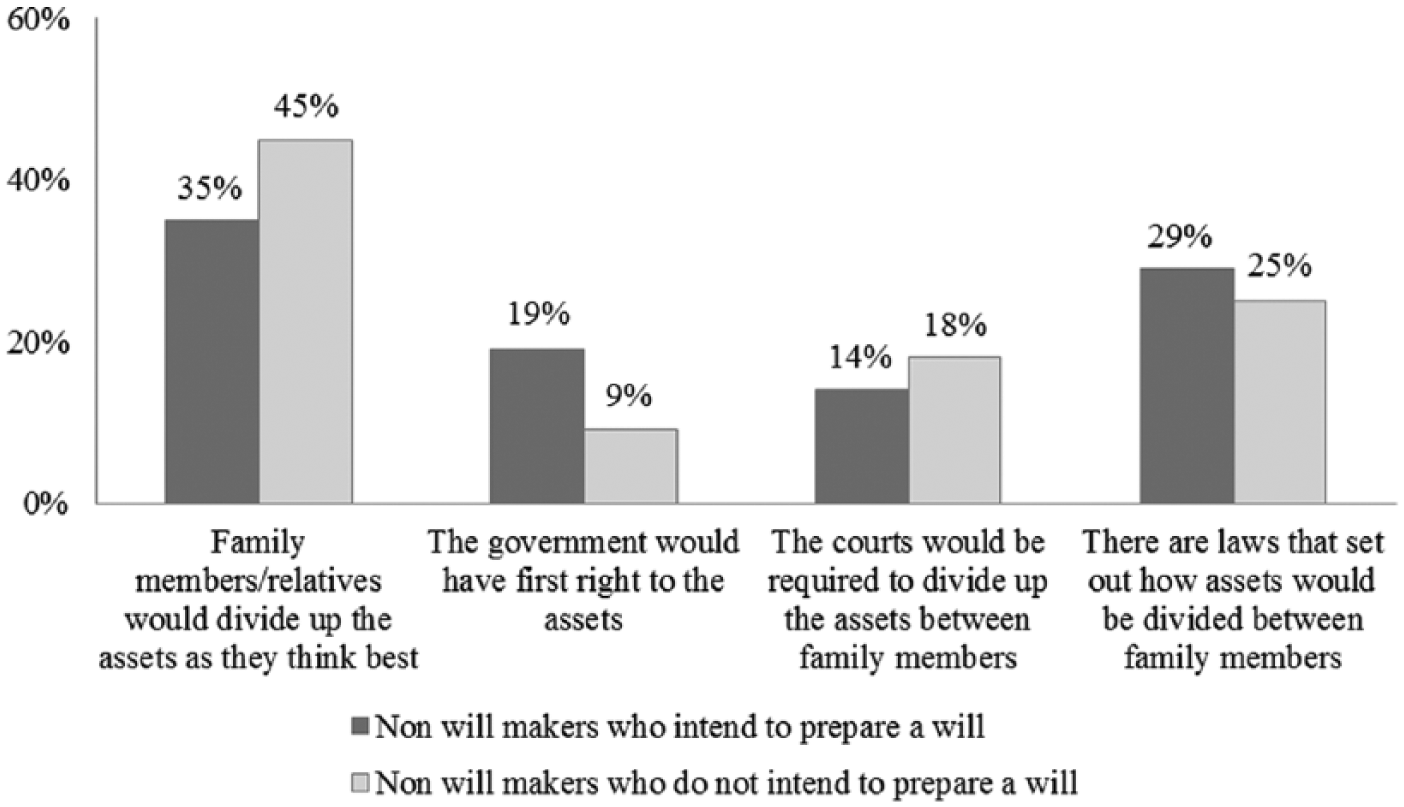
Non-will makers’ beliefs about what the law says about how their assets will be divided if they die intestate as a function of their intention to prepare a will.
This pattern was largely consistent across key demographic variables, including age, gender, relationship status, ethnic diversity, and estate value. Significant differences were observed, however, between non-will makers who intended to make a will at some stage and those who did not intend to make a will (see Figure 1). 5 Non-will makers who intended to prepare a will were significantly more likely to believe that the law said the government had first right to their assets than believe that their family can determine how assets are divided. By contrast, non-will makers who did not intend to prepare a will were significantly more likely to believe family members and relatives were responsible for dividing up the assets. 6
This research provided little evidence to suggest that the decision not to make a will is driven by an awareness of the consequences of dying intestate. For example, only seven out of 980 non-will makers reported not having a will because they believed existing laws would divide their assets appropriately:
I’m happy with the laws
I don’t think about death. I presume my assets will go to my closest relatives
I have faith in the system
However, there was wide variation in their understanding of intestacy laws among non-will makers who do not intend to prepare a will. Three respondents believed laws set out how their assets would be divided, two believed family would be responsible for dividing their assets, and two respondents believed the government or the courts would divide their assets.
Overall, non-will makers’ understanding of intestacy laws varied markedly. It is also interesting to note that only 8% (n = 108) of will makers described their main purpose in having a will as being to ensure the government does not step in. Thus, it appears that it is not concerns about intestacy laws that prompt will making.
Triggers That Prompt Will Making
Will makers were asked what events had triggered their will making. The three most commonly reported events were as follows:
efforts to get organized in general (n = 751, 53%)
having children (n = 299, 21%)
acquiring more assets (n = 240, 17%).
Very few will makers attributed their decision to prepare a will to generic advertising or third party suggestion (e.g., from family members or professionals). Most (n = 1,170, 82%) believed that no one had prompted them to prepare their most recent will. These findings suggest that although there are a range of circumstances that potentially trigger will making, the circumstances that ultimately lead an individual to prepare a will are likely to be specific for that person. Most individual will makers reflect a view that the decision to make a will must come from them and be motivated by self-assessment of their circumstances. Having made the decision to prepare a will, respondents were most likely to seek advice about making a will from their partner (n = 369, 45%) and/or a lawyer (n = 363, 44%).
Non-will makers were asked what events might trigger will making in the future. The majority of non-will makers believed changes in health, financial, or family circumstances would prompt will making. Circumstances that received endorsement as a likely trigger of will making by at least 20% (n = 196) of all non-will makers included the following:
being diagnosed with a serious illness (n = 772, 79%)
acquiring more assets (n = 468, 48%)
efforts to get organized in general (n = 399, 41%)
having children (n = 210, 21%)
a death in the family (n = 205, 21%).
Will making can be reactive or proactive. It is of interest to note that non-will makers were much more likely to nominate a serious illness as a potential trigger in contrast to those who had made a will. This suggests the importance of a real and tangible confrontation with their own mortality as a primary motivator for non-will makers in contrast to will makers who appear more likely to plan in response to taking on (adult) responsibilities such as having children or acquiring assets.
Triggers That Prompt Changes to Wills
Of the 1,425 will makers who participated in this research, just under half had made changes to their will (n = 658, 46%). Within this group,
half had made changes only once (n = 321, 49%)
one quarter had made changes twice (n = 162, 25%)
the remaining quarter had made changes three or more times (n = 175, 26%).
Compared with people who had not made changes to their will, respondents who had made changes were older 7 and had estates of higher estimated value. 8 For those who had made three or more changes, having children or grandchildren and relationship changes were significantly associated with will revisions rather than changes in financial circumstances, work, or health.
Those circumstances that prompted changes to wills were similar to those that prompted individuals to prepare their first will. The most commonly reported reason was having children (n = 217, 33%). As shown in Table 3, changes were most likely to address asset distribution and least likely to reflect alterations to instructions regarding funeral, guardianship, or health care arrangements. 9
Types of Changes Made to Wills.

Note. Percentages reflect the proportion of all will makers who reported making changes to their wills.
The relationship between demographic characteristics and types of changes participants made to their wills reflected the links between age and life course events. For example,
people who added a beneficiary 10 or changed guardianship instructions 11 were, on average, younger than people who had not made these changes
people who had changed executors 12 or amended funeral instructions 13 were, on average, older than those who had not
a higher proportion of respondents not in a relationship, in a new relationship, or in a de-facto relationship than those who were currently or previously married had removed a beneficiary. 14
These results suggest that the changes made adjusted provisions to meet evolving life circumstances in terms of the current asset base, family responsibilities, and relationship changes. For many, will making is part of ongoing planning to protect assets and provide for family.
Discussion and Conclusion
Results revealed that approximately 59% of Australian adults have a will, the greater proportion of these being older adults and those who have acquired more assets. This is, internationally, a relatively high figure (DiRusso, 2009; Douglas et al., 2011; Humphrey et al., 2010). Findings relating to non-will makers suggest that procrastination, a lack of time and/or interest, and perceived relevance for life stage, rather than systemic barriers or resistance to the idea of will making, account for most non-will making behavior, even among those respondents who do not currently intend to prepare a will. This is consistent with other research (Humphrey et al., 2010; Wilson & Tilse, 2012). The high prevalence rate and limited resistance to making will suggest that making a will is generally accepted as a social norm.
The higher prevalence of will making in Australia than in other Western countries especially the United States is interesting. Even for comparable older age cohorts, Australian rates of will making are much higher than in the United States and the United Kingdom. Some American research suggests dying without a will is the product of an overly costly, complex, and obscure will making process (Weisbord, 2012); conversely, Australians surveyed here identified few barriers in terms of cost or access to advice. This does not, however, explain the difference between prevalence rates in Australia, and in England and Wales (37% of those aged 16 and above); as in Australia, few non-will makers in England and Wales identified lack of knowledge or cost as disincentives (Brooker, 2007). As Brooker (2007) has suggested, however, it is important to explore further whether procrastination actually masks other barriers such as not knowing where to access information, concerns about discussing inheritance in complex families, or lack of knowledge about the utility of wills for more than asset distribution, for example, guardianship arrangements.
There are a number of other differences between countries that might help to explain some variation in will making prevalence. Compared with Americans, a higher proportion of Australians have significant assets such as their own home (69% cf. 65% in the United States and 68% in the United Kingdom), a second home or investment property (20% cf. 5% in the United States and 11% in the United Kingdom), and a personal superannuation (non-government pension plan; 80% cf. 25% in the United States and 76% in the United Kingdom 15 ; Australian Bureau of Statistics, 2013; Office for National Statistics, 2014; U.S. Census Bureau, 2013). Given fairly similar rates of asset ownership in the United Kingdom and Australia, a more important factor may be that, unlike the United States and the United Kingdom, there are no inheritance taxes in Australia. Hence, in Australia, there are no tax incentives to distribute wealth prior to death (Wiepking, Madden, & McDonald, 2010), encouraging the completion of a will to distribute assets after death.
Age and estate value were strongly associated with will making, in keeping with earlier studies (e.g., Dekker & Howard, 2006; Wilson & Tilse, 2012). Characteristics shown in previous research to be associated with will making behavior, such as gender, parenthood, and relationship status (Baker & Gilding, 2011; Humphrey et al., 2010; Olsberg & Winters, 2005), were less useful in distinguishing between will makers and non-will makers here. Some studies suggest there may be a misconception among younger people that estate planning is only relevant to older and wealthier people (Rowlingson & McKay, 2005). However, younger individuals can acquire significant assets, including life insurance and superannuation payouts made at death. Younger people with superannuation to be paid to their estate rather than a nominated beneficiary require a will to ensure assets are distributed according to their preferences. Younger people may also fail to recognize that wills are not only useful in transferring assets but are importantly a mechanism to put in place guardianship and trust arrangements for dependent children and to include or exclude ex-partners. It can also be imperative to provide for a new partner for those who have separated but not divorced.
What is clear is that knowledge (or more accurately lack of knowledge) of the implications of dying intestate does not drive the decision to make or not make a will. These findings support previous research which has suggested that individuals have very little understanding of the consequences of dying intestate (Rowlingson & McKay, 2005; Weisbord, 2012). It is worth noting that beliefs surrounding the value of assets to bequeath influenced around one fifth of non-will makers, the effect on non-will making rising as the value of assets declines. This finding is consistent with earlier work (e.g., Finch & Mason, 2000; Rowlingson & McKay, 2005; Wilson & Tilse, 2012) and demonstrates that having both the time and believing there is something to leave are influential factors in the decision to draft a will.
The circumstances that trigger will making in previous research include a range of changes in personal circumstances (e.g., marriage, parenthood, death of a loved one) or personal wealth (e.g., buying a home, receiving an inheritance; Humphrey et al., 2010; Palmer et al., 2006; State Trustees Limited, 2012; Wilson & Tilse, 2012). The majority of respondents identified more than one trigger for will making, suggesting that a combination of factors leads people to prepare a will. Will makers failed to consistently identify any single specific change in personal circumstances that motivated them to draft a will. Instead, when asked what triggered them to prepare a will, respondents were most likely to refer to general efforts to “get organized.” This finding suggests most individuals prepare a will at times when they are taking steps to get their life in order. What triggers getting their life in order requires further investigation. Responses to questions about intentions in making or changing a will suggest that providing for family and adjusting to changing family circumstances are important. What is clear and consistent is that most had accepted an obligation to make a will.
In this study, slightly less than half of respondents had made changes to their will. The extent to which respondents’ wills reflected their current intentions and/or circumstances was not clear. It is important that wills reflect testators’ current situation and intentions; accordingly regularly reviewing and updating a will are extremely important throughout life. Contestation arising from not having an up to date will can substantially reduce the value of the estate or even consume it all (Begleiter, 1994) and leave a legacy of family discord and mistrust (Love & Sterk, 2008; Stimmel, 2002).
The policy and practice issues arising from this research include how to (a) ensure people have a valid and up-to-date will that truly reflects current assets, life circumstances, and intentions, and (b) encourage people with dependents to see wills as the way of formally nominating guardians and trustees for minors.
The findings of few attitudinal and systemic barriers to will making, and the common view that will making is individually initiated rather than prompted by advertising suggest that awareness raising campaigns (e.g., advertising by the Public Trustees highlighting free will making services and educating the community about the purpose of will making) are likely to have little impact on non-will makers. Most will makers consider that the decision to make a will must come from them in response to a self-assessment of their circumstances. This suggests that the appropriate timing and methods of targeting Australians to encourage making the initial will need to be considered in more detail.
Despite the above limitations, the research findings suggest some useful avenues for targeted public education. Efforts to get organized, especially in combination with life stage and asset changes, trigger will making. Targeted campaigns promoting will making for various age groups that link to life stage events are therefore likely to have impact. A key focus should be on the quite large cohort of younger people (those aged less than 50 years) who did not have wills, particularly those with dependents. Intestacy laws are poorly understood; however, this research indicates that public education on this topic is unlikely to increase will making. An alternate message of public education campaigns may be around looking after family given that intestacy creates problems for families in terms of practical inconvenience.
Education campaigns also need to target current will makers about updating their will to ensure their will reflects current circumstances and intentions. As with making an initial will, prompts to consider updating wills in the event of changes in assets, for example, as part of conveyancing packages for properties (Brooker, 2007) and/or changing family circumstances such as marriage, divorce, separation, or the birth of a child could be useful. Campaigns intended to promote will making may benefit from identifying the coincidence of factors that encourage people to “get organized” and include will making in educational and advertising strategies to raise awareness about financial, retirement, and care planning.
Very few participants reported using their wills to leave additional instructions (e.g., funeral instructions). Although wills are predominantly used as means of asset distribution, they can be used for much wider purposes including nominating guardians for dependents to provide for their ongoing care and support. Broadening the understanding of what a will is for, how and when it should be updated, and the risks and costs of contestation is an important issue to consider in any social marketing strategy.
A strength of this study is that it is the first large-scale, broad-based, nationally representative survey focusing specifically on will making undertaken in Australia. With a few exceptions (e.g., DiRusso, 2009; Giving Australia, 2005; Goetting & Martin, 2001), existing data are primarily based on non-representative samples. A limitation is the relatively low response rate (33%). However, this is similar to other surveys (Vines, 2011; Wiepking et al., 2010) about wills and estate planning and may reflect an avoidance of discussing these issues. Furthermore, the sample was representative of the broader Australian population on a number of indicators. An additional limitation is that cross-sectional surveys do not allow for exploration of changes in attitudes and practices over time and generations.
In the context of predicted large wealth transfers between generations, increased cultural diversity, and changing family structures, baseline data on the making and changing (or lack of changing) of wills are critical. Failure to have a will, or having a will that does not reflect current intentions, can lead to distributions of wealth not wanted by a person as well as contestation by family and others. This has significant adverse consequences not only for the individuals involved but also for the state, for example, through the cost of engaging the judicial process to resolve these disputes. The starting point for tackling these issues is understanding who is not making or updating wills and why. This article provides an evidence base for policy makers and will drafters to respond to these challenges.
Footnotes
Acknowledgements
The researchers wish to thank the Australian Research Council for their funding of this research and our Industry Partners: the Public Trustees of Queensland, Tasmania, South Australia, Western Australia, and the Australian Capital Territory, State Trustees of Victoria and New South Wales Trustee and Guardian for their extensive engagement with the project.
Declaration of Conflicting Interests
The author(s) declared no potential conflicts of interest with respect to the research, authorship, and/or publication of this article.
Funding
The author(s) disclosed receipt of the following financial support for the research and/or authorship of this article: This research was supported under the Australian Research Council’s Linkage Projects Funding scheme (project number: LP110200891) and contributions from our Industry Partners.