




Abstract
Technological pedagogical and content knowledge (TPACK) is a pedagogical tool that can provide teachers and preservice teachers opportunities to receive enhanced lesson input, engage in classroom interactions, and improve learning outcomes. This study aims at examining the factors related to the TPACK skills of preservice social studies teachers. Participants consisted of 368 preservice teachers studying at the social studies teacher education department of a university located in the Central Black Sea Region of Turkey. Participants completed the TPACK scale and personal information form. The data were analyzed using descriptive statistics, one-way multivariate analysis of variance, and one-way analysis of variance. The results of the study reveal that gender is associated with the preservice teachers’ technological knowledge, content knowledge, and pedagogical knowledge; education year is associated with technological knowledge and technological pedagogical knowledge; high school type is correlated with technological knowledge, technological pedagogical knowledge, technological content knowledge, and technological pedagogical and content knowledge; home computer ownership is associated with technological knowledge; and average weekly time spent using a computer is associated with technological knowledge and technological pedagogical and content knowledge. Finally, technical computer skills are correlated with technological knowledge, content knowledge, pedagogical knowledge, pedagogical content knowledge, technological pedagogical knowledge, and technological pedagogical and content knowledge. The current study may contribute to determining culturally specific and cross-cultural correlates of TPACK skills among preservice teachers.
Rapid advances in information and communications technologies (ICT) over the past 30 years have dramatically affected the learning and teaching process as well as teacher education curricula. Moreover, the integration of ICT into education has also become widespread. For example, tablets, interactive whiteboards, e-readers, and flipped classrooms have become indispensable parts of education in developed and most developing countries. With the widespread use of these technologies, researchers are now interested in how teachers can use ICT to improve their teaching practices and also the skills and qualifications required to efficiently integrate these technologies into the teaching process (Mishra, 2019; Schmid et al., 2021; Tondeur et al., 2020). Furthermore, researchers have developed theoretical models to determine the knowledge and skills required for teachers and preservice teachers to successfully integrate technology into the education and training process (Schmid et al., 2020). One of these models is the technological pedagogical and content knowledge (TPACK) model developed by Koehler and Mishra (2009). TPACK is a pedagogical tool that can provide teachers and preservice teachers opportunities to receive enhanced lesson input, engage in classroom interactions, and improve learning outcomes. TPACK is a conceptual framework for integrating content, pedagogy, and technology into teacher knowledge. This model is based on an early conceptualization of Shulman’s pedagogical content knowledge (Shulman, 1986), in which content and pedagogy are combined to understand how a particular content is related to specific pedagogical strategies. TPACK has also been defined as a framework for explaining and describing teachers’ knowledge and skills related to technology integration (Bustamante, 2020; Polly & Brantley-Dias, 2009).
The TPACK model consists of seven interrelated dimensions: content knowledge (CK), technological knowledge (TK), pedagogical knowledge (PK), technological pedagogical knowledge (TPK), pedagogical content knowledge (PCK), technological content knowledge (TCK), and technological pedagogical and content knowledge (TPACK). TK includes not only individuals’ basic computer knowledge but also their level of knowledge about different tools related to ICT (Scherer et al., 2018; Valtonen et al., 2019). A preservice social studies teacher’s ability to install new software on their computer without help is an example of TK. While CK refers to an individual’s level of knowledge of specific concepts and principles that are taught and learned in specific academic courses, PK reflects the individual’s level of knowledge regarding creating effective teaching and learning environments. PK also includes information on principles and methods of teaching, such as the way students learn, teaching methods, different educational theories, classroom management and organization, and curriculum planning and evaluation (Chai et al., 2013; Koehler & Mishra, 2009). For example, while preservice social studies teachers’ knowledge of map information is an example of CK, their knowledge regarding different teaching methods and techniques—such as simulation, role-playing games, demonstration, brainstorming, project-based learning, and using case studies—is an example of PK.
PCK, however, refers to teachers’ skills in effectively adapting CK and pedagogical strategies so that students can understand certain concepts (Andyani et al., 2020; Kind & Chan, 2019). For instance, preservice social studies teachers’ ability to use the demonstration method for social studies content can be considered an example of PCK. TPK relates to teachers’ knowledge of and ability to use various technologies for teaching and learning rather than their knowledge of content (Chai et al., 2013; Koehler & Mishra, 2009; Koehler et al., 2013). An example of TPK might be a teacher’s ability to employ digital storytelling and computer-aided cooperative learning to create a family tree in a social studies lesson. TCK, however, describes teachers’ knowledge of the different ways that technologies are used in a specific content domain without focusing on teaching. For example, using Google Maps, MapQuest, or Scribble Maps for drawing a map in a social studies lesson can be considered an example of TCK. Finally, TPACK refers to teachers’ ability to use technology for specific subject content development (Koehler & Mishra, 2009; Lavidas et al., 2021). The knowledge required to employ software such as Skype or Padlet as an interaction tool to improve cooperative learning in social studies education is an example of TPACK.
There has been a transformation from the behaviorist approach of the 1960s to the technological pedagogical content knowledge approach, which integrates content knowledge, pedagogy, and technology in teacher education and training as well as defines their competencies in the Turkish Education System according to the changing policies of the Turkish Ministry of Education (Arslan et al., 2022; Ministry of National Education [MoNE], 2022). The MoNE has determined the general competencies of the teaching profession to control the professional qualifications of teachers after they have received the necessary training and have been appointed. These general competencies consist of 11 main competencies and 65 performance indicators (Ministry of National Education, 2017).
MoNE specifies five special competency areas for the social studies field: planning and organizing the teaching process, the learning and teaching process; monitoring and evaluation; cooperation with the school, family, and society, and providing professional development. In particular, MoNE states that technological tools and information technologies should be used by social studies teachers in the performance indicators of the competence area of planning and organizing the teaching process and the ability to use materials and resources suitable for the teaching process (Ministry of National Education, 2017). Although MoNE emphasizes the importance of technology integration in educational practices, recent studies conducted among teachers and preservice teachers in Turkey indicated that educational technologies cannot be effectively integrated into the teaching process despite the large technology investments made to provide the technology infrastructure in schools (Baran & Canbazoğlu Bilici, 2015). To solve this problem, practices and research studies are needed that will enable preservice teachers and teachers to develop effective technology integration knowledge in their fields in in-service training and preservice teacher education programs.
Moreover, the majority of prior studies examined the factors related to TPACK. In these studies, the researchers examined learning strategies (Gündoğmuş & Gündüz, 2015); attitudes toward technology and digital literacy levels (Muhaimin et al., 2019); academic success (Erdogan & Sahin, 2010); and sociodemographic factors such as gender, age, education year, computer ownership, computer skills, and weekly time spent using a computer (Hsu & Chen, 2018; Jang & Tsai, 2013; Koh & Chai, 2011; Lee & Tsai, 2010; Lin et al., 2013; Muhaimin et al., 2019; Naaz & Khan, 2018). However, a literature survey demonstrated a limited amount of research examining sociodemographic factors related to the TPACK skills of preservice social studies teachers. In addition to the limited number of previous studies, examining TPACK skills among preservice social studies teachers is also important for several reasons. Firstly, social studies education helps students understand the world in which they live so they can make informed decisions about issues that affect them as they grow older. Through social studies, students develop historical thinking and literacy skills as a way of navigating the world. For this reason, equipping social studies teachers and preservice teachers with good TPACK skills is crucial. Secondly, with the widespread use of technology in education, it is essential to prepare preservice teachers to effectively integrate technology into their teaching practices. TPACK offers a deeper understanding of how technology can be used with pedagogy as well as content knowledge to enhance student learning (Ning et al., 2022; Tseng et al., 2022). Thirdly, since TPACK is a framework that helps teachers develop effective teaching practices by considering a unique blend of pedagogical, content, and technological knowledge required for successful instruction, Turkish social studies preservice teachers can develop the necessary knowledge and skills to design, implement, and evaluate effective technology-enhanced learning experiences for their students. Fourthly, the MoNE has set curriculum standards for social studies education in Turkey. By examining correlates of TPACK skills among preservice social studies teachers, it can be ensured that they have the necessary knowledge and skills to meet these standards and effectively deliver curriculum content. Lastly, identifying the factors that affect preservice social studies teachers’ TPACK skills can assist teacher education programs in designing more targeted and effective curricula that address the specific needs of different preservice teacher groups. For example, a study by Naaz and Khan (2018) found that gender was a significant correlate of TPACK skills among teachers. Another study by Lee and Tsai (2010) also found that younger preservice teachers are more likely to have higher TPACK skills than older preservice teachers. Demirtaş and Mumcu (2021) also found that preservice teachers who have a personal computer and higher computer usage skills exhibit higher TPACK skills compared to those who have not. These findings suggest that teacher education programs could provide greater support for female and older preservice teachers, as well as those who do not possess a personal computer, and those with low computer skills. Moreover, understanding how sociodemographic factors (gender, grade level, computer ownership, the type of high school, technical computer skills, and average weekly time spent on the computer) impact preservice social studies teachers’ TPACK skills can help identify potential equity issues in teacher education. Identifying such disparities can help promote greater equity and inclusion in teacher education programs. Identifying the sociodemographic factors that impact preservice social studies teachers’ TPACK skills can also help promote more effective technology integration in social studies education, ultimately leading to improved student outcomes. The purpose of this study is to examine sociodemographic variables related to the TPACK skills of preservice social studies teachers. The specific research questions that guided the present study were as follows:
Are there significant differences in the TPACK skills of preservice social studies teachers with respect to gender?
Are there significant differences in the TPACK skills of preservice social studies teachers with respect to grade level?
Are there significant differences in the TPACK skills of preservice social studies teachers with respect to the type of high school that they graduated from?
Are there significant differences in the TPACK skills of preservice social studies teachers with respect to home computer ownership?
Are there significant differences in the TPACK skills of preservice social studies teachers with respect to technical computer skills?
Are there significant differences in the TPACK skills of preservice social studies teachers with respect to average weekly time spent on the computer?
Method
Research Model
This cross-sectional study aimed to examine the TPACK-related variables of the preservice teachers in a social studies education department (Cohen et al., 2018). The goal of this type of research design is to describe similarities and differences in a sample or the temporal relationship between variables within a given timeframe without any intervention. The research design of this study is also quantitative with respect to the study approach (Ajimotokan, 2022) and descriptive with respect to the study purpose (Coolican, 2019). The dependent variables in this study were TPACK skills, and the independent variables were gender, grade level, high school type, home computer ownership, technical computer skills, and average weekly time spent on the computer. The research model of this study is shown in Figure 1.

Research model.
Participants
The minimum required sample size for this study was determined through power analyses using a power of 0.90 and a margin of error of 0.05 with a medium effect size (Faul et al., 2007). Power analyses revealed that the minimum sample size required for this study varied from 124 to 191 for each multivariate analysis of variance. Participants consisted of 368 preservice social studies teachers studying at the social studies teacher education department of a university located in the Central Black Sea Region of Turkey. The participants were selected using the convenience sampling method (Cohen et al., 2018). Convenience sampling is a nonprobability sampling method in which participants are chosen considering factors such as cost, time, and accessibility to the researcher. Of the participants, 148 (40.2%) were male and 220 (59.8%) were female. The age of the participants ranged from 17 to 25 years old, with a mean age of 21.10 (SD = 3.15). There were 40 (10.9%) first-year preservice teachers, 82 (22.3%) second-year preservice teachers, 167 (45.4%) third-year preservice teachers, and 79 (21.5%) fourth-year preservice teachers. The reason for the low number of first-year preservice teachers among the research participants is that the preservice teachers attending these classes were less willing to participate in the study compared to other grades.
Data Collection Tools
Sociodemographic Characteristics
The personal information form was used to collect the preservice social studies teachers’ sociodemographic information, including their gender, education year, the type of high school from which they graduated, home computer ownership, technical computer skills, and average weekly time spent on the computer.
TPACK Skills
Preservice teachers’ TPACK levels were measured using the TPACK scale developed by Pamuk et al. (2015). In developing the TPACK scale, Pamuk et al. (2015) examined the scale’s content validity, construct validity, and reliability. Results of exploratory factor analysis indicated that the TPACK scale consists of seven factors—namely TK, CK, PK, PCK, TPK, TCK, and TPACK—that explain approximately 70.13% of the total variance. The factor loadings of subscales range from 0.60 to 0.84 in TK, 0.59 to 0.78 in CK, 0.56 to 0.72 in PK, 0.54 to 0.76 in PCK, 0.55 to 0.78 in TPK, 0.57 to 0.72 in TCK, 0.66 to 0.83 in TPACK. The internal consistency reliability of subscales was also good, ranging from 0.76 (PK) to 0.92 (TPACK). The scale measures the TPACK levels of the participants with the subscales of TK (four items), CK (eight items), PK (four items), PCK (six items), TPK (four items), TCK (four items), and TPACK (7 items). Participants indicated their degree of agreement on a five-point Likert-type scale ranging from 1 (strongly disagree) to 5 (strongly agree). The possible total scores ranged from 5 to 20 for the TK, PK, TPK, and TCK subscales; 6 to 30 for the PCK subscale; 7 to 35 for the TPACK subscale; and 8 to 40 for the CK subscale. Higher scores indicate greater skills for each dimension. Table 1 displays sample items for each subscale and the Cronbach alpha internal consistency reliability coefficients calculated in this study.
Sample Items for Subscales of TPACK Scale and Reliability Coefficients.
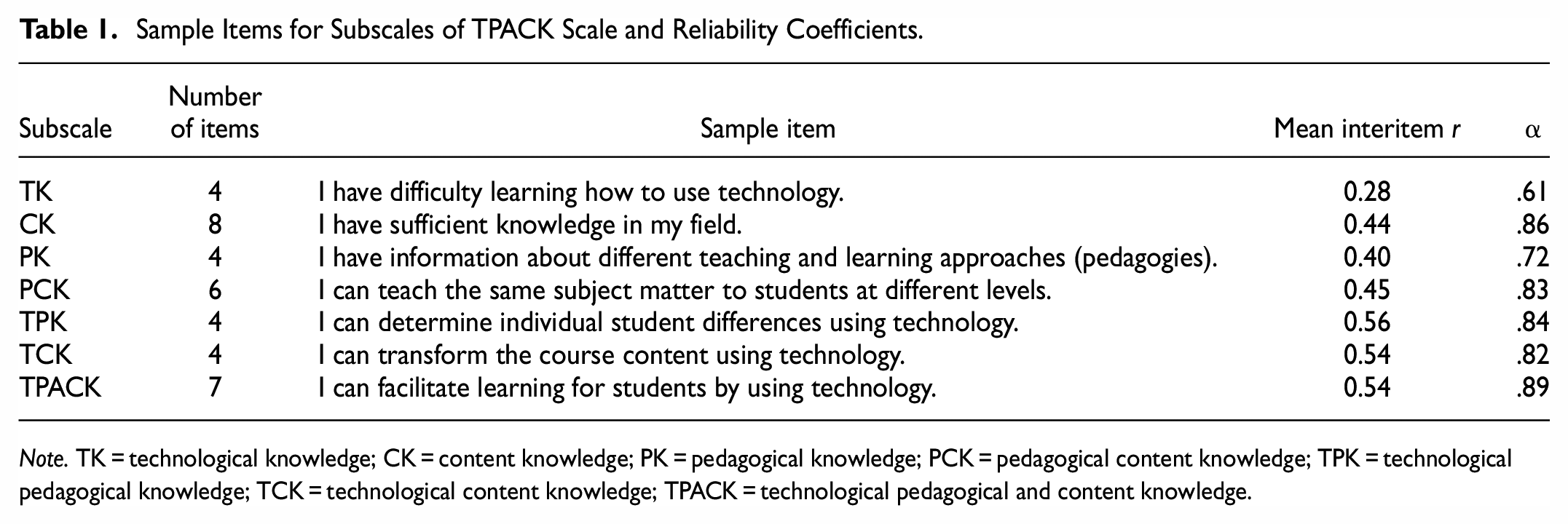
Note. TK = technological knowledge; CK = content knowledge; PK = pedagogical knowledge; PCK = pedagogical content knowledge; TPK = technological pedagogical knowledge; TCK = technological content knowledge; TPACK = technological pedagogical and content knowledge.
Data Collection Process
The author collected the study data during the 2017 to 2018 academic year. Under the supervision of the researcher in a classroom environment, preservice teachers completed a survey consisting of the personal information form and TPACK scale. Before survey administration, all preservice teachers were told that their participation was voluntary, all answers would be kept confidential, and they were free to leave at any time during the survey without any repercussions. Written informed consent was also obtained from each participant before they responded to the questionnaire. All preservice teachers voluntarily participated in the study without any incentive or reward. The completion of the survey took approximately 20 min.
Data Analysis
The data were analyzed using SPSS 23 statistical software. Prior to the main analyses, the data were examined for accuracy, missing values, and outliers, as well as assumptions for statistical tests. The examination of minimum and maximum values revealed that all variables were within the expected values. No missing data or outliers were observed. There were no missing data because the author checked every questionnaire, and in the case of missing data, the participant was asked to answer the relevant item(s) during the data collection. The data were analyzed using a one-way multivariate analysis of variance (MANOVA). The one-way MANOVA is a multivariate analysis that can be employed when there is one independent variable and more than one dependent variable (Field, 2014). When the dependent variables positively correlate with each other, researchers often prefer one-way MANOVA because it provides greater statistical power and effectively controls the type I error rate (Hair et al., 2018; Tabachnick & Fidell, 2012). Previous studies have indicated that TPACK subscales are generally moderately correlated with each other (Deng et al., 2017; Koh & Chai, 2011; Zhang & Wang, 2016). Therefore, considering the number of comparisons and expected positive moderate correlation between variables, one-way MANOVA was used. For all statistical tests, the type I error rate was set as p < .05.
Findings
Preliminary Findings
Preliminary analyses were conducted to examine data accuracy, missing values, univariate and multivariate outliers, and the extent of MANOVA assumptions. Examination of minimum and maximum values as well as frequency distributions of TPACK subscales and independent variables indicated that all values were within the expected range. These findings demonstrate the accuracy of the data. Although the data were initially collected from 377 participants, five univariate outliers and four multivariate outliers were detected and excluded from the data set. Thus, statistical analyses were performed using 368 participants.
The assumptions of MANOVA, including univariate and multivariate normality, linearity, independence, and homogeneity of variances and covariances, were also thoroughly investigated prior to the data analysis (Hair et al., 2018; Tabachnick & Fidell, 2012). The assumption of independence was examined by plotting standardized residuals against levels of each independent variable (i.e., gender, education year, high school type, home computer ownership status, level of technical computer skills, and average weekly computer use). Using scatterplots provided strong evidence for the independence assumption by showing a random display of residuals below and above the zero line for each category of the independent variables (Tabachnick & Fidell, 2012).
Univariate normality was examined using skewness and kurtosis values of TPACK subscales. Examination of skewness and kurtosis values indicated that skewness values ranged from −0.33 to −1.08, and kurtosis values ranged from −0.15 to 3.21. Moreover, a Q-Q plot of standardized residuals of each MANOVA model also indicated a relatively normal distribution, with only nonnormality suggested in the details of the distribution. As a general rule, skewness and kurtosis values within the range of ±3.29 indicate relatively normal distribution (Kim, 2013). Thus, these findings denote that the dependent variables are relatively normally distributed. To examine the multivariate normality assumption, examining a plot of squared Mahalanobis distance suggested that the multivariate normality assumption is tenable (Hahs-Vaughn, 2017). Linearity of TPACK subscale scores was examined using scatterplots of all pairs of dependent variables. Examination of scatterplots indicated that TPACK subscales exhibit weak to strong positive linear associations.
Lastly, the homogeneity of variance–covariance assumption was examined using boxplots of the TPACK subscales as a visual means to determine the equality of covariances and variances. There were no substantial differences in the box lengths or whisker lengths for TPACK subscale scores by group suggesting evidence of homogeneity of covariance. However, examining the homogeneity of variance assumption using formal Levene’s test for equality of error variances and examining homogeneity of covariance matrices using Box’s M test suggested the violation of the homogeneity of variance or homogeneity of covariance assumption. Because the assumption of the homogeneity of covariance matrices and/or homogeneity of variance was violated in some analyses, Pillai’s trace test was used to report the multivariate main effect, as suggested by Tabachnick and Fidell (2012). A follow-up one-way analysis of variance (ANOVA) was used to examine each univariate main effect. Post hoc Tukey HSD or Games–Howell tests (in violation of the assumption of the homogeneity of variance) were used to determine the difference between groups when there were more than two groups. To examine the robustness of the MANOVA findings in case of violation of the homogeneity of variance or homogeneity of covariance assumption, a series of independent sample t-tests or one-way ANOVAs were also conducted. The results of these analyses were identical to the MANOVA results, indicating robustness of the findings. The data that support the findings of this study are openly available in Mendeley Data Repository (https://doi.org/10.17632/6crcy92jkz.1).
Descriptive Statistics
Table 2 presents the descriptive statistics related to the preservice social studies teachers. The majority of the participants were women (59.8%), third-year preservice teachers (45.4%), graduates of nonselective high schools (75.3%), with a home computer (56.8%), a moderate level of technical computer skills (58.7%), and who spend an average 0 to 5 hr weekly using a computer.
Descriptive Statistics of Study Group.
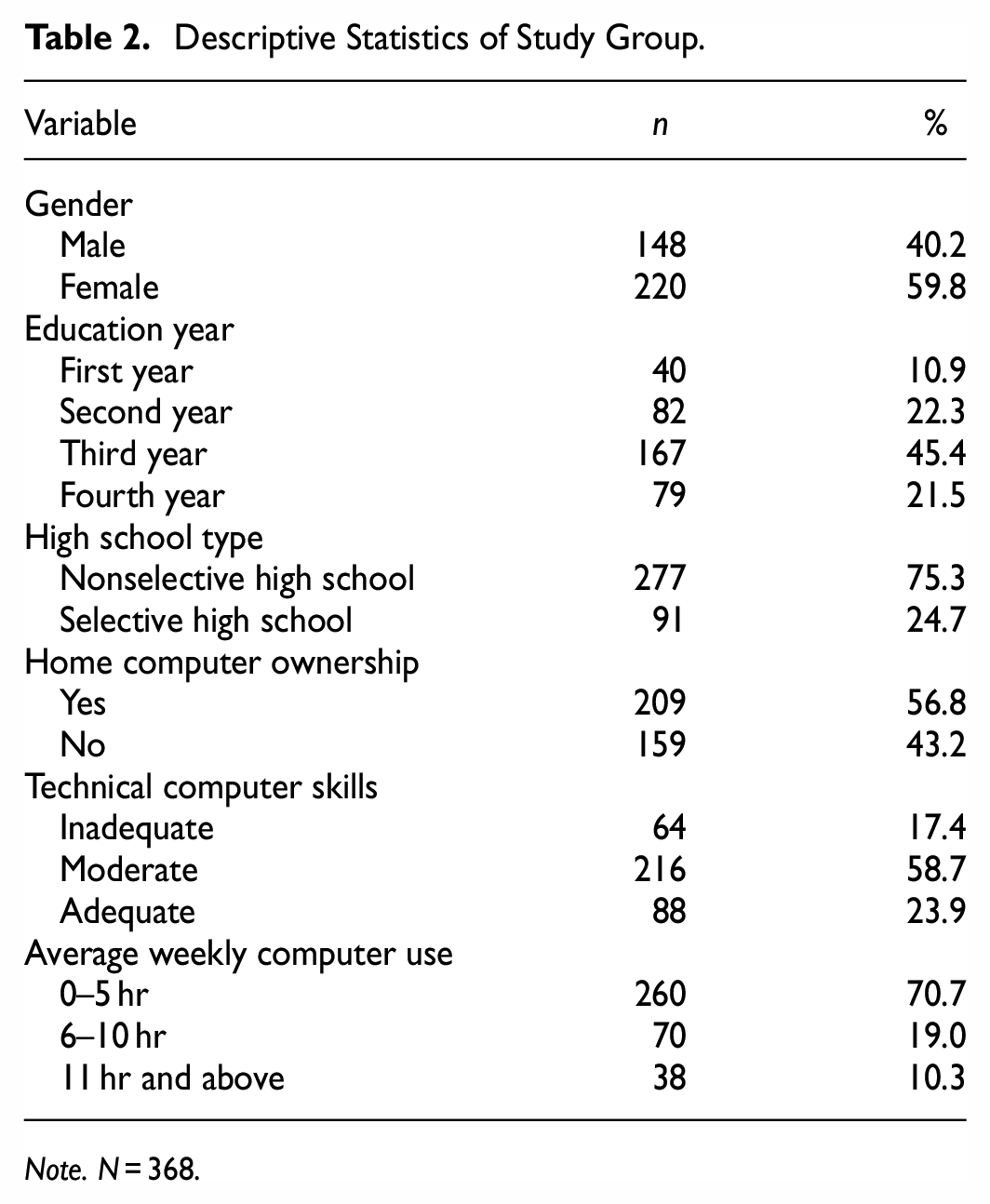
Note. N = 368.
Gender Differences in TPACK Skills
A one-way MANOVA was conducted to analyze the differences among the TPACK subscale scores according to gender. Table 3 presents means and standard deviations for the TPACK subscale scores and findings of subsequent one-way ANOVAs according to gender.
Findings of One-Way ANOVA for Gender.

Note. Statistically significant = a > b. TK = technological knowledge; CK = content knowledge; PK = pedagogical knowledge; PCK = pedagogical content knowledge; TPK = technological pedagogical knowledge; TCK = technological content knowledge; TPACK = technological pedagogical and content knowledge.
p < .05. **p < .01. ***p < .001.
The one-way MANOVA findings indicated that the multivariate main effect of gender was significant and moderate (Pillai’s Trace = 0.06, F(7, 360) = 3.38, p = .002, Partial η2 = .06). A series of one-way ANOVA tests was carried out to determine which dependent variable(s) produced statistically significant score differences with respect to gender, and the results are presented in Table 3. As seen in Table 3, the one-way ANOVA findings suggested that the male preservice social studies teachers had significantly higher TC, CK, PK, and PCK mean scores than their female counterparts. The effect size of TC, CK, PK, and PCK was small.
Grade Level Differences in TPACK Skills
A one-way MANOVA was conducted to analyze the differences among the TPACK subscales according to grade level. Table 4 presents means and standard deviations for the TPACK subscale scores and findings of subsequent one-way ANOVAs according to grade level.
Findings of One-Way ANOVA for Grade Level.

Note. . Statistically significant = a > b. TK = technological knowledge; CK = content knowledge; PK = pedagogical knowledge; PCK = pedagogical content knowledge; TPK = technological pedagogical knowledge; TCK = technological content knowledge; TPACK = technological pedagogical and content knowledge.
p < .01. ***p < .001.
The one-way MANOVA finding suggested that the multivariate main effect of grade level was significant and moderate (Pillai’s Trace = 0.19, F(21, 1080) = 3.45, p = .001, Partial η2 = .06). A series of one-way ANOVA tests was carried out to determine which dependent variable(s) produced statistically significant score differences with respect to grade level, and the results are presented in Table 4. The results of one-way ANOVAs suggested a significant difference in TK and TPK scores with respect to grade level. The effect sizes of TK and TPK were moderate and small, respectively. The post hoc Tukey HSD tests revealed that the TK mean scores of the first- and second-year preservice teachers were significantly higher than those of the third-year preservice teachers. Moreover, the TPK mean scores of the first-year preservice teachers were significantly higher than those of the third- and fourth-year preservice teachers.
High School Type Differences in TPACK Skills
A one-way MANOVA was conducted to analyze the differences among the TPACK subscales according to high school type. Table 5 presents means and standard deviations for the TPACK subscale scores and findings of one-way ANOVAs according to high school type.
Findings of One-Way ANOVA for High School Type.

Note. Statistically significant = a > b. TK = technological knowledge; CK = content knowledge; PK = pedagogical knowledge; PCK = pedagogical content knowledge; TPK = technological pedagogical knowledge; TCK = technological content knowledge; TPACK = technological pedagogical and content knowledge.
p < .05. **p < .01.
The multivariate main effect of high school type was significant and small (Pillai’s Trace = 0.05, F(7, 360) = 2.46, p = .018, Partial η2 = .05). The results of one-way ANOVAs indicated that the TK, TPK, TCK, and TPACK mean scores of the preservice social studies teachers who graduated from a nonselective high school were significantly higher than those of preservice teachers who graduated from a selective high school. All effect sizes were small.
Home Computer Ownership Differences in TPACK Skills
A one-way MANOVA was conducted to analyze the differences among the TPACK subscales according to home computer ownership. Table 6 presents means and standard deviations for the TPACK subscale scores and findings of one-way ANOVAs according to home computer ownership.
Findings of One-Way ANOVA for Home Computer Ownership.

Note. Statistically significant = a > b. TK = technological knowledge; CK = content knowledge; PK = pedagogical knowledge; PCK = pedagogical content knowledge; TPK = technological pedagogical knowledge; TCK = technological content knowledge; TPACK = technological pedagogical and content knowledge.
p < .001.
The multivariate main effect of home computer ownership was significant and small (Pillai’s Trace = 0.04, F(7, 360) = 2.07, p = .046, Partial η2 = .04). One-way ANOVA tests were carried out to determine which dependent variable(s) produced statistically significant score differences with respect to home computer ownership, and the results are presented in Table 6. The results of one-way ANOVAs revealed that the TK levels of preservice social studies teachers who have a home computer were significantly higher than those who do not have. The effect size of TK was small.
Technical Computer Skills Differences in TPACK Skills
A one-way MANOVA was conducted to analyze the differences among the TPACK subscales according to technical computer skills. Table 7 presents means and standard deviations for the TPACK subscales according to technical computer skills.
Results of One-Way ANOVA for Technical Computer Skills.

Note. Statistically significant = a > b > c. TK = technological knowledge; CK = content knowledge; PK = pedagogical knowledge; PCK = pedagogical content knowledge; TPK = technological pedagogical knowledge; TCK = technological content knowledge; TPACK = technological pedagogical and content knowledge.
p < .001.
The multivariate main effect of technical computer skills was significant (Pillai’s Trace = 0.38, F(14, 720) = 11.92, p = .001, Partial η2 = .19). On the other hand, the multivariate effect size for technical computer skills was found to be large. A series of one-way ANOVA tests was carried out to determine which dependent variable(s) produced statistically significant score differences with respect to gender, and the results are presented in Table 7. The results of one-way ANOVA tests indicated a statistically significant difference in all subscale scores. The results of the post hoc Tukey HSD and Games–Howell tests indicated all the subscale mean scores of the preservice social studies teachers with a high or moderate level of technical computer skills were higher than those with low technical computer skills. Moreover, the TK, CK, PK, TPK, and TPACK levels of participants with a high level of technical computer skills were higher than those of participants with a moderate level of technical computer skills. The effect size of PCK was small, whereas, the effect size of PK, TPK, and TCK was moderate, and the effect size of TK, CK, and TPACK was large.
Average Weekly Computer Use Differences in TPACK Skills
A one-way MANOVA was conducted to analyze the differences among the TPACK subscales according to average weekly computer use. Table 8 presents means and standard deviations for the TPACK subscale scores according to average weekly computer use.
Results of One-Way ANOVA for Average Weekly Computer Use.
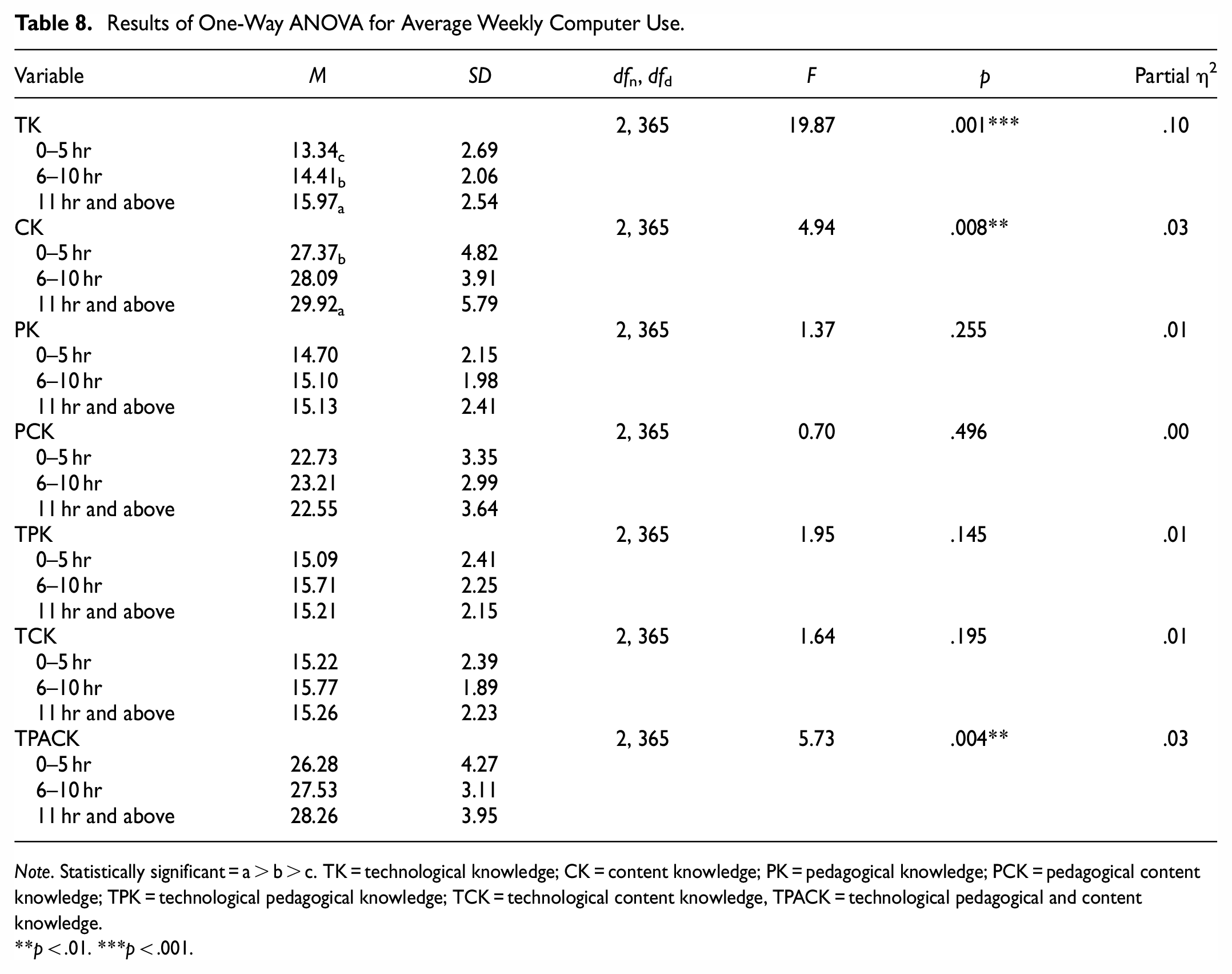
Note. Statistically significant = a > b > c. TK = technological knowledge; CK = content knowledge; PK = pedagogical knowledge; PCK = pedagogical content knowledge; TPK = technological pedagogical knowledge; TCK = technological content knowledge, TPACK = technological pedagogical and content knowledge.
p < .01. ***p < .001.
The multivariate main effect of average weekly computer use was significant and moderate (Pillai’s Trace = 0.14, F(14, 720) = 3.92, p = .001, Partial η2 = .07). The results of one-way ANOVA tests revealed that the TK levels of preservice social studies teachers who spent an average of 11 hr or more per week using a computer were significantly higher than those who spent an average of 6 to 10 or 0 to 5 hr per week using their computer. Furthermore, the TK mean scores of preservice social studies teachers who spent an average of 6 to 10 hr per week on their computers were significantly higher than those who spent an average of 0 to 5 hr per week. Additionally, the CK levels of preservice social studies teachers who spent an average of 11 hr or more per week using their computer were significantly higher than those who spent an average of 0 to 5 hr per week. The effect size of CK and TPACK was small, whereas the effect size of TK was found to be moderate.
Discussion
This study examined the factors related to the TPACK skills of preservice social studies teachers. The results revealed that the gender of preservice social studies teachers was associated with their TK, CK, and PK. Specifically, the TK, CK, PK, and PCK levels of male preservice social studies teachers were significantly higher than those of female preservice teachers. These findings are consistent with previous reports on teachers and preservice teachers from different fields. In line with the findings of this study, other studies have indicated the TK (Hsu & Chen, 2018; Jang & Tsai, 2013; Lin et al., 2013; Naaz & Khan, 2018), CK (Tosuncuoğlu, 2018), PK (Muhaimin et al., 2019), and PCK levels of male teachers or preservice teachers were higher than those of female teachers or preservice teachers. Unlike previous studies, because this study was carried out with preservice social studies teachers, the findings for TK, CK, PK, and PCK according to the gender of the participants can be generalized for preservice social studies teachers. Extensive research has indicated that men have more a positive attitude toward using ICT, have higher ICT competencies, and more frequently use these technologies in their daily lives than women (Castaño & Webster, 2011; International Telecommunication Union, 2021). Other studies have also indicated that female preservice teachers have lower digital competencies than male preservice teachers (Gómez-Trigueros & Yáñez de Aldecoa, 2021). Thus, having high digital competencies and familiarity with ICT sources may help male preservice social studies teachers to develop some TPACK skills.
The findings of this study also revealed that there are differences in preservice teachers’ TK and TPK levels according to their education year. Specifically, it was found that the TK levels of third-year preservice teachers were significantly lower than those of first- and second-year preservice teachers. Moreover, the TPK levels of first-year preservice teachers were significantly higher than those of third- and fourth-year preservice teachers. Only a few studies have examined the TPACK levels of preservice teachers according to education year or the age of participants, and the results of these studies suggested the presence of a weak and negative correlation among the TK, PK, and TPACK levels of preservice teachers according to the age variable (Koh & Chai, 2011; Lee & Tsai, 2010). Thus, it can be argued that the results presented in this study align with those of previous studies. The TPACK model considers teachers’ ability to integrate technology into their teaching approaches. Because younger preservice teachers do not have sufficient teaching experience and have not yet encountered the possible difficulties and challenges of integrating technology into teaching, it should be expected that the TK and TPK levels of these preservice teachers will be lower than those of older preservice teachers. However, this interpretation requires additional empirical evidence among preservice social studies teachers.
Furthermore, the findings of this study showed that the TK, TPK, TCK, and TPACK levels of the preservice teachers who graduated from nonselective high schools were significantly higher than those of participants who graduated from selective high schools. The majority of the studies carried out in Turkey have suggested that the TPACK area levels (e.g., TK, PK, TPK, and PCK) of preservice teachers who graduated from selective high schools (e.g., Anatolian high schools and science high schools) were significantly higher than those of participants who graduated from nonselective high schools (e.g., vocational high schools and regular high schools; Balçın & Ergün, 2018; Çiftçi & Dikmenli, 2018). In this respect, the results of this study are not consistent with previous reports using samples from different branches of teaching. However, considering the conditions of the Turkish education system, it can be argued that the results obtained are to be expected. Students in Turkey must prepare for a large number of exams at every educational stage, such as scholarship exams in the last years of primary school, selective high school examinations during secondary school, and the Student Selection and Placement Examination during high school. Approximately 1.3 million students take the selective high school examination every year, and more than 2 million students participate in the Student Selection and Placement Examination. However, only a small portion of these students will be eligible to study in top high schools (e.g., science high schools, social sciences high schools, Anatolian high schools, and medical high schools) and 4-year college degree programs. Moreover, selective high schools have more sophisticated education programs compared to nonselective schools, and students of selective high schools pursue top 4-year programs. Therefore, to succeed in these challenging exams, these students have to spend most of their time studying, exerting maximum effort to learn each subject effectively. From this point of view, students who graduate from selective high schools may have fewer opportunities to develop their technical knowledge and skills compared to students who graduate from nonselective schools. Consequently, this situation may negatively affect the preservice teachers’ TK, TPK, TCK, and TPACK levels.
The study results also showed that the TK levels of preservice social studies teachers with a home computer were significantly higher than those of participants who did not have a home computer. This finding is in line with previous studies carried out with preservice teachers indicating home computer ownership positively affects TK levels (Balçın & Ergün, 2018; Kartal & Afacan, 2017). The TK subscale aims to evaluate basic computer usage skills, such as saving an image from a website to the computer, searching for a specific topic on the internet, attaching a file to an e-mail, downloading and installing software successfully, and creating content using programs such as Microsoft Office (Graham et al., 2009; Santos & Castro, 2021; Thohir et al., 2022). According to skill development theory, acquiring and improving a skill requires a conscious knowledge of ideas, concepts, or facts that can help with implementing skills easily. Acquiring skills also requires content and context knowledge, and skills tend to improve with regular replication (Taie, 2014). Thus, having a home computer can improve the basic computer skills of preservice social studies teachers by allowing them to increase their TK through practice.
Another finding of this study was that the TK, CK, PK, PCK, TPK, TCK, and TPACK levels of preservice social studies teachers who have high or moderate technical computer skills were significantly higher than those of respondents with low technical computer skills. Moreover, the TK, CK, PK, TPK, and TPK mean scores of preservice teachers with high technical computer skills were significantly greater than those of respondents with moderate technical computer skills. These research findings are consistent with the predictions of skill development theory (Taie, 2014) as well as previous studies indicating that the technical computer skills of preservice teachers correlate with all different TPACK skills (Balçın & Ergün, 2018). For example, Balçın and Ergün (2018) highlighted that all TPACK dimensions of preservice science teachers with high or moderate technical computer skills were significantly higher than those of preservice teachers with low technical computer skills. In this case, high technical computer skills can help preservice social studies teachers effectively overcome the problems they may encounter during the teaching process and, thus, positively affect their TPACK competency levels. Finally, the results showed the amount of average weekly time spent using a computer may positively affect TK, CK, and TPK levels. These findings also align with recent studies that have found that average weekly computer use may positively affect TK, TCK, and TPACK skills (Balçın & Ergün, 2018).
Certain limitations should be kept in mind when interpreting the results of this study. First, this research was conducted with a limited number of preservice social studies teachers studying at a university in the Central Black Sea Region of Turkey. Therefore, the study has low external validity and limited generalizability. The validity of the results should be tested in follow-up studies with preservice social studies teachers from different regions of Turkey. Second, in this study, data on preservice social studies teachers’ TPACK levels were collected through self-report scales, which are subject to some common method biases, such as midpoint responding and social desirability, response bias, and limited scope (Podsakoff et al., 2003). For example, preservice social studies teachers may not answer questions honestly or may give inconsistent or inaccurate responses. This can be due to a variety of factors, such as misunderstandings of the question, confusion, or fatigue. Moreover, self-reported data is limited to the preservice social studies teachers’ own experiences and perceptions. It may not provide a complete picture of the attitudes, behaviors, or experiences of others or the broader population. Finally, although the results of the self-report scales indicate that female participants were less confident about their technological skills than males, this finding does not imply that these female participants were less skilled than males. In future studies, data should be collected regarding preservice social studies teachers’ TPACK skills using different data collection tools.
Conclusion
This study examined the correlates of TPACK skills of preservice social studies teachers in Turkey. Results of this study indicate that gender, education year, high school type, home computer ownership, technical computer skills, and average weekly time spent on the computer were associated with different components of preservice social studies teachers’ TPACK skills. Based on these findings and the limitations of this study, the following recommendations may be made. Firstly, since the findings showed that female preservice social studies teachers are prone to have lower levels of TK, CK, PK, and PCK compared to their male counterparts, educational interventions can be designed to improve these skills of female preservice social studies teachers. Moreover, the results also suggested that the factors related to computer knowledge and skills (e.g., home computer ownership, technical computer skills, and weekly computer use) of preservice social studies teachers were associated with TPACK. Therefore, improving the computer knowledge and skills of preservice social studies teachers may increase their TPACK skills. In this respect, adding courses aiming to improve computer knowledge and skills to the social studies teacher education curriculum can provide opportunities for preservice teachers to improve their TPACK skills. Furthermore, since this study suggested that low TPACK levels were related to being female, not having a computer, low levels of technical computer skills, higher grade level, and low weekly computer usage, these factors should be considered in identifying preservice teachers with low TPACK levels. Educational researchers should develop their TPACK skills by trying out different technologies in their teaching and learning to gain experiences and this cover what work best for their subject matter and pedagogical approach. Educational researchers can also examine the association between TPACK skills and personality traits among preservice social studies teachers. Consequently, the current study may contribute to understanding the factors related to the TPACK skills of social studies teachers, a population about whom limited research has been conducted, as well as determining culturally specific and cross-cultural correlates of TPACK skills among preservice teachers.
Footnotes
Declaration of Conflicting Interests
The author declared no potential conflicts of interest with respect to the research, authorship, and/or publication of this article.
Funding
The author received no financial support for the research, authorship, and/or publication of this article.
Ethical Approval
All procedures performed in studies involving human participants were in accordance with the ethical standards of the institutional and/or national research committee and with the 1964 Helsinki Declaration and its later amendments or comparable ethical standards.
Informed Consent
Informed consent was obtained from all individual participants included in this study.
