




Abstract
In secondary school English as a Foreign Language (EFL) contexts, skill in argumentative writing is among the most important aspects for students’ academic success. However, EFL writing in secondary school remains largely unexplored in second language writing research, which seldom focuses on functional features of language, such as text structure and cohesion. This study investigates how a functional approach can help secondary school EFL students develop their ability to write argumentative texts. To accomplish this, a functional approach, Genre-Based Approach (GBA), was used as a teaching intervention to examine how it impacted 26 Japanese secondary school EFL students’ linguistic choices on essay writing tests. Using data from pre- and post-intervention essays, a quantitative analysis was conducted, showing a statistically significant difference in students’ task performance, text structure, and cohesion in argumentative writing. The results suggest that GBA had a meaningful impact on the students’ argumentative writing performance and that explicit instruction that connects language resources with a social context might help raise students’ genre awareness and improve their writing performance. These findings are expected to help secondary school EFL teachers better understand how text structure and cohesion should be taught in secondary school EFL contexts.
Keywords
Introduction
As English has become the global language that has expanded to various academic and business fields of the world, the importance given to English written communication has increased over the past decades. Accordingly, in the context of English as a Foreign Language (EFL) teaching and learning, many governments and educational institutions have implemented writing education programs to satisfy the demands of today’s interconnected world (Lee, 2016). To help them develop their English writing ability, second language (L2) learners are expected to write different types of texts and learn to make appropriate linguistic choices depending on different contexts (Hyland, 2019; Siekmann et al., 2022). Among these, one text type considered significant for language learners’ success in schooling is argumentative texts, wherein a writer argues a case and supports it with a logical explanation, evidence, and exemplification (Humphrey et al., 2012). A major reason for its significance is that this ability is often assessed in high-stakes English proficiency tests (e.g., IELTS and TOEFL) that have allowed increasing numbers of non-native English learners to enroll in English-medium universities (Reichelt et al., 2012; Yasuda, 2023). Despite its growing importance, however, many EFL learners have limited exposure to and experience with advanced English literacy practices that will enable them to prepare for successful argumentative writing at university. Consequently, some struggle to construct appropriate text structure (Siekmann et al., 2022), and others have difficulty creating cohesive texts (Qin & Uccelli, 2016). Therefore, there is an essential need to address these issues in EFL contexts.
From the pedagogical perspective, EFL writing programs, particularly those for lower-proficiency learners, often ignore the social purposes of writing, giving greater attention to producing fixed lexical and syntactic patterns to build vocabulary, improve accuracy, and enhance confidence. This decontextualized way of teaching may confuse EFL learners when they are writing in real situations in which they must communicate with readers to achieve a particular social purpose (Hyland, 2019). Furthermore, L2 teachers often have difficulty teaching the linguistic constructs that should be chosen for argumentative writing and with regard to how learners should be scaffolded (Yasuda, 2023). Thus, there is a pressing need to improve writing pedagogy in EFL contexts.
To address these challenges and needs, some scholars have suggested that the most appropriate L2 writing instruction is to adopt the Genre-Based Approach (GBA) based on Systemic Functional Linguistics (SFL), inspired by the work of Australian linguist Michael Halliday and his collaborators (Christie & Derewianka, 2008; Halliday & Matthiessen, 2014; Martin & Rose, 2008; Rose & Martin, 2012). GBA enables teachers to explicitly teach L2 learners how to use various linguistic resources (e.g., text structure, cohesive devices) to achieve the social purposes of different contexts (Derewianka & Jones, 2016). GBA has demonstrated its effectiveness for L2 writing development over the decades in various English as a Second Language (ESL) contexts and in tertiary EFL contexts. However, little attention has been paid to the use of GBA in secondary school EFL contexts. Thus, this study aims to examine how GBA can work for secondary school EFL students to develop their ability to write argumentative texts by analyzing their meaning-making and linguistic choices in their written texts. Particularly, this study focuses on text structure and cohesion, which are often problematic for L2 learners.
Theoretical Framework and Literature Review
Systemic Functional Linguistics and Genres
SFL seeks to explain how language functions within social contexts (Halliday & Matthiessen, 2014; Martin & Rose, 2008), emphasizing “meaning-making as a process through which language shapes and is shaped by the context in which it is used” (Schleppegrell, 2012, p. 21). The relationship between language and context is explained by the concept of genre, which refers to the recurrent patterns of meanings realized by language and is viewed as goal-oriented social practices that are recognizable within members of a culture or discourse community (e.g., family, business, and educational institutions) to enable people to accomplish things (Martin & Rose, 2008). Genres are often visualized as a stratified model, as shown in Figure 1. Specifically, genre is realized by the register, which consists of three contextual variables that have an influence on the language choice we make: field (i.e., the subject matter we develop in a situation), tenor (i.e., the roles we play and our relationships with others in a situation), and mode (i.e., the channel of communication we use in a situation; Derewianka & Jones, 2016). The relationship between genre and its contextual variables might be explained by a context (e.g., an argument genre) where, in the classroom, students (i.e., tenor) are writing (i.e., mode) an argumentative essay about the importance of physical education at school (i.e., field). Each register variable is realized by distinct types of functional language resources. The field is realized by ideational metafunction, referring to language resources for expressing and connecting ideas. The tenor is realized by interpersonal metafunction, referring to the resources for creating interpersonal meanings. The mode is realized by textual metafunction, which refers to the resources for organizing texts coherently and cohesively. Next, these language resources or metafunctions are realized by patterns of grammar and then by patterns of phonology (i.e., sound) and graphology (i.e., letters).

Stratified relationship between genre and language.
In addition to the stratified genre model, SFL clearly explains how genres are structured. Each genre has a distinctive text structure that goes through obligatory stages to achieve its social purpose (Martin & Rose, 2008). Stages have particular functions with predictable order and are realized by one or more smaller phases, which include one or more messages that include further elaboration and creativity (Martin & Rose, 2008). Phases are more flexible than stages in terms of “which to include, where to include them, how many to include, and even whether to include them” (Derewianka & Jones, 2016, p. 10). In sum, every stage and phase of a genre plays a specific role in achieving the genre’s overall purpose, and each has certain language features that create the meaning of the whole.
SFL Perspective on the Analytical Exposition Genre: Text Structure
The target genre of this study is the analytical exposition genre, which is an argument genre that is particularly prevalent in high-stakes international standardized tests (e.g., IELTS and TOEFL; a detailed explanation of the analytical exposition genre is presented in Appendix A). This section explains the first essential characteristic of the analytical exposition genre: text structure. The analytical exposition genre is typically structured to persuade readers to think in a particular way by arguing a case while taking a one-sided view. The text structure involves the following three stages: statement of position, argument, and reiteration (Derewianka & Jones, 2016; see Table 1). The statement of position stage is designed to introduce what a writer hopes to convince readers of regarding a particular issue (i.e., thesis). The argument stage is to explain and provide evidence for the thesis. The reiteration stage serves to signal what the writer has argued by re-affirming their thesis. More specifically, these stages are realized by various phases. The phases of the statement of position include background, position, and preview of arguments. The phases of the argument stage are point and elaboration. The reiteration stage comprises the phases of summarizing argument and reiteration of position. In summary, SFL clearly explains how these stages and phases construct the analytical exposition genre to achieve its social purpose. The next section explains the second key feature: cohesion.
Text Structure of the Analytical Exposition Genre.

Source. The concept of stages and phases described above is based on Derewianka and Jones (2016), Humphrey et al. (2012), Martin and Rose (2008), and Rose and Martin (2012).
Cohesion in the Analytical Exposition Genre
Cohesion is a key language resource for making meaning from the perspective of textual metafunction. Cohesion refers to the way in which language is used to create links between items in a text (Derewianka & Jones, 2016). Linking is achieved by various cohesive devices: conjunctions, references, substitutions, ellipses, and lexical cohesion (Halliday & Hasan, 1976; Halliday & Matthiessen, 2014; Matthiessen et al., 2010). These cohesive devices are prominent in linking meanings in any text at the sentence, paragraph, and whole text levels. Among these, a crucial cohesive device that constructs logical and persuasive arguments is text connectives within conjunctions. Text connectives refer to words/phrases that function as signposts, for readers, how an argument will be developed at the sentence, paragraph, and the whole text level (Derewianka & Jones, 2016). They are used in arguments for various purposes, including sequencing ideas (e.g., first, second, to conclude), adding information (e.g., in addition, furthermore, similarly), clarifying ideas (e.g., for example, in other words, that is), describing cause and effect (e.g., therefore, because of this, as a result), and conceding opposing ideas (e.g., on the other hand, nevertheless).
The other essential cohesive resources in argument genres are abstract nouns and nominalization (Derewianka & Jones, 2016; Humphrey et al., 2012), both of which are closely related to lexical cohesion (Halliday & Matthiessen, 2014). Abstract nouns are used to help readers understand how the arguments will unfold or have already unfolded, packing the meanings of a paragraph or a stretch of text into a single term, such as issue, problem, and reason (Derewianka & Jones, 2016). These are often used to summarize the points that will be made in the statement of position stage (e.g., There are two
The government decided in favor of taking legal action on these issues.
In this case, an event underlined in the first sentence is nominalized into a thing, their legal decision-making, in the second sentence, which functions to package the meanings of the event concisely. In argument genres, nominalization can be used at the paragraph and whole text levels. At the paragraph level, it is used to make a point of the argument in the argument stage (e.g., Another reason for this is
Literature Review: EFL Writers’ Characteristics of Argumentative Writing
Previous research revealed major characteristics of EFL learners’ argumentative writing regarding text structure and cohesion, mainly in university contexts (see Hirose, 2003; Kobayashi & Rinnert, 2012; Liardét, 2013). However, fewer studies have focused on secondary school contexts, which is the focus of this study. In secondary school contexts, recent studies (Keller et al., 2020; Qin & Uccelli, 2016; Siekmann et al., 2022; Yasuda, 2024) have clarified the relationship between a particular proficient group and their lexical choice in secondary school contexts, showing that more proficient EFL learners construct text structure and cohesion more effectively. For example, Keller et al. (2020) examined the argumentative writing ability of 2,643 upper secondary school students in Swedish and German EFL academic track schools. The scoring, based on the operational holistic TOEFL iBT scale, demonstrated that more than 80% of the students reached the B2 level of the CEFR. The results suggested that students with higher proficiency could create text structure in a more coherent and communicative manner. Siekmann et al. (2022) analyzed 326 argumentative texts by 166 upper secondary school students in German EFL middle and lower-performance track schools and found that most argumentative texts were significantly less structured, with few students writing the thesis stage and only one-fourth writing the reiteration stage, while the majority failed to develop their ideas with explanation and/or exemplification in the arguments stage. Regarding cohesion, many students failed to use text connectives to show their logic. These results suggest that less proficient learners could struggle with text structure and cohesion. Qin and Uccelli (2016) examined argumentative essays written by Chinese secondary school EFL students (n = 100) in years 6 to 11. The authors found that highly rated texts showed a higher level of cohesion, including a higher frequency of abstract nouns (e.g., idea, perspective) and a wider variety of text connectives (e.g., on the other hand, for example, in summary). These results suggest that higher-proficiency learners have control of using abstract nouns and text connectives to improve the cohesion of their arguments. Yasuda (2024) also explored the argumentative constructs of 102 secondary school students at a variety of proficiency levels. The analysis showed that using complex nominal features such as nominalization with modifiers to expand meanings leads to more persuasive essay quality, which was observed among all proficiency-level students.
Instructional Impacts: Genre-Based Approach
A functional approach based on SFL called GBA has been widely adopted for writing instruction in many university EFL contexts (see Kessler & Casal, 2024; Zhai & Razali, 2023), which has contributed to EFL learners’ writing development in terms of text structure and cohesion (details of GBA will be discussed in the method section). For example, Chen and Su (2012) investigated the change in 41 Taiwanese EFL undergraduates’ summary writing through GBA. The results showed a statistically significant difference in the scores of text structure and cohesion, between the pre- and post-tests. Yasuda (2015) examined how 30 Japanese EFL undergraduates’ genre knowledge and awareness of summary writing changed over the 15-week semester. The comparison between pretest and posttest scores showed that GBA enabled higher-proficiency learners to condense meaning into noun phrases (e.g., nominalization) for improved information flow and cohesion between sentences. Yasuda (2011) also examined how Japanese undergraduate EFL writers developed their genre awareness of email writing. The comparison showed a statistically significant difference in cohesion and organization between the pretest and posttest scores.
Regarding argumentative writing, Damayanti et al. (2023) investigated argumentative genre texts written by 20 to 35-year-old Indonesian EFL students enrolled in the IELTS preparation course at university before entering master’s or doctoral degree programs overseas. Analysis of their pretest and posttest after the GBA intervention demonstrated that they showed progress in developing cohesion, with the learners signposting the main points in paragraphs to the readers. Nagao (2019) examined the changes in 52 Japanese undergraduate EFL students’ awareness of writing an argumentative genre through GBA. The student survey showed that all students, particularly those with lower proficiency, improved their awareness of social purpose and text structure in writing. This study also found that most students successfully created text structure in the post-test, while in the pre-test, many students failed to construct appropriate phases in argument genres. Although previous research has revealed the effectiveness of GBA in many university EFL settings, there is a dearth of studies—empirical ones in particular—exploring GBA in secondary school EFL contexts, and it remains unclear whether GBA could be effective in such contexts (Lee, 2016; Zhai & Razali, 2023).
The current study thus aims to address this gap by identifying the effect of GBA on EFL learners’ writing in a secondary school context. The following three research questions were formulated: (a) What effect does GBA have on secondary school EFL students’ argumentative writing in terms of overall task achievements? (b) What effect does GBA have on their argumentative writing in terms of text structure? (c) What effect does GBA have on their argumentative writing in terms of cohesion? The findings are expected to contribute to developing writing pedagogical practices in secondary school EFL contexts.
Methods
Context
The instructional context of this study was a Japanese upper secondary school. It is a private, all-male boarding school viewed as being on a middle-performance track based on a widely accepted standardized test in Japan, the Benesse test. The school regularly offers students four English classes a week that mainly teach reading, listening, vocabulary, and grammar; one class that teaches speaking; and two classes that teach writing in a week, which is mostly common among Japanese upper secondary schools. This study was implemented as a 6-day summer intensive writing course during the summer vacation at the end of August 2020 to develop the students’ ability to compose argumentative texts and to better prepare for Japan’s upcoming national university entrance examinations at the end of the academic year, February 2021. Two classes participated in this study, and both received the same instruction by the same teacher using the same materials and procedures. The course consisted of six lessons, each lasting 90 min. This was an extracurricular course provided by the school, and no other intervention in English education occurred during the period.
Participants
Two groups of participants were 26 male students aged 18 years (Year 12) who had studied at the school from year 7 and who were preparing to enter upper-tier universities in Japan. They had studied English for at least 7 years before this study and voluntarily registered for the summer intensive course. Their writing proficiency varied from A2 to B1 of the Common European Framework of Reference for Language criteria (Council of Europe, 2001) in light of the results of the pre-writing test administered at the beginning of the course. In regular writing classes, students usually practice translating texts from Japanese to English and using correct grammar and wording in a decontextualized way, which is typical of those who receive English education in secondary schools in Japan (Yasuda, 2014). Thus, students in this study likely received instruction from the functional perspective for the first time. However, the author did not survey the students about this beforehand. At the beginning of the course, all participants were informed about the objectives of this study, the confidentiality of their responses, and the security of collected and stored data. Written consent was obtained from all individual participants.
Instruction
This study followed a unit of learning activities designed based on the concept of the Sydney school GBA, known as the Teaching-Learning Cycle (TLC; see Table 2). The Sydney school GBA was selected because it has been successfully adopted to develop argumentative writing in secondary school contexts (Rose & Martin, 2012). TLC refers to literacy pedagogy through which “a particular genre is introduced, modeled, and practiced in a series of four stages” (Gibbons, 2009, p. 115): (a) building the field, (b) modeling the genre, (c) joint construction, and (d) independent writing. The goal of TLC is to scaffold learners to become independent writers of genres included in the school curriculum. As this study aimed to help learners develop the ability to write analytical exposition genre texts, the cycle involved the following in sequential order. The first step was the building the field stage, where students read an analytical exposition genre text to understand its meaning and gain relevant knowledge to the topic (e.g., the importance of physical education at school). The second step was the modeling the genre stage, where students analyzed the model text from a functional perspective to familiarize themselves with the typical features of the target genre (e.g., social purpose, text structure, and lexico-grammatical features). The third step was the joint construction stage, wherein all students discussed the topic, contributing ideas to create an example text together. The teacher scribbled their proposals on the board, encouraging them to use the functional language resources of the target genre. This scaffolding is a key point of GBA, allowing all the students to understand what language is used and how it is used in argumentative writing (Gibbons, 2009). The fourth step was the independent writing stage, which encouraged students to individually write an argument text. After the independent writing, students had the opportunity to assess their own writing and peers’ writing from the functional perspective and receive the teacher’s written corrective feedback. At the end of this stage, they rewrote their writing based on the assessment and feedback. This cycle was repeated twice during the course.
Unit of Activities Provided During the Summer Intensive Course.

Data Sources: Pre- and Post-Writing Tests
As a data source, this study provided students with two argumentative writing tasks to investigate the changes in their linguistic choices at the beginning and end of the course. To better ensure that the difficulties of these two tasks were comparable, the same functional goal (i.e., persuading readers to think in a certain way) was set for both tasks. The prompts were as follows:
The students were asked to complete these tasks within 30 min. The text length was at least 100 words, which is mostly typical of the writing tasks of entrance examinations in Japanese national and public universities. The students were allowed to use their paper dictionaries during the tests.
Data Analysis
This study employed a one-group pretest posttest design to investigate the effects of GBA on students’ writing performance. A control group was not included due to ethical and practical limitations in the school context. In classroom-based research, withholding potentially beneficial instruction from some learners for the sake of comparison is often not appropriate (Dörnyei, 2007). Therefore, all students (N = 26) in the two groups received the same intervention. In addition, due to institutional constraints, dividing students into proficiency-based groups was not feasible. All students were assigned to two mixed-proficiency classes based on scheduling and administrative decisions. This study treated them as a single group. A pretest comparison revealed no significant difference in writing proficiency between the two classes (p > .05). This justifies the decision to treat them as a single group for analysis purposes. Then, participant pretest scores were used post hoc to explore whether participants who had different proficiency, including the higher proficiency group (N = 13) and lower proficiency group (N = 13), responded differently to the GBA intervention. The average pretest scores of the higher and lower proficiency groups were 3.48 and 2.27, respectively.
Task Achievement
To gain an overall impression of students’ task achievement on the writing tests, holistic scoring was adopted, where raters assess a text as a whole and assign a single score (Brown & Abeywickrama, 2019). The rubric follows the TOEFL’s analysis of writing for an academic discussion (Educational Testing Service, 2023; see Appendix B) because it deals with extensive linguistic aspects for assessing argumentative texts. The rubric has a six-point scale (0–5) with a set of descriptors that address typical language features of exposition, including persuasiveness, text organization, content, cohesion, grammar, vocabulary, punctuation, and length. For scoring, two experienced raters were assigned, who were from Australia and the United Kingdom, with a master’s degree in TESOL and more than 15 years of teaching experience in writing in the Japanese EFL context. The scoring benchmarks were provided as a guide in advance to increase inter-rater reliability (Weigle, 2002). Each rater independently assessed the pieces of student writing collected from the pretest and posttests and was allowed to add 0.5 points to the ratings if he/she wanted to make a difference between the ratings. Inter-rater reliability was evaluated using the Intraclass Correlation Coefficient (ICC), based on a two-way mixed-effects model with absolute agreement. The analysis revealed excellent agreement between the two raters, with ICC(3,1) of 0.78, F = 7.9, p < .001. Next, the individual scores of the ratings were averaged, and if the ratings had more than two scale-point discrepancies, a third rater was assigned, who was from Australia with more than 10 years of teaching experience in EFL writing. The final score was determined by averaging the two closest scores out of the three. The Shapiro-Wilk test was then conducted to check sample normality. Finally, to identify statistically significant differences in the scores, a paired-sample t-test was conducted.
Text Structure
The text structure was analyzed in accordance with the analytical exposition genre to clarify how students constructed stages and phases in argumentative texts. The occurrences of phases in each stage were counted. To investigate the structural changes in each phase in detail, writing fluency (i.e., the number of words) per phase was calculated as an indicator of the extent to which students elaborated their arguments (Ortega, 2009). This enables us to gain an overall impression of student performance in the phases. Then, a qualitative analysis of the student writing was conducted, and sample texts were extracted to demonstrate qualitative changes in the text structure.
Cohesion: Text Connectives, Abstraction, and Nominalization
In analyzing cohesive features of argumentative texts, the frequencies of text connectives, abstract words, and nominalization were counted. In addition, the frequency of text connectives used in each phase was counted. As with the text structure analysis, some sample texts were extracted to demonstrate the qualitative changes in these features.
Results
Task Achievement
It was found that 21 (76.7%) of the 26 students performed better after the intervention, while 4 students (15.4%) received the same mark and only 1 student (3.8%) received a lower mark. Furthermore, the results of a paired-sample t-test showed that the difference in task achievement was statistically significant, t(25) = −3.943, p < .001, d = 1.046 (see Table 3). It should be noted that although the ratings of higher proficiency students were better than those of lower proficiency students in both pretest and posttest, lower proficiency students’ performance improved more significantly. These results showed that the application of GBA to argumentative writing had a meaningful impact on the task achievement of students at various proficiency levels.
Task Achievement.

Note. N = 26. SD = Standard deviation. Statistical significance: *p < .001
Text Structure
The Statement of Position Stage
To clarify the structural change of the statement of position stage, the occurrence of each phase was counted (see Table 4). One point worth noting here is that 23 students (88.5%) created the background phase after the intervention, while all students created the preview of arguments phase. The analysis showed a significant difference in the occurrences of the background phase, t(25) = −10.247, p < .001, d = 2.690, and the preview phase, t(25) = −3.333, p < .01, d = 0.983. These results suggest that the intervention had a positive impact on students’ appropriate construction of the statement of position stage, and in particular, that of the background phase.
Occurrence of the Phase in the Statement of Position Stage.
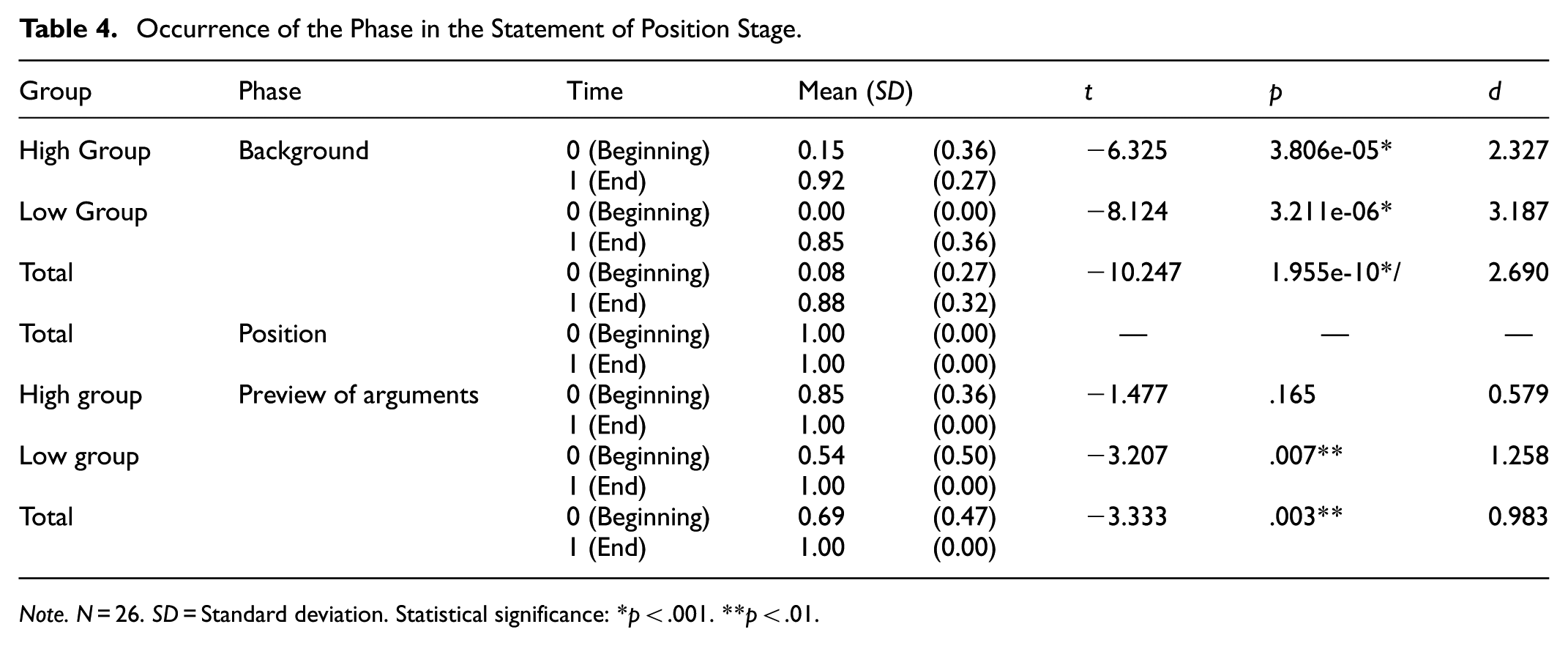
Note. N = 26. SD = Standard deviation. Statistical significance: *p < .001. **p < .01.
Table 5 shows the qualitative changes in the phase construction of two students. In the pre-test, a higher proficiency student (S1) constructed the position phase and the preview of arguments phase, whereas a lower proficiency student (S14) only created the position phase. However, in the post-test, their text structure changed greatly, as both of them created all three essential phases in the stage.
Extracts That Show Changes in Students’ Phase Construction in the Statement of Position Stage.

Note. Words in brackets indicate the names of the phases within the statement of position stage.
The Argument Stage
To examine the structural change in the argument stage, the occurrence of the point and elaboration phases was counted. Overall, in the pre-test, 16 students (61.5%) created two-point phases, 7 (26.9%) created three-point phases, 2 (7.7%) created a one-point phase, and 1 (3.8%) created four-point phases, while in the post-test, 25 students (96.2%) constructed two-point phases. Furthermore, the analysis of the change in fluency per phase was conducted to gain an overall impression of students’ attempts to elaborate on their arguments. It showed that there was almost no change in the fluency of the point phase, while there was a significant increase in the elaboration phase from the pre-test (M = 21.39, SD = 10.44) to the post-test (M = 31.85, SD = 12.13; see Table 6). Of particular note is that the lower proficiency students’ fluency significantly improved. These results suggest that the intervention could have a meaningful impact on the construction of the elaboration phase. Table 7 shows the qualitative change in two selected students’ stage construction. Both higher proficiency student (S2) and lower proficiency student (S15) developed their arguments by exemplifying their ideas with more wordings in the post-test than in the pre-test.
Occurrence and Writing Fluency of the Point and Elaboration Phase in the Argument Stage.

Note. N = 26. SD = Standard deviation.
Extracts That Show Changes in Students’ Phase Construction in the Argument Stage.

Note. Words in brackets indicate the names of phases in the argument stage.
The Reiteration Stage
The analysis of the reiteration stage showed that 5 students (19.2%) constructed the summarizing argument phase in the pre-test, while 15 students (57.7%) did so in the post-test, t(25) = –3.077, p < .01, d = 0.844 (see Tables 8 and 9). In addition, 2 students (7.7%) did not construct the reiteration of position phase in the pre-test, while all the students successfully did so in the post-test. This suggests that GBA had a meaningful impact on student performance in the phase structure of the reiteration stage. Table 10 qualitatively indicates how higher (S2) and lower (S22) proficiency students constructed the phases between the pretest and posttest.
Occurrence of the Phase in the Reiteration Stage.

Note. n = 26. SD = Standard deviation. Statistical significance: *p < .05. **p < .01. Regarding the reiteration of position phase, there was no statistically significant difference observed.
Extracts That Show Changes in Students’ Phase Construction in the Reiteration Stage.
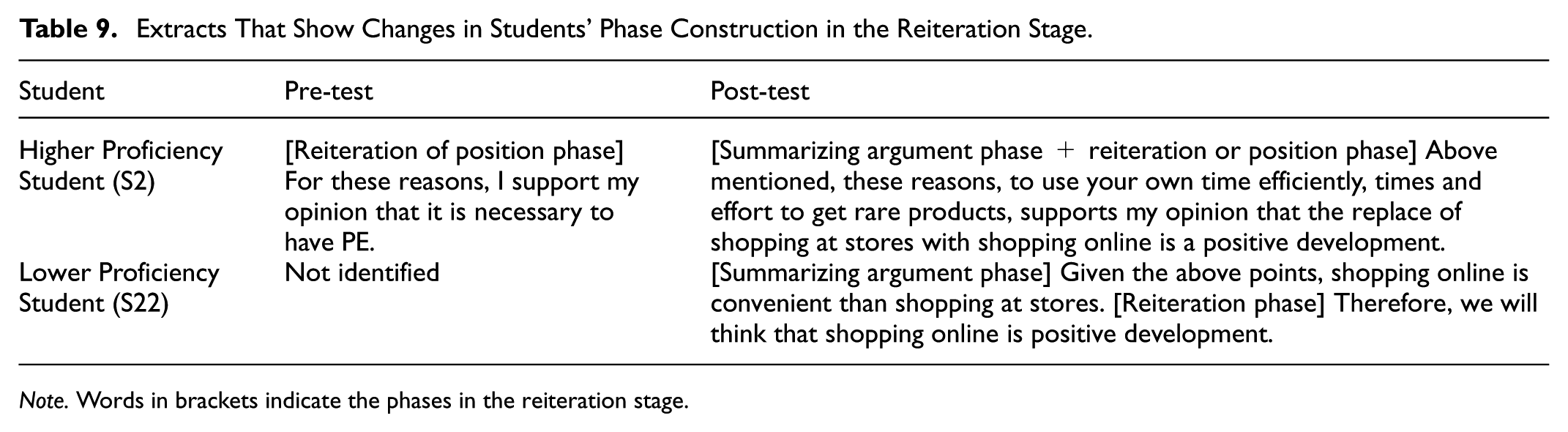
Note. Words in brackets indicate the phases in the reiteration stage.
Frequencies of Text Connective Use for Different Purposes.
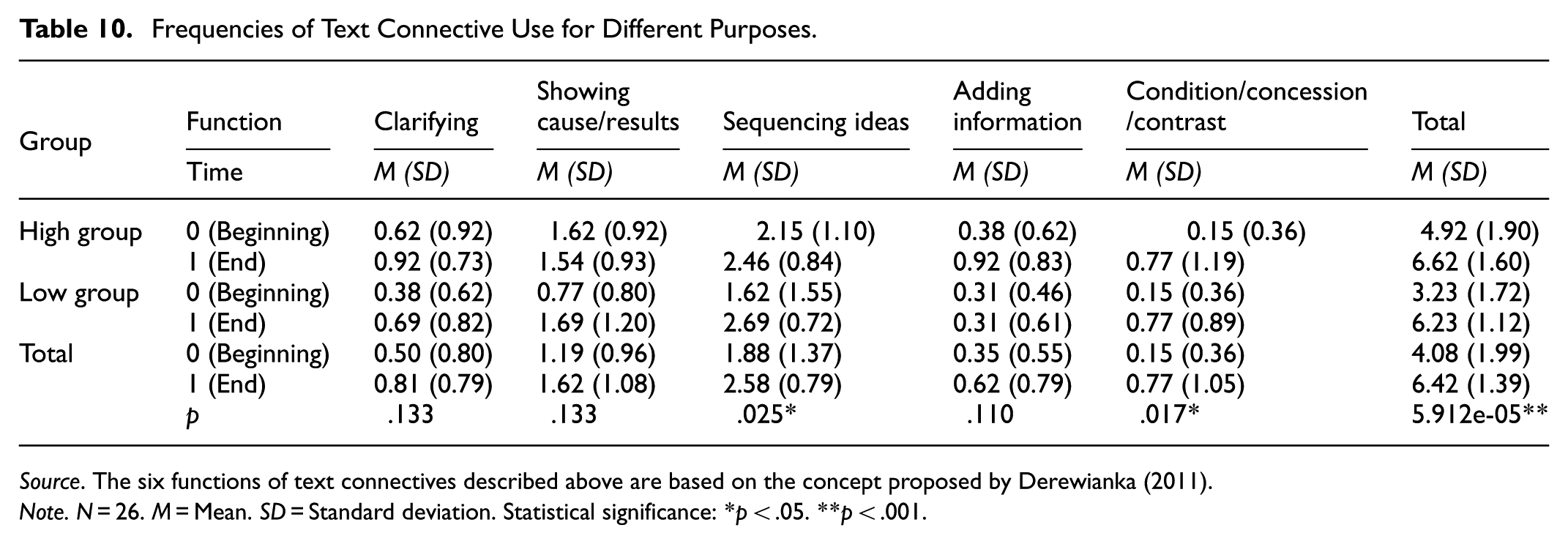
Source. The six functions of text connectives described above are based on the concept proposed by Derewianka (2011).
Note. N = 26. M = Mean. SD = Standard deviation. Statistical significance: *p < .05. **p < .001.
Cohesion
Text Connectives
Table 10 presents the average frequency of text connectives observed in the students’ essays over time. The total frequency increased from the pre-test (M = 4.08, SD = 1.99) to the post-test (M = 6.42, SD = 1.39). The paired-sample t-test showed a significant difference between the periods: t(25) = −4.822, p < .001, d = 1.336. Notably, the frequencies of sequencing ideas and condition/concession/contrast were significantly different between in the pretest and posttest, t(25) = −1.294, p < .05, and t(25) = −2.540, p > .0.5, respectively. It is worth noting that higher proficiency students used more text connectives than lower proficiency ones in both pretest and posttest. However, the difference in low-proficiency student text connective use between pretest and posttest was more significant than that of high-proficiency student use.
Table 11 indicates the frequency of text connectives in each phase in the pretest and posttest. The analysis demonstrated the significant difference in the use of text connectives in the elaboration phase. These results suggest that GBA has a great impact on student use of text connectives for elaborating on their arguments. Table 12 shows the qualitative changes in a lower proficiency student’s (S17) essay, which indicates his attempt to use text connectives for various purposes (e.g., sequencing ideas, clarifying, contrasting) to construct his arguments.
Frequency of Text Connective Use in Phases of Exposition Genre Texts.

Note. N = 26. BG = background; Preview = preview of arguments; ELB = elaboration; Summary = summarizing argument; Reiteration = Reiteration of position; M = Mean; SD = Standard deviation. *p < .01. **p < .05.
Extracts That Show Changes in Students’ Use of Text Connectives.

Note. Words in bold indicate text connectives. Words in brackets indicate the functions of text connectives.
Abstract Words
As shown in Table 13, the results indicated a statistically significant difference in the frequencies of the abstract words. Students used abstract words to preview and review their arguments, t(25) = −4.804, p < .001, d = 1.361. Interestingly, although higher proficiency students used abstract words more frequently (M = 1.77) than lower ones (M = 1.54) in the pretest, lower proficiency students used more (M = 3.85) than higher ones (M = 3.08) in the posttest. The results suggest that GBA had a meaningful impact on their cohesive text creation through abstract words. Table 14 provides an example of how one lower proficient student (S16) used abstract words to preview and review his arguments in the posttest.
Abstract Word Use to Preview and Review the Text.
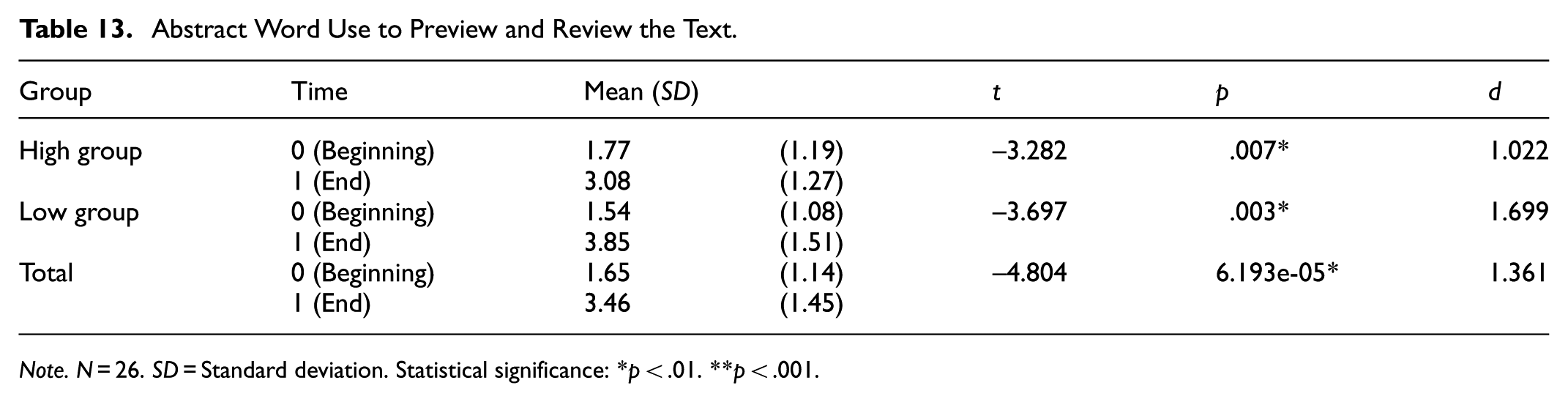
Note. N = 26. SD = Standard deviation. Statistical significance: *p < .01. **p < .001.
Examples of Abstract Word Use to Preview and Review Arguments.
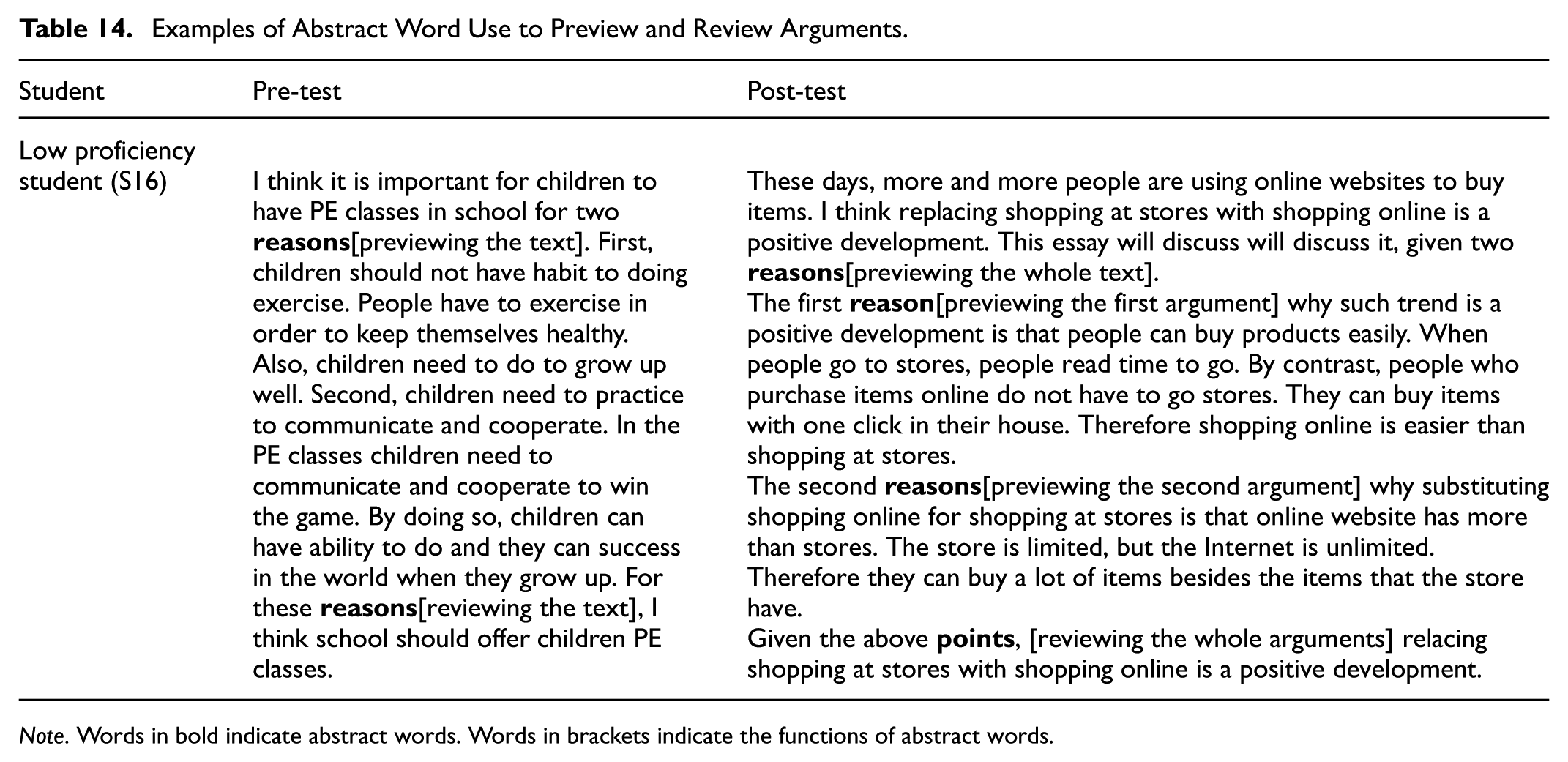
Note. Words in bold indicate abstract words. Words in brackets indicate the functions of abstract words.
Nominalization
Table 15 summarizes the changes in the frequency of nominalization used to preview and summarize the arguments between the pretest and posttest. The analysis revealed that although both groups of students used fewer nominalized words in the pretest, they used nominalization more frequently in the posttest. The difference was statistically significant, t(25) = −2.837, p < .01, d = .758 (see Table 15). Although higher proficiency students used more nominalized words than lower proficiency students in both pretest and posttest, the improvement achieved by lower proficiency students was more significant. Table 16 shows how two students used nominalization: A lower proficiency student (S18) used it to preview the arguments, while higher proficiency student (S3) used it to summarize with pre-modifiers (e.g., the increased choice).
Nominalization Use to Preview and Review the Text.

Note. N = 26. SD = Standard deviation. Statistical significance: *p < .05. **p < .01.
Examples of Nominalization Use to Preview and Summarize Arguments.
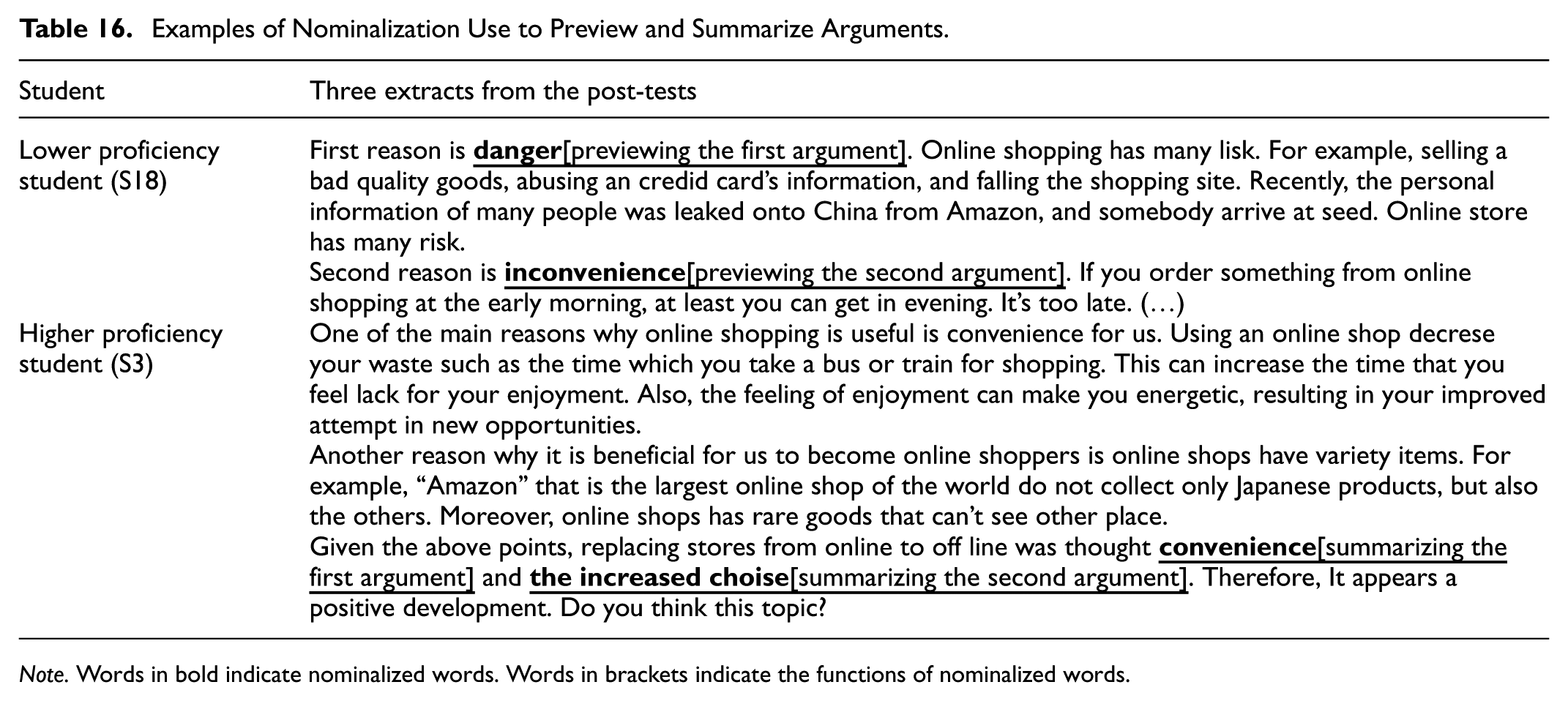
Note. Words in bold indicate nominalized words. Words in brackets indicate the functions of nominalized words.
Discussion
Previous studies have shown that EFL learners, in particular lower proficiency learners, typically have difficulty in creating text structure and coherent texts. Although GBA has usually been applied in tertiary EFL education, little is known about its effectiveness in secondary school contexts. This study thus investigated how GBA contributes to changes in secondary school EFL writers’ linguistic choices in argumentative writing from the perspectives of task achievement, text structure, and cohesion as employed in SFL theories. During a 6-day summer intensive course, this study administered a pretest and posttest of argumentative writing to 26 Japanese secondary school EFL students. Overall, the findings showed substantial improvement in all three aspects after the course.
Improvement in Overall Task Performance
One of the most important findings was a statistically significant difference in students’ task performance. The majority of students (76.7%) achieved higher scores on task performance in the posttest, indicating their improved ability to produce argumentative texts in a more structured, elaborate, and linguistically appropriate manner. Although the task performance scores of higher proficiency students outperformed those of lower proficiency students in both pretest and posttest, the improvement achieved by lower proficiency students was more significant. These findings are of critical importance to our understanding of how GBA scaffolds various proficiency level students to write argumentative texts. The improvement could be explained by GBA’s emphasis on explicitly teaching how language resources and their metalanguages are used in a particular context (Rose & Martin, 2012). This conscious learning process of connecting language systems to contexts through TLC tasks (e.g., deconstructing a model text from functional perspectives, writing a model text with teacher and peer scaffolding, and self-assessing own writing and re-writing) might help students clearly understand what constitutes effective argumentative writing. Particularly, GBA can provide a powerful scaffolding for learners who usually focus strongly on lexico-grammatical accuracy rather than function in writing, enabling them to make informed linguistic choices to achieve the social purpose.
Structural Development
The study also found that students improved their understanding of how an exposition genre text should be structured by designing stages and phases. The frequency of essential phases, including the background and preview of arguments phases in the statement of position stage and the summarizing argument phase in the reiteration stage, increased significantly after the intervention. This improvement suggests that students understood the rhetorical functions of each stage and phase in an exposition genre text and manipulatively constructed each phase to achieve its social purpose. Furthermore, the writing fluency of the elaboration phase in the argument stage increased significantly. This finding may suggest students’ attempts to elaborate on their arguments. This manipulation is especially noteworthy because mature writers tend to demonstrate greater elaboration and show creativity in the argument stage to achieve their social purposes (Derewianka & Jones, 2016; Humphrey et al., 2012). However, it should be noted that improved fluency does not always warrant other aspects of writing quality, such as accuracy and complexity (Skehan, 2009). Overall, these findings align with those of previous studies that investigated the improvement in text structure through GBA in university EFL contexts, including descriptive report writing (Nagao, 2022), summary writing (Chen & Su, 2012), email writing (Yasuda, 2011), and argumentative writing (Nagao, 2019). What is notable about this study is that similar results were found in a secondary school EFL context, which has not been adequately explored so far.
Although students tended to successfully construct many essential phases in argumentative writing in the posttest, the evidence that many students failed to construct the background phase, the preview of argument phase, and the summarizing argument phase in the pre-test raises a question of why they did so. This might be explained by a lack of experience in argumentative writing. Japanese secondary school EFL students, including those who participated in this study, tend to lack experience writing argumentative essays in the language classroom, where the structure-based approach has been mainly adopted. In these contexts, lexical and grammatical accuracy is strongly emphasized, and students rarely write multiple paragraphs, considering their intended readers (Hirose & Harwood, 2019; Yasuda, 2014). Such trends in writing instruction might prevent students from writing arguments in a genre-appropriate way. However, as the analysis of this study demonstrated, explicit exposure to genre knowledge, that is, explicitly learning the social purpose and functions of text structure within the analytical exposition genre, might help them clearly understand how to construct appropriate stages and phases in writing.
Increased Use of Cohesive Devices
Regarding cohesion, overall, students used more cohesive devices, including text connectives, abstract nouns, and nominalization, after the intervention. These linguistic choices can function to unify the meanings in a whole text, thereby making arguments more logical and persuasive. One interesting finding is a statistically significant difference in the frequency of text connectives between the pretest and the posttest. Particularly, the frequencies of sequencing ideas (e.g., first, in conclusion) and condition/concession/contrast (e.g., in that case, however) increased significantly. This increased use of text connectives aligns with the results reported by other scholars who examined foreign language learners’ control of text connectives through GBA in various genres, including a personal recount genre (Crane & Malloy, 2021) and a descriptive report genre (Nagao, 2022). Further analysis showed that both higher and lower proficiency students tended to use more text connectives in the elaboration phase in the argument stage after the intervention, suggesting that various proficiency level students attempted to elaborate on their arguments in a more cohesive manner. These findings are critical, as mature writers are typically familiar with various text connectives and their functions and frequently use them to signal to the reader what will unfold in the text (Christie & Derewianka, 2008).
Another finding of this study is a statistically significant difference in the frequency of abstract words and nominalization between the pretest and posttest. Interestingly, the analysis showed that both higher and lower proficiency students used more abstract words in the posttest. These findings suggest that students with various proficiencies began to use abstract nouns and nominalization to improve cohesion by previewing and/or reviewing their arguments. To the author’s knowledge, this is the first study to examine changes in secondary school EFL students’ attempts to use nominalization to preview and summarize their arguments through GBA. These findings are significant because more mature language learners use abstract words and nominalization more frequently to foreshadow and summarize arguments, leading to increased cohesion (Christie & Derewianka, 2008). Interestingly, higher proficiency students used more nominalizations than lower proficiency students in both pretest and posttest. This finding is consistent with those of previous studies that EFL learners with higher proficiency had better control of nominalization in L2 summary writing (Liardét, 2013; Yasuda, 2015). This tendency might be explained by the difference in learners’ proficiency level. As Manchón (2011) argued, less proficient EFL writers tend to be more engaged in compensating for their language deficiencies (i.e., transforming their ideas into language) in writing, whereas more proficient writers often allot more time for improving the quality of their ideas from the ideational and textual metafunctional perspectives. In this sense, students who did not use nominalization after intervention in this study might be unable to devote much attention to improving cohesion through nominalization in the writing test.
Conclusion
The findings of this study provide several pedagogical implications for EFL writing instruction in secondary school contexts. First, a measurable change in student task performance during a short-term, intensive course suggests that even limited exposure to GBA might be beneficial for EFL secondary school students to improve their genre awareness and argumentative writing skills. Second, this study highlights the importance of teaching writing by focusing on language functions rather than mechanical aspects. By incorporating functional features of SFL, teachers can help EFL learners explicitly understand how linguistic choices are shaped by and shape a context. This improved understanding can help them prepare for academic and real-world writing tasks they will face in the future. Third, GBA can be applicable to mixed-proficiency classrooms in secondary school EFL contexts. The tasks based on the TLC can enable teachers to provide different proficiency learners with appropriate scaffolding to become more independent learners.
However, the results of this study are subject to several limitations. First, the absence of a control group prevents strong causal inferences. Although the one-group pretest-posttest design allows for the observation of changes over time, external variables cannot be fully excluded. Second, the findings might not be generalizable to other secondary school EFL contexts because the sample size was small, and the participants were homogeneous. Third, since the duration of GBA provided to the participants was limited to 6 days due to institutional constraints, the extent to which they could maintain their genre knowledge and apply it to future writing situations, which is critical to educational contexts, is unclear. Future research should seek to address these limitations by adopting experimental or quasi-experimental designs, expanding sample sizes, and investigating long-term impacts of genre-based instruction. Fourth, the study’s scope of cohesion was limited to text connectives, abstract words, and nominalization without focusing on other cohesive devices suggested by Halliday and Hasan (1976). This was due to the limited instructional time available, which made it impractical to address all elements of cohesion in sufficient depth. Therefore, the findings may not be generalized to overall cohesion development. Future research should investigate other types of cohesion (e.g., references) to build a more comprehensive understanding of how GBA impacts EFL learners’ cohesive writing. Finally, this study only focused on the participants’ lexical change by collecting quantitative data (i.e., pretest and posttest) and did not employ qualitative data sources (e.g., interviews and questionnaires). Thus, it is unclear why their text structure and language choices changed as they did. Further research should employ other data sources and examine the evidence from multiple perspectives to enhance its generalizability.
Despite these limitations, the findings of this study contribute to our greater recognition of GBA as a powerful tool for improving EFL learners’ argumentative writing in terms of task performance, text structure, and cohesion. Given that secondary school EFL learners have difficulty dealing with text structure and cohesion in argumentative writing, GBA should be better incorporated into such educational contexts to overcome this difficulty. GBA can help EFL learners be more fully engaged in academic discourse communities—a crucial goal for EFL education in an increasingly globalized world.
Footnotes
Appendix
Holistic Scoring Rubric for Pre- and Post-Tests.

| Score | Description |
|---|---|
| 5 | A fully successful response The response is a relevant and very clearly expressed contribution to the prompt, and it demonstrates consistent facility in the use of language. A typical response displays the following: • Relevant and well-elaborated explanations, exemplifications, and/or details • Effective use of a variety of syntactic structures and precise, idiomatic word choice • Almost no lexical or grammatical errors other than those expected from a competent writer writing under timed conditions (e.g., common misspellings or substitutions such as there/their) |
| 4 | A generally successful response The response is a relevant contribution to the prompt, and facility in the use of language allows the writer’s ideas to be easily understood. A typical response displays the following: • Relevant and adequately elaborated explanations, exemplifications, and/or details • A variety of syntactic structures and appropriate word choice • Few lexical or grammatical errors |
| 3 | A partially successful response The response is a mostly relevant and mostly understandable contribution to the prompt, and there is some facility in the use of language. A typical response displays the following: • Elaboration in which part of an explanation, example, or detail may be missing, unclear, or irrelevant • Some variety in syntactic structures and a range of vocabulary • Some noticeable lexical and grammatical errors in sentence structure, word form, or use of idiomatic language |
| 2 | A mostly unsuccessful response The response reflects an attempt to contribute to the prompt, but limitations in the use of language may make ideas hard to follow. A typical response displays the following: • Ideas that may be poorly elaborated or only partially relevant • A limited range of syntactic structures and vocabulary • An accumulation of errors in sentence structure, word forms, or use of language |
| 1 | An unsuccessful response The response reflects an ineffective attempt to contribute to the prompt, and limitations in the use of language may prevent the expression of ideas. A typical response may display the following: • Words and phrases that indicate an attempt to address the task but with few or no coherent ideas • Severely limited range of syntactic structures and vocabulary • Serious and frequent errors in the use of language • Minimal original language; any coherent language is mostly borrowed from the stimulus |
| 0 | The response is blank, rejects the topic, is not in English, is entirely copied from the prompt, or is entirely unconnected to the prompt. |
Note. A decimal point of 0.5 could be used for scoring if a rater judges that an essay does not fit the score described above (e.g., 3.5, 4.5).
Acknowledgements

Author note
This study was conducted while Koji Osawa was at Kaiyo Secondary School. He is now at Kyoto Tachibana University and can be contacted at
Ethical Considerations
Kaiyo Secondary School approved this study on June 19, 2020. The participants provided written consent for this study before the intervention commenced.
Consent to Participate
Prior to the study, participants were informed about the purpose of the research, the procedures involved (including the pre- and post-writing tests), and their right to withdraw from the study at any time without penalty. Written informed consent was obtained from all participants, and they were assured that their test results would remain confidential and used solely for the purposes of this research. The data were anonymized to ensure that no individual participant could be identified in the final report.
Author Contributions
The author solely conceptualized and designed the study, collected and analyzed the data, and wrote the manuscript. The author also reviewed and approved the final version of the manuscript for publication.
Funding
The author disclosed receipt of the following financial support for the research, authorship, and/or publication of this article: This research was partially supported by Grants-in-Aid for Scientific Research (Grant Number JP24K04065) from the Japan Society for the Promotion of Science.
Declaration of Conflicting Interests
The author declared no potential conflicts of interest with respect to the research, authorship, and/or publication of this article.
Data Availability Statement
The data that support the findings of this study are available from the corresponding author upon reasonable request. Owing to privacy concerns, data are not publicly available but can be accessed with permission for research purposes. All data have been anonymized to protect participant confidentiality. Please write to