



Abstract
It is widely recognized that writing conferences benefit second or foreign language writers for the immediacy and the potential to address their needs and provide tailored and individualized support. However, limited attention has been given to the foci and interaction between teacher and student in writing conferences longitudinally. To address this need, this study examined writing conferences between five university English-as-a-foreign-language (EFL) students and their instructor in an argumentative writing course over one semester in a key Chinese university. Multiple sources of data were collected, including conferences, students’ essay drafts and written reflections, and interviews with the students and the instructor. Data analyses show that the conferences covered a large variety of topics such as varied aspects about argumentative writing, learning habits, and expectations about the course, which were related to English proficiency and English writing ability of each student. Second, the instructor took different approaches to communicate with each student in writing conferences considering their difficulties and needs. Finally, the conferences contribute to a deliberative process critical to the process of learning to write argumentation. The students found conversations with the instructor helpful in their subsequent revisions whereas the instructor gained a better understanding of students’ difficulties in writing. This study suggests that more research is needed to examine the role of conferences in EFL writing instruction. This study supports that conferences, as an important aid, will facilitate EFL students in the process of learning to write in English in addition to teacher written feedback and peer review.
Introduction
The use and study of teacher-student writing conferences began in first language (L1) writing pedagogy and were gradually introduced into second/foreign language (L2/FL) writing instruction contexts (Carnicelli, 1980; Zamel, 1985). The conferences are individual, face-to-face teacher-student conversations about written products, writing processes, or future projects. Researchers and educators indicate that, compared with teacher written feedback and peer feedback, one-on-one teacher–student conferences can provide students an opportunity for individualized instruction and allow students to express their opinions and needs and clarify teachers’ comments, setting learning goals, and increase their motivation, writing skills, and critical thinking (e.g., Adawiyah, 2019; Eckstein, 2013; Ferris & Hedgcock, 2004; Maliborska & You, 2016; Weissberg, 2006; Yu, 2020). Also, writing conferences in combination with direct written feedback had a greater effect than direct written feedback alone on improved accuracy over time (Bitchener et al., 2005). On the other hand, conferences allow teachers to have a better understanding of students’ ideas and problems (Maliborska & You, 2016; Yu, 2020). Compared with the growing body of research on teacher written feedback, relatively limited amount of research has investigated teacher–student interactions during writing conferences longitudinally. To address this need, the present study aimed to examine discussion foci and interaction patterns occurred in writing conferences outside normal class hours for an English as foreign language (EFL) academic argumentative writing course in a Chinese university over a semester. The following research questions are of particular interest:
What were the foci of EFL writing conferences for an argumentative writing course?
How did the teacher and students interact during writing conferences over a semester?
Literature Review
Theoretical Background
Guided by Vygotskian sociocultural theory (Vygotsky, 1978), this study viewed writing conference as a mediating tool of facilitating the writing process of learners. Vygotsky argued that learning and cognitive development are influenced by the interactions that individuals have with others who are more skilled or knowledgeable and the environment. This process takes place in the “zone of proximal development” (ZPD), which refers to the distance between what learners can do independently and what they can do with the assistance of an expert or a more capable person (Vygotsky, 1978). In a writing conference, a teacher or tutor (an expert) has interactions with a learner, adjusting to the interaction foci according to the actual development of a learner (a novice) and thus making the process of feedback provision graduated and contingent (Lantolf & Poehner, 2014). Hence, the writing conference assists the learner in solving the problems (e.g., language, content, or organization) encountered in writing. Mediated through conferencing, knowledge is externalized for giving the learner both the satisfactory resolution of the immediate task at hand and multiple opportunities to acquire that knowledge (Yeh, 2016). Language, which functions as the most powerful mediational means in human social interaction (Vygotsky, 1978), allows the learner to negotiate and co-construct the knowledge with the expert (e.g., teacher) in writing conferences. Just as Werani (2018, p. 144) proposed, “the materialized process that teachers use empowers students to learn via external speech and trains them how to do so.” With the support of the expert (e.g., teacher) or capable person, the novice outperforms their current competence at the given task. To make writing conferences successful, experts need to have an understanding of the learner’s background, especially language competence, and adjust the way of assistance according to an ongoing assessment of the learner’s performance.
Relevant Studies
The benefits of writing conferences are acknowledged in composition pedagogy, but there is quite fewer number of studies on teacher-student conferences in comparison to teachers’ written response and peer feedback to student writing, especially in L2/FL writing instruction contexts. Previous studies have examined various aspects of writing conferences in terms of teacher talk, negotiation, intervention types (error correction or procedural facilitation), impact on revision, students’ attitudes, and teachers’ perceptions (e.g., Aljaafreh & Lantolf, 1994; Bitchener et al., 2005; Cumming & So, 1996; Ewert, 2009; Goldstein & Conrad, 1990; Haneda, 2004; Patthey-Chavez & Ferris, 1997; Strauss & Xiang, 2006; Williams, 2004; Yeh, 2016, 2017; Yoshida, 2008, 2010; Yu, 2020). Researchers found that systematic relationships exist between the nature of the conference interaction and students’ characteristics (e.g., culture, language proficiency). For example, advanced or assertive writers tended to frequently introduce topics of their own, skillfully negotiate with the teachers’ suggestions, confidently display their specific knowledge domains in the conferences, and consequently produce more substantial revisions (Goldstein & Conrad, 1990; Patthey-Chavez & Ferris, 1997). In contrast, less proficient or less assertive writers appeared to prompt the teacher to take on the directive role of explicitly assessing their essays and giving specific instructions for text revisions and revise their drafts in accordance with their teacher’s suggestions (Goldstein & Conrad, 1990; Patthey-Chavez & Ferris, 1997; Yeh, 2016; Yu, 2020). Moreover, the conferences with advanced writers were longer in terms of duration and number of words and had more even distributions of talk between teachers and students (Patthey-Chavez & Ferris, 1997).
Furthermore, students’ engagement in the conferences was influenced by the teacher’s interactive style or the stance the teacher established in the conferences as either collaborative facilitator or prescriptive authority (Ewert, 2009). The interaction patterns were also influenced by students’ self-selected revision goals, which were related to their level of target language proficiency, the choice of discussion topic, and the teacher’s underlying pedagogical goals (Haneda, 2004; Yoshida, 2008). The teacher’s overarching pedagogical goals may determine the overall orientation of the conference (Adawiyah, 2019; Yu, 2020). For instance, Haneda (2004) found that the teacher varied her moment-by-moment interaction strategies such as how to initiate and demand or how to give information considering students’ intentions (e.g., setting up their own revision goals) and needs as developing writers. Yu (2020) found that writing tasks influenced both the problem areas addressed by the tutor and the tutor’s directive role in writing conferences. In particular, Yu (2020) noticed that the problem-solution essay task appears to retrieve more direct feedback from the tutor as he asked for more explanations regarding the solutions proposed by the student.
However, the interaction patterns in conferences may change. An adult English-as-a-second-language (ESL) student who participated in a series of four weekly writing conferences in Young and Miller’s (2004) study gradually participated more in the conferences and the writing instructor adjusted her way of talking accordingly to facilitate the student’s learning, showing mutual co-construction of their roles. Likewise, Strauss and Xiang (2006) found that, with the writing instructor’s guidance, seven ESL students gradually moved from uncertainty, confusion, negative self-evaluation, and negative other-evaluation in the interactions to active participation such as proposing candidate solutions to actual or perceived problems and exhibiting more authorial direction with the progress of conferences. Mediated by the conferences, the students not only articulated their difficulties and obstacles associated with the writing tasks but also progressively figured out how to overcome them. Young and Miller (2004) and Strauss and Xiang (2006) demonstrate that writing conferences can serve as an effective pedagogical activity in which student writers learn to traverse through challenges and obstacles associated with university-level reading and writing tasks.
Researchers also examined students’ attitudes and preferences toward writing conferences. For example, Yeh (2016) found that 34 EFL college students in Taiwan held high expectations and gave high ratings on the helpfulness and success of the one-on-one teacher-student writing conferences. In particular, students tended to expect teachers to provide direction, explicit suggestions, detailed explanations, immediate answers to writing problems, and perhaps a secret formula for better writing. Most significantly, the study found that although students did not openly reject setting and leading the agenda, most were not enthusiastic about taking on the responsibility of orienting the direction of the conference. Students’ preference toward explicit feedback is supported by Williams (2004), which observed a substantial amount of revision taking place when the tutors provided explicit scaffolding. Williams also highlighted tutees’ active participation in the talk such as writing down their revision plans as conditions for substantial revisions. However, Williams indicated that more revisions did not necessarily indicate an improvement in the text quality. To solve the time-consuming issue of one-on-one conferencing, Yeh (2017) examined teacher conferencing with pairs of EFL students and found that students held favorable opinions about paired conferencing although sharing teacher time and attention might still be a concern with some students. In particular, students reported learning from both their peers’ strengths and weaknesses and reducing anxiety or embarrassment that might be experienced in one-on-one conferences.
In addition, researchers examined teachers’ choice toward writing conferences. For example, Yoshida (2008) found a gap between the teachers’ choice of corrective feedback (CF) and learners’ preferences. That is, Japanese as a foreign language (JFL) teachers at an Australian university chose recasts (i.e., utterances involving the reformulation of learners’ erroneous utterances) due to time restrictions whereas most of the JFL learners preferred to have the chance to think about the errors and the correct forms before being given the answers. Furthermore, Yoshida (2010) revealed that the teachers tended to overestimate “strong” students’ noticing of CF and their understanding of correct forms when students responded to their CF. This suggests that teachers’ perceptions of individual learners sometimes lead them to misinterpret the learners’ responses after their CF. In comparison, Adawiyah (2019) examined one teacher’s implementation of writing conference in teaching process essay writing in an Indonesian university. The study shows that the teacher attempted to balance the use of direct and indirect feedback during writing conference. The teacher also gave a clear explanation to the students and even changed the language into the native language when the students did not understand the teacher explanation in English. The teacher gave equal attention to the content, structure, and vocabulary selection, but still did not give detailed feedback about students’ grammar mistakes.
In sum, as Maliborska and You (2016) show, despite the variations in attitudes and perspectives of the students and instructors, writing conferences overall were recognized as an effective component of the writing course. Instructors also believed that writing conferences aid the revision process that students undertook after each meeting. For the students, conferences served the purpose of discussing feedback and revisions with the instructors and obtaining individualized help with writing. However, it is still not clear whether instructor-student interactions might change the discussion focus and interaction patterns across different tasks and multiple writing conferences over the semester.
Method
The Context
This study adopted a qualitative case study design (Creswell, 2007). It was situated in a one-semester argumentative writing course for second-year English majors in a key university in Beijing. The primary purpose of this course was to enable students to write proper argumentative writing in English. The teacher and students met once for 2 hours each week over 16 weeks (another 2 weeks were for mid-term and end-term examinations). There were a number of activities in this course, including classroom instruction, writing practices, peer review, teacher written feedback, and writing conferences. In class, the instructor gave a series of lectures on how to make claims, develop arguments, provide evidence, avoid logical fallacies, practice refutation skills, and use proper reference formats. The instructor also discussed common problems across student writings in class. Over the semester, students needed to accomplish four writing assignments with multiple drafts (at least two drafts). They also needed to set up a folder for each assignment presenting the whole writing process, including pre-writing preparation, multiple drafts and related self-evaluation, peer review, teacher written feedback, and reflective journal on the writing process, following the format given by the instructor.
Participants
The instructor and 5 of her 24 students from the argumentative writing course participated in the present study voluntarily. The instructor, Lee, middle-aged and female, had been a writing instructor for 8 years and active in practicing different types of feedback. She viewed that her students were competent to address most of the language problems such as wording and grammatical errors in writing as her university could recruit the top high school graduates through university entrance examinations in China. Thus, she considered her main responsibility as cultivating students’ ability “to argue effectively” and “to establish natural link between appropriate evidence and the claim without logical fallacy” (Lee, interview). Realizing the time-consuming nature of conferences, Lee still insisted on integrating conferences as part of her teacher feedback practices because she believed that “some problems can only get clear when the teacher and students interact face to face” (interview). She thus set up a fixed time period outside the class and encouraged students to come to her conferencing hours.
Understanding the purpose of the present study, 10 of Lee’s students volunteered to participate in the study. However, only five frequently came to the conferences and thus were chosen to be the participants. Table 1 presents the profiles of the five participants such as age, English proficiency, and four essay topics they wrote about over the semester. They were all female, aging from 17 to 20. Their pseudonyms were given according to their English proficiency evaluated by themselves and Lee. The initial letters of the pseudonyms, H, M, and L, represent high-intermediate, intermediate, and low-intermediate English proficiency respectively. In this class, Hong and Hua had high-intermediate English proficiency, Meng and Miao had intermediate English proficiency, and Ling had low-intermediate English proficiency. The underlined essay topics represent that the drafts on these topics were discussed in the conferences.
Profile of Student Participants.

As the top students in the class, Hong and Hua were confident in English writing and relied less on teacher and peer feedback in revision. Miao was confident in her English proficiency, but not satisfied with her English writing competence and was keen to get both teacher and peer feedback for her revision. In comparison, Meng was not confident in her English proficiency, especially her English writing competence. She often became confused with teacher written feedback and peer feedback, and thus relied much on conferences for revision. Different from the other students, Ling was from an underdeveloped area of China and became the student of this university on a special program for the underdeveloped area. With low-intermediate English proficiency, Ling made more language errors and had difficulty in making clear arguments and refutation for her claims in argumentative writing. Consequently, she received more feedback on micro-level problems from both peer and teacher feedback and relied more on others’ suggestions for revision.
Data Collection
Multiple sources of data were collected including writing conferences, interviews, and essay folders. In this study, writing conferences were on students’ own choice to attend. All the student participants chose to go to conferences when their first drafts were graded to get more specific suggestions on revision and gain higher scores for their second drafts. As Lee told students the first essay would not be considered for the final score of this course, only Miao and Ling started their writing conferences on the third week, and the other three started on the sixth week while working on the second essay. The five students had two to four conferences with Lee, ranging from 8 to 55 minutes. These writing conferences (15 conferences, 384 minutes in total) were observed and recorded with the participants’ permission. To examine students’ perceptions of conferences, each student was interviewed three times, in the middle of (week 12) and at the end of the semester (week 17). They were also interviewed 3 months later to verify the researcher’s interpretation of the previous two interviews and learn whether the participants had some different views on writing conferences. The questions covered the topics such as topics discussed in the conferences, the role of conferences compared with other types of feedback, and their participation in the conferences. The instructor was interviewed four times, once every 5 weeks over the semester. The questions for the instructor included such topics as her past practice with conferences, her views on different types of feedback, teaching objective, her evaluation of students’ English writing competence and participation in the conferences, her strategies with individual students in the conferences, and overall comments on the conferences. The folders for each assignment were also collected. In particular, as required by Lee, students wrote reflective journals after completing each assignment to record and reflect on their writing experiences, feelings, difficulties, strategies, and responses to teacher and peer feedback for each draft. Lee addressed those confusions or difficulties in writing conferences.
Data Analysis
All the verbal data were transcribed verbatim and confirmed by the participants. Multiple sources of data were repeatedly read to elicit recurrent themes (Corbin & Strauss, 2008; Miles & Huberman, 1994). The data such as interviews and reflective journals were mainly searched for emerging themes, especially those concerning writing conferences. The multiple drafts of the participants’ writings were examined in terms of any changes made because of writing conferences. The number of words used in the original language (Chinese and English) and turns uttered by the instructor and students were counted in each writing conference for comparison among the participants. The conference transcripts were segmented into episodes of interaction, where an episode has a specific theme regarding the suggestion or comment on writing. To identify the foci of writing conferences, a coding scheme was developed to categorize the episodes, including content, language, structure, reflection, ability development, course requirement, and others. The author and a research assistant coded 30% of the conference transcripts individually. We reached an agreement of 100% on the episodes segmented and an agreement of 93% on coding the episodes. The differences between us were then resolved through discussion. Then the research assistant coded the rest of the conference transcripts. The utterances in the excerpts presented in italics were originally spoken or written in Chinese, whereas those in regular typeface were originally spoken or written in English (and the latter are presented verbatim, without correction of grammatical infelicities) in this paper.
51. Hong: Then I find that the third argument . . . when they did peer feedback for me they mentioned that this one was shorter than the previous two and I failed to give enough evidence here. 52. Lee: They are right. You just explained your argument directly, did you? . . . 54. Lee: . . . Especially here, how do you know they will “feel lonely and unsettled”? Do you have any evidence? Then as readers we want to ask, why do you put this point [argument] at the end and explain so little about it? Do you think this point is not significant enough? Do you just want to make up three points? . . . 59. Hong: Actually I considered enriching the third point [argument] when I wrote the second draft. Maybe I could use some data to show old people could not totally live on their own.
8. Lee: Are you sure how to use the word DINK? Here you used the expression “encourage to DINK”. I did not find anything wrong when I read it the first time, but then I was confused. What does “encourage to DINK” mean? 9. Hong: I did not . . . 10. Lee: Do you want to say “DINK families”? 11. Hong: It is better to use it as a noun. Usually people say “DINK couples”. 12. Lee: Yes, you are right. It is commonly used as a noun.
103. Hong: I find that some essays we read, like the one on euthanasia, do not have much statistics either. . . . 108. Lee: You are right. That’s why I did not urge you to read the essay. 109. Hong: Because it is not a representative argumentative essay. . . . 112. Lee: . . . I did not say it was a model essay. I just said it was clearly written. But you may find some weak points in it after reading. 113. Hong: Yes. I think it is hard to make it a perfect argumentative essay.
116. Meng: Well, how can I use words appropriately in my writing? 117. Lee: It depends on your input, I mean, you need to read extensively. 118. Meng: Just reading? What else should I do? 119. Lee: You also need to write. That’s why we say writing is painful. . . 120. Meng: Yes. I suffered a lot.
I mainly looked for content themes in the drafts while also drawing on their group discussions and e-mail messages. I aimed to establish how the group papers were put into shape from the beginning to the end.
Findings
This study examined the focus of writing conferences and teacher-student interaction in these conferences for EFL students in an argumentative writing course. The findings reported below derived mainly from the analysis of conference transcripts, supported with students’ writings and interviews with the students and the teacher.
The Focus of the Writing Conferences
To examine the focus of the conferences, 15 conferences were coded and analyzed, resulting in 178 episodes. These episodes covered a wide range of issues. Most of the issues were directly related to the drafts such as content, organization, and language use in student writings, whereas the other issues were beyond the drafts such as students’ reflection on the course and their writing experiences and students’ comments on their development of writing ability and course requirements.
Of the 178 identified episodes, 45 (25.3%) were produced in Hua’s conferences, ranking the first in the total number of episodes; 37 (20.8%), 36 (20.2%), and 31 (17.4%) episodes resulted from Miao’s, Meng’s, and Hong’s conferences with Lee respectively. Although Ling had four conferences, only 29 (16.3%) episodes were identified. This difference might be related to the students’ English proficiency and English writing ability. As Table 2 shows, the focus of the conferences varied among the students. Hong and Miao discussed more about their reflections with Lee; Hua focused more on her essays’ argument, evidence, and the structure; and Ling and Meng seemed to struggle more with their claims and arguments.
Episodes of Writing Conferences.
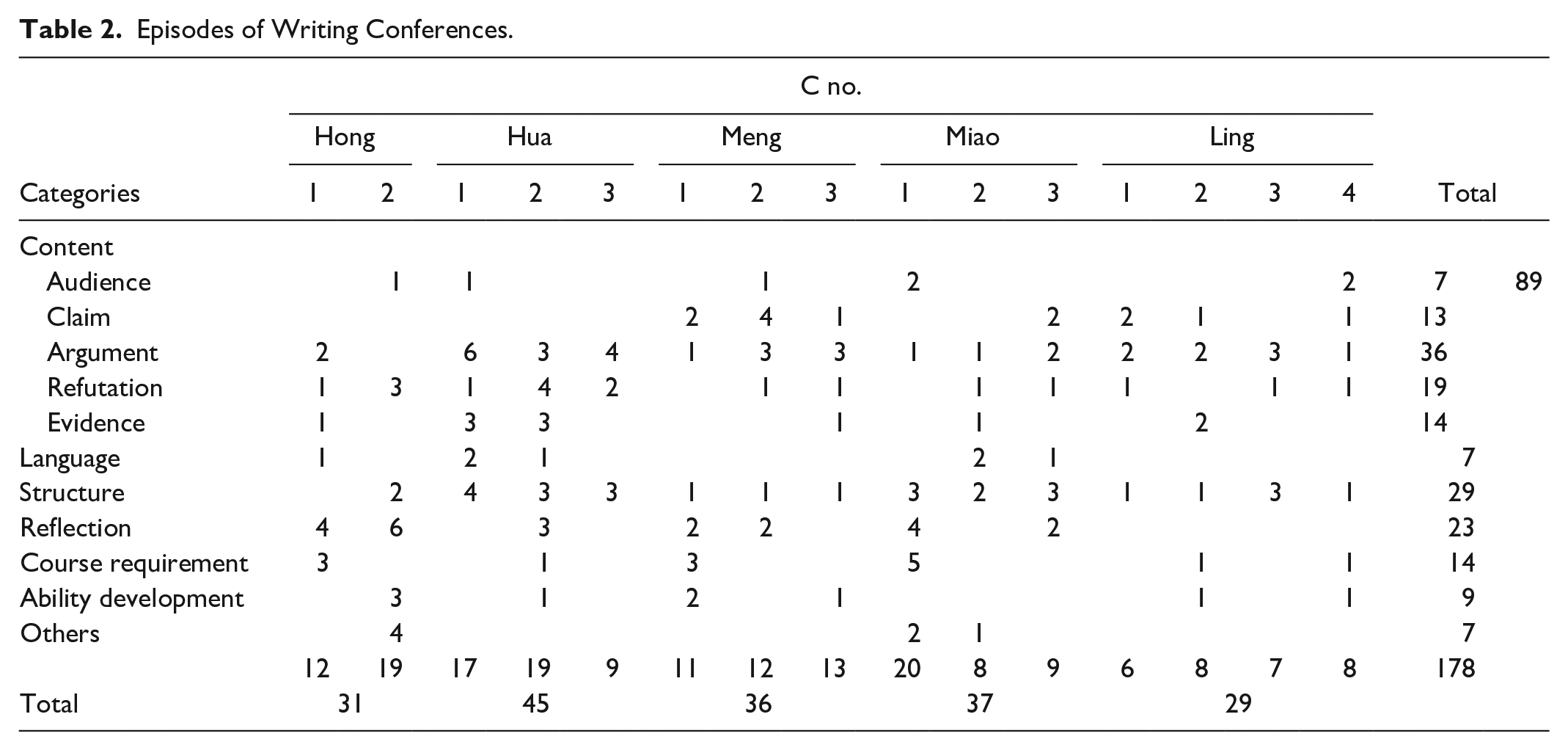
Further analyses of the episodes (see Table 2) revealed that discussions on the content of the essays (89/50%) comprised the largest part of the conferences, followed by discussions on structure (29/16.3%) of the essays, the students’ reflections (23/12.9%) on their own writing, course requirements (14/7.9%), and development of writing ability (9/5.1%). Language problems only accounted for 4.8% (7) of the total discussions. Of 89 discussions on the content of the essays, arguments (36/40.4%) made up the largest portion, followed by refutation (19/21.3%), evidence (14/15.7%), claim (13/14.6%), and audience (7/7.9%) respectively.
Teacher-Student Interaction in the Conferences
To explore teacher-student interaction patterns in the conferences, the length and words of each conference were calculated. As Table 3 shows, the average length of each conference lasted about 25.6 minutes. The length of conferences varied among the students. Hong, Hua, and Meng obviously spent more time on each conference than Miao and Ling, revealing different degrees of engagement of the student participants in the conferences. This difference might be related to the problems occurred in the students’ essays and their English proficiency.
Number of Words and Mean Number of Words per Turn—Teacher/Student in Writing Conferences.

With regard to the distribution of turns at each conference, a rather consistent pattern existed across the 15 conferences in that the instructor and students produced similar number of turns. However, the instructor generally dominated the discussions, uttering three times of words (6,962 words) more than what the students spoke (2,287 words). The ratio of teacher words to student words varied across each conference and student, indicating specific interaction patterns in different situations. For example, in Miao’s third conference, Miao (2,701 words) talked nearly as much as Lee (2,751 words), while in Ling’s fourth conference, Lee talked (6,981 words) 12 times more than what Ling did (567 words). This conspicuous disparity among the ratios could be attributed to varied factors such as students’ English proficiency, preparation, and English writing ability.
Further analyses of the conference transcripts showed that the teacher employed varying ways to propel the conversations with different students, as Lee said, “they (students) need help in different levels and I have to treat them accordingly” (interview). Hong participated in two conferences, and Hua, Meng, and Miao participated in three conferences while Ling attended four conferences, but the average length of Ling’s writing conferences was the shortest, being 13.5 minutes long. Hong, Hua, and Miao were often well prepared and actively engaged themselves in the discussions, initiating topics, and exchanging ideas with Lee, whereas Ling and Meng relied more on Lee and tended to passively take her suggestions without questioning, as illustrated below.
Hong
Lee commented that conferences were unnecessary for Hong, because “Hong understand the requirements of argumentative writing and is able to deal with the difficulties on her own” (interview). Likewise, Hong said, “the teacher has made the principles clear in the class and I know how to make revisions according to her written feedback” (interview). Hong’s active participation in the conferences could be easily noticed when she initiated topics, expressed her meanings, answered Lee’s questions, commented on reading materials, and reflected her learning process in the interactions. Noticing Hong’s proficiency in English and active engagement in the conferences, Lee adopted an indirect approach to push Hong to realize the problems in her essays.
In the two conferences, Hong discussed the first draft of her second essay on DINK families and the second draft of her fourth essay on TV commercials respectively. The discussions focused on the refutation problems in her essays, reflections on her reading, her revision plan, and other issues such as other students’ writing problems and learning habits. For example, the main focus of Hong’s first conference was on the revision of one argument and its refutation, which had been suggested in teacher written feedback and peer feedback. Hong initiated the conversation with Lee most of the time by indicating the problems she noticed in her writing and asked Lee for suggestions. As previous Excerpt 1 shows, Hong questioned peer feedback on her argument, which “was shorter than the previous two” and “failed to give enough evidence” (turn 51) to support the argument. To help Hong figure out the problems, Lee asked questions from a reader’s point of view and questioned Hong’s arrangement of the argument (turn 54).
Excerpt 5 is about how to write refutation better, in which Hong initiated the problem and acknowledged the opinion in teacher written feedback that her refutation part needed to be revised. Instead of directly indicating the problems in Hong’s refutation part, Lee first asked Hong to explain her rationale of refuting the statement “they have DINK families in order to contribute to the control of population” (turn 86). Lee then used questions to make Hong reconsider the inappropriateness of her choice because the opposing view she refuted could not stand for the majority (turn 90).
75. Hong: And I did not do well in the refutation part. My thinking was messy. . . . 86. Lee: So I want to know why you choose this argument to refute. Is it easier to attack? 87. Hong: Well, . . . like they do not have enough money to raise children, or they are afraid not to have a stable job.
. . . . . .
90. Lee: . . .How many people claim that they have DINK families in order to contribute to the control of population of our country? The majority or the minority? 91. Hong: Not the majority.
Based on this conference, Hong revised her draft substantially. She deleted the original second argument and strengthened the other two by “paying more attention to coherence and applying materials those are more relevant and authoritative” (reflective journal) and also replaced the refutation part with the idea obtained from Lee because Lee’s ideas seemed “more significant and powerful” (reflective journal). Hong believed that she had benefited a lot from the conferences, for she “not only learned how to solve those practical problems in the essay, but also formed a better understanding of the purpose of argumentative writing,” which was “not to piece together the evidence and the reasoning” but rather “to train our ability to distinguish what is convincing and significant from what is not” (reflective journal).
Hua
Hua appeared to know how to benefit from the discussions. In particular, Hua initiated most of the topics in discussions, explained her ideas, argued with Lee when she held different views, and expressed her thoughts about the course. Hua’s first conference happened in the sixth week for the revision of her second essay entitled “Capital punishment should be abolished in more places.” As Excerpt 6 shows, Hua explained why she did not elaborate on violating human rights as one supporting point for abolishing capital punishment (turns 18, 24, and 26). She believed it was difficult to illustrate it regarding different religious traditions in different countries (turn 24). In contrast, Lee emphasized the significance of this point and encouraged Hua to find more evidences (turn 21). When Lee asked further about specific evidence (turn 27), Hua failed to have a definite answer (turn 28), and then shifted the topic of discussion.
18. Hua: Another reason is that many people hold that capital punishment is immoral and it violates human rights. But I am afraid it is hard to write about it clearly. . . . 21. Lee: I remember you have mentioned there are very few countries where capital punishment is implemented. Have you explored the reasons for this? . . . 24. Hua: Emm. Maybe it relates to religion. I think Chinese people are much less religious. But in those countries where people refuse to use capital punishment, they are more serious about human rights or religious beliefs. . . . 26. Hua: In China few people have religious beliefs. Most Chinese are atheists. 27. Lee: That’s your assumption. Maybe that’s the case for the past. Do you have any statistics? How about now? Is there more people with some religious beliefs? 28. Hua: Emm. . .I am not so sure.
After discussing other issues such as arguments and refutation for about 15 minutes, Hua resumed this topic as Excerpt 7 shows. Conferencing with Lee, Hua realized that she needed to develop the point about human rights into an argument. In Excerpt 7, she voiced her difficulty of finding convincing evidences (turn 119). Lee realized the difficulty that Hua confronted and thus changed her thought-provoking questions into explicit suggestions (turns 122 and 124). With Lee’s explicit guidance, Hua eventually had this problem solved and made it her first argument “To begin with, abolishing capital punishment should be called for in more places since it violates fundamental human rights” in her second draft (folder 2) and used supporting UN documents suggested by Lee. Excerpts 6 and 7 show the recursive pattern of discussion. It might take time for both the teacher and the student to understand each other. Once mutual understanding was established, the unsolved issue at the earlier discussion was likely to be picked up and then solved.
119. Hua: I am afraid the point about human rights is hard to further illustrate, because I do not have any examples or surveys. 120. Lee: No example . . .Is there an international standard on human rights? 121. Hua: Maybe governments have no right to deprive man’s right to live. 122. Lee: Then I think you need to mention this. Otherwise, how can you say capital punishment “should be abolished in more places”? 123. Hua: Good ideas. I can put this as the first point. 124. Lee: You can try to find some UN documents about human rights. . . . I think there must be some official documents about human rights. Is it OK? 125. Hua: OK.
In brief, Hua actively participated in the conferences, discussing her problems and revision plans with Lee, and tried to make the best of each conference. Accordingly, Lee listened to Hua carefully and helped Hua to recognize the nature of the problems and find out proper solutions.
Miao
Miao actively exchanged opinions with Lee and seldom hesitated to express her views which were different from her peers or teacher. For example, Excerpt 8 is on the revision of her fourth essay on homeschooling, where Miao explicitly expressed her views on the peer feedback she received. Miao first explained that her peer questioned her use of SAT scores as evidence of academic excellence (turns 146 and 148). Lee then asked Miao for further information about other kinds of tests (turn 149). With Miao’s explanation about her use of SAT scores (turn 152), Lee was convinced and supported Miao’s decision (turn 153). This excerpt shows that Miao did not accept others’ comments blindly.
146. Miao: But Heather pointed out that the SAT scores were not convincing. . . 147. Lee: She means academic excellence could not be represented simply by higher SAT scores. 148. Miao: Yes. But the USA only has SAT scores. 149. Lee: Are there any other tests except SAT? 150. Miao: I did find many tests, but I think SAT scores are straightforward. You see, children with homeschooling get higher SAT scores. . . 151. Lee: SAT scores are mainly for college admission. 152. Miao: Right. SAT scores are straightforward. I also find some vague statistics such as the percentage of home-schooling students with above average SAT scores compared to those regular students. This percentage is not an exact number. I think SAT scores are more convincing and direct. Is it acceptable? 153. Lee: Hmmm, I think it is acceptable. Your explanation makes sense.
As an active participant in the conferences, Miao behaved differently compared with Hong and Hua. Miao appeared to treat herself as an equal partner to the instructor. In addition to issues directly related to the writing tasks, Miao and Lee discussed other issues such as learning habits, writing experiences, feelings toward scores on assignments, and other students, revealing a friendly and trusting teacher-student relationship during the conferences. Miao acknowledged the effect of the conferences on her revision, but she had short conferences compared with Hong, Hua, and Meng, probably because she had rather focused discussions in the conferences.
Meng
Meng usually behaved with less confidence in writing conferences, where she often brought up the issues occurred in peer feedback or teacher written feedback and asked for further explanation, probably resulting from her under preparation for the conferences or her incompetence in English writing. As shown in Excerpt 4, Meng asked Lee for suggestions on the improvement of her command of language. Moreover, instead of contributing her own ideas, Meng tended to rely on Lee’s suggestions for revisions. For example, in Excerpt 9, Lee asked Meng to clarify the intended audience for her claim (turn 64), suggesting that those who wanted to do plastic surgery could come from different backgrounds (turns 64 and 66). Unable to come up with proper intended audience, Meng asked Lee whether she could change the topic (turn 73), as she often did when confronting problems in the conferences, showing her uncertainty and lack of confidence in writing.
63. Meng: . . .my intended audience are more specific, that is, those who want to do plastic surgery. . . 64. Lee: Who are they? Many people want to do plastic surgery, they don’t have to be college students. Many celebrities have done plastic surgery. 65. Meng: Um um. 66. Lee: So who are you trying to persuade? College students or celebrities? They have different concerns. So you have to know who your intended audience are.
. . .
73. Meng: I am stuck here . . . what do you think I should do? How about I find a new topic?
After the conference, Meng made a holistic revision including the claim, arguments, and refutation in the second draft. However, this draft did not improve much in terms of quality, as she did not narrow down the intended audience as Lee suggested in the conference but generally referred to “people who want to have plastic surgery.” The problem on audience were also noted and commented in her peer feedback such as “Hope the author can . . . have intended audience in mind to make bigger progress.” Meng realized her passive participation in the conferences. In her reflective journal on this conference, she stated: “I did not make good use of the writing conference this time and I think the main reason is on me, because I didn’t prepare enough when I came to my teacher’s office. I don’t know why but most of the time my mind is blowsy. I can’t think clearly and I feel that I just want to sit there, and listen to my teacher, waiting her to tell me what to do about my essay. This is not nice. I should be less dependent and do more critical thinking.”
Meng also showed less confidence in giving feedback to her peers’ writing. As Excerpt 10 shows, Meng revealed her hesitation in giving comments (turns 176 and 178). Lee released Meng’s worry by explaining that her feedback acted as references for her peers to consider and Lee would offer help to the students who needed (turn 179).
176. Meng: Sometimes I am not sure whether I am right or not. 177. Lee: Don’t worry. If the author doesn’t agree with your view, she or he can say “sorry”. The author can stick to his or original version. 178. Meng: Sometimes I just pointed out some grammar errors or some problems in sentences. Actually, I am not quite sure how to solve the problems. 179. Lee: You can just point out the problems . . . If the author leaves the problems unsolved, I would tell her/him the solutions in the second draft.
Ling
Different from the other participants, Ling usually expressed difficulty in understanding the problems marked in peer feedback and/or teacher written feedback she had received earlier, and asked for detailed suggestions from Lee in conferences. Accordingly, Lee initiated most of the topics and gave Ling more direct instruction on her revision rather than stimulate Ling to figure out the answers. For example, Ling’s third essay was about whether college students should take part-time jobs. In writing, Ling simply listed the benefits of doing part-time jobs rather than arguing about the necessity of taking part-time jobs. Commenting on this draft, Lee wrote, “your focus on the importance of doing part-time job is not relevant to your topic sentence.” To fix the problem, Ling attended the third writing conference for help.
5. Lee: Who is your intended audience? 6. Ling: College students.
. . .
9. Lee: Then what’s their goal? You want to encourage them to take part-time jobs, do you know what they are interested in? Ling: They can gain work experience, or . . .
. . .
17. Lee: Then you need to judge which benefit could attract them the most if they do part-time jobs. This benefit should be put as your first point.
. . .
20. Ling: I see. In my writing, I just describe that nowadays many college students tend to do part-time jobs in my first point. . . . 21. Lee: You are talking about a social phenomenon and its significance. But your essay doesn’t aim to focus on its significance but how college students can benefit from part-time jobs. There are lots of benefits to do part-time jobs, but you need to abstract those benefits with the support of proper examples. 22. Ling: I see.
As shown in Excerpt 11, Lee first asked Ling to reconsider her intended audience (turn 5) and then imagined what college students aimed to gain from taking part-time jobs (turn 9). With Lee’s guidance, Ling voiced that college students might gain working experience through part-time jobs (turn10). Lee then suggested that Ling put the most attractive benefit as her first point in making argument (turn 17). At this moment, Ling appeared to figure out the problem in her writing, that is, description instead of argument (turn 20). Lee then gave further explicit guidance on how to develop her argument (turn 21). Though being passive in the conference, Ling finally understood Lee’s suggestion and revised the first argument accordingly in her second draft, adding a topic sentence “doing a part-time job can improve the college students’ communication skills” and providing some research evidences.
Lee did not always directly tell Ling how to handle the problems in her essays. For example, as shown in Excerpt 12, in the fourth conference, when Ling asked for help about the reference format because she felt it “too complicated” (turns 64, 65), Lee showed her principle of conditional assistance, asking Ling to read the instructions carefully and fixed the reference format by herself (turns 65, 67).
64. Ling: I am still not good at MLA format. 65. Lee: I have sent the class a file about MLA format. Have you read it? 66. Ling: Yes, I got the file, but I skipped it because it is too complicated. 67. Lee: It is complicated, but you need to follow it. You are required to follow this MLA format next semester for all the works cited in your writing assignments. 68. Ling: OK. I will read the file.
In general, Ling acted as a passive and dependent learner in the conferences. This might be attributed to her relatively poor English and inappropriate attitude toward Lee’s assignment requirements such as reference format. Facing this situation, Lee gave more explicit guidance to help Ling understand the problems in her writing. Compared to other students, Ling contributed little in the conferences. However, she indicated that she benefited a lot from the conferences, as she wrote about the third conference in the reflective journal, “I have clearly known the problems of my essay and understood the suggestions on strengthening the argument.”
In conclusion, Lee took different approaches to communicate with each student in writing conferences considering their difficulty and needs. Lee used heuristic questions to inspire active students to think and encourage them to debate before they finally came to conclusions. When finding students not ready to identify and solve their problems, Lee adopted more direct approach and took the chance as a complement to classroom lectures as well as offered emotional support to less confident students.
Discussion and Conclusion
Different from the existing literature (e.g., Ewert, 2009; Goldstein & Conrad, 1990; Haneda, 2004; Young & Miller, 2004), the issues discussed in the conferences in the present study were not just about language problems or sentence-level problems, but also about various aspects of argumentative writing such as structure, idea, claim, and argument. In fact, both the teacher and the students in this study did not spend much time discussing wording, sentence structures, or coherence within paragraphs in the conferences. Instead, they focused more on broad issues of argumentative writing such as the intended audience, how to argue and refute, the use of evidence, logical fallacies, and how to introduce a topic and how to conclude one’s argument. The language problems in writing were left at the hand of peer feedback and teacher written feedback. This might be related to students’ language proficiency and the objectives of argumentative writing course. On the one hand, the student participants in the present study had lower and/or upper-intermediate English proficiency and were able to solve the language problems through peer feedback and teacher written feedback. On the other hand, the primary purpose of the argumentative writing course was to “develop students’ awareness of this genre, to develop their critical thinking ability and to prepare them for research paper writing” (Lee, interview), rather than to correct and polish their written English.
In the present study, the students not only discussed with the teacher the problems directly related to the students’ essays, but also shared their writing experiences, voiced their views on reading materials and course requirements, and sought the teacher’s suggestions on how to develop their writing ability. These “indirect” topics were rarely explored in the previous studies, probably because the participants with relatively higher language proficiency could discuss the issues on language learning and writing development beyond their immediate concerns on the improvement of their writing drafts. However, these seemingly “indirect” topics showed that the teacher and students were in rapport with each other over the progress of the course through weekly instruction when working together to deal with the problems in writing.
In addition, the teacher-student interaction pattern in the conferences differed from student to student in the present study. With varied English proficiency, writing ability, individual characteristics, and level of preparation, the students had different contributions to their conferences, confirming the findings of previous studies (e.g., Ewert, 2009; Goldstein & Conrad, 1990; Haneda, 2004; Patthey-Chavez & Ferris, 1997; Yeh, 2016; Young & Miller, 2004; Yu, 2020). Lee demonstrated both a directive role like Class A teacher and a nondirective role like Class B teacher in Yeh (2016) in the writing conferences, though she generally dominated the conferences, as researchers observed in other contexts (Adawiyah, 2019; Williams, 2004; Yeh, 2016, 2017; Yu, 2020). Lee appeared to relinquish the control of the conferences when she worked with the active participants (Hong, Hua, and Miao) who tended to initiate topics, express their ideas, and even argue with her. In contrast, Lee offered expert opinions and explanations as needed and expected when working with the passive participants (Meng and Ling) who relied much on the teacher and always followed the teacher’s suggestions without further questioning. It should be noted that the active or passive participation was not simply decided by the students themselves; the teacher was also responsible for the interaction pattern of the conference discussions (Ewert, 2009; Young & Miller, 2004). In the present study, the teacher did have deliberate dialogs (Sperling, 1991) with her students in the conferences. The teacher behaved more as a “collaborator,” raising more thought-provoking questions when working with active students. In comparison, the teacher behaved more as a “director,” offering more explicit guidance when working with passive students. Overall, writing conferences allow the teacher to use both direct and indirect feedback types according to students’ needs or learning styles (Haneda, 2004; Yu, 2020).
Moreover, writing conferences were “an unparalleled opportunity to provide targeted individualized instruction” (Weissberg, 2006, p. 261). The face-to-face conversations enabled the students to clarify their puzzles, voice their own ideas, ask for specific help, and come to a mutual understanding with the teacher. A careful reading of the students’ revised drafts showed that the students incorporated most of the suggestions discussed in the conferences into their revisions. This might be related to the fact that “the discussions in the conferences are often clear, highly pertinent and thorough” (Hua, reflective journal), “the conferences made me better understand what the problems in my essays are” (Meng, reflective journal), and “the teacher often give me concrete suggestions on revision” (Ling, interview). This might also be related to the fact that what was discussed during the conferences was often what the students believed important or had trouble with. From the teacher’s point of view, the practice of the conferences was fairly rewarding, and she was sure that “the same improvement in their writing could never be achieved just by classroom instruction and written feedback” (Lee, interview). From the students’ perspective, the conferences were also greatly helpful, as the students “can figure out the problems in my writing and then find out the solutions” (Hong, interview) and “can have my voice heard by the teacher” (Miao, interview). These findings were in line with the previous studies (e.g., Adawiyah, 2019; Yeh, 2016; Yu, 2020).
The findings of the present study show that writing conferences can serve as an important means in addition to peer and teacher written feedback in EFL writing classes to facilitate students’ improvement in revision and consequent writing, as Bitchener et al. (2005) indicated. In many cases, students may not be able to clearly or fully understand peer and teacher written feedback. Without face-to-face discussions, misunderstanding, confusion, and frustration may thus be incurred, hindering students’ further revision or making students less interested in teacher or peer written feedback. Therefore, writing conferences provide important opportunities for students to clarify their questions and puzzles and to communicate with the teacher on various aspects of writing such as their learning difficulties and their expectations of the course, possibly resulting in higher quality of writing.
Finally, in line with Yeh (2016, 2017) and Adawiyah (2019), this study observed that using learners’ first language (L1) in the conference seemed to exert positive influence on students’ conferencing experience. This study shows that the use of a common L1 appears to enable the students to discuss with the teacher about these broad issues regarding argumentative writing. In other words, L1, as an important cognitive tool, mediates the learning process of Chinese EFL students in understanding and practicing argumentative writing in English. The use of L1, as “a point of referential knowledge or a mental resource” (Cumming & So, 1996, p. 205), appears to offer the students more profound opportunities to voice their problems, negotiate with their teacher, and get their teacher’s support in the process of approaching argumentative writing. During the conferences, the use of L1 not only facilitates these students’ metatalk (Brooks et al., 1997), that is, talk about how to do the task and talk about their thinking, but also creates an affective situation of cultural empathy or solidarity (Cumming & So, 1996), and serves to deepen learners’ comprehension of the features of argumentative writing in English. Despite the fact that the use of L1 ensures students’ free expression, this study noticed the variability of students in participating in the conferences (e.g., being active or passive), some students still consider the writing conferences as an extension of classroom lectures and thus choose to be passive and expect the explicit guidance from the teacher, as Yeh (2016) observed.
In this study, in spite of sharing the same L1 culture, the teacher varied her way of interaction with individual students in the conferences, similar to those teachers who did not share the same L1 culture in ESL contexts (e.g., Ewert, 2009; Goldstein & Conrad, 1990; Patthey-Chavez & Ferris, 1997). As Patthey-Chavez and Ferris (1997, p. 86) observed, “the same instructional event does not meet with the same response from all students, and the divergent backgrounds students bring to instructional events have a structuring effect that cannot be dismissed solely as teacher bias or self-fulfilling prophecy.” In these apparently homogenous student groups, the students were actually at different stages of foreign language learning. The upper-intermediate level English learners paid more attention to content aspects of argumentative writing in the conferences whereas the lower-intermediate level English learners needed to get support for both content and language aspects. Therefore, teachers do not need to homogenize instructional talks or promote “preferred patterns” of interaction when holding writing conferences with students. As Sperling (1991, p. 156) stated, “interactional patterns reflect the participants involved and their situated encounters; these variables are, by their nature, changeable.” The teacher might shift her role as a collaborator or director based on their evaluation of the student’s needs or students’ engagement at the specific moment. In this study, students (such as Ling) acknowledged the benefits from explicit guidance on revisions. Thus, the success of writing conferences cannot be simply determined by teacher-student interaction patterns, but needs to consider students’ needs and attitudes toward conferences and subsequent revisions after conferences.
The present study focuses on a small group of students with intermediate English proficiency in argumentative writing course. A different teacher-student interaction pattern might occur in conferences with students at lower or advanced English proficiency levels. And what is covered in the conferences might be different accordingly as well. More research is needed to examine conferences in other types of writing courses such as those on different genres or rhetorical patterns (e.g., narratives, exposition) and for various student groups (e.g., graduate, non-English majors) to better understand content, benefits, drawbacks, and other characteristics of conferences in foreign language writing classes, because “writing conferences are not stable entities but rather, dynamic events affected by context and participants” (Goldstein & Conrad, 1990, p. 459).
Footnotes
Declaration of Conflicting Interests
The author declared no potential conflicts of interest with respect to the research, authorship, and/or publication of this article.
Funding
The author disclosed receipt of the following financial support for the research, authorship, and/or publication of this article: This study was supported by the Project of Discipline Innovation and Advancement (PODIA)-Foreign Language Education Studies at Beijing Foreign Studies University, Beijing (Grant No.: 2020SYLZDXM011).
