



Abstract
This study offers an in-depth exploration of the lived experiences and challenges faced by middle school students enrolled in inclusive education programs in rural southwestern Turkey. Unlike previous research that often focuses on policy or teacher perspectives, this study centers student voices, highlighting how they navigate academic, social, and emotional dimensions of inclusion. Through qualitative analysis of semi-structured interviews with 15 students from two rural secondary schools, the findings reveal that students view school not only as a site of academic learning but also as a key space for social connection and emotional expression. While many students reported general satisfaction with mainstream education, critical concerns emerged regarding the adequacy and accessibility of special education services. Furthermore, the study identifies both supportive and exclusionary peer behaviors, as well as varying degrees of student-teacher communication quality. By foregrounding students’ perspectives, this research contributes original insights into how inclusive practices are experienced on the ground and offers actionable recommendations for creating more responsive and equitable school environments. Implications for inclusive education policy and practice are discussed, and directions for future research are proposed.
Plain Language Summary
This study looks at what school is like for middle school students who take part in inclusive education programs in rural Turkey. Inclusive education means that students with and without special needs learn together in the same classroom. The research is based on interviews with 15 students and focuses on their own experiences and feelings about school. Most students said they enjoy school because it is a place to learn and spend time with friends. However, some said that the support for students with special needs was not always enough. While many students felt happy and safe at school, others reported problems like teasing or difficulty talking to teachers. This study shows that to make schools truly inclusive, it is important to support both learning and students’ emotional well-being. Listening to students’ voices can help teachers and school leaders improve education for everyone.
Introduction
Middle school represents a critical stage in students’ cognitive, emotional, and social development, particularly for those with special educational needs (Chung & McBride, 2015; Taylor et al., 2017). Inclusive education, which integrates students with special needs into mainstream classrooms, has gained prominence as a means to enhance academic performance, promote social adaptation, and encourage equitable participation in educational environments (Galkienė & Monkevičienė, 2021; Passeka & Somerton, 2022). The effectiveness of such practices is closely tied to the availability of adequate resources, teacher training, and institutional support (Warshaw & Ciarimboli, 2024).
Despite its potential benefits, inclusive education presents significant challenges, especially during the middle school years. Research reveals that students with special needs often experience social isolation, peer rejection, and inadequate pedagogical strategies, which can hinder both academic progress and social integration (Bachtsis et al., 2024; Nikula et al., 2021; Walton & Engelbrecht, 2022). These difficulties are frequently linked to broader systemic issues such as insufficient teacher preparedness and limited institutional commitment to inclusivity (Calderón-Almendros et al., 2022; Nieminen, 2022).
School perception—how students interpret their educational environment—is shaped by interpersonal relationships, teacher attitudes, and the inclusivity of the school climate (Saenen et al., 2024; Singh et al., 2023). For students in inclusive settings, these perceptions are crucial indicators of both academic engagement and emotional well-being (Öztürk et al., 2024; Schwab et al., 2021). Positive perceptions are associated with improved social skills, motivation, and overall school satisfaction, while negative experiences often correlate with decreased self-esteem and academic underachievement (Baykut et al., 2022; Saloviita, 2018).
Moreover, peer relationships in inclusive settings function as both a facilitator and barrier to successful inclusion. While positive interactions can enhance empathy, cooperation, and mutual understanding, negative peer dynamics can reinforce exclusion and stigmatization (Grütter et al., 2018; Pinto et al., 2019). Educators play a pivotal role in mediating these interactions through the use of adaptive teaching strategies and the promotion of an inclusive school culture (Chow et al., 2023; Spitzer & Aronson, 2015).
In the Turkish context, despite policy efforts to promote inclusive education, students with special needs in mainstream middle schools continue to face systemic obstacles, including inadequate instructional support, insufficiently trained educators, and limited institutional sensitivity to diversity (Hazir & Harris, 2023; Kesik & Beycioglu, 2022). While inclusive education frameworks have demonstrated promise in enhancing both academic and social outcomes (Tuncay & Kizilaslan, 2021), a gap persists in understanding how these students perceive their educational environments and navigate daily challenges within them.
There is a growing global emphasis on inclusive education as a means of ensuring equity and equal opportunity for all learners. However, the practical implementation of inclusive education varies significantly across national and regional contexts. In Türkiye, despite policy-level commitments to inclusive schooling, challenges persist in translating these policies into effective classroom practices—particularly in rural areas where resources and support services may be limited. Middle school students in inclusive settings often navigate complex social and academic environments shaped by peer dynamics, teacher interactions, and institutional expectations. Yet, their voices remain underrepresented in both national and international literature.
Therefore, this study addresses a critical gap by exploring the lived experiences of middle school students in inclusive education programs within rural Turkish schools. By focusing on how students perceive institutional structures, peer relationships, and teacher support, the research aims to generate contextually grounded insights. These insights are essential for informing educational practices and policies that are not only inclusive in intent but also effective in addressing the realities of diverse learners in Türkiye’s evolving educational landscape.
Purpose of the Research
This study aimed to thoroughly examine the educational experiences and challenges faced by students in inclusive middle school settings. It specifically analyzed how inclusive environments and educator-student interactions affect the academic and social experiences of students with additional learning needs. This study sought to better understand challenges in educational systems by gathering feedback from students in inclusive programs on their social interactions and overall school experiences. By identifying the obstacles these students face, the research aims to aid in developing solutions at both individual and organizational levels. This study aimed to enhance educational inclusion by evaluating the impact of inclusive practices on students’ social skills, peer relationships, and support within the educational environment. The findings offer valuable insights for educators, administrators, and policymakers to improve the effectiveness of inclusive education.
This study sought to elucidate the challenges faced by individuals with special needs in education and to develop effective interventions. By fostering an inclusive and supportive learning environment, it aims to enable all students to realize their full potential.
This study explored the following research questions:
Method
Research Design
This study adopted a phenomenological qualitative research design to explore middle school inclusion students’ perceptions of educational institutions and the challenges they face (Donato, 2024; Mir & Waheed, 2022). Phenomenology aims to investigate how individuals experience and interpret specific phenomena, particularly those that are widely recognized but insufficiently understood (Lim, 2025; Stolz, 2020). In this study, phenomenology served to provide deep insight into the lived school experiences of students with special educational needs (SEN) who have been mainstreamed in rural public middle schools.
Data were collected through semi-structured interviews, allowing for open-ended exploration while ensuring consistency across participants. Interviews focused on students’ school-related perceptions and personal challenges within the inclusive education framework (Pirker et al., 2023; van den Heuij et al., 2022).
Participants
The study was conducted with 15 inclusion students from two rural middle schools in southwestern Turkey. Participants were selected using convenience sampling, focusing on accessibility and familiarity (Campbell et al., 2020; Cooksey & McDonald, 2019). Initially, 23 students were invited to participate. However, eight students (34.78%) declined, citing discomfort or unwillingness to engage. This high refusal rate is acknowledged as a limitation and may introduce selection bias, potentially skewing the findings toward students with more positive or articulate perceptions of their schooling. This limitation is taken into account in the interpretation of results.
To be eligible, students were required to:
Have completed at least 5 years in a mainstream setting, providing adequate exposure to reflect meaningfully on their experiences (Kulturel-Konak et al., 2024).
Demonstrate the cognitive and communicative ability to participate in interviews (Table 1).
Participants’ Demographics.

The final study group included 13 males and 2 females, aged 11 to 14. All students lived in rural farming communities. The students had diverse learning needs, including mild cognitive impairments, speech delays, and attention-related challenges (as classified by their individualized education plans and confirmed by school counselors). Six participants were receiving ongoing special education support, such as resource room assistance or part-time pull-out sessions.
Researcher—Participant Relationship and Ethical Considerations
Interviews were conducted by the second researcher, a social studies teacher employed at the same schools. While this prior relationship fostered trust and participant comfort, it also introduced possible power dynamics. To mitigate this, interviews were conducted in private guidance rooms without other school staff present, and participation was emphasized as voluntary and non-evaluative. Researchers obtained parental consent and student assent, ensured confidentiality, and anonymized all data.
Participants used pseudonyms (e.g., S1–S15), and all identifying information was removed. Interviews were conducted sensitively, with access to school guidance services during or after interviews if needed. Ethical approval was obtained in accordance with national regulations, and the study was conducted in line with ethical standards for research with vulnerable populations (Fahey et al., 2024).
Data Collection and Interview Process
Data were gathered through a semi-structured interview protocol that included two sections: (a) demographic information and (b) open-ended questions exploring perceptions of school, peer and teacher interactions, facilities, and personal challenges. The tool was developed in collaboration with three PhD-level experts in special education and qualitative methodology and piloted with a mainstreamed student, resulting in minor revisions for clarity and appropriateness (Assmann et al., 2024; Ferreira et al., 2024).
The average interview duration was approximately 11 min, totaling 172 min of recorded data. Although this duration is relatively brief for phenomenological studies, it reflects the cognitive and emotional capacity of the participants, many of whom had special needs. Given their developmental stage and attention span, shorter interviews were necessary to reduce cognitive load and ensure data quality. Depth was preserved by using carefully designed prompts, follow-up questions, and opportunities for clarification.
Data Analysis
The audio-recorded interviews were transcribed verbatim, resulting in a total of 96 pages of textual data. A content analysis approach grounded in phenomenological inquiry was employed (De Paoli, 2024) to explore how students make meaning of their experiences within inclusive educational settings. This analytical strategy was selected to move beyond surface-level responses and uncover underlying patterns of meaning and perception.
Three researchers independently read and openly coded the transcripts. Rather than imposing predefined categories based on the research questions, the initial coding process was inductive—allowing themes to emerge organically from the data. Researchers focused on recurring expressions, emotional cues, and descriptions of social and academic experiences to ensure a data-driven categorization process.
Through iterative discussions, an integrated coding framework was collaboratively developed, refined, and applied. Discrepancies were resolved through consensus-building discussions. This process yielded six emergent themes that reflect students’ lived realities, not simply predefined research foci: (a) The meaning of school: How students conceptualize the role and value of school in their lives, (b) Perceived sufficiency of the school environment: Students’ evaluations of the adequacy of both general and special education services, (c)Willingness to attend: Attitudes and emotional responses toward school attendance, (d) Ability to express thoughts and emotions freely: Perceptions of psychological safety and communicative openness in the school environment, (e) Behavioral style and adaptation: Experiences with peer behavior, including inclusion, exclusion, or conflict, and (f) Communication with peers and staff: Comfort and fluency in interactions with teachers and classmates.
Each of these themes was further broken down into sub-themes to reflect the complexity of students’ experiences. To enhance the credibility of the findings, follow-up interviews were conducted with select participants to clarify ambiguous statements. Additionally, five students participated in a member-checking process to assess the accuracy and relevance of the thematic interpretations, confirming that the findings resonated with their lived experiences.
Trustworthiness and Rigor
To enhance the credibility of the study, the interview questions were reviewed by three independent academic experts, followed by external peer feedback from an uninvolved qualitative researcher (Van den Wyngaert et al., 2024). Triangulation was ensured through multiple coders and feedback loops. For reliability, a qualitative research expert transcribed all interviews to ensure accuracy.
The research team’s multi-disciplinary background—including specialists in special education, qualitative research, and social studies—enabled robust interpretation. The study adhered to best practices in qualitative rigor, incorporating member checking, peer debriefing, and researcher reflexivity throughout the process (Rose & Johnson, 2020).
Results
This section presents a thematic interpretation of the data derived from in-depth interviews with 15 inclusion students. The participants’ responses were not merely categorized, but interpreted to uncover deeper insights into how students perceive their schooling experiences within inclusive settings. The analysis also considers contextual elements such as gender imbalance (13 boys, 2 girls) and the functional illiteracy of six students, both of which bear on the themes discussed below.
Theme 1: Meaning of School
When asked, “What does school signify to you?,” students’ responses reflected a combination of academic, social, and emotional dimensions. The overwhelming theme was that school is a site of learning, but also one of social connection and emotional experience (Table 2).
Students’ Views on the Meaning of School.

A 13-year-old male student (S7) described school as “a place where I learn new things, where I meet my friends, and where I can play football.” This fusion of learning and social life was echoed by S12, who remarked, “I learn math and Turkish here, but also, I’m with my friends. That’s what I like most.” Such comments indicate that for these students, education is not limited to academic content but is inseparable from their social belonging.
While five students used the word “learning” directly, others expressed it more emotionally. S1, who is functionally illiterate, defined school as “a place to play and have fun,” suggesting that despite limited academic engagement, the school still serves a positive socio-emotional function.
Interestingly, students rarely used institutional or formal descriptors (e.g., exams, classrooms), instead highlighting friendship, play, and “good things.” As S11 (female, age 11) stated, “It means good things, especially with my friends.” Her response may reflect gendered differences in emotional expressiveness, although with only two female participants, broader generalizations remain limited.
The illiteracy status of six students may partly explain the prevalence of affective rather than academic descriptions. Despite being in middle school, these students struggle with reading and writing. Their comments reveal an orientation toward non-verbal learning or social aspects, possibly due to difficulties with traditional instructional content. These findings suggest that for inclusion students, school is meaningful less for structured academic success and more for social affirmation and emotional safety.
Theme 2: Sufficiency Level
When prompted with, “Do you find the education provided at school adequate?,” 11 students responded affirmatively. However, three students specifically noted that while general education was sufficient, special education support was lacking, and one student found all education insufficient (Table 3).
Students’ Views on Whether the Education Provided at School Is Adequate or Not.

S6 stated, “School education is okay, but special education is not enough for me. We don’t get enough extra help.” This highlights a key systemic gap—a lack of tailored support despite being labeled “included.”
S10 added, “Special education is insufficient. They give us the same things, but I don’t always understand.” These comments suggest that while mainstream instruction might be reaching students at a surface level, individualized instructional design is missing, undermining the very purpose of inclusion.
S8 was the sole student to outright reject the adequacy of school education: “No, it’s not enough. I don’t learn the things I want. It goes too fast.” His view may represent the frustration felt by students who fall between the cracks—not fully supported by either mainstream or special education frameworks.
This theme reveals a layered understanding: “adequacy” does not only mean curricular completeness, but relevance, accessibility, and pace—areas where the school appears to underperform for certain inclusion students.
Theme 3: Willingness
All 15 students stated that they attend school willingly, though their motivations vary from academic interest to social enjoyment (Table 4).
Students’ Opinions on Whether They Come to School Willingly.

S4 noted, “I love coming to school, especially to play ball.” S2 offered a nuanced view: “I like coming to school, but I get bored in class.” This subtle dissatisfaction may hint at disengagement, particularly among boys, most of whom associated school with physical activity or peer engagement rather than classroom learning.
Interestingly, the two female students (S10, S15) also expressed enthusiasm, but their responses centered more on the school environment as a place of security and belonging: “I love school very much. It’s better than home.” (S10). This could suggest differing emotional relationships with school based on gender roles in rural, agrarian contexts—though the sample limits strong conclusions.
Overall, willingness to attend school appears tied more to emotional and social factors than to academic interest, especially for students facing learning difficulties. Yet their positive affect toward school may be a crucial resource for further engagement and retention.
Theme 4: Ability to Express Freely
In response to the question, “Can you express yourself comfortably in the school environment?,” 13 students reported feeling able to express themselves, while two noted challenges (Table 5).
Students’ Views on Their Ability to Express Themselves Comfortably at School.
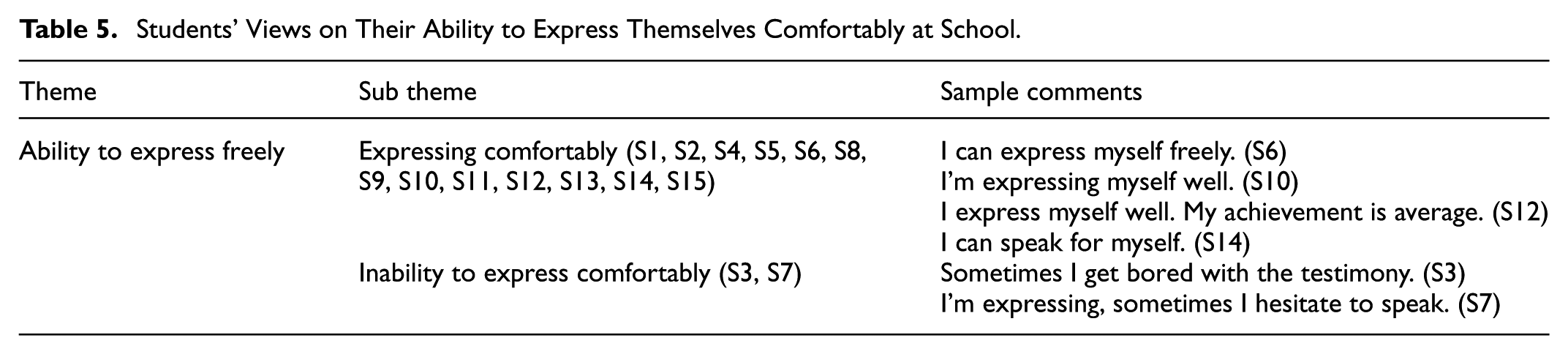
S6 shared, “I can express myself freely, but sometimes teachers don’t listen well.” This comment suggests that structural openness exists, but interactional challenges remain. S7 admitted, “I express myself, but I hesitate sometimes. I’m scared I’ll say the wrong thing.” His hesitancy may reflect internalized stigma or past experiences of being dismissed.
Notably, the students who identified as struggling with expression also had limited literacy skills, implying that verbal or written communication challenges may shape their confidence. In this light, self-expression is not just about opportunity, but linguistic competence and emotional readiness—elements often overlooked in inclusion strategies.
These findings underscore the need for inclusive communication practices, such as multimodal expression, peer support, and increased teacher awareness of subtle cues indicating discomfort.
Theme 5: Behavioral Style
When asked, “How do you perceive your classmates’ behavior toward you?,” students shared a complex mixture of acceptance and rejection. Nine students reported positive interactions, while six described negative or exclusionary behaviors (Table 6).
Inclusive Students’ Views on Their Classmates’ Behaviors Toward Them

S2 described an interesting form of perceived positive discrimination: “They say we get 100 in every subject just because we’re special ed. They say we’re lucky.” While this might indicate social acceptance, it also reveals resentment or misunderstanding of inclusion benefits.
By contrast, S3 shared, “Sometimes they hit me.” and S6 stated, “They make fun of me. They laugh when I say things wrong.” These comments suggest ongoing peer victimization, possibly rooted in visible or verbal differences.
The gender imbalance in the sample may be relevant here. Boys may be more likely to express or experience overt physical conflict, while social exclusion among girls might manifest differently. Yet with only two girls, this dynamic remains speculative.
The prevalence of violence, ridicule, and exclusion among nearly half the sample is alarming. It signals a social barrier to true inclusion, where physical presence in the classroom is not matched by emotional safety.
Theme 6: Convenience of Communication
Asked, “Can you communicate comfortably with your teachers?,” 10 students reported comfort, three noted embarrassment, and two felt occasional hesitation (Table 7).
Inclusive Students’ Views on Their Ability to Communicate Easily With Their Teachers.
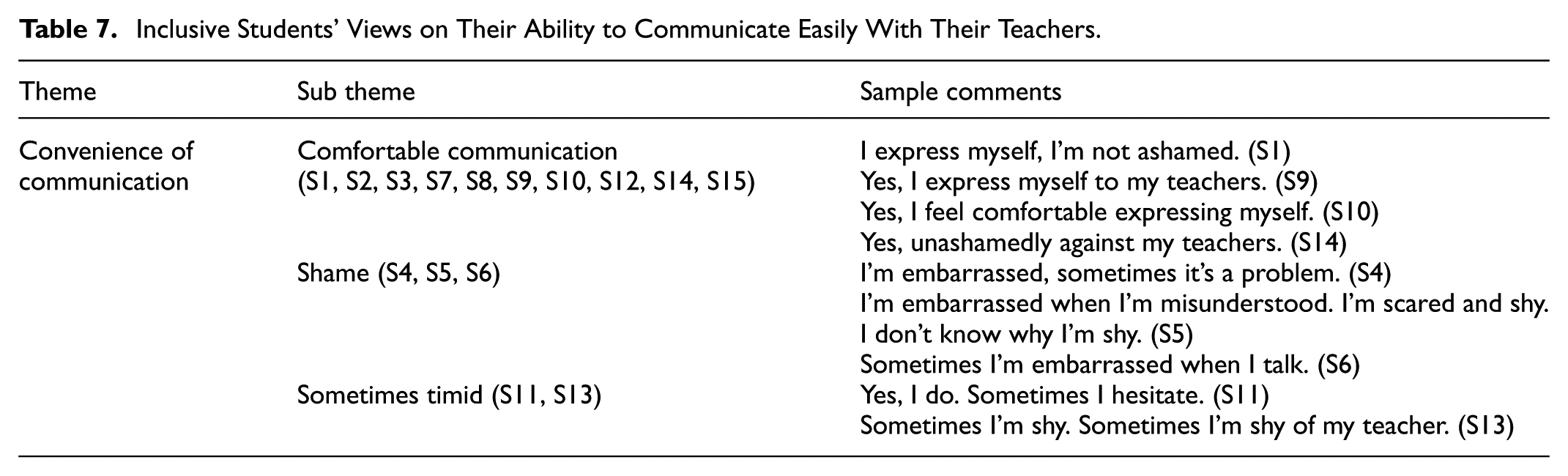
S5 admitted, “I’m scared and shy. I don’t know why. I feel bad when I don’t understand.” This reveals that teacher-student interaction is not just functional but deeply emotional, and that miscommunication may lead to shame.
S14, in contrast, said, “I express myself without shame. Teachers listen to me.” This positive experience reflects the potential of supportive teacher relationships to mitigate social and academic insecurities.
Interestingly, students who reported difficulties often had low literacy or were recipients of special education services, pointing to a pattern: students with more significant educational needs tend to feel less comfortable in teacher interactions, possibly due to feelings of inadequacy or fear of being misunderstood.
These findings emphasize that teacher empathy, patience, and inclusive communication methods are essential—not only to academic success but to students’ emotional resilience.
Discussion
This study examines secondary school students’ experiences of inclusive education and the challenges they face. Students’ perceptions of educational environments, interactions with teachers and peer behaviors significantly influence the quality of learning and social dynamics. These experiences reveal a complex structure that affects academic performance and social development.
Perception of School
Students’ responses reveal that educational environments are complex spaces of experience. School is seen as a central place for both academic development and social interactions. Students’ statements such as “school includes both play and learning” indicate that education is not only a place for the transfer of knowledge, but also an important space for the development of social skills.
However, some students state that school is perceived only as an academic environment. This may suggest that educational institutions do not sufficiently support the areas of social interaction and personal development. In the literature, it is emphasized that school is an important area not only for academic but also for social development.
Students’ Educational Experiences
Students’ perceptions of educational adequacy indicate that the general education program is adequate for most students. However, some students expressed dissatisfaction with the quality of special education services. This shows that there are deficiencies in the implementation of inclusive education systems and that better support is needed.
One student’s statement that “school education is not enough” indicates that the education system does not adequately support all students. This view suggests that institutions need to adopt more comprehensive strategies.
Willingness to Attend School
Students’ positive attitude toward their schools is important for both their academic and emotional development. Students’ statements such as “I like school; it is a good time” emphasize the role of social interactions and fun activities in education. A positive attitude toward school can increase interest in learning and positively affect academic achievement.
However, some students express their reluctance toward school. This may indicate that school environments do not adequately respond to the needs of all students. In the literature, the importance of adapting school environments to the individual needs of students is emphasized.
Students’ Self-Expression Skills
Most of the students state that they can express themselves freely. However, some students have difficulty in expressing themselves due to social discomfort or lack of self-confidence. This suggests that educational environments should be designed to support students’ self-expression skills.
Supportive peer relationships and positive teacher-student relationships can improve students’ self-expression skills. Educators should create an environment where students can express themselves comfortably.
Peer Support and Challenges
Students’ academic experiences are significantly influenced by peer support and the challenges they face. Many students report positive attitudes of their classmates. However, some students mention negative classroom experiences such as “sometimes violent behavior” and “teasing.” This shows how peer relationships can influence educational experiences.
Supportive peer relationships can increase students’ sense of confidence, while negative behaviors can increase academic anxiety. Educators should monitor classroom dynamics and allocate resources to reduce negative behaviors.
Communication with Teachers
Students’ educational processes and the social atmosphere in learning environments are greatly influenced by teacher-student interactions. Many students state that they can easily communicate with their teachers. However, some students have difficulties in interactions due to social anxiety and communication difficulties. This suggests that teachers should develop strategies to support students’ communication skills.
Limitation
This study presents several limitations that warrant careful consideration. Firstly, the data were collected from only two rural secondary schools, limiting the extent to which findings can be generalized to all inclusive middle school students in Türkiye. The rural context, with its specific socioeconomic, cultural, and infrastructural dynamics, may shape students’ school experiences differently than in urban or suburban settings. Moreover, the study primarily relied on qualitative data, which, while rich in depth, may not fully capture broader patterns across larger student populations.
Another key limitation is the potential influence of researcher bias during data interpretation, despite efforts to ensure objectivity. The absence of data from other stakeholders—such as teachers, administrators, and parents—also limits the comprehensiveness of the findings. Additionally, the study did not distinguish between types or levels of special educational needs, which may have influenced the varied perceptions of educational adequacy and support.
Future research should consider including diverse geographical settings, employ mixed-methods designs, and incorporate the voices of multiple stakeholders. Longitudinal studies may also better capture changes in students’ experiences over time and provide more robust insights into the effectiveness of inclusion practices.
Conclusion
This study offers valuable insights into the academic and social experiences of middle school students in inclusive education settings. The findings reveal that students conceptualize school not only as a place of learning but also as a social and emotional environment. While many students expressed satisfaction with the general curriculum and valued positive peer and teacher relationships, notable disparities were observed in the quality of special education services and the consistency of social support.
Implications for Educational Practice
Strengthen Special Education Support; Schools should invest in more robust special education services, including trained personnel, tailored learning materials, and individualized support plans to address the unmet needs identified by students.
Foster Inclusive Social Environments; Implement structured peer support systems, such as buddy programs and cooperative learning groups, to promote empathy, reduce social isolation, and mitigate incidents of teasing or exclusion.
Enhance Teacher-Student Communication; Professional development for teachers should include training on inclusive communication strategies, with a focus on building trust, reducing student anxiety, and encouraging self-expression.
Monitor and Address Negative Peer Interactions; Schools must proactively identify and address bullying or exclusionary behaviors by fostering a culture of respect and inclusion through regular social-emotional learning sessions and restorative practices.
Tailor Approaches to Local Contexts; Recognizing the rural setting of this study, educational policies should consider how community-specific factors, such as agricultural family backgrounds or limited access to services, influence students’ educational participation and attitudes.
Directions for Future Research
Employ mixed-method approaches that integrate quantitative surveys with qualitative interviews to triangulate data and strengthen generalisability.
Conduct comparative studies between rural and urban inclusion settings to understand contextual effects on inclusive education outcomes.
Examine the long-term impacts of inclusive practices on students’ academic trajectories, well-being, and social development.
Investigate the perspectives of underrepresented groups, such as students with more complex learning needs, or those with linguistic or cultural differences, to ensure policy and practice address a broader spectrum of inclusion challenges.
Footnotes
Acknowledgements
We appreciate the anonymous reviewers for their efforts in reviewing our manuscript and their positive feedback.

Ethical Considerations
The study was conducted in accordance with the guidelines of the Declaration of Helsinki and approved by the Institutional Review Board of Akdeniz University (approval no. 06.12.2023, No: 541).
Author Contributions
Conceptualization, Ahmet Köç and Hilmi Demirkaya; methodology, Ahmet Köç, Hilmi Demirkaya, and Tuğba Sarıtekin; software, Hilmi Demirkaya; validation, Ahmet Köç, Hilmi Demirkaya, and Tuğba Sarıtekin; Formal Analysis, Hilmi Demirkaya, Ülkü Tuğçe Çal Pektaş; investigation, Tuğba Sarıtekin; resource, Tuğba Sarıtekin; Data Curation, Mustafa Boran; Write—prepare original draft, Hilmi Demirkaya; Write—review and editing, Ahmet Köç, and Tuğba Sarıtekin; visualization, Hilmi Demirkaya; supervision, Mustafa Boran; project administration, Ülkü Tuğçe Çal Pektaş. All authors have read and agreed to the published version of the manuscript.
Funding
The authors received no financial support for the research, authorship, and/or publication of this article.
Declaration of Conflicting Interests
The authors declared no potential conflicts of interest with respect to the research, authorship, and/or publication of this article.
Data Availability Statement
The data supporting the findings of this study are available from the corresponding author upon reasonable request. Data will be provided, if necessary, after consultation with the corresponding author.