




Abstract
With the development of the Internet economy, online shopping has become the main way for consumers to obtain goods, especially for organic infant milk. Do millennials who grew up in the era of Internet prefer online purchasing channel? Or are they stickier to online channel than offline channel? To solve these issues, we conduct the regression analysis of a latent class and the model of Quadratic Engel Almost Ideal Demand System aimed at the user stickiness in China. Moreover, we further analyze the environmental social governance effect of multi-channel stickiness, which is able to further explore the impact of environmental social governance investment strategy on consumers’ purchasing behavior. Through these analyses, we confirm the online channel stickiness and platform stickiness of Taobao. Results also indicate that (i) The primary factor influencing the inertia of consumption and trade volume is the channel and platform stickiness, the latter positively affects the former. (ii) The ESG rating index plays a positively moderating role in the consumers’ user stickiness. (iii) Environment and Social Score have a significant positive impact on online platform stickiness.
Keywords
Introduction
A business revolution has been and tends to be omnipresent recently (Lim, Ciasullo, Douglas, & Kumar, 2022). Under the impact of digital economy and new technology of e-commerce platform, along with the the popularity of smartphones, internet coverage and online payment systems, an increasing number of firms start to sell more products to consumers via online channel and target the online customer group based on their purchasing record obtained from the actual transaction activities. Until 2013, the market size of internet market has surpassed that of the USA, which is estimated that China’s E-tailing has been expected to reach approximately $900 billion since 2015. This is more than double the market size of USA (H. H. Wang et al., 2019). Correspondingly, online marketing is rapidly expanding its territory into the traditional offline sector in China. Under the view of knowledge of online channel, online marketing based on web mining technology is a new marketing strategy for producers (Shafiee & Bazargan, 2019). This tool forms important foundation of e-loyalty, which is Shafiee et al. (2016) defined as the willingness of customers to perform an e-business activities based on their future expectation.
In this context, we can easily notice that the majority of millennials growing with digital economy is mostly responsible for buying products via online channel, which has the main force of online shopping. According to the data from China Internet Network Information Center (CNNIC) (2017), the total number of millennials has accounted for 72.5% of the consumers who purchase via online channel since 2017. Lim (2022a) explain this phenomenon as an inter-generational shift in the behavior of consumers who pay more attention to the well-being of human civilization and the surroundings in the natural ecosystem. Levin and Levin (2010) find the impact of brand names on the product choice of children and parents, which is by Harvey et al. (2011) explained as the moderating role of social media. This inter-generational effect significantly influences the formation of online user stickiness via the reinforcement of emotional connections (Mackey, 2016). Thus, the study of user stickiness contributes to reexamining the inter-generational shift of consumers’ purchasing behavior (Lim, 2022b).
In fact, in the digital era, as the “digital natives,” the most of millennials who is exposed to new web technology is more likely to receive the product information than past generations (Lim et al., 2021). Correspondingly, they tend to focus on the products’ online reviews due to the availability of recommender system in the consumer communities supported by big Data technology, thereby potentially forming their trust of branded products and online channel stickiness (Kumar et al., 2021). Thus, “the choice philosophy of customers” has achieved the transformation from the buying experience to the product electronic word-of-mouth (e-WOM) among this consumer group. In the long term, the constantly updated technology of consumers’ information capture promotes the precision advertising toward the targeted consumers, thereby virtually improving their tech-savviness of product information search and demand for technology (Lim et al., 2021). In essence, this technology enhances the consumers’ perception of ease of use regarding online information (F. D. Davis, 1989), which contributes to forming the user stickiness via the accumulation of e-satisfaction among these consumer groups (Polites et al., 2012). In this sense, the study of user stickiness helps to the construction of theoretical analysis framework of millennials’ online purchasing behavior.
From the perspective of e-commerce platform itself, it is the product of new web technology combining with client data mining, building the information-sharing platform between consumers and sellers (Luo et al., 2020). In this social community, the efficiency of information exchange can be greatly improved, which is convenient for millennials to understand the trading history and market evaluation of products. The e-commerce platforms including Taobao, Tmall, 1# Store and JD are the best example to illustrate. Reputable conglomerate producers, such as COFCO and Temu, have established their own e-commerce platforms for catering for the need for young consumer. In addition, traditional grocery retailers, such as Freshippo, have recently developed a consumer-oriented online outlets providing free delivery and in-store pickups.
However, it cannot be denied that traditional offline channels are considered to be consumers’ preferred purchasing channels (T. Li et al., 2013). Taking the China’s market of OIM as an example, the proportion of purchasers via offline channel is 48.1% in 2016 (China Commerce Industry Research Institute, 2017). The underlying reasons for this phenomenon are as follows: On the one hand, some young consumers are more likely to purchase branded goods because they are able to directly perceive brand value (T. Li et al., 2013); On the other hand, the short distance from physical shops is one of the most essential factors in consumers who prefer to purchase goods via offline channel (Chocarro et al., 2013), which creates an obvious incentive for these young consumers close to the physical shops to firstly consider the traditional offline channels.
In particular, we take the retailing industry as the research object. Kootenaee and Shafiee (2021) figure out that the market incumbents in the retailing industry accelerate the formation of brand competitiveness through the environmental stimulus, and potentially offer the essential condition for generating brand value, which is by Ghorbanian et al. (2015) called as retailer equity. In the long term, the business ethics issue is essential for retailers, which potentially affect the retailers’ image and their market competitiveness (Eyvazpour & Shafiee, 2020). Nevertheless, the issue sustainable agenda regarding business ethics is seldom focused by the academic circle (Lim, 2016, 2022a). This means that retailers and consumers remained unaware of the sustainability of product behavior and consumption behavior, both of which are defined as “the conscious and deliberate product and consumption decision based on moral belief and values” (Crane & Matten, 2004). This is closely linked to Environmental social governance (ESG), which first appeared in a United Nations Global Compact (2004) report called as Who cares wins: Connecting financial markets to a changing world. This is by Clementino and Perkins (2021) defined as “the comprehensive performance appraisal for company by the standards of product quality management and corporate behavior in terms of environmentally friendly, social public and governance affairs,” the corresponding components and weights of ESG rating index are shown in appendix S4. This derives from producers’ ESG non-financial investment activities, implying that enterprises are accountable for public interests while pursuing economic benefits. Thus, it is necessary for us to introduce the ESG evaluation system into the retailing industry in order to achieve the sustainable development of marketing strategy (Lim, Ciasullo, Douglas, & Kumar, 2022). In this context, the conception of ESG will become the thought compass of socially responsible practice and technological innovation, which has a significant influence on the consumer purchasing behavior (Dang et al., 2022; Lim et al., 2023). Therefore, the ESG rating index fit well the purpose of this paper.
Based on the above analysis, retailers and producers not only maintain the offline channel to keep the offline consumers’ user stickiness, but also explore the online channel in order to stay relevant with consumers who have a preference for online purchase mode (H. H. Wang et al., 2019). In particular, owing to the limited growth potential of traditional offline channel, increasing physical shops are expanding toward E-tailing sector propelled by the web. As an example, overseas flagship store from Carrefour has successfully settled JD Worldwide platform since 2019. Due to the difficulty for potential entrants to enter a highly competitive and Chinese e-commerce market, studying the issue of the consumption behavior in the context of multi-channel is helpful for retailers to understand the consumers’ multi-channel purchase behavior of product, thereby efficiently placing their products in marketing channels.
The aim is to be expanded to explore the user stickiness of multi-channel (channel stickiness), taking the market of OIM as an example, to enhance the theoretical contribution of this paper. Specific objectives are as follows in this paper: (i) How the user stickiness of online and offline channel formed? (ii) What is the relationship between the user stickiness of online channel and that of online business platform? This research proposes a novel interpretation of multi-channel purchase behavior by addressing these above problems.
Our research is novel in various dimensions: Firstly, we conduct the model of consumers’ selection and QEAIDS to analyze the consumers’ purchasing behavior combining with their socioeconomic status; Secondly, we conduct the mechanism analysis of online channel stickiness from the perspective of online platform. More importantly, the variable of ESG rating index is introduced into the econometric analysis of consumers’ purchasing behavior in order to reveal the effect of ESG rating index on the user stickiness of multi-channel.
Theoretical Background and Hypotheses
The importance of user stickiness to consumers’ purchasing decision has attracted more and more attention from researchers (H. H. Wang et al., 2019), which is viewed as the final criterion for the long-term performance of enterprises (Lien et al., 2017). Kim et al. (2021) define user stickiness as the consumers’ preference for some specific brands or products, which is closely associated with the consumption inertia, which is by E. Wang et al. (2019) defined as the consumers’ recognition cost, adjustable cost and use-cost that have been useful in the process of long-term study. Recently, business academics mainly discuss the topic of user stickiness from the following aspects: offline channel stickiness and online channel stickiness.
Regarding the former, it is by Hult et al. (2019) defined as the consumers’ repurchasing intention for products in the offline channel. Hult et al. (2019) attribute the formation of offline user stickiness to the impact of the consumption satisfaction, which is by Hollander (2008) defined as the assessable experience of post purchase behavior. From the view of Hult et al. (2019), the consumer psychology of consumption satisfaction potentially enhance the connection between consumers and offline retailers, thus, consumers are more likely to repurchase this product in the future because of the reduced cognitive endeavor and the decision efficiency of purchase. Concerning the latter, it is by Kim et al. (2021) defined as “the ability of websites to draw in and retain purchasers, which helps to prolong the duration of user stays.” This means that the long-term dependent relationship between consumers and retailers can be shaped above all by the effective communications of online product information (Hsu & Lin, 2016). Therefore, the platform dependency that is maintained by customers’ long-term paper views (PV) of company websites results in online user stickiness (Kim et al., 2021).
After defining these conceptions, business scholars also explore the formation mechanism of user stickiness. Shao et al. (2019) and Wu and Cheng (2019) find the positive correlation between the word-of-mouth (WOM) and user stickiness, which is by Ring et al. (2016) defined as the informal communication between buyers and sellers regarding the evaluation of goods in some special context. In the online environment, this is by Friedrich et al. (2019) identified as one of the most important predictors of users’ continuance intention. In the context of offline channel, WOM helps to the formation of offline channel user stickiness moderated by the past purchasing experience (Karjaluoto et al., 2016).
Therefore, we believe that there are insufficient in the economic literature concerning how user-sticky online grocery shopping is, especially for OIM (H. H. Wang et al., 2019). Moreover, most researches on user stickiness do not attach great importance to the impact of demographic characteristics on online purchasing behavior and it is viewed as a control variable (Bhatnagar & Ghose, 2004). In particular, although many scholars focus more on the importance of platform reputation for online user stickiness (Shao et al., 2019), marketing research on the impact of producers’ ESG rating index on user stickiness quite limited in the economic literature (E. Wang et al., 2019; Y. Wang et al., 2020). Narrowing these gaps will provide producers with professional guidance for the effective establishment of multi-channel marketing strategies.
The Channel Selection of Customers
From the perspective of consumers, they will make an optimized choice of multi-channel in the long term. Compared with offline environment, online environment provides consumers with detailed product information, which is positively associated with their purchasing attitudes toward a branded product (Shafiee & Bazargan, 2018). Thus, consumers tend to purchase branded products, which is by Shafiee and Bazargan (2018) explained as a solution for purchasing risk. Bao and Zhu (2022) further argue that the convenience of online channel encourages more consumers to purchase milk products online, which is supported by E. Wang et al. (2019). Regarding the producers, brand manufacturers potentially guide consumers to purchase via online channel by implementing an multi-channel strategy that is closely associated with the e-commerce channel (Basu & Sondhi, 2021). Bakos and Dellarocas (2011) point out that an online reputation system is more efficient in enforcing desired behavior compared with the traditional offline system resulting from high-end services in the online channel (Shafiee & Bazargan, 2018). Affected by this service quality, consumer involvement is greater because consumers tend to engage in browsing and ESG information searches of producers (Brun et al., 2017), which is closely associated with product image (Shafiee & Es-Haghi, 2017). Correspondingly, consumers tend to care more about the importance of corporate responsibility for their purchasing behavior in the context of online environment (Boulstridge & Carrigan, 2000). Therefore, we propose the following hypothesis.
The Online Purchasing Intention and Channel Stickiness
In this context of online channel, user stickiness is an essential factor in the relationship between the multi-transaction tools and consumers’ purchase intention (Vahdat et al., 2021). User stickiness is by Liu et al. (2021) defined as an antecedent to market interaction between consumers, which contributes to the accumulation of knowledge-based trust and characteristic-based trust (Vahdat et al., 2021). From the perspective of consumers, this trust is able to enhance the consumers’ online purchase intention of product (X. Chen et al., 2022). In the online environment, the quality of information can be revealed via the advanced web technology, which further strengthens their e-commerce consumption behavior (X. Zhang et al., 2021). In particular, the advancement of social network service in the online channel provides consumers with more shopping options and successfully creates the brand image they desire during the online purchasing activities, thereby potentially improving their online purchasing intention in the long term (Tabaeeian & Shafiee, 2023). Thus, we propose hypothesis H1.
The Channel Stickiness and Platform Stickiness
From the perspective of sellers, the perfection of e-commerce platforms makes producers and retailers constantly provides high quality products and platform service for consumers purchasing goods via online channel, which helps to the formation of online channel stickiness (Friedrich et al., 2019). The existence of online platform stickiness will encourage consumers to repurchase products via online channel (Hsu & Liao, 2014), which contributes to the accumulation of excellent e-commerce experience (Kim et al., 2021). These consumers with shopping experience will expand the social influence via online channel (Lee et al., 2021), thereby increasing the online channel stickiness, which is by W. T. Wang et al. (2016) called as the power of social psychology. Affected by this psychology, consumers who is loyalty to online platforms tend to seek for the information via these platforms and use these information to make their online purchase decision, contributing to the formation of e-trust (Hsu & Liao, 2014). Trusted by consumers, they may response to the high-quality purchasing information positively, thereby increasing their repurchasing intention for online channel, which helps to the formation of online channel stickiness (Gao et al., 2018). Therefore, we propose hypothesis H3.
The Moderating Role of ESG Rating Index
Platform stickiness in marketing has been regarded as loyalty, indicating repeated purchase activities in the context of online platforms (Kim et al., 2021). Y. Li et al. (2021) further view this stickiness as the time spent on a network platform during a visit, which represents the consumers’ long-term purchasing behavior. Moreover, Singh and Malla (2017) argue that the purchasing behavior of buyers are positively associated with CSR, which helps to the formation of online purchase intention for products. This propensity, to some extent, has a significant impact on shopping trust in the long-term purchase of product (Izogo & Jayawardhena, 2018), which is closely associated with the accumulation of user stickiness of online channel (Zhao et al., 2020), especially for the purchase of milk products (O. Wang et al., 2020). Concerning the organic consumption, it is closely related to moral identity and CSR (X. Yang & Zhang, 2021). Fang et al. (2023) further point out that ESG rating index can comprehensively measure the long-tern development of the company’s CSR, which is closely linked to buyers’ experience. Particularly, to maintain the sustainability of food products, producers fit the environmentally-friendly and social welfare concept into the creation of brand value (Boulstridge & Carrigan, 2000). Both of them are focused by consumers, thereby potentially affecting their sustainable behavior (Boulstridge & Carrigan, 2000), which is by Z. Yang et al. (2019) explained as the impact of ethics perception on consumers’ repurchasing intention. Therefore, the following hypotheses are proposed by us.
Methodology
In this paper, we investigative the user stickiness of online and offline channels using the infant milk powder business in China as an example. In this section, we mainly adopt the econometric models including the consumers’ choice model and QEAIDS model. The problem is the customers’ purchasing behavior with a focus on multi-channel purchasing behavior comparisons regarding the China’s organic infant milk (OIM) market. In particular, as an essential replacement for breast-feeding, OIM is essential to the growth and well-being of infants. Some nutritional ingredients, such as amino acids, creatinine, and protein, etc., play a vital role in the infants’ healthy living. In addition, the increasing number of households are willing to produce more children in the context of three-children family, thereby creating more demand for OIM. It has been estimated by Ho et al. (2017) that China’s consumption of OIM has accounted for approximately 70% of the total dietary spending of babies since 2017. Correspondingly, a sizable amount of the entire cost of infant supplies has been spent by families with newborns on OIM use. This creates the largest market of OIM around the world with an annual growth rate of 20% (Tang et al., 2014). Therefore, we select the China’ s market of OIM as the research sub-sample.
The Model of Consumers’ Online Channel Choice
For simplicity, let yt as an indicator taking value 1 if the current OIM purchase via online channel and 0 offline channel. At the same time, concerning the channel stickiness, based on the latent class method (Benni et al., 2019), it is assumed that consumers would opt for the purchasing channel i (i = 1, 0) if the option generates the highest consumers’ utility (Ui). Here, i = 0, 1 corresponds to the offline and online purchasing channel in the current period, respectively. Therefore, the likelihood that customers will choose the online channel is given by:

Here U1 and U0 represent the utility when consumers select the online channel and offline channel, respectively. Hereby, the consumers’ utility can be split into two components, the observable attributes of the consumers’ characteristics Vi and unobserved attributes, that is, the error term εi (Gulseven & Wohlgenant, 2017):

We construct the probability of consumers’ choosing the online channel based on Equation 2. We assume, for convenience, that the consumers’ online purchasing decisions are mainly determined by their own socioeconomic status. At the same time, we introduce the dummy variable of city, because of the urban heterogeneity of consumers’ brand choice. Thus, the cumulative distribution function (CDF) of consumers’ online channel selection in the current period can be denoted as the following form, the corresponding proof is shown in appendix S5:

Where xt represents the demographic characteristic, which includes purchasers’ gender, the age of baby (month), consumers’ income and family size. Ci (i = 1,2,3) signifies the dummy variable of city, i = 1,2,3 corresponds to Shanghai, Beijing, and Guangzhou, respectively. In particular, to avoid dummy variable trap of the regression results of a discrete consumer choice model, the dummy variable of Shenzhen is regarded as the default value, whose proportion is 10.2% in this sample. Brandj (j = F, A, M, others) denotes the dummy variable of brand. It should be noted that other brands, in order to improve the efficiency of regression, are treated as the default variable. j = F, A, M denotes brand FRISCOCARE (FRI), APTAMIL (APT), MEADJOHNSON (MEA), and other brands, respectively; The subscript t is the indicator of time series, which corresponds to the coefficient ρ and β; the positive coefficient ρ represents that consumers tend to buy the products in the current period. In particular, the consumers’ wage is divided into six categories including the income level of below $718, from 719 to 1,005, from1,006 to 1,292, from 1,293 to 1,724, and from 1,725 to 2,299. Note that we treat the dummy variable of L6 (more than $2,300) as the default value in order to reflect the representation of the consumers’ income sample.
Therefore, we posit the logit regression model of consumers’ online channel selection:
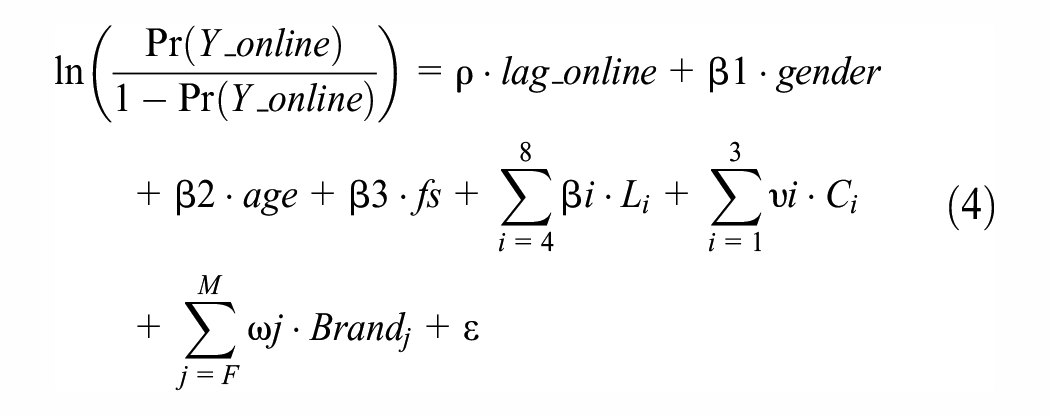
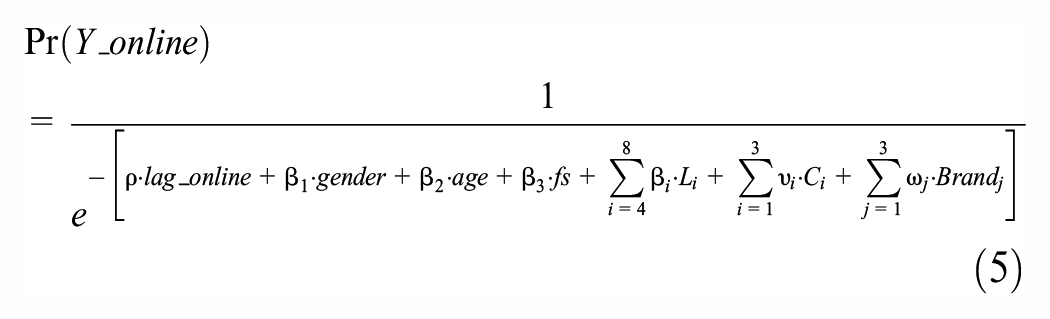
Here Y_online and lag_online stand for, respectively, the customers’ online consumption and corresponding lagged value; The dummy variable for the purchasers’ category is gender, with a value of 1 for female purchasers and 0 for male purchasers; Age and fs represent the dummy variable of baby’s mouth of age and household size, respectively; The dummy variable Ci includes Shanghai, Beijing and Guangzhou; The dummy variable of Brandj includes FRISCOCARE (FRI), APTAMIL (APT) and MEADJOHNSON (MEA); L l (l = 1, 2, 3, …, 5) represents the consumer income below $718, from 719 to 1,005, from1,006 to 1,292, from 1,293 to 1,724, and from 1,725 to 2,299, respectively.
Based on this, we further conduct the logit regression of consumers’ brand selection, which can be denoted as the following form:
Moreover, we construct the probit regression of consumers’ online channel choice based on the probit model, which can be denoted as follows:
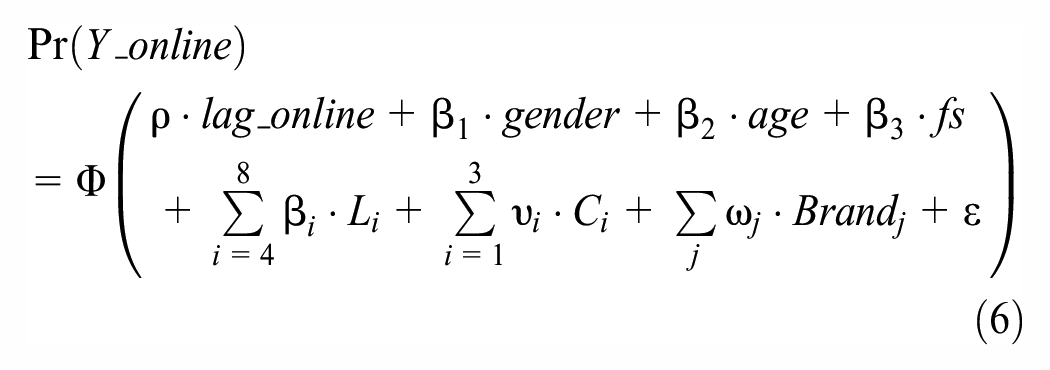
Where Φ is the cumulative distribution function of probit regression; ε represents the disturbance term.
The Comparison of Online and Offline Channel Choice
In fact, consumers’ behavioral features varies in the different purchasing channel (Huseynov & Özkan Yıldırım, 2019). Based on QEAIDS method, we will compare the consumers’ online behavior with their offline behavior in the next section. This advantage of this model is that the QEAIDS model not only nests the system of Almost Ideal Demand System (B. Chen et al., 2018; Deaton & Muellbauer, 1980), but also incorporates all of the desirable properties of Source Differentiated Almost Demand System (C. G. Davis et al., 2010).
Inspired from Dharmasena and Capps O (2012), the QEAIDS equation has been depicted as follows:

Here wih denotes the market share of brand i in the purchasing channel h; h = 1,2 corresponds to the online and offline channel, respectively; F, A, and M represent brands FRI, APT, and MEA, respectively; xFI denotes the consumer demographic variable. Here, due to the importance of family size and consumers’ income for their omni-purchase behavior (Ali et al., 2010), the effect of family size (fs) and consumers’ income (I) are discussed by us. In particular, in order to examine the hypothesis H1b, we also add the variable of ESG rating index (ESG) into QEAIDS model. The variables of p and Y are served as the price of brand in different purchasing channel and the total expenditure of purchasers concerning branded OIM; P is for the QEAIDS brand price indicator, ζi is the fixed effect of consumers’ socioeconomic features including purchase gender and mouth age of babies.
Then Equation 7 can be transformed into the following form:

For convenience, let P be the aggregation form of Cobb-Douglas (Dharmasena & Capps O, 2012). That is,

Then, we can obtain the following equation by taking log of Equation 9, which can be expressed as follows:

To input Equation 10 into 8, we can obtain the formula of QEAIDS, which can be denoted as follows:

In particular, to diminish the regression biases caused by potential endogeneity of brand prices and consumers’ income, the above-mentioned system of equations is estimated with seemingly unrelated regression (SUR) inspired from Holly and Denis (1982).
To decrease the number of estimated parameters and improve the efficiency of regression models (Barnett & Seck, 2008), the theoretical constraints-homogeneity, symmetry and adding-up-can be imposed by the above regression during estimation, which can be expressed as follows:


Here Equation 12 satisfies the aggregated analysis requirement of QEAIDS model; Introduction of conditional constraints, say Equations 13 and 15, can check the robustness of QEAIDS model when ignoring the heterogeneity of brand price; Equation 14 can improve the efficiency and symmetry of QEAIDS results. In particular, these constraints imply that the elasticity involving other brands of OIM and three brands (FRI, APT and MEA) ought to form certain relationships derived from homogeneity of consumers’ demand curve and the budget constraints based on the thought of B. Chen et al. (2020). It should be noted that we treat other brands as the equivalent goods for the sake of convenience suggested by H. H. Wang et al. (2019).
Then, the conditional regression of QEAIDS can be denoted by this program:

Here the observation value of zero consumption volume has been removed to increase the robustness of QEAIDS regression model. Based on Equation 16, the price elasticities of brands are computed from the estimated parameters as follows:
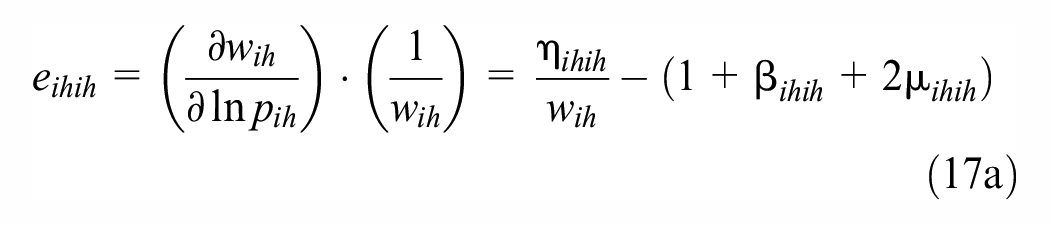


Where the subscript m denotes consumers’ income; Equations 17a and 17b represent own-price elasticities and cross-price elasticities between different brands, respectively; Equation 17c denotes the income elasticities of brands.
The Mechanism Analysis of Online Channel
In this section, we mainly analyze the influencing mechanism of consumers’ online channel stickiness. In order to explore the reason for the formation of consumers’ online user stickiness, the following probability of online channel selection is adopted, that is,
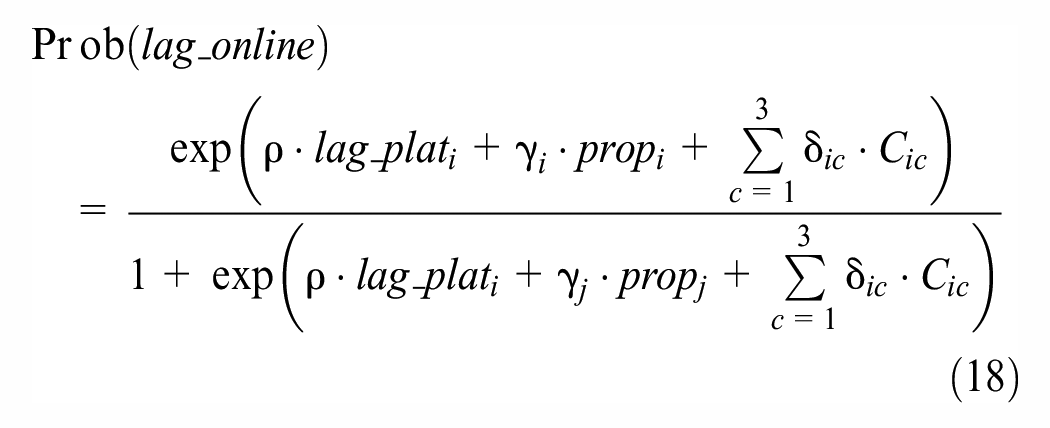
Here i = 1,…,4 represents the online platform 1#store, Tmall, JD, and Taobao, respectively; lag_plati denotes the platform stickiness of consumers; city·c is served as the dummy variable of city, which can measure the regional heterogeneity of online channel stickiness; c = 1,2,3 represents Shanghai, Beijing, and Guangzhou, respectively; propj represents the market choice propensity of online platform, which can denoted as the following form based on the thought of Mintz et al. (2013):

Where Qj represents the consumers’ purchasing amount of brand via online platform j; Q represents the total quantity of brand purchases; Uj and Ui represent the utility value when consumers opt for the online platform and overseas shopping channel, respectively. It is noteworthy that we treat the overseas shopping as the reference standard because majority of offline consumers purchases goods via traditional offline channel in this dataset.
Combining with the hedonic method (Rosen, 1974), Equation 18 can be given by:

Here the coefficient of market choice propensity γ can measure the impact of e-commerce platform on the consumers’ online channel selection.
Constructing the hedonic regression of consumer online channel activity allows us to test the robustness of Equation 20, which is written as the following form:

Because social preference is affected by gender differences to some extent (Kamas & Preston, 2015), a hedonic regression of consumer online channel selection based on the purchasers’ gender is denoted as the following form to check the gender differences of consumers’ channel selection:

Where the subscript of g represents the purchasers’ gender; k = 0,1 denotes the female purchasers and male purchasers, respectively.
The Further Discussion of Consumers’ Online Purchasing Behavioral
In this section, in order to check the moderating role of ESG rating index, we posit the following model based on the method shown in section 3.3. The corresponding estimated method is as follows:
After introducing the variables of lag_plat, prop and brandi into the model of consumers’ channel choice, we replace these variables with the form of ESG·lag_Y_online, ESG·lag_plat, ESG·prop, and ESG·brandi. The subscript i = 1,2,3 corresponds to brand FRI, APT and MEA, respectively. In particular, the variable of ESG rating index (ESG) is incorporated into this regression analysis. To measure the Corporate Social Responsibility (CSR) of OIM producers, we adopt the indicator of ESG rating index provided by ESG dataset of Wind Data Service Platform. Moreover, in order to measure the impact of Environmental Disclosure Score (E_score), Social Disclosure Score (S_score), and Governance Disclosure Score (G_score) on consumers’ online purchasing behavior, we add the variable of the following sub-ESG rating index into the regression analysis. In addition, inspired from S. W. Li et al. (2019), we control the variable of purchasing region and consumers’ socioeconomic features with the fixed effects in order to diminish the errors of moderating effect regression caused by the heterogeneity of the consumers’ socioeconomic characteristics and purchasing region. Particularly, these consumers’ features include their household income, family size, purchase gender and mouth age of babies.
Data
Respondents
The data used in this paper come from the Kantar Worldpanel offered by CTR Market Research CO. Ltd from 2015 to 2022. Note that, CTR Market Research CO. Ltd is one of the first qualified foreign-related survey agencies authorized by the National Bureau of Statistics, which is committed to combining nearly 30 years of China market insight experience with the Internet big data technology to provide comprehensive market analysis. Thus, the reliability and validity of this transaction data can be guaranteed. Note that, because this dataset is provided by market research business center in China, it is commercially confidential. Correspondingly, the confidenciality analysis of data is not available for this dataset. In this section, we only check the reliability and validity of ESG rating index based on the measurement system including the principal components factor (PCF), Cronbach’s Alpha (CA) value and composite reliabilities (CRs) (Lu et al., 2010). This is shown in appendix from S1 to S3, which evidences the availability of ESG rating index.
Data Description
In this dataset, a representative panel of families in China provided information for this dataset with details concerning the consumption of OIM in four major cities in China-Beijing, Shanghai, Guangzhou, and Shenzhen. This data keeps the record of information on consumers’ OIM purchases, including socioeconomic characteristics of consumers, product specifications, and brand price. Furthermore, this dataset also tracks the consumers’ purchasing activities of channel-online and offline channel in four first-tier cities from 2015 to 2022. Particularly, to simplify our analysis, we focus on three brands including FRI, APT, MEA and other brands. In this dataset, the CR3 value of FRI, APT and MEA is 81.5% and the market share of three brands corresponds to 50.7%, 15.6%, and 15.2%, respectively.
In particular, the above cities have been selected as research object for the following reasons: First, as per China Statistical Yearbook 2020, these cities are among the most developed regions in China, with the highest GDP and GDP per capita from 2015 to 2020. Thus, the consumers from these cities have the higher disposable income, thereby becoming the potential purchasing power of the market of the high-end OIM in China; Second, the convenience of omni-channel influences consumers, particularly young people from these cities, to strongly favor the purchase of OIM. The market research data from 2019 Chinese Market Research Report on the Purchasing Group in the Mother-to-Child Industry issued by Tencent demonstrates that over 30% of young consumers from four main cities tend to choose branded OIM products. The market demand from these cities has become the important factor which affect the market positioning of the high-end OIM. According to China Statistical Yearbook 2020, the market share of high-end branded OIM from the above-mentioned cities has accounted for 75.2% of the whole market of OIM.
The descriptive statistics of explanatory variables are shown in Table 1. From this table, the larger variance of purchased amount demonstrates that consumers who is loyal to a particular online platform might develop the behavior of platform switch under some circumstance, thus, increasing the competitiveness of e-commerce platform, which can be explained that consumers’ preference and purchasing behavior is affected by the shopping situations to some degree (Huber & Puto, 1983). Particularly, the mean value of Taobao is larger than other platforms, whereas the variance of the former is slightly smaller than that of the latter, which signifies that the most of consumers tends to be stickier to Taobao platform than other e-commerce platform. We also find that the mean value of Beijing, Guangzhou and Shanghai surpasses the corresponding value of Shenzhen, which confirms the finding of the regional difference of the brand market. The underlying reason for this phenomenon is that an increasing number of mothers in Shenzhen have a preference for breastfeeding since 2008 (E. Wong, 2013). Therefore, retailers and producers should formulate a cross-channel retailing strategy according to regional characteristics of the market of OIM in China. Particularly, the mean value of consumers’ income (2,237.2437) implies that the middle-class families make up a significant share of the entire family sample (H. H. Wang et al., 2019).
The Descriptive Statistics of Explanatory Variables (Sample Size 8,266).
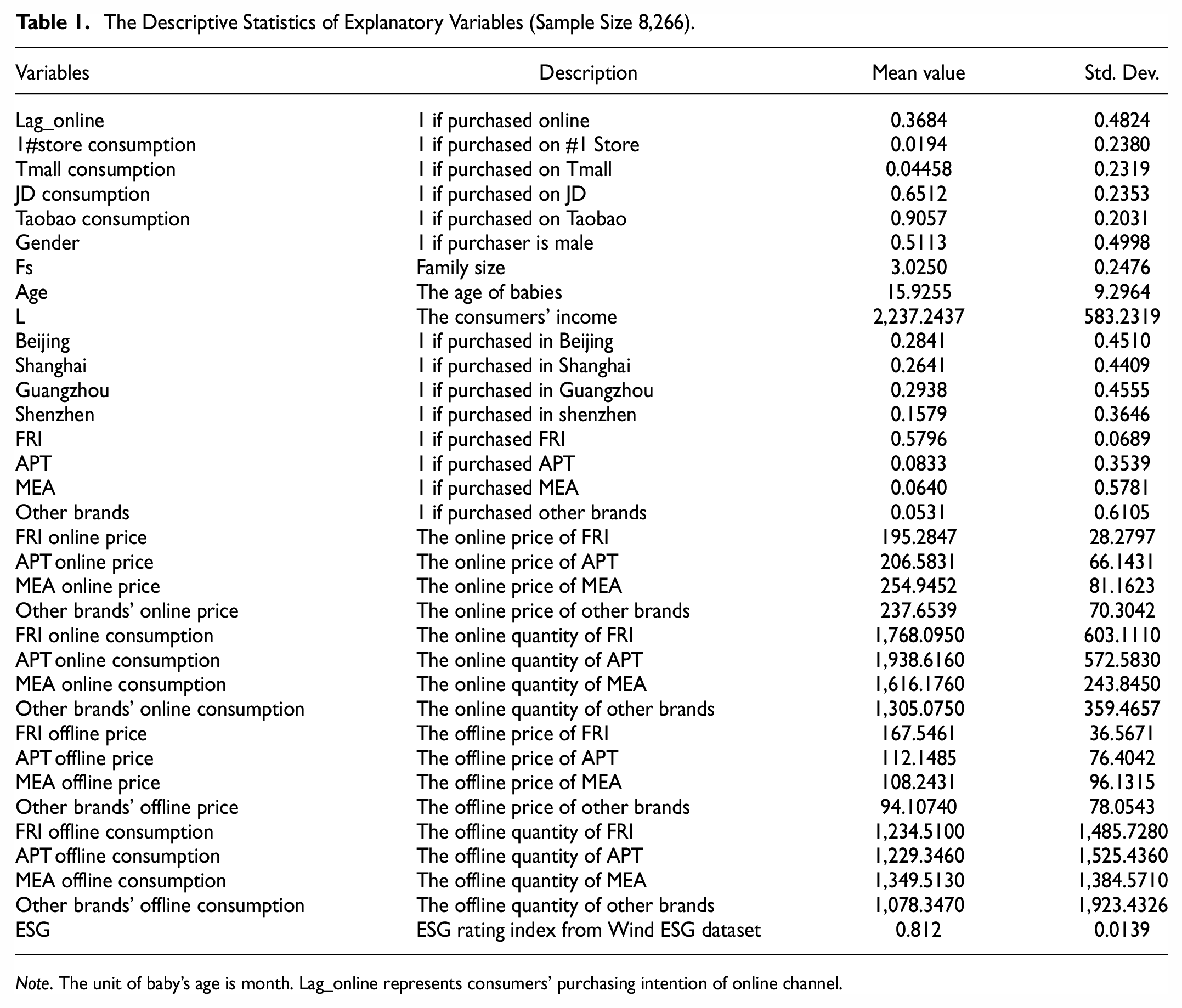
Note. The unit of baby’s age is month. Lag_online represents consumers’ purchasing intention of online channel.
Moreover, the tiny differences of mean values and standard deviation among brands demonstrate that consumers might switch the brand portfolio under some circumstance. For example, when one brand adopts the strategy of low price to seize the online market share of OIM, consumers might transform from the initial brands to the new brands. Furthermore, the mean value of online prices concerning three brands are higher as compared to the corresponding value of offline brand prices, whereas the variances of the former is inferior to these of the latter. This illustrates that online producers tend to implement the strategy of price premium in the long term, which causes the stability of online brand price (X. Li, 2022). However, we also witness the patterns that are consistent between the factors of brand consumption both online and offline. This shows that consumers choose to purchase branded OIM online even though they may have to pay a high price premium, which can be explained as the market recognition of online business platform by Iyer et al. (2019). It should be noted that the mean value of FRI is maximal among three brands, showing consumers’ preference for the brand FRI due to the China’ s market reputation of FrieslandCampina since 2013 (Dai & Zhou, 2016).
It is interesting to find that the mean value of ESG rating index is 0.812, which is larger than the corresponding value of lag_online. This shows that the ESG rating index of producers plays an important role in consumers’ purchase behavior, especially for young users (Singh & Malla, 2017).
The Analysis of Regression Results
Baseline Estimates
The Model of Consumers’ Channel Selection
Table 2 presents the estimated coefficient and p value of the logit model. A positive coefficient, at the significance level of 5%, associated with the variable of lag_Y_online provides the evidence for the user stickiness of online channel, verifying the hypothesis H2. As for consumers’ income, the coefficient of L3, L4 and L5 is significant positive at the significance level of 5%, whereas the consumers’ wage of L1 and L2 negatively influence consumers’ channel selection, which shows that consumers with high wage tend to purchase goods via online channel.
The Regression Results of Logistic, Logit and Probit.

Note. ***Statistical significance at the 1% level, ** at the level of 5%, and * at the level of 10%.
Concerning the variable of city, majority of the online channel coefficients are significant positive at the significance level of 5%, whereas the coefficient of Beijing is significant negative. This demonstrates that consumers in Shanghai and Guangzhou hold the stronger preference for online channel relative to Beijing and Shenzhen, which can be explained as the high degree of e-participation due to the development of information and communication technology (W. Li et al., 2020). Particularly, the coefficient of city shows that the prevalence of online channel varies in different cities. This implies that purchase location information is an essential cue to consumers to make online purchase decisions. Therefore, as for producers, to maintain the user stickiness of online channel, they should implement heterogeneous marketing strategies according to regional characteristics.
Family demographic status plays important roles in the user stickiness of online channel. We find that the baby’s age is positively associated with consumers’ online channel selection. Moreover, the gender of purchasers and households’ size are positively related to the consumers’ online channel selection. This implies that channel usefulness, social interaction and self-image caused by e-commerce platforms significantly affect mothers’ loyalty of online purchase channels. In addition, by comparing the coefficient of family size (fs) and male, we also notice that the former surpasses the latter, which illustrates that the female purchasers have a significant impact on the consumption of online channel.
Concerning the variable of brand, we find that the online channel stickiness of consumers, in general, is positively associated with the brand differentiation. This is in line with the work of Pozzi (2012), which is by him explained as the fact that brand differentiation decreases the consumers’ search cost and accelerate the process of consumers’ brand exploration. Therefore, producers ought to design the differentiated products to adapt to the consumers’ personalized needs. In particular, the coefficients of other brands are less than these of brands FRI, APT and MEA, which implies the market preference for these three brands (Dai & Zhou, 2016).
The Model of Multi-Channel Brand Selection of Consumers Based on QEAIDS Regression
In this section, we primarily choose the online and offline market share of brands FRI, APT and MEA as the research object, and then introduce the dummy variable of Beijing, Shanghai and Guangzhou into QEAIDS model in order to measure the heterogeneous effect of consumption behavior of the above-mentioned brands. Because household size and consumer income are vital for the consumers’ purchasing decision of food products in emerging economies (Ali et al., 2010), we mainly explore the impact of family size and income on consumers’ multi-channel purchasing behavior in this section. The regression results of QEAIDS model are shown in Table 3.
The Robustness Results of QEAIDS Model.
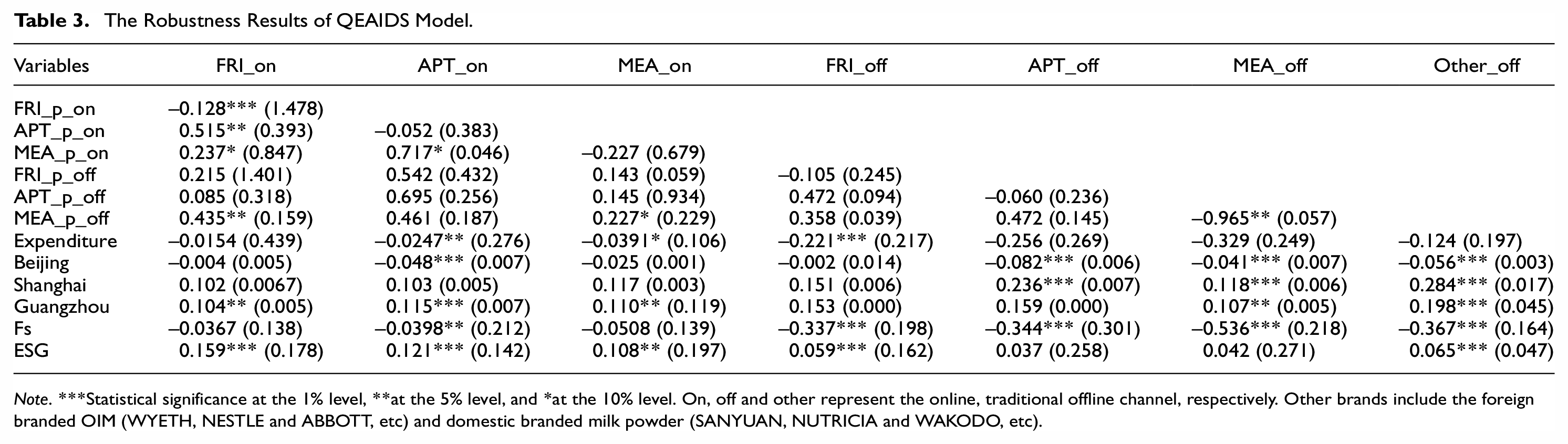
Note. ***Statistical significance at the 1% level, **at the 5% level, and *at the 10% level. On, off and other represent the online, traditional offline channel, respectively. Other brands include the foreign branded OIM (WYETH, NESTLE and ABBOTT, etc) and domestic branded milk powder (SANYUAN, NUTRICIA and WAKODO, etc).
From this table, the coefficient of explanatory variables is significant at the statistical level of 5%. From the whole perspective, consumers’ purchased amount of OIM is negatively and positively associated with the price of corresponding brand and alternative brands respectively, which signifies that own-price elasticity of consumers’ brand selection is less relative to the substitution elasticity of consumers. In addition, the coefficient of substitution elasticity concerning three brands also demonstrates that the substitution elasticity of brand FRI and APT is significant at the significance level of 10%, whereas the corresponding elasticity of brand MEA is insignificant. Furthermore, we notice that the coefficient of online brand is greater than that of offline brand. Similar results is line with the work of Chu et al. (2010) showing that moderate online customers have the greatest brand elasticity of the online channel. What is more, the coefficients of brand selection across channels indicate that consumers have a strong preference for online purchasing channel relative to traditional offline channel, verifying the hypothesis H1a.
Regarding the consumers’ expenditure, we find that the spending of brands is negatively associated with the consumption behavior of brands. Moreover, we also find that the coefficients of income is larger than these of family size. This results are in line with the work of B. Chen et al. (2018) implying that income plays an essential role in consumers’ multi-channel choice of milk products. It should be noted that the online income elasticities are all insignificant compared with the offline income elasticities. This demonstrates that the change in consumers’ expenditure slightly affects the online consumption of OIM, which provides evidence for the sticky online purchase behavior of consumers.
Concerning city variables, we find that consumers in Shanghai and Guangzhou have a stronger preference for branded OIM relative to consumers in Beijing. In particular, The coefficients of city implies that the marketing strategies of OIM have the regional heterogeneity, which is supported by Zheng et al. (2020).
The coefficient of fs shows that household size is negatively associated with multi-channel purchasing behavior of OIM. It is surprising that we do not find evidence to support the finding of a positive relationship between household size and the multi-channel purchasing amount of organic milk (Jonas & Roosen, 2008), which is consistent with the fact that consumers living in a small family tend to purchase basic foods via multi-channel (Dominici et al., 2021). Moreover, the coefficient of fs in different channels evidenced that online consumers show a stickier size loyalty than offline consumers, which is by Chu et al. (2010) is defined as the sensitivity of the change in household size to purchased amount of goods. By comparing the coefficient of expenditure and fs, we also find household size has a larger impact on consumers’ purchasing behavior than expenditure in the context of multi-channel, which is line with the idea of Zheng et al. (2020) showing that household size plays an important role in the online consumption behavior of products, especially for the consumers’ repurchasing retention for basic foods.
In addition, we can also notice that the online market elasticity of FRI, APT and MEA is less than the corresponding elasticity of three brands in traditional offline channel, which shows that the online consumption of OIM is insensitive to changes in consumers’ income relative to the offline purchasing behavior. This is by Pozzi (2012) explained as the fact that brand features reducing the cost of online shopping are a main hurdle to online brand exploration relative to traditional offline channel. Furthermore, the different coefficient of brand implies that the consumers’ multi-channel purchasing behavior relies on the marketing strategies’ design of the different brand which is primarily under the control for OIM producers.
Notably, the coefficient of ESG shows that the ESG rating index positively affects the consumers’ long-term purchasing behavior, which is in line with the work of Olbrich and Holsing (2011) showing that the high market shop ratings on producers increases the likelihood of online consumers’ repeat purchase behavior, that is, online user stickiness. Note that the coefficient of online ESG rating index surpasses that of offline ESG rating index, verifying the hypothesis H1b. This implies that producers should pay more attention to the construction of online ESG rating in order to maintain the consumers’ user stickiness.
The Mechanism Analysis of Online Channel Stickiness
Table 4 reports the results of the mechanism of online channel stickiness. A positive coefficient, at the statistical level of 5%, associated with the online platform stickiness confirms that online business platform accelerates the formation of consumers’ channel stickiness, verifying the hypothesis H3. In the OLS and logit regressions, the coefficient of JD for online platform stickiness is 0.247 and 4.978, respectively. Specifically speaking, the stickiness of other platforms is almost twice as much as that of JD platform, which shows that the majority of consumers have the preference for 1#store, Tmall and Taobao compared with JD platform. At the significance level of 10%, the corresponding coefficient for the market preference propensity of an online platform is significant positive, which demonstrates that the market propensity of online business platform enhances the consumers’ identification of online purchase channel. In particular, the coefficient of market propensity of Taobao is maximal, which shows that consumers have the preference for Taobao platform based on the offline channel represented by overseas shopping. Moreover, the coefficient of market propensity reveals that consumers’ selection of online platform is positively associated with the formation of online channel stickiness, which is confirmed by Hsu and Lin (2016). This implies that producers ought to focus on the design of online platforms and construction of social communities in order to catch the purchasing interest of our customers.
The Mechanism Results of Online Channel Stickiness.
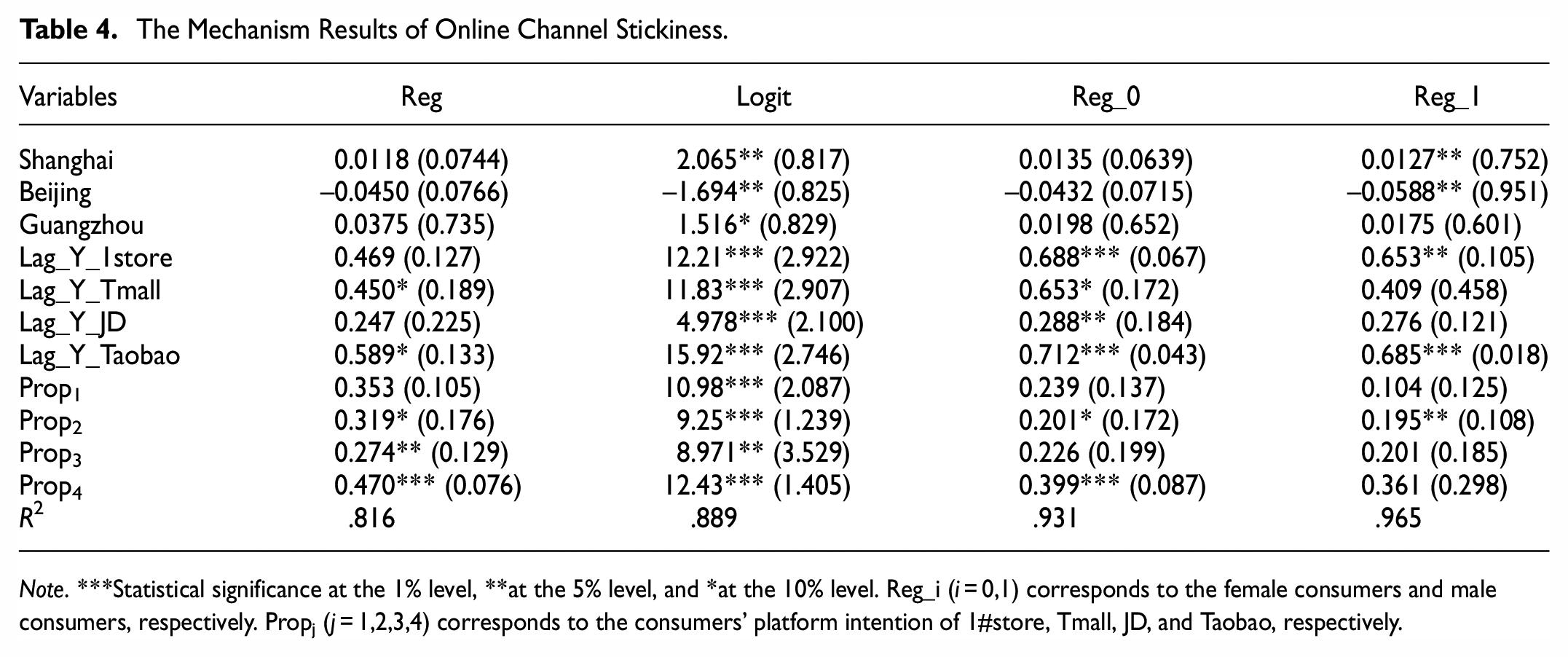
Note. ***Statistical significance at the 1% level, **at the 5% level, and *at the 10% level. Reg_i (i = 0,1) corresponds to the female consumers and male consumers, respectively. Propj (j = 1,2,3,4) corresponds to the consumers’ platform intention of 1#store, Tmall, JD, and Taobao, respectively.
Regarding the variable of city, it can be noticed that the coefficient of Shanghai and Guangzhou is significant positive at the statistical level of 5%, whereas the coefficient of Beijing is negative, which illustrates that consumers in Guangzhou and Shanghai tend to buy branded products via online business platform. Furthermore, by comparing the coefficient of Shanghai and Guangzhou, we find that consumers in Shanghai have the stronger preference for online business platform relative to those in Guangzhou.
In columns (3) and (4) of Table 4, we find that female consumers have the stronger preferences for online channel relative to male consumers. Moreover, the coefficient of city demonstrates that female consumers in Guangzhou prefer to purchase branded OIM via online channel, which by W. M. Wong and Tzeng (2021) explained as the impact of consumers’ organic label awareness and food safety awareness in Guangzhou. From the perspective of the market choice propensity of online platform and online channel stickiness, the corresponding coefficient indicates the preference for Taobao platform and positive relationship between the market choice propensity of online platform and online channel stickiness.
Why Platform Stickiness Induce Channel Stickiness?
The moderating effect analysis of ESG rating index are shown in Table 5. At the significance level of 5%, we find that the coefficients from the second to the eleventh line are positive, verifying the hypothesis H4a. This implies that online platform should introduce the ESG marketing evaluation system in order to establish a good market image and win the majority of customer recognition and trust.
The Further Analysis of Consumers’ Online Purchasing Behavior.

Note. ***Statistical significance at the 1% level, **at the 5% level, and *at the 10% level. ESG rating index is composed of three pillars: Environment Disclosure Score, Social Disclosure Score, and Governance Disclosure Score.
Moreover, by comparing the coefficients of online channel and traditional offline channel, we notice that the ESG rating index of online community helps to increase the consumers’ stickiness degree of online business platform relative to traditional offline channel, which is confirmed by Singh and Malla (2017). It is noteworthy that the ESG rating index of platform has the heterogeneous effect on consumers’ choice behavior. In particular, we also find that the coefficient of the interaction term corresponding to market propensity of platform illustrates the strong positioning of Taobao in the market competition of online platform, which is consistent with the fact that Taobao platform is rated favorite e-commerce platform in China (F. H. Yang et al., 2017). Therefore, as a leader in China’s e-commerce market, Taobao should give play to its comparative advantages in online market, eagerly anticipate the technological innovation and pay more attention to consumers’ needs in order to maintain the consumers’ online channel stickiness.
Interestingly, the coefficient of brand concerning ESG rating index shows the incentive effect of brand values on consumers’ brand online selection behavior (Park & Kim, 2003). Moreover, the coefficient of brand and user stickiness evidence that the product differentiation has an insignificant effect on the consumers’ online selection behavior relative to user stickiness, which is consistent with the fact that the application of reality-enhancing technology enhances the consumers’ decision making and then promote their user stickiness by Pala et al. (2022). This implies that online retailers should enhance the construction of brand virtual community through the reality-enhancing technology in order to maintain purchasers’ user stickiness.
Note that, the coefficients of sub-score demonstrate that Environment score have a more significant positive effect on the online platform stickiness of consumers relative to other sub-ESG scores, showing the importance of environmental characteristics for the cultivation of consumers’ purchasing behavior (Shuai et al., 2014). This is by Liu et al. (2021) explained that technical environmental features increase consumers’ purchase intentions through customer-to-customer interaction and perceived value, implying that producers should enhance the research and development of green production technology in order to increase the online channel stickiness of consumers. Moreover, by comparing the coefficients of S_score and G_score variables, we find that the former surpasses the latter, verifying the hypothesis H4b. This implies that the retailers should focus on the management of reputation carrier and build the industry reputation via the improvement of corporate social responsibility.
Discussion and Implications
By investigating the existing literature, most previous literature focus more on the study of consumers’ preference and willingness-to-pay based on the small sample data of OIM (E. Wang et al., 2019). However, marketing studies on the user stickiness of online shopping behaviors, especially OIM, are emerging (S. W. Li et al., 2019), but quiet limited, especially in the economic and business literature. This research, taking the China’s market of OIM as an example, set out to examine more closely what drives the emergence of user stickiness.
We provide the compelling evidence for the power of user stickiness. Moreover, we find that online platform stickiness has a significant influence on the formation of online channel stickiness. We also evidence the ESG and sub-ESG effect of user stickiness. In addition, we can notice that the ESG effect of user stickiness is more significant in the online channel relative to the traditional offline channel, which confirms the importance of ESG score performance for consumers’ online channel stickiness. These findings provides a new angle of view to re-cogitating the importance of multi-channel strategy in the complex business environment.
Contributions in Method
In prior studies on this model, Krystallis et al. (2010) mainly investigate the impact of consumers’ socioeconomic characteristics and their purchasing attitude on consumers’ buying intention for food products through the consumer discrete choice model. However, the application of user stickiness is seldom discussed by the prior scholars (Benni et al., 2019), especially for the industry of OIM. Thus, we first employ a latent class model to test the user stickiness, which contributes to furthering the understanding of the user stickiness of consumers.
Moreover, due to the importance of ESG rating index for consumers’ online purchasing behavior (Lim et al., 2023), we introduce the variable of ESG into the latent class analysis of online channel stickiness, which can add the deeper understanding of the consumers’ online purchasing behavior. In particular, whether the ESG rating index affect the consumers’ omni-channel purchasing behavior in the China’ s market of OIM is an issue worthy of discuss because the ESG evaluation system will comprehensively reshape the market confidence of consumers (Dai & Zhou, 2016). Thus, we introduce the ESG variables into the QEAIDS analysis of consumers’ omni-channel behaviors to compare the ESG effect of user stickiness in the context of omni-channel.
In addition, because ESG rating index can evaluate the comprehensive capabilities of enterprises dealing with environmental, social or governance issues, we introduce the sub-ESG variable into the mechanism analysis of user stickiness. We evidence that Environment Disclosure Score and Social Disclosure Score have a larger impact on the consumers’ online channel stickiness compared with Governance Disclosure Score. This interpretation is consistent with the notion of environmental factor as a long-term commitment of product quality that values highly (Grimmer & Bingham, 2013), which implies that ESG rating index, as a cue-response associations that are learned by producers, potentially reinforce the consumers’ omni-channel purchasing behavior in the long term.
Furthermore, our findings on the relationship between the online channel stickiness and consumers’ online purchasing behavior lend further empirical support to the power of online channel stickiness, which signifies that online purchasers can accumulate the loyalty of online channel with the increase of online communities spent by consumers. As supported by previous research, our study implies the importance of online community for retailers and producers, perceiving that the construction of online platforms, as the most important information-sharing platform, encourage its members to provide high-quality information in the community, which contributes to forming the belonging and affective commitment of consumers.
Implication for Practice
After the above analysis of user stickiness, we evidence that ESG evaluation system not only helps to increase the consumers’ user stickiness, but also contributes to the improvement of the market reputation of branded products, which provides producers and retailers in the industry of OIM with useful information for devising the marketing strategy of user stickiness and ESG investment.
It is suggested that producers and retailers first examine whether the consumers purchasing branded products have substantiality for repurchase in market analysis relative to sellers’ goal of maintaining the market share. If consumers are loyal to specific brands, brand sellers ought to enhance the market investigation of buyers’ socioeconomic characteristics and implement the marketing strategy aimed at target customer in the context of multi-channel. Moreover, the presence of user stickiness indicates that retailers should exert every effort to maintain and increase the channel stickiness by the improvement of service quality of purchasing channels.
In addition, ESG rating index represents the market value of producers and retailers from the view of corporate ethics, which has a crucial role in the maintainence of user stickiness, especially in the multi-channel purchase of OIM. Thus, to enhance the market competitiveness of e-commerce platform, ESG priority strategy should be effectively implemented by producers. Specifically, due to the omni-channel heterogeneity of ESG rating index concerning household size, the construction of ESG evaluation system should be designed on the base of consumers’ socioeconomic characteristics participating in the purchase of OIM. More importantly, to promote the sustainable development of OIM industry, producers should pay more attention to the construction of Environment Disclosure Score and Social Disclosure Score, and invest more money into the social programs aimed at upgrading the compliance management system aimed at controlling and identifying the compliance risks, product traceability system aimed at integrating product quality into product life cycle of OIM, and environmental and social management system aimed at organic unity between of business interests, consumers’ needs and environmental performance.
Limitation and Future Research
As with any study, this research is not without limitations. First, this research only pay attention to brands FRI, APT and MEA and others including domestic brands, which influences the regression results of brands to some extent. Further study should also extend the research object into OIM with the whole brands; Secondly, we do not examine the mechanism of brand pricing from the standpoint of brand equity. Further study can develop the hedonic regression model of brand equity to analyze the price premium of branded infant milk powder, which contributes to effectively guiding the marketing strategy of producers and retailers. Thirdly, this research only conducts an empirical study on consumers’ online and offline consumption behavior. In the future, we would conduct the game model of consumers’ multi-channel consumption behavior to reveal the formation mechanism of online and offline user stickiness; More importantly, combining with the idea of Tham et al. (2022), the studies of the alternative scenarios concerning the internet and platform-sharing economy can be developed in the future, which contributes to improving the theoretical generalizability of this study.
Supplemental Material
sj-docx-1-sgo-10.1177_21582440231206970 – Supplemental material for What People Talk About Multi-Channel Purchasing Behavior and What They Intend to do: Related Perspective From ESG Evaluation System
Supplemental material, sj-docx-1-sgo-10.1177_21582440231206970 for What People Talk About Multi-Channel Purchasing Behavior and What They Intend to do: Related Perspective From ESG Evaluation System by Jiangyuan Hou, Mingyue Du and Qingjie Zhou in SAGE Open
Footnotes
Acknowledgements
We thank the support provided by Institute of New Commercial Economy, we also thank valuable advice from three anonymous experts.
We thank CTR Marketing Research for collaborating with us on this research.
Author Contributions
Jiangyuan Hou, Conceptualization; data collection; formal analysis; writing—original draft; Mingyue Du, Literature search; writing—original draft, writing—review & editing; Qingjie Zhou, Conceptualization, formal analysis; funding acquisition, supervision, review & editing.
Declaration of Conflicting Interests
The author(s) declared no potential conflicts of interest with respect to the research, authorship, and/or publication of this article.
Funding
The author(s) disclosed receipt of the following financial support for the research, authorship, and/or publication of this article: This study was supported by Beijing Commercial Development Research Center [No. JD-YB-2022-055] and the Key Program of National Social Science Foundation of China (No. 21ATJ007).
Ethics Approval Statement
Not applicable.
Permission to Reproduce Material From Other Sources
No.
Supplemental Material
Supplemental material for this article is available online.
Data Availability Statement
The data that support the findings of this research are available from CTR Market Research CO. Ltd with permission. Restrictions may apply to the availability of these data, which were used under joint agreements between the authors and CTR Market Research CO. Ltd.
References
Supplementary Material
Please find the following supplemental material available below.
For Open Access articles published under a Creative Commons License, all supplemental material carries the same license as the article it is associated with.
For non-Open Access articles published, all supplemental material carries a non-exclusive license, and permission requests for re-use of supplemental material or any part of supplemental material shall be sent directly to the copyright owner as specified in the copyright notice associated with the article.
