




Abstract
This paper aims to identify and categorize the factors influencing consumer goods’ value into ecological and economic dimensions and subsequently compare them. The analysis employs the Allegro Reviews (AR) dataset, comprising post-purchase product reviews, with a focus on a sample of 1,400 randomly selected reviews from a pool of 10,615 comments. Through this examination, distinct influencing factors are identified, categorized as either ecological or economic, and their frequency of reference in online reviews was compared. The research findings show that consumers consistently address economic dimensions in their reviews. Notably, emphasis is placed on goods’ quality, pricing, and the price-quality relationship. On the other hand, ecological aspects receive limited attention in reviews, suggesting their lesser significance to consumers compared to economic considerations. This study’s implications for theory and practice indicate that companies should prioritize economic aspects in their value creation endeavors, relegating ecological factors to a secondary role. However, from a global standpoint, enterprises must incorporate ecological dimensions during the value creation process to avert environmental degradation, which could otherwise undermine overall societal quality of life. In terms of originality and value, this research diverges from typical consumer choice studies that rely on questionnaires. Instead, it analyzes actual post-purchase product reviews, providing insights into tangible elements contributing to goods’ value, thus bypassing reliance on mere declarations.
Plain Language Summary
This paper focuses on what influences people when they choose products. It focuses on comparing the impact of economic and ecological aspects. The study uses a dataset of reviews called Allegro Reviews (AR), examining 1,400 randomly chosen reviews out of 10,615. The findings reveal that consumers mostly concentrate on economic factors like quality and pricing in their reviews. On the other hand, ecological factors get less attention. The study suggests that companies should prioritize economic aspects in creating value, while still considering ecological concerns globally to protect the environment. The research is unique because it analyzes real product reviews instead of relying on surveys.
Keywords
Introduction
Value creation of a good is the core element of creating consumer usefulness. This constitutes a central aspect in supply-side operations, as the provision of useful goods ensures demand for them. However, when evaluating a company’s activities in meeting stakeholders’ expectations, the primary focus should be on prioritizing value creation (Mahajan, 2020). As value itself is a subjective term, and the creation of value is certainly a complex process. Value is linked to the notation of utility, making it evaluated on the basis of particular perspectives. Consequently, due to the personal nature and dependence on individual preferences and expectations, the value of a good may be perceived differently by various stakeholders (Oliveira & De Muylder, 2012). Consumers’ subjective opinion about the good should be considered the most while discussing value. Entrepreneurs must know and understand what consumers desire, not what they appear to want. This implies that the same good may carry different value in the perspective of the good recipient, which is reflected in the emergence of distinct market segments (see: the concept of “perceived value”; Minerbo et al., 2023; Sánchez-Fernández & Iniesta-Bonillo, 2007).
Furthermore, the value of a particular good is tied to both the set of functional characteristics it possesses as well as the perceived features (Pitelis, 2009). While the consumer is making a choice, they pay attention to the qualities of the good actually used, but also consider those potentially necessary to satisfy their needs. It should be indicated that a single need can be satisfied using a variety of goods, but greater value can be placed on goods that are not more capable of fulfilling a need, but are coherent with the consumer’s lifestyle and convictions (Burgiel et al., 2015). For example, consumers living an eco-friendly lifestyle gain a greater value from consuming “green” (eco-friendly) goods.
Currently, ecology is a popular trend among consumers and enterprises, as it aligns with the narrative of sustainable development promoted and implemented by international organizations. Many consumers lead an eco-friendly lifestyle and attempt to make sustainable choices, mainly by purchasing and consuming green goods. This makes the issue of sustainability one of the leading trends in consumer decision-making, expressed, among other things, by selecting products that minimize environmental impact. The eagerness to embrace the ecological aspect is being pursued by enterprises because they are the ones expected to be sustainable (Kubiczek & Hadasik, 2022; Müller & Voigt, 2018).
The sustainability dimension holds significant importance to consumers when making product choices (Buerke et al., 2017). The trend prompts consumers to consider sustainability as a significant determinant of their choice. There are a series of studies exploring the significance of ecology as a factor of consumer preferences. Joshi and Rahman (2017) investigated the determinants of sustainable purchasing behavior, as well as perceived knowledge regarding sustainability issues and environmental concern. Paswan et al. (2017) researched attitudinal determinants of environmentally sustainable behavior. They also state that if individuals find joy in nature, believe in balancing humanity and the environment, and expect immediate benefits from conservation, they are more likely to engage in various levels of environmentally friendly actions. Steg et al. (2014) further created a framework designed to foster pro-environmental behavior based on the concept of values, among other things. However, traditionally it is the economic aspects that are the most considered while discussing the purchase of goods. Even when reflecting on sustainability, the economic aspect of goods is often brought into comparison. For example, Kulshreshtha et al. (2019) took economic aspects into consideration in their research, finding that some consumers are inclined to pay more if the product is environmentally friendly. Consumers perceive green goods as having greater value (de Medeiros et al., 2016), and their perceptions toward green goods or arrangements (along with their preferences around them) are changing due to social influences from their surroundings (Axsen et al., 2013).
While there are a number of studies on the elements of expectations, preferences and choice of goods, most of them are based on survey questionnaires, that is, on statements/declarations rather than actual behavior. For example, McNeill and Moore (2015) investigated sustainable choices in fashion by surveying consumers in the main shopping high street of one of New Zealand’s cities, or Grilli et al. (2021) administered a survey questionnaire to residents of the United Kingdom, researching tourist preferences for sustainable tourism development in Small Islands Developing States. However, oftentimes survey respondents strive to present themselves in a more positive light than reality (e.g., posing as more eco-friendly than they actually are), thus creating an attitude-behavior gap. Numerous studies showed that stated intentions (declarations) are not reflected in real actions (such as purchase behaviors). For instance, Wiederhold and Martinez (2018) researched the attitude-behavior gap in Germany, contributing to overall understanding of the gap, while Dirzyte and Rakauskiene (2016) revealed that even though green consumption might be perceived as an important influencing facet, it will not necessarily affect consumers’ real actions. This indicates that the subject of expectations of ecological qualities and their satisfaction by products available on the market is still under-investigated, as consumers’ real choices are rarely taken into consideration.
The aim of the paper is to identify the factors that impact the value of goods for consumers, allocate them into ecological or economic dimensions, and subsequently compare each of them. Instead of using a survey questionnaire, as in previously mentioned studies, this research is anchored on the analysis of consumers’ real behaviors, based on the product reviews. This prevents the emergence of an attitude-behavior gap, as only the post-purchase behavior is under scrutiny. This study focuses on examining the value dimension in consumers’ choice, using post-purchase reviews—online comments on products actually purchased by Internet users. Such comments reflect the authentic post-purchase experience involving the realization of their expectations and needs by the product.
Literature Review
Value Creation: A Resource-Based and Innovation-Driven Approach
According to Peter F. Drucker, satisfying customer needs is the primary objective of an organization (Webster, 2009). Therefore, products offered by the enterprise are intended to satisfy the consumers’ needs. When formulating an offer, an enterprise must consider the diversity and multifaceted nature of consumer needs. The greater use value of products, which manifests itself in more effectually satisfied consumer needs, provides an opportunity to generate profits from their sale being the result of value creation by the company (Terho et al., 2015). The products that a company offers need to possess value so that the enterprise may serve as a successful market player, generate above-average profits and build a competitive advantage, helping to determine the company’s market position (Sahaidak et al., 2017). Consequently, value creation is key to attaining strategic success being one of the most important tasks of strategic management (Dyduch, 2021; Tantalo & Priem, 2016) and a driver of achieving competitive advantage (Othman & Sheehan, 2011).
Researchers’ stances discussing the concept of value creation are deliberated from the perspective of the resource-based view. Value is created on the basis of resources that are valuable, rare, and difficult to substitute or imitate. It is the difference between the highest value that a marginal user is able to pay for a product and the lowest selling price of the required resources (Dyduch & Bratnicki, 2015), and therefore stems from the best possible use of resources. Value creation considered from a resource perspective is most commonly tied to the innovation construct (Dyduch, 2021; Urbanowska-Sojkin et al., 2007, p. 216). The subjective comprehension of value leads innovation research (in the value creation context) to focus on investigating how an organization and its stakeholders act together in order to create value in a sustainable and mutually desirable way (Bacq & Aguilera, 2022). Amidst the management of the value creation process, there is a significant challenge to motivate stakeholders to cooperate, even in the face of ongoing problems, that is, scenarios in which stakeholders might be inclined to prioritize their individual interests above enhancing joint value generation (Bridoux & Stoelhorst, 2022). The essence of value creation requires revised governance mechanisms (Bacq & Aguilera, 2022), as there is a multi-pronged relationship of consumers toward the value creation process. Consumers continually participate in value creation, as they co-create value with companies and other stakeholders (Nadeem et al., 2020).
In the majority of management studies centered around the strategic stream, the aforementioned aspects are viewed together to form the concept of “value creation – value capture” (VCVC). Dyduch et al. (2021) stated that “even the most valuable and useful innovations will not translate into performance if innovative organizations are not able to capture a proportion of the value.” When value is created, the process usually goes hand in hand with value capture (which is desired by the company), making the groundwork for the VCVC concept inherent. The VCVC concept, being based on the creation of new products and services, is fostered by modern business models, which represent a framework of interdependent activities and processes. They provide an opportunity to seek instruments and ways to achieve competitive advantage, as well as to the very establishment of a combination of resources capable of generating value, through the exploitation of business opportunities (Amit & Zott, 2001; Sjödin et al., 2020). Additionally, new products and services, as well as novel means of production, distribution or marketing, while being sources of value creation (Rudny, 2013), enable the enterprise to enter new market sectors. Existing products are being adjusted to emerging trends, resulting in an increase of their value (Walter & Ritter, 2003). The VCVC concept coincides with the Triple Bottom Line (TBL) idea that organizations have a significant socio-environmental impact. At the core of the TBL concept, instead of one bottom line, there are three: people, profit and planet, and this framework evaluates companies’ performance from a broader perspective, thus creating greater and more accurate business value (Hussain et al., 2018; Slaper & Hall, 2011). It is noted, however, that TBL in its current form is proving insufficient to encompass sustainability notation, and it is recommended to advance the discussion on this topic (Tseng et al., 2020).
Consumer-Centric Value Creation
Customer and consumer value are interrelated, as customers purchase offerings so consumers can produce value by means of them (Jensen, 1996). With regard to this matter, the term “customer” is employed as a synonym for consumer or user throughout this paper. Customer value, according to Kotler and Keller (2021, p. 168), is “based on the difference between benefits the customer gets and the costs they assume for different choices.” They supplement the definition with the note that customer value is characterized as the customer’s feeling of being benefited, and having received a service in excess of what they paid. This is because payment does not only have a price dimension (cash, interest or payment), but is also considered in non-price terms, accounting for time, energy or inconvenience, among others. Benefit considerations, on the other hand, consist of all the virtues of a product, including its quality, the services provided, and the experience of using the product (Mahajan, 2020). Vargo et al. (2008) differentiated value definition as consumer’s perception about goods or services utility (used value) or the amount that consumers are ready to pay for goods or services (exchange value). Notably, each of these definitions incorporate the economic dimension of value.
Consumer value represents a pre-purchase judgment (consumer’s evaluation at the time of purchase), which is determined by consumer’s perception (Potra et al., 2018; cf. Woodruff & Gardial, 1996). Consumers’ judgment about value is also affected by their benefit and risk perception (Hu et al., 2023, p. 10). Ulaga and Eggert (2006) defined consumer perceived value as a benefit’s and cost’s trade-off which follows Levitt’s (1960) position that a product carries value only when it pleases some consumers.
Consumer value research focuses on the concept of costs and benefits (Payne & Holt, 2001), but also on the feelings of preference, with an emphasis on the experience-expectation relationship (Holbrook, 2005). An intrinsic trait in consumer value is subjectivity (Kawa et al., 2019), as different consumers’ perception of the same product might be different. It is notable that during the use of a product/service, the value may change. The value to the consumer can be discerned at different stages of the customer journey, that is, during the intention to purchase the product/service, the actual purchase, installation or commissioning, and in some cases during resale. The value perceived by the consumer fluctuates as the consumer’s needs change (Mahajan, 2020).
Value is a strategic category in organizational operations. Both its creation and capture determine the efficacy of management and utilization of resources, and thus translate into a competitive position in the market (Dyduch et al., 2021). Reflecting value from the perspective of the organization itself is synonymous with value for its stakeholders, since the organization operates in a particular environment. It is imperative to acknowledge consumers as key stakeholders, which is in line with Nam and Hwang’s (2019) approach (cf. Frynas & Yamahaki, 2016; Hörisch et al., 2014; Montiel & Delgado-Ceballos, 2014). In this regard, it should be stressed that value is a subjective category, and therefore depends on the expectations of individuals.
Enterprises need to be prepared for the changing dynamics of consumer preferences, expectations and the emergence of new trends. Such expectations or preferences can be affected by media communication and promotional efforts (Hidayanti et al., 2018). If a certain attribute is promoted more prominently, it might contribute to the development of expectations, as seen in the case of environmental values. Consumer value creation is a central marketing concept that has been the subject of a number of studies (Kumar & Reinartz, 2016; Payne et al., 2017; Smith & Colgate, 2007; Xie et al., 2016). Addressing and accommodating consumer expectations and preferences is a critical task for marketers, specifically when developing new products and services or establishing new organizations (Smith & Colgate, 2007), as it offers substantial benefits for the company. For instance, consumer value creation increases loyalty, market share and performance of the company, which leads to higher profits for the enterprise. It also enhances consumer satisfaction and favorable consumer experience, which in turn creates value for the consumer (Mahajan, 2020). Hence, companies and consumers co-create value. Consumer-oriented value creation is coherent with the major task of modern strategic management, which is identified as seeking sources of value and fostering the organization to deliver above-average results (Tapaninaho & Heikkinen, 2022).
Smith and Colgate (2007) presented a practical framework for understanding the whole process of creating value for consumers. They explained that their approach was strategic, because it aimed at finding the types of value that could make the offerings stand out, rather than listing all the possible benefits and costs that consumers might perceive. Their framework identifies five main sources of value: information, products, interactions, environment and ownership, which are all related to the core processes of the value chain. It also pinpoints four types of value that can be engendered by organizations:
functional/instrumental value—the extent to which a good (product or service) possesses desirable features, is beneficial, or fulfills an envisioned function;
experimental/hedonic value—the extent to which a product provides acceptable sensations, feelings, and emotions for the consumer;
symbolic/expressive value—the extent to which consumers attribute psychological meaning to a product;
cost/sacrifice value—associated with transaction costs.
This framework is coherent with one presented by Pitelis (2009), who placed value in the center of his VCVC framework. According to him, value can be understood with a perceived set of utilitarian advantages. As value has many aspects, it began to be recognized that value creation must enable not only economic, but also environmental and social benefits (Tapaninaho & Heikkinen, 2022). The idea of VCVC has begun to be promoted in these contexts to advance the goals of sustainable social development (Bocken et al., 2018; Boons & Lüdeke-Freund, 2013).
Various management theories emphasize the value creation by involving stakeholders, among which consumers hold a significant position (Frynas & Yamahaki, 2016; Montiel & Delgado-Ceballos, 2014). Such theories examine the relationship between an organization and its stakeholders to create value for sustainability. In order to address sustainable development-related issues, it is necessary to identify stakeholder interests in the field and use them to create common interests, with consumer being the key stakeholder (Hörisch et al., 2014).
To confront sustainability challenges, Hörisch et al. (2014) proposed linking educational, regulatory and value creation schemes precisely. These mechanisms aim to: (1) reinforce stakeholder attitudes toward sustainability, (2) create mutual interests in sustainability based on specific sustainability interests, and (3) empower social stakeholders to act as intermediaries on behalf of the common good, which is the environment. The framework presented by Hörisch et al. (2014) allows the value of sustainability to become a source of mutual interest for all stakeholders. By using this sustainability management approach, it is possible to find out which stakeholders are the most important to promoting corporate sustainability and thus need to engage in a specific business context.
In turn, Houssard et al. (2022) analyzed the concept of shared value to achieve sustainability goals. In their work, the notion of eco-efficiency is introduced, which is defined as “environmental performance of a system is a function of its value.” In the light of this, the trade-off between the environment and value creating interests should be detected. They also state it is key to perform a paradigm shift in the value creation toward sustainability, as well as to focus more on integration and cooperation of the stakeholders within the value chain rather than individual goals and competition. As the importance of sustainability rises, businesses are compelled to place greater emphasis on it, aligning with the preferences of an ever-growing environmentally aware consumer base. Their failure to do so can lead to a competitive disadvantage. Consumers perceive value in sustainability and actively engage in co-creating it with suppliers and other consumers (Lacoste, 2016).
Expected and Realized Value—Consumer Choice and Post-Purchase Experience
Consumers are faced with an overwhelming array of choices when it comes to purchasing products and services. Every day they are constantly making decisions that shape their buying behavior. With each decision, consumers evaluate the value of a product or service and compare it with offerings from competitors. Gaining insight into how consumers perceive and assess value is crucial in comprehending their purchasing choices (Stankevich, 2017). As understanding the consumer decision process is pivotal for academics and businesses, many scholars propose an array of consumer behavior models. These models allow us to gain a deeper understanding of why individuals choose certain products or services, what are their underlying values and preferences they consider while making a choice, how they evaluate alternatives, and what factors ultimately drive their final purchase decisions.
Consumer behavior models are simplified representations of actual behaviors, designed to exemplify the relationships between various elements of the process. Alan R. Andreasen put forward the first consumer behavior model in 1965, where he suggested that information reaches the consumer right after being filtered (Burgiel, 2010, p. 221; Friedman, 1988; Reina Paz & Rodríguez Vargas, 2023). This influences their opinions, emotions and attitudes. Since then, research on consumer behavior experienced substantial advancement, resulting in the emergence of various models, which continue to be utilized presently and are even altered to suit current situations. For example, Srivastava et al. (2021) propose a model on channel attributes of online and offline shopping channels based on the EKB model. Conversely, Juan et al. (2017) advanced a framework based on the Howard–Sheth model to identify behavioral factors that may affect consumer purchases of green buildings.
The most commonly encountered models of consumer behavior include Nicosia’s model, Howard-Sheth model, and Engel-Kollat-Blackwell model (EKB). All of them focus on the individual’s decision-making process, particularly how and to what extent a consumer derives value from their choice. Table 1 presents a utility of these frameworks in explaining specific aspects of consumer behavior. Displayed models in this table are commonly mentioned in academic literature, as they thoroughly illustrate various aspects of consumer behavior. They are also based on facts, and while being logical and original, these models explain how and why consumer behaviors emerge, provide predictive capability, have heuristic power, and are verifiable (Burgiel, 2010; Friedman, 1988; Reina Paz & Rodríguez Vargas, 2023).
Comparison of Selected Consumer Behavior Models.
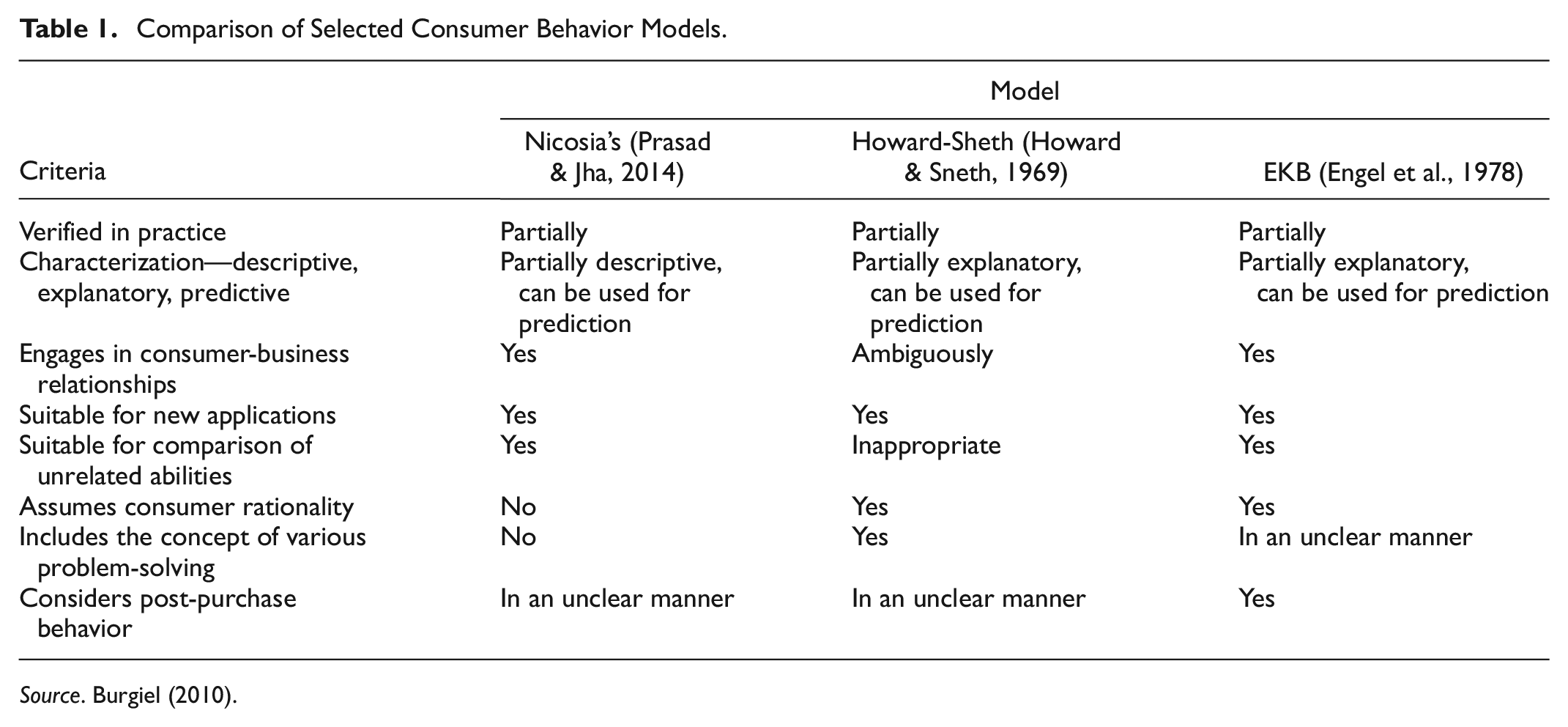
Source. Burgiel (2010).
While the selected consumer behavior models do not explicitly include ecology or green choices as determinants, external influences in these models encompass social and cultural factors, which can potentially comprise ecological or environmental considerations. In practice, consumers’ growing awareness of sustainability and environmental issues may affect their attitudes, perceptions, and ultimately their decision-making process (Panda et al., 2020). Incorporating ecology and green choices as determinants within the framework of these models would require expanding or adapting them to account for these factors explicitly. Fundamentally, these three models reckon various factors having an impact on consumer purchase decisions. Nicosia’s model focuses on the relationship between the enterprise and potential client, stating that companies and consumers are connected and impact each other (Prasad & Jha, 2014). Howard-Sheth model distinguishes three tiers of learning which describe problem-solving abilities of consumers. Thereafter, it extensively explains purchase behavior, dividing it into four constructs—“input,”“perception and learning,”“output,” and “exogenous variables” (Howard & Sneth, 1969; Prakash, 2016). The EKB model places particular emphasis on consumer information handling during decision-making process, differentiating five levels of purchase process: recognition of the problem (in the form of the need), search for information, evaluation of alternatives, buying decision and consequences of choice, including post-purchase evaluation (Engel et al., 1978). In this model, there are two types of consumer post-purchase impression: satisfaction (when expectations are met or exceeded), and dissonance (when doubts regarding the purchase arise or when expectations are not met). A satisfied consumer might show loyalty toward the store or product, or even recommend the purchased product to others. However, a dissatisfied consumer acts differently and seeks to reduce the dissonance (Łysiak & Gąsiorowska, 2016). Nowadays, consumers are able to leave comments on e-shops’ webpages, which are a form of product/store review and exhibit the consumer satisfaction or dissonance.
Methodology
Determining the expected dimensions of the created value of goods from the perspective of consumers is possible using various research methods, the most popular of which is a survey questionnaire (Babbie, 2021). On the other hand, topping the assumption to compare the realized value along with the expected value considerably hinders the research process, since the consumer must be the actual owner of the good and also exploit it. The examination of actual data regarding post-purchase behavior complements previous studies, which exclusively relied on survey responses. Furthermore, the consumer as a body of research must be observable, that is, within reach of the researcher, so that the examination shall be performed. Allegro Reviews (AR) dataset prepared and provided by Rybak et al. (2020) fulfilled these conditions and allowed us to conduct the investigation on the basis of factual value from the consumer perspective. As the originators of the AR dataset have initially used it to test the sentiment analysis, this raw dataset was utilized in this study to achieve a different, more consumer-oriented, goal.
AR dataset consists of product reviews made by customers of Allegro, the largest auction portal and marketplace in Poland, being one of the major e-commerce backbones in Central and Eastern Europe. Reviews on this portal were written in Polish and could only be issued by actual buyers, hence the reviews originate from legitimate product users. Since the analyzed dataset comprises solely reviews without any supplementary information on the characteristics of Internet users (e.g., socio-demographic), it is not feasible to verify these characteristics per dimensions. Nevertheless, as Allegro is the largest and dominant player in the Polish e-commerce market, both in terms of the share of real users and the number of products offered (Erling, 2022), it is reasonable to treat it as a reflection of the national e-commerce market and its active participants. The pattern of selection of comments was not predefined, so it has certain aspects of randomness. Moreover, the reviews are not related to a specific group of goods, so it can be presumed that they reflect the general expected and realized dimensions of the created value of goods.
The AR dataset is composed of three subsets: train, test and dev, consisting of 9,577, 1,006, and 1,002 observations, respectively. Besides the review itself, the dataset includes an overall product rating on a scale of 1 to 5 (where 1 means the lowest possible rating as perceived by the customer, and 5—the highest possible rating), albeit not relevant to the qualitative nature of this study. Moreover, various socio-demographic characteristics may affect this rating, but as we are unable to possess them, this aspect was not taken into account. Since the purpose of this study is not to implement an econometric model, these three subsets reasonably could have been consolidated into one. In order to preserve the quality of the study, we have imposed an exclusion criteria of eliminating reviews with less than 50 words, as according to the recommendation of Rybak et al. (2020) such short reviews are not capable of capturing their context. After applying the filter, 10,615 observations remained.
The analysis was performed on a simple random sample (Fan et al., 1962) of 1,400 reviews from a pre-filtered dataset of 10,615 comments. Applying survey sampling assumptions allowed for drawing conclusions about the entire dataset. While this dataset may not encompass all comments, it serves as a lens into expectations of Poles regarding products, and as such it can provide insights into certain trends. This approach differs from the methods used in the literature so far and complements previous research conducted by other scholars using different methods.
Based on a survey by Sobocińska et al. (2022), it appears that Poles consider both economic and environmental aspects in their purchasing decisions. Our study, in turn, aims to examine post-purchase aspects, but in order to maintain consistency and a point of reference with respect to the work of Sobocińska et al. (2022), it was decided on the basis of reviews to identify and assign comments in these two fields. It is critical to be aware that the review dataset may be characterized by asymmetry, as there are typically more negatively charged reviews than positively charged ones (Dimensional Research, 2013). Negative comments are also more influential in shaping consumer behavior (Craciun & Moore, 2019; see more in: Filieri et al., 2019). If certain aspects emerged in comments (either positively or negatively), it indicated their significance with respect to the realized value compared to expected value. Consequently, the study’s purpose determined their classification into two core dimensions: ecological and economic.
The analysis with the utilization of a classificatory algorithm will not provide a fully correct classification due to, among other things, a notable number of spelling errors, punctuation errors and typos among the comments, which affected the unreliability of the adopted algorithm. Hence the decision was made to assess the context of the review and their assignment to an economic or ecological dimension. Of all the comments drawn, 12 were removed because they did not substantively relate to the product purchased. For the most part, the remainder of the reviews mainly addressed product quality and price, as well as the price-quality ratio.
Results
Comments relating to quality were related to the consistency of the product description with reality, and therefore its realization of expected values. The use of the word “quality” was also linked to the description of the actual characteristics of the product, as well as the assessment of its originality. The issue of questioning the originality of a product arose when it did not meet expectations, for example, there was poor workmanship or lack of interoperability with original components (both in the case of software and physical products). However, it is vital to mention that some comments highlighted that despite the product being likely not original, it still performed admirably, contributing to the overall satisfaction of owning it.
Reviews in which attention was paid to the price aspect referred to a comparison with the offering of the same product in other stores—both stationary and online. Comparison of the price of other products to the purchased one was linked to the thread of quality, for example, “after equipment several times more expensive than the cheapest one, I expected better quality,” or “very poor price-quality ratio.”
Quite often, attention was paid to the esthetics of the product, including the materials used (which, at the same time, often referred to quality, so the emphasis was on the solidity of workmanship). Esthetic qualities were emphasized in a significant part in those reviews whose expectation was to “look nice,” which was particularly applicable to various cases, especially phone protective cases.
It is worth remarking on the aspect of frequency of attention in the reviews to the aspect of energy efficiency (i.e., energy consumption, or battery endurance), as the incidence of comments addressing this point was low. Assessing this aspect, taking both ecological and economic dimensions into account, presented a complex challenge. The ecological dimensions focused on mitigating the environmental impact by using less electricity, while the economic aspects were centered on longer use of a product without recharging (in terms of cost expressed in money or time). However, a significant proportion of comments relating to minimizing energy consumption were concerned with lowering the economic cost of use rather than environmental concerns. There was only 1 review qualifying for the environmental dimension, which was “good washing machine, especially for its energy efficiency (…).”
With regard to esthetics, attention was paid to the product’s packaging or lack thereof. It is noteworthy that the packaging of a product can also be an aspect of meeting environmental expectations, for example, the use of recycled or biodegradable materials. Only one comment referred to this aspect as well, sounding as follows: “(…) packaging in an ecological carton is not a bad idea (…).”
In the broad view of values in the ecological dimension, only one comment referenced the product’s ability to realize the expected ecological behavior: “I drink a lot of water and for ecological reasons I decided to buy a water pitcher to reduce the production of plastic.” Additionally, none of the comments referred just to ecology, but also combined the other economic aspects discussed. Thus, it is reasonable to conclude that the ecological dimension of value is far less important to consumers than the economic aspect.
On the basis of the qualitative analysis of the reviews conducted from the perspective of consumer value, its individual components were listed, which were classified into the two dimensions considered: ecological and economic. The results are presented in Table 2. Comments have been modified to address spelling mistakes and typos.
Examples of Product Reviews Derived From Allegro Website With Assignment to Ecological and Economic Aspects.

Source. Own elaboration.
Note. The comments were translated from Polish to English by the authors.
Discussion
The results of the analysis of e-buyers’ comments for products indicated the variety of aspects that consumers pay attention to. The classification of economic and environmental dimensions is applicable, however what stood out as the core observation of this work is the scant frequency of reviews addressing the environmental dimension. Moreover, in each of the analyzed comments, the ecological dimension does not appear alone, but always is accompanied by another economic one. The results are strongly supported by a study conducted by Mazurek-Łopacińska et al. (2022) revealing that consumers place significantly greater importance on personal (egoistic) reasons for product usage rather than altruistic ones related to the common good, such as the planet, climate, or environment. The outcomes are also corresponding to research findings of Buerke et al. (2017), who lay an emphasis on the fact that egoistic values negatively affect environmentally friendly behaviors. The study of Sobocińska et al. (2022) revealed that environmental awareness of consumers is an insufficient condition for the development of sustainable consumption, as consumption depends on many factors, with economic aspects often taking precedence. This is in line with our research findings, as consumers rarely mention ecological factors, focusing on price as an important criterion considered in their post-purchase reviews.
Economic Drivers in Consumer Product Choices
Egoistic and altruistic reasons for product usage are represented by various product aspects that consumers pay attention to when they choose and use a purchased product. Primarily, these are significant drivers that affect the immediate feelings of using a product, whether it is a physical product or software. The main aspect that consumers take into account is the product’s quality, however, in the case of physical products, consumers distinguish between factors concerning workmanship (i.e., relating to the quality of manufacturing), and factors concerning usability (i.e., relating to the functionality of the product in everyday use). In addition, emphasis is also placed on the price aspect, which is often compared in relation to overall product quality. This confirms the observation, and is in line with research by Mazurek-Łopacińska et al. (2022) that Poles show a greater commitment to satisfying their own needs rather than engaging in environmental conservation, as should be a matter of public interest.
In addition to the most frequently indicated economic aspects of product quality and price (as well as price-quality ratio), customers also pay attention to other factors classifiable to this dimension. Among them can be listed the authenticity of the product, which manifested itself, inter alia, in attention to whether the product is not a counterfeit. This side also emerged in relation to software (or electronic products) and the aspect of its usability quality, since customers remarked on the lower compatibility of non-original software or hardware with their currently owned products.
Bloch et al. (2003) observed that product esthetics hold significant importance for customers when making decisions. Esthetics are a matter of personal perception, yet considerably impact the experience of using the product. This is a category that is less objective than workmanship, and due to its personal measurement cannot be classified as “product quality.” Linked to this is also another axis that consumers pay attention to, namely brand reputation. Despite the fact that this is a more objective category than esthetics (but not entirely), it is important to keep in mind that an individual consumer may have varying experiences toward a brand, endowing it with different levels of trust. This can also shape personal feelings toward a product and influence a given purchase decision (e.g., a consumer may not purchase a given product due to a personal low level of trust toward the brand, even though it has an established reputation). From an economic aspect, customers also ponder after-purchase care, mainly in the form of an extended manufacturer’s warranty, but this aspect is not often itemized in reviews.
Ecological Considerations in Consumer Choices
Customers also take note of environmental aspects, but the results of this study indicate that comments touching on this aspect are in a distinguished minority. What is emphasized from the environmental side is the sustainable packaging of the product. Here, it is essential to differentiate that customers are concerned with how the product is secured in transit (labeled as the “wrapping” aspect), which is not related to the sheer eco-friendliness of the packaging in which the product is contained (labeled as the “packaging” aspect). The former aspect should be attributed to the economic dimension, given how it contributes to further personal impressions of the product’s use (without regard to the environmental care aspect). Another green characteristic which is important to consumers is energy efficiency. This, however, may flow from egoistic motives of cost savings from reduced energy consumption, as Perlaviciute and Steg (2015) also point out. It is noteworthy that only one comment referred to the consumer’s personal beliefs, which stemmed from their environmental awareness and desire to contribute to the mitigation of negative climate effects by reducing plastic use.
The phenomenon of not paying attention to green aspects in the purchase and post-purchase process is thus noticeable at least among Polish consumers these days, as the studied dataset (Rybak et al., 2020) is relatively new and dates back to 2020. Despite the fact that Poles rate their attitude toward the environment as positive, it should be highlighted that consumers frequently make decisions that are not optimal but merely gratifying with the least amount of work (cf. Thøgersen et al., 2012). To encourage consumers to adopt the desired green activity, their perceived benefit-cost ratio must be considerably greater than that of other options (Gleim et al., 2013). Poles regard the monetary aspect of their choices, and when it comes to ecologically sound products, the challenge that most inhibits their consumption is the excessively high price (Hermaniuk, 2018). This is due to the fact that Poles have insufficiently shaped ecological awareness (Kubiczek et al., 2023), which translates into making decisions with little or no environmental consideration. On the other hand, scarce information about green products effectively retards the expansion of the market for sustainable products, making them less attractive to the consumer (Chekima et al., 2016).
It is noted that sustainability stability can be achieved through the use of current market mechanisms, including—under the framework of consumerism—“promotion of aspirational green lifestyles and products” (Diprose et al., 2018). This can be referred to the desirable phenomenon of green consumerism, which is accomplished through the final purchase of a sustainable good, being effectively influenced by, inter alia, environmental commitment or perception of eco-products (Chekima et al., 2016; Hojnik et al., 2020). Attention should also be paid to the influence of culture and demographic factors on the “consumers’ degree of greenness” (Chekima et al., 2016). It is therefore recommended that attention should be paid to disseminating the information more widely among Poles to influence their perception of green goods, making them more inclined to make green purchasing decisions.
Concluding Remarks
In economic terms, the value of a good is equated with its utility, that is, the ability to satisfy needs. Consequently, the goods supplied should incorporate the expectations and preferences of consumers, and their prior identification allows them to optimize the use of resources at the disposal of the enterprise. Companies engage in a range of marketing activities, including market research, to comprehend the values that drive consumers and improve the fit of product offerings to their needs. It merits noting that the measurement of value is an outstandingly complex category due to, amongst other things, its distinct constituents and consumer preferences. One of the approaches employed is post-purchase evaluation, that is, the side-by-side comparison of expectations about a good with its utility.
The research carried out revealed that consumers touched on the economic dimension in all reviews, in particular they drew attention to the quality and price of the goods. Findings, based on the review exploration, show that the environmental aspects were barely mentioned in the dataset of reviews. This suggests, albeit ambigously, that the ecological dimension may not be the primary basis for product value among Poles. However, this hypothesis still requires further examination in additional research. From a micro perspective, it is reasonable to conclude that companies should focus only on economics, leaving aside ecological aspects, for it is the basis of value creation. Viewing from a macro perspective, companies’ activities occur in the environment, including the regulatory environment, which often necessitates accounting for the ecological dimension. This is because it is salient, as failure to include it in the long term would result in the degradation of the environment and thus the deterioration of the quality of life for society as a whole.
The analysis provided other practical conclusions as well. The low reference to the ecological dimension in the reviews enables us to conclude that Polish consumers do not have expectations in this respect. This stems from the low environmental awareness of Poles, because if it were significant, they would highlight it in reviews. Consequently, it accentuates the urgency of taking further steps for environmental education.
The research process itself showed the limitations of the original scheme of investigation. Above all, the diversity of aspects raised in the comments did not unequivocally determine the classification in the economic and ecological measurements, which translates into the inability to apply any algorithms, and the entire study was based on expert evaluation of the comments. Nevertheless, the typology made of aspects addressed in the reviews in the economic and ecological dimensions can serve as a basis for developing a certain methodological framework in further research. Subsequent investigation of this area, using the results provided in this article, is recommended.
Supplemental Material
sj-rar-1-sgo-10.1177_21582440241238516 – Supplemental material for Perspective of Created Value in Consumer Choice: Comparison of Economic and Ecological Dimensions
Supplemental material, sj-rar-1-sgo-10.1177_21582440241238516 for Perspective of Created Value in Consumer Choice: Comparison of Economic and Ecological Dimensions by Jakub Kubiczek, Bartłomiej Hadasik, Dominika Krawczyńska, Kornelia Przedworska, Erika Zsuzsanna Madarász and Aleksandra Ryczko in SAGE Open
Footnotes
Declaration of Conflicting Interests
The author(s) declared no potential conflicts of interest with respect to the research, authorship, and/or publication of this article.
Funding
The author(s) disclosed receipt of the following financial support for the research, authorship, and/or publication of this article: The paper has received funding by Metropolis GZM (Metropolia GZM) and is part of the project “Ecology or economics – determinants and propensity of Poles for energy transition” (“Ekologia czy ekonomia – determinanty i skłonność Polaków do transformacji energetycznej”). The project “Ecology or economics – determinants and propensity of Poles for energy transition” has been subsidized by the Upper Silesian and Zagłębie Metropolis (GZM) within the framework of the Program “Metropolitan Fund for Support of Science” in the period 2022-2024 (RW/71/2023). (Projekt “Ekologia czy ekonomia – determinanty i skłonność Polaków do transformacji energetycznej” został dofinansowany przez Górnośląsko-Zagłębiowską Metropolię w ramach Programu “Metropolitalny Fundusz Wspierania Nauki” w latach 2022-2024 [RW/71/2023]).
Ethics Statement
Not applicable—the study has involved neither humans nor animals.
ORCID iDs

Data Availability Statement
Data sharing not applicable to this article as no datasets were generated or analyzed during the current study.
Supplemental Material
Supplemental material for this article is available online.
References
Supplementary Material
Please find the following supplemental material available below.
For Open Access articles published under a Creative Commons License, all supplemental material carries the same license as the article it is associated with.
For non-Open Access articles published, all supplemental material carries a non-exclusive license, and permission requests for re-use of supplemental material or any part of supplemental material shall be sent directly to the copyright owner as specified in the copyright notice associated with the article.
