




Abstract
This research investigates the psychology and behavior of users engaging in short-form video shopping platforms (SVSP) from a user experience perspective. By extending the Technology Acceptance Model (TAM) and the Information System Success Model (ISS), an intention-to-use model for SVSP was developed. We conducted a survey on participants of SVSP shopping through the Questionnaire Star platform, obtaining 1,026 valid responses. Structural equation modeling (SEM-AMOS) was utilized to validate the hypotheses. Key findings include: perceived usefulness positively influences user engagement, purchase intention, and satisfaction; information quality positively impacts purchase intention; perceived ease of use negatively affects user engagement and satisfaction. Indirect effects on use intention were observed via mediation variables. Additionally, price negatively moderates the relationship between satisfaction, user engagement, and purchase intention. These findings contribute to theory and emphasizes user experience and provides actionable insights for sellers to boost engagement and satisfaction, along with managerial strategies to optimize short-form video live shopping experiences.
Plain Language Summary
This study explores how people behave and think when using short video shopping apps. We looked at factors like how easy the app is to use and whether people find it helpful. We surveyed over a thousand users and used a method called structural equation modeling to analyze the data. Our findings show that when users find an app useful, they are more engaged and satisfied. Also, the quality of information on the app affects whether people intend to make purchases. Surprisingly, when an app is too easy to use, it can actually reduce user engagement and satisfaction. We also found that the price of items affects how satisfied users are and whether they intend to make purchases. This research helps us understand user experiences better and provides useful tips for app sellers to improve user engagement and satisfaction.
Keywords
Introduction
As the e-commerce field penetrates social platforms, social commerce (s-commerce) shows up as a novel business model for enterprises (Busalim & Hussin, 2016). This is mainly driven by the evolution of e-commerce in the digital economy. The emergence of s-commerce is accompanied by new social media, namely short-form video platforms (SFVPs). In comparison with social networks and e-commerce platforms, SFVPs are characterized by being intuitive, concise, and fragmented (Wu et al., 2021).
The social and entertainment SFVPs represented by “Kuai shou,”“Tik Tok,”“Little Red Book,”“Bilibili,” and “WeChat Channels” (Cheng et al., 2023) are just a few examples of the new SFVPs that are constantly appearing. As suggested by the 51st “China Statistical Report on Internet Development” released by the China Internet Network Information Center (CNNIC), up to December 2022, in China, the user number of online video platforms (covering SFVPs) had reached 1.031 billion, with a year-on-year rise of 55.86 million, taking up 96.5% of the total Internet users. What’s more, among this large population, those using SFVPs reached 1.012 billion, with a year-on-year rise of 77.7 million, taking up 94.8% of the total Internet users (CNNIC, n.d.). Additionally, the increase in users of short-form video drives the development of short-form video live shopping (SVSP). SVSP is a platform that combines social media functions, mobile shopping, and amusement. The content is incorporated into the SVSP to capture the experience intent of consumers interacting with product content. Multiple channels exist within the brief video platform. By way of illustration, consumers are introduced to the live purchasing interface via brief video links. Also, they can complete transactions via product links or purchasing portals and share their entire shopping experience via the in-app platform. SVSP can generate traffic through the brief video platform, enabling mobile-ecommerce to be more sustainable and fundamentally changing the way consumers shop on their mobile devices.
Many scholars have contributed to the research field of purchase intention on social platforms (Dai, 2007; Dehghani & Tumer, 2015; See-To & Ho, 2014). The majority of existing research has focused on diverse intentions or behaviors associated with the usage of short-form video applications. These include the aim to impact user experience and the intention to adopt new technologies (Y. Wang, 2020), the addiction potential of short-form video applications, consumer participation behaviors, and consumer stickiness on mobile SFVPs (X. Zhang et al., 2019), continued intent to use short-form video application (Mou et al., 2021), factors that influence consumers’ engagement behaviors (Meng & Leung, 2021), and short-form video content characteristics and consumer purchase intentions (Y. Xiao et al., 2019). The current requirement for mainstream research is to explore the factors influencing customers’ purchase intentions in diverse circumstances or with varied theoretical emphases (Zhao et al., 2020). Mou et al. (2021) pointed out that individual contentment, novelty of new products, and privacy concerns were positively affected by the app recommendation algorithm. Privacy concerns of individuals have a favorable influence on privacy-protection behavior, which in turn improves contentment. In addition, by applying the stimulus-organism response theory (S-O-R), Bag et al. (2021) studied the effects of artificial intelligence (AI) technologies on user behavior on social networking sites. The experience, engagement, satisfaction, and conversion rates of users are all improved by the usage of artificial intelligence technologies. In a recent study, Huo et al. (2023) explored the influencing factors of consumer impulse buying behavior in live-streaming. Nevertheless, few studies focused on user engagement, consumer intent to use SVSP purchasing and SVSP user experience factors. To fill the gap, the current research conducts the behavior research of SVSP consumers using e-commerce content as a foundation and establishes a framework of consumers’ intention to use factors to enhance the comprehension of consumer behavior and participation in SVSP shopping.
The proliferation of short-form video fragmentation has led to the appearance of SVSP shopping on various sections of short-form video applications. Although customers can interact with live presenters to enhance their purchasing experience (Ren et al., 2021), SVSP is still confronted with multiple challenges. For instance, low customer use intention may be caused by low product quality, high return rates, and pricing being opaque, etc. To secure a place in this business model, mobile e-commerce needs to stimulate buying intention and use intention of consumers significantly.
There is quite limited research using the extended Technology Acceptance Model (TAM) and Information System Success Model (ISS) to explore the intention to use SVSP (research gap 1). Moreover, existing research rarely analyzes the correlation between user engagement in live purchasing and users’ use intention on purchase intention (Research Gap 2). No researchers have probed into the correlation between information quality, user engagement, price, and intention to use, according to a review of the existing literature (Research Gap 3). Specifically, delving into the challenges users encounter when navigating short-form video shopping platforms, such as the overwhelming amount of content, the authenticity of product information, and the influence of peer recommendations, can shed light on the complexities of user interactions and preferences within this emerging digital landscape.
This research refers to relevant studies on perceived value and purchase intention, and the well-known Technology Acceptance Model (TAM) and Information System Success Model (ISS), to cover research gaps. To be specific, it developed a novel model that combines both TAM and ISS constructs, for instance, perceived ease of use (PEU), perceived usefulness (PU), and information quality (IQ), and components such as satisfaction (SAT), user engagement (UE), purchase intention (PI), intention to use (IU), and price (PRI). In view of this, the current research mainly aims to explain and predict SVSP product purchase intentions. This study created an intention-to-use model for SVSP, trying to clarify and predict the correlation between purchase intention and other features. Moreover, it explored the influencing factors of perceived experience, user engagement, and satisfaction, the influence of satisfaction, user engagement, and purchase intention on use intention, and the moderating effect of price, purchase intention, satisfaction, and user engagement.
Theoretical Background and Hypotheses
Short-Form Video Shopping Platforms (SVSP)
Short-form video is a popular video pattern that the audience can finish watching within several seconds or minutes (Y. Wang, 2020). With short-form video applications, users can create and share videos as well as interact with others. For instance, users can share engaging anecdotes and practical day-to-day advice. Users can “like,” comment, and share videos posted by others, and follow the creators they like. This brings huge user traffic and frequent social interactions, allowing sellers to get their products promoted via short-form videos. This marketing model is described as short-form video commerce, and the live shopping interface is called a short-form video shopping platform (SVSP).
Short-form video’s powerful editing and modification characteristics enable sellers to present their products in the way they want. If a video is attractive to consumers personally, they can engage with sellers via commenting, liking, and sharing. The short-form video’s product link shortcut will take consumers to a second e-commerce site where they can purchase the product, or they can find the seller who directly released the video.
With the increasing usage of short-form video among Internet users and a continuing rise in the number of users, researchers have begun studying the behavior of users while utilizing short-form video. As with other new technologies, the majority of studies focus on the influencing factors of user engagement, adoption, and sustained use. To be specific, C. Zhang et al. (2022) noted that short-form video entertainment can improve its user engagement and visibility by reasonably integrating recurring topics, musical types, and emotions. L. Xiao et al. (2023) found that combining uses and gratifications theory and signal theory advances research on consumer engagement behavior. Additionally, it emphasizes the significance of product categories in advertising literature. In terms of users’ addictive behavior toward short-form video applications, many researchers have explored the inducing factors. For instance, interpersonal relationships and site attachments have a strong favorable impact on the addiction to short-form video apps (X. Zhang et al., 2019). According to Y. Liu, Ni, et al. (2021), perceived stress promotes short-form video addiction, whereas shyness decreases this association.
Despite several studies shedding light on user behavior under the short-form video context, up to now, few studies have analyzed user participation and consumption behavior in SVSP. The currently available literature explored the correlation between digital customer experience and customer loyalty by applying a human-computer interaction method. These studies mainly examined customer attitude loyalty and behavioral loyalty from stickiness (Yang & Lee, 2022).
Technology Acceptance Model (TAM)
The version of the TAM developed by Venkatesh and Davis integrates modifications to an attitude that generated a more precise and intuitive model (Davis, 1989). This TAM is commonly applied to interpret and predict users’ acceptance and constant use of systems (Albort-Morant et al., 2022). Also, a large number of Internet platform studies use TAM. For instance, internet-based mobile health services (Gu et al., 2018), user-generated content platforms (Filieri et al., 2020), mobile banking adoption (Purohit & Arora, 2021), and consumers’ Adoption (Gawron & Strzelecki, 2021).
In terms of mobile internet health services, Gu et al. (2018) noted that TAM perceived utility is significantly positively correlated with behavioral intentions. Koksalmis created a scenario-based research model based on TAM and validated that TAM’s findings are still applicable to the research of behavioral intentions and actual behaviors (Hancerliogullari Koksalmis, 2019). In addition, Gawron and Strzelecki applied TAM to analyze the factors that affect electronic money purchase behavior, finding that purchase intention is affected by perceived trust, usefulness, convenience of use, and risk (Gawron & Strzelecki, 2021).
Traditionally, the TAM model focuses on perceived ease of use and perceived usefulness. However, this study extends the TAM by adding variables like information quality, satisfaction, user engagement, purchase intention, and use intention, offering a more comprehensive view of user behavior in SVSPs. This extension provides a deeper understanding of user experience in short-form video shopping platforms, crucial for devising strategies to boost engagement, satisfaction, and overall success in SVSPs.
Information System Success Model (ISS)
The information systems success model (ISS Model) was put forward by the famous American scholars De Lone and MaLean in 1992. It is comprised of six key variables, including system quality, information quality, system usage, user satisfaction, personal impact, and organizational impact.
Numerous academic investigations have been carried out by experts by adopting the information system success model, with extremely plentiful findings, for instance, the discussion on influencing factors of continuous use intention of library WeChat official accounts from the perspective of user perception (Bai et al., 2022). Empirical research shows that service quality affects user satisfaction most, followed by information quality and system quality. Moreover, user satisfaction promotes users’ continuous (DeLone & McLean, 1992). By adding the trust and personalization features of the government website, the success model of the government information system is developed, and the result reveals that the system quality, information quality (Stefanovic et al., 2021), and service quality significantly and positively affect the user’s satisfaction with the government website.
Overall, the study’s contributions to existing theories and literature are clearly emphasized through its novel application of the ISS Model to the SVSP context, as well as its identification of key determinants of user behavior and engagement, thereby advancing our understanding of digital commerce dynamics.
Relationship Between User Engagement, Satisfaction, Purchase Intention, and Usage Intention
Engagement by users is a crucial variable in this study. Emotional cognition, value cognition, trust cognition, and cost cognition generated by users of the short-form video platform for live purchasing will all influence user participation. As the economy and society have evolved, short-form videos have become a way for people to alleviate the pressures of daily life and a method for passing fragmented time. In terms of the influence of emotional cognition on user engagement behavior, if users feel relaxed as a result of engaging in short-form video live purchasing, they will frequently turn to SFVPs when they seek emotional satisfaction again.
In terms of social value cognition and user participation, Song and Kim (2006) pointed out that social identity positively affects user participation behavior. It can be seen that users are more willing to use short-form videos when they get more engagement through using short-form videos.
Satisfaction theory was first put forward by American scholars (Cardozo, 1965). After decades of development, it has become increasingly mature. Using the perspectives of Howard and Sheth, Oliver, and other researchers, this study defines satisfaction as the user’s gratification with the use of SVSP. It probes into the correlation between intention to use and purchase intention based on whether the user has the intention to use again after engaging in the SVSP. Consequently, the expectation confirmation model is used to validate the user’s continuous use intention. As a commonplace Internet service, SVSP shares similar or identical characteristics with other Internet services. In the research on the impacting factors of college students’ intention to use mobile shopping platforms, the basic theory of expectation confirmation model was used as a reference, and it was confirmed that college students’ satisfaction with mobile shopping platforms has a significant positive effect on their continued use intentions, expectation confirmation, and usefulness. Their perceived intention also significantly positively affects their level of satisfaction. Hence, the hypotheses are put forward as follows:
H1: Satisfaction positively affects the intention to use.
H2: User engagement positively affects the intention to use.
H3: Purchase intention positively affects the intention to use.
The Relationship Between Perceived Ease of Use, Satisfaction, and User Engagement
Research indicates that people are generally more ready to adopt information systems that are straightforward to learn, and perceived ease of use (PEU) has been extensively employed in the technology acceptance model to analyze the utilization rate of information systems. Users will have a greater motivation to adopt a new system or technology if they find it to be practical and straightforward to use in their everyday lives. In contrast, the likelihood is lower for users to use a system or technology if it is difficult to understand and use. The learning curve of the platform will also have an effect on the amount of time each individual user spends interacting with the brief video platform. For instance, some older people rarely utilize information technology like the Internet since their capacity for learning has decreased, and they are unwilling to learn because they think it to be difficult. According to this research, the level of engagement and contentment that users have with short-form video live purchasing will be influenced by their opinions of how difficult it is to use the platforms that offer SVSP. Thus, this research makes the following hypotheses:
H4a: The perceived ease of use is positively correlated with satisfaction.
H4b: The perceived ease of use is positively correlated with user engagement.
The Relationship Between Perceived Usefulness, Satisfaction, and User Engagement
The concept of perceived usefulness first appeared in the studies of scholars Davis (1989), and Bhattacherjee (2001). Originally, the technology acceptance model was adopted to analyze the acceptance of information technology. Perceived usefulness is deemed one of the most crucial influencing factors of users’ acceptance of new technologies in the classic technology acceptance model. Perceived usefulness in the technology acceptance model denotes the extent to which users believe a certain information system or a new technology can enhance their work performance. In this research, perceived usefulness is defined as the user’s judgment on whether the video resources and functions provided by mobile short-form video live shopping are useful.
When users believe that a particular new technology, new system, or new product is extremely beneficial, they will be more inclined to adopt it. In contrast, consumers believe that a particular new technology, new system, or new product is ineffective. If it is so useful, the user will be less inclined to adopt the new technology, system, or product; conversely, the usefulness of a technology is positively linked to the likelihood for users to apply it. Borrero et al. (2014) claimed that perceived usefulness positively affects users’ intention to use. Stone et al. (1983) clarified that perceived usefulness exerts a positive influence on engagement. In addition, Braun (2013) analyzed how perceived usefulness and perceived ease of use influence older adults’ intentions to use social media. Grounded on the aforementioned impact relationship analysis, the following hypotheses are put forward:
H5a: The perceived usefulness positively affects satisfaction.
H5b: The perceived usefulness positively affects user engagement.
H5c: The perceived usefulness positively affects purchase intention.
The Relationship Between Information Quality and User Participation and Purchase Intention
During the use of information systems, the subjective consciousness of users is frequently influenced by external environmental factors such as space, efficiency, and quality, which have a substantial impact on users’ willingness or behavior. Information quality, system quality, and service quality are significant variables that make up the information system success model (ISS), as well as significant indicators that are utilized to examine the features of information system administrators. All three variables are significantly positively linked to user satisfaction.
This research applies the information quality research model from the information system success model (ISS) as a variable to measure the characteristics of mobile short-form video live purchasing operation companies in order to determine user engagement and purchasing intentions. When users engage in SVSP, operators frequently offer them a variety of services, such as system upgrade services, personalized services, and prompt responses to user requests. The operators will endeavor to preserve the stability of the mobile short-form video client interface, improve the quality of the short-form video platform, and enhance the precision of SVSP information and the clarity of video image content. These consumers can perceive that the quality level will have a substantial impact on user engagement to improve their perception of quality. In this study, purchase intention refers to the possibility for a user to plan or be willing to buy products via SVSP (Arruda Filho et al., 2020). By utilizing the information system success model (ISS) theory, in line with the analysis findings of the features of government websites, a research model is constructed. The empirical research finds that information quality and service quality both exert a significantly positive effect on user satisfaction with government websites (Khayun et al., 2012).
In summary, this study draws on the research results of scholars such as Tam and Oliveira (2016) and introduces the dimension of information quality into the conceptual model. Thus, the following hypothesis is put:
H6: The information quality positively affects purchase intention.
The Moderating Relationship of Satisfaction, User Engagement, Purchase Intention, and Price
Product or service price starts to accumulate when customers weigh perceived gains versus costs (Chae et al., 2020). In other words, for customers, their perception of value plays a decisive role in their PI and buying behaviors (Arruda Filho et al., 2020; Hsiao & Chen, 2016). PI is a decision-making method through which consumers decide whether to buy or attempt to buy certain products or services (Dodds et al., 1991; Sung, 2021). More substantial customers’ PI indicates a higher possibility for them to buy the related product later—and vice versa. In the current study, purchase intention refers to the willingness of users to buy short-form video live-streaming room products, and price is one of the factors. While the perceived satisfaction is more prominent than the price, users convey positive satisfaction (Kim et al., 2012). Shankar et al. (Shankar et al., 2021) confirmed the mediating role of price and noted the indirect impact of online search benefits and offline purchase benefits on behavioral intentions through price. Users’ buying intention is reliant on the price (Chae et al., 2020; Kim et al., 2012; Zhao et al., 2020). Consequently, this study hypothesizes:
H7a: Price negatively regulates satisfaction.
H7b: Price negatively regulates user engagement.
H7c: Price negatively adjusts purchase intention.
Summary
Consumers from varied social backgrounds show evident disparities in their purchase intention (Bueno & Gallego, 2021; Hsiao & Chen, 2016). In the meantime, factors like gender (C.-H. Wang et al., 2013), age (Lai et al., 2020), and education (Tom & Phang, 2022) level may influence the actual execution of the user’s behavior. Bueno and Gallego (2021) pointed out that age and gender have radically different purchase intentions for users. In this research, age, gender, and education are taken as control variables. In a word, five independent variables (Attitude, satisfaction, purchase intention, perceived usefulness, perceived ease of use, Information quality), one moderation variable (price), three control variables (age, gender, education), and one dependent variable (Intention of use) are examined in the conceptual study framework shown in Figure 1.

Research framework.
Research Methodology
Measures
This research investigates the impact of SVSP on usage intent. Based on the presented assumptions and models, each variable must be measured. There are eight independent variables, dependent variables, and moderator variables. In this study, the independent variable experience includes six components: perceived ease of use, perceived usefulness, information quality, satisfaction, user engagement, and purchase intention. Price is the moderating variable. The dependent variable is the intention to use. Each variable’s scales are mature, indicating that there is no need for a large number of modified designs. Because there are latent variables in this study that cannot be directly seen, the Likert scale, which is approved and utilized by many researchers, is employed for measurement (Adel et al., 2021; Shankar et al., 2021). To guarantee the scientific nature of the measurement scales, the measurement scales of the research variables in this paper are all existing, mature scales, and the problem descriptions of individual measurement scales have been modified slightly to accommodate the research environment.
The final questionnaire is comprised of two sections. One is the features of the important demographic variables of the respondents, while the other focuses on the influencing factors of users’ intention in SVSP. The measurement items of PU and PEU are adapted from Venkatesh et al. (2003) and Yousafzai et al. (2007). SAT is adapted from Tian et al. (2022). INF is adapted from the information system success model theory (DeLone & McLean, 1992). UE is adapted from Venkatesh et al. (2003). PI is adapted from Chen et al. (2023).
The questionnaire is designed with three sections. First, it introduces the questionnaire, including the survey purpose, meaning, and privacy protection guarantee to eliminate their doubts about information leakage. Second, the questionnaire examines the personal dimension of the participants, mainly covering gender, age, education level, and so on. The final section focuses on clarifying the situation of the respondents using SVSP, including the platform used, frequency of use, usage behavior, shopping items, etc.; this questionnaire measures the factors influencing users’ intention in SVSP using a five-level Likert scale, mainly divided into “strongly agree,”“basically agree,”“generally agree,”“basically disagree,” and “strongly disagree.”
Samples
This research focused on SVSP platform in China. Through the Questionnaire Star platform, survey questionnaires were distributed and collected for this study. This company holds the distinction of being China’s largest survey organization, counting more than 2.6 million registered panel members. We utilized a commercial sampling service supplied by Questionnaire Star to contact target respondents who used SVSP platforms for shopping. The questionnaire distribution and rehabilitation period lasted two months, from February to April 2023. To confirm the legitimacy of the collected questionnaires, this research analyzed the IP addresses and the time each respondent spent participating in the investigation. Altogether 1,233 questionnaires were sent to consumers of a mobile short-form video platform and subsequently recovered. The number of recovered questionnaires was 1,098 questionnaires, accounting for 89.1%. The effective recovery rate was 93.5% (M. Zhang et al., 2020), with 1,026 valid questionnaires recovered out of 1,098 total questionnaires. The sample population collected covers SVSP consumers in most areas of China and at different age levels. According to Table 1, among all valid samples, 550 were male (53.6%), and 476 were female (46.4%). In terms of the educational background, high school or below took up 54.4%. Most of the respondents (n = 300, 29.2%) were 18 to 25 years old. The platform that respondents (n = 385, 37.5%) use more is TikTok. Most of the respondents shop on SVSP for lifestyle products (n = 287, 28.0%). Table 1 lists the demographic features of the respondents in detail.
Demographic Characteristics of the Sample Dataset.

Data Analysis and Results
In this research, SPSS 25 and AMOS 24 were applied for data analysis and the assessment of the measurement and structural models. It was proposed to divide the analysis into two parts based on previous studies theories (Oyman et al., 2022). One evaluates the measurement model, whilst the other assesses the Structural Equation Model.
Measurement Model
The measurement model was analyzed by reliability, convergent validity, and discriminant validity of the study instrument (Hair, 2011). Thus, in the questionnaire design phase, the content validity was examined by assessing the consistency with the previous literature.
To begin with, the values of Cronbach’s alpha, KMO, and Bartlett’s Test were utilized to assess the internal reliability of constructs. Indicators’ reliability was checked based on the values of their loadings. The latent variables’ CR values and the minimum Cronbach’s alpha coefficients are above .7. As revealed in Table 2, the measurement model has a high level of internal consistency and dependability (Radwan et al., 2020). KMO and Bartlett’s tests were implemented to analyze the validity of the questionnaire. Table 3 presents the results. It can be seen that the KMO value is above 0.7, and the significance of the Bartlett sphericity test statistical value is .000 < .01. Thus, the data are confirmed to be suitable for factor analysis.
Dependability Analysis.

KMO and Bartlett’s Test.

Exploratory factor analysis was further carried out. The default extraction criterion of the principal component approach in factor extraction is that the eigenvalue is above 1. As shown in Table 4, altogether 8 common factors were extracted, and the cumulative variance contribution rate was above 60%. The interpretation extent of the extraction was satisfying, suggesting that the extracted factors had a more favorable effect.
Total Variance Explained.

Note. Extraction method: principal component analysis.
The factor loading matrix was constructed, which reveals the extent of association between the original variable and each factor. To better interpret and name each main factor, the variance maximum approach was adopted to conduct orthogonal rotation on the factor loading matrix. In terms of the section of the measurement items, the size of the factor load value was taken as the standard for retention and removal. The factor load matrix was constructed, and the factor loads below 0.5 were removed. Moreover, the items of the same column in the final factor arrangement are categorized into the same type. To conclude, each measurement item of the questionnaire consists of eight perspectives, and factor analysis performs well. As shown in Table 5, all indicators have passed the KMO sum and Bartlett test, with the variance interpreted by the extracted factors being above 60 and each factor’s loading being above 0.5. The dimension division can be distinguished, and the items falling into the same dimension are consistent and thus it fulfills the requirements, suggesting good validity of the data.
Rotated Component Matrix a .

Note. Extraction method: principal component analysis. Rotation method: Varimax with Kaiser normalization. PEU = perceived ease of use; PU = perceived usefulness; INF = information quality; SAT = satisfaction; UE = user engagement; PI = purchase intention; PRI = price; IU = intention to use.
Rotation converged in six iterations.
As for descriptive statistical analysis, the index level of each variable is mainly assessed via the mean and standard deviation. A larger average value indicates a higher average level of the sample for this indicator. The discrete trend is utilized to depict the dispersion extent of the data within the data distribution. For instance, the standard deviation reveals the extent of the disparity between various samples on the same indicator. This questionnaire observes dimensions and a higher score means a larger extent of agreement. As shown in Table 6, the scores in most perspectives are relatively high, suggesting that the respondents have a higher likelihood to accept this.
Descriptive Statistics.
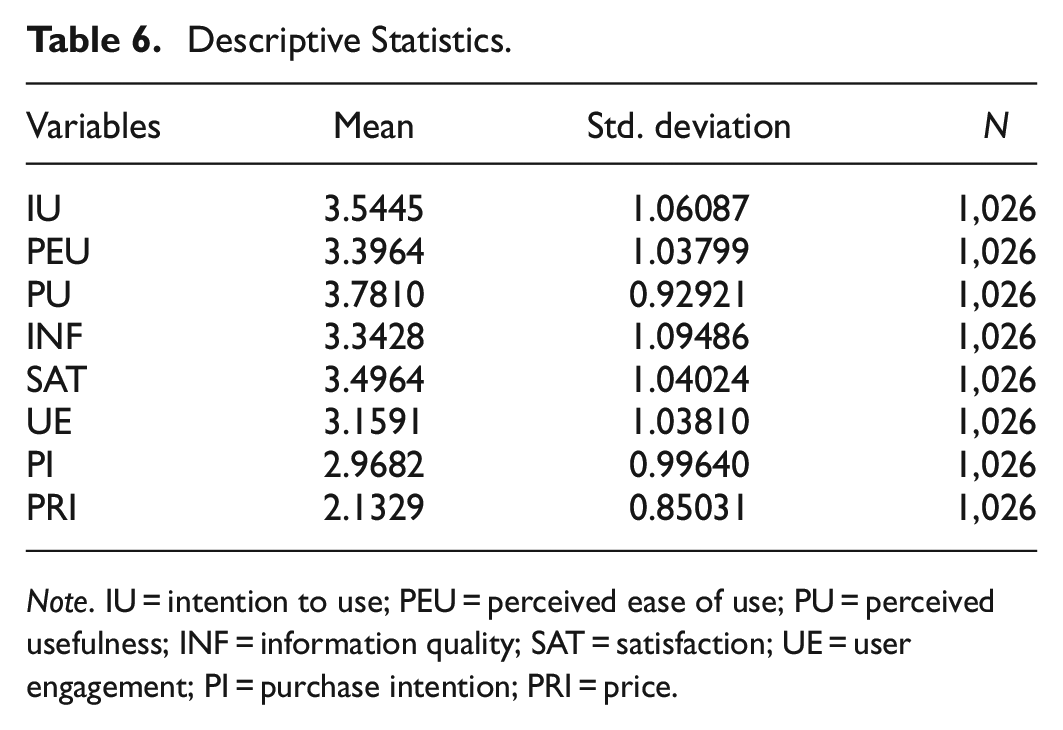
Note. IU = intention to use; PEU = perceived ease of use; PU = perceived usefulness; INF = information quality; SAT = satisfaction; UE = user engagement; PI = purchase intention; PRI = price.
Table 7 displays Pearson correlations, and the means and standard deviations of the main variables. In line with the expectation, IU positively affected PEU (r = .253**, p < .05) and PU (r = .379**, p < .05). Moreover, IU had a positive correlation with INF (r = .365**, p < .05), SAT (r = .379**, p < .05), UE (r = .369**, p < .05), and PI (r = .365**, p < .05).
Correlations.

Note. IU = intention to use; PEU = perceived ease of use; PU = perceived usefulness; INF = information quality; SAT = satisfaction; UE = user engagement; PI = purchase intention; PRI = price.
Correlation is significant at the .01 level (2-tailed).
Structural Model
In this study, AMOS24.0 was utilized to examine the Model fitting indicator, with the details presented in Table 8. The chi-square distribution χ2/df is below 3, and the majority of other indicators perform well in fitting. Passing the test value indicates the effectiveness of the model.
Model Fitting Indicator.

This research examined the structural model to validate the correlation between the constructs put forward in the research model. Table 9 illustrates the standardized path coefficients between constructs as well as the constructs’ significance level. As can be observed in Table 9, SAT has a positive relationship with IU, and its path coefficient is 0.294 (p < .05). This indicates that H1 is true. UE has a positive correlation with IU, and its path coefficient is 0.201 (p < .05). Similarly, PI is also positively linked to IU with a path coefficient of 0.149 (p < .05), which is consistent with H2 and H3. Additionally, PU positively influences UE, and its path coefficient is 0.69 (p < .05), and SAT with a path coefficient of 0.656 (p < .05). Thus, H5a and H5b are supported. The path coefficient of PEU to SAT is −0.046 (p > .05), and that to UE is −0.014 (p > .05). This reveals the absence of a significant positive correlation. Thus, hypotheses H4a and H4b are rejected. Furthermore, the fit for the structural model is acceptable (Figure 2). Tables 8 and 9 present more details.
Path Coefficients.

Note. IU = intention to use; PEU = perceived ease of use; PU = perceived usefulness; INF = information quality; SAT = satisfaction; UE = user engagement; PI = purchase intention.
p < .001.
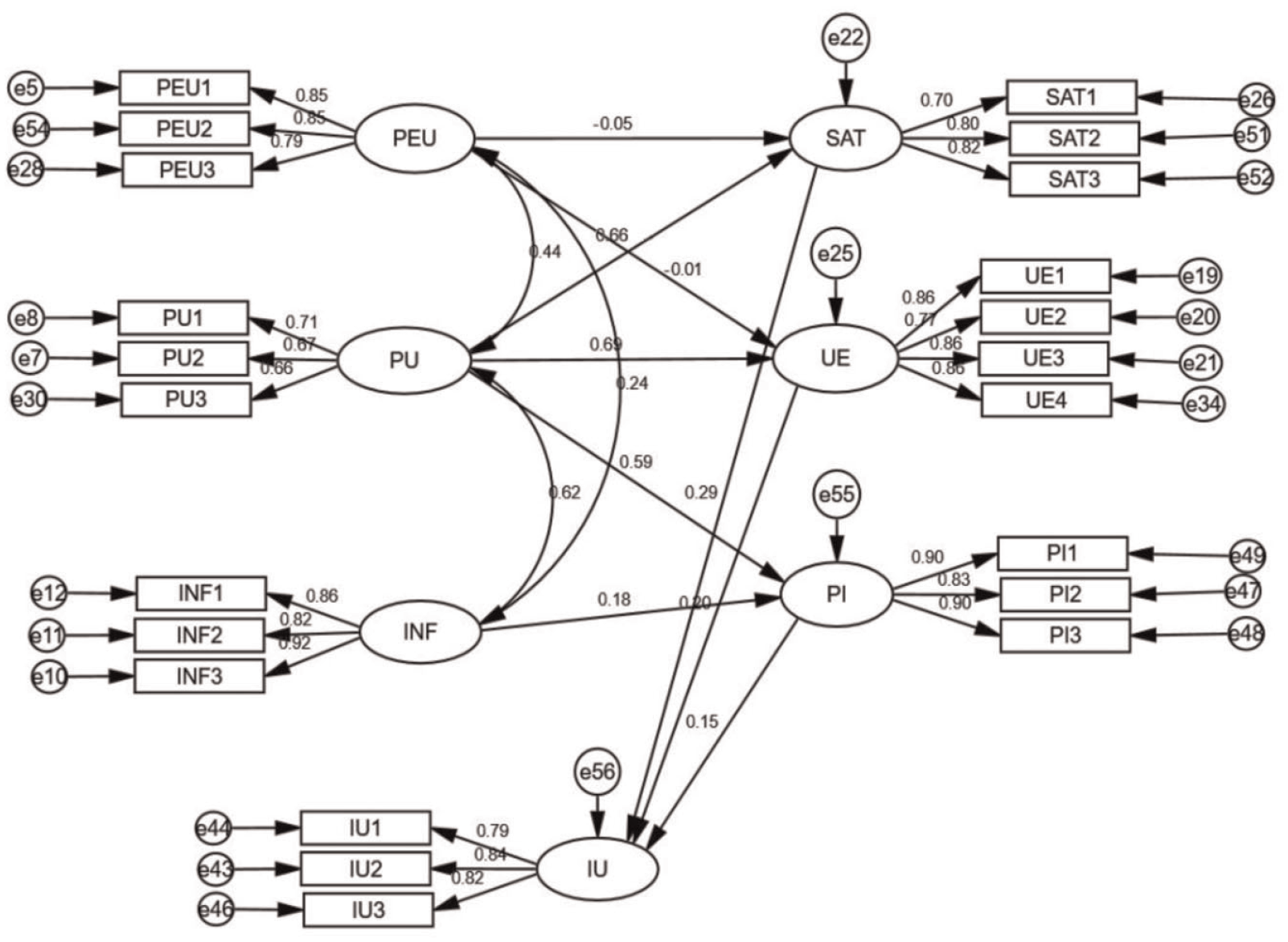
The structural equation model of users’ intentions to use SVSP.
Moderation
Shyness was expected to have a moderating effect on the direct correlation among PRI, SAT, UE, and PI, and the indirect correlation in Hypotheses 7a, 7b, and 7c. These hypotheses were examined by estimating a moderated mediation model with the PROCESS macro (Bolin, 2014), and an adverse moderating effect of PRI was identified on the correlation between SAT, UE, and PI (Figure 3).

Structural model representing path coefficients.
Discussion and Implications
Discussion of Key Findings
SVSP offers diverse content to consumers and enhances their purchase experiences. From the perspective of customer experience, this research investigates SVSP customers’ intent to use. Consumer engagement has figured prominently in consumer behavior studies over the years. The majority of relevant studies were predominantly founded on survey and questionnaire items (Huang & Choi, 2019). This study relies on user-generated questionnaire data from SVSP to establish the correlation between user engagement, intention to use, and purchase intention. The TAM and ISS models are used to evaluate the SVSP user engagement, satisfaction, and purchase intention as determinants of intention to use. In addition, price functions as a moderator between consumer experience and inclination to use. How these concepts can be implemented using findings from related prior research is demonstrated (Friedrich et al., 2019; Liang et al., 2011; Uhm et al., 2022).
Several findings are obtained. To begin with, user engagement exerts a significant and positive effect on consumers’ use intention. The majority of research on user engagement mainly focuses on how performance expectation affects buying intention, consumer satisfaction, and electronic word of mouth (Alalwan, 2018; Loureiro et al., 2018), neglecting its influence on consumers’ intentions to use. The findings of this research enrich existing studies by probing into the influence of performance expectations on actual consumer engagement.
Second, satisfaction positively influences consumers’ use intention. Kang et al. (2021) and (Nanne et al., 2021) examined the participation intention of consumers based on indicators such as likes, comments, and facial expressions on visual social network sites. The intention to use can be impacted by improving the satisfaction of users’ perceived usefulness, and this research ultimately demonstrated the positive influence of satisfaction on consumers’ intentions to use SVSP.
Third, both perceived usefulness and information quality positively affect purchase intention. Users like and embrace SVSP as an up-and-coming sales channel for retailers. During the SVSP live broadcast, users can receive discounts and lower their payment costs. The engagement in SVSP’s live streaming can help customers understand online products better, increasing their perception of their worth and propensity to buy. The findings indicate that one of the crucial variables influencing purchase intention is information quality. When buyers buy virtual goods, they gather the necessary data, evaluate various possibilities, and then develop their idea of a purchase intention before making judgments. This result is in line with earlier research (Arruda Filho et al., 2020).
Fourth, price is a moderator variable in the model that negatively modifies the link between satisfaction, user engagement, and purchase intention influence on intention to use. Thus, to foster user satisfaction, user engagement, and the impact of purchase intention, pricing, and product links do not necessarily need to be presented intuitively. Depending on the user’s preference, the price link or commodity link can be displayed in the SVSP interface. Users no longer comprehend the exact price of the goods directly or indirectly. This finding contrasts with previous studies and underscores the need for a nuanced understanding of price moderation effects in short-form video shopping platforms.
Finally, those who are older and relatively younger are more interested in SVSP. The fact that SVSP is a new retail platform makes it more appealing to both younger and older generations who enjoy killing time on video-based platforms. While the study finds interest in SVSP among both older and younger individuals, exploring potential age-related biases in the sample or variations in technology adoption rates among different age groups may be necessary. Additionally, while the study highlights the influence of consumers’ educational background on their propensity to buy, it is essential to consider potential confounding factors or alternative explanations that may impact this relationship. Overall, a critical discussion of these factors would provide a more nuanced understanding of the research findings and contribute to the robustness of the conclusions.
Implications for Theory
This study provides theoretical implications from multiple aspects. To begin with, it contributes to relevant literature on social media live shopping by analyzing a novel genre of business model, namely, short-form video shopping. Research on the social media business model has primarily concentrated on post advertising or live streaming (P. Liu, Li, et al., 2021; Wongkitrungrueng & Assarut, 2020), but overlooked the newer short-form video shopping. Conversely, even if short-form video’s social implications have drawn the most attention (Fei et al., 2021; Tian et al., 2022; X. Zhang et al., 2019), its business potential has not been fully investigated. This research is among the first batch of studies exploring the influence of short-form video shopping on consumer engagement behavior, and thus further extends the social media live shopping literature. Second, by integrating TAM and ISS, this research broadens relevant literature on customer engagement behavior. Prior research has mostly ignored actual customer engagement behavior manifestations while using the TAM model to study the motive of consumers from the consumer dimension (Bazi et al., 2020; Busalim et al., 2021; Molinillo et al., 2020). Customer perceptions and motivations have received scant consideration in studies investigating factors that affect the manifestation of customer participation (Shahbaznezhad et al., 2021). The current research takes into account consumer engagement motivations and their manifestations, which can generate more accurate search results for consumer engagement behavior. From this perspective, this study contributes to consumer engagement behavior research.
Third, this research underscores the value of user experience in the short-form video livestreaming literature. Existing research has focused primarily on the moderating effect of product category on the correlation between online consumer reviews and purchase intentions (Lee & Shin, 2014; Park & Lee, 2009). Although the content of this research differs greatly from that of earlier studies, consumers digest information in a similar manner. Consumers may pay more attention to product experience for experience goods than for information seeking. Thus, different business strategies are required to attract customers for various sorts of items. Future consumer behavior research should include the distinctions between different product categories.
Implications for Practice
This study has practical consequences for both sellers and consumers, as well as managerial ones for strategic marketers. First, because the findings suggest that user engagement positively affects intention to use, sellers can boost interaction with consumers while livestreaming. Second, perceived usefulness is found to have positive effects on user engagement, such as likes, comments, and shares. As a result, sellers should incorporate guidelines into their short-form video live shopping videos. TikTok and other SFVPs have fostered many guide components for users to design their own entertaining material, and thus sellers can make use of playful pictures, emoticons, and messages, as well as physical beauty, in their films to increase user stickiness. Third, consumer satisfaction has positive effects on their intention to use. Therefore, the seller must make tie strength and consumer contact easier. For example, sellers can react to consumers’ questions quickly and constructively in comments by providing “hot reviews” that are both fun and instructional. Moreover, as the results show, price has a negative moderating influence on satisfaction, user engagement, and purchase intention. This means that sellers should stay away from transaction-based sales tactics as well as untrustworthy terms such as “to buy,”“worth,”“low price,”“discount,”“value,” and other related words. Furthermore, they should concentrate on the strength to generate more remarks, whereas the introduction of products should be minimized because excessive introduction of products does not result in an increase in consumer engagement in buying items. Sellers should pay attention to video duration in particular because longer videos generate more shares. They should also take effective steps to expand their number of followers while avoiding pushing costly products.
In terms of consumers, the extent of consumer engagement behavior manifests the capability of the SVSP to satisfy their motivations and individual demands. Poor consumer engagement behavior indicates that SVSP has unsatisfying quality. The follower number can give hints to consumers. A larger volume of fans indicates a better reputation and trust. This research assists strategic marketers in better assessing the marketing effectiveness of SVSP and making predictions more quickly. To be specific, the five factors in this research have been determined to positively affect intention to use behavior, which provides references for sellers to estimate the marketing effect of SVSP. The study’s recommendations provide actionable insights for stakeholders in the short-form video shopping industry. Designers can enhance user engagement by creating interactive interfaces and optimizing video duration. Marketers should focus on authentic engagement, avoiding transaction-based tactics and prioritizing consumer satisfaction. Policymakers are urged to implement regulations ensuring transparency and fairness while fostering industry standards to protect consumer interests. These tailored recommendations aim to optimize user experience and drive success in the dynamic landscape of short-form video shopping platforms.
Limitations and Future Research Directions
There are several limitations to the current study. First, as China is a geographically large country, regional and economic differences are important factors affecting consumer behavior. It is advised that future studies pay attention to this aspect. Second, this research only polled Chinese customers, and cultural disparities may appear in other nations too. Douyin, as known to everyone, has an international version named TikTok. In the future, scholars can compare the findings of the suggested study paradigm in other countries. Third, in this study, it only looked at a small number of characteristics that may impact customer engagement. Some frame characteristics including height-width ratio, intricacy, face features, human body features, spatial distance (Tok et al., 2021), view from the camera (Y. Wang, 2020), and voice characteristics (S. Liu et al., 2020), may potentially have an impact on customer engagement behavior. In future studies, it would be beneficial to investigate potential biases resulting from the sampling method and their implications for the findings’ generalizability. Addressing any limitations in survey design or data collection processes that may have affected result accuracy or reliability is also recommended. Additionally, conducting a thorough exploration of external factors, such as socio-economic conditions, technological infrastructure, and regulatory environments, could offer valuable context for interpreting the study findings. Furthermore, from a macroscopic perspective, as did in the study of Aazami and Saidi-Mehrabad (2021) and Alaei and Manavizadeh (2022), it is meaningful to explore the game process among consumers, sellers, and producers.
Conclusion
Given the boom of SVSP, this research tries to better comprehend consumer behavior when participating in SVSP. TAM and ISS were taken as the theoretical framework to figure out how short-form video characteristics affect consumer intention to use. The literature review-based research questionnaire received 1,026 valid responses, and SEM-AMOS was utilized to examine the obtained data. This research is conducive to social media livestreaming literature by exploring a novel category of business model. It extends the findings of related research by revealing how short-form video features can affect users’ engagement behaviors. Methodologically, this study illustrates how SVSP user questionnaire data can effectively analyze user behavior on these platforms. Regarding policy implications, it provides valuable insights for sellers and strategic digital marketers to enhance product promotion via SVSPs. Understanding the factors influencing consumer behavior allows for tailored strategies that improve user experience and drive sales. In summary, this research offers a comprehensive understanding of consumer behavior in SVSPs, providing practical recommendations for sellers and marketers. Leveraging these insights enables businesses to effectively engage consumers and promote their products through SVSPs.
Footnotes
Acknowledgements
The authors would like to thank all those who supported us in this work.
Declaration of Conflicting Interests
The author(s) declared no potential conflicts of interest with respect to the research, authorship, and/or publication of this article.
Funding
The author(s) disclosed receipt of the following financial support for the research, authorship, and/or publication of this article: This research was partially supported by College of Chinese and ASEAN Arts, Chengdu University, the major scientific research achievements.
Informed Consent Statement
Ethical review and approval was not required for the study on human participants in accordance with the local legislation and institutional requirements. Written informed consent for participation was not required for this study in accordance with the national legislation and the institutional requirements.

Data Availability Statement
The data presented in this study are available from the corresponding author upon request.