




Abstract
Employees not being able to express their thoughts and opinions about work has been argued to result in detrimental organizational outcomes. Employee silence has recently become a prevalent organizational issue but studies that have explored proximal and distal outcomes of silence are scarce. Therefore, the study explored anxiety and happiness as mediating mechanisms for the relationship between silence and psychological withdrawal and the moderating effect of social network services usage for the relationship between silence and the mediators. The study conducted a two-wave self-reported questionnaire and sampled 257 full-time employees. Anxiety and happiness were found to mediate the relationship and social network services moderated the relationships between silence with the mediators. Moreover, supplementary analysis found mediated moderation for the study.
Introduction
Employee silence refers to the intentional withholding of one’s expression (e.g., ideas, suggestions, constructive criticism, and information) that may help improve the organization in work settings (Morrison & Milliken, 2000; Pinder & Harlos, 2001; Van Dyne et al., 2003). Organizational researchers and practitioners have realized that organizations need to rely on the contributions of employees for information and development. Research has revealed that employee input benefits change initiation, organizational commitment, and innovation (e.g., Edmondson, 2003; LePine & Van Dyne, 1998), while a lack of opinions on work issues can interfere with detecting organizational errors, effective decision-making, and learning processes (e.g., Beer & Eisenstat, 2000; Morrison & Milliken, 2000). Despite the organizational benefits, employees constantly choose to remain silent about their ideas and suggestions mainly due to the fear of managerial retaliation such as damaged performance evaluation and career setbacks, and to the sense of futility associated with management’s deaf ear and inaction (e.g., Bisel & Arterburn, 2012; Knoll et al., 2021; Sherf et al., 2019). Unfortunately, remaining silent at work has been found to result in numerous negative outcomes such as stress, cynicism, withdrawal, and reduced motivation (e.g., Dedahanov et al., 2016; Dong & Chung, 2021; Morrison, 2014).
The present study contributes to this emerging stream of literature by exploring how employee silence can influence employee work engagement and enthusiasm by incurring adverse emotional implications. According to Milliken et al. (2015), affective events theory (AET) can explain how refraining from communicating what one wants to express can lead to unfavorable emotional reactions such as decreased happiness and increased anxiety, which in turn lead to psychological withdrawal toward work. According to AET, emotional changes are proximal consequences to events, indicating an affective process between events and subsequent individual outcomes (Weiss & Beal, 2005). Affective events influence an individual’s well-being, goal achievements, and value realization (Lazarus, 1991, 2000; Spector & Fox, 2002; Weiss & Cropanzano, 1996). In this regard, being silent at work can create discrepant cognitions and threaten one’s perceived control over one’s work environment (Morrison & Milliken, 2000). Thus, employee silence can be suggested to be a negative work event that induces negative emotional reactions such as anxiety while diminishing positive emotions such as happiness.
Previous literature has argued that withholding information can result in employee withdrawal behaviors (Milliken et al., 2015; Morrison & Milliken, 2000). Drawing on AET, the present study suggests that employee silence can elicit anxiety and happiness as emotional reactions that drive psychological withdrawal. In particular, withholding information costs employees a significant way of applying control over the work environment (Morrison & Milliken, 2000) and employees thus tend to feel a sense of uncertainty and threat, which will most likely give rise to anxiety (Lazarus, 2000). As anxiety is an emotion characterized by avoidance tendency (Lazarus, 2000), it will drive employees to psychologically escape from their relevant work event. Happiness, on the other hand, is related to goal attainment and with an action tendency of approach (Lazarus, 2000). As silent employees fail to express what they want to say, they may experience thwarted goal accomplishment and feel less happiness (Kahn, 1990; Lazarus, 2000; Perlow & Repenning, 2009), which then cause employees to be less motivated to maintain their cognitive energy toward work.
Furthermore, AET posits that the appraisal of a work event is subject to the work environment (Weiss & Cropanzano, 1996). Social networking services (SNS) usage has become a part of everyday life and an inseparable part of the work environment, and it can be an effective tool for organizational communication. With the usage of SNS, employees can exchange their opinions with peers and thus may perceive silence to be less aversive (Morrison & Milliken, 2000). Subsequently, it may allow employees to view silence as a less threatening and uncomfortable experience and attenuate the negative emotional reactions as a response to employee silence.
A growing number of research has devoted effort to unravel the destructive outcomes of employee silence, however, little empirical evidence has been provided to support individual-level consequences (Morrison, 2014). The present study first contributes to the literature by incorporating AET into silence literature as an underlying framework to understand the consequences of employee silence. Second, the study further contributes to silence literature by investigating discrete emotions (i.e., anxiety and happiness) as mediating mechanisms that explain the consequences of silence. Besides attitudinal and psychological factors (Morrison & Milliken, 2000), emotional experiences are also important mechanisms that has been missing in literature (Kirrane et al., 2017). Last, the study investigated SNS use for work as a conditional situation that moderates the effect of employee silence and how SNS usage can influence the event-emotional reaction process.
Employee Silence and Psychological Withdrawal Behavior
Employee silence is a common phenomenon that permeates in a wide range of organizations and industries (Milliken et al., 2003) and can produce unfavorable organizational outcomes. In organizations, there are critical work details and issues that can only be observed by front-line employees who undertake specific work tasks as opposed to management. When employees tend to remain silent, there can be a lack of critical information within the organization that can result in inefficient work processes, failure of error correction and prevention, lack of positive change and innovation, and undermined organizational learning (Detert & Edmondson, 2011; Milliken & Lam, 2009; Sherf et al., 2018). Even though there has been a great amount of effort to understand the consequences of silence in terms of information obstruction, studies on other individual-level repercussions are limited and in order to further build knowledge of silence outcomes, the current study investigated psychological withdrawal as a detrimental consequence associated with employee silence. Withdrawal behaviors are behaviors that employees intentionally engage in to distance themselves from aversive work situations (Lehman & Simpson, 1992). It can be categorized as physical withdrawal such as absenteeism, lateness, and turnover (Beehr & Gupta, 1978) and psychological withdrawal such as cyberloafing, daydreaming, taking less responsibilities, and conducting personal matters during work (Beehr & Gupta, 1978; Mawritz et al., 2014). Psychological withdrawal is harder to detect by supervisors compared to physical withdrawal, thus its existence and potential disruptive organizational outcomes can be easily overlooked by practitioners and has not received much academic attention (Song & Lee, 2020).
Employee input not only is an important channel where the organization can obtain valuable information, but also is a significant approach where employees can exert impact on the organization. Morrison and Milliken’s (2000) proposed that withholding one’s opinions and ideas indicates unsatisfied control over work and as a result cause employee withdrawal. In addition, they argued that silent employees are less committed and tend to withdraw from their organization as they feel less important to the organization. Moreover, when employees believe that it is unfavorable to speak up about a particular work issue, they are likely to generalize this belief to other issues they encounter at work through collective sense-making activities (Milliken et al., 2015; Morrison & Milliken, 2000). Thus, when employees are constantly silent on different issues, they may develop a sense of learned helplessness toward the work setting and become apathetic and psychologically withdraw from their organization (Milliken et al., 2015).
Among the limited empirical studies that have investigated the consequences of employee silence, a few studies have provided direct and indirect evidence that associated silence with psychological withdrawal. Whiteside and Barclay (2013) found a positive relationship between silence and psychological withdrawal. They suggested further investigation of potential mechanisms explaining silence outcomes and argued that these outcomes can be subjected to situational factors. A recent meta-analytic study (Sherf et al., 2021) found that silence has a strong association with exhaustion and withdrawal. In addition, researchers have associated silence to lower organizational commitment and higher turnover intentions which have been frequently operationalized as indicators of psychological withdrawal. For example, Knoll and van Dick (2013) found employee silence to be positively correlated with turnover intention while Astvik et al. (2021) found silence to reduce organizational commitment and increase turnover intentions.
Anxiety and Happiness as Mediating Mechanisms
To understand the psychological process through which employee silence influences psychological withdrawal, the study is based on Milliken et al.’s (2015) study which suggests that employee silence will have direct impact on their attitudes, cognitions, and emotional reactions. In this notion, the present study integrates AET by treating employee silence as an affective work event that can provoke emotional responses, which in turn lead to psychological withdrawal.
Emotional reactions toward events experienced by individuals can shape an individual’s attitudes and behaviors (Barclay & Kiefer, 2014; Lord & Kanfer, 2002; Weiss & Cropanzano, 1996). Positive emotions occur when individuals think of an experience as consistent with or facilitating to their goal (Lazarus, 1991). Positive emotions can generate positive work outcomes such as creativity, commitment, prosocial behavior, task-focused behaviors, and employee resilience (e.g., Boehm & Lyubomirsky, 2008; Cohn et al., 2009; Lord & Kanfer, 2002). Whereas negative emotions come from experiences that hinders one’s goal (Lazarus, 1991; Scherer, 2001) and are suggested to bring about unfavorable work outcomes such as decreased performance and citizenship behavior and increased counterproductive behavior and withdrawal (e.g., Barclay & Kiefer, 2014; Rodell & Judge, 2009; Spector & Fox, 2002).
AET posits that work events can elicit emotional reactions and these emotions can function as antecedents of subsequent attitudes and behaviors, thereby indicating an affective mediating mechanism (Weiss & Cropanzano, 1996). Employee silence is a negative experience to employees that increases cognitive dissonance and taxes cognitive resources (Knoll et al., 2019; Morrison & Milliken, 2000). According to AET, specific work events are antecedents of emotional responses, and the cognitive appraisal of work events determine the type of emotions that will arise. Anxiety most likely develops when uncertainty and threat exist and is determined by situational factors (Cheng & McCarthy, 2018; Lazarus, 2000). Employees who feel that they need to withhold their ideas, suggestions, and concerns are likely to perceive cognitive dissonance and a threat of losing control over work procedures and outcomes (Morrison & Milliken, 2000). This uncertainty thus is likely to arouse anxiety as a threat-based emotional reaction (Ferris et al., 1996).
Anxiety is related to an action tendency of avoidance (Lazarus, 2000). Individuals who feel anxious tend to neglect and psychologically distance themselves from the stimuli. Studies have indicated that employees who feel anxious about a work event tend to exhibit an avoidance response and withdraw themselves from the work unit (e.g., Ashkanasy et al., 2014; De Clercq et al., 2020; Rodell & Judge, 2009). This is in alignment with AET in that psychological withdrawal is a typical affect-driven behavior provoked by negative emotional reactions to a work event (Weiss & Cropanzano, 1996). Therefore, we hypothesize the following:
Hypothesis 1: Anxiety mediates the relationship between employee silence and psychological withdrawal behavior.
Happiness is an emotion pertinent to goal achievement and facilitation (Lazarus, 2000). In general, people can believe that their opinion is important and that it can help with organizational functioning. However, when they cannot voice their opinions and remain silent, they can perceive a sense of goal obstruction thus hindering feelings of happiness. In addition, silence can give rise to cognitive dissonance and silent employees strive to rebuild consistent cognitions (Festinger, 1962; Morrison & Milliken, 2000). However, it is difficult to achieve consistent cognitions as speaking up and incur too much risk to valued interpersonal relations and career development. As a result, silent employees tend to feel less happy as they cannot achieve what they want.
Happiness is characterized by an approaching action pattern (Lazarus, 2000; Smith et al., 1993). Individuals experiencing happiness tend to engage with the environment and concentrate and become involved with activities (Fredrickson, 2001). With reduced levels of happiness, employees who have to remain silent at work are less motivated to maintain their cognitive energy at work and tend to engage in psychological withdrawal. Thus, we propose the following hypothesis:
Hypothesis 2: Happiness mediates the relationship between employee silence and psychological withdrawal behavior.
The Moderating Role of SNS for Work
The last decade has witnessed a booming use of SNS (Verduyn et al., 2017), especially with the rapid development of smartphones. Through SNS, individuals can easily expand and maintain social networks (Bevan et al., 2012) and exchange information (Bennett et al., 2010; Cao et al., 2012). Subsequently, SNS is frequently implemented at work for work purposes as employees can exchange work-related information and develop interpersonal relationships with other colleagues (Leftheriotis & Giannakos, 2014). SNS for work has been found to be instrumental for both employees and organizations. Studies have found SNS usage to improve job satisfaction, trust, collaboration, innovation, and performance (e.g., Bennett et al., 2010; Huang & Liu, 2017; Leftheriotis & Giannakos, 2014). Further, Koch et al. (2012) contended that SNS at work may engender positive emotions such as happiness.
In this regard, it is reasonable to presume that using SNS for work purposes can affect employee perceptions at work because it is another form of communication that organizational members can participate in. SNS can provide opportunities for silent employees to communicate their opinions and beliefs to others without the discomfort of direct communication. This may help alleviate the aversive perception of silence as SNS is indirect in nature and that individuals may perceive that SNS is a more comfortable method of communication. Similarly, communication research asserts that the social context can shape an individual’s appraisal of communication and the emotional reactions (Berlo, 1960; Butts et al., 2015; Byron, 2008), providing support to our assumption. Therefore, we propose the following:
Hypothesis 3: SNS use for work moderates the relationship between employee silence and anxiety such that SNS usage weakens the relationship.
Hypothesis 4: SNS use for work moderates the relationship between employee silence and happiness such that SNS usage weakens the relationship.
Therefore, Figure 1 shows the hypothesized research model.

The theoretical model.
Method
Procedures and Participants
The study collected data by conducting a two-wave questionnaire for full-time employees working in several industries such as the finance, advertising, and consulting industries in China. For the first wave, questionnaires sealed in numbered envelopes were distributed to 320 employees with the help of a contact point for each organization. In the cover letter of the questionnaire, the authors clearly stated that the study will ensure anonymity and confidentiality and will only be used for research purposes. The contacts were asked to record the participants and their corresponding envelope numbers in a form provided by the authors. All contacts were not in supervisory positions and did not participate in the study. At this time point, employee silence, SNS for work, anxiety, and happiness were collected. Two hundred eighty-one completed questionnaires were received (87.8% response rate). After a 3-week interval, the second wave of questionnaires with matched numbers were distributed to the same participants based on the contacts’ previous records. At this time point, data on psychological withdrawal behavior were collected. Demographic variables were collected at both time points to further ensure response matches. Two hundred fifty-seven matched and completed questionnaires were collected (80.3% response rate).
Measurement
The study measures were translated to Chinese and then the translations went through a back-translation procedure to ensure validity (Brislin, 1970). The items were measured with a 7-point Likert scale from 1, “strongly disagree,” to 7, “strongly agree.”
Employee Silence
A five-item scale adapted from Tangirala and Ramanujam’s (2008) study was used to measure employee silence. Sample items are “I choose to remain silent when I have concerns about the work,” and “Although I have ideas for improving the work, I do not speak up.”
SNS for Work Purposes
Consistent with previous studies (e.g., Chung & Kim, 2017; Leftheriotis & Giannakos, 2014), SNS for work purposes were measured by a three-item scale adapted by Kankanhalli et al. (2005). Sample items are “I often use social media to obtain work related information and knowledge,” and “I regularly use social media to maintain and strengthen communication with my coworkers at work.”
Happiness
Happiness was measured with Joseph et al.’s (2004) six-item scale. Sample items are “I feel happy,” and “I feel cheerful.”
Anxiety
Anxiety was measured using Spitzer et al.’s (2006) seven-item scale. Sample items include “I feel nervous, anxious or on edge,” and “I worry too much about different things.”
Psychological Withdrawal Behavior
Psychological withdrawal behavior was measured using Lehman and Simpson’s (1992) eight-items. Sample items are “I have thoughts of being absent,” and “I put less effort into my job than I should have.”
Control Variables
Consistent with prior research on employee silence and psychological withdrawal (e.g., Dedahanov et al., 2016; Mawritz et al., 2014), gender, age, education, position, tenure, team tenure, and leader tenure were taken as control variables.
Results
Confirmatory factor analysis with Amos 26 was conducted. The results showed that the hypothesized model was a better fit compared with the alternative models (χ2 = 601.45, χ2/df = 2.27, CFI = 0.92, RMSEA = 0.07, SRMR = 0.05). To further ensure construct validity, the study followed the Fornell-Larcker criterion (Fornell & Larcker, 1981) and conducted a series of tests. The results exhibited that AVE values for all of the constructs were above 0.50 (employee silence = 0.60, anxiety = 0.66, happiness = 0.74, SNS for work = 0.55, psychological withdrawal behavior = 0.52), implying convergent validity and that any correlation coefficient between two constructs was less than the square root of AVE of any of the two constructs, indicating discriminant validity. Descriptive statistics and correlations are displayed in Table 1.
Means, Standard Deviations, and Correlations.

Note. N = 257.
p < .05. **p < .01. ***p < .001.
Parallel mediation was examined due to the research model having multiple mediating variables (Hayes, 2013). Table 2 shows silence to positively affect anxiety (β = .28, p < .001) and negatively affect happiness (β = −.17, p < .01). Further, silence was found to positively affect psychological withdrawal behavior (β = .19, p < .01), anxiety to positively affect psychological withdrawal behavior (β = .25, p < .001), and happiness to negatively affect psychological withdrawal behavior (β = −.20, p < .01). Furthermore, the indirect effect of silence through anxiety (0.08) was significant as the confidence interval did not contain zero (0.02–0.15), supporting Hypothesis 1. Similarly, the indirect effect of silence on psychological withdrawal behavior through happiness (0.04) was also significant (0.01–0.08), supporting Hypothesis 2.
Multiple Mediators Regression Analysis.
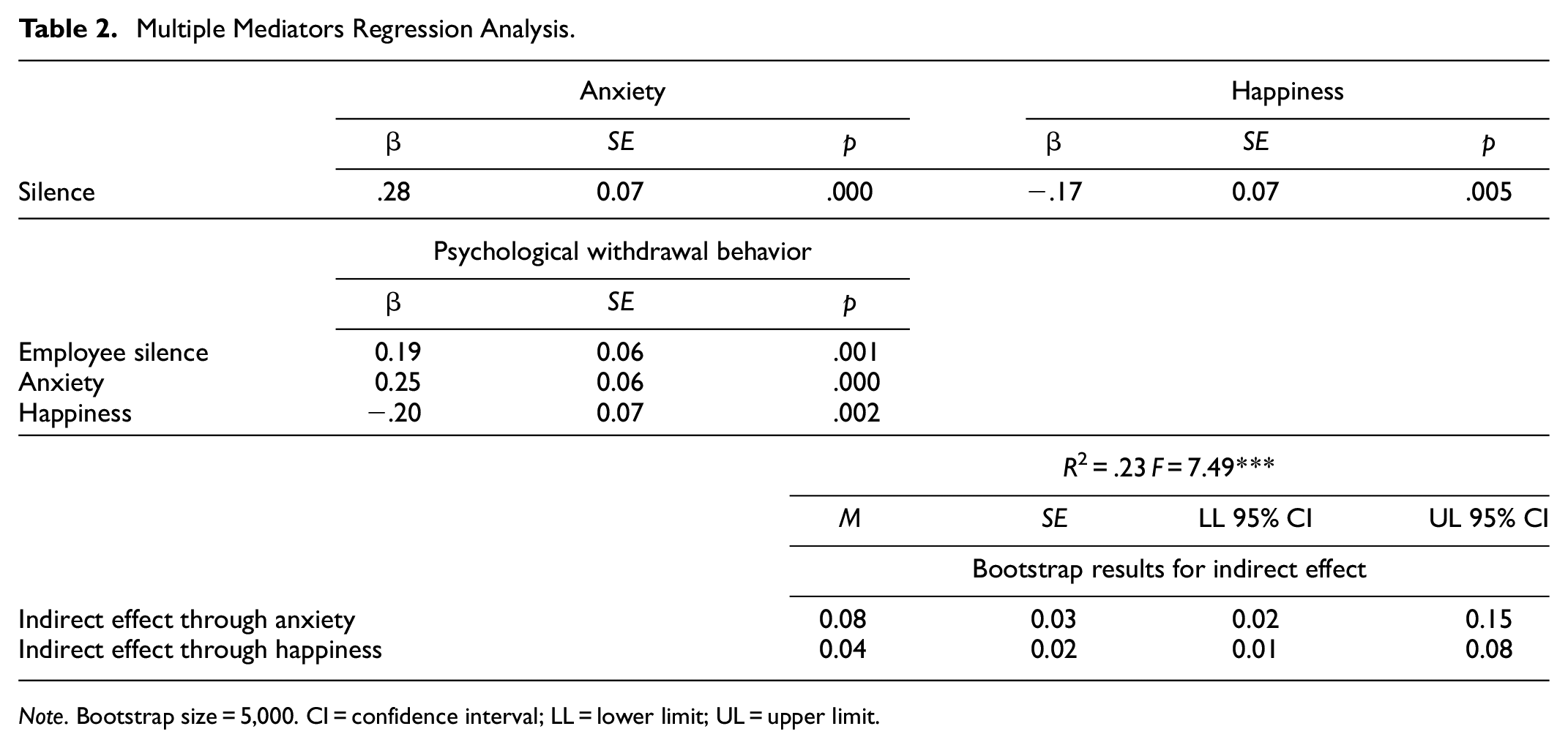
Note. Bootstrap size = 5,000. CI = confidence interval; LL = lower limit; UL = upper limit.
Table 3 exhibits the moderation results. Before conducting the analyses, the values were mean-centered as recommended by Aiken et al. (1991). SNS use for work significantly moderated the relationship between employee silence and anxiety (β = −.20, p < .01). Similarly, SNS significantly moderated the relationship between employee silence and happiness (β = .18, p < .01). The moderating effects were then plotted at values one standard deviation higher and lower than the mean (Aiken et al., 1991). As depicted in Figure 2, when SNS usage was high, the effect of employee silence on anxiety appears to be weaker than when SNS usage was low. Therefore, Hypothesis 3 was supported. As depicted in Figure 3, there was a negative effect of employee silence on happiness when SNS usage was low and the negative effect was weakened at high levels of SNS usage. Thus, Hypothesis 4 was supported.
Regression Results for Moderation.

p < .05. **p < .01. ***p < .001.

The moderating role of SNS use for work in the relationship between employee silence and anxiety.

The moderating role of SNS use for work in the relationship between employee silence and happiness.
Due to the nature of the research model, additional analysis was conducted to examine mediated moderation using PROCESS Model 7. As shown in Table 4, mediated moderation through anxiety was found as the confidence interval did not include zero (−0.08, −0.01). Similarly, mediated moderation through happiness was also found (−0.06, −0.01).
Mediated Moderation Results.

Note. Bootstrap size = 5,000. CI = confidence interval; LL = lower limit; UL = upper limit.
Discussion
Morrison and Milliken (2000) argued that silent employees may be less likely to participate in job tasks. Similarly, studies have also linked employee silence to withdrawal behaviors as one of its potential behavioral outcomes (e.g., Whiteside & Barclay, 2013). With an attempt to scrutinize the process in which silence influences withdrawal, based on AET the study investigated anxiety and happiness as mediating mechanisms associating silence and psychological withdrawal behavior. Furthermore, given the prevalence of SNS, the study explored whether work SNS can moderate the effects of employee silence on anxiety and happiness.
The study found anxiety and happiness to mediate the relationship between employee silence and psychological withdrawal behavior. In line with AET, being silent can be perceived as a negative work event which then can instigate negative emotional reactions. As a negative event, silence can affect anxiety and happiness. Further, anxiety and happiness were found to stimulate affective-driven behaviors such as psychological withdrawal behavior. Emotions can induce action tendencies as happiness is argued to be accompanied by the approach tendency, thereby allowing happy individuals to be more resilient and be likely to proactively deal with their possible problems (Core & Alquist, 2014; Fredrickson, 2001). In contrast, anxiety is suggested to be accompanied by the avoidance tendency which allows individuals perceiving negative affective experiences to drive off-task focus (Beal et al., 2005; Lazarus, 2000). Thus, the study is aligned with previous studies where positive affect reduces withdrawal and negative emotions promote withdrawal (Pelled & Xin, 1999).
The study posited that work SNS moderates the silence-emotion link. SNS can function as a communication channel where silent employees can receive and share work information which then can reduce dissonance and the negative effects of silence. Since employees tend to feel happy when SNS facilitates their goals (Koch et al., 2012), the study suggests that the negative impact of silence on happiness weakened when employees frequently used SNS for work purposes. However, it was unexpected that high levels of SNS usage may also increase anxiety as seen in Figure 2. This result can be explained by the dark side of SNS. Although SNS allows individuals to attain and share work information, they might have to filter irrelevant information, decide which information to use, and keep constant attention which then could lead to information overload and a sense of anxiety (Bawden & Robinson, 2009). Despite the positive effects of SNS such as to increased job satisfaction, morale, knowledge exchange, and reduced loneliness (e.g., Moqbel et al., 2013; Yoo & Jeong, 2017), it can also result in detrimental consequences such as increased task and relationship conflict, envy, and jealousy while reducing life satisfaction and well-being (e.g., O’Leary & Volkmer, 2021; Saleem et al., 2021; Wang et al., 2018). Therefore, even with the instrumentality of SNS usage that can decrease the negative effects of silence, employees may feel somewhat overwhelmed and anxious. Last, mediated moderation was found suggesting that silent employees that frequently used SNS for work were less anxious and happier which then reduced the likelihood of withdrawal behaviors.
Theoretical Implications
First, in alignment with Morrison and Milliken (2000) and Morrison’s (2014) framework, the study extends the nomological network of employee silence as anxiety and happiness were found to be underlying mechanisms that associate the relationship between employee silence and psychological withdrawal behavior. In addition, as there are only a few studies (e.g., Dong & Chung, 2021; Hsieh & Huang, 2022; Maqbool et al., 2019) that have included boundary conditions for employee silence, the study contributes to silence literature as SNS was found to significantly moderate the relationship between employee silence and emotions. Second, AET can be integrated into silence literature to explain certain proximal and distal outcomes of employee silence. Silence can be considered a negative work event that can stimulate emotions such as anxiety and happiness which then can result in behavioral outcomes. Third, the study adds to emotion literature as previous research has mainly investigated positive and negative affect as two broad dimensions, ignoring discrete forms of emotions (Hu & Kaplan, 2015). Positive discrete emotions have not received much academic attention compared with negative discrete emotions (Core & Alquist, 2014; Hu & Kaplan, 2015), hence the study investigated both positive and negative discrete emotions. Last, mediated moderation was also significant, thereby contributing to theory as it goes beyond the direct effects of silence, suggesting that under certain conditions the negative effects of silence can be lessened and that work SNS can indirectly influence psychological withdrawal.
Practical Implications
The study can provide practical insights to organizations and managers. First, management should comprehensively understand the effects of silence. Management should emphasize employee input for healthy organizational development and employee well-being. Safe communication channels also need to be built so that employees will not worry about potential retaliation. Edmondson (2003) suggested that new technology can be implemented to create new conditions in which organizational members can feel free to communicate with others about issues they encounter. Further, she mentioned that leaders should coach others so that a climate of speaking up without fear is created. Similarly, Knoll et al. (2021) argued the importance of creating a safe climate where employees can easily speak up and thus managers need to take actions such as thematic training and applying authentic leadership to set a model for employees to change the collective sense-making that speaking up is inappropriate. Second, management should pay more attention on employee emotions. Social activities can be arranged to cultivate positive feelings and organizations can offer counseling services to employees who want to vent their emotions (McLeod, 2010). Last, given the alleviating role of SNS on silence, management should reconsider SNS usage at work and should not inhibit SNS usage just because of the possibility of cyberloafing. As a communication channel, SNS can be “an untapped resource” (Holland et al., 2016, p. 2630) that can help reduce silence among employees and be useful for discussing workplace concerns. However, as there is a dark side for SNS, managers need to make the accessibility and value of SNS as a formal form of communication to be fully understood not only by employees but also by management so that it will facilitate genuine employee participation and exhibit its positive organizational impact to the greatest extent (Holland et al., 2016). Also, organizations should consider implementing organizational SNS such as IBM’s Beehive that is developed for internal usage and is customized for specific organizational functionality which may further allow individuals to perceive it as a formal organizational communication method while reducing inappropriate usage.
Limitations and Future Research
The study has some limitations. First, self-reported questionnaires were used, hence common method bias can be a concern. However, procedures were conducted to minimize method bias (Podsakoff et al., 2003). Confidentiality and the purpose of the study were clearly stated in the cover of the questionnaire to ensure genuine responses. A 3-week interval was adopted as a temporal separation to reduce the influence of common method. Additionally, Harman’s single factor test was conducted (34.07%) and the results indicated that common method was not a concern. However, future research should consider collecting data from multi-sources such as supervisors and coworkers to reduce common methods and biases. Second, despite that Kirrane et al.’s (2017) study has found employee silence to produce emotional outcomes, which provides an initial foundation for the causal relationship, longitudinal research should be adopted to further strengthen the causal relationships. Moreover, considering the changing nature of affective experiences (Weiss & Beal, 2005), within-person level of analysis can provide more insights and strengthen the study. Last, as the study was conducted in China, the generalizability of the results may be constrained by cultural factors.
Conclusion
Based on AET, the study suggests employee silence to be an affective work event and found it to result in emotional responses. Subsequently, these emotions can be underlying mechanisms associating employee silence and psychological withdrawal behavior. Moreover, work SNS moderated the relationships between silence and emotions and mediated moderation was supported, thus the study supports Morrison and Milliken (2000) and Morrison’s (2014) overarching model on the antecedents and consequences of silence.
Footnotes
Declaration of Conflicting Interests
The author(s) declared no potential conflicts of interest with respect to the research, authorship, and/or publication of this article.
Funding
The author(s) received no financial support for the research, authorship, and/or publication of this article.
Ethics Declarations
An Institutional Review Board statement was not applicable at the time of the study.
