




Abstract
According to Russian researchers, university studies is among the most stressful activities for a person. First-year university students are particularly vulnerable to stress. The use of mindfulness-based programs to help students reduce and manage stress is gaining popularity around the world. Previous research has shown that such programs can improve the psychological well-being of students by reducing levels of anxiety and depression. In addition, students in helping majors, such as psychology students, would greatly benefit from mastering the skills of managing stress, as anxiety and stress are pertinent to their future profession. This pilot case study assesses the effectiveness of a brief mindfulness training aimed at improving Russian students’ mental and physical health. The participants were 83 first-year undergraduate students from the Psychology Department of the Ural Federal University named after B.N. Yeltsin. Data collection was completed in November 2019. A non-randomized controlled trial was conducted using a brief mindfulness training. The results show that the participants in the experimental group demonstrated significantly lower levels of depression (η2 = .07, p = .00) and significantly higher levels of subjective happiness (η2 = .02, p = .02) than participants in the control group. Also, the participants in the experimental group showed marginally significant lower levels of anxiety (η2 = .02, p = .06). Frequent mindfulness meditation practice and the study of theoretical materials were associated with higher rates of psychological well-being of students. The findings suggest that mindfulness training may be an effective tool in addressing psychological challenges experienced by first-year students of the Psychology Department of Ural Federal University.
Introduction
According to the Russian researchers, university studies is one of the most mentally demanding activities that puts pressure on students leading to burnout, anxiety and depressive modes (Garanyan et al., 2007; Matyushkina, 2016). Moreover, increasing use of information technologies in students’ daily life and for educational purposes may create additional stress factors (Arden, 2010; Lutz et al., 2014; Reinecke et al., 2017; Shrivastav & Hiltz, 2013).
The first year of university studies appears among one of the most stressful experiences as newcoming students have to become more independent in their academic and social life, study greater amount of more complex material, and integrate into a new community both in and outside of classroom (Nikonorov & Chuklova, 2009; Teplyakova, 2018). All of these changes become stress factors, which may undermine young adults’ mental and physical health (Nikonorov & Chuklova, 2009; Pritchard et al., 2007; Teplyakova, 2018). Symptoms of anxiety and depression are quite common among first-year university students (Amirov et al., 2019; Harchenko, 2013; Ostankina & Ukrainchenko, 2014). Hence, it is paramount that first-year students learn how to manage stress. Otherwise, stress can accumulate overtime and lead to poor academic performance and serious health problems (Dvořáková et al., 2017; Jakubenko, 2009). To help first-year students cope with stress, universities may offer programs intended to help students effectively deal with stress and acquire stress-management skills that could be applied in their future life.
Unfortunately, in Russian educational institutions, students do not always receive the necessary support to successfully adapt to the demands of a new environment (Andronnikova, 2020; Krushelnitskaya & Tretyakova, 2015). A large percent of first-year university students in Russia report low stress-resistance and an acute need for such support (Ostankina & Ukrainchenko, 2014; Teplyakova, 2018).
This problem manifests itself at the Ural Federal University (UrFU). The results of the Beck questionnaire that surveyed the first-year psychology students at the beginning of the study showed that 23% of respondents experienced moderate or severe depression; the results of the Spielberger questionnaire showed that 58% of these students demonstrated high levels of personal anxiety. The Psychology Department of UrFU offers a freshman seminar called Introduction to Educational Activities. Initially, this course intended to familiarize students with various aspects of university life and academic skills. Then, the course was changed to teach students how to write term papers. This course has never addressed such psychological issues as stress management and self-regulation.
International experience suggests that there are programs aimed at helping students address stress and improve self-regulation and, as a result, decrease levels of anxiety and depression. Designed to help people cope with stress and challenges of modern life, mindfulness-based programs are gaining popularity worldwide, and have been extensively used in educational settings, including at universities. The popularity of such programs has skyrocketed after the positive effect of mindfulness on psychological well-being during various stressful situations has been observed (Li et al., 2017; Janssen et al., 2018).
Mindfulness can be seen as a state of consciousness, a practice, and a personality trait. A state of mindfulness can be defined as “a kind of nonelaborative, nonjudgmental, present-centered awareness in which each thought, feeling, or sensation that arises in the attentional field is acknowledged and accepted as it is” (Bishop et al., 2006, p. 232). It is in many ways the opposite of what is called the “wandering mind,” or switching attention from the current task and/or surrounding events to spontaneous thoughts or feelings (Killingsworth & Gilbert, 2010). If we consider mindfulness as a practice, then the main tool of this practice is mindfulness meditation. The difference between mindfulness meditation and other types of meditation is that it is aimed at developing uncritical attention toward one’s current experience (Kabat-Zinn, 1996). This practice develops mindfulness as a personality trait—a person’s tendency to more frequently enter and remain in a state of mindfulness (Black, 2011).
Research on the impact of mindfulness practices on students shows a wide range of positive outcomes. Teaching students to cultivate non-judgmental attention and caring attitude toward their bodily sensations, thoughts, and emotions through mindfulness meditation could serve as an effective way of managing stress and regulating emotions. Therefore, students can become more resilient in the face of challenges associated with the transitional period of university study (Shapiro et al., 2011). Furthermore, practicing mindfulness improves one’s ability to concentrate and shift one’s attention (Jha et al., 2007; Semple, 2010), which could enhance students’ ability to process large amounts of information while decreasing instances of burnout and anxiety from such work (Levy et al., 2012). Particularly, students who practiced mindfulness exhibited reduced levels of depression and anxiety (Falsafi, 2016; Gallego et al., 2015; Song & Lindquist, 2015).
Although the topic of mindfulness is quite popular in various scientific fields, and thousands of scientific articles have been published on this issue, to date, there are very few Russian studies on this topic. There are no studies on the impact of mindfulness training on first-year university students. Moreover, the appropriateness and feasibility of mindfulness-based programs in different cultural contexts is to be further explored by researchers and mindfulness teachers (Carlson, 2018; Crane et al., 2017). Therefore, with this study, we aimed to bridge this gap and look at the role of mindfulness practice in improving first-year students psychological well-being within a Russian cultural context.
First-year students of the Psychology Department of UrFU were targeted as participants of the present study for a number of reasons. First of all, stress management and self-regulation skills are key in the psychology profession (Dolgova & Golyeva, 2013; Solovyova et al., 2019). Psychology students need to be prepared for a variety of stress-related experiences in their future professional activities (Hannigan et al., 2004; McCormack et al., 2018; Solovyova et al., 2019). Moreover, the educational standards of the Russian Federation for future psychologists indicate that a graduate of the faculty/department of psychology must have “the ability and willingness to master the skills of analyzing their activities and the ability to apply methods of emotional and cognitive regulation (to optimize) their own activities and mental state” (Ministry of Education and Science of the Russian Federation, 2009, p. 4). Also, the results of some Russian studies show that psychology students are more stressed and overwhelmed than students of other majors (Garanyan et al., 2007; Solovyova et al., 2019). Finally, the Psychology Department of UrFU, in contrast to many other departments of the university, mainly enrolls female students (in this study, the sample of psychology students consisted of 89% of female students). Numerous studies have shown that women tend to experience more stress than men (Garanyan et al., 2007; Matud, 2004; Repina & Rogachevskaya, 2019), and are at greater risk of developing anxiety and depressive disorders (Bekker & van Mens-Verhulst, 2007; Leach et al., 2008). Accordingly, the need for stress management skills, in general, may be higher among psychology students of UrFU than, on average, among representatives of other departments of the university.
Previous studies on the effects of mindfulness programs on psychology students have shown positive results. For example, Cohen and Miller (2009) showed that a 6-week interpersonal mindfulness training led to a decrease in perceived stress and anxiety among graduate students in counseling and clinical psychology majors in the US. de Vibe et al. (2013) found a moderate effect of a 7-week mindfulness-based stress reduction program on mental distress and a small effect on the subjective well-being of psychology students in Norway.
A mindfulness training adopted in the present study was based on mindfulness-based cognitive therapy (MBCT) program, which has repeatedly been shown to be effective in reducing the symptoms of anxiety and depression, including in student samples (Piet & Hougaard, 2011; Taylor et al., 2014). This program was chosen as an intervention tool for the present research as it combines the methods of cognitive behavioral therapy and meditative practices.
There are at least three potential mechanisms that explain the MBCT’s positive effect of anxiety and stress (Kuyken et al., 2010). First of all, the completion of an MBCT course has been associated with the reduction of rumination (Hawley et al., 2014; Kuyken et al., 2010; Michalak et al., 2011). Rumination is a problematic cognitive process in which individuals repetitively focus on symptoms of distress, and on their possible causes and consequences (Nolen-Hoeksema, 1991). Rumination is considered one of the main symptoms of and causes of depression and could significantly reduce one’s psychological well-being (McLaughlin & Nolen-Hoeksema, 2011). Second, taking an MBCT course can increase self-compassion (Frostadottir & Dorjee, 2019; Kuyken et al., 2010). Low self-compassion is linked to depression (Krieger et al., 2013; Raes, 2011) and lower well-being (Neff & Seppälä, 2017; Zessin et al., 2015). Thirdly, the completion of such a program increases the level of mindfulness (Alsubaie et al., 2017; Kuyken et al., 2010). Mindfulness allows one to register negative thought and behavior patterns and to decrease their use in one’s life (Kuyken et al., 2010). Additionally, this program was chosen for its versatility and applicability to different categories of people (Seligman & Reichenberg, 2014). The program is also closely related to the development of skills and qualities needed by university freshmen. The research suggests that interventions based on MBCT contributes to the development of stress-management skills (Gallego et al., 2015; Taylor et al., 2014), emotional regulation (Chiodelli et al., 2018; Shin, 2017) and attention (Gu et al., 2018; Taylor et al., 2014) in university students. Moreover, such effects of these interventions have been shown across different cultures (Chiodelli et al., 2018; Gallego et al., 2015; Shin, 2017).
Purpose of Research
The current non-randomized controlled pilot study aimed to assess the effectiveness of a brief 8-week mindfulness program, the main purpose of which was to improve psychological well-being among first-year psychology students of UrFU, and its possible use as a regular tool in working with first-year psychology students.
Research Hypothesis
We hypothesized that students who completed the brief mindfulness-based program, when compared with students from a control group, would show better indicators for mental health and well-being, including lower levels of anxiety and depression and higher levels of subjective happiness.
Methods
Participants
The participants were 83 first-year students from the Psychology Department of UrFU, the largest university in the Ural Federal District of Russia. During a practical class, in mid-September of the fall semester 2019, students were invited to participate in the study, to which all consented. The students were informed about the objectives and procedure of the study. They were informed that participation in the study is voluntary and that they can terminate their participation at any time. It was also explained that participation in the study was anonymous and all data would be processed and presented in a generalized form. In addition, to reduce the possible risk of worsening of their psychological state from the practice of mindfulness students with diagnosed mental disorders such as clinical depression, bipolar disorder, PTSD and other were excluded from the sample (Lindahl et al., 2017; Lomas et al., 2015). All the participants provided verbal consent. In addition, consent to the study was obtained from the head of the Ural Humanitarian Institute (a structural unit of UrFU, which includes the Department of Psychology), responsible for ethical issues.
The study included students from five groups. Two groups studied general psychology and three studied clinical psychology. The sample was predominantly female (89%, 74 females, 9 males) with a mean age of 18.2 (SD = 0.84, range from 17 to 22) years. There were no differences in the gender ratios among the groups, as the proportion of males in all groups did not exceed 13%. None of the participants in the experimental and control groups had previous experience with mindfulness meditation practice.
Participants received no financial compensation for participating in this study.
Procedure
The method by which participants were distributed into the experimental and control groups and analyzed is presented in Figure 1. In total, 118 students (the general number of freshmen in the Psychology Department) were divided into five groups (46 general psychology students and 72 clinical psychology students).
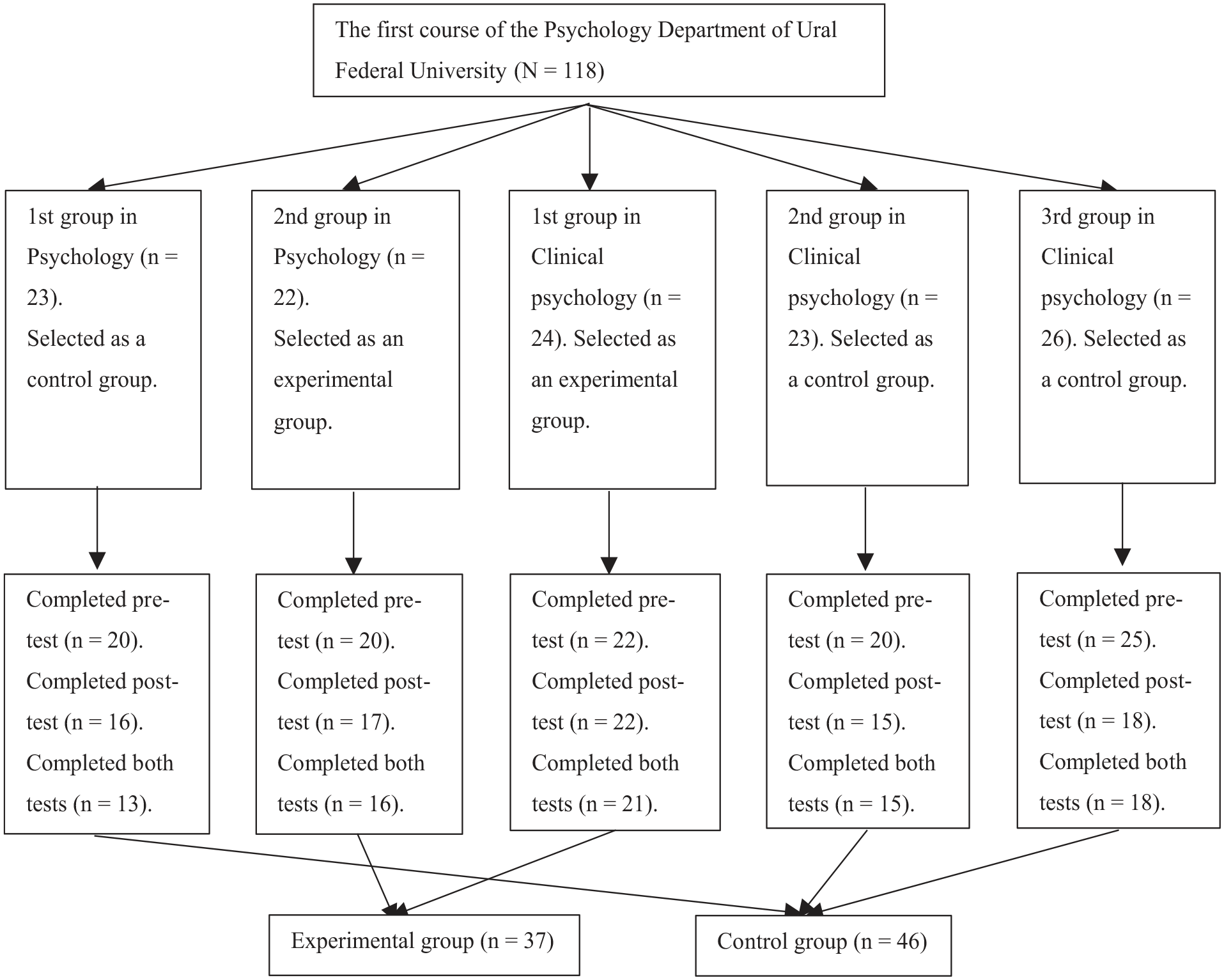
Flow diagram of participants’ distribution into the experimental and control groups and analysis.
Randomly, one of the two groups studying general psychology and one of the three groups studying clinical psychology were selected as the experimental groups. Representatives from the remaining groups were included in the control group.
In total, 107 students took part in the pre-test. For various reasons, 11 people did not complete the pre-test.
A post-test was conducted at the end of November 2019 and included data collection, in both paper and electronic forms; 88 students completed the post-test. Due to reduced attendance at the end of the semester, online forms replicating the paper questionnaire were made available on Google forms, for greater access. In total, 83 students completed both tests (37 in the experimental group and 46 in the control group) and the associated data was subsequently used in the analysis.
Pre- and post-tests were anonymous. During the paper pre-test, students were asked to come up with a pseudonym by which they would sign the completed questionnaires. They were asked to remember the pseudonym and record it on their phones. For the post-test, they were supposed to sign with the same pseudonym.
Along with the pre- and post-tests, anonymous surveys were regularly conducted during mindfulness training sessions. After the introductory session, where participants of the experimental group learned about mindfulness, they filled out a short questionnaire, where they indicated how much they were interested in mindfulness practice (on a 4-point scale, ranging from “not interested” to “very interested”) and whether they were ready to devote a small amount of time each day to mastering this practice (Yes/No). In subsequent surveys, students specified the number of days they devoted to practicing mindfulness. They also reported whether they had read the materials sent to them and performed practical program exercises. During these short anonymous surveys, students also indicated their pseudonym, which they came up with during the pre-test. This allowed tracking time and efforts devoted to the program and assessing their contributions to the final results.
The control group was not affected in any way. At the university, the control group followed the same program as the participants in the experimental group. They only had a general idea of the research they were participating in. Their task was to pass a pre- and post-test to control the effect of side variables. Contact with participants in the control group during the study was minimal.
The following steps were taken to control for the influence of all possible side variables. A control group was used to control for side effects that could occur during the course of the program (parallel events and activities at the university, such as tests, term papers, and extracurricular activities, etc). Since the study did not use full randomization, pre-test data for the experimental and control groups were compared with each other; the comparison of post-test data between the experimental and control groups was carried out taking into account pre-test data. Participants with psychological conditions were excluded from the study. The influence of gender was also controlled for: it was found that in all groups there was approximately the same ratio of participants by gender. In order to exclude the influence of social desirability, all participants were previously told that all data would be processed and presented in a generalized form. In addition, all participants indicated their pseudonym when filling out the questionnaires. The influence of possible previous experience of mindfulness practice was also controlled. It was preliminary established that none of the participants had such experience. In order to exclude the influence of specialization (clinical psychology, general psychology), the experimental and control groups consisted of study groups from both specializations. To exclude the influence of communication between participants in the experimental and control groups, participants in the experimental group were strongly asked not to discuss their experience of participating in the program with the participants in the control group. In addition, class attendance and completion of homework assignments by the participants of the experimental group were monitored.
Exposure
The experimental group completed mindfulness training based on Finding Peace in a Frantic World (FPFW) Program, which is a modified version of the MBCT program intended for general audiences. This version retains all the main features of the classic MBCT, but it places more emphasis on addressing stress factors related to modern work or study. As a teaching aid, the Russian version of Mindfulness: Finding Peace in a Frantic World by Williams and Penman (2011) was used. The program’s trainer completed a certified online course on mindfulness by University of Minnesota, and had personal meditation practice experience in the amount of approximately 300 hr.
The mindfulness training used in the present study was delivered in accordance with the curriculum of FPFW with a slight change in the length of the face-to-face sessions. FPFW pre-supposes face-to-face meetings that last from 60 to 90 min. In the framework of the present research, face-to-face meetings were shortened to 30 min, except for the introductory session that took 45 min and included additional information about the training. Face-to-face meetings were shorter in time in order to better suit university conditions, as students may not have enough time and motivation to take part in a full version of the program. Previous studies using brief versions of mindfulness-based programs have been shown to be effective (de Vibe et al., 2013; Phang et al., 2016).
The program was conducted after class hours. Face-to-face sessions were held once a week. Separate sessions were held for psychology and clinical psychology students. The groups consisted of 18 to 20 students and the trainer.
The training was designed to gradually develop participants’ mindfulness skills and enhance emotion regulation skills. The program consisted of eight sessions. In each of the eight sessions, new theoretical material was provided, and a new meditation technique was analyzed. Within short face-to-face sessions approximately 15 min of each session was devoted to theoretical material analysis. Then, a 10-min group meditation was held, followed by a 5 to 10 min discussion session, where participants exchanged their experiences with each other and the trainer. All theory during the sessions was given in accordance with the FPFW program. At the end of each session, students were given homework for the week, which included reading theoretical materials (about five pages per week), 10 to 15 min of daily meditation, and practical exercises that promote mindfulness. Additionally, for the purpose of regular communication, a group chat was created on a popular Russian social network (www.vk.com), where participants could ask questions and share their experiences.
Measures
Depression
The Russian version of the Beck Depression Inventory (BDI; Prohorov, 2004) includes 21 categories of symptoms and complaints. Each category consists of four to five statements corresponding to the specific manifestations/symptoms of depression, and the respondent is asked to select the options that best describe his or her condition over the past week. The BDI has two subscales: somatic-performance subscale and cognitive-affective subscale. The observed reliability (Cronbach’s alphas) of the questionnaire was .90 for the pre-test and .91 for the post-test in the present sample.
Anxiety
The trait anxiety subscale of the Russian language, State-Trait Anxiety Inventory (Batarshev, 2005) was used in the present study. The subscale consists of 20 questions, rated on a Likert scale ranging from “never” (1) to “almost always” (4). The internal consistency of the questionnaire was .90 for the pre-test and .91 for the post-test in the current sample.
Subjective Happiness
The Russian version of the Lyubomirsky and Lepper’s Subjective Happiness Scale (Yelshansky et al., 2015) consists of four questions, rated on a 7-point Likert scale ranging from “I strongly disagree” to “I strongly agree.” The internal consistency (Cronbach’s alphas) of the questionnaire was .79 for the pre-test and .69 for the post-test. These indicators correspond to the most-accepted required level of .7 or higher (Cortina, 1993) and are consistent with the results of previous studies. Osin and Leontiev (2008) reported a Cronbach’s alpha of .75 in a sample of 1,142 people, and Yelshansky et al. (2015) received a result of .68 in a sample of 358 people.
Opposite variables, such as subjective happiness on the one hand, and anxiety and depression, on the other, were used to more accurately determine the effect of the mindfulness training on students’ psychological well-being. Subjective happiness as a psychological construct does not completely overlap with opposing constructs such as depression and anxiety (Lyubomirsky & Lepper, 1999). In addition, research interventions based in the MBCT program have mainly focused on the effects of these interventions on depression. Much less research focused on the effects of the MBCT interventions on subjective happiness. This study will help reduce this imbalance.
Data Analysis
Missing data in the pre- and post-tests were excluded from the data analysis. Data were checked for normal distribution. Deviations from normality were found in the data distribution for depression. To reduce skewness and kurtosis, a square root transformation was applied (Tabachnick & Fidell, 2007; Howell, 2007). The transformed variables were used in the data analysis. To assess the possible differences between students with different specializations and between participants in the experimental and control groups, independent-samples t-tests were conducted (Howell, 2007). A significant difference was found for BDI scores between the experimental and control groups among psychology students (t = −2.23; p = .03). A paired-sample t-test was also used to evaluate changes in the results of the pre- and post-tests in the experimental and control groups. Analysis of covariance (ANCOVA), was used to test the effect of exposure in the study, given the differences in student groups and the non-application of randomization during the enrollment of students in either experimental or control group (Tabachnick & Fidell, 2007). The pre-test data were used as covariates. To estimate effect size, η2 was used in accordance with the range established by Tabachnick and Fidell (2007): between 0 and .009, negligible; between .010 and .089, low effect size; between .090 and .249, medium effect size; and from .250, large effect size. Multiple linear regression analysis was used to test the relationship between program attendance, reading the materials, doing homework, and the final results from the program. The multiple linear regression analysis used survey data from face-to-face mindfulness training sessions. To assess the correlation between Depression, Trait anxiety and Subjective happiness, Pearson’s correlation coefficient was used due to the linear relationship between the variables. All statistical analyzes were performed using SPSS version 23.0, with the alpha level used to determine the two-sided significance p < .05.
Results
Mindfulness program attendance among those who completed both the pre- and post-tests was quite high, with 64% of participants attending at least five of the eight sessions. On average, students attended 5.07 sessions (SD = 2.04). After an introductory session in which participants were told about mindfulness and its benefits, 78% indicated they were interested in mindfulness practice, with 22% showing a strong interest toward it. Additionally, 89% indicated they were willing to regularly devote a small amount of time to mindfulness practice. Only 11% indicated an aversion to the course homework.
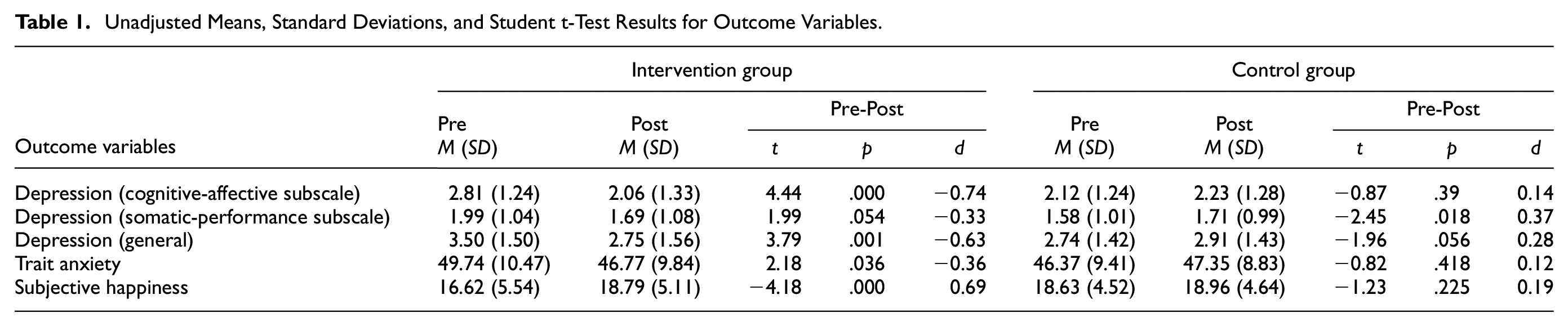
The pre- and post-test unadjusted means and the results of comparing the means using t-tests are shown in Table 1. Significant shifts occurred in the experimental group for all main measurements: the overall level of depression significantly decreased at the time of the post-test, M = 2.06, SD = 1.33, compared to the pre-test results, M = 2.81, SD = 1.24; t = 3.79, p = .001, d = −.63; happiness increased quite strongly at the post-test, M = 18.79, SD = 5.11, compared to pre-test, M = 16.62, SD = 5.54; t = −4.18, p = .00, d = .69; and personal anxiety decreased slightly during the post-test, M = 46.77, SD = 9.84, compared to pre-test data, M = 49.74, SD = 10.47; t = 2.18, p = .036, d = −.36. In the control group, significant changes were found only for the somatic performance subscale of the BDI: post-test results, M = 1.71, SD = 0.99, when compared to pre-test data, M = 1.58, SD = 1.01, showed a slight increase in somatic symptoms (t = −2.45, p = .018, d = .37).
Unadjusted Means, Standard Deviations, and Student t-Test Results for Outcome Variables.
The adjusted post-test means, ANCOVA results, and effects sizes are shown in Table 2. Participants in the experimental group showed substantially lower levels of depression (F = 14.4, p = .00, η2 = .07) and significantly higher results on the scale for subjective happiness (F = 5.54, p = .02, η2 = .02). Significantly lower levels of depression were found on both the cognitive-affective (F = 14.3, p = .00, η2 = .07), and somatic-performance subscales (F = 5.53, p = .02, η2 = .04).
Intervention Effects for All Outcome Variables, Adjusted Post-test Means, ANCOVA Results, and Effects Sizes.

Note. Significance statistics were calculated via ANCOVA with treatment group as a predictor and pre-test scores as covariates. Eta2 was calculated by the formula η2 = SSeffect/SStotal.
Data on trait anxiety did not show significant differences between the experimental and control groups. Nevertheless, the results were almost significant and, given the small sample size, could be taken into account. Participants in the experimental group showed lower levels of personal anxiety (F = 3.78, p = .06, η2 = .02).
Multiple linear regression analysis showed that attending mindfulness training sessions and completing additional course exercises did not affect the outcome indicators for depression, anxiety, or subjective happiness. The frequency of meditation practice and reading the course materials were shown to be significant moderators of the effects of the training, when considering the influence of the pre-test results. Thus, reading materials predicted levels of subjective happiness (β = .24, p = .03), while frequency of meditation predicted levels of depression (β = −.34, p = .01) and anxiety (β = −.26, p = .04).
Correlation analysis for depression, anxiety and subjective happiness showed that all three variables have strong significant relationships with each other (from | .59 | to | .7 |). The direction of the relationship is as expected: positive for depression and anxiety; negative for subjective happiness and depression, and subjective happiness and anxiety.
Discussion
The purpose of this study was to examine whether a brief mindfulness-based program could reduce stress experienced by first-year students of the Psychology Department of UrFU. As hypothesized, such a program reduced students’ depression and increased their subjective happiness. Other similar studies conducted on student samples also showed a decrease in depression after taking mindfulness intervention (Assumpcao et al., 2019; Gallego et al., 2015). There have been no other studies investigating the effect of a mindfulness-based intervention based on MBCT on subjective happiness in a student sample. At the same time, the study by Collard et al. (2008), conducted on a student sample revealed an increase in the level of life satisfaction after the MBCT course. However, the adapted FPFW program did not affect anxiety levels significantly. This result was surprising given that previous studies of this kind had shown significant positive outcomes for anxiety (Gallego et al., 2015; Taylor et al., 2014). Nevertheless, the result of this study turned out to be close to significant and can be taken into account. The lack of significant positive results regarding anxiety may be explained by the fact that the post-test was conducted in the pre-exam period of the school year, during which all students generally experienced increased anxiety.
The effect of the program was small for depression and subjective happiness. This result is generally consistent with the results of similar studies conducted with student samples. Gallego et al. (2015) showed a moderate decrease in depression in students after taking a mindfulness course based on MBCT. Collard et al. (2008) showed a slight increase in student life satisfaction after completing an MBCT program. It should be noted that in this research, the duration of the sessions was shorter than in other similar studies.
Mindfulness, rumination, and self-compassion have been shown to have a significant effect on levels of anxiety, depression, and subjective well-being (Frostadottir & Dorjee, 2019; Kuyken et al., 2010; Michalak et al., 2011). Hence, we anticipate that the observed effect of the program may be due to a decrease in rumination, an increase in mindfulness and self-compassion among the participants of the experimental group. Rumination could potentially be associated with adaptation to a new learning environment, the laboriousness of the educational process in the Department of Psychology of the Ural Federal University, and personal experiences typical of a young age. Pre-test data on the Spielberger questionnaire showed that at least half of the participants in the experimental group had an increased level of rumination: Fifty-seven percent of the participants noted that they “often” or “very often” experience anxiety when they think about their affairs and worries. At the same time, post-test data showed that the levels of rumination decreased: only half of the participants responded that they “often” or “very often” experienced anxiety. Low levels of self-compassion were also characteristic of the participants in the experimental group. Thus, pre-test data on the Beck questionnaire showed that 59% of participants experienced disappointment to one degree or another in relation to themselves; 57% of participants experienced some degree of guilt. After the training, only 42% experienced some degree of disappointment in relation to themselves, and only 34% experienced some degree of guilt.
The individual effect of the program depended on each student’s willingness to regularly devote time to mindfulness development. It is noteworthy that the fact of attending course sessions did not affect the student well-being. Since the sessions were held once a week and lasted for only 30 min, the main work involved practicing meditation, reading course materials and performing additional exercises at home. Those who completed their homework consistently exhibited better results. Previous studies that examined the relationship between attendance, homework, and outcomes have shown controversial results ranging from no correlations (Jain et al., 2007) to positive correlations (Collard et al., 2008).
At the end of the study the control group registered a significant decrease in somatic performance subscale of the BDI, which negatively impacts student psychological well-being and is reflective of depressive modes. These changes attest to earlier studies suggesting that the first year at a university is associated with deterioration in students’ mental and physical health (Nikonorov & Chuklova, 2009; Pritchard et al., 2007). At the same time, the mindfulness program showed that it can prevent such a decline, and even improve psychological well-being of the participants in the experimental group. Mindfulness skills can equip students with healthy ways to overcome the discomfort related to their introduction to a new environment. Instead of reacting emotionally, students can learn how to recognize and regulate their emotions, which leads to a sense of freedom, and helps them make healthier and more appropriate decisions (Shapiro et al., 2011). Intervention effects on depression, anxiety, and subjective happiness are particularly important, as they might play a foundational role in predicting students’ academic and social adjustment (Pritchard et al., 2007), which in turn can lead to better long-term outcomes later in life (Maggs et al., 2012).
High rates of active participation in this study (64% of participants attended at least five of the eight face-to-face sessions of the program) suggest students’ interest in the topic of stress management and the need for relevant information. This may also be due to the fact that a significant portion of the students experienced symptoms of anxiety and depression before the study began. Nevertheless, given the positive results obtained, it can be assumed that the students gained some experience that helped them reduce the severity of these symptoms. In addition, the lessons learned in the course can be applied to future personal and professional activities.
As expected, mindfulness practice showed positive results within a Russian cultural context and supported the cross-cultural validity of mindfulness-based interventions.
Generally, the results of the present study suggest that the brief mindfulness training should be further studied as a tool that could be used by UrFU to work with freshmen in the psychology department on a regular basis and that could be extended to students of other departments.
Limitations
The present research took the form of a case study, which does not allow to generalize its results to students from different educational institutions. Students’ initial level of mental health, intensity of stress factors, and stressors at other institutions of higher education in Russia may differ. Nevertheless, the positive results of the present study and the feasibility of conducting such research in a university setting in Russia gives support for its further replication at a larger scale. The second limitation has to do with the figure delivering the training. The mindfulness-based program was led by a specialist who did not have prior experience delivering mindfulness training. This may affect the program’s quality which could be reflected in the results. Since only one trainer taught the program, his/her personality may also have had an influence on the results. Finally, the present study only considered the effect immediately after the training. Hence, it is impossible to conclude the length of such an effect. This could be addressed in further studies. Finally, the absence of active control group does not allow for isolating the specific effects of the program versus the general benefits of attending a regular group outside of the classroom. Although the social desirability effect among the experimental group was controlled for, future studies would benefit from including physiological measurement, time-intensive assessments, and second-person objective perspectives on students’ lived experiences, such as assessments from family members, friends, or teachers.
Conclusions
Mindfulness-based programs are actively used by foreign universities in their work with students. Previous research has shown that such programs can have a positive impact on the psychological well-being of students, including first-year students who are subject to increased stress caused in the process of adaptation to a new learning environment. Even short versions of such programs, which are most convenient for working with students, can have a positive impact.
Since Russian universities do not provide sufficient support to first-year students, especially to students of helping professions, in the process of their adaptation to a new university life, the present study explored the feasibility and effectiveness of mindfulness training as a way to support students’ well-being. The study hypothesized that a brief version of a mindfulness-based psychotherapy program would have a positive impact on the mental health of first-year students from the Psychology Department of UrFU. This pilot study found that a brief mindfulness training can lead to a decrease in depression and an increase in subjective happiness. These results support the use of this version of the program in regular work with first-year students of the Psychology Department of the UrFU as a way to support students’ adaptation and well-being during their first year at the university. Further research could additionally explore what aspects of first-year university experience contribute to students’ anxiety and stress and, hence, what support programs a university can develop to address students’ needs. We intend to use this case study to explore the effect of mindfulness-based training on first-year students’ well-being among a wide student population of the Ural Federal University by including active control group, randomization, and additional measurements that would allow for a more objective assessment of the effect of the program. Conducting such a study would make it possible to consider the possibility of introducing this program across the entire university.
Footnotes
Declaration of Conflicting Interests
The author(s) declared no potential conflicts of interest with respect to the research, authorship, and/or publication of this article.
Funding
The author(s) received no financial support for the research, authorship, and/or publication of this article.
Ethics Statement
Consent to the study was obtained from the head of the Ural Humanitarian Institute (a structural unit of Ural Federal University, which includes the Department of Psychology), responsible for ethical issues.
