




Abstract
This study presents the dementia researchers views of research networks, and how the networks fit into their pursuit of research objectives and dementia research funding. We conducted 10 semi-structured interviews with 10 leading dementia researchers in Norway, for a qualitative study inspired by grounded theory. The dementia researchers consider the six categories to determine the legitimacy of the proposed network and its proposing person. The six categories are: personal motivation, relationship and friendship, communication, research funding, research management, and network characteristics. The dementia researcher offers insights into best practice of research networks. The study suggests that leading dementia researchers collaborate effectively on research activities toward personal research interests and objectives, but these are not actively aligned coordinated with the interests of the public research funding institutions. Lack of coordination between the funded dementia researchers and the funding institutions limits the potential performance from the dementia research.
Introduction
In 2022 it became evident that the Norwegian Government wanted to change the public research funding model, including but not limited to allocation of funds, communication, collaboration, reporting and governance. “The Government believes that it is time to review the research system to assess whether changes are needed that can make optimal contribution to achieving research policy objectives” (Ministry of Education and Research, 2022). The Government has now initiated a White Paper on the future Norwegian research structure in 2025. Such revision of the research structure, can be particularly relevant to life sciences where the volume of research papers has grown rapidly, but with declining disruptive impact (Park et al., 2023).
Research in Norway is funded by public (53%) and private (47%) sector. The total funding of Norwegian research was NOK 78 billion in year 2020 (Research Council of Norway, 2022). Medical and health research is funded more than 90% by public funding (Den norske legeforeningen, 2016), through the Research Council of Norway (RCN) and the operating budgets of public research institutions, for example, universities and university hospitals.
A research team working in a research project is often called a “research network.” The researchers, themselves, can be employed full time by an institution, but many are employed part time by multiple employers/institutions and/or hired on a project basis.
In the case of dementia research, researchers fundraise from internal and external research funding bodies to finance their research and to secure a personal income for themselves and the research team, hereunder their respective research staff, such as PhD students, postdoc staff, statisticians, and data specialists. Applying for grants and other research funding is time consuming and preliminary conversations with dementia researchers in preparation for this study, suggests that leading dementia researcher fundraise a significant part of their working time.
Research project teams develop respective research bid documents (funding application) which responds to an invitation to bid (“call for proposal”) in competition with other research projects. These calls for proposals are issued by the public funding bodies, such as RCN, and the funding objectives in the “calls for proposals” will reflect their political priorities and/or market demands.
The Theoretical Gap This Study Aims to Address
Research has been done to quantify the efficiency of research networks from the funders point of view, and oriented around institutional “supply-side” of networks, rather than the “demand” from the researchers themselves. Regardless, the conclusions from network research are fragmented and inconclusive. It is difficult to draw firm conclusions from this research, due to evaluation quality, definition variations, range of application and multifaceted implementation and measuring of actions (Eglene et al., 2007; Lee & Bozeman, 2005; Provan & Milward, 2001; Ranmuthugala et al., 2011; Robeson, 2009). One study suggests that research networks did not increase research production during the funding period, but rather inspire collaboration after expiration of the funding period (Defazio et al., 2009), while another study states: All networks are dissatisfied and frustrated with the present state of affairs as far as Danida’s research policy is concerned ( Tostensen, 2006).
Most network participants experience challenges related to their network participation. They can experience challenges related to role expectations, selection of participants and culture. It is beneficial if the network participants have participated earlier, that they consider themselves to have similar research status, that they define common goals, and communicate in a varied and appropriate manner (e.g., video conferencing, phone, email, newsletters, blogs, chat (Sibbald et al., 2014).
We have not found previous research on the dementia researchers’ views on research networks and how this relates to dementia research funding. Thus, this study aims to provide such insight to researchers, policy makers, institutional management, and other decision makers in the research value chain that can be utilized in policy making and public health management.
The literature search was primarily done on the literature databases, Medline (PubMed), Scopus, Web of Science, Embase, and the publisher Elsevier. Multiple search words and combinations have been used across the databases. Search words include but are not limited to: research*, collaboration network*, research network* collaboration, funding, financing, researcher, scientist, perspective, experienc*, view*, perce*, attitude?, researcher?, scientist? “communit* of practice.”
The Aim of the Study
First, this study seeks to present leading Norwegian dementia researchers’ views of research networks and collaborations and how that fit their pursuit of research objectives and their personal take-aways as “best practice.”
Second, these networks and researcher collaborations are dependent on funding. The network and collaboration findings will therefore be discussed in a management theory context to explore the research execution fit with Norwegian public funding objectives.
Theory
Management of dementia research is inherently complex. In order to be able to explore the research execution fit with Norwegian public funding objectives, we want to discuss these findings a management theory context. The complexity includes managing stakeholders’ and individual researchers’ interests and objectives, across roles, organizations, office locations, and planning periods.
Thus, management theories based on a common sets of objectives and priorities, such as Management by Objective (Drucker, 2012) can be considered less appropriate as a theoretical framework for, even if precise and challenging work objective can have a motivational effect (Latham et al., 1994)
As an alternative, Fair Process (Kim & Mauborgne, 1997) was selected. Fair Process is a management theory that assumes that individuals are driven by more than rational economic self-interest, but also good working processes, which complement the economic/rational outcome with personal satisfaction, trust and creativity.
This management theory has its roots from studies on legal compliance in the 1970s (Thibaut et al., 1974). The benefits of Fair Process were later confirmed across cultures and collaborative models early 2000 (Tyler et al., 2000). Fair Process is in this respect a process-oriented and operational management theory, that is not limited to work processes within one organization and/or within a defined organizational hierarchy.
The elements of Fair Process are proven, intuitive and have a low cost of implementation. Some may even argue that it is too inexpensive to implement, because leaders and administrators may discounts its implementation value (Brockner, 2006).
Fair Process has three required elements that need to be managed and executed diligently:
Engagement
The relevant persons must be invited to share their ideas on the topic discussed. This iterative engagement process makes better decisions and improves execution.
Explanation
When decision makers land a decision, efforts should be made to explain why the decision was made and elaborate on how the Engagement was used as an input to the final decision. This makes it easier for the persons involved to thrust the reasoning behind the decision, also if the decision is not aligned with the comments and input from the Engagement process.
Expectation Clarity
The third element is to define the how the final decision will impact the people involved. New procedures, expectations and rules are formulated in the Expectation Clarity process. Fair Process promotes collaboration and reduces the probability of haggling and “sand-bagging” the execution, but it is key to address that non-compliance to the decision will have consequences.
The expected benefits from conducting all three elements of Fair Process are increased trust and commitment from the individuals involved and motivate voluntary cooperation to deliver results exceeding expectations and defined objectives.
The elements of Fair Process is not a foreign concept of management for large and complex organizations. One robust variation of Fair Process is Mission Command leadership (Norwegian: Oppdragsbasert ledelse) implemented in the Norwegian Armed Forces (Kristoffersen, 2020; The Norwegian Armed Forces, 2020).
Method and Analysis
Research Method Inspired by Grounded Theory
The purpose of this study is to map dementia researchers’ views of networks and collaboration, and how it may contribute to their research. It was therefore deemed appropriate to use semi-structured interviews in a qualitative study. Arguments for this method include: The dementia researchers are asked to talk about a topic they normally do not talk about, and the selected format allows for a reflective and dynamic development of the interview, where the dementia researchers can express themselves using their own words within their own individual context (Brinkmann & Tanggaard, 2020, p. 43).
This study explores perceptions and social behavior by individual dementia researchers in networks across research institutions, on which previous studies have not been found. Different methods and data driven analysis strategies were considered for the study. It was a priority to identify meaningful and data driven categories to develop new theory through reorganization and analysis of the interviews. Therefore, data driven, but less structured analysis strategies such as immersion-crystallization and template analysis based on a priori and predefined analytical categories were not selected (Malterud, 2002). An editing analysis strategy was selected, where the reports from the interviews were analyzed with inspiration from grounded theory with a Glaserian approach as set forth by Cathy Urquhart (Urquhart, 2022), and supported by Merete Watt Boolsen and Christina Goulding (Brinkmann & Tanggaard, 2020; Buchanan & Bryman, 2009).
The use of grounded theory in this study generates a new theory of perceptions and social behavior by individual dementia researchers in networks across research institutions. We have not found comparable theories or opponents to this new theory developed in this study. However, this new theory can be tested in future research, hereunder by hypothesis-testing and quantitative research methods.
Theoretical Sampling—The Interviewed Dementia Researchers
We identified persons that would be likely to provide early, hands-on and in depth insights to dementia research networks and research funding (Buchanan & Bryman, 2009), within a planned range of 10 to 25 participants. (Malterud, 2013). Theoretical sampling is a key concept of grounded theory, where data collection is continued until additional data collection do not add insights toward the theory being developed (Suddaby, 2006), and a required theoretical saturation is achieved. In this respect grounded theory differs from other scientific methods based on hypothesis testing, where the number of interviews are determined by rules (Buchanan & Bryman, 2009).
A total of strategic selection of 13 leading Norwegian clinical dementia researchers were considered relevant as prospective interviewees.
During the 5 week data sampling and analysis period with constant comparison, ten of these dementia researchers were invited and interviewed (the “participant” or the “researcher”), before theoretical saturation was reached, ref Table 1. With careful research planning and execution, four to seven participants can be sufficient to provide an acceptable pool of research data (Malterud, 2013). Data saturation in accordance with grounded theory was achieved with less than 10 interviews, but to ensure a sufficient level of abstraction in national representativeness and research experience, all 10 researchers were interviewed.
Respondent Characteristics.
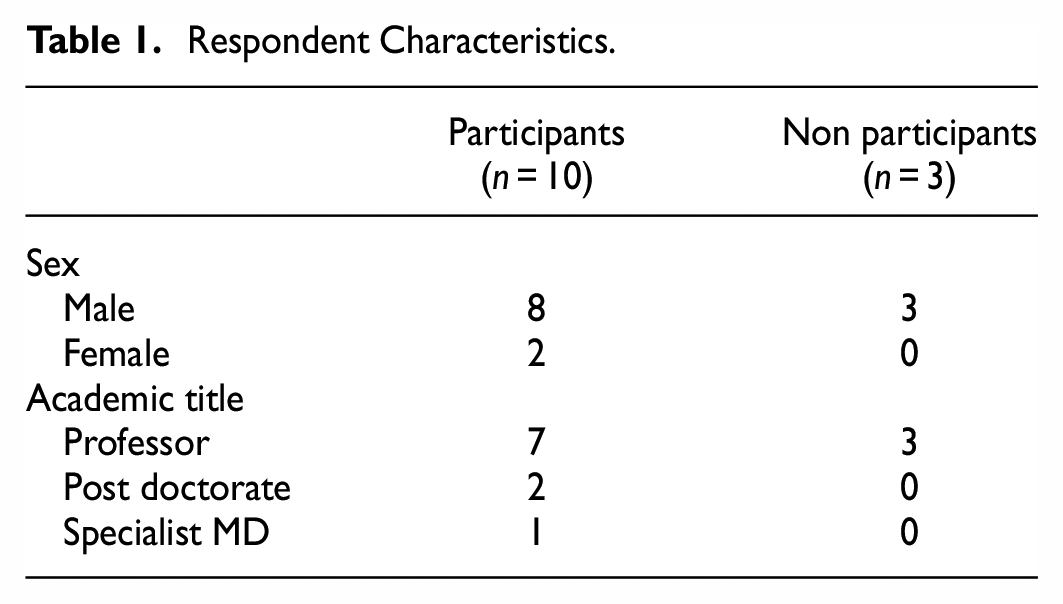
The selected participants were a purposeful and theoretical sample that were expected to be able to provide insights into own research work and the Norwegian dementia research ecosystem and culture (Buchanan & Bryman, 2009). The participants, ref Table 1, had the following characteristics:
Have a full or part-time leading research position on a regional, national, and international level;
hold a leading research position as chief investigators, head of research and/or have a leading research position in the Norwegian and international dementia research community;
are combining dementia research with clinical work or are full time researchers;
work in three of four Norwegian regional health authorities;
are networking regionally, nationally, and/or internationally, and
are employed by one employer or employed by more than one national and/or international employers. All invitees know each other from earlier research studies, networks and collaborations. One invitee declined to participate because he no longer worked in the field of dementia, and two invitees failed to reply to the invitation to participate.
The 10 participants were given a number between 1 and 15 by the first author. Participation in the study was informed voluntary and based on written consent from the participants.
Data Collection—The Interviews
The interviews were planned to be about 30 min, and actual interview times were between 25 and 60 min. The interviews were one-on-one with the respective participants and the first-author. The first-author, who conducted the interviews, has more than 20 years of experience from corporate management, financing and management consulting, hereunder management interviews.
All interviews were held within a 5-week period April to May 2022.
The interviews were based on an interview guide with seven questions. The interview guide was used as a general reference and started with more general questions before moving into more operational topics.
The participants were not challenged on topics covered by Art. 9 GDPR (General Data Protection Regulation).
The first general question was in most cases the key question necessary to kick-start the dialog, but with complementary questions in the interview guide to elaborate on topics in the conversation.
The first general question was:
Participation in research networks is a part of daily work for a clinical dementia researcher. Can you tell more about your experiences and reflections from such networks and informal research collaborations (Communities of Practice") with colleagues in Norway?
Fair Process was the preferred management theory at the time of the interviews, but this was not used to add structure to the semi-structured interview guide or to actively direct the respective interviews.
In the introduction to the interview, the first-author presented himself:
his background, from corporate management, financing, and management consulting,
his relationship with the Center for Age-Related Medicine at Stavanger University Hospital (SESAM) in Stavanger, Norway,
the practicalities regarding taking notes during the interview,
the process and timing of making/approval of an interview report,
the interview agenda.
The written invitation to the invitees were based on a standard information letter template developed by Norwegian center for research data (NSD) (the “Invitation”). The Information letter included the consent form.
Notes were made by the first-author during the interviews and the notes were used to write interview reports from each interview as soon as possible. The respective interview report was sent to the participant no later than 3 days after the interview for review, comments, and approval. Total time from interview to approved interview reports were typically done within 1 week. The interviews were not audio nor video recorded. The deciding arguments for this was that the topics discussed most likely would require significant exploratory reflection during the interview, and an approved report would allow the participants to clarify any statements they may have made in an exploratory conversation. The approved interview reports were 3 to 6 pages. The interview reports were anonymized for review by the co-authors.
Constant Comparison and Category Development
The interviews were conducted in batches of three, three, three, and one over a 5-week period. This allowed an evolving process for the interview data and analysis, to provide a purposive sampling and subsequent theoretical sampling to pursue developments in the evolving theory (Chun Tie et al., 2019).
When the interview reports were approved the first step was to read the reports to get an overall understanding of the content when approved by the participants. Each paragraph in the reports were open coded to identify its key words and group of words in a search for meaningful categories that made sense, and that could have explanatory power.
The participants are involved in a range of areas, such as basic research, genetics, biomarkers, diagnostic, and drug development, and much of the data consisted of personal stories and reflections. The analysis and coding required multiple rounds of intermediate coding and category comparison to develop from the 31 initial code categories, which included these categories grant applications, funding competition, institution insights, network experience, personal needs, personal power, relations, management, and social governance.
Memo writing is key to grounded theory (Chun Tie et al., 2019) and short memos was noted through the analytical process. This was a particularly helpful during the process clarifying connections and sequences of a theoretical link between the categories (Glaser & Holton, 2004). The memos were also complemented by storyline diagrams. The use of storylines are debated by some (Birks et al., 2009), but proved helpful in the analysis after the open and axial coding. The storylines were also helpful when discussing the analysis is with cowriters and other researchers to assure trustworthiness of the data, ref Figure 1.

Example storyline diagram from the advanced coding phase developing selected categories.
The batched interviews and evolving analytical process described above added to the theoretical sensitivity and ability to judge the significance of new data and additional coding to achieve data saturation for the grounded theory. This allowed better understanding of recognizing the similarities, but also identifying and explaining the differences in researchers’ behavior, which is key to grounded theory (Buchanan & Bryman, 2009).
The participants’ input was thereafter coded in seven selective categories, which leads to an emergence of a meaningful core category which summarizes how researchers reviews and potentially accepts participation in networks.
The Network Invitation—The PROTECT Norge Network
After the invitations was sent to the invitees, but prior to the interviews, all participants were invited to participate in a network to promote a digital research database, PROTECT Norge (https://www.protect-norge.no/). Nasjonal samarbeidsgruppe for helseforskning i spesialisthelsetjenesten, NSG, funded the establishment of a PROTECT Norge network and this study. PROTECT Norge is managed by Center for Age-Related Research (SESAM) in Stavanger is a Norwegian research database building on the PROTECT UK infrastructure (https://www.protectstudy.org.uk/). The network invitation was sent by Head of Research at SESAM, an internationally renowned dementia researcher and well known to the invitation recipients and the participants. The intention was to have a network opportunity as a real time reference for the interviews.
In the PROTECT Norge invitation, the names of the invited persons to the network were visible in the email invitation.
The first-author participated in developing the invitation to the network, but the final text and list of recipients were determined by the sender.
All participants to this study had responded to the PROTECT Norge network invitation before their respective interviews. Therefore, the network invitation was a current network event, which was a timely talking point and example when the participants elaborated in their interviews.
Data Protection and Ethics
There are no known reasons this study cannot be repeated. All interviews may potentially include sensitive personal data, and it is a legal obligation to seek the advice of the Data Protection Officer. University of Bergen has an agreement with Norwegian Center for Research Data (NSD) to ensure compliance with this obligation. NSD reviewed the study project outline, the interview guide, the invitation to participate and the NSD dialog questions. The NSD compliance was received before the Invitation was sent to the invitees.
Research is governed by ethical principles, rules and regulations. This is to protect people against damaging research and from unauthorized distribution of personal information (Johannessen et al., 2010; Malterud, 2012). The reports in this study are stored in Stavanger University Hospital’s Research encrypted data storage facility. To get such access, an additional Data Protection Officer review was done by Stavanger University Hospital, eProtocol, to the same effect and conclusion as by NSD, that the project is in accordance with rules and regulations applicable to Data Protection Services.
The study does not include any special categories of personal data, ref Art. 9 GDPR (General Data Protection Regulation).
Results
The analysis led us to a workflow that led to a core category, which explains how dementia researchers considers new research networks and collaborations: Legitimacy.
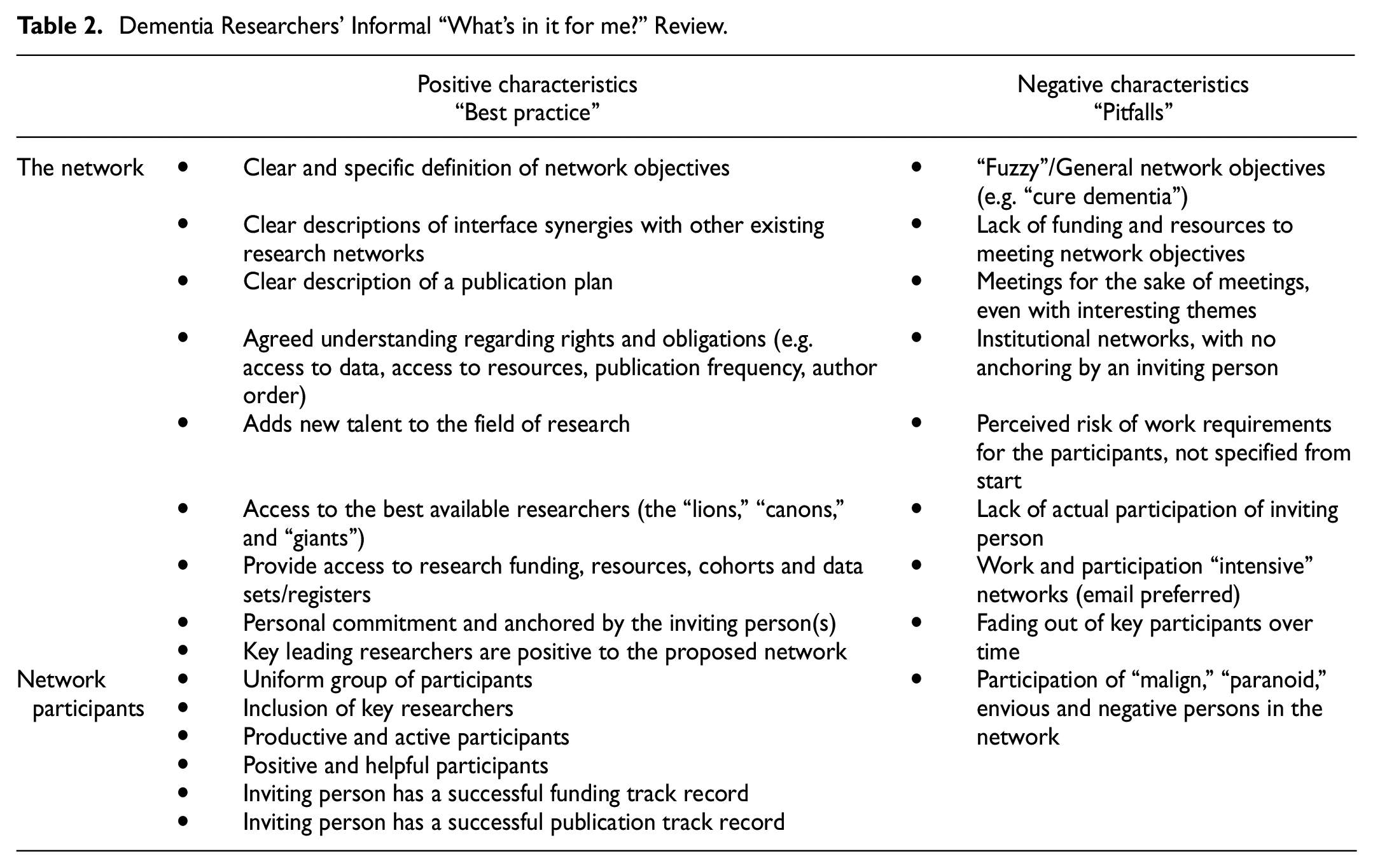
The seven selected categories are sub-elements compromising the legitimacy review. “Personal motivation” means that the dementia researchers’ personal interests are at the core when considering research collaboration, but that continuing good personal “relationship/friendship” is attractive. The network “communication” must fit into the daily routine of the reviewing dementia researchers. The network members do not want to be surprised with unexpected network tasks so the planned network “research management” must be solid. In addition to this, the dementia researchers are acutely aware of lessons learned from past networks, so collectively they are quite specific in their list of “network characteristics” that can be considered network “best practice” and “ pitfalls.”
Core Category—Legitimacy
Before entering into new research projects and networks, the researchers review the research invitations carefully to determine whether to participate or not. The researchers consider the inherent qualities of the (i) the proposed research project/network and (ii) the inviting person before they are willing to participate in a network/collaboration. Some researchers specifically state that they consider the “legitimacy” of the inviting person and proposed network, others describe the review processes in more general terms.
“My experience has shown that networks with the “right” persons are important in applications for funding. … It strengthens the legitimacy of the application.” (Participant 2) “General objectives for a network reduce its legitimacy, and it is probably easier to have higher legitimacy if a network has a concrete and limited field of interest.” (Participant 3)
It can be argued that the definition of “legitimacy” is more a description than a specific definition. For the purpose of this study, I use the following definition (Suchman, 1995):
Legitimacy is a general perception or assumption that the actions of an entity are desirable, proper or appropriate within some socially constructed system of norms, values, beliefs and definitions.
This review and testing of legitimacy is not described by the researchers as a formal and/or uniform process by the dementia researchers, but more as a subjective and intuitive review. Regardless, common to all researchers, is the purpose of the legitimacy review, and to answer the question: What’s in it for me?
“It sounds egocentric, but the first thing I think of is: • What’s in it for me? • Is the network relevant for the work I do? • Are the inviting persons to the network proactive and productive people?” (Participant 5)
As a core category, “legitimacy,” can be developed to a theory describing how researchers considers participation in research networks. This can be utilized to design strategies and action plans for implementation of networks/collaborations. The theory can also be used to explain why networks have succeeded or failed.
Before concluding with legitimacy as a core category it was tested by the six core category criteria (Brinkmann & Tanggaard, 2020, p. 326). Legitimacy complies with the six criteria of a core category and explains the complexities of establishing new networks/collaborations. The selected categories can all be related to the core category. Elements of the dementia researchers’ legitimacy review occurs frequently in the reports. Review of the selected categories is a logical and consistent topic for the dementia researchers. Legitimacy is an abstract category which can elaborated from other specialties (e.g., business management, law, sociology, political science) to develop a more general theory. Legitimacy can be related to other concepts, which can be used analytically to develop the theory, and explains the data and its variations.
The researchers’ legitimacy review includes a personal and institutional component, and follows the traditional definitions of legitimacy (Rasinski et al., 1985)
These review items were confirmed in practice when they received an invitation to participate in a network related to PROTECT Norge. The written feedback was positive, courteous, and quick, as the invitation was sent from a research “lion” (Participant 6). In line with the above, the invited researchers stated that they wanted to confirm that the inviting lion intended to participate in the PROTECT Norge network after network start-up. Unless, addressed adequately to the potential participants satisfaction, it is likely that the invitation would be considered institutional and therefore not to be prioritized.
Personal Motivation
The researchers are generally positive to work in networks. The category dimensions are varied. The less experienced researchers join research groups to meet peers in an early phase in their careers, and to build reputational capital.
“I think it is good to be part of a network where I have a “proforma” participation because it helps to get an overview of what is happening in the dementia research community, and it is an element of I scratch you back-you scratch my back.” (Participant 6)
Dementia researchers uses research networks as a motivational factor.
“Research is a lifestyle. It can be little bit boring, and it can at times be fulfilling and easier to do the work on Friday nights if you work [in networks] with people you like.” (Participant 5).
A complementary personal dimension is idea generation and the ability to execute the research. An experienced dementia researchers is dedicated to own work only, but others seek new ideas in collaboration across institutions and national borders.
“I always work in networks that are targeted on my personal goals, that is a rule for me.” (Participant 13) “Networks are a place to (i) test ideas, (ii) where plans are made for actual execution and (iii) implementation of research that answers to those ideas.” (Participant 11)
Common to all participants’ motivation is that they are carefully considering the personal benefits of participating in a prospective network prior to accepting an invitation. Four researchers want answers to their explicit question:
“What’s in it for me?” (Participant 1, 3, 5, and 9).
Relationship and Friendship
The Norwegian dementia research community is relatively small and transparent. The participants have a clear and personal perception of the network participants they work with. In many cases, they describe them as their friends. Friends with positive social energy, efficiency, high quality work, intelligence, and network inclusion. Friends that they can message if they need something and from who they can get a very quick answer.
“They are my good friends…they have been key to my research. Not only because they have a high h-factor, but they are unique people, who continue to care genuinely about weak groups in society.” (Participant 15)
The social elements of networks are important for some. One participant makes this point.
“Networks are not only academics and publications, it is also nice to eat lunch/dinner together. Much laughter and fun. That is an important point. It creates energy.” (Participant 2)
Having said this, the participants are equally conscious about the other end of the category dimension, by carefully staying away from negative people who are “paranoid,”“malign,”“envious,” and “worried that others take their ideas and are likely to “take” their funding ideas.
The personal relations between the dementia researchers are the key building blocks of a successful network. In fact, some researcher will not even prioritize responding to network invitations on behalf of institutions.
“I’m in the networks long term. I consider if the networking relationships are beneficial going forward. It is personal relations, so if an institution ask me to contact an institution I’m not familiar with - yes - then it drops to the bottom of my agenda.” (Participant 5)
Communication
A leading researcher’s day is filled with emails and digital meetings (e.g., Teams and Zoom). Communication has two dimensions. Communication that requires review and commenting and communication between research friends. Long hours are spent processing the “inbox,” sorting out well meant but irrelevant emails sent to applaud and support.
The emails are pouring in from a multitude of networks and projects. Attached to emails are documents sent for other researchers’ review. This email workload from existing networks is a contributing factor to their reluctance to accepting participation in new networks. Despite this, there is little interest in replacing emails and meetings with more modern communication platforms. A younger researcher is an exception and uses Ryver, a team communication app, for research communication, “very much, very frequent, all day (24 hr)” (Participant 6).
If urgent, a text message can replace email for most of the researchers. Phone calls are not a preferred alternative, as the researchers are communicating to their research networks at different times of day.
“Our form of communication is old-school, but the leading dementia researchers are typically older persons, so maybe it is a natural thing.” (Participant 3) “Networks leads to an enormous number of emails and Teams-meeting. Too many people reply uncritically to emails with “me too”, applause and support words with no additional meaning. In addition is it necessary to filter emails with respect to own relevance, and relate to large volumes of documents for review.” (Participant 11)
Research Funding
Networks are closely linked to specific research projects and its funding. In that sense this category has a more binary dimension. Networks do not work without dedicated funding.
“My experience has shown that networks with the “right” people are important for funding applications.” (Participant 2)
Many networks are formed for the purpose of fundraising—as part of a grant application. The overall positive effect is that it promotes collaboration across the Norwegian research organizations, and forces people to update their research ideas to be more relevant with respect to political and public objectives.
The mandates of the public calls for proposals are political. Some researchers are impressed with the Government’s ability to be forward looking and in tune with the needs of society, but others strongly disagree with this viewpoint. Regardless, fund raising for dementia research is time consuming. All participants report using a significant part of their working time writing applications for funding. One researcher finds this a very positive activity.
“I’m a fan of writing applications and use 70% of my time on this It is really fun and makes sense to me. Calls for proposals trigger me. I’m thankful writing applications, even if I’m not awarded any grants…. It is very little money in the system, and you need to be better than 94% of the other applicants applying for funding from the Research Council of Norway.” (Participant 15)
Therefore, some networks are established to fit the requirements of the calls for proposals, rather than the researchers perceived need for collaboration itself. The participants are therefore expressing that they don’t intend to collaborate if not awarded the financing.
“Many networks exist because money is connected to the establishment of these networks…” “Networks are sometimes a necessary evil in order to get funding to dementia research. Sometimes they are fictitious, with known names to get a “name-dropping” effect.” (Participant 3)
Research Management
Many dementia researchers have one or more employers, and the employment situation is relatively dynamic as it follows the availability of salary payments and research funding. The employers can be formal organizations like hospitals, universities, private/public institutions and or temporary project organizations in Norway and in combination with international engagements.
The mix of employers affects the alignment of personal research goals with institutional research goals, negatively. None on the participants mentioned or related their personal or project goals to institutional goals.
“We may have a common mission/vision, but I recognize that the overall goals drown in the work related to smaller projects. Each project is its own silo with its own goal, even if resources and support teams are shared. It is not so that everybody working in [the institution] have a common goal and everybody is working to achieve that goal. The projects have definitely own goals.” (Participant 2)
None of the dementia researchers suggested that their research was coordinated on an institutional or national level. There are several good research teams and research “ecosystems” in Norway. Leading researchers are allowed their own research projects and opportunity to “shine.” No institution provides a coordinated Norwegian scientific “brand” or set of objectives. However, one researcher said: “It should be one network in Norway. Networks are only coordination and branding. We should include the clinicians because the best assets we have are the registers and databases. We must take the best scientific idees to this network.” [but] “…We can’t be entirely Stalinist.” (Participant 1).
The researchers express a general willingness to seek government funding for a coordinated dementia research initiative, but no researcher suggested a way to do this in practice.
A handful named researchers are considered to be key in the Norwegian dementia research community. This status is based on their research quality and quantity, funding track record and personal skills. They are the Norwegian research “Lions” and the key persons when dementia funding is awarded, distributed and prioritized within the Norwegian research community.
“The “lions” of research have strong opinions of research work and what to prioritize. These “lions” do not always agree, but the different groups seem to collaborate well. These “lions” are also the ones that attract most funding.” (Participant 6)
Research is a competitive activity, and it can be a challenge to get research funding to own ideas, when in competition with the lions. One participant made a clear statement:
“The most known researchers have power, and they utilize it to a certain extent to employ the people they need or to enter agreements. Networks are capital.” (Participant 5)
Network Characteristics
The researchers spoke enthusiastically about the different aspects of participating in networks. Their input can be summarized under two dimensions; the research network and its participants, and their respective positive and negative characteristics. The interviews revealed that the researchers perform a careful but informal due diligence of network invitations when received, and before they respond to the invitation.
Positive characteristics are items suggesting that the new network is worth considering and negative characteristics are items suggesting the researchers would decline participating.
Some of these characteristics were tested when they received the invitation to the PROTECT Norge network. The participants response to the network invitation was very predictable after reviewing the interview reports. All participants responded by email within 24 hr and confirmed their positive interest. However, all participants required additional information on goals, resources and a description of expected synergies with other networks.
In their interviews they were also questioning if it was likely that the inviting person would participate actively in the day-to-day operation of the proposed network.
“I believe it is interesting with PROTECT Norge… but too often we are invited to a “fuzzy thing, that do not specify what work we need to do and how we are paid to participate. We are paranoid with respect to participating in unknown things, without knowing how we must contribute with voluntary work.” (Participant 2)
Discussion
The findings provide a faceted insight of the dementia researchers views on working in research networks and collaborations, and how the networks relate to research funding and objectives.
Researchers are highly motivated and passionate about their research. Dementia research is described as a way of life, filling workdays and “days off.”
The researchers are employed in different universities, hospital, and other institutions throughout Norway. Their research work is partly financed through the institutional budgets, so to mitigate the budget deficit, the researchers seek additional funding from external private and public sources on an ongoing basis. Some report fundraising up to 70% of their working time. There are public and private funding sources for dementia research in Norway, but public project/grant funding are stated to dominate.
Most researchers offer a description of their personal research goals but offers no description or alignment of the objectives with their employing institution. The researchers prioritize their time to achieve their personal goals carefully, and they actively avoid commitments and meetings that are not perceived efficient and goal oriented.
The leading Norwegian researchers work or have working experience from multiple research institutions, with may require commuting within Norway and/or abroad. Some lions have “schools” of PhD students, postdocs and discipline staff (e.g., statisticians and data specialists) for support. The lions are focused on research quality, but not forgetting the need to “pump up” the number of publications. These may be contributing factors to the lions being awarded a large share of the available research funding, and in line with expectations (Bloch et al., 2014)
Calls for proposals from public strategic institutions, such as Research Council of Norway (“RCN”) require the lions to collaborate with other lions in Norway or abroad. This introduces a strict need to prioritize the planned use of time. When researchers are invited to participate in a new project study, the researchers consider the benefits and disadvantages with respect to the pursuit of own personal goals, the proposed objective of a research project and project funding capacity. The researcher performs the test of legitimacy, and if acceptable the researchers join the research project and the project “network.”
There are institutional networks Norway, but researchers consider these “artificial,” as research is considered done through personal relations. Not surprisingly, the researchers actively avoid participation in these institutional networks, unless they are backed by “sufficient” operational funding for specified objective. Having said this, an argument for researchers to prioritize institutional networks activities is if the participation is deemed to be an access point to research funding or access to other types of resources (e.g., support staff and data sets) to support own research.
The Norwegian dementia research community is relatively small and transparent, and some researchers have worked together in teams over years, even decades. The researchers have, in practice, direct personal access to each other, both on a professional and a personal level. Such close relationships between key researchers are important to excel professionally in the research community and will over time increase the ability to fund research as well (Ebadi & Schiffauerova, 2015). This collaboration between the individual researchers is a tacit ecosystem that meets the definition of a Community of Practice a “group of people who share a concern, a set of problems, or a passion about a topic; and who deepen their knowledge and expertise in this area by interaction on an ongoing basis” (Wenger et al., 2002).
The dementia researchers’ community of practice (The “dementia researchers collective”) is active, efficient and solidly based on competence (Wenger, 1999). There is a strong sense of joint vision; the vision of dementia prevention and cure, and better life for the dement patient and their families.
Despite different individual scientific specialties, the common research mission enables them to participate as a collective and work complementary short and longer term. The lack of organizational commitment by the researchers seems to inspire a strong individual engagement.
In the interviews for this study, the researchers speak politely about each other’s interests, strengths, weaknesses, and the norms that forms the researchers collective. A positive “can do” attitude, with high quality research and frequent publications activity are elements of this norm. A norm that builds mutually beneficial reputational capital and ensures willingness to share personal networks and research resources from outside the Norwegian dementia research collective. A sharing of common resources and routines strengthen the collective. Time efficiency is another research collective norm, and this allows a researcher to send a question or request to other researcher without time consuming pleasantries and wording. Communication within the dementia research collective is prioritized, and an answer to a question could come back within minutes. As one researcher said: “It can’t get better than that” (Participant 3).
Some researchers recognize that the dementia research collective has its limitations. One example is that the researchers are getting older and the recruitment to dementia research is lacking. The efficiency-oriented norms may not be an advantage to solve the need for recruitment and succession planning.
The dementia research collective is founded on a strong structure. Seven elements support this (McDermott, 1999):
The researchers have collaborated in the research collective over an extended period and all report added value to their research work and to their personal life.
It is a low threshold for communication, both offering knowledge and know-how and clarifications to ensure relevance of reaching out. The long-term relationships within the research collective adds to the shared understanding of what information is considered valuable to the recipient(s).
Personal communication is complemented with access to information and data sets. This has built interpersonal relationships and a group identity which motivate sharing ideas and tacit knowledge.
The researchers use multiple communication forms, depending on what is considered appropriate. This includes, but is not limited to: email, SMS, chat, personal meetings, video meetings, seminars and social events.
When researchers need information, they can “pull” information from the dementia research collective, rather than accessing a pool of unsolicited (“pushed”) information based on an information distribution requirement (“dissemination”).
The dementia research collective operates within institutional contexts (they are institutionally employed) where the researchers are encouraged to participate
The efficiency and effectiveness of the collaboration has been proven over time and the research collective has proven its “natural energy” for existence.
The Fair Process Gap: Lack of Active Alignment of Objective Between the Research Funding Sources and the Dementia Researchers
The findings in this study offer insights into the networking, collaborations and communications of the Norwegian dementia research ecosystem. We have also identified that applying for research funding is an ongoing and significant research activity.
The dementia researchers have specific requirements of how an appropriate and cost-efficient research network should be structured, and how the researcher use due diligence to determine whether these research networks are beneficial to the respective researchers, and ultimately if the research network is acceptable or not.
The current public funding model for Norwegian dementia research is a distribution model where:
the assumed best suited researchers are rewarded with funding/grants to their research projects and inherent networks, based on “closed bid” applications responding to institutional “calls for proposals,”
incentive schemes are used to promote extensions to the initial funding,
research tasks are standardized, monitored and measured, and
organizational structures are motivated to be developed, for example, with required participation in networks
These are efficient funding principles generating the performance required by the funder, building on the management philosophies building on Fredrick Taylor’s work in the beginning of last century, but they do not inspire trust, collaboration and creativity (Kaufmann & Kaufmann, 2003).
However, significant developments in brain research have emerged from unintentional, but valuable results, “serendipities.” Successful research processes tend to be more chaotic than many people think, and seldom follow straight lines from hypothesis to empirical results. Nobel laurate of medicine, Edvard Moser, still considers traditional hypothesis testing important as a “torch lights in scientific darkness,” but state that it is key not to be limited by the hypothesis or the current knowledge to be able to capitalize on the serendipities (Forskerforum, 2022).
This insight triggers the question: Is management by objectives in a tayloristic tradition limiting the creativity in dementia research? An introduction of Fair Process in public research management can offer higher trust and commitment to the strategic funding institutions’ objectives; a higher degree of voluntary cooperation between the funders and the researchers; and dementia research performance
The strategic funding institutions may, therefore, find it appropriate and cost effective to collaborate with the funded dementia researchers and their respective network to ensure Fair Process, with Engagement, Explanation and Expectation Clarity for future public funding of Norwegian dementia research.
Today, when public funding is awarded, efforts are made to explain why the decision was made, for example, RCN use panel assessments that are shared with the applicants, and the applicants are allowed to submit a brief clarification document to avoid inadvertent misunderstandings. It could therefore be argued that Fair Process Explanation is done.
The strategic funding institutions regulate how the use of the awarded research funding shall be monitored and reported on. In that sense, the funded research projects and networks have Expectation Clarity.
However, the dementia researchers receiving funding are not invited to discuss and align their personal objectives with the policy makers and the strategic funding institutions to ensure alignment of the parties’ objectives. A gap that limits the research performance and co-operation to a lower performance level. According to the Fair Process theory, this lack of feed-back loop (Engagement) represents a “Fair Process Gap,” ref Figure 3.
This study has shared light on researchers’ experiences from working in networks and how they consider new research networks, and how they endeavor to align network participation and research funding with the personal goals and ambitions.
The dementia researchers are motivated to participate in research networks, provided that they have had an opportunity to perform a due diligence of “legitimacy” and ensure alignment between the network and their individual interests. In the case of the PROTECT Norge networks invitation, this legitimacy review was initiated with individual emails from all the invited researchers. The email replies were positive in general, but all asked for supplementary information for them to be able to consider the invitation.
“Thank you for the invitation. This sounds interesting, but could you say more about what it means, beyond a targeted network. Which objectives?” (Participant 3) “Agree, interesting, and positive. But maybe have a discussion on objectives, resources and synergies with existing activities?” (Participant 1)
This Engagement process was in other words, necessary to ensure the researchers’ motivation to participate on networks.
Their request for more information can be considered a first step in an engagement process, before asking for a clarification of the “rules of the game” for that particular network.
Again, Fair Process suggests that if the researcher have an opportunity to conduct an Engagement process and collaborate with the network decision maker to develop a set of networks rules (Expectation Clarity), the network may be perceived as more legitimate and more likely to succeed.
The PROTECT Norge findings are in line with the theory of “Fair Process” (Kim & Mauborgne, 1997), but the Fair Process was only partly executed.
First, the researchers expect Explanation, a network invitation to include explanatory information of the background and intentions of a proposed network, and to be able to comment on the legitimacy elements above.
Second, the invited researchers requested Engagement in a dialog with additional information when the invitation to the PROTECT Norge network was received.
Third, the next step would be to develop Expectation Clarity through dialog with the prospective participants and thereby decide how the PROTECT Norge network will work going forward.
The next steps implementing the PROTECT Norge network would therefore be to revisit the design and the operational execution of the networks in line with the perceived “best practice” in Table 2 and describe this to the prospective participants in a format suitable for a legitimacy review, ref Figure 2.
Dementia Researchers’ Informal “What’s in it for me?” Review.

Test of legitimacy of new networks and research projects by dementia researchers.
Validity of This Study
The validity of the results in this study is considered to be acceptable. Ten participants are considered adequate for the execution of the grounded theory analysis, as the categories were deemed “saturated” and additional evidence did not emerge (Brinkmann & Tanggaard, 2020). Earlier research on networks and funding has an institutional viewpoint. The use of grounded theory was deliberately selected to develop a theory that was applicable on an “executing-researcher-level.” The participants reviewed and accepted the interview reports. Furthermore, findings are logical and reasonable, and the practical validity is acceptable through actionable results. The participant’s response to the PROTECT Norge network invitation was in line with their stated views recorded in the reports. In the context of “small-N” validity deliberations, the findings in this study may be considered heuristic generalizations offering understanding of researchers operational interface and engagement with research networks and communication, that are open to change subject to experiences outside the dementia researchers realm (Buchanan & Bryman, 2009).
Limitations of the Study
The first-author has background from corporate management, financing and management consulting. This is may lead to analytical interpretations different from interpretations performed by persons with other disciplinary perspectives, for example, by researchers with medical training. In line with modern science theory, awareness and transparency have been actively employed by the authors to address this. It is well accepted that personal experience, motives and background will influence the interpretation of available data for a study (Malterud, 2013).
The applied method and analysis have been described so that it can be repeated by other researchers and so that the reader can judge the worthiness of the researched claims (Polkinghorne, 2007), but it remains a challenging to describe the iterative processes of grounded theory fully transparent.
Ten researchers were interviewed to achieve theoretical saturation and sufficient level of abstraction for national representativeness and research experience. The number of participants are above what is considered a small number (4–7 participants), but in the lower end of a typical number of participants in an qualitative study (10–25 participants) (Malterud, 2013). This should be considered with respect to nuanced interpretation of this study.
Another potential weakness of the study is that the interviewed researchers know each other and may offer strategic answers in the interviews based on this knowledge. Although, there is no information or indication, direct or indirect, suggesting that this association has influenced the input from the researchers in their interviews.
As per the study design, the interviews were conducted one-on-one with the respective participants and the first-author. This may represent a potential data collection bias, as spoken and unspoken communication may have been omitted or interpreted with the first-author bias. To mitigate this, all interview reports are reviewed, revised and approved by the respective interviewed participants.
So what?
The study suggests that there is little proactive dialogic discourse and alignment between the researchers and the strategic funding sources’ goals and ambitions, ref Figure 3, the “Fair Process Gap.” This represents a potential inefficiency from a public perspective and from a research perspective.

The Fair Process Gap: Dementia research is not actively aligned with public and political priorities.
This study is based on Norwegian participants only, but the participants collaborate extensively with international funding institutions, researchers, and co-authors. An Italian study suggests that top research managers should engage in more representative work on behalf of their research organization; and focus on leadership rather than command and control (Coccia & Rolfo, 2013), that is, more Fair Process. This suggest that the findings and discussions may be representative for research networks and research processes outside Norway.
A next step from this study could be to discuss alternative research models and research funding models with the key stakeholders, on political, institutional and research level, to explore alternative complementary and targeted research/funding models. Further work could also include a cost-effectiveness study of closing the Fair Process Gap. This could provide a comparative economic analysis, which could be helpful if considering an optimalization of the Norwegian research funding model.
After four decades of clinical research, the availability of effective drug treatments for dementia is very limited. Only four drugs are currently available internationally for Alzheimer’s disease (World Health Organization, 2022), but with a new Alzheimer’s medicine possibly effective in November 2022 (van Dyck et al., 2023). Even with this in mind, close to 100% of the studies on prospective medical compounds have failed or been abandoned (Yiannopoulou et al., 2019). Cancer research has in comparison had a success rate of about 20% (Burke, 2014; Khachaturian, 2018).
In 2022, 37% of all compounds researched by dementia researchers are linked to repurposed drugs. Successful research on repurposed drugs is the quickest way to a cure for dementia. Nevertheless, no repurposed drugs are moved to Phase 3 testing, due to legal issues related to intellectual property rights (Cummings, Kinney, & Fillit, 2022; Cummings, Lee et al., 2022) (Phase 3 clinical trials compare the safety and effectiveness of the new treatment against the current standard treatment). This statistic is an example of the need to better align the political and corporate funding objectives with the researchers’ objectives, as significant research funding is spent on repurposing of drugs, but legal viability is unsolved.
The new insights from Cummings, is one practical example of an interdisciplinary void needed to be filled if treatment is a defined objective for dementia research. The practical implication could be that legal review, legal strategy, legal design thinking, IP buy-outs and “compounds-to-market strategies” should be included and funded in the dementia research value chain for repurposed drugs.
More dialog and better feed-back processes between the researchers, research networks and the funding bodies, in accordance with Fair Process, will increase the researchers’ trust and commitment to the funding goals and the intended political priorities and increase the probability of research results above expectation.
For dementia research in particular, the potential benefits of a Fair Process could be profound. After 40 years of research, no cure for dementia has been achieved (Khachaturian, 2018). Dementia costs the Norwegian society NOK 44 billion per year in medical cost (E. Skogli et al., 2020)—more than the medical costs of cancer and heart/lung diseases combined (Oslo Economics, 2016; A. E. Skogli et al., 2019). We can only imagine what the results would be if the goals and ambitions of Norwegian clinical researchers were aligned with the public needs. We can expect a doubling in number of people with dementia in society by 2050 (Ministry of Finance, 2021), and management of The Fair Process Gap represents a significant public health opportunity for society.
Conclusions
This study suggests that dementia researchers have specific views on working in research networks, and that these have direct links to research funding:
Formal network participation is typically related to project funding but building relationships for the future can also be an argument for being part of a network for some researchers. Proposals to participate in new networks are reviewed informally by the dementia researchers to ensure that the inviting person and the proposed network structure to verify the legitimacy of both.
This study suggests that the dementia researchers’ interests, objectives and ambitions are not coordinated between the public funding institutions and the dementia researchers receiving public funding. This lack of coordination is called the Fair Process Gap. An introduction of Fair Process management in Norwegian research funding processes could encourage more trust and commitment to the funding mutual objectives and improved dementia research performance (Kim & Mauborgne, 1997).
The Norwegian strategic funding institutions, hereunder the Research Council of Norway may find it attractive to limit the use of management by objectives in the interface with researchers and research projects and implement Fair Process management principles to motivate more creativity and flexibility in research execution, improved scientific quality and development of world leading research communities.
Footnotes
Acknowledgements
The author gratefully thanks Center for Age-Related Medicine (SESAM), Stavanger University Hospital for financial support. I would also like to thank, Tor Cranner, Pamela Cranner for their participation as user representatives; Tor Albert Ersdal, and Svein Skeie for valuable discussions and comments to the article.
Declaration of Conflicting Interests
The author(s) declared no potential conflicts of interest with respect to the research, authorship, and/or publication of this article.
Funding
The author(s) received no financial support for the research, authorship, and/or publication of this article.
