




Abstract
With an emphasis on combining individual and environmental factors in entrepreneurship, this study aims to explore the relationship between the perception of the institutional environment, risk-taking propensity, and start-up readiness by drawing on the institutional theory and human capital theory. This study collected data online and finally got 580 respondents aged 18 to 40. Through SmartPLS software, results reveal that perceived regulatory and cognitive environments influence risk-taking propensity, and risk-taking propensity influences start-up readiness. Moreover, prior entrepreneurial experience positively moderates the relationship between risk-taking propensity and start-up readiness. However, we do not find the direct and moderating effects of entrepreneurship education. This study theoretically contributes to institutional theory, human capital theory, and entrepreneurial behavior with a self-developed construct –“start-up readiness.” This study also provides practical implications for educators and policymakers based on the findings. This study was limited to one personality trait and future research could examine other traits. In addition, more future studies can adopt this measurement scale to measure the entrepreneurial behavior of people in different regions and other human capital factors are worth studying in future research.
Plain Language Summary
Empirical studies have separately explored personality traits and environmental effects on entrepreneurial intention, with little attention to the effects of personality traits and perception of the environment on the downstream stage of intention – entrepreneurial behavior. With an emphasis on combining individual and environmental factors in entrepreneurship, this study aims to explore the relationship between the perception of the institutional environment, risk-taking propensity, and start-up readiness by drawing on the institutional theory and human capital theory. Through surveying Hong Kong young people online, we finally got 580 respondents. Using SmartPLS software, this study reveals that the perception of regulatory and cognitive environments influences risk-taking propensity, and risk-taking propensity influences start-up readiness. In addition, prior entrepreneurial experience positively moderates the relationship between risk-taking propensity and start-up readiness. However, this study does not find the direct and moderating effects of entrepreneurship education. This study theoretically contributes to institutional theory, human capital theory, and entrepreneurial behavior with a self-developed construct –“start-up readiness.” This study also provides practical implications for educators and policymakers based on the findings.
Keywords
Introduction
Entrepreneurship has been widely regarded as a tool to deal with youth unemployment and promote economic growth (Audretsch et al., 2006; Urbano et al., 2019). Therefore, government and policymakers have attention and make efforts to cultivate a supportive entrepreneurial context and release lots of support and schemes (Acs & Szerb, 2007). In Hong Kong, the government worked with Youth Development Commission to support Hong Kong youths to pursue their business careers with incubation and counseling services in Hong Kong and the Greater Bay Area. According to World Bank, Hong Kong ranks third in terms of “ease of doing business,” representing that the entrepreneurial environment is supportive of potential entrepreneurs. However, the level of entrepreneurial behavior for Hong Kong youth is low (Sun et al., 2022) and total early-stage entrepreneurial activity is lower than 10% (GEM, 2016). It is necessary for us to understand what impacts entrepreneurial behavior in Hong Kong since potential entrepreneurs will be influenced by government laws, regulations, support and socially accepted norms for entrepreneurship if they engaged in entrepreneurial activities (Yi, 2021).
The environment has been identified as an important dimension to influence entrepreneurial intention (Elnadi & Gheith, 2021; Nwosu et al., 2022; Pelegrini & Moraes, 2022; Zhuang & Sun, 2023). To measure the impact of the environment on entrepreneurial intention, the institutional theory was treated as a useful framework to measure it (Dehghanpour Farashah, 2015; Urban & Kujinga, 2017) (See Table 1). The relationship between institutional environment and entrepreneurial intention has been addressed in many studies (Dehghanpour Farashah, 2015; Ju & Zhou, 2020; Oftedal et al., 2018; Urban & Kujinga, 2017) (See Table 1). In addition, although entrepreneurial intention has been shown to be a crucial factor in the formation of entrepreneurial behavior (Abbasianchavari & Moritz, 2021; Gieure et al., 2020; Kautonen et al., 2015; Shinnar et al., 2018), few studies moved downstream to investigate entrepreneurial behavior under institutional theory.
Relevant Studies.

Note: EI = entrepreneurial intention; EB = entrepreneurial behavior;
In addition to the institutional environment, to investigate entrepreneurial behavior, it should consider personality traits since personality traits can predict entrepreneurial behavior (Li et al., 2020; Neneh, 2019; Okhomina, 2010). Numerous studies in entrepreneurship have found that a person’s personality plays a significant role in shaping their propensity to launch a new venture (Bazkiaei et al., 2020; Nasip et al., 2017; Zhuang et al., 2022) (See Table 1). For example, Nasip et al. (2017) outlined the correlation between five personality traits (e.g., risk-taking propensity and tolerance for ambiguity) and the desire to start a venture. Also, Bazkiaei et al. (2020) revealed that attitude toward entrepreneurship was shown to mediate the connection between entrepreneurial education and the big five personality characteristics and the desire to start a business. A recent study by Zhuang et al. (2022) found creativity and risk-taking propensity can impact entrepreneurial behavior through the planned behavior model’s components. Although numerous personality traits are explored in previous studies, the direct impact of traits on entrepreneurial behavior remains unknown. Therefore, this study adopted risk-taking propensity because it is the most influential one in Hong Kong context (Zhuang et al., 2022). Risk-taking propensity is defined as the predisposition to accept some degree of risk in one’s business endeavor, especially while making business choices (Sitkin & Pablo, 1992). Since a willingness to take risks is frequently portrayed as an essential characteristic of an entrepreneur, the function of personality characteristics can gage a person’s readiness to launch a business (Wenhong & Liuying, 2010) .
Furthermore, human capital theory can influence different entrepreneurial phases, including entrepreneurial intention and behavior (Marvel, 2013; Marvel et al., 2016). The theory states that people’s business-related skills and knowledge are the sum total of their investments in formal education, training, and relevant experience (Bae et al., 2014) and is increasingly being used in the study of entrepreneurship (Kong & Kim, 2022; Marvel et al., 2016; Zhuang et al., 2022). This study anticipates some impacts of human capital on the connection between risk-taking propensity and start-up readiness, given that our study focus is young people rather than students. This research took into account two critical elements of human capital, namely entrepreneurship education and previous entrepreneurial experience (Marvel et al., 2016).
Therefore, this study aims to explore how the perception of the environment determines risk-taking propensity, which in turn influences their start-up readiness. Moreover, we expect that the two crucial human capital factors (entrepreneurship education and prior entrepreneurial experience) can reinforce the relationship between individuals with a risk-taking propensity, and their start-up readiness. This study first formulates a construct of “start-up readiness” to represent entrepreneurial behavior. Start-up readiness refers to a variety of entrepreneurial activities prior to actual business registration, including market research, business plan, team formulation, funding seeking, and gaining information on business procedures (Zhuang et al., 2022).
Thus, we proposed the following research questions:
(1) How does the perceived institutional environment influence risk-taking propensity?
(2) How does the risk-taking propensity influence start-up readiness?
(3) How do human capital factors influence risk-taking propensity and start-up readiness?
This study contributes in three ways. First, in contrast to extant entrepreneurial intent research that treats the institutional environment as direct antecedents of the intention (Schlaegel et al., 2021; Urban & Kujinga, 2017), we shed light on the mechanism of how the perception of the institutional environment interacts with personal personality traits on the basis of taking into account the mutual influence of personal and environmental elements (Nwosu et al., 2022). Second, on the basis of rich research on risk-taking propensity and entrepreneurial intention, we continue the discussion of the role of risk-taking propensity on entrepreneurial behavior (start-up readiness). Third, previous studies adopted the convenience sampling method and surveyed the sample of students with little pay attention to prior entrepreneurial experience. This study contributes to human capital research by illuminating the moderating effects of human capital factors on relationships between individual personality traits and entrepreneurial behavior based on the young people sample rather than the student sample.
This paper will be organized as described below. We begin with a presentation of the theory and development of hypotheses. In the following section, we detail the research methodology, including sample and data collection and measures. Next, the section presents the analysis results. The last section goes through discussions and conclusions, including discussions of the findings, theoretical implications for entrepreneurship literature, practical implications for educators and policymakers, conclusions, and suggestions for future directions.
Theory and Hypotheses
Theoretical Framework
The theoretical framework was constructed by combining human capital theory and institutional theory simultaneously.
First, the institution theory consists of regulatory, normative, and cognitive dimensions (Busenitz et al., 2000). The regulatory dimension normally refers to laws, regulations, and financial supports, and the cognitive one refers to the people’s knowledge and skills about business in a certain region (Busenitz et al., 2000). The normative dimension refers to the extent of admiration or respect for self-employment by people in a certain region (Busenitz et al., 2000). The relationship between institutional environment and entrepreneurial intention has been widely investigated in previous empirical studies (Ju & Zhou, 2020; Oftedal et al., 2018; Schlaegel et al., 2021; Urban & Kujinga, 2017; Zhuang & Sun, 2023). As entrepreneurial intention can predict the formation of entrepreneurial behavior (Abbasianchavari & Moritz, 2021; Gieure et al., 2020; Kautonen et al., 2015; Shinnar et al., 2018), this study moves downstream to investigate entrepreneurial behavior under institutional theory. In addition, Schlaegel et al. (2021) revealed that institutional context can impact personality traits, which in turn influence entrepreneurial behavior. Therefore, this study expects that the perceived institutional environment influences risk-taking propensity (H1a, H1b, and H1c) and risk-taking propensity influence start-up readiness (H2).
In addition, this study considers human capital theory because human capital may influence many entrepreneurial phases such as entrepreneurial intention (Marvel et al., 2016) and entrepreneurial behaviors (Marvel, 2013). The theory is increasingly being adopted in the field of entrepreneurship (Becker, 2009; Unger et al., 2011). Human capital refers to a set of skills, knowledge, and characteristics that contribute to a person’s ability to conduct a productive job (Schultz, 1980). Two important human capital factors, education, and previous entrepreneurial experience are used in numerous studies (Kong & Kim, 2022; Marvel et al., 2016; Zhuang et al., 2022). Entrepreneurship education is one of the most critical human capital that could promote entrepreneurial behavior (Davidsson & Honig, 2003). Entrepreneurial experience also contributes to human capital (Gimeno et al., 1997). For example, entrepreneurs have gained the information, abilities, and networks required to perform their start-up readiness via earlier venture experiences, such as forming start-up teams and conducting market research (Shane & Khurana, 2003). Moreover, entrepreneurs with business experience may be better at detecting business possibilities than novice entrepreneurs, which aids them in developing business planning (Shane & Khurana, 2003). Based on the role of entrepreneurship education and prior entrepreneurial experience, we expect the direct and moderating role of these two factors (H3 – H6). The theoretical framework with the proposed hypotheses is illustrated in Figure 1.

The theoretical framework.
Perceived Institutional Environment Support and Risk-Taking Propensity
The individual is exposed to a diverse entrepreneurial environment, which profoundly affects his or her behavior (Scafarto et al., 2019). This study used the institution theory to measure individuals’ perceptions of the environment, consisting of perception of regulatory, normative, and cognitive environments (Busenitz et al., 2000). The regulatory dimension normally refers to laws, regulations, and financial supports, and the cognitive one refers to the people’s knowledge and skills about business in a certain region (Busenitz et al., 2000). The normative dimension refers to the extent of admiration or respect for self-employment by people in a certain region (Busenitz et al., 2000).
The entrepreneurial risk-taking tendency is influenced by the environment in which entrepreneurs operate (Riedo et al., 2019). To be more precise, the more the perceived availability of a solid entrepreneurial infrastructure, readily available financial resources, and access to professional mentors and assistance, the greater the level of entrepreneurial support (Obaji & Olugu, 2014), the greater risk-taking propensity and propensity to participate in entrepreneurial activities (Grable, 2000; Yusoff et al., 2021). Research shows that intention is shown to be favorably correlated with social support (Lüthje & Franke, 2003). In addition, Bacq et al. (2017) support the idea that a supportive community for new venture creation strengthens the link between risk tolerance, confidence in one’s own start-up abilities, and the desire to start a business. Therefore, this study expects that if the perceived high entrepreneur-friendly institutional environment, the people may have a strong predisposition to take risks that lead them to venture out into entrepreneurship. Then, we propose:
Risk-Taking Propensity and Start-Up Readiness
Risk-taking propensity is defined as the predisposition to accept some degree of risk in one’s business endeavor, especially while making business choices (Sitkin & Pablo, 1992). Several studies have looked at the plausibility of specific qualities and characteristics often associated with entrepreneurs (Brockhaus, 1980; Thomas & Mueller, 2000). In this regard, several scholars have argued that entrepreneurs are characterized by and driven by certain personality qualities. Risk-taking propensity was determined to be the greatest predictor of future behavior in the research by Zhao et al. (2010), which analyzes the influence of the big five personality traits. Before acting, entrepreneurs should calculate the risks of their actions and evaluate the pros and cons of taking risks at various stages of entrepreneurship. Thus, entrepreneurs are more tolerant of risk than others, and being able to take risks is one of the hallmarks of successful entrepreneurs. When entrepreneurs start their own businesses, they take career, financial, family, and reputational risks (Karabulut, 2016). Numerous research with student populations reveals that those with an entrepreneurial disposition are more likely to take risks than those without (Gurel et al., 2010, 2021; Karabulut, 2016). In addition, studies have found those who are willing to take calculated risks might have higher levels of entrepreneurial behavior (Darmanto & Yuliari, 2018; Okhomina, 2010). Then, we propose:
The Direct and Moderating Role of Human Capital Theory
Skilled and experienced potential individuals are more likely to have higher levels of entrepreneurial behavior and better business performance. Researchers have shown that business owners’ human capital resources are a significant impact on whether or not their businesses succeed (Estrin et al., 2016). Some studies have provided evidence linking the knowledge gained in entrepreneurship classes to increased confidence (Shah et al., 2020; Soomro & Shah, 2022) and a desire to launch a business (Martin et al., 2013). However, human capital’s moderating function in the connection between environment perceptions and startup readiness has yet to be explored in any research. Two important human capital factors are entrepreneurship education and prior entrepreneurial experience (Marvel et al., 2016).
Entrepreneurship education refers to that education and training aiming to cultivate personal entrepreneurial skills and knowledge (Fayolle et al., 2006). Empirical research has provided evidence of the positive role of entrepreneurship education on intention (Anwar et al., 2021; Bae et al., 2014) and behavior (Rauch & Hulsink, 2015). For example, Rauch and Hulsink (2015) found entrepreneurship education is an important predictor of intention and subsequent behavior. And few recent studies have stated that entrepreneurship education positively influences risk-taking propensity (Bandera et al., 2018; Ndofirepi, 2020; Rauch & Hulsink, 2015). Therefore, we believe that entrepreneurship education enables individuals to be risk-taker through mastery experience in entrepreneurship-related tasks, which in turn, promotes their start-up readiness activities.
In addition, prior entrepreneurial experience refers to if the person has experience starting or running a business (Ucbasaran et al., 2009). Such a kind of prior entrepreneurial exposure can increase personal self-efficacy toward starting a business (Krueger, 1993; Zapkau et al., 2017). Hence, those who have been exposed to such ventures early in life may have a more developed understanding of entrepreneurship as a career option and a more robust set of skills for engaging in entrepreneurial conduct (Liñán, 2004). In addition, prior entrepreneurial experience equips those entrepreneurial risk-takers to be confident to start their entrepreneurial behavior (Zhao et al., 2010). In addition, entrepreneurs with years of experience have developed their ability to spot, assess, and capitalize on business possibilities (Nguyen, 2019). Empirical studies have found that prior entrepreneurial experience can increase the likelihood of one pursuing entrepreneurship (Bignotti & le Roux, 2020) and encourage nascent entrepreneurial behavior (Farmer et al., 2011). Therefore, we reasonably expect that risk-takers might be more likely to engage in entrepreneurial readiness if they are equipped with prior entrepreneurial experience. Thus, we propose:
Methodology
Sample and Data Collection
This study used a convenience sampling method and relied on responses from an online survey sent to residents of Hong Kong. The target population of the study was young people aged 18 to 40 because this group of people is the targeted group supported by the government for self-employment.
The questionnaire was created by using Google Forms. The questionnaire is available in both Traditional Chinese and English. Five students from our university participated in pilot study to test the questionnaire’s survey content. Each survey question was checked for clarity and understandability after we corrected for misinterpretations of traditional Chinese.
The online questionnaire began with an introduction detailing the research objectives and age requirement (over 18) and stated that respondents to this study were voluntary (they could opt out of filling out the questionnaire at any time) and that all responses were kept anonymous. The online survey started in January and ended in July 2022. This study finally got 612 respondents. After filtering out 11 respondents older than 40, a total of 601 valid responses were received. Since this study does not have missing values, we conducted the data screen by using SPSS for examining the outliers. The box plots of all items marked all the outliers. Of 601 responses, 21 responses were found to be outliers and thus were removed. The removal of outliers can improve the robustness of PLS-SEM results (Garson, 2016). The profile of the remaining 580 responses were reported in Table 1.
The profile of the respondents is as follows: 34.3% for males and 65.7% for females; 60.0% for 18 to 24, 22.4% for 25 to 30, and 17.6% for 31 to 40; Respondents with entrepreneurship education (14.1%) and individuals without entrepreneurship education backgrounds (85.9%); 10.7% of respondents have prior entrepreneurial experience and 89.3% of respondents have not prior entrepreneurial experience. The profile of respondents is reported in Table 2.
Profile of the Sample.

Measures
The instruments of perception of regulatory environment (PRE), perception of normative environment (PNE), perception of cognitive environment (PCE), and risk-taking propensity (RTP) used in this research were derived entirely from established, reliable measurements. This study self-developed the construct of “start-up readiness” (SR). This study used a five-Likert scale to measure those items from 1 (“strongly disagree”) to 5 (“strongly agree”). The institutional environment of three dimensions includes a four-item scale of PRE, a five-item scale of PNE, and a five-item scale of PCE, developed and revised based on Busenitz et al. (2000). A sample item of PRE is as follows: “There are sufficient grants and subsidies available for Hong Kong youth entrepreneurship.” A sample item of PNE is as follows: “Entrepreneurship is seen as the road to success in Hong Kong.” A sample item of PCE is as follows: “Many youths know how to handle the risks associated with a start-up.” Then, RTP was a five-item instrument adopted from Zhuang et al. (2022). Finally, Start-up readiness, the dependent variable in this study, was self-constructed by referring to some entrepreneurial activities prior to actual action (Mamun et al., 2017). Examples of items are “I have prepared a business plan.” and “I have conducted market research. All the survey items are presented in Table 3.
Measures and Reliability Tests.

Results
This study adopted partial least squares structural equation modeling (PLS-SEM). We used Smart PLS software (v.3.3.3) to evaluate the research model and its hypotheses. The reasons for choosing PLS-SEM are as follows: First, PLS-SEM is suitable for model complexity (Hair et al., 2019). Accordingly, the proposed model consists of complex relationships (the direct effects (H1a, H1b, H1c, H2, H3, and H4), and the moderating effects (H5 and H6)); (2) PLS-SEM is suitable for exploratory research (Hair et al., 2019). Instead of testing theories, this research aims to predict the underlying relationships between variables. Accordingly, with the self-developed construct, some of the relationships have been first proposed and have never been tested before (H1a, H1b, H1c, H2, H5, and H6). In this case, PLS was chosen as the better suitable method of analysis.
Common Method Bias
To test the common method bias, we use the widespread approach - Harman’s single-factor test (Malhotra et al., 2006). This study ran a factor analysis without rotation in SPSS, and the results show that one factor accounts for only 42.754% of the overall variance, lower than 50%, indicating that common method bias is not present in our data and so will not affect future statistical analyses (Fuller et al., 2016).
The structural equation model is evaluated separately and sequentially by the measurement model and structural model.
The Measurement Model
There are two types of measurement models, namely formative and reflective. This study only includes the reflective ones since the indicators have similar meanings and can be interchangeable within each construct (Urbach & Ahlemann, 2010). In this case, assessing the reflective measurement model should follow the procedures: indicator reliability (indicator’s loading), internal consistent reliability (Cronbach’s alpha (α) and Composite reliability (CR)), convergent validity (average variance extracted (AVE)), and discriminant validity (Cross-loading, Fornell-Larcker criterion, and Heterotrait-Monotrait Ratio (HTMT)). Regarding the indicator of each construct, Chin (1998) suggests the values should be larger than 0.700. Values of PNE1, PNE2, PNE3, and RTP4 are smaller than 0.700, and these indicators have been deleted from corresponding constructs. Then, the values of Cronbach’s alpha and CR should be at least .700 (Nunnally & Bernstein, 1994). Table 3 represents that all the values of Cronbach’s alpha and CR are acceptable, presenting good internal consistency reliability. Regarding evaluating the discriminant validity, the acceptable results of the cross-loading require that the loading values of each construct should be larger than their cross-loading with other constructs (Chin, 1998). Accordingly, Table 4 presents acceptable results of cross-loading. Additionally, the Fornell-Larcker criterion requires that “the square root of AVE for each construct should be higher than its highest correlation with the other constructs.” (Fornell & Larcker, 1981). Table 5 presents the acceptable results. Finally, the values of HTMT should be less than 0.85 (Henseler et al., 2015). All the acceptable values of HTMT are in Table 6. Therefore, the results shown in Tables 3 to 5 together approve the discriminant validity.
Cross Loadings.

Note. Bold figures mean indicator loadings of each construct.
Fornell-Larcker Criterion.

Note. Diagonal values mean the square root of AVE.
Heterotrait–Monotrait.

The Structural Model
First, we used the value of the coefficient of determination (R2) to measure the explained variance of independent latent variables to the related latent dependent variable. Values of 0.670, 0.333, and 0.190 indicate substantial, moderate, and weak effects (Hair et al., 2014). Therefore, Table 6 reports the results of R2. 21.5% of the variance of risk-taking propensity was explained by the three dimensions of the institutional environment. The value was larger than 0.190 but lower than 0.333, determining a weak effect. In addition, 36.5% of the variance of start-up readiness was explained by risk-taking propensity. The value is larger than 0.333 but lower than 0.670, determining a moderating effect.
Second, we assessed the structural model’s predictive relevance through Stone-Geisser Q2 value through running the blindfolding procedure (Geisser, 1975). The Q2 measures the extent to which this prediction is successful with a threshold value larger than zero. As reported in Table 7, The Q2 value of risk-taking propensity (Q2 = 0.154) and start-up readiness (Q2 = 0.3) meets the requirement of the suggested value.
Direct effects.

Third, we used the bootstrapping results with 5,000 sub-samples to test our proposed hypotheses. The results show that the four direct path coefficients are significant at least 0.05 level (t-value > 1.96) (see Table 6). Perception of regulatory and cognitive environments positively influence risk-taking propensity (β = .156, p < .01; β = .391, p < .001; respectively), supporting the H1a and H1c. However, this study reveals that the perceived normative environment non-significantly and negatively influences risk-taking propensity (β = −.076, p = .139), not supporting H1b. In addition, risk-taking propensity positively influence start-up readiness (β = .414, p < .001), supporting H2. The finding advances previous studies on risk-taking propensity and intention (Zhuang et al., 2022).
Fourth, entrepreneurship education positively but non-significantly influences individual start-up readiness (β = .116, p = .198), not supporting H3. Similarly, prior entrepreneurial experience significantly and negatively influences start-up readiness (β = −.285, p = .021). Therefore, H4 is not supported.
This study also conducts the moderation analysis of the two human capital factors. The results are presented in Table 8. Entrepreneurship education non-significantly influences the relationship between risk-taking propensity and start-up readiness (β = .007, p = .942) (See Figure 2), whereas prior entrepreneurial experience can enhance the relationship between risk-taking propensity and start-up readiness (β = .496, p < .001) (See Figure 3). Then, these results support H6 but do not support H5.
Moderation Effects.

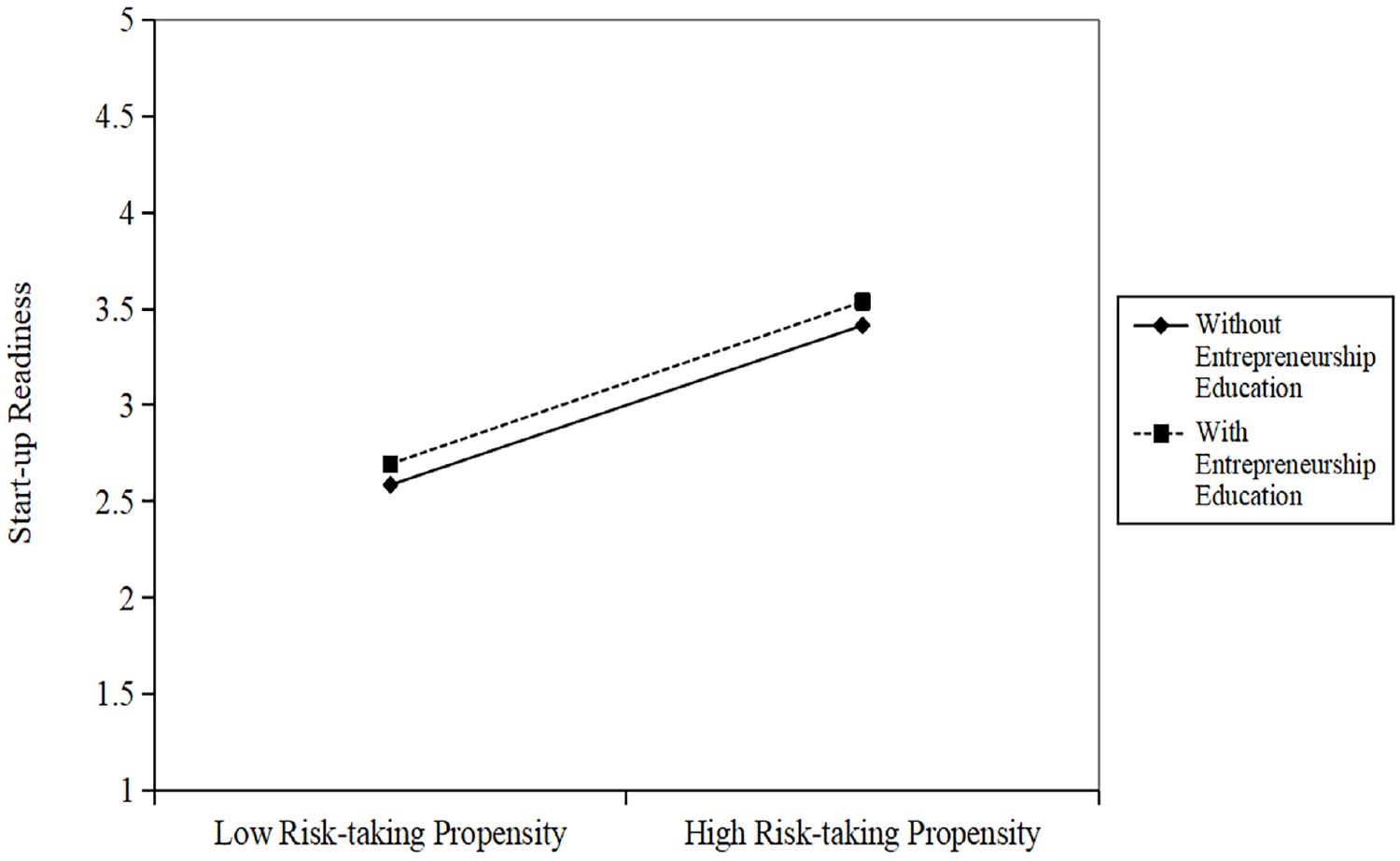
Interaction of EE on RTP and SR.
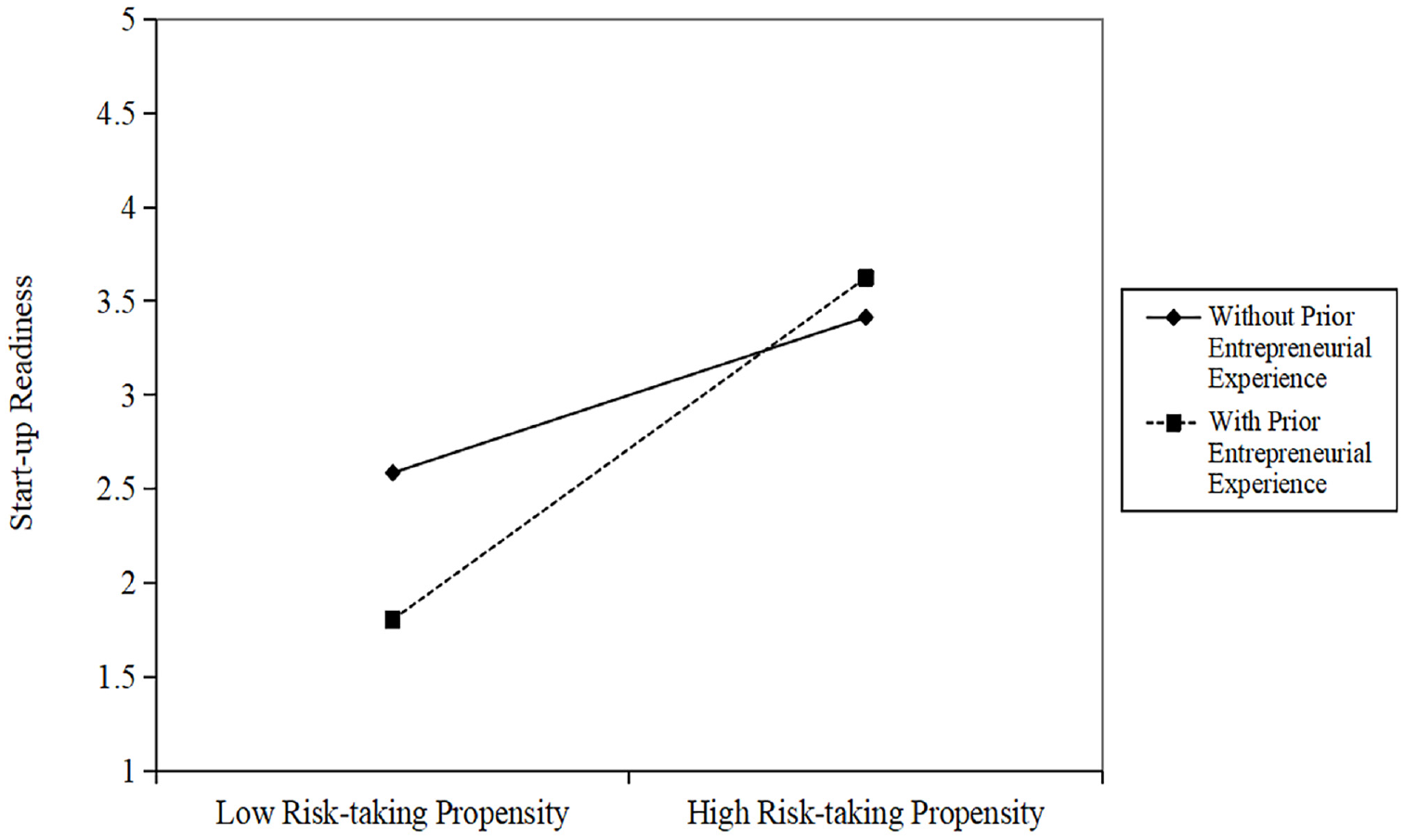
Interaction of PEE on RTP and SR.
Discussion and Conclusions
Discussions
This study aims to explore the relationship between young people’s perception of institutional environment risk-taking propensity and start-up readiness and the moderating impact of two human capital factors on the relationship between risk-taking propensity and start-up readiness. Our findings provided empirical evidence for the important role of institutional environment perception on individual risk-taking propensity, emphasizing that if individuals have a high sense of the regulatory (e.g., business laws and regulation, funding supports) and cognitive dimensions (knowledge and skills to deal with business risks), they are more willing to take business risks. These findings are aligned with previous studies on regulatory and cognitive environments (Ju & Zhou, 2020; Oftedal et al., 2018). However, this non-significant influence of normative environment suggests that normative environment in Hong Kong is not supportive. Many young people would not respect and even consider entrepreneurship as their career choice because of the popularity of other stable and decent jobs, such as doctors, professions, and civil servants (Kang & Xiong, 2021; Moy et al., 2003).
In addition, the relationship between risk-taking propensity and start-up readiness suggests that risk-takers are prone to start their business readiness. Prior research has confirmed the important role of risk-taking propensity on the intention to be self-employed (Chye Koh, 1996; Gurel et al., 2010, 2021; Karabulut, 2016).
Moreover, this study does not find the direct influence of entrepreneurship education on start-up readiness as well as the moderating effect of entrepreneurship education. These findings contrast with those of prior research with emphasis on the positive role of entrepreneurship education (Anwar et al., 2021; Bae et al., 2014; Iwu et al., 2021). The findings imply that entrepreneurship education and training do not motivate people to engage in start-up readiness. There are reasons behind these findings: due to the limited educational resources, not all young people in Hong Kong have access to entrepreneurship education (Sun et al., 2022). Also, even for people who joined business programs, few actually set up their companies due to the high running cost (Cheung, 2008).
Finally, the non-significant direct influence of prior entrepreneurial experience on readiness is in contrast to early findings on the positive role of prior entrepreneurial experience (Krueger, 1993; Zapkau et al., 2017). This phenomenon can be explained by the fact that young people with entrepreneurial experience have a better understanding of the challenging entrepreneurial environment in Hong Kong, such as the lack of financial support, high labor costs, and rent, lack of government support, and fierce business competition (Moy et al., 2003). Therefore, prior entrepreneurial experience hinders young people’s entrepreneurial readiness. However, the moderating effect of prior entrepreneurial experience on the relationship between risk-taking propensity and start-up readiness suggests that risk-takers with prior venture experience are prone to engage in start-up readiness activities. Similarly, prior research has found that individuals with entrepreneurial experience background might have relevant human capital necessary to their businesses, thus enhancing the relationship between risk-taking propensity and their desire to engage in entrepreneurial activities (Bignotti & le Roux, 2020; Davidsson & Honig, 2003; Farmer et al., 2011).
Theoretical Implications
This study advances the entrepreneurship literature by adopting institutional theory and human capital theory simultaneously.
First, extant entrepreneurial intent research treats the institutional environment as antecedents of the intention (Schlaegel et al., 2021; Urban & Kujinga, 2017). Noting recent calls for entrepreneurship studies to focus on different entrepreneurial processes (Fayolle & Liñán, 2014), this study moves downstream to explore the effects of institutional environment on entrepreneurial behavior by offering a self-developed construct by considering “start-up readiness” as a dependent variable. In addition to advancing the entrepreneurial behavior literature by first developing a construct (“start-up readiness”) to measure the extent of engagement in entrepreneurial activities, this study further shed light on the indirect mechanism between institutional environment and entrepreneurial behavior. Moreover, based on the importance of risk-taking propensity in Hong Kong (Zhuang et al., 2022), this study improves our understanding of how the two important dimensions of the institutional environment (regulatory and normative) influence entrepreneurial behavior through risk-taking propensity.
Second, most studies adopted convenience sampling based on the survey of university students with little pay attention to prior entrepreneurial experience. Also, following the calls of Marvel et al. (2016) on the adoption of human capital theory in entrepreneurship research, this study explores how two human capital factors moderate the relationships between risk-taking propensity and the self-constructed dependent variable (Start-up readiness). This study contributes to human capital research by illuminating the moderating effects of human capital factors on relationships between individual personality traits and entrepreneurial behavior.
Practical Implications
Hong Kong educators and policymakers could benefit from our study’s conclusions.
First, the strong effect of institutional environment perception (regulatory and cognitive) on risk-taking propensity suggests that governments and educators should facilitate youths to be risk-taker by implementing policy measures to improve the regulatory environment (e.g., more financial support and free consultations). In addition, policymakers should consider improving the normative environment. For instance, they can launch a speech for successful entrepreneurs to share their experiences to provide a role model for young people (Sun et al., 2017).
Second, the study has demonstrated that risk-taking propensity is crucial to enhance start-up readiness. The chances of a startup failing are much higher than the chances of being successful. Since risk-taking propensity can influence entrepreneurs’ entrepreneurial behavior (Wenhong & Liuying, 2010; Yusoff et al., 2021), entrepreneurs need a tolerance for risk because they regularly face ambiguous situations in Hong Kong, such as financial shortage, high labor costs, and rent (Kang & Xiong, 2021; Moy et al., 2003). Otherwise, their entrepreneurial behavior will be hindered. In this case, governments and educators do need to work on the enhancement of individual entrepreneurial risk-taking capacity (Scafarto et al., 2019; Yusoff et al., 2021). For instance, governments need to develop policies to provide viable start-up loan guarantees, legal assistance, and start-up advice. In addition, educators develop curricula tailored to boost entrepreneurial risk-taking (Ferreira et al., 2017).
Third, regarding the effect of human capital theory, this study reveals that education does not promote start-up readiness and does not even encourage risk-takers’ entrepreneurial readiness. Due to the low level of entrepreneurship education receiver, the government should work with higher education institutions to provide entrepreneurship learning opportunities (e.g., free social entrepreneurial education and training programs) for people who lack entrepreneurial knowledge and skills (Tam et al., 2021). Moreover, since education does not encourage people to start their readiness, educators should reconsider teaching methods. For instance, young people have the chance to be exposed to real-world business scenarios through different methods (e.g., experiential learning) and learn how to deal with risks in a simulated business environment in practice (Martin et al., 2013; Pérez-Pérez et al., 2021). Then, we suggest educators should examine the effectiveness of existing entrepreneurship education. In addition, risk-taking individuals with prior venture experience are prone to take their business readiness. It is common that most young people do not have actual venturing experience. Instead, they can gain entrepreneurial experience through business competitions and incubation (Giordano Martínez et al., 2018; Stolz & Sternberg, 2022). This implies that government and educators can provide social business competitions and incubation for the whole community.
Limitations and Suggestions for Future Research
This study has some research limitations, so we propose some corresponding future research directions. First, this study first proposes to examine the relationship between institutional environment and personality traits, focusing on one personal trait, risk-taking propensity. Future research could examine other traits, such as the need for achievement, locus of control, and innovativeness. Second, this study self-developed a construct of “start-up readiness” to measure entrepreneurial behavior. More studies can adopt this measurement scale to measure the entrepreneurial behavior of people in different regions. Moreover, this study uses human capital theory to study the moderating effect of entrepreneurship education and prior entrepreneurial experience. Similarly, other human capital factors, such as work experience, are worth studying in future research.
Footnotes
Contribution Statement
Jiahao Zhuang: Writing – review & editing, Writing – original draft, Methodology, Investigation, Formal analysis, Data curation, Conceptualization.
Hongyi Sun: Supervision, Funding acquisition.
Declaration of Conflicting Interests
The authors declare there is no conflicts of interest.
Funding
The author(s) disclosed receipt of the following financial support for the research, authorship, and/or publication of this article: This paper was supported by the Strategic Public Policy Research Funding Scheme from the Policy Innovation and Co-ordination Office of the Government of the Hong Kong Special Administrative Region (S2020.A1.033.20S) and a matching fund by the City University of Hong Kong (9678240).

Data Availability Statement
The data has been used is confidential.